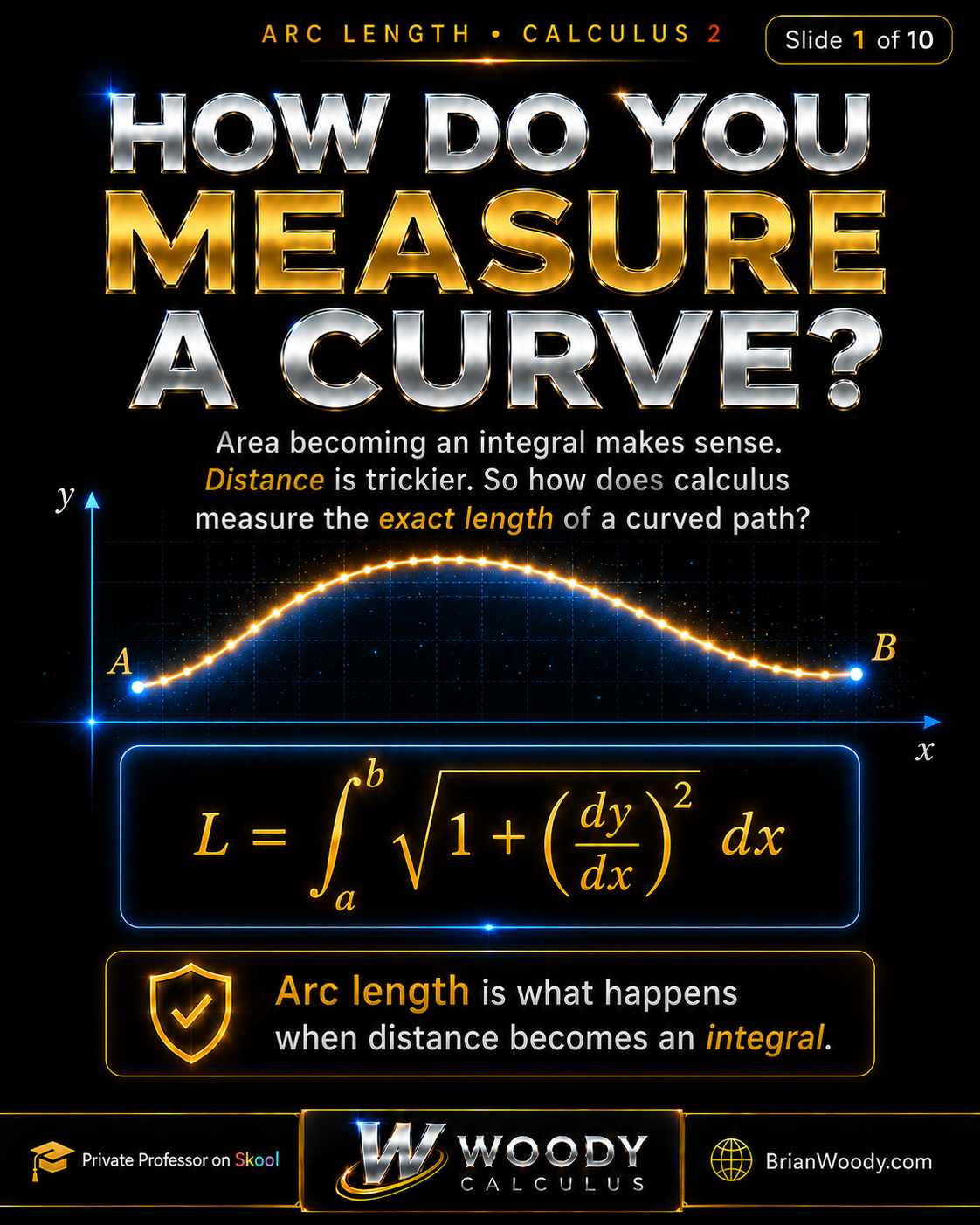
Arc length is one of the first places in Calculus 2 where students realize that distance is more subtle than area.
Area becoming an integral makes sense to most students. You slice a region into tiny rectangles, add them up, and let the slices become infinitely thin.
But distance along a curve is trickier.
A straight line has a simple length formula. A curve bends continuously. So how does calculus measure the exact distance from one point on a curve to another?
Arc length is what happens when distance becomes an integral.
The main formula for a smooth curve \(y=f(x)\) from \(x=a\) to \(x=b\) is:
L=\int_a^b \sqrt{1+\left(\frac{dy}{dx}\right)^2}\,dx.
\]
This Woody Calculus lesson explains where that formula comes from, why the tiny distance \(ds\) appears, how to set up an arc length integral, and how to solve the classic hard arc length example:
y=\frac{x^2}{2}-\frac14\ln x,\qquad 1\le x\le 2.
\]
Estimated read time: 10–12 minutes.
Last updated: .
What Is Arc Length?
Arc length is the distance measured along a curve.
If a path is straight, we can measure its length with the distance formula. But if the path bends, the distance formula between the endpoints only gives the straight-line distance from start to finish. It does not measure the actual length traveled along the curve.
Arc length asks a different question:
How far would you travel if you walked along the curve itself?
For a smooth curve \(y=f(x)\) on \(a\le x\le b\), the answer is:
\boxed{
L=\int_a^b \sqrt{1+\left(\frac{dy}{dx}\right)^2}\,dx.
}
\]
This formula is not magic. It comes from a tiny right triangle.
Tiny Straight Distances
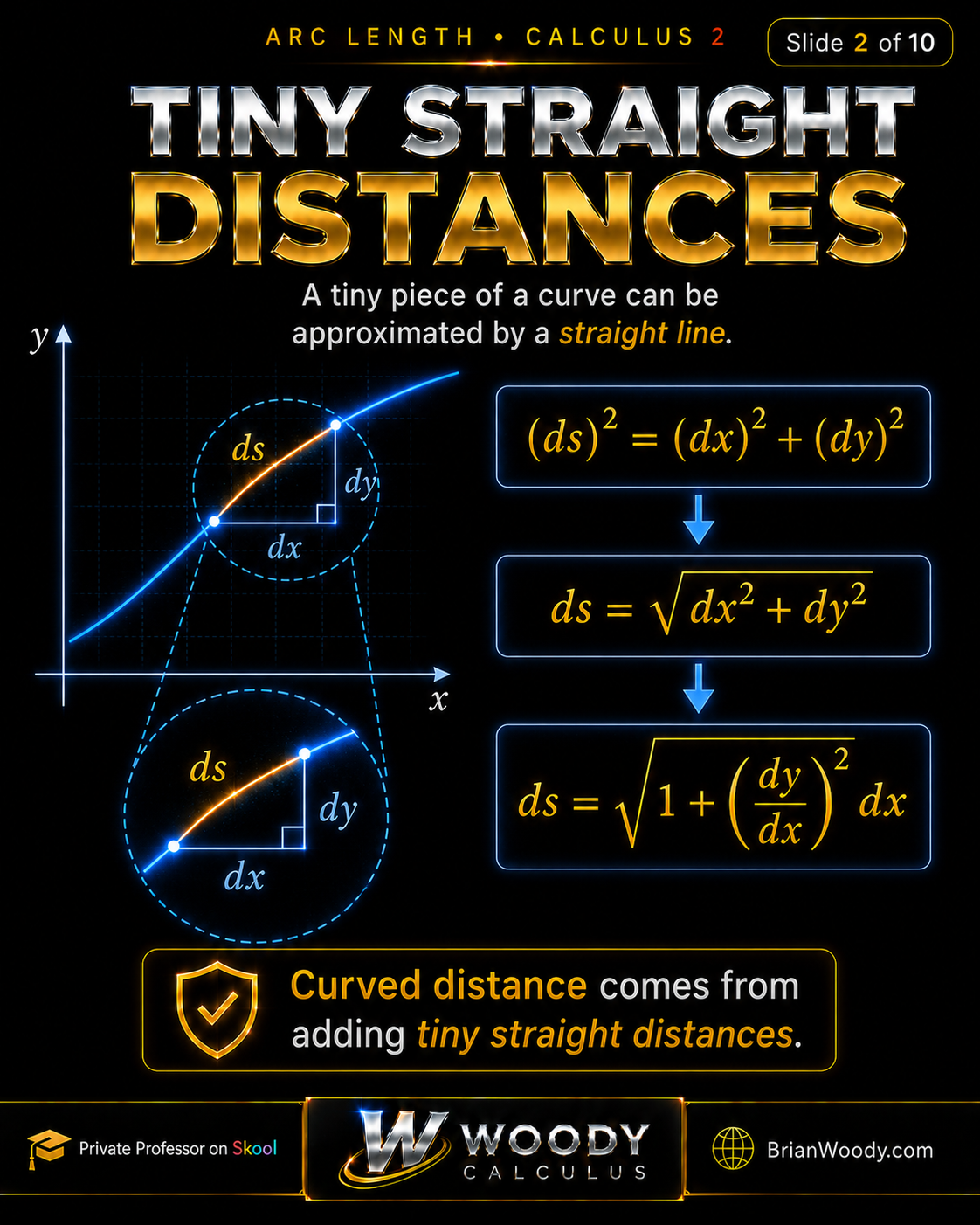
A tiny piece of a smooth curve can be approximated by a tiny straight-line segment.
Call the tiny horizontal change \(dx\), the tiny vertical change \(dy\), and the tiny distance along the curve \(ds\).
These three quantities form a tiny right triangle:
(ds)^2=(dx)^2+(dy)^2.
\]
Taking the square root gives:
ds=\sqrt{(dx)^2+(dy)^2}.
\]
Now factor out \((dx)^2\):
ds=\sqrt{(dx)^2\left(1+\left(\frac{dy}{dx}\right)^2\right)}.
\]
So:
ds=\sqrt{1+\left(\frac{dy}{dx}\right)^2}\,dx.
\]
This is the heart of the arc length formula.
Why Arc Length Is an Integral
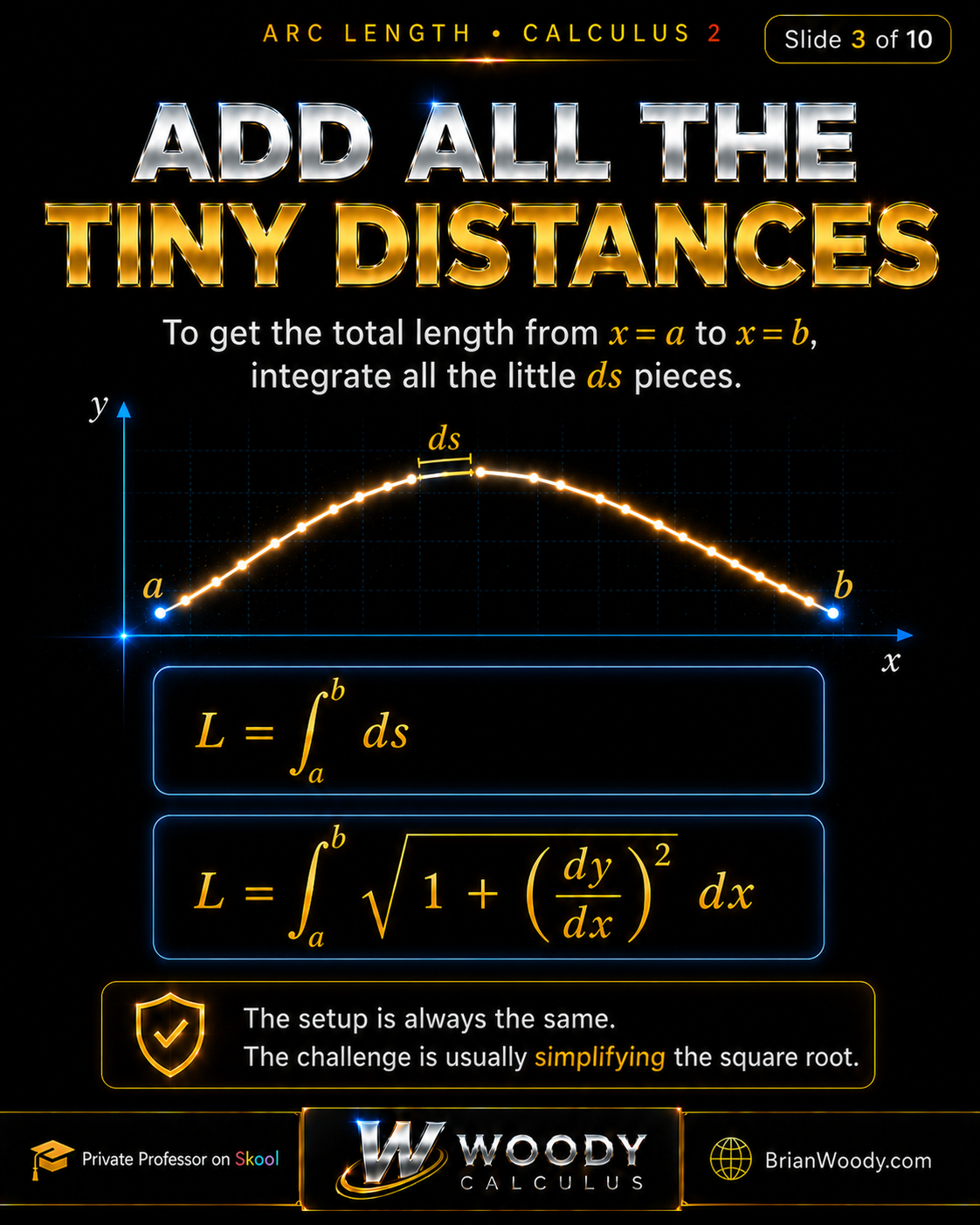
Once each tiny distance is written as \(ds\), the total length is found by adding all those tiny distances.
That gives:
L=\int_a^b ds.
\]
Substitute the expression for \(ds\):
L=\int_a^b\sqrt{1+\left(\frac{dy}{dx}\right)^2}\,dx.
\]
The setup is always the same:
- Differentiate \(y=f(x)\).
- Build \(\sqrt{1+(y^{\prime})^2}\).
- Integrate from \(x=a\) to \(x=b\).
The challenge is usually not the formula. The challenge is simplifying the square root.
A Classic Arc Length Problem
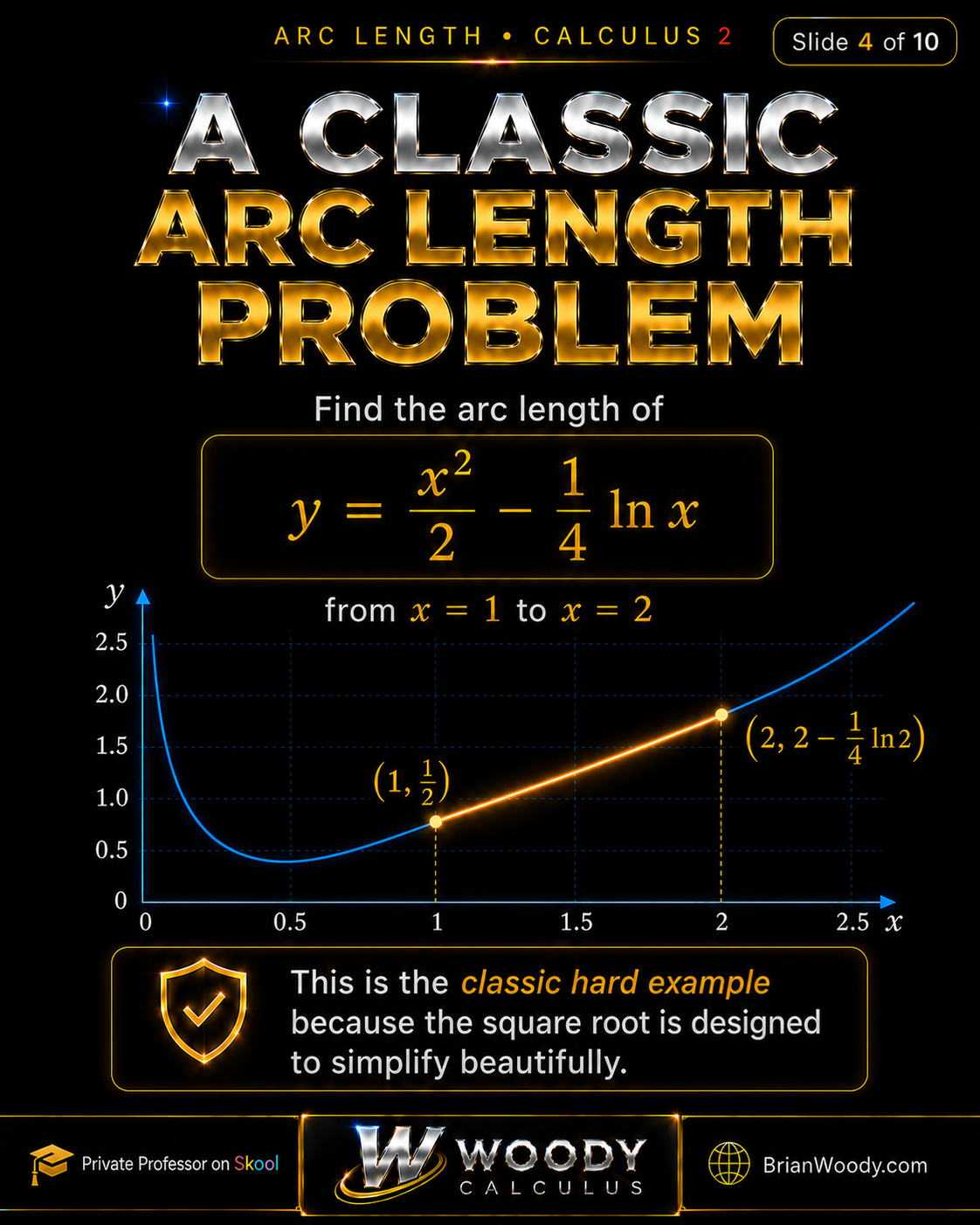
Now consider the classic hard-looking arc length problem:
y=\frac{x^2}{2}-\frac14\ln x,
\qquad
1\le x\le 2.
\]
This is a famous style of Calculus 2 example because the square root is designed to simplify beautifully.
At the left endpoint:
y(1)=\frac{1^2}{2}-\frac14\ln 1=\frac12.
\]
At the right endpoint:
y(2)=\frac{2^2}{2}-\frac14\ln 2
=
2-\frac14\ln 2.
\]
So the exact endpoint values are:
\left(1,\frac12\right)
\qquad\text{and}\qquad
\left(2,2-\frac14\ln 2\right).
\]
The goal is to find the exact arc length from \(x=1\) to \(x=2\).
Start the Usual Way
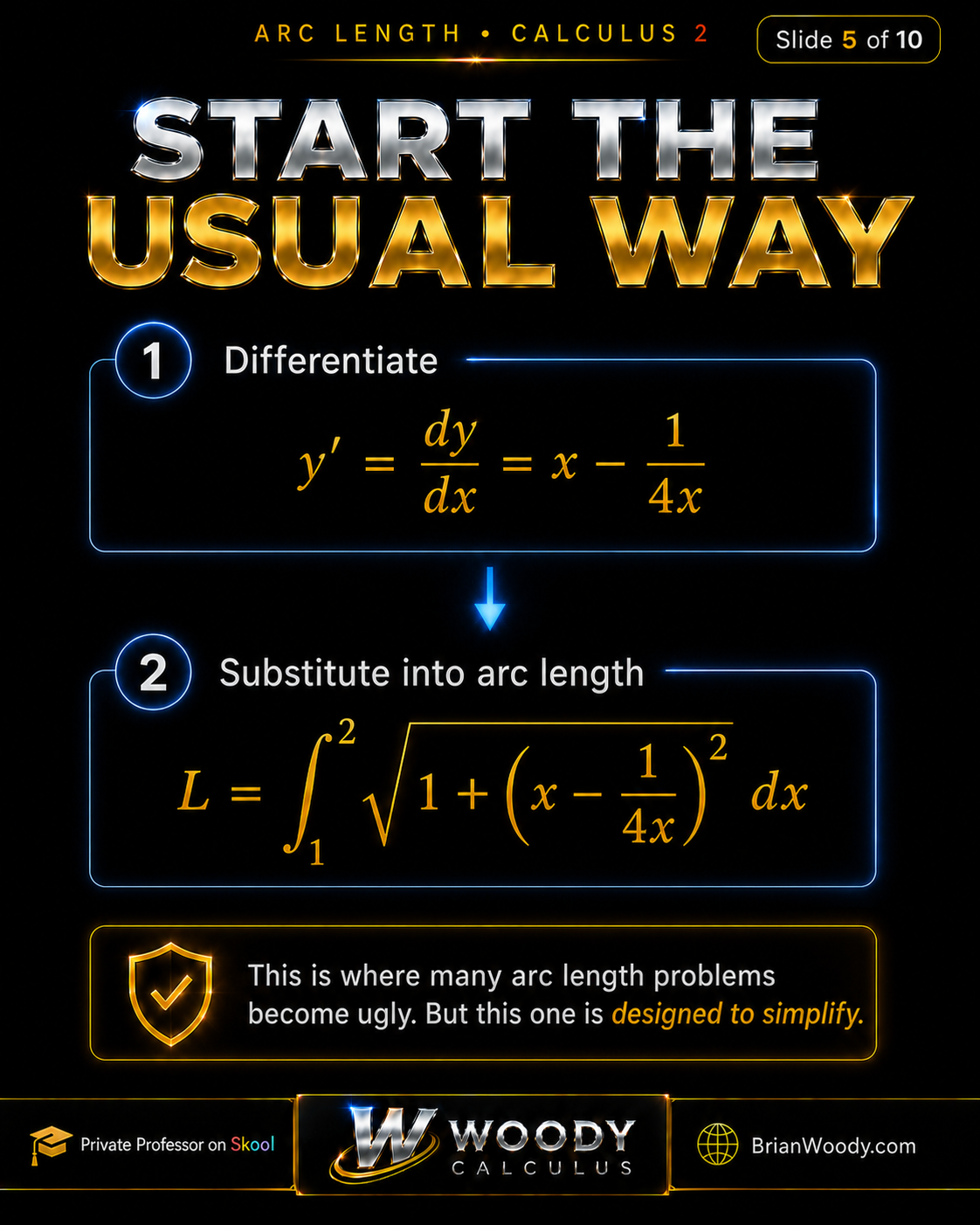
Begin by differentiating:
y=\frac{x^2}{2}-\frac14\ln x.
\]
Then:
y^{\prime}=\frac{dy}{dx}=x-\frac{1}{4x}.
\]
Substitute into the arc length formula:
L=\int_1^2\sqrt{1+\left(x-\frac{1}{4x}\right)^2}\,dx.
\]
This is where many arc length problems become ugly. The square root often becomes difficult or impossible to integrate using elementary functions.
But this example is special. It is built to simplify.
Recognize the Pattern
The key expression is:
1+\left(x-\frac{1}{4x}\right)^2.
\]
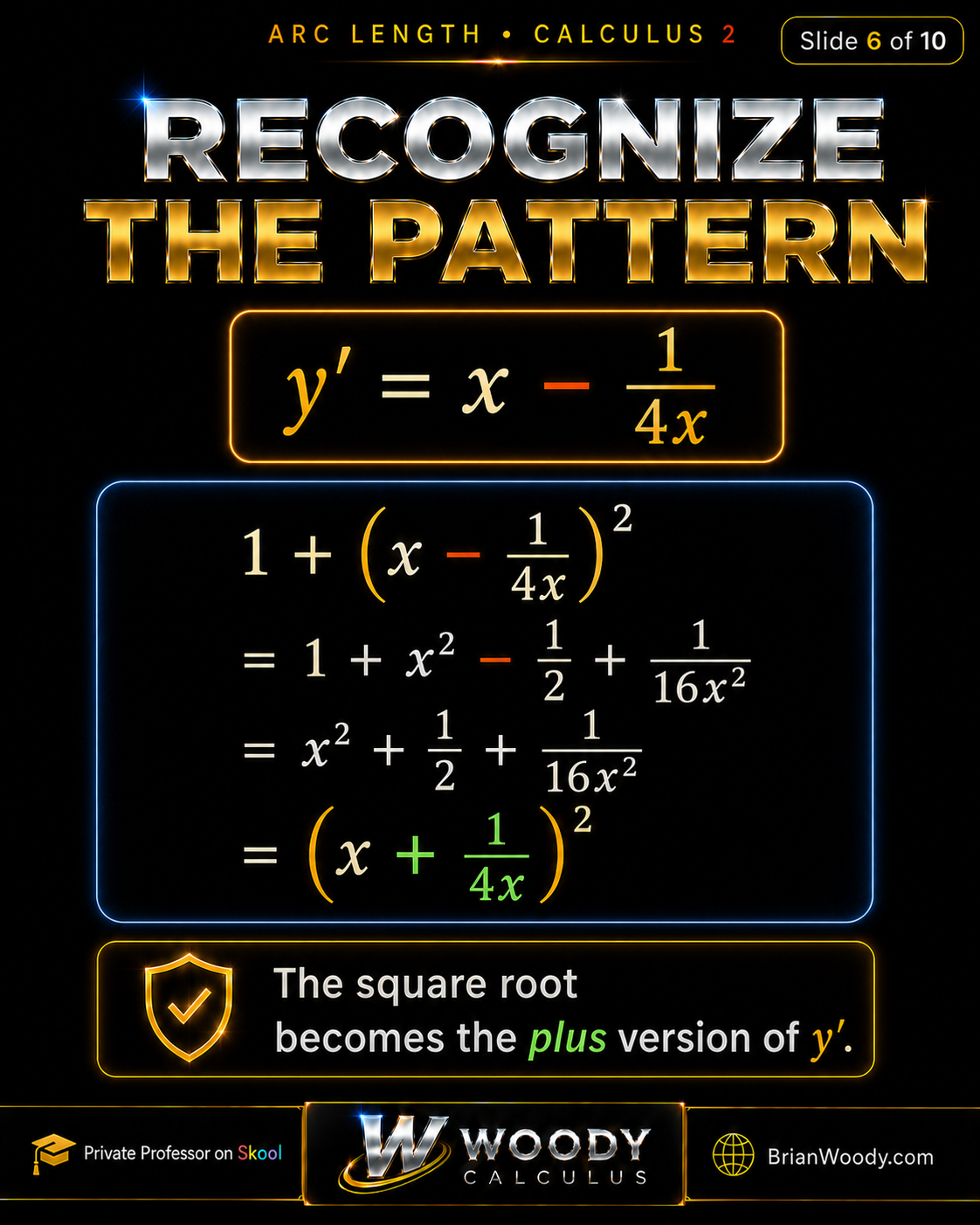
Expand the square:
\left(x-\frac{1}{4x}\right)^2
=
x^2-\frac12+\frac{1}{16x^2}.
\]
Now add \(1\):
1+\left(x-\frac{1}{4x}\right)^2
=
1+x^2-\frac12+\frac{1}{16x^2}.
\]
Simplify:
1+\left(x-\frac{1}{4x}\right)^2
=
x^2+\frac12+\frac{1}{16x^2}.
\]
But this is a perfect square:
x^2+\frac12+\frac{1}{16x^2}
=
\left(x+\frac{1}{4x}\right)^2.
\]
Therefore:
1+\left(x-\frac{1}{4x}\right)^2
=
\left(x+\frac{1}{4x}\right)^2.
\]
Since \(1\le x\le 2\), the expression \(x+\frac{1}{4x}\) is positive. So the square root becomes:
\sqrt{1+\left(x-\frac{1}{4x}\right)^2}
=
x+\frac{1}{4x}.
\]
The Conjugate Clue
This example has a special recognition pattern.
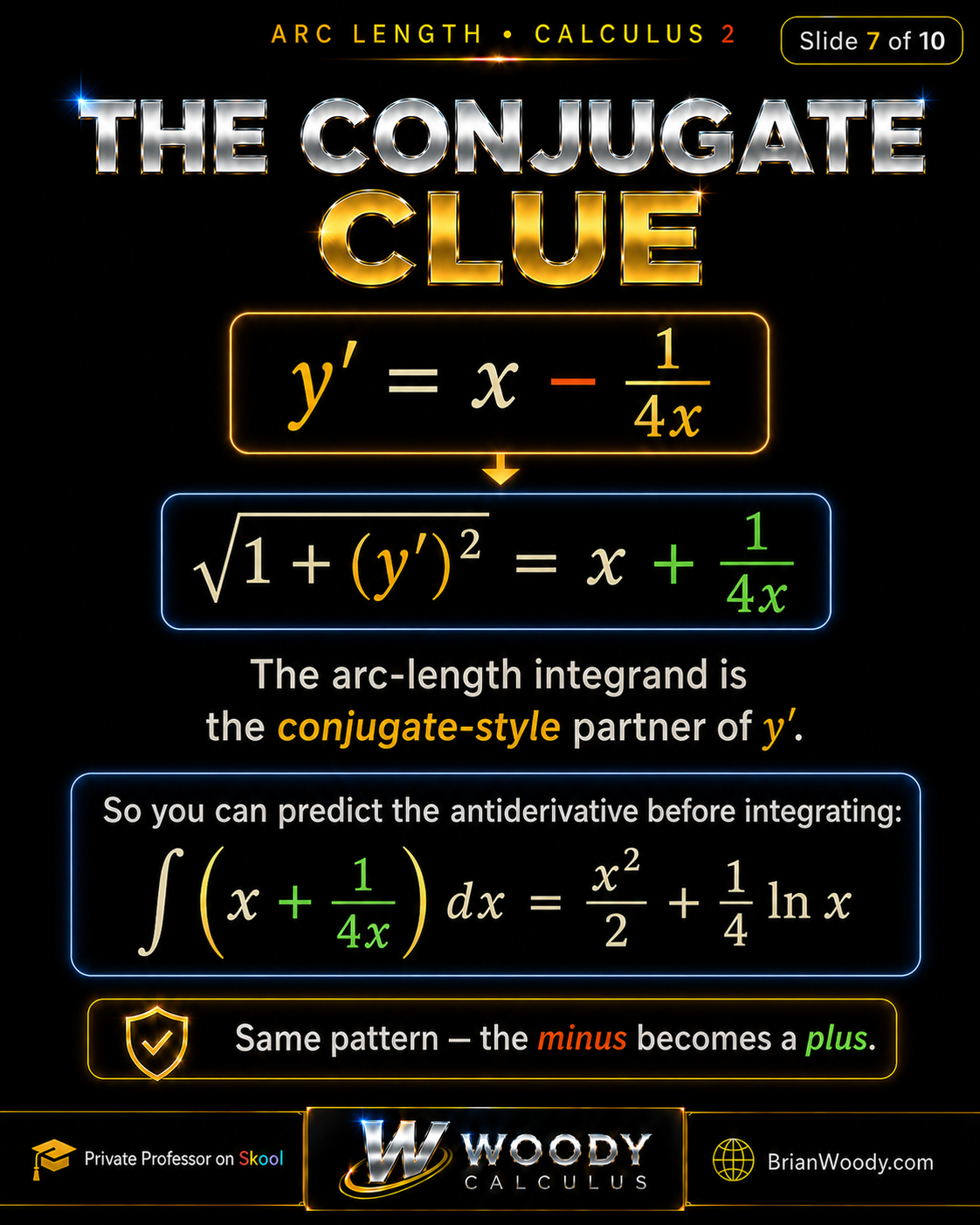
The derivative is:
y^{\prime}=x-\frac{1}{4x}.
\]
But the arc length integrand becomes:
\sqrt{1+(y^{\prime})^2}=x+\frac{1}{4x}.
\]
The minus becomes a plus.
This is a conjugate-style pattern:
x-\frac{1}{4x}
\quad\longrightarrow\quad
x+\frac{1}{4x}.
\]
That means you can often see the antiderivative before doing the integration:
\int\left(x+\frac{1}{4x}\right)\,dx
=
\frac{x^2}{2}+\frac14\ln x.
\]
Important: this is a special feature of this cooked example. It is not a universal shortcut for every arc length problem. But recognizing it saves time and builds mathematical intuition.
You Already Know the Antiderivative
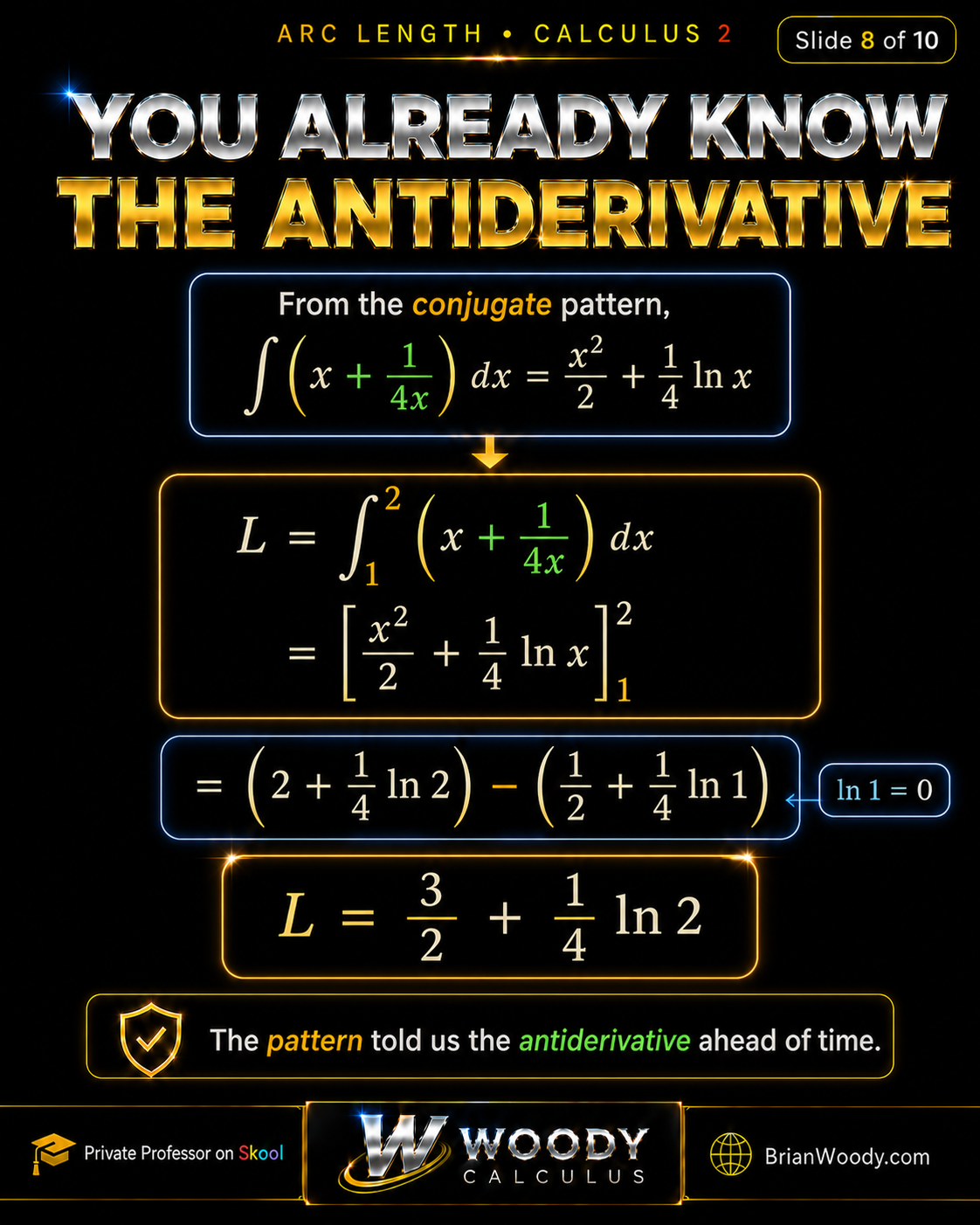
The arc length integral has simplified to:
L=\int_1^2\left(x+\frac{1}{4x}\right)\,dx.
\]
An antiderivative is:
\frac{x^2}{2}+\frac14\ln x.
\]
Strictly speaking, the antiderivative of \(\frac1x\) is \(\ln|x|\), but on the interval \(1\le x\le 2\), \(x>0\), so \(\ln|x|=\ln x\).
Now evaluate:
L=\left[\frac{x^2}{2}+\frac14\ln x\right]_1^2.
\]
At \(x=2\):
\frac{2^2}{2}+\frac14\ln 2
=
2+\frac14\ln 2.
\]
At \(x=1\):
\frac{1^2}{2}+\frac14\ln 1
=
\frac12.
\]
Therefore:
L=\left(2+\frac14\ln2\right)-\frac12.
\]
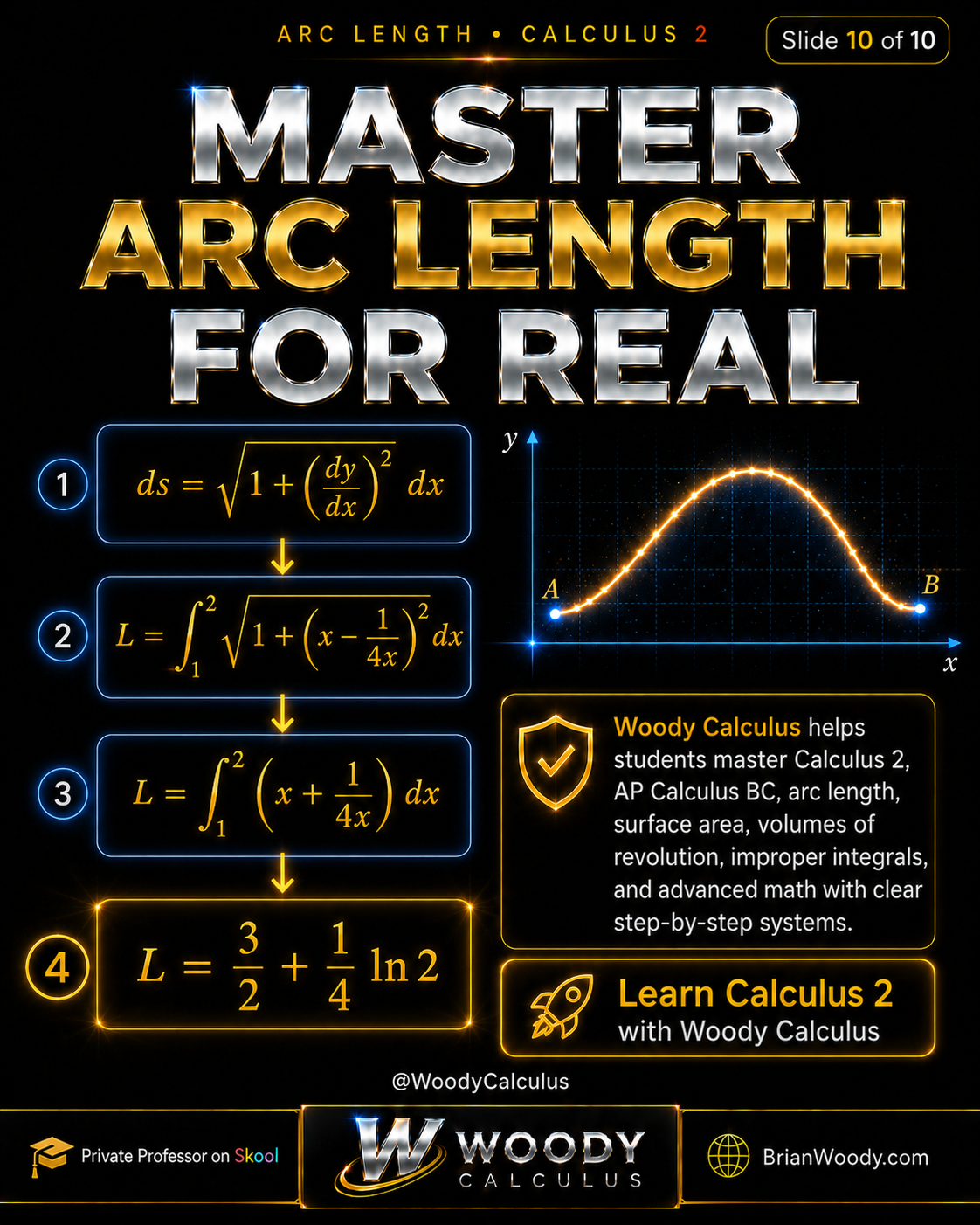
Final answer:
\boxed{
L=\frac32+\frac14\ln 2.
}
\]
Plain-language answer: the exact arc length of the curve from \(x=1\) to \(x=2\) is \(\frac32+\frac14\ln2\).
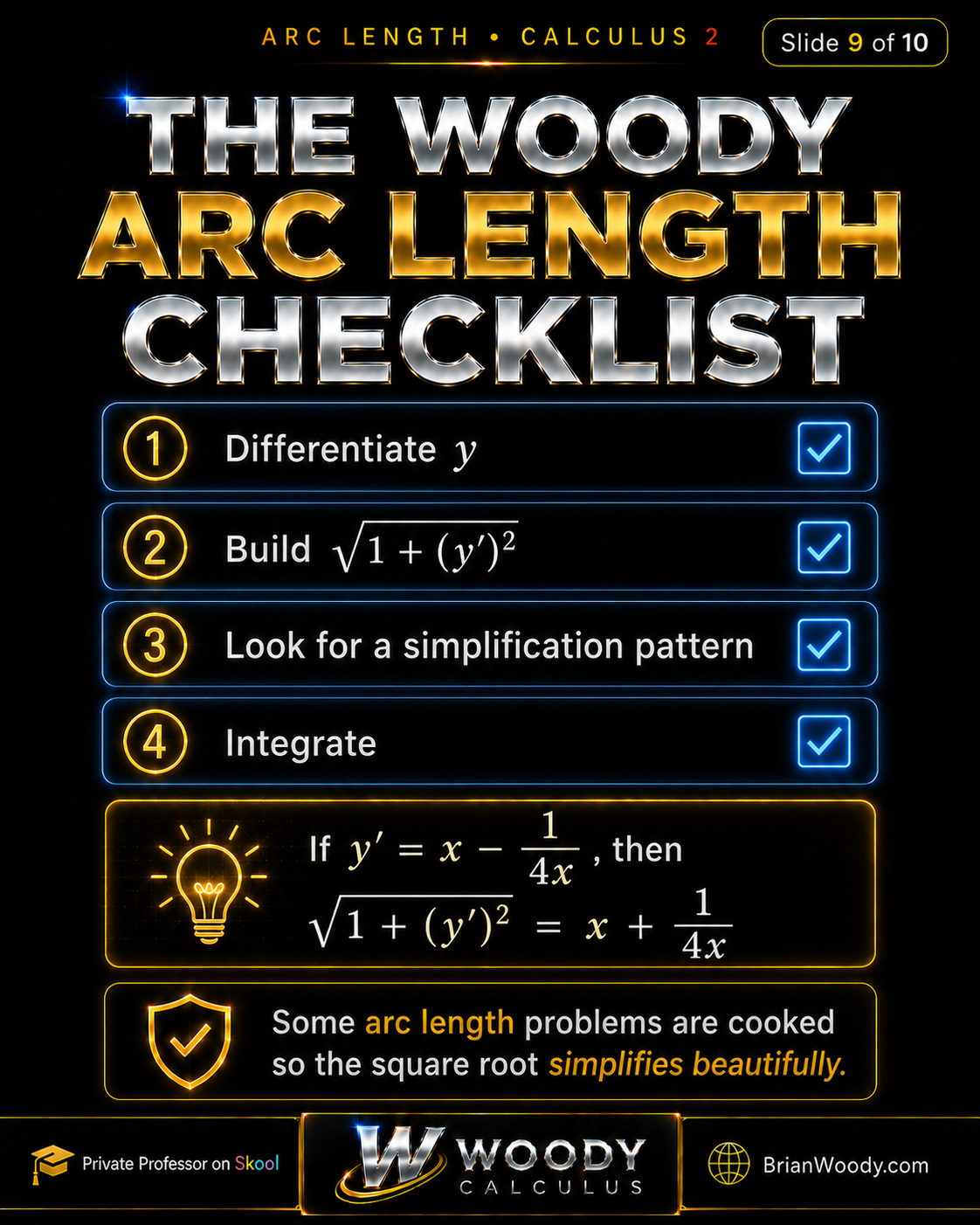
The Woody Arc Length Checklist
The Woody Calculus Arc Length Method
The Woody Calculus method is to treat every arc length problem as a disciplined sequence. Formula memorization matters, but execution matters more.
- Write the arc length formula.
- Differentiate \(y=f(x)\).
- Build \(\sqrt{1+(y^{\prime})^2}\).
- Look for a simplification pattern.
- Check the sign of the square root on the interval.
- Integrate.
- Evaluate the bounds carefully.
- Write the exact final answer.
Reading the solution is not enough. A serious Calculus 2 student should be able to rewrite the perfect solution from start to finish while saying each step out loud: differentiate, build the square root, simplify, integrate, evaluate.
Complete Worked Example
Find the arc length of:
y=\frac{x^2}{2}-\frac14\ln x
\]
from \(x=1\) to \(x=2\).
Step 1: Write the formula
L=\int_1^2\sqrt{1+\left(\frac{dy}{dx}\right)^2}\,dx.
\]
Step 2: Differentiate
\frac{dy}{dx}=x-\frac{1}{4x}.
\]
Step 3: Substitute into arc length
L=\int_1^2\sqrt{1+\left(x-\frac{1}{4x}\right)^2}\,dx.
\]
Step 4: Simplify the square root
1+\left(x-\frac{1}{4x}\right)^2
=
\left(x+\frac{1}{4x}\right)^2.
\]
Since \(x>0\) on \([1,2]\):
\sqrt{1+\left(x-\frac{1}{4x}\right)^2}
=
x+\frac{1}{4x}.
\]
Step 5: Integrate
L=\int_1^2\left(x+\frac{1}{4x}\right)\,dx.
\]
L=\left[\frac{x^2}{2}+\frac14\ln x\right]_1^2.
\]
Step 6: Evaluate
L=\left(2+\frac14\ln 2\right)-\left(\frac12+\frac14\ln 1\right).
\]
L=2+\frac14\ln 2-\frac12.
\]
\boxed{
L=\frac32+\frac14\ln2.
}
\]
Plain-language answer: the exact length of the curve is \(\frac32+\frac14\ln2\), which is approximately \(1.6733\).
Common Mistakes
Mistake 1: Confusing arc length with area
Arc length does not measure area under a curve. It measures distance along the curve.
Mistake 2: Forgetting to square \(y^{\prime}\)
The formula uses \(1+(y^{\prime})^2\), not \(1+y^{\prime}\):
L=\int_a^b\sqrt{1+(y^{\prime})^2}\,dx.
\]
Mistake 3: Not simplifying the square root
Many arc length problems are difficult because the square root does not simplify. In this example, the square root is designed to become:
x+\frac{1}{4x}.
\]
Mistake 4: Ignoring the sign of the square root
When:
\sqrt{\left(x+\frac{1}{4x}\right)^2}
\]
appears, it technically becomes:
\left|x+\frac{1}{4x}\right|.
\]
On \(1\le x\le 2\), the expression is positive, so we may write \(x+\frac{1}{4x}\).
Mistake 5: Expecting every arc length problem to integrate nicely
Many arc length integrals do not have elementary antiderivatives. This example is a classic because it is specifically built to simplify.
Arc Length FAQ
What is arc length in Calculus 2?
Arc length is the exact distance measured along a curve. In Calculus 2, it is found by adding infinitely many tiny straight-line distances using an integral.
What is the arc length formula for \(y=f(x)\)?
The arc length formula is \(L=\int_a^b\sqrt{1+\left(\frac{dy}{dx}\right)^2}\,dx\).
Where does the arc length formula come from?
The formula comes from the Pythagorean theorem applied to a tiny piece of the curve: \((ds)^2=(dx)^2+(dy)^2\).
Why does distance become an integral?
A curve is measured by adding many tiny straight-line distances. As those pieces become infinitely small, the sum becomes an integral.
Why is this arc length example considered hard?
The example looks hard because the formula creates a square root involving \(1+(y^{\prime})^2\). It becomes manageable only because the expression is designed to simplify into a perfect square.
What is the derivative of \(y=\frac{x^2}{2}-\frac14\ln x\)?
The derivative is \(y^{\prime}=x-\frac{1}{4x}\).
Why does the square root simplify in the classic example?
Because \(1+\left(x-\frac{1}{4x}\right)^2=\left(x+\frac{1}{4x}\right)^2\). Since \(x>0\) on \([1,2]\), the square root becomes \(x+\frac{1}{4x}\).
What is the arc length of \(y=\frac{x^2}{2}-\frac14\ln x\) from \(1\) to \(2\)?
The arc length is \(L=\frac32+\frac14\ln2\).
Master Arc Length with Woody Calculus
Arc length is not just another formula. It is the bridge between geometry and integration: distance along a curve becomes the integral of tiny straight-line distances.
The core chain is:
(ds)^2=(dx)^2+(dy)^2
\quad\Longrightarrow\quad
ds=\sqrt{1+\left(\frac{dy}{dx}\right)^2}\,dx
\quad\Longrightarrow\quad
L=\int_a^b ds.
\]
For students who want structured Calculus 2 help, join the Woody Calculus Mastery Lab. The Mastery Lab helps students build skill through repetition, step-by-step lessons, written solutions, exam-focused systems, and direct support.
You can also visit Woody Calculus on Skool for the learning community.


Related Woody Calculus Mathematical Essays
Explore more Woody Calculus lessons connecting Calculus 2, arc length, surface area, volumes of revolution, applications of integration, improper integrals, parametric equations, infinite series, and advanced mathematics.
- How to Learn Calculus and Advanced Mathematics: A Peak Performance Study Guide
- Washer or Shell Method Explained: The Calculus 2 Decision Rule
- Hydrostatic Force Explained: Calculus 2 Pressure, Depth, and the Slice Method
- Trig Substitution Explained: The Woody Calculus 3-Type System
- Improper Integrals Explained: Calculus 2 Limit Problems
- Parametric Equations Explained: Motion, Direction, and Tangent Lines
- Taylor Series Explained: Mathematical Time Travel in Calculus 2
- Radius of Convergence and Interval of Convergence Explained
- Gabriel’s Horn Explained: Finite Volume and Infinite Surface Area
- View All Woody Calculus Blog Posts
External Calculus References
For students who want an additional reference after studying the Woody Calculus explanation, these open educational resources cover arc length and related applications of integration:
- MIT OpenCourseWare: Introduction to Arc Length
- OpenStax Calculus: Arc Length of a Curve and Surface Area
Private Instruction
Brian M. Woody works privately with a limited number of serious students who need one-on-one help in AP Calculus BC, Calculus II, Calculus III, Differential Equations, and advanced mathematics.
Private instruction is reserved for serious students, requires weekly sessions, requires enrollment in the Woody Calculus Mastery Lab first, and approval is not guaranteed.
Students interested in private instruction can learn more here: Private Math Tutor and Advanced Mathematics Instruction.
Related University Math Help Pages
Woody Calculus supports students at major universities with structured help in Calculus 2, Calculus 3, Differential Equations, Linear Algebra, and advanced mathematics. For the full list of supported schools, visit the University Calculus Tutor Hub.
- University Calculus Tutor Hub
- AP Calculus BC Support
- Calculus 2 Help for Purdue Students
- University of Florida Calculus 2 and AP Calculus Help
- Colorado State University Calculus Help
- UCF Calculus 2 Tutoring
- University of Nevada, Reno Math Support
- Auburn Calculus Tutor and Exam Prep
- University of Alabama Calculus Help
- University of Wisconsin Calculus Tutor
- University of Michigan Calculus Help
- UCLA Calculus 2 Support
- MIT Calculus Tutor
Trusted by Students Nationwide
The Woody Calculus Mastery Lab gives university students access to structured mathematics support, written solutions, video lessons, exam-focused training, and expert guidance from Brian M. Woody.
Students use Woody Calculus for Calculus II, Calculus III, Differential Equations, Linear Algebra, Abstract Algebra, and other advanced mathematics courses.