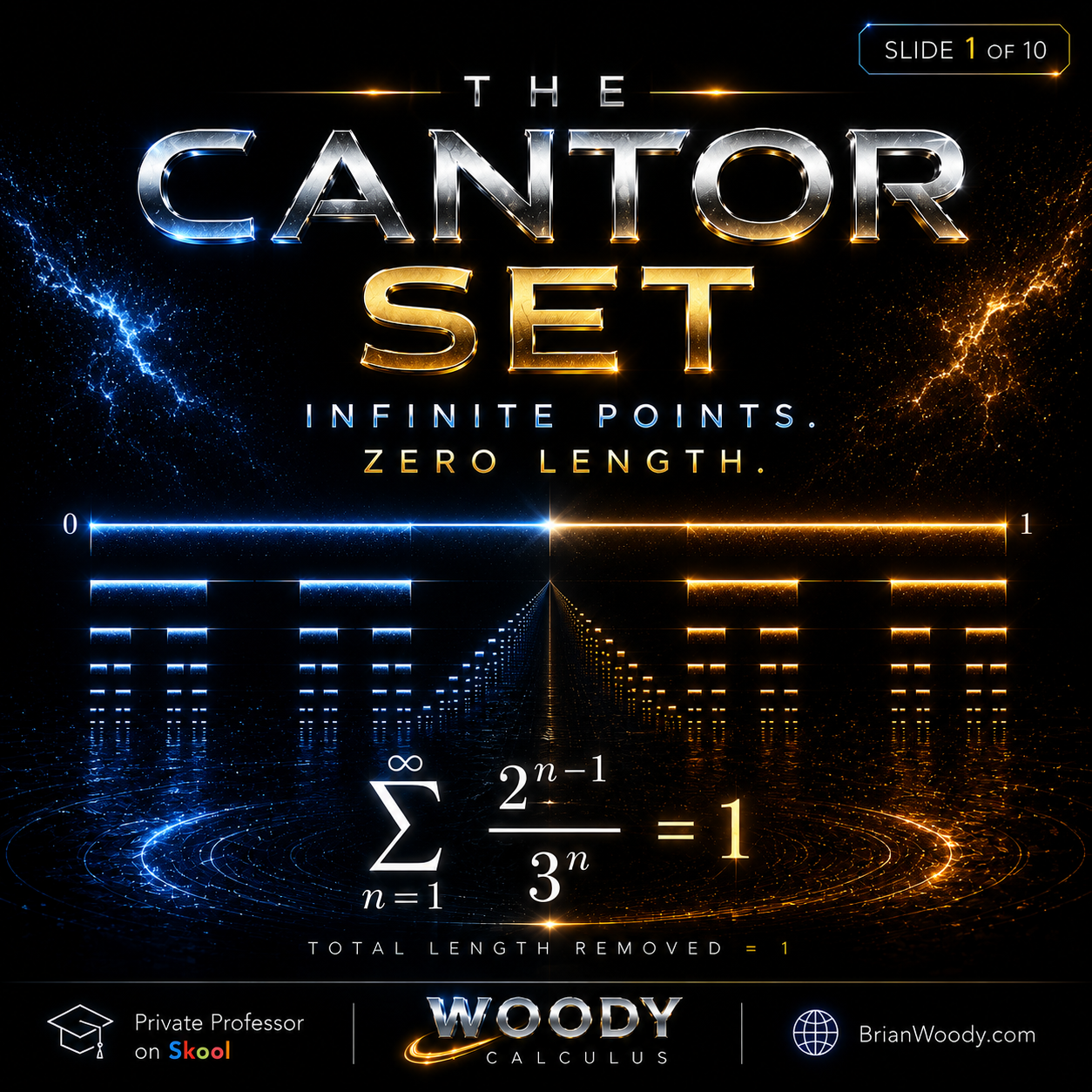
The Cantor Set is one of the strangest and most beautiful constructions in Real Analysis.
It begins with something simple: the interval \([0,1]\).
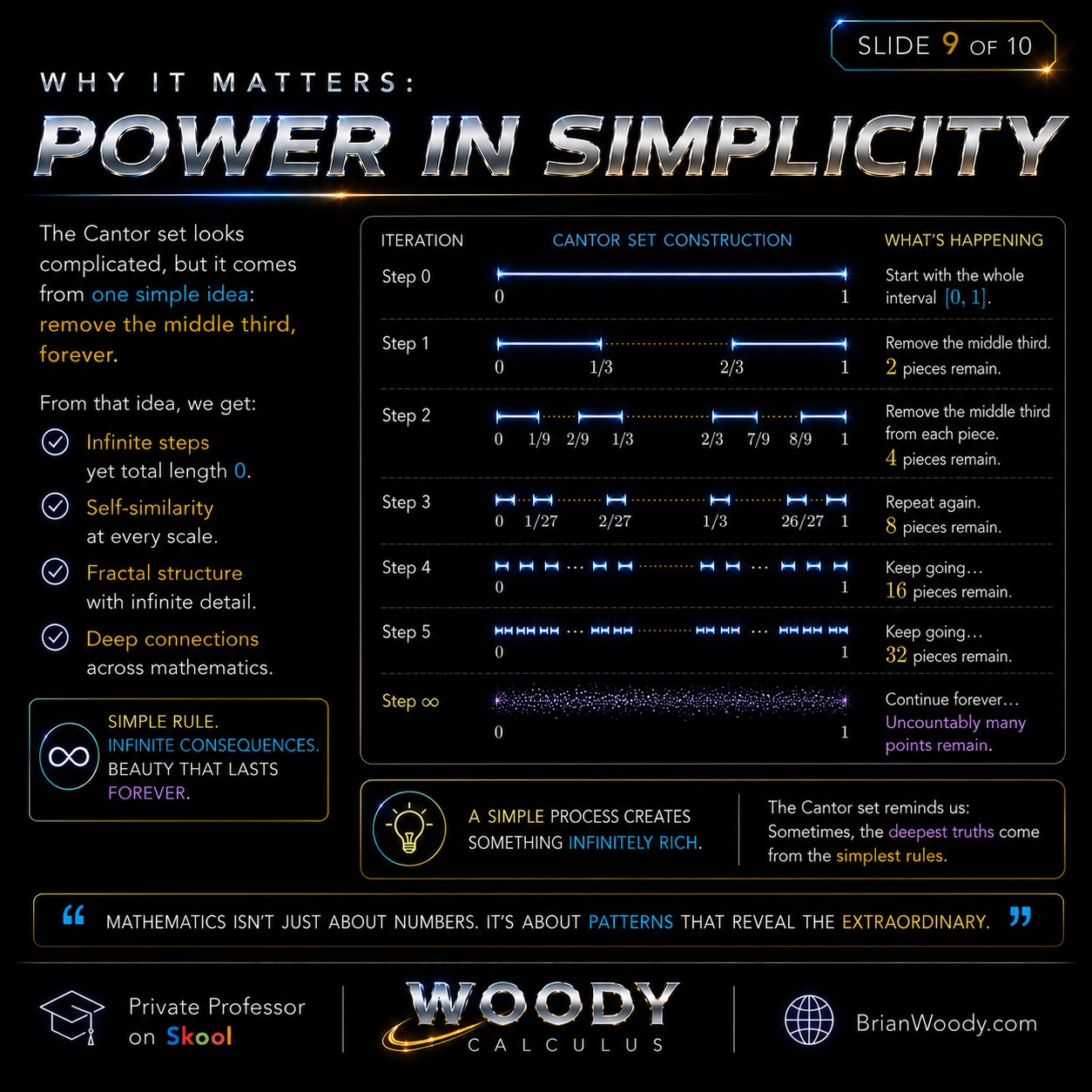
Then we remove the middle third. Then we remove the middle third of every remaining interval. Then we repeat the process forever.
Somehow, after removing enough length to add up to the entire interval, infinitely many points still remain. Even more shocking:
The Cantor Set has total length zero, but it contains uncountably infinitely many points.
This is why the Cantor Set is such a powerful example in Real Analysis, measure theory, topology, fractal geometry, and advanced mathematics. It shows that infinity is not one idea. There are different sizes of infinity, different kinds of smallness, and different ways a set can exist inside the real line.
Key Takeaways
- The Cantor Set starts with the interval \([0,1]\).
- At each stage, remove the open middle third of every remaining interval.
- The construction repeats forever.
- The total length removed is \(1\).
- The total length remaining is \(0\).
- The Cantor Set still contains uncountably infinitely many points.
- The Cantor Set is self-similar: it contains scaled copies of itself.
- The Cantor Set is perfect and nowhere dense: every point is a limit point, but the set contains no interval.
- Its Hausdorff dimension is \(\log 2/\log 3\approx 0.63093\).
- This is a foundational example in Real Analysis, topology, fractals, and measure theory.
What Is the Cantor Set?
The Cantor Set is the classic middle-third subset of \([0,1]\) formed by repeatedly removing the open middle third from every remaining interval. The process leaves a set that is closed, perfect, nowhere dense, self-similar, uncountable, and has Lebesgue measure zero. Its points are exactly the numbers in \([0,1]\) that admit a ternary expansion using only the digits \(0\) and \(2\), and its fractal dimension is \(\log 2/\log 3\approx 0.63093\).
Start with the full interval:
\[
C_0=[0,1].
\]
Remove the open middle third:
\[
\left(\frac{1}{3},\frac{2}{3}\right).
\]
The remaining set after one step is
\[
C_1=\left[0,\frac{1}{3}\right]\cup\left[\frac{2}{3},1\right].
\]
Then remove the middle third of each remaining interval. Keep doing this forever.
The Cantor Set is the infinite intersection
\[
C=\bigcap_{n=0}^{\infty} C_n,
\]
where \(C_n\) is the set remaining after \(n\) stages.
Definition: Cantor Set
The Cantor Set is the set of all points in \([0,1]\) that are never removed during the repeated middle-third construction. It is closed, perfect, nowhere dense, uncountable, self-similar, and has Lebesgue measure zero.
Why the Cantor Set Matters in Real Analysis
The Cantor Set matters because it destroys several beginner-level assumptions about sets, length, and infinity.
Before seeing the Cantor Set, many students assume that a set with infinitely many points must have positive length. The Cantor Set proves that intuition wrong.
It has:
- no intervals and empty interior,
- total length, or Lebesgue measure, zero,
- uncountably many points,
- perfect and nowhere-dense topological structure,
- fractal self-similarity,
- a deep connection to base-three expansions.
This is why the Cantor Set appears in Real Analysis, topology, measure theory, fractal geometry, and even discussions about probability and dynamical systems.
The Cantor Set at a Glance
| Property | What It Means | Why It Matters |
|---|---|---|
| Length zero | The total length remaining is \(0\). | The set is extremely small in measure. |
| Uncountably infinite | It has as many points as a continuum-sized set. | Zero length does not mean few points. |
| Closed | It contains all of its limit points. | Together with boundedness, this makes the Cantor Set compact in \(\mathbb{R}\). |
| Perfect | Every point of the Cantor Set is a limit point of the set. | It has no isolated points. |
| Nowhere dense | Its closure has empty interior. | There are gaps at every scale. |
| Self-similar | Zooming in reveals scaled copies of the whole set. | This creates fractal structure. |
| Fractal dimension | \(\dim_H(C)=\log 2/\log 3\approx 0.63093\). | Its dimension lies strictly between that of a point and an interval. |
| No intervals | It contains no interval of positive length. | Its interior is empty. |
How to Construct the Cantor Set
The construction is simple:
- Start with \([0,1]\).
- Remove the open middle third.
- Remove the open middle third from every remaining interval.
- Repeat forever.
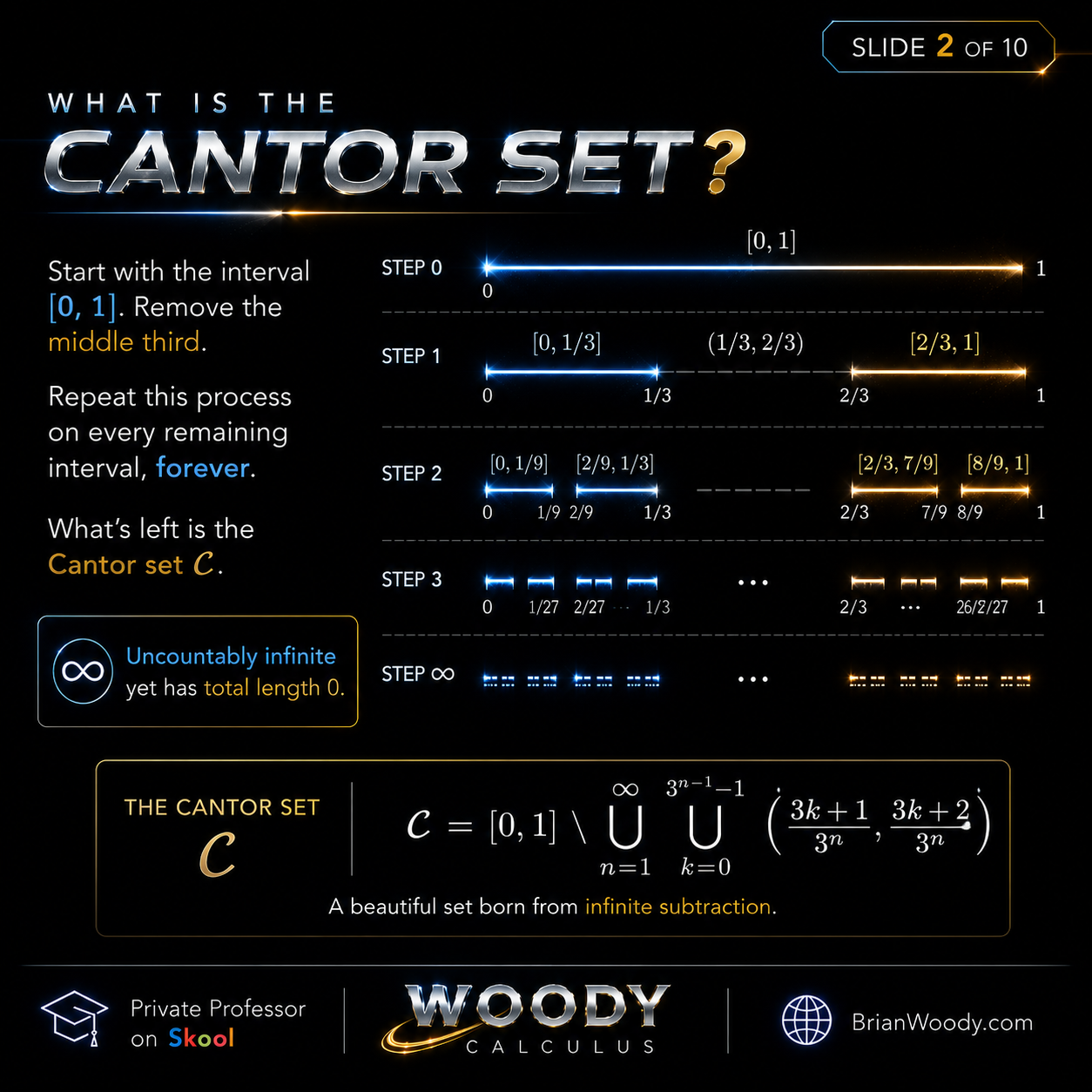
After step 1, two intervals remain. After step 2, four intervals remain. After step 3, eight intervals remain. After \(n\) steps, there are
\[
2^n
\]
remaining intervals, each with length
\[
\frac{1}{3^n}.
\]
That is the first deep pattern:
The number of intervals doubles, but the length of each interval is divided by three.
Visualizing Infinite Subtraction
At each stage, we remove more length. But we never remove everything point by point.
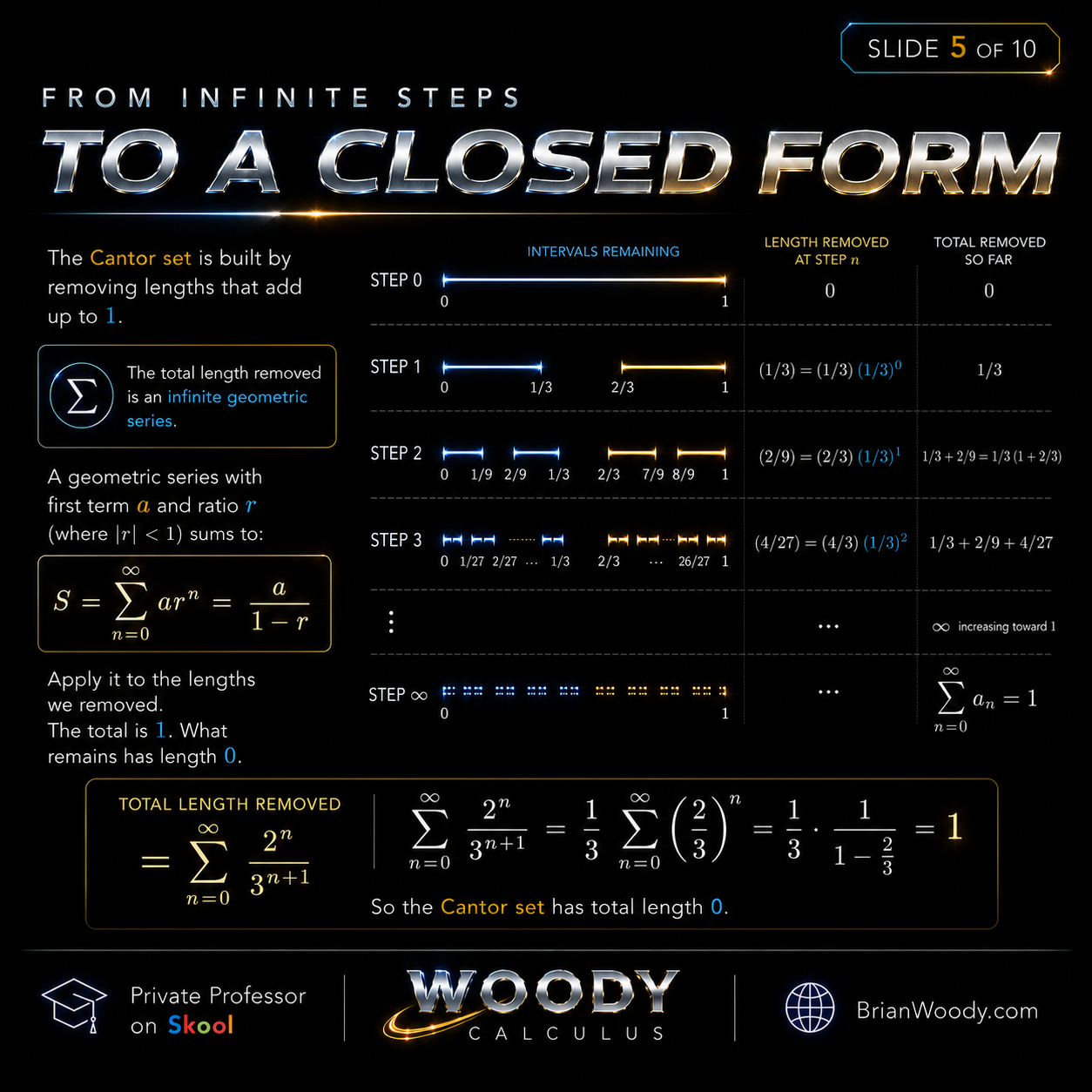
At step 1, we remove one interval of length
\[
\frac{1}{3}.
\]
At step 2, we remove two intervals, each of length
\[
\frac{1}{9}.
\]
So the total length removed at step 2 is
\[
2\cdot\frac{1}{9}=\frac{2}{9}.
\]
At step 3, we remove four intervals, each of length
\[
\frac{1}{27}.
\]
So the total length removed at step 3 is
\[
4\cdot\frac{1}{27}=\frac{4}{27}.
\]
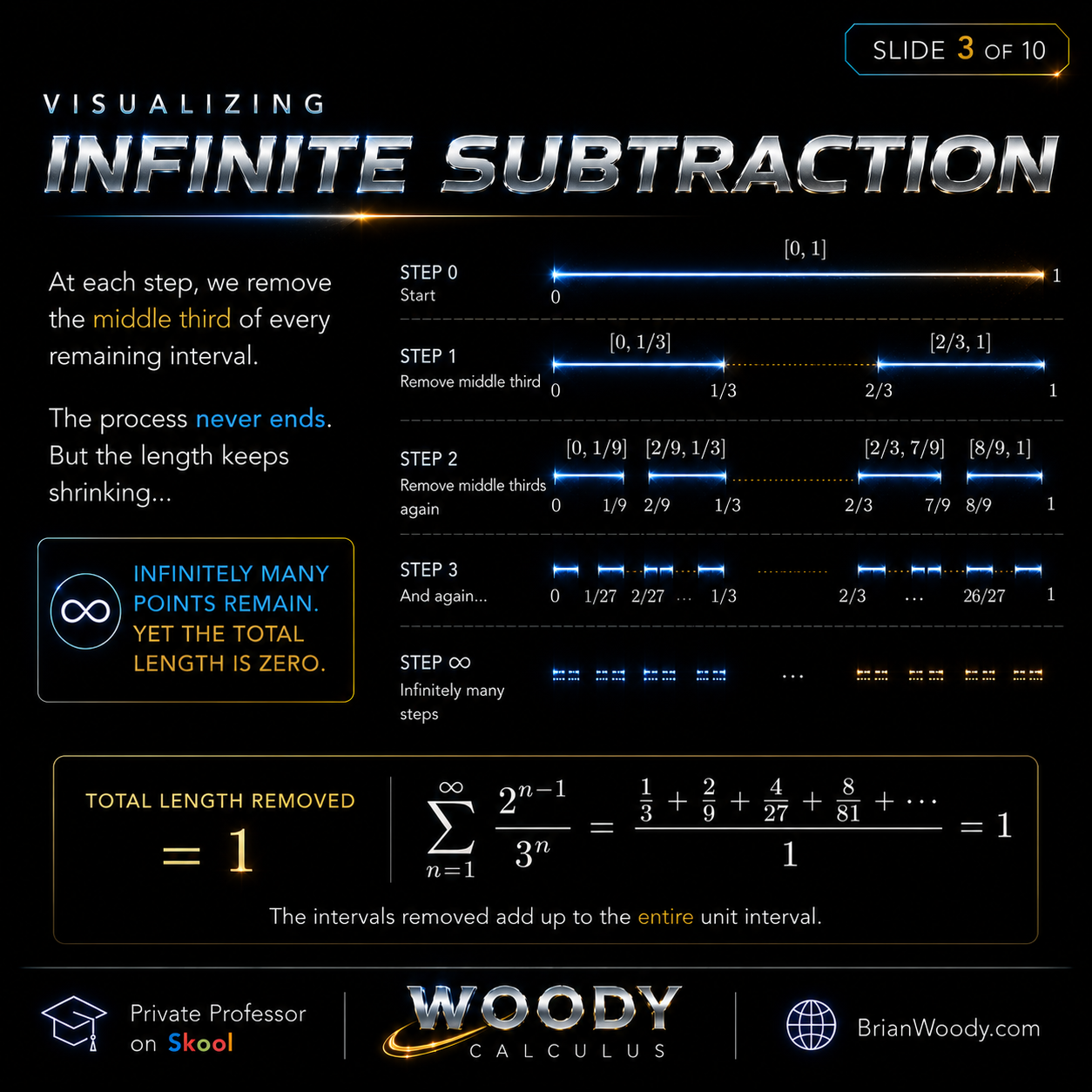
The process never ends. But the total length removed follows a clean geometric series.
Why the Removed Length Adds Up to 1
The total length removed is
\[
\frac{1}{3}+\frac{2}{9}+\frac{4}{27}+\frac{8}{81}+\cdots.
\]
This is a geometric series. The first term is
\[
a=\frac{1}{3},
\]
and the common ratio is
\[
r=\frac{2}{3}.
\]
So the total length removed is
\[
\sum_{n=0}^{\infty}\frac{2^n}{3^{n+1}}
=
\frac{1}{3}\sum_{n=0}^{\infty}\left(\frac{2}{3}\right)^n.
\]
Using the geometric series formula,
\[
\sum_{n=0}^{\infty} ar^n=\frac{a}{1-r},
\qquad |r|<1, \]
we get
\[
\frac{1}{3}\cdot \frac{1}{1-\frac{2}{3}}
=
\frac{1}{3}\cdot 3
=
1.
\]
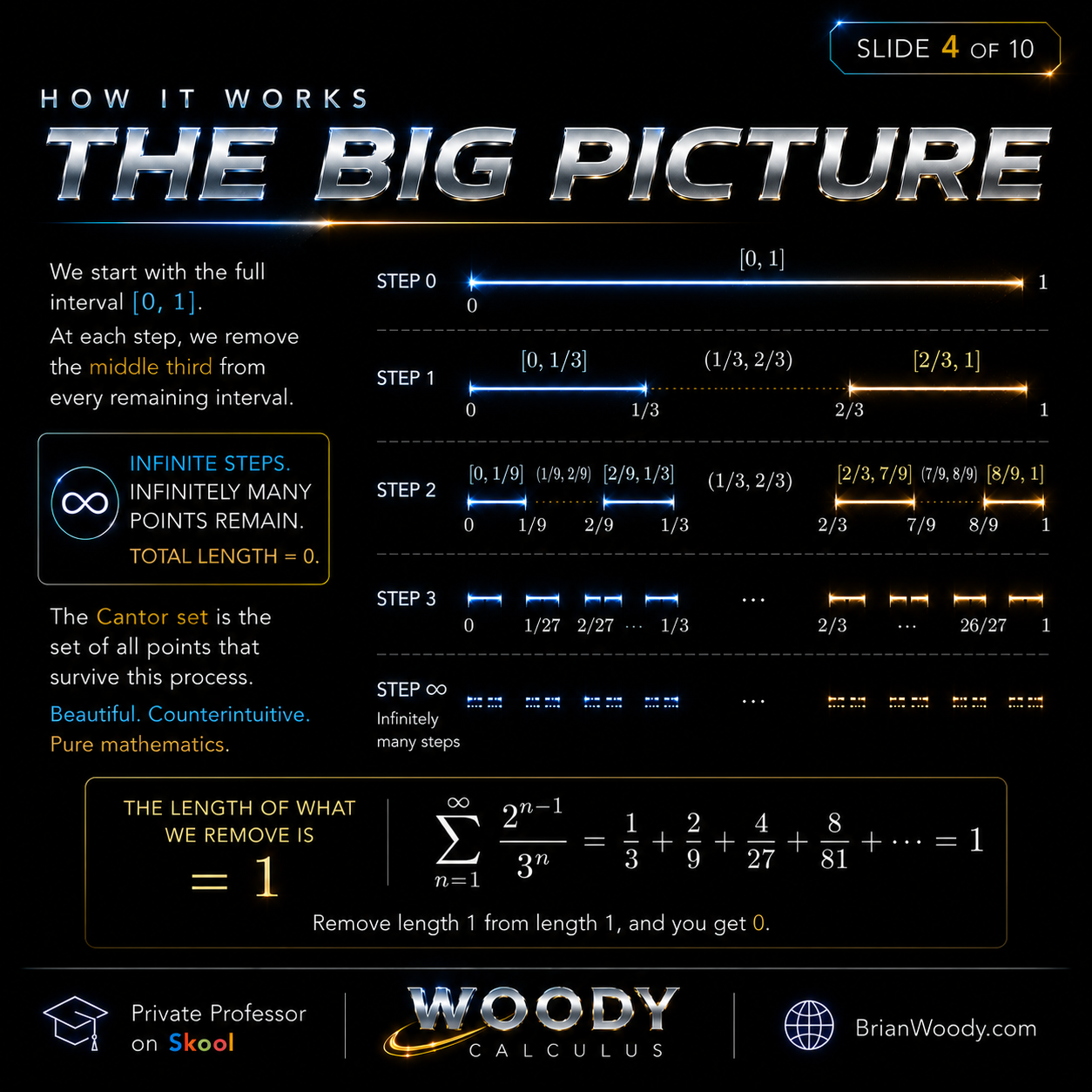
So the total length removed is exactly \(1\).
Why Does the Cantor Set Have Measure Zero?
The original interval \([0,1]\) has length \(1\).
The total length removed is also \(1\).
Therefore, the total length remaining is
\[
1-1=0.
\]
This is why the Cantor Set has length zero. In measure theory language, we say:
The Cantor Set has Lebesgue measure zero.
Real Analysis Lesson
Length zero does not mean the set is empty. It means the set is small in the sense of measure. The Cantor Set is measure zero, but it still contains uncountably infinitely many points.
Is the Cantor Set a Fractal? Self-Similarity Explained
The Cantor Set is self-similar. That means when you zoom in on part of it, you see a scaled copy of the original structure.
The left third contains a smaller copy of the Cantor Set. The right third contains another smaller copy.
Symbolically, the Cantor Set can be described as
\[
C=\frac{1}{3}C\cup\left(\frac{2}{3}+\frac{1}{3}C\right).
\]
This says:
The Cantor Set is the union of two scaled copies of itself.
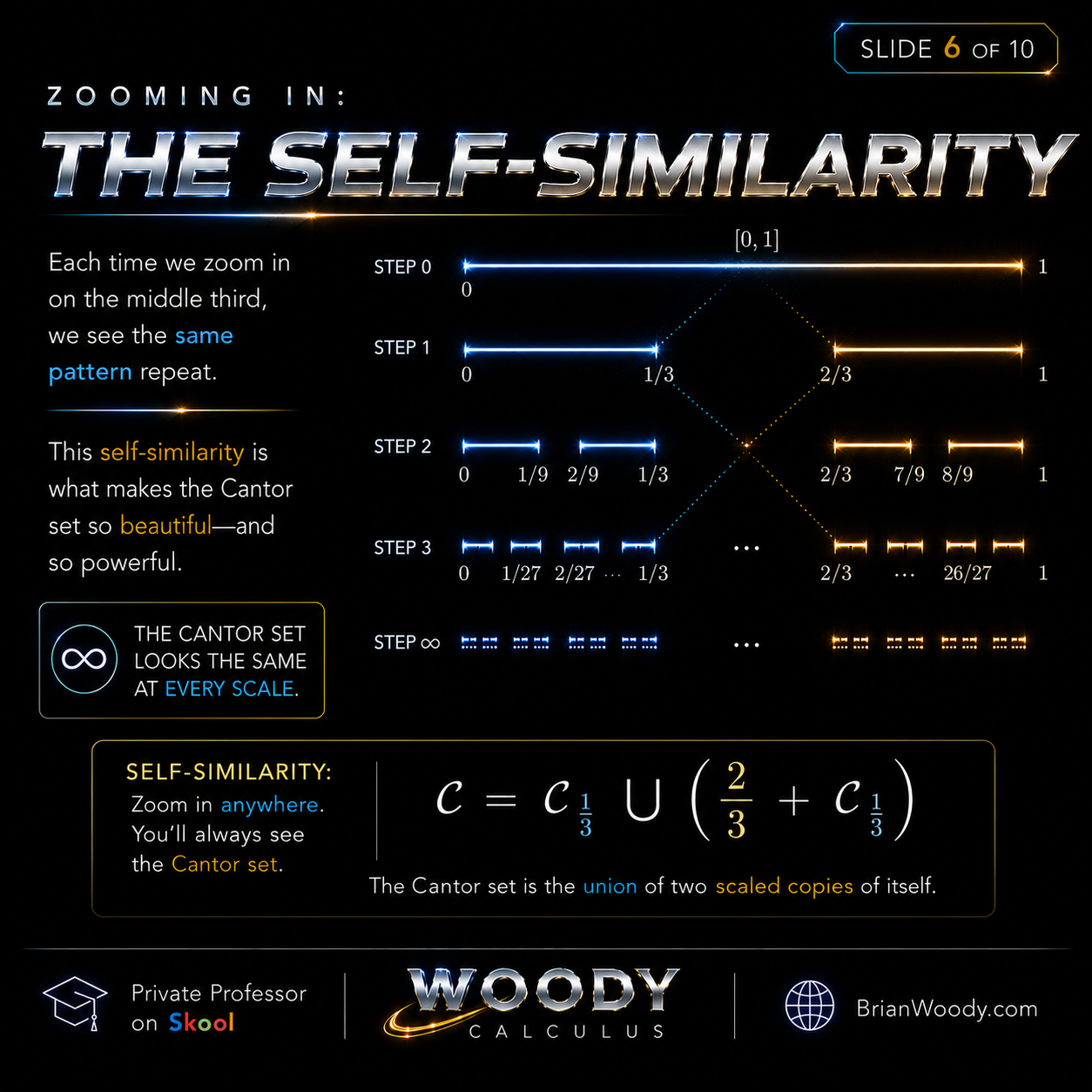
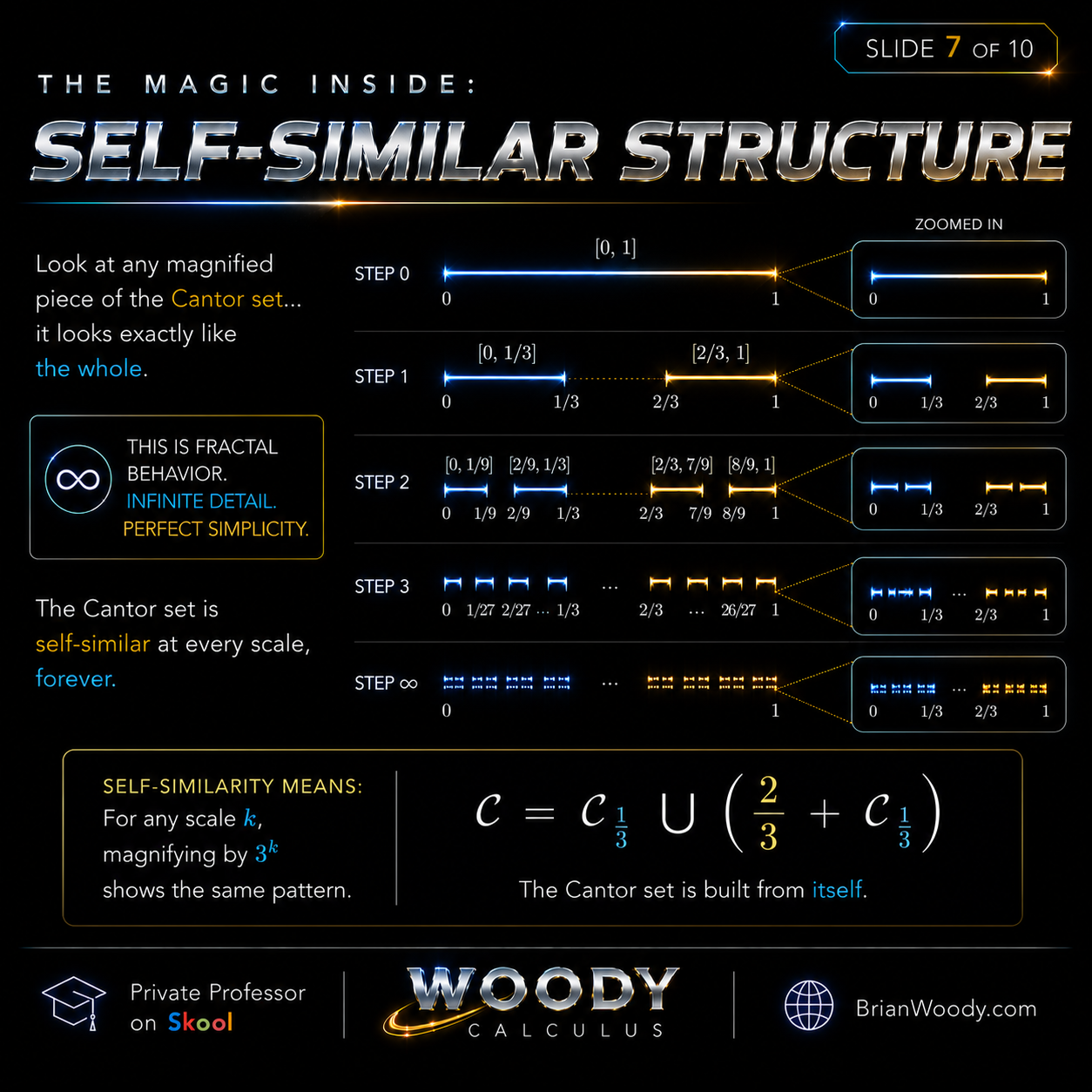
This is why the Cantor Set is a classic fractal. It has structure at every scale. No matter how far you zoom in, the same two-copy pattern persists.
What Is the Fractal Dimension of the Cantor Set?
The middle-third Cantor Set has Hausdorff dimension
\[
\dim_H(C)=\frac{\log 2}{\log 3}\approx 0.63093.
\]
The reason comes directly from self-similarity. The Cantor Set consists of \(2\) copies of itself, and each copy is scaled by a factor of \(1/3\). If \(D\) is the similarity dimension, then
\[
2\left(\frac{1}{3}\right)^D=1.
\]
Solving gives
\[
D=\frac{\log 2}{\log 3}.
\]
For the Cantor Set, this similarity dimension equals both its Hausdorff dimension and its box-counting dimension. The value lies between \(0\) and \(1\), reflecting a set that is more complicated than isolated points but thinner than an interval.
Why Is the Cantor Set Uncountable?
The Cantor Set is uncountable: it has the same cardinality as the real numbers in an interval, even though its Lebesgue measure is zero. One clean proof uses ternary, or base-three, expansions.
Every point in \([0,1]\) can be written using a base-three decimal expansion:
\[
0.a_1a_2a_3\ldots_3.
\]
A point belongs to the Cantor Set exactly when it admits a ternary expansion using only the digits \(0\) and \(2\). The digit \(1\) marks a middle-third region that is removed.
Now replace each ternary digit \(0\) by the binary digit \(0\), and each ternary digit \(2\) by the binary digit \(1\). This identifies Cantor-set digit sequences with infinite binary sequences. Since the set of infinite binary sequences is uncountable, the Cantor Set is uncountable as well. In fact, its cardinality is the continuum, \(2^{\aleph_0}\).
The Paradox in One Sentence
The Cantor Set has length zero, but it contains uncountably many points because infinitely many ternary sequences using only \(0\) and \(2\) remain.
Why Is the Cantor Set Closed?
The Cantor Set is closed because all of the intervals removed during its construction form an open subset of \(\mathbb{R}\).
Let \(U\) be the union of every removed open middle-third interval. Then \(U\) is open, so \(\mathbb{R}\setminus U\) is closed. Since
\[
C=[0,1]\setminus U=[0,1]\cap(\mathbb{R}\setminus U),
\]
and both sets on the right are closed, the Cantor Set \(C\) is closed in \(\mathbb{R}\).
Another way to say this:
The Cantor Set contains all of its limit points.
This matters in Real Analysis because the Cantor Set is simultaneously closed, bounded, measure zero, and uncountable. Since it is closed and bounded in \(\mathbb{R}\), the Heine-Borel theorem also tells us that the Cantor Set is compact.
Why Is the Cantor Set a Perfect Set?
A set is perfect if it is closed and every point of the set is a limit point. The Cantor Set is closed, and it has no isolated points.
To see why, take any \(x\in C\) and any \(\varepsilon>0\). Choose \(n\) large enough that \(3^{-n}<\varepsilon\). At stage \(n\), the point \(x\) lies in a surviving interval of length \(3^{-n}\), and that interval contains another point \(y\in C\) with \(y\neq x\). Therefore
\[
|x-y|<\varepsilon.
\]
So every point of the Cantor Set can be approached arbitrarily closely by other Cantor-set points. Therefore every point is a limit point, and the Cantor Set is perfect.
Why Is the Cantor Set Nowhere Dense?
The Cantor Set is nowhere dense because its closure has empty interior. Since the Cantor Set is closed, its closure is the set itself. So it is enough to show that the Cantor Set contains no nonempty open interval.
At every scale of the construction, each surviving interval contains a smaller open middle-third gap that is removed. Therefore every neighborhood of every point of the Cantor Set contains points that are not in the Cantor Set. No open interval can lie entirely inside \(C\), so
\[
\operatorname{int}(C)=\varnothing.
\]
Because \(\overline{C}=C\), we have \(\operatorname{int}(\overline{C})=\varnothing\). That is exactly what it means for the Cantor Set to be nowhere dense.
The Big Picture: Zero Length, Infinite Complexity
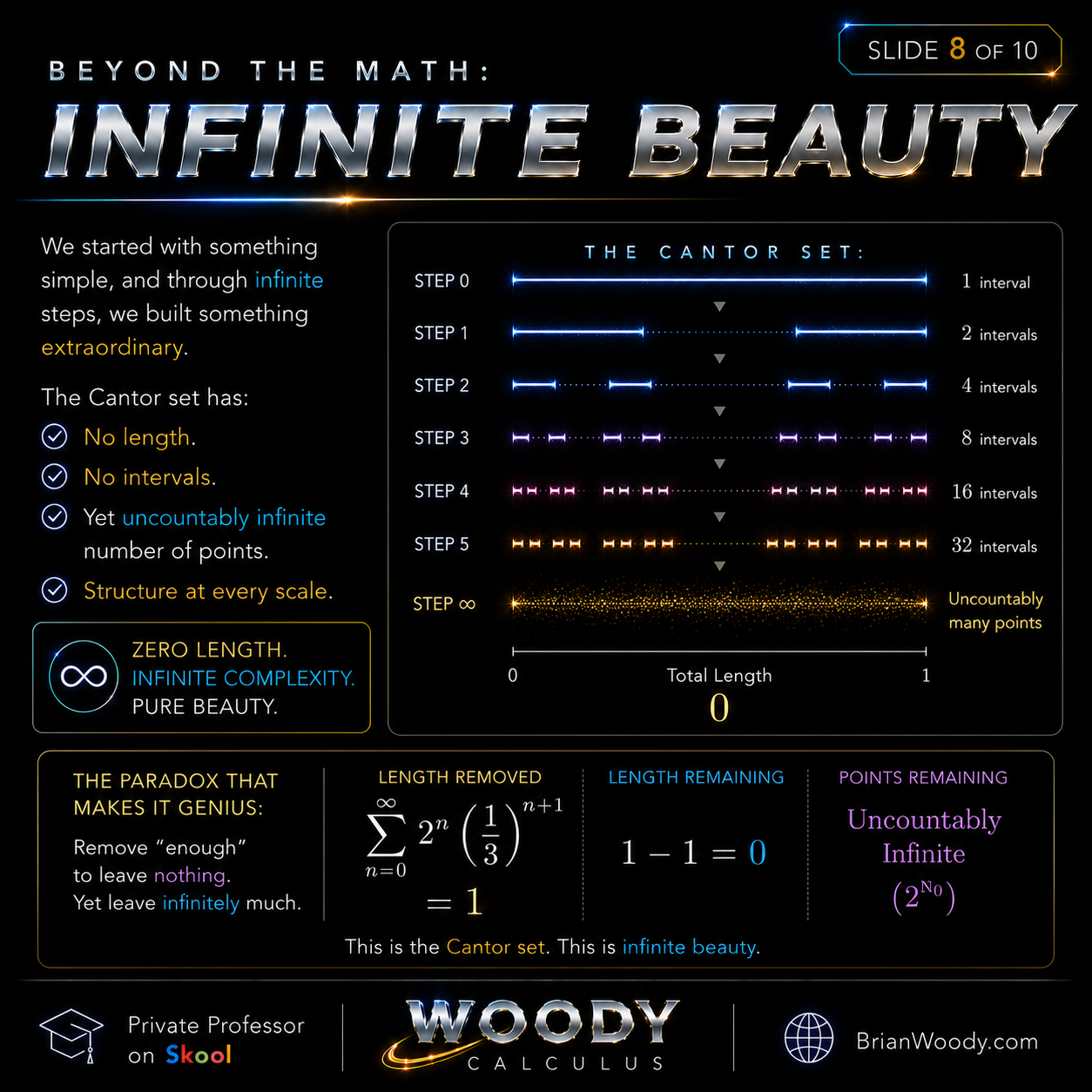
The Cantor Set starts with one interval and removes middle thirds forever.
After infinitely many steps, the total length remaining is zero. But the set is not empty. It is uncountable, closed, perfect, nowhere dense, compact, and self-similar, with fractal dimension \(\log 2/\log 3\).
This is the deeper lesson:
Measure and cardinality are different ideas.
Length measures size in one sense. Cardinality measures how many points exist. The Cantor Set has length zero, but it still has uncountably many points.
That is why the Cantor Set is not just a construction. It is a doorway into the deeper architecture of Real Analysis.
Common Mistakes Students Make
The Cantor Set is conceptually subtle, so students often make the same mistakes.
Mistake 1: Thinking length zero means no points
Length zero does not mean empty. A single point has length zero. A countable set can have length zero. The Cantor Set shows that even an uncountable set can have length zero.
Mistake 2: Thinking the Cantor Set is countable
The Cantor Set is not countable. It is uncountable. The ternary expansion argument shows that there are as many surviving digit sequences as there are infinite binary sequences.
Mistake 3: Forgetting endpoints remain
At each step, we remove open middle thirds. The endpoints of removed intervals stay. That is why points like \(1/3\), \(2/3\), \(1/9\), and \(8/9\) remain in the Cantor Set.
Mistake 4: Confusing no intervals with no points
The Cantor Set contains no interval of positive length, but it still contains infinitely many points. In fact, it contains uncountably many points.
Mistake 5: Treating intuition as automatic
The Cantor Set does not feel intuitive at first. That is normal. Intuition is trained by repeating the construction, rewriting the geometric series, and saying the logic out loud until the structure becomes familiar.
Complete Worked Explanation
Problem
Construct the Cantor Set from \([0,1]\). Show that the total length removed is \(1\), explain why the remaining set has length \(0\), and explain why the set still contains uncountably many points.
Step 1: Build the set
Start with
\[
C_0=[0,1].
\]
Remove the open middle third:
\[
\left(\frac{1}{3},\frac{2}{3}\right).
\]
Then
\[
C_1=\left[0,\frac{1}{3}\right]\cup\left[\frac{2}{3},1\right].
\]
Repeat this process forever on every remaining interval.
Step 2: Compute the length removed
The total length removed is
\[
\frac{1}{3}+\frac{2}{9}+\frac{4}{27}+\frac{8}{81}+\cdots.
\]
This is
\[
\sum_{n=0}^{\infty}\frac{2^n}{3^{n+1}}
=
\frac{1}{3}\sum_{n=0}^{\infty}\left(\frac{2}{3}\right)^n.
\]
Using the geometric series formula,
\[
\frac{1}{3}\cdot\frac{1}{1-\frac{2}{3}}
=
\frac{1}{3}\cdot 3
=
1.
\]
Step 3: Conclude the Cantor Set has length zero
The original interval has length \(1\). The total length removed is \(1\). Therefore, the remaining length is
\[
1-1=0.
\]
So the Cantor Set has length zero.
Step 4: Explain why points remain
The process removes open intervals, not every point. Many endpoints remain. More deeply, points whose ternary expansions use only \(0\) and \(2\) remain.
There are uncountably many infinite sequences of \(0\)’s and \(2\)’s, so the Cantor Set is uncountably infinite.
Final Answer
The Cantor Set has total length
\[
\boxed{0}
\]
but contains
\[
\boxed{\text{uncountably many points}}.
\]
FAQ: The Cantor Set in Real Analysis
What is the Cantor Set?
The Cantor Set is the set of points left in \([0,1]\) after repeatedly removing the open middle third of every remaining interval forever. It is closed, perfect, nowhere dense, uncountable, self-similar, and has Lebesgue measure zero.
Why does the Cantor Set have length zero?
The total length removed is \( \frac{1}{3}+\frac{2}{9}+\frac{4}{27}+\cdots=1 \). Since the original interval has length \(1\), the remaining set has length \(0\); equivalently, its Lebesgue measure is zero.
Is the Cantor Set empty?
No. The Cantor Set is not empty. It contains many points, including all endpoints created during the construction, and it actually contains uncountably infinitely many points.
Is the Cantor Set countable or uncountable?
The Cantor Set is uncountable. Its points admit ternary expansions using only the digits \(0\) and \(2\), which correspond to infinite binary sequences. Its cardinality is the continuum, \(2^{\aleph_0}\).
How can a set have zero length but infinitely many points?
Length and number of points are different concepts. The Cantor Set has measure zero, but it still contains uncountably many points.
Is the Cantor Set closed?
Yes. If \(U\) is the union of all removed open middle thirds, then \(C=[0,1]\cap(\mathbb{R}\setminus U)\). Both sets in this intersection are closed, so the Cantor Set is closed in \(\mathbb{R}\).
Is the Cantor Set a fractal?
Yes. The Cantor Set is self-similar because it is made from two copies of itself, each scaled by \(1/3\). Its Hausdorff dimension is \(\log 2/\log 3\approx 0.63093\).
Does the Cantor Set contain any intervals?
No. The Cantor Set contains no interval of positive length. Because it is closed and has empty interior, it is nowhere dense.
Why is the Cantor Set important in Real Analysis?
The Cantor Set is important because it is closed, perfect, nowhere dense, compact, uncountable, self-similar, and measure zero. It separates ideas such as cardinality, measure, topology, and fractal dimension.
What topics does the Cantor Set connect to?
The Cantor Set connects to Real Analysis, topology, measure theory, compactness, fractal geometry, Hausdorff dimension, infinite series, ternary expansions, and different sizes of infinity.
Woody Calculus Mastery Task
Train the Cantor Set Until the Pattern Becomes Automatic
The Cantor Set is not something to passively admire. It is something to train.
- Write \(C_0=[0,1]\).
- Say out loud: “Remove the open middle third.”
- Write:
\[
C_1=\left[0,\frac{1}{3}\right]\cup\left[\frac{2}{3},1\right].
\] - Write the first few removed lengths:
\[
\frac{1}{3},\quad \frac{2}{9},\quad \frac{4}{27},\quad \frac{8}{81}.
\] - Rewrite the geometric series:
\[
\sum_{n=0}^{\infty}\frac{2^n}{3^{n+1}}=1.
\] - Say out loud: “Total length removed is \(1\), so total length remaining is \(0\).”
- Close the book, then explain why length zero does not mean empty.
- Close the book again, then explain why ternary expansions with only \(0\) and \(2\) imply uncountably many points.
That is the Woody Calculus method: memorize the critical structure, rewrite perfect explanations, say the steps out loud, and repeat until the intuition becomes automatic.
Final Thought: The Cantor Set Is Power in Simplicity
The Cantor Set comes from one simple rule:
Remove the middle third forever.
From that rule, we get length zero, uncountably many points, self-similarity, fractal structure, and deep connections across advanced mathematics.
This is why Real Analysis is so powerful. It teaches you not to trust surface intuition. It trains you to see the structure underneath.
Simple rule. Infinite consequences.
Ready to Master Real Analysis and Advanced Mathematics?
Woody Calculus Private Professor on Skool is built for serious students who want structure, clarity, and mastery in advanced mathematics.
Inside the Woody Calculus Mastery Lab, students can submit homework and practice exams, get perfect typed solutions, access massive problem libraries, ask questions in real time, and train using the Woody Calculus Method.
Get support in Real Analysis, Calculus 2, Calculus 3, Differential Equations, Linear Algebra, Abstract Algebra, and advanced university mathematics.
This is not casual tutoring. This is structured mathematical training.
1 thought on “Cantor Set Explained: Infinite Points, Zero Length in Real Analysis”