Euler’s Identity Explained: The Most Beautiful Equation in Mathematics
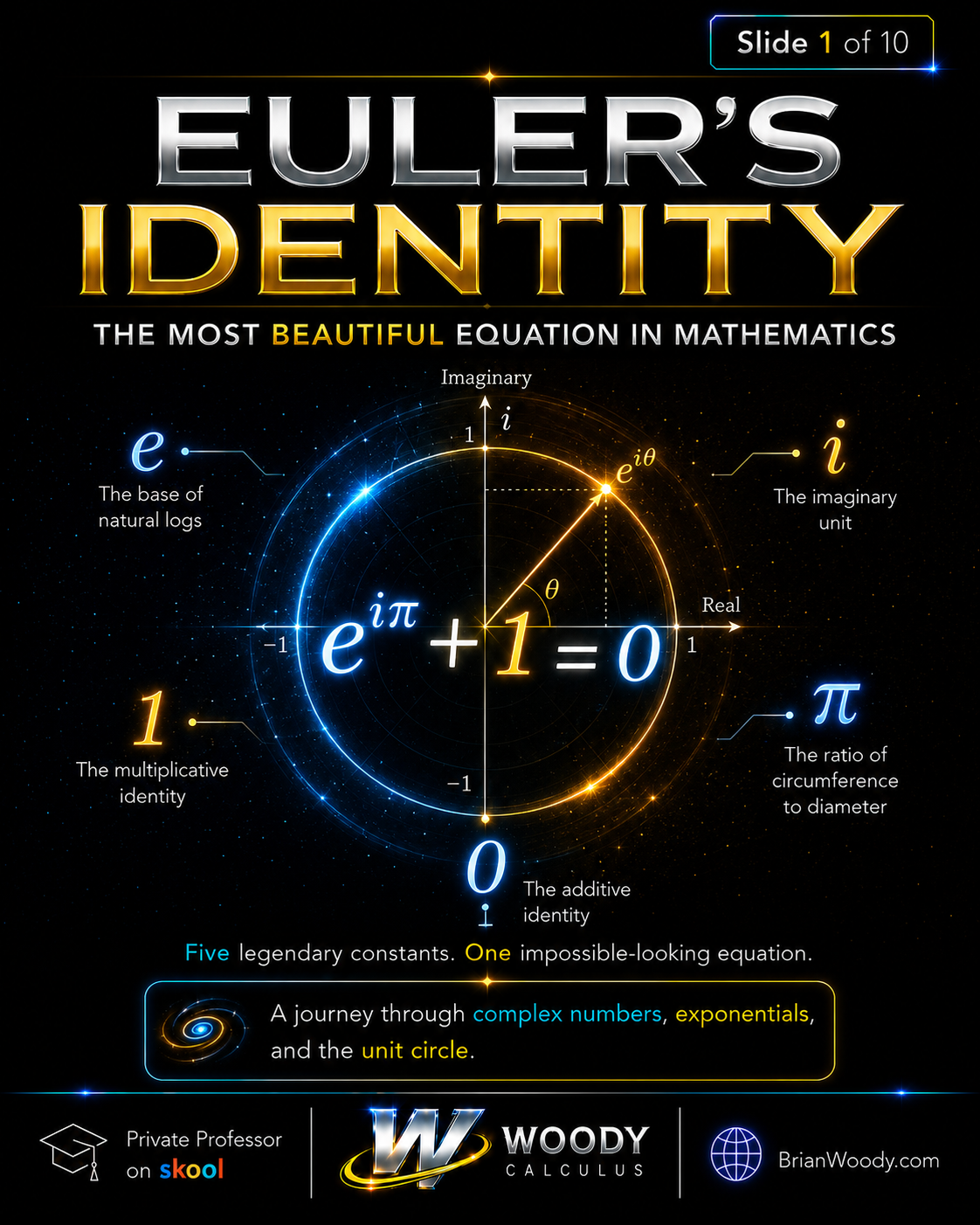
Euler’s Identity is often called the most beautiful equation in mathematics because it connects five of the most important constants ever discovered:
\[
e^{i\pi}+1=0.
\]
In one impossibly compact equation, Euler’s Identity brings together \(e\), \(i\), \(\pi\), \(1\), and \(0\). It connects exponential functions, complex numbers, trigonometry, the unit circle, Taylor series, algebra, geometry, analysis, and the deeper structure behind much of advanced mathematics.
This Woody Calculus visual lesson walks through the full story in order: the constants, Euler’s formula, the complex plane, the unit circle, the Taylor series proof, the moment \(x=\pi\), Euler’s Identity, and why this equation appears in Fourier analysis, waves, quantum mechanics, electrical engineering, control theory, and differential equations.
What Is Euler’s Identity?
Euler’s Identity is the equation
\[
e^{i\pi}+1=0.
\]
It is famous because it combines five legendary mathematical constants:
- \(e\), the base of natural logarithms
- \(i\), the imaginary unit, where \(i^2=-1\)
- \(\pi\), the ratio of a circle’s circumference to its diameter
- \(1\), the multiplicative identity
- \(0\), the additive identity
Each of these constants comes from a different part of mathematics. The number \(e\) appears in exponential growth, calculus, differential equations, compound interest, and natural processes. The number \(i\) extends algebra into the complex plane. The number \(\pi\) comes from circles, geometry, trigonometry, waves, and periodic motion. The numbers \(1\) and \(0\) are the foundations of multiplication and addition.
Euler’s Identity brings them together in one equation. That is why it feels almost impossible the first time you see it.
Euler’s Formula: The Big Idea
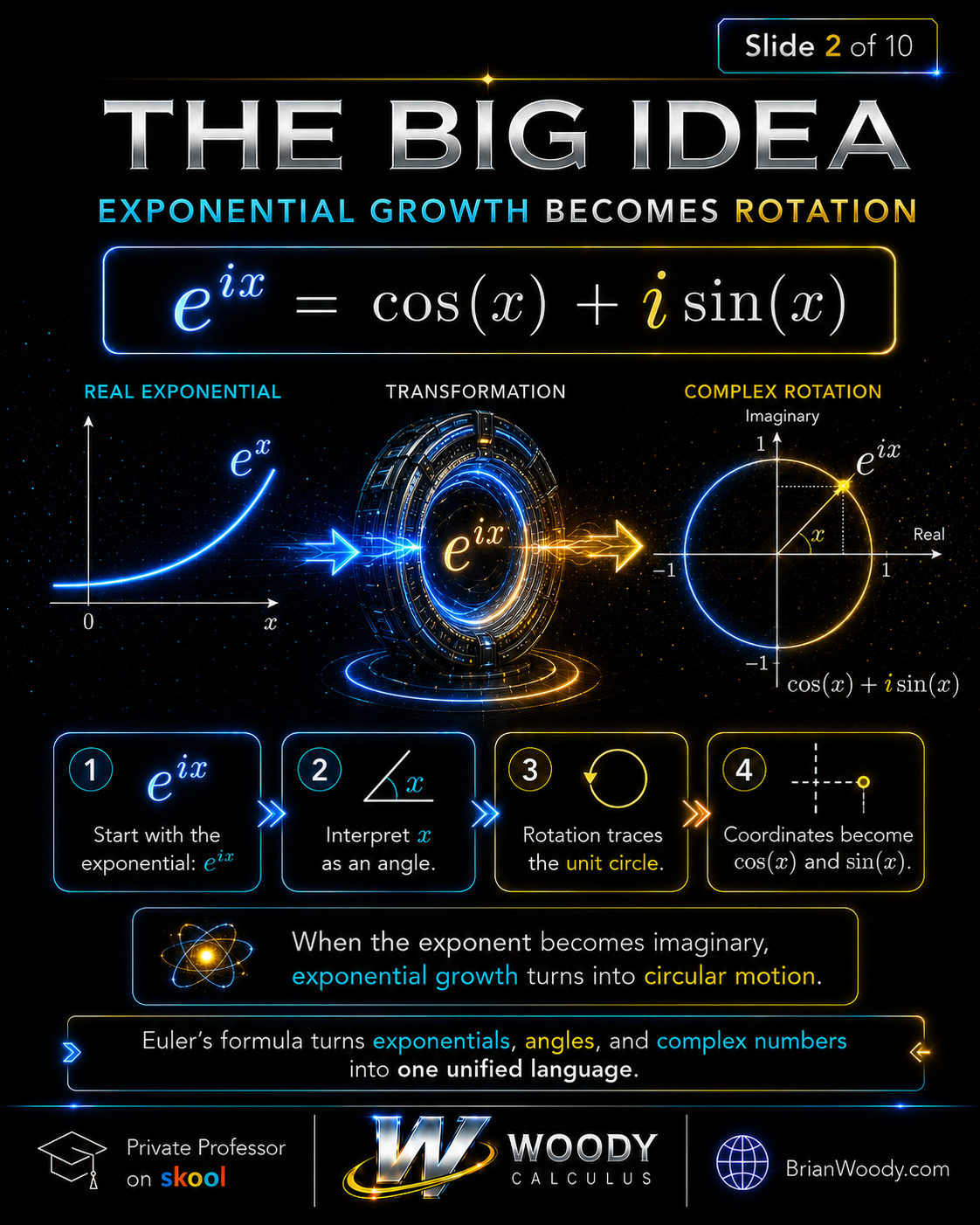
Euler’s Identity comes from the more general equation called Euler’s formula:
\[
e^{ix}=\cos x+i\sin x.
\]
This formula says something extraordinary. When the exponent becomes imaginary, exponential behavior becomes rotation.
Normally, students first meet exponentials through functions like
\[
e^x,
\]
which grow continuously. But when we replace the real exponent \(x\) with an imaginary exponent \(ix\), the behavior changes completely. Instead of growing along the real number line, the expression
\[
e^{ix}
\]
moves around the unit circle in the complex plane.
That is the central idea:
\[
\text{real exponential growth}
\quad \longrightarrow \quad
\text{complex rotation}.
\]
Euler’s formula turns exponentials, angles, trigonometry, and complex numbers into one unified language.
The Complex Plane
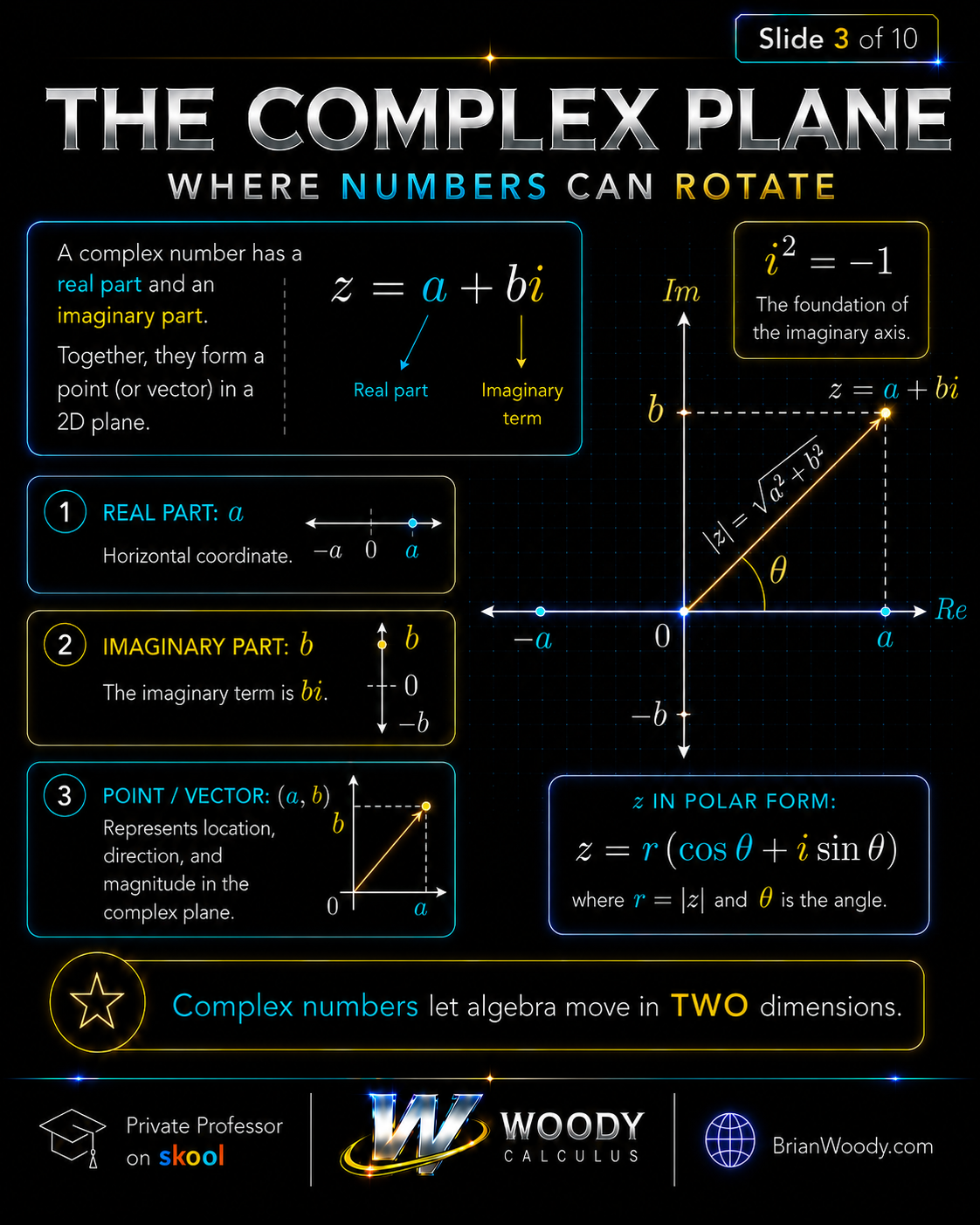
To understand Euler’s formula, we first need the complex plane. A complex number has the form
\[
z=a+bi,
\]
where \(a\) is the real part and \(b\) is the imaginary coefficient.
The imaginary unit satisfies
\[
i^2=-1.
\]
Together, the real and imaginary parts form a point in a two-dimensional plane:
\[
z=a+bi
\quad \longleftrightarrow \quad
(a,b).
\]
The horizontal axis is the real axis. The vertical axis is the imaginary axis. This is why complex numbers allow algebra to move in two dimensions instead of only along a line.
The magnitude of the complex number is
\[
|z|=\sqrt{a^2+b^2}.
\]
The polar form of a complex number is
\[
z=r(\cos\theta+i\sin\theta),
\]
where
\[
r=|z|
\]
and \(\theta\) is the angle.
This polar form is the doorway to Euler’s formula, because it connects complex numbers with trigonometry and rotation.
The Unit Circle Behind Euler’s Formula
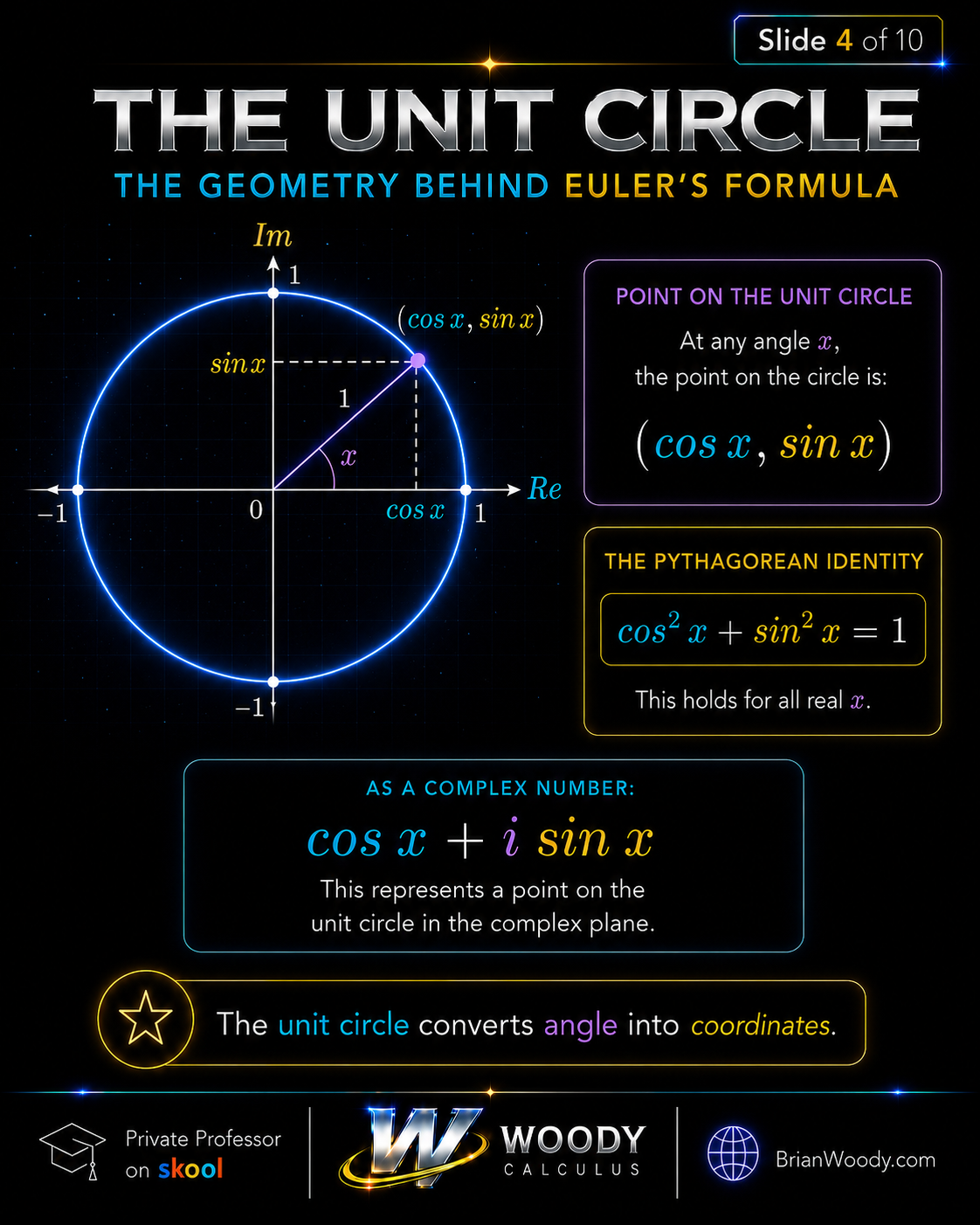
The unit circle is the circle of radius \(1\) centered at the origin. At an angle \(x\), the point on the unit circle has coordinates
\[
(\cos x,\sin x).
\]
This comes directly from right-triangle trigonometry. The horizontal coordinate is \(\cos x\), and the vertical coordinate is \(\sin x\).
Because the radius is \(1\), the point satisfies the Pythagorean identity:
\[
\cos^2 x+\sin^2 x=1.
\]
In the complex plane, the same point can be written as the complex number
\[
\cos x+i\sin x.
\]
This expression represents a point on the unit circle. The real part is \(\cos x\), and the imaginary part is \(\sin x\).
So the unit circle converts angle into coordinates:
\[
x
\quad \longrightarrow \quad
(\cos x,\sin x)
\quad \longrightarrow \quad
\cos x+i\sin x.
\]
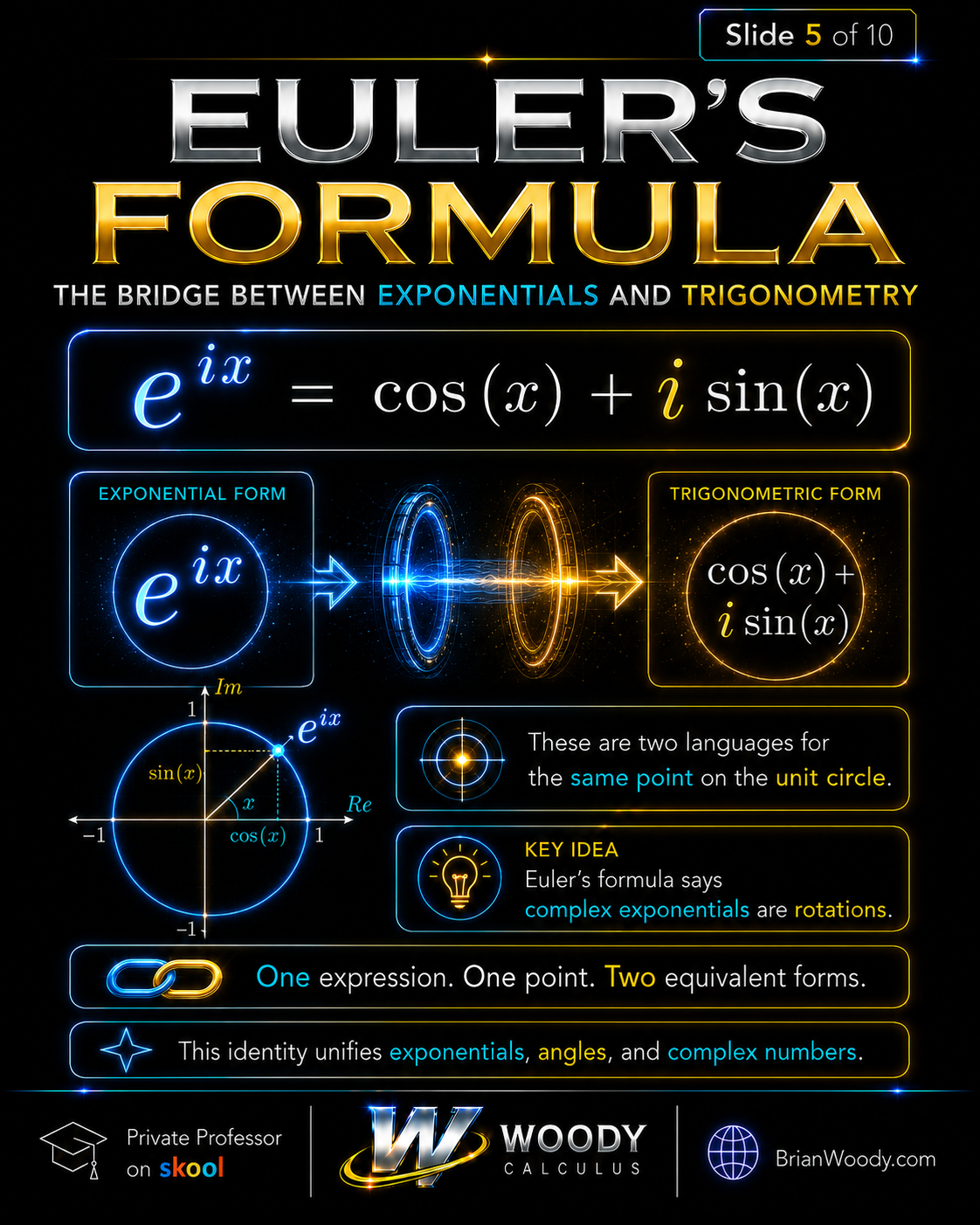
Euler’s Formula Explained
Euler’s formula states:
\[
e^{ix}=\cos x+i\sin x.
\]
This formula says that the exponential form \(e^{ix}\) and the trigonometric form \(\cos x+i\sin x\) describe the same point on the unit circle.
The left side is exponential:
\[
e^{ix}.
\]
The right side is trigonometric:
\[
\cos x+i\sin x.
\]
These look like completely different mathematical languages. But Euler’s formula reveals that they are two equivalent descriptions of the same object.
The key idea is this:
\[
\text{complex exponentials are rotations}.
\]
As \(x\) changes, the point \(e^{ix}\) moves around the unit circle. Its real part is \(\cos x\), and its imaginary part is \(\sin x\).
That is why Euler’s formula is one of the most important bridges in mathematics. It unites exponentials, angles, trigonometry, and complex numbers.
Why Euler’s Formula Works: Taylor Series Proof
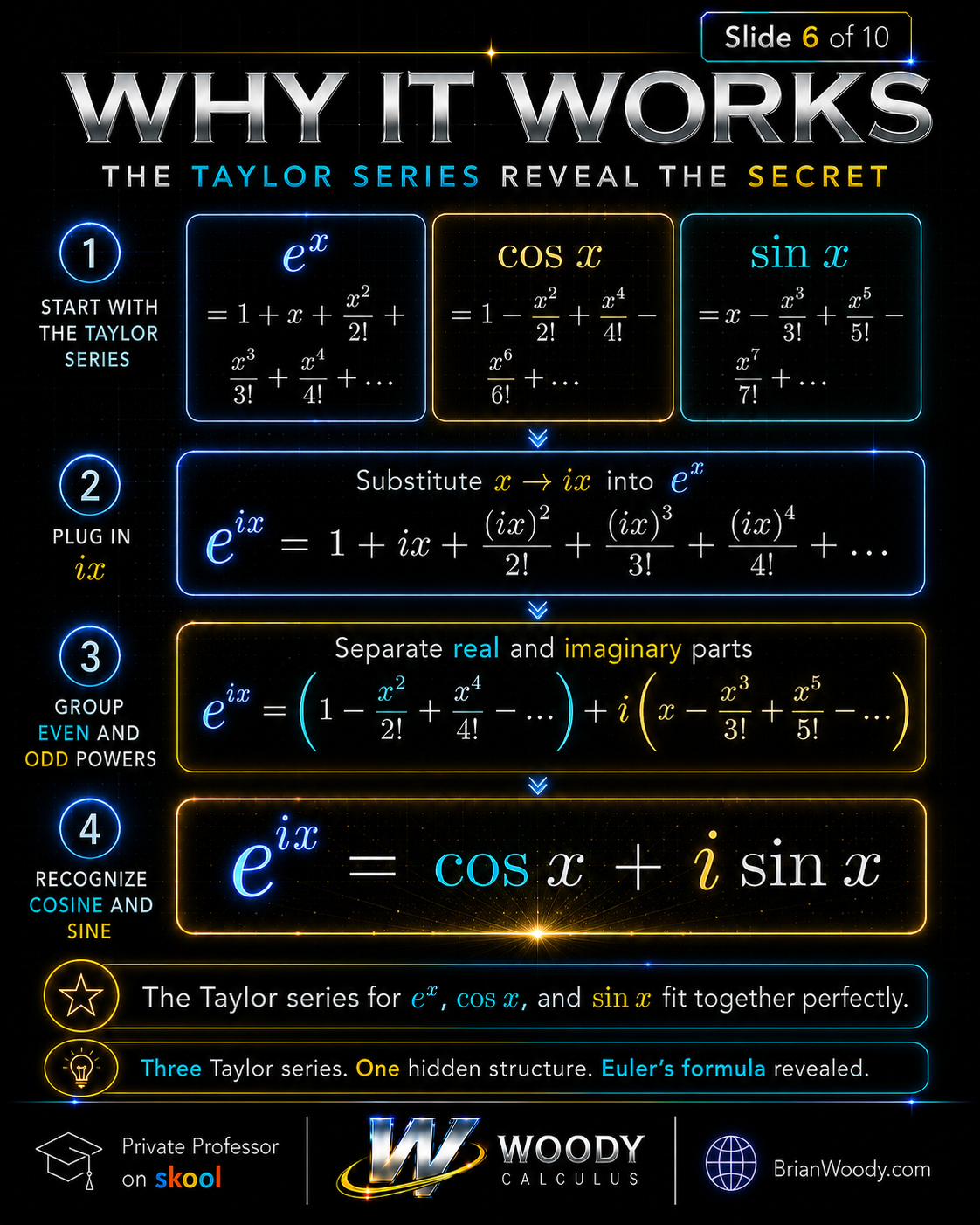
One of the cleanest ways to see why Euler’s formula works is through Taylor series. The three essential Taylor series are:
\[
e^x=1+x+\frac{x^2}{2!}+\frac{x^3}{3!}+\frac{x^4}{4!}+\cdots,
\]
\[
\cos x=1-\frac{x^2}{2!}+\frac{x^4}{4!}-\frac{x^6}{6!}+\cdots,
\]
and
\[
\sin x=x-\frac{x^3}{3!}+\frac{x^5}{5!}-\frac{x^7}{7!}+\cdots.
\]
Now substitute \(ix\) into the Taylor series for \(e^x\):
\[
e^{ix}=1+ix+\frac{(ix)^2}{2!}+\frac{(ix)^3}{3!}+\frac{(ix)^4}{4!}+\cdots.
\]
Use the powers of \(i\):
\[
i^2=-1,\qquad i^3=-i,\qquad i^4=1.
\]
Since \((ix)^2=-x^2\), \((ix)^3=-ix^3\), and \((ix)^4=x^4\), the series becomes
\[
e^{ix}
=
1+ix-\frac{x^2}{2!}-i\frac{x^3}{3!}
+\frac{x^4}{4!}+i\frac{x^5}{5!}-\cdots.
\]
Now group the real terms and imaginary terms:
\[
e^{ix}
=
\left(1-\frac{x^2}{2!}+\frac{x^4}{4!}-\cdots\right)
+
i\left(x-\frac{x^3}{3!}+\frac{x^5}{5!}-\cdots\right).
\]
The real part is exactly the Taylor series for \(\cos x\). The imaginary part is exactly the Taylor series for \(\sin x\). Therefore,
\[
e^{ix}=\cos x+i\sin x.
\]
This is the moment where the hidden structure becomes visible. The Taylor series for \(e^x\), \(\cos x\), and \(\sin x\) fit together perfectly.
Set \(x=\pi\): The Moment of Magic
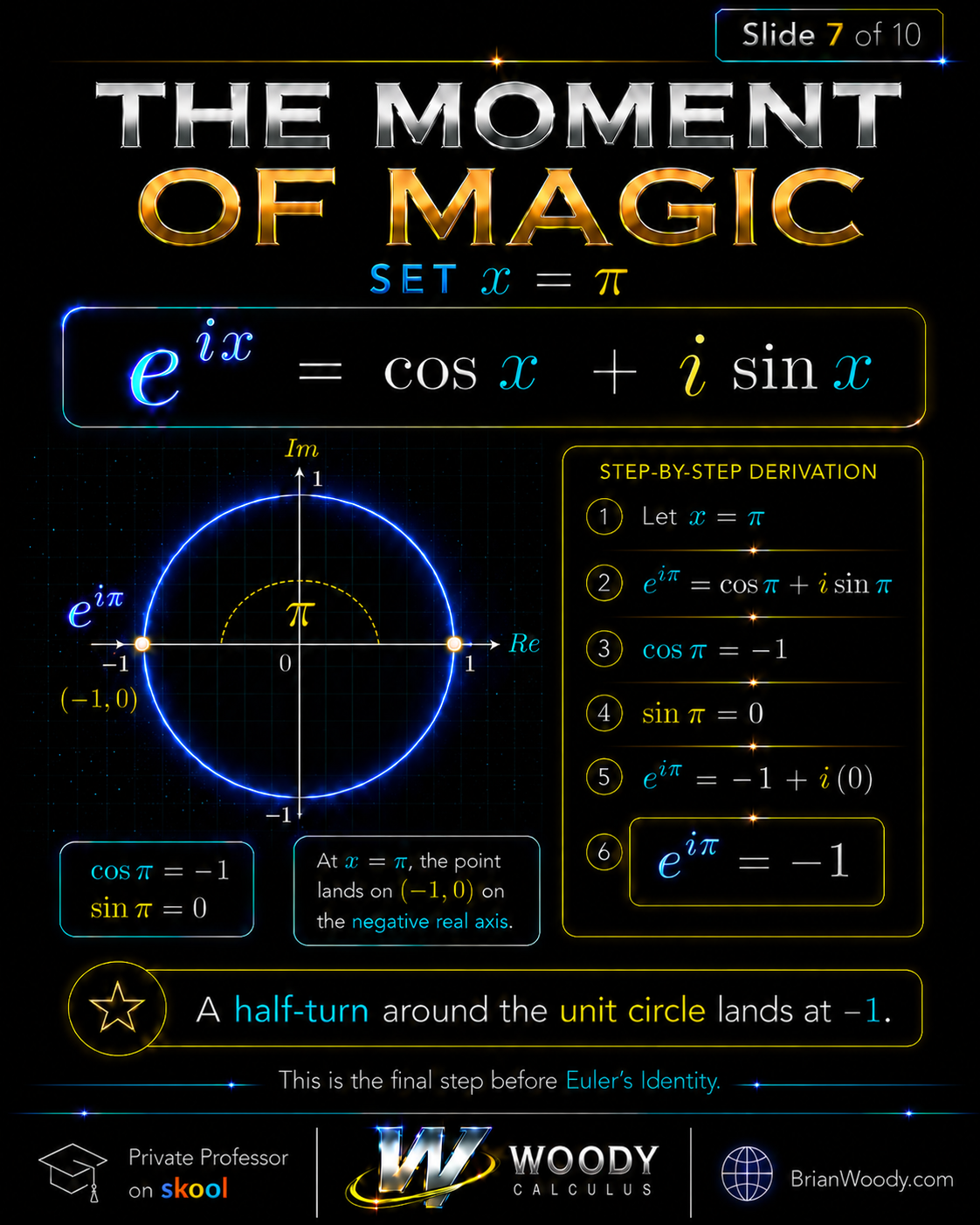
Euler’s formula is
\[
e^{ix}=\cos x+i\sin x.
\]
Now set
\[
x=\pi.
\]
Then
\[
e^{i\pi}=\cos \pi+i\sin \pi.
\]
On the unit circle, an angle of \(\pi\) radians is a half-turn. It lands at the point
\[
(-1,0)
\]
on the negative real axis.
That means
\[
\cos \pi=-1
\]
and
\[
\sin \pi=0.
\]
Substitute these values into Euler’s formula:
\[
e^{i\pi}=-1+i(0).
\]
Therefore,
\[
e^{i\pi}=-1.
\]
Add \(1\) to both sides:
\[
e^{i\pi}+1=0.
\]
That is Euler’s Identity.
Euler’s Identity: Five Constants, One Equation
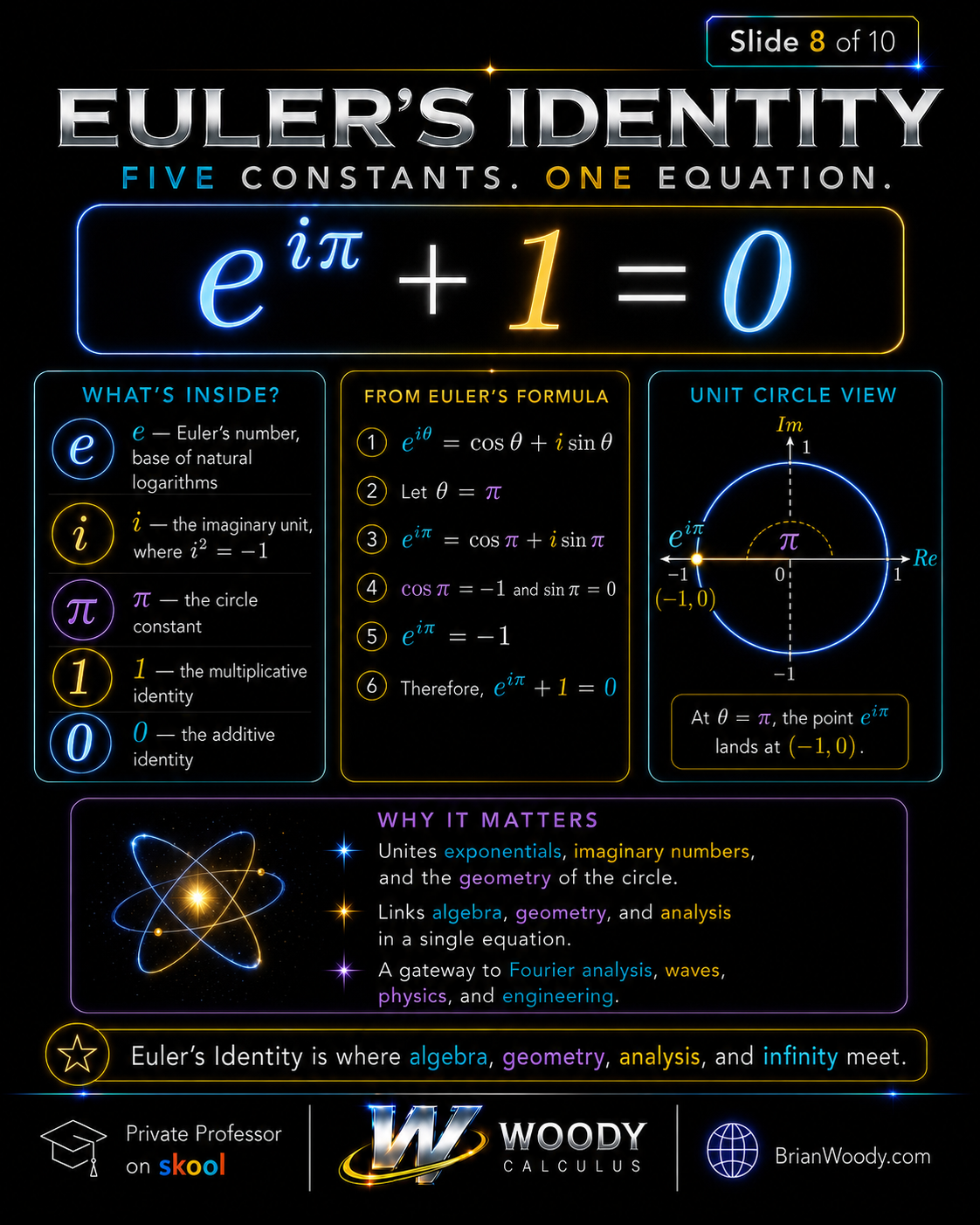
Euler’s Identity is
\[
e^{i\pi}+1=0.
\]
This single equation contains five fundamental constants:
- \(e\), Euler’s number, the base of natural logarithms
- \(i\), the imaginary unit, where \(i^2=-1\)
- \(\pi\), the circle constant
- \(1\), the multiplicative identity
- \(0\), the additive identity
From Euler’s formula,
\[
e^{i\theta}=\cos\theta+i\sin\theta.
\]
Let
\[
\theta=\pi.
\]
Then
\[
e^{i\pi}=\cos\pi+i\sin\pi.
\]
Since
\[
\cos\pi=-1
\]
and
\[
\sin\pi=0,
\]
we get
\[
e^{i\pi}=-1.
\]
Therefore,
\[
e^{i\pi}+1=0.
\]
Euler’s Identity matters because it links algebra, geometry, and analysis in a single equation. It also opens the door to Fourier analysis, waves, physics, engineering, quantum mechanics, signal processing, and many topics in advanced mathematics.
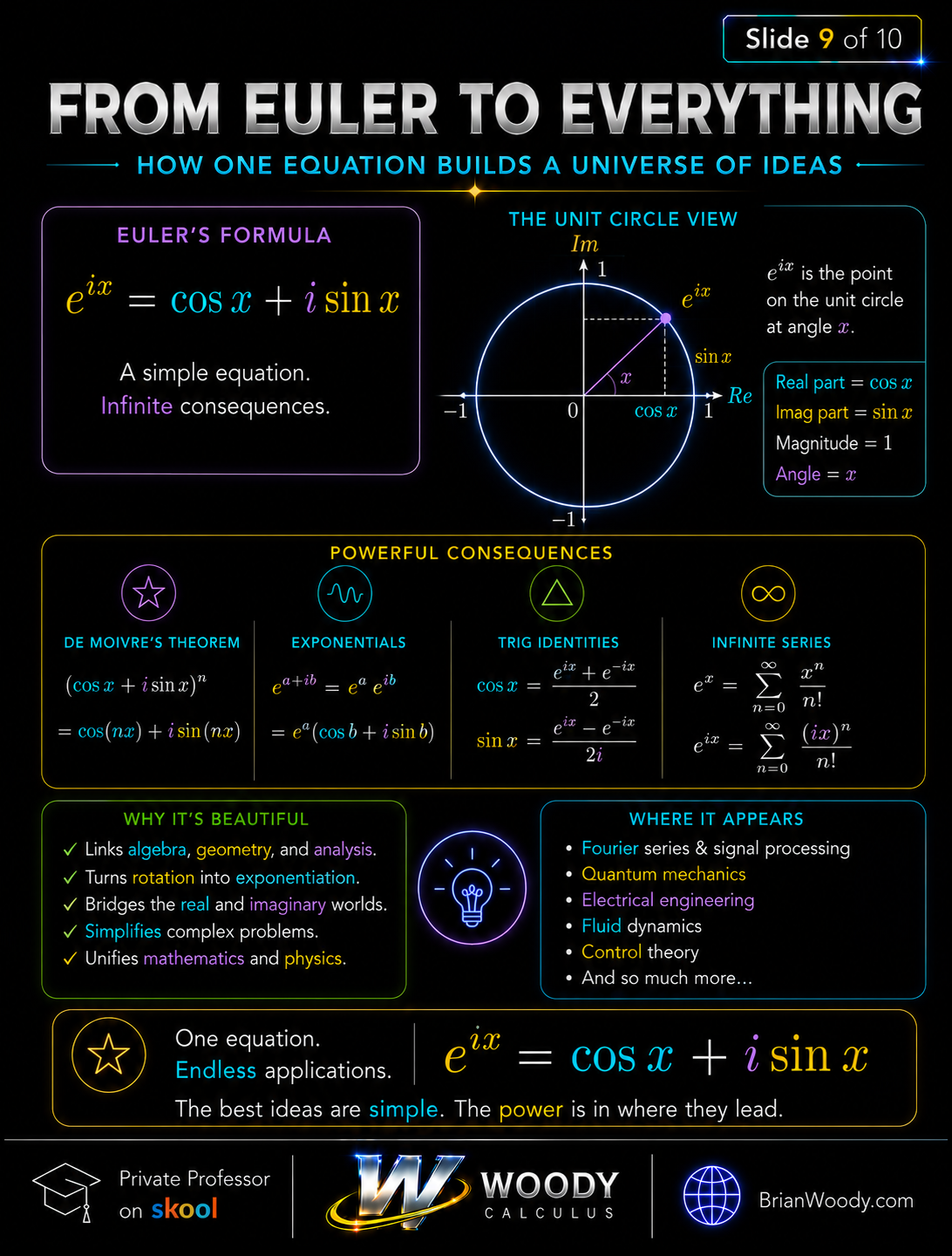
From Euler to Everything
Euler’s formula is simple:
\[
e^{ix}=\cos x+i\sin x.
\]
But its consequences are enormous. It becomes a bridge between many areas of mathematics and science.
De Moivre’s Theorem
Euler’s formula gives a clean path to De Moivre’s Theorem:
\[
(\cos x+i\sin x)^n=\cos(nx)+i\sin(nx).
\]
This formula is essential in complex numbers, trigonometry, roots of complex numbers, and many advanced algebra problems.
Complex Exponentials
Euler’s formula also explains why
\[
e^{a+ib}=e^a e^{ib}.
\]
Since
\[
e^{ib}=\cos b+i\sin b,
\]
we get
\[
e^{a+ib}=e^a(\cos b+i\sin b).
\]
This shows how growth and rotation can be combined in a single complex exponential.
Trig Identities From Euler’s Formula
Euler’s formula also gives powerful identities for sine and cosine:
\[
\cos x=\frac{e^{ix}+e^{-ix}}{2}
\]
and
\[
\sin x=\frac{e^{ix}-e^{-ix}}{2i}.
\]
These identities are fundamental in complex analysis, Fourier series, differential equations, signal processing, and physics.
Infinite Series
The exponential function has the infinite series
\[
e^x=\sum_{n=0}^{\infty}\frac{x^n}{n!}.
\]
Substituting \(ix\) gives
\[
e^{ix}=\sum_{n=0}^{\infty}\frac{(ix)^n}{n!}.
\]
This is the series structure behind Euler’s formula. It is one reason this identity is so deeply connected to calculus, analysis, and the foundations of advanced mathematics.
Euler’s formula appears in:
- Fourier series and signal processing
- Quantum mechanics
- Electrical engineering
- Fluid dynamics
- Control theory
- Waves and oscillations
- Complex analysis
- Differential equations
Master the Math Behind the Beauty
Euler’s Identity is beautiful, but it is not just something to admire. It is something students can understand deeply by building the right foundation.
To truly understand Euler’s Identity, students need fluency with:
- Taylor series
- Trigonometric identities
- The unit circle
- Complex numbers
- Exponential functions
- Vector and geometric thinking
- Differential equations
- Linear algebra
- Abstract algebra
- Real analysis
At Woody Calculus, the goal is to build automatic mastery. Students develop fluency through rigorous repetition, formula memorization, rewriting perfect solutions, and vocalizing each step out loud. This disciplined process creates the foundation for deeper visualization, stronger pattern recognition, and true mathematical understanding.
Euler’s Identity is a perfect example of what happens when formulas stop being random symbols and start becoming connected ideas.
— Brian M. Woody
Students who want to go deeper can explore the Woody Calculus Mastery Lab, where Brian M. Woody teaches advanced mathematics through clear structure, expert-guided repetition, and exam-focused problem solving.
Join Woody Calculus Private Professor on Skool
You can also explore more lessons, mathematical essays, and advanced mathematics support at BrianWoody.com.
Related Woody Calculus Mathematical Essays
Explore more Woody Calculus visual lessons and deep-dive mathematical essays connecting
Real Analysis,
Calculus 2,
Calculus 3,
Differential Equations,
Abstract Algebra,
topology, Fourier series, chaos theory, Galois theory, and advanced mathematics.
- Laplace Transforms Explained: Turning Differential Equations Into Algebra
- How to Learn Calculus and Advanced Mathematics: A Peak Performance Study Guide
- Taylor Series Explained: Mathematical Time Travel in Calculus 2
- Cantor Set Explained: Infinite Points, Zero Length in Real Analysis
- Möbius Strip Explained: Orientation, Vector Calculus, and Stokes’ Theorem
- Fourier Series Explained: Harmonics, Sound, Heat, and Quantum Mechanics
- Gabriel’s Horn Explained: Finite Volume, Infinite Surface Area in Calculus 2
- Line Integrals and Vector Fields: What They Measure in Calculus 3
- Chaos Theory Explained: Butterfly Effect, Lorenz System, and Lyapunov Exponents
- Galois Theory Explained: Hidden Symmetry and the Quintic
- The Baader-Meinhof Phenomenon in Mathematics: Pattern Recognition and Subconscious Training
- Blockchain Mathematics Explained: Hash Functions, Cryptography, AI, and Consensus
- View All Woody Calculus Blog Posts
Related University Math Help Pages
Woody Calculus supports students at major universities with structured help in Calculus, Differential Equations, Linear Algebra, Abstract Algebra, Real Analysis, and advanced mathematics.
- University Calculus Tutor Hub
- MIT Calculus Tutor
- Purdue University Calculus Tutor
- University of Florida Calculus Tutor
- Colorado State University Calculus Help
- UCF Calculus Tutor
- Georgia Tech Calculus Tutor
- University of Michigan Calculus Tutor
- Michigan State Calculus Tutor
- Virginia Tech Calculus Tutor
- University of Nevada, Reno Calculus Tutor
Trusted by Students Nationwide
The Woody Calculus Mastery Lab gives university students access to structured mathematics support, written solutions, video lessons, exam-focused training, and expert guidance from Brian M. Woody.
Students use Woody Calculus for Calculus II, Calculus III, Differential Equations, Linear Algebra, Abstract Algebra, Real Analysis, AP Calculus BC, and other advanced mathematics courses.
- Read Woody Calculus Google Reviews
- Private Math Tutor and Advanced Mathematics Instruction
- Join the Woody Calculus Mastery Lab
Universities Supported by Woody Calculus
Students from universities across the United States use Woody Calculus for help with Calculus, Differential Equations, Linear Algebra, Abstract Algebra, Real Analysis, and advanced mathematics.
- View the full university calculus tutor hub
- Colorado State University Calculus Help
- UCF Calculus Tutor
- Purdue University Calculus Tutor
- University of Florida Calculus Tutor
- Georgia Tech Calculus Tutor
- Texas A&M Calculus Tutor
- Penn State Calculus Tutor
- Arizona State Calculus Tutor
- UCLA Calculus Tutor
- UC San Diego Calculus Tutor
- Michigan State Calculus Tutor
- Virginia Tech Calculus Tutor
- University of Washington Calculus Tutor
- University of Illinois Urbana-Champaign Calculus Tutor
- Rutgers Calculus Tutor
- University of Maryland Calculus Tutor
- Indiana University Calculus Tutor
- UNC Calculus Tutor
- Auburn University Calculus Tutor
- SDSU Calculus Tutor
- University of Nevada, Reno Calculus Tutor