Möbius Strip Explained: Orientation, Vector Calculus, and Stokes’ Theorem
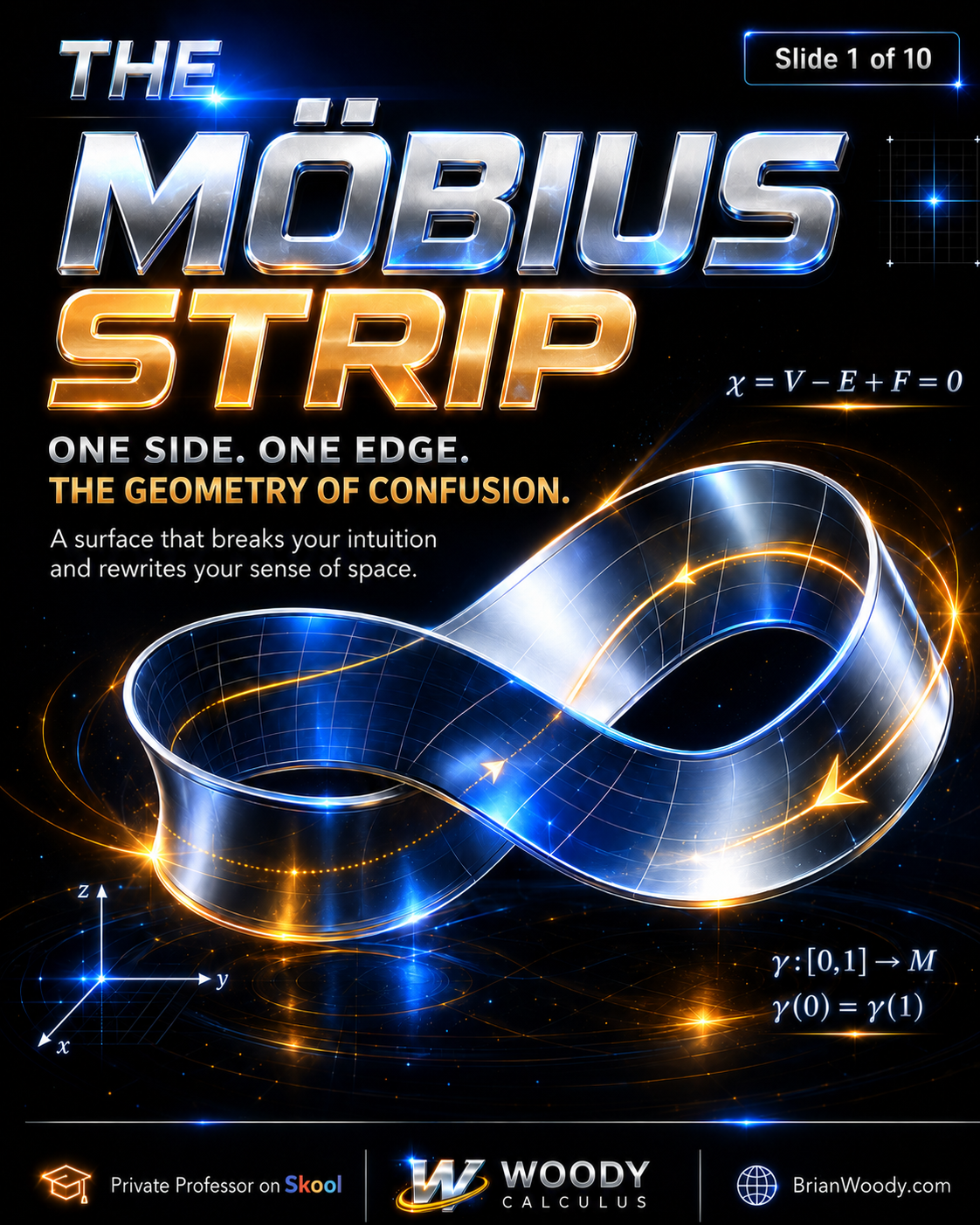
The Möbius strip is not just a visual trick.
It is one of the clearest ways to see why orientation matters in Calculus 3, vector calculus, topology, surface integrals, flux integrals, differential geometry, and Stokes’ Theorem.
One side. One edge. One half-twist. And suddenly ordinary geometric intuition breaks.
The Möbius strip, often searched as the Mobius strip without the umlaut, is powerful because it looks simple. But beneath that simplicity is a deep obstruction: there is no way to choose a consistent normal vector on the entire surface.
That failure is called non-orientability.
And it explains why the standard global form of Stokes’ Theorem cannot be applied to the whole Möbius strip in the usual way.
The Möbius strip teaches one of the deepest lessons in vector calculus: direction only makes sense when orientation can be chosen consistently.
Key Takeaways
- A Möbius strip is created by taking a rectangular strip, adding one half-twist, and joining the ends.
- The Möbius strip is non-orientable because a normal vector reverses after one trip around the surface.
- The surface has one continuous side, not two separate sides.
- The surface has one connected boundary edge, not two separate boundary edges.
- The Möbius strip has Euler characteristic \( \chi = 0 \), just like a cylinder, but it is not orientable.
- Surface integrals in vector calculus require a consistent choice of normal direction.
- The standard global form of Stokes’ Theorem requires an orientable surface.
- The Möbius strip connects Calculus 3, vector calculus, topology, differential geometry, and advanced mathematics.
What Is a Möbius Strip?
A Möbius strip is a surface with one side and one boundary component. It is made by taking a rectangular strip, giving it one half-twist, and joining the ends together.
The result is not merely a twisted loop. It is a non-orientable surface. That means there is no consistent way to define a global “up” direction across the whole surface.
In ordinary surfaces like a plane, sphere, cylinder, or orientable patch, you can choose a normal vector and move it continuously without contradiction. On a Möbius strip, if you move a normal vector once around the strip, it returns pointing the opposite way.
Definition: Non-Orientable Surface
A surface is non-orientable if it is impossible to choose a continuous unit normal vector field over the entire surface. The Möbius strip is the classic example.
Who Discovered the Möbius Strip?
The Möbius strip is named after August Ferdinand Möbius, a German mathematician and astronomer. The surface was discovered in the nineteenth century, with both Möbius and Johann Benedict Listing associated with its early discovery.
This historical detail matters because the Möbius strip is not just a classroom curiosity. It became one of the most famous examples in topology: a surface that looks simple, but forces mathematicians to think carefully about sides, boundaries, orientation, and global structure.
Cylinder vs. Möbius Strip
The fastest way to see what makes the Möbius strip strange is to compare it with a cylinder.
| Property | Cylinder | Möbius Strip |
|---|---|---|
| Sides | 2 | 1 |
| Boundary edges | 2 | 1 |
| Orientable? | Yes | No |
| Global normal vector? | Exists | Does not exist |
| Euler characteristic \( \chi \) | 0 | 0 |
| Vector calculus issue | Surface orientation works | Global orientation fails |
This comparison is important. The cylinder and Möbius strip both have Euler characteristic \( \chi=0 \), but they are not the same kind of surface. The difference is not captured by Euler characteristic alone. The key difference is orientability.
Euler Characteristic of the Möbius Strip
The Euler characteristic is
\[
\chi = V – E + F.
\]
For the Möbius strip,
\[
\chi(M)=0.
\]
That number alone does not tell the whole story. A cylinder also has Euler characteristic \(0\), but a cylinder is orientable while a Möbius strip is not.
This is the deeper lesson: topology needs more than one invariant. Euler characteristic is powerful, but it does not fully detect orientation. To understand why the Möbius strip breaks vector calculus intuition, we need orientability.
Key Mathematical Point
The Möbius strip and cylinder both have \( \chi=0 \), but only the cylinder admits a continuous global normal vector. That is why orientability, not Euler characteristic alone, is the crucial issue for surface integrals and Stokes’ Theorem.
How to Make a Möbius Strip
The construction is simple:
- Start with a rectangular strip.
- Add one half-twist.
- Join the two ends.
Without the half-twist, you get a cylinder-like band with two sides and two boundary circles. With the half-twist, the topology changes. The apparent inside and outside become part of one continuous surface.
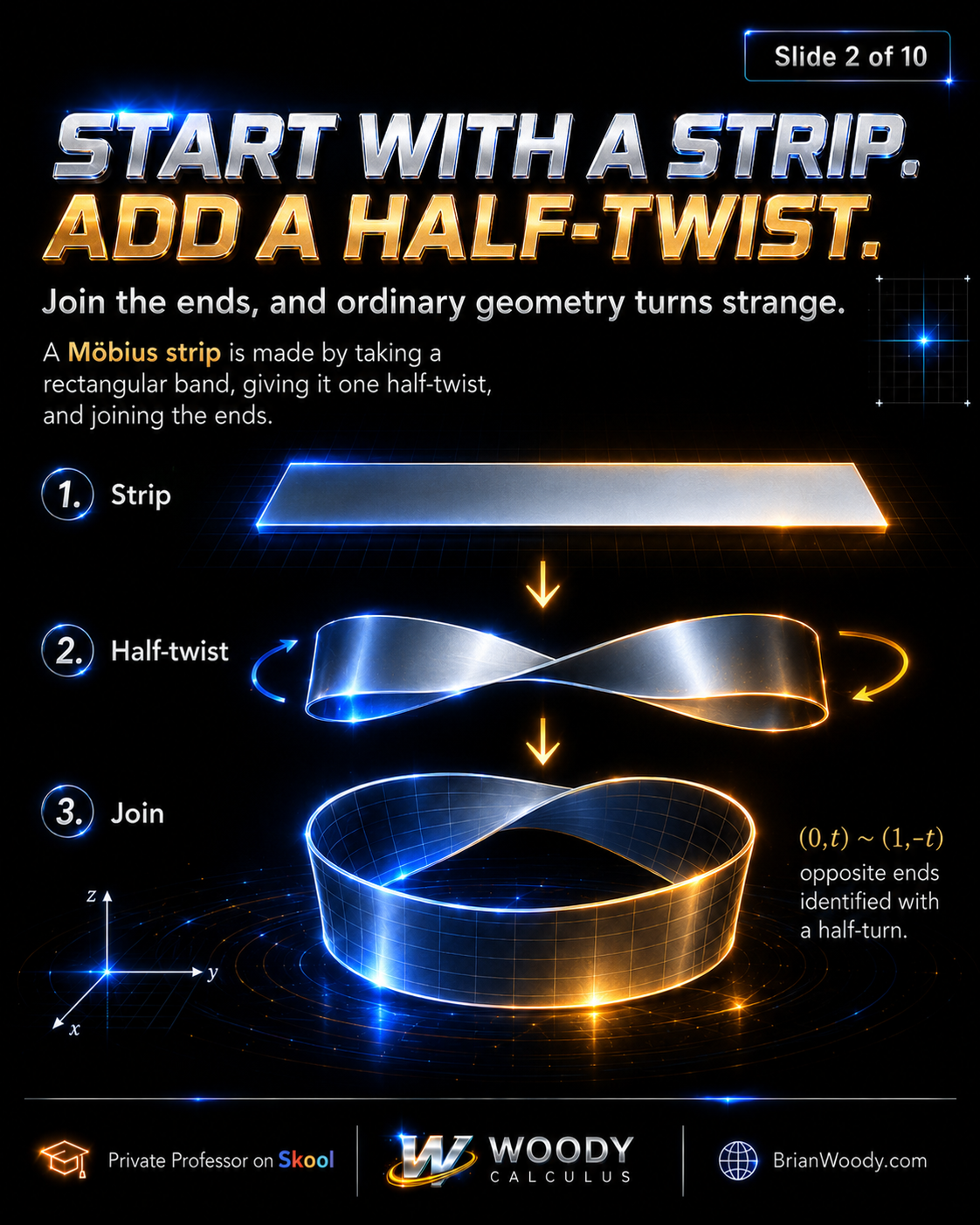
One way to describe the gluing is
\[
(0,t)\sim (1,-t).
\]
This means opposite ends are identified with a half-turn. The coordinate across the width flips sign when the ends are joined.
Non-Orientability: Why “Up” Becomes “Down”
The Möbius strip is non-orientable because a normal vector reverses direction after one trip around the surface.
Imagine choosing a tiny normal vector at a starting point. It points “up.” Now move it continuously around the strip without letting it jump or flip artificially. When it returns to the starting point, it points in the opposite direction.
Symbolically, the idea is
\[
\gamma(0)=\gamma(1)
\]
but
\[
\vec n(1)=-\vec n(0).
\]
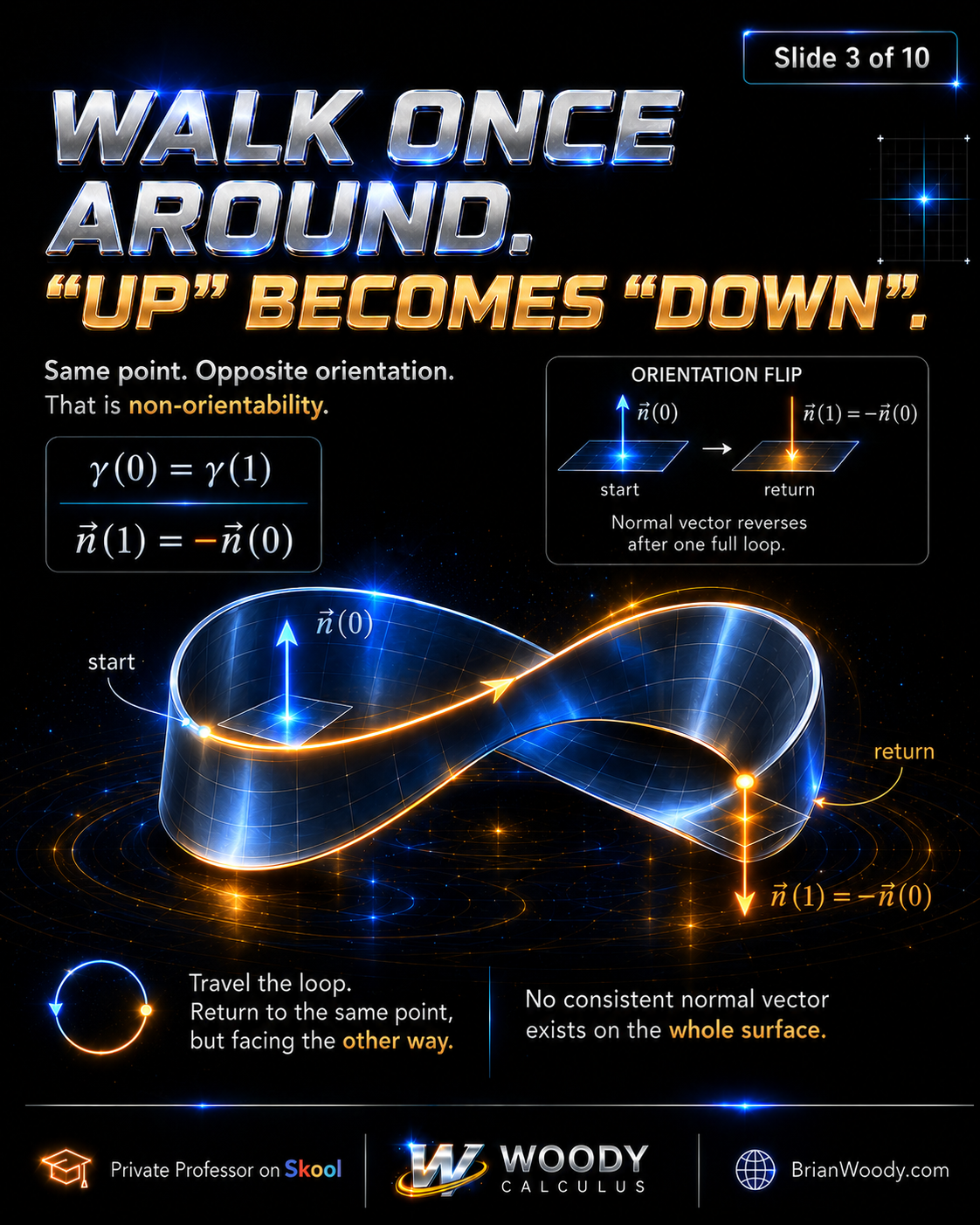
This is the heart of non-orientability. The surface lets you move continuously, but it does not let you define one consistent global choice of normal direction.
Why No Global Normal Vector Exists
In vector calculus, a surface is orientable when we can choose a continuous normal vector field over the entire surface.
For an orientable surface, once you choose a normal direction at one point, you can extend that choice continuously across the whole surface. The normal vectors may bend and rotate, but they do not return with a contradiction.
On the Möbius strip, that fails. After one loop, the normal vector returns as its own negative.
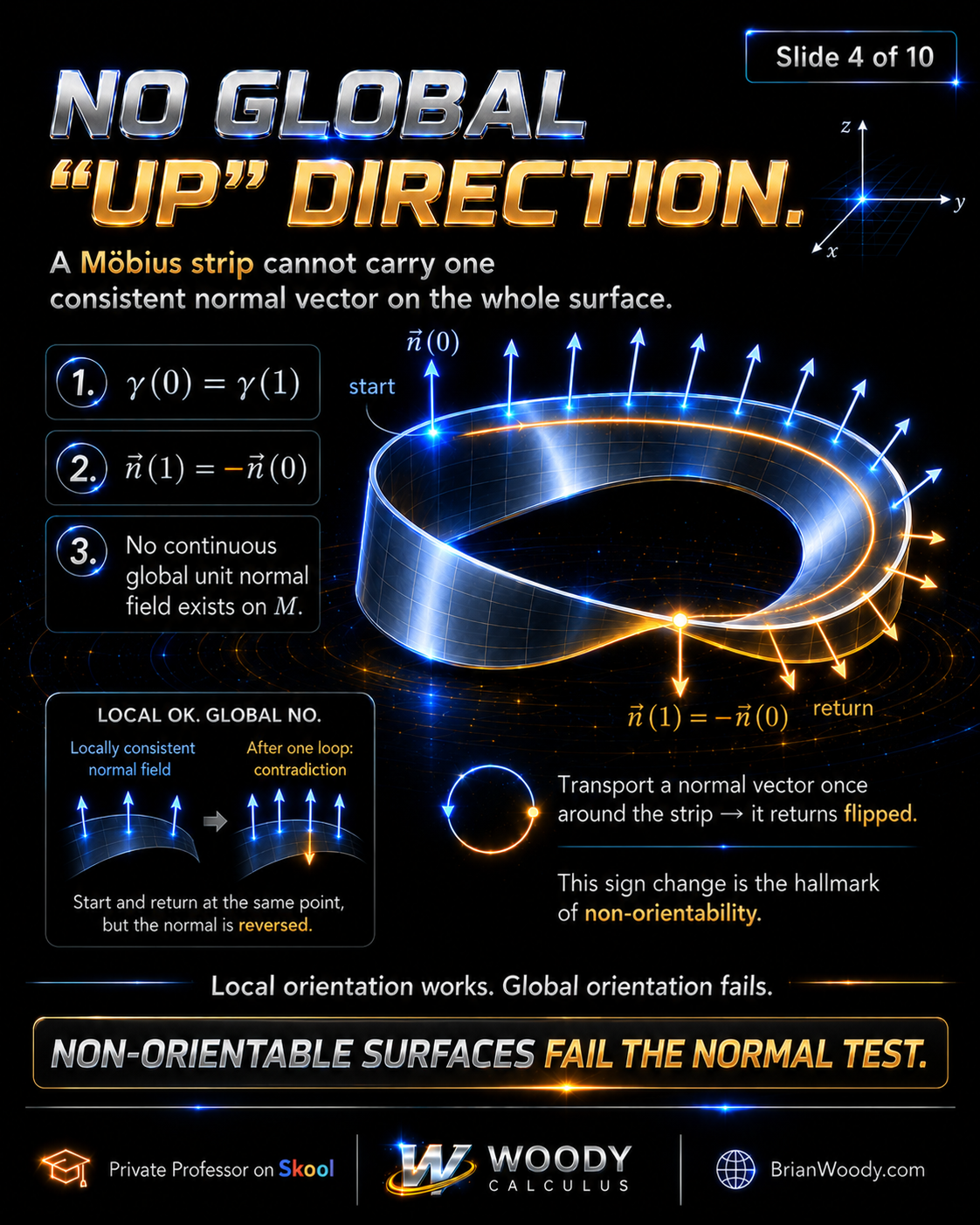
That means local orientation works, but global orientation fails. You can choose normal vectors in a small patch. You can even choose them consistently for a while. But if you go all the way around the strip, the half-twist forces a contradiction.
Orientability Test
If a surface admits a continuous global unit normal vector field, it is orientable. If every attempted continuous normal field returns reversed after traveling around the surface, the surface is non-orientable.
Why the Möbius Strip Has One Side
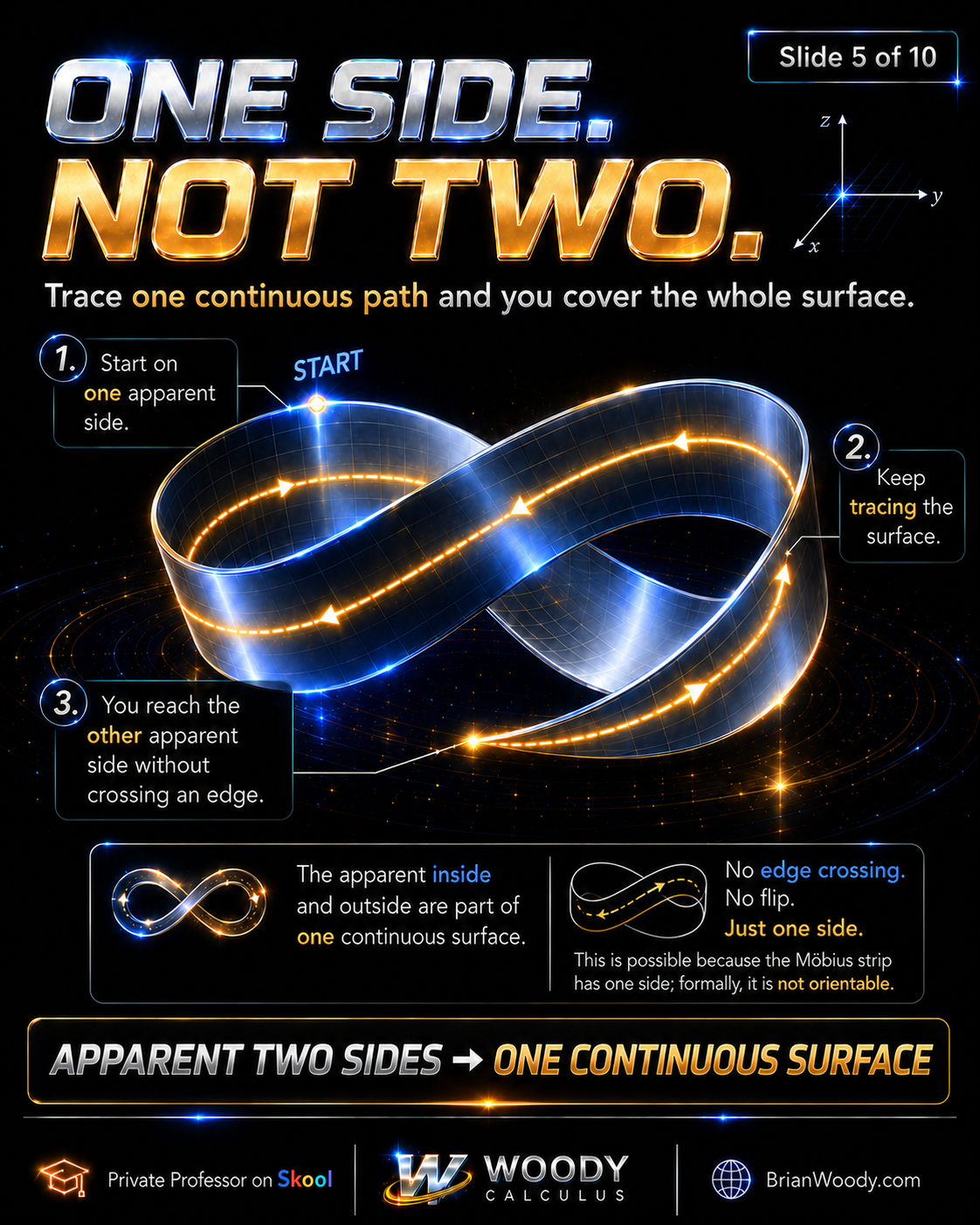
The most famous property of the Möbius strip is that it has one side.
If you start drawing a line on what appears to be one side of the strip and keep tracing without crossing an edge, you eventually arrive at what looked like the “other side.” But you never crossed a boundary. You just followed the continuous surface.
That is why the phrase “inside versus outside” breaks down. The Möbius strip does not have two separate sides. It has one continuous side.
Local vs. Global
Locally, the Möbius strip behaves like an ordinary surface. Globally, the half-twist creates a contradiction in orientation. This local-global distinction is one of the central ideas in topology and differential geometry.
Why the Möbius Strip Has One Edge
The Möbius strip also has one boundary edge, not two.
At first glance, it looks like there should be two separate rim curves: one on the top edge and one on the bottom edge. But because of the half-twist, those apparent edges are connected into one continuous boundary curve.
If you trace the boundary once, you travel along the entire edge and return to your starting point after covering what looked like both rims.
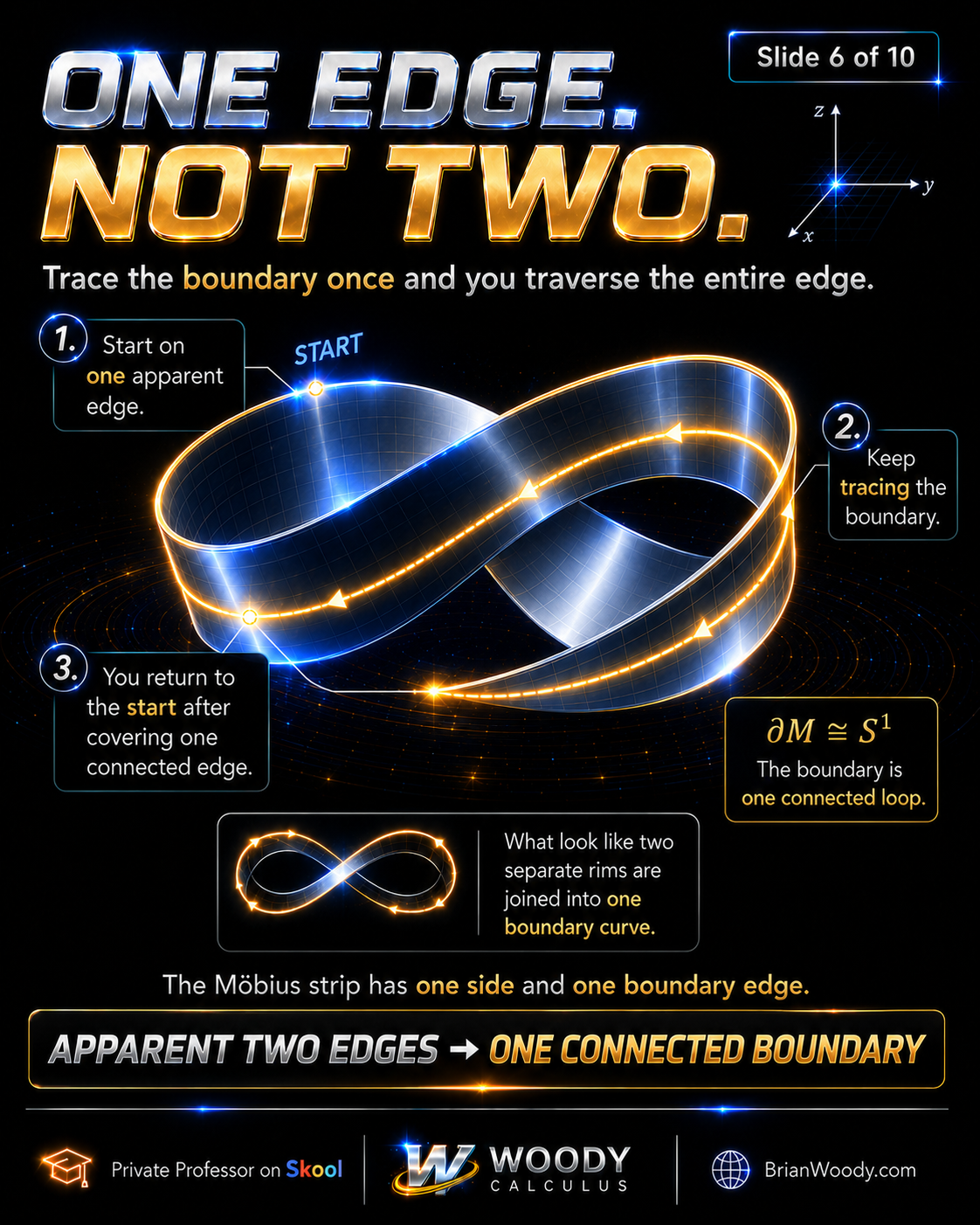
Topologically, we can say the boundary of the Möbius strip is one circle:
\[
\partial M \cong S^1.
\]
This is one of the reasons the Möbius strip is such a perfect example for students: it is simple enough to visualize, but strange enough to expose deep mathematical structure.
Möbius Strip Parameterization
A common parameterization of the Möbius strip is
\[
\mathbf r(u,v)=
\left(
\left(R+v\cos\frac{u}{2}\right)\cos u,
\left(R+v\cos\frac{u}{2}\right)\sin u,
v\sin\frac{u}{2}
\right),
\]
where
\[
0\leq u<2\pi,\qquad -w\leq v\leq w.
\]
Here, \(u\) wraps around the strip, while \(v\) moves across the width of the strip.
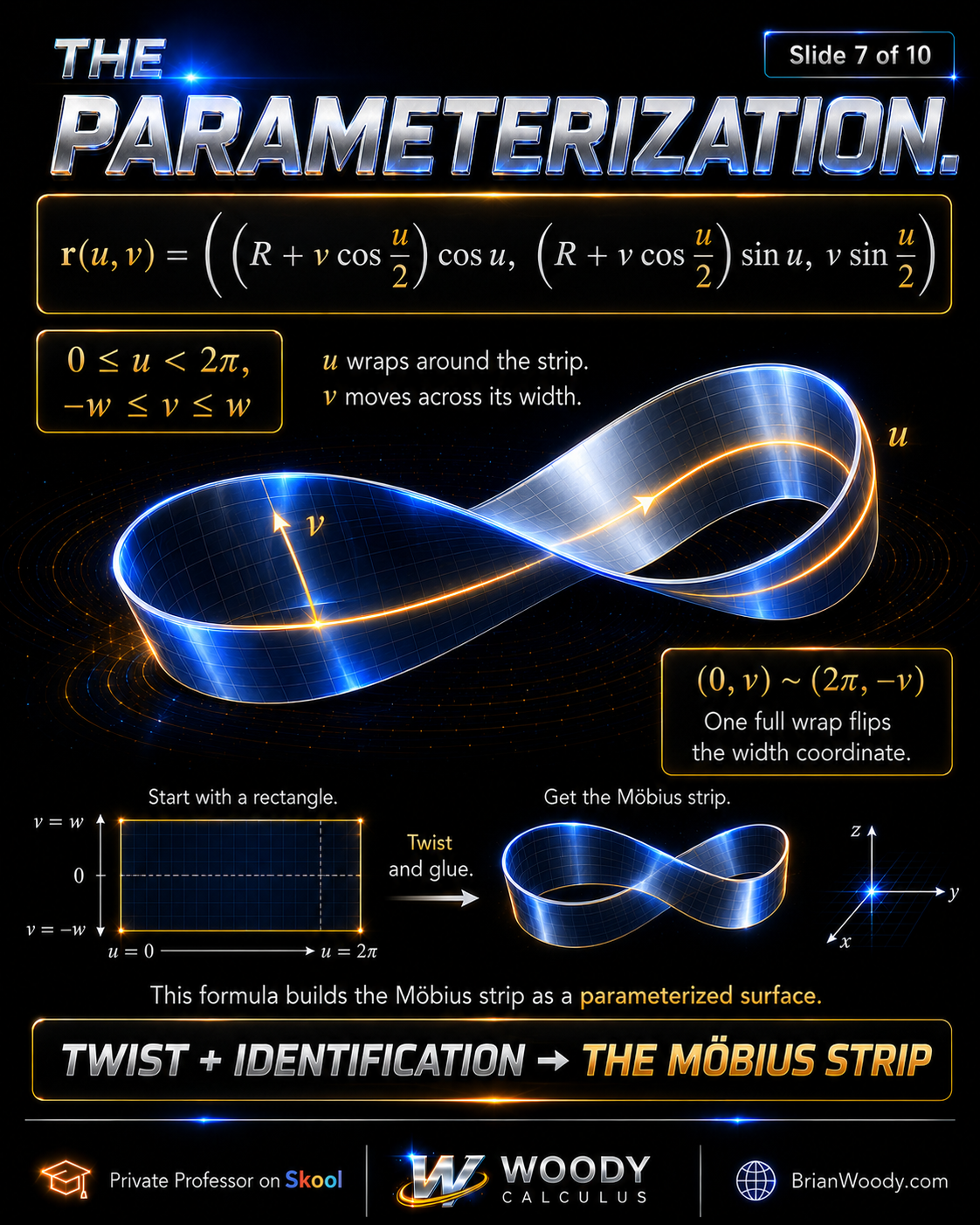
The crucial identification is
\[
(0,v)\sim (2\pi,-v).
\]
That is the half-twist in mathematical form. One full wrap around the strip flips the width coordinate.
This formula is a beautiful bridge between geometry and topology. The trigonometric functions build the shape in three-dimensional space, while the identification rule encodes the global twist.
Why Vector Calculus Needs Orientation
Orientation becomes unavoidable in vector calculus because surface integrals need a normal direction.
For example, a flux integral has the form
\[
\iint_S \mathbf F\cdot \vec n\,dS.
\]
Equivalently, we often write
\[
d\vec S=\vec n\,dS.
\]
The vector \( \vec n \) tells us which way the surface is oriented. If we reverse the normal vector, the sign of the flux integral changes.
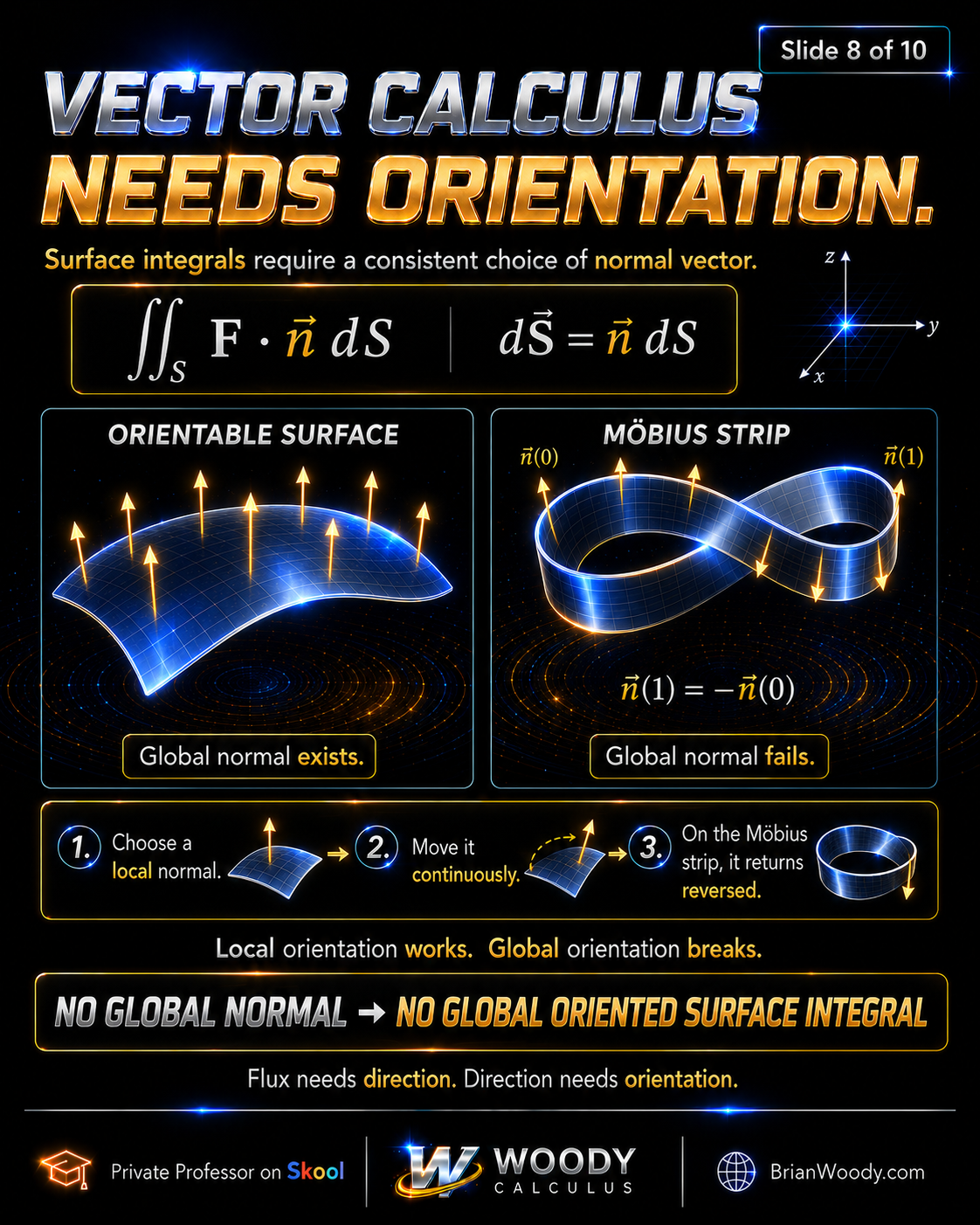
For ordinary orientable surfaces, this is manageable. We choose one side as positive and stay consistent. For the Möbius strip, there is no way to do this globally. The normal vector reverses after one trip around the surface.
Why Stokes’ Theorem Needs an Orientable Surface
Stokes’ Theorem relates a surface integral over a surface to a line integral around its boundary:
\[
\iint_S (\nabla\times \mathbf F)\cdot \vec n\,dS
=
\oint_{\partial S}\mathbf F\cdot d\vec r.
\]
But this theorem requires a consistent orientation of the surface. The boundary orientation is induced by the chosen surface normal. Once you choose the normal direction, the direction of the boundary curve is determined by the right-hand rule.
On a Möbius strip, the boundary exists. In fact, it has one connected boundary curve. But the whole surface is non-orientable, so a global normal direction does not exist.
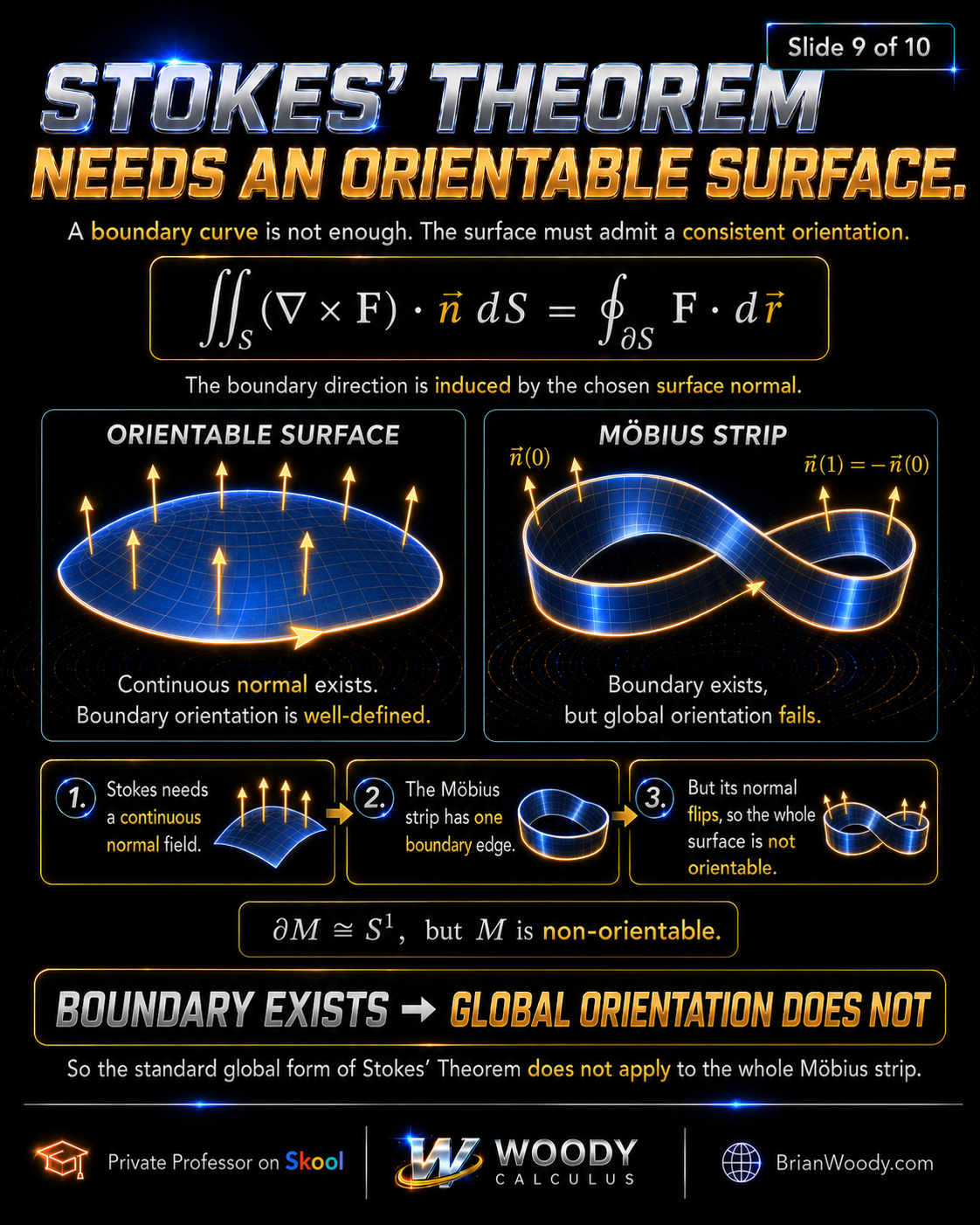
This is the key point: a boundary curve is not enough. The surface must also admit a consistent orientation.
Important Clarification
The standard global form of Stokes’ Theorem does not apply to the whole Möbius strip as a single oriented surface because the Möbius strip is non-orientable. The issue is not that the boundary is missing. The issue is that global orientation fails.
What Happens When You Cut a Möbius Strip?
One of the most famous Möbius strip experiments is also one of the most searched questions: what happens when you cut a Möbius strip?
If you cut a Möbius strip exactly down the middle, you do not get two separate strips. Instead, you get one longer loop. That loop has a full twist rather than a half-twist.
If you cut the Möbius strip about one-third of the way in from the edge, the result is even stranger: you get two linked loops. One is a smaller Möbius strip, and the other is a longer twisted band.
Cutting a Möbius Strip
- Cut down the center: one longer loop with a full twist.
- Cut one-third from the edge: two linked loops, one of which is a smaller Möbius strip.
- Why it happens: the surface has one side and one connected boundary structure, so cutting follows the global topology, not ordinary two-sided intuition.
This cutting experiment is a perfect classroom demonstration because it turns abstract topology into something physical. The result is not magic. It is the topology of the half-twist becoming visible.
Real-World Applications of the Möbius Strip
The Möbius strip is famous in topology, but it also has real-world applications and design inspiration.
One common example is a conveyor belt design. If a belt is given a Möbius-style half-twist, the wear can be distributed across what would otherwise be two sides of the belt, helping the belt wear more evenly over time.
The Möbius strip also appears in engineering-inspired designs, resistor concepts, art, architecture, and mathematical modeling. Its value comes from the same strange feature: a single continuous side created by a half-twist.
For students, the most important application is conceptual. The Möbius strip shows that global structure matters. Local behavior is not enough. A surface can look ordinary in every small patch and still fail to have a consistent global orientation.
Worked Example: What Goes Wrong With the Normal Vector?
The Problem
Explain why the Möbius strip cannot have one continuous global unit normal vector field.
Step 1: Start With a Normal Vector
Choose a point on the Möbius strip and assign a normal vector \( \vec n(0) \). Locally, this is possible. In a small patch, the Möbius strip looks like an ordinary surface.
Step 2: Transport the Normal Around the Strip
Move continuously around the strip once. Because the strip has a half-twist, the normal vector is forced to rotate as it moves around the surface.
Step 3: Return to the Same Point
After one full loop, the path returns to the same point:
\[
\gamma(0)=\gamma(1).
\]
But the normal vector returns reversed:
\[
\vec n(1)=-\vec n(0).
\]
Step 4: Identify the Contradiction
A continuous global normal field would have to assign one normal direction to the same point. But after moving around the strip, the same point demands the opposite normal direction.
That is impossible.
Conclusion
The Möbius strip has no continuous global normal vector field. Therefore, it is non-orientable.
This is the core mathematical obstruction. The Möbius strip is not confusing because it is complicated. It is confusing because it is simple locally but contradictory globally.
FAQ: Möbius Strip, Orientation, and Vector Calculus
What is a Möbius strip?
A Möbius strip is a surface made by taking a rectangular strip, adding one half-twist, and joining the ends. It has one side and one connected boundary edge.
Is Mobius strip the same as Möbius strip?
Yes. “Möbius strip” is the spelling with the umlaut, while “Mobius strip” is the common English search spelling without the umlaut. Both refer to the same one-sided, non-orientable surface.
Does a Möbius strip really have one side?
Yes. If you trace along the surface without crossing an edge, you eventually reach what appears to be the other side. The apparent two sides are actually one continuous surface.
Does a Möbius strip have one edge or two edges?
A Möbius strip has one connected boundary edge. What look like two separate edges are joined into one continuous boundary curve by the half-twist.
What happens when you cut a Möbius strip in half?
If you cut a Möbius strip down the middle, you get one longer loop with a full twist, not two separate loops.
What happens if you cut a Möbius strip one-third from the edge?
If you cut a Möbius strip about one-third of the way from the edge, you get two linked loops: one smaller Möbius strip and one longer twisted band.
What is the Euler characteristic of a Möbius strip?
The Möbius strip has Euler characteristic \( \chi=0 \). A cylinder also has Euler characteristic \(0\), so Euler characteristic alone does not distinguish them. Orientability is the key difference.
What does non-orientable mean?
Non-orientable means that a surface cannot carry a continuous global unit normal vector field. On the Möbius strip, a normal vector returns reversed after one loop around the surface.
Why does orientation matter in vector calculus?
Orientation matters because surface integrals, flux integrals, and Stokes’ Theorem require a consistent choice of normal direction. Without a global normal vector, global oriented surface integrals cannot be defined in the usual way.
Why does Stokes’ Theorem need an orientable surface?
Stokes’ Theorem requires a surface orientation so that the boundary orientation is well-defined. The Möbius strip has a boundary, but it does not have a global orientation, so the standard global form of Stokes’ Theorem does not apply to the whole Möbius strip.
What is the difference between a Möbius strip and a Klein bottle?
A Möbius strip is a non-orientable surface with a boundary. A Klein bottle is also non-orientable, but it has no boundary. In three-dimensional space, a Klein bottle must pass through itself if drawn without cutting.
Is the Möbius strip part of Calculus 3?
The Möbius strip is usually a topology object, but it is highly relevant to Calculus 3 and vector calculus because it explains why surface orientation, normal vectors, and orientability matter for surface integrals and Stokes’ Theorem.
What is the parameterization of a Möbius strip?
One common parameterization is \( \mathbf r(u,v)=((R+v\cos(u/2))\cos u,(R+v\cos(u/2))\sin u,v\sin(u/2)) \), where \(0\leq u<2\pi\) and \(-w\leq v\leq w\).
Woody Calculus Mastery Task
Train the Geometry Until It Becomes Automatic
The Möbius strip is not mastered by memorizing the phrase “one side, one edge.” You need to train the geometry until you can explain why those facts are true.
- Say out loud: “A Möbius strip is made from a strip, one half-twist, and a gluing.”
- Write the identification \( (0,v)\sim(2\pi,-v) \) five times.
- Say out loud: “A normal vector returns reversed after one loop.”
- Explain why this means no global normal vector exists.
- Explain why tracing the surface gives one continuous side.
- Explain why tracing the boundary gives one connected edge.
- Explain why \( \chi=0 \) does not prove the Möbius strip is the same as a cylinder.
- Connect the idea to vector calculus: “Surface integrals need orientation. Stokes’ Theorem needs an orientable surface.”
That is the Woody Calculus method: train the words, train the structure, rewrite the logic, and say the steps out loud until the geometry becomes automatic.
Final Thought: One Half-Twist Changes Everything
The Möbius strip feels strange because it exposes the difference between local behavior and global structure.
Locally, it looks like an ordinary surface. Globally, it has one side, one edge, and no consistent normal direction. That is why it is such a powerful example in topology, vector calculus, and advanced mathematics.
It teaches that geometry is not only about shape. It is also about structure, orientation, and what remains consistent when you move around the whole object.
One half-twist is enough to change everything.

Ready to Go Beyond Surface-Level Mathematics?
Woody Calculus Private Professor on Skool is built for serious students who want structure, clarity, and mastery in advanced mathematics.
Inside the Woody Calculus Mastery Lab, students train through advanced problem-solving systems, complete step-by-step explanations, exam preparation, homework support, pattern recognition, and mathematical fluency.
Get support in Calculus 1, Calculus 2, Calculus 3, Differential Equations, Linear Algebra, Abstract Algebra, Real Analysis, vector calculus, topology, Stokes’ Theorem, and advanced university mathematics.
This is not casual tutoring. This is structured mathematical training.