Chaos Theory Explained: The Butterfly Effect, Lorenz System, and Lyapunov Exponents
Most people think chaos means randomness.
Mathematics says otherwise.
Chaos theory reveals one of the most beautiful and unsettling ideas in modern mathematics: a system can be completely deterministic, completely governed by equations, and still become impossible to predict long-term.
This is the true meaning of the Butterfly Effect. It is not magic. It is not randomness. It is the mathematical reality that tiny changes in initial conditions can grow exponentially inside nonlinear systems.
This lesson explains the mathematics behind the Lorenz system, sensitive dependence on initial conditions, Lyapunov exponents, strange attractors, fractal geometry, phase space, nonlinear differential equations, and the hidden order beneath deterministic chaos.
Key Takeaways
- The Butterfly Effect means tiny initial differences can grow into massive future differences.
- Chaos is not randomness. Chaotic systems are deterministic but extremely sensitive.
- The Lorenz system is a famous nonlinear differential equation model that produces chaotic motion.
- Lyapunov exponents measure how fast nearby trajectories separate.
- Strange attractors reveal hidden geometric order inside chaotic systems.
- Deterministic chaos explains why exact equations can still produce practical unpredictability.
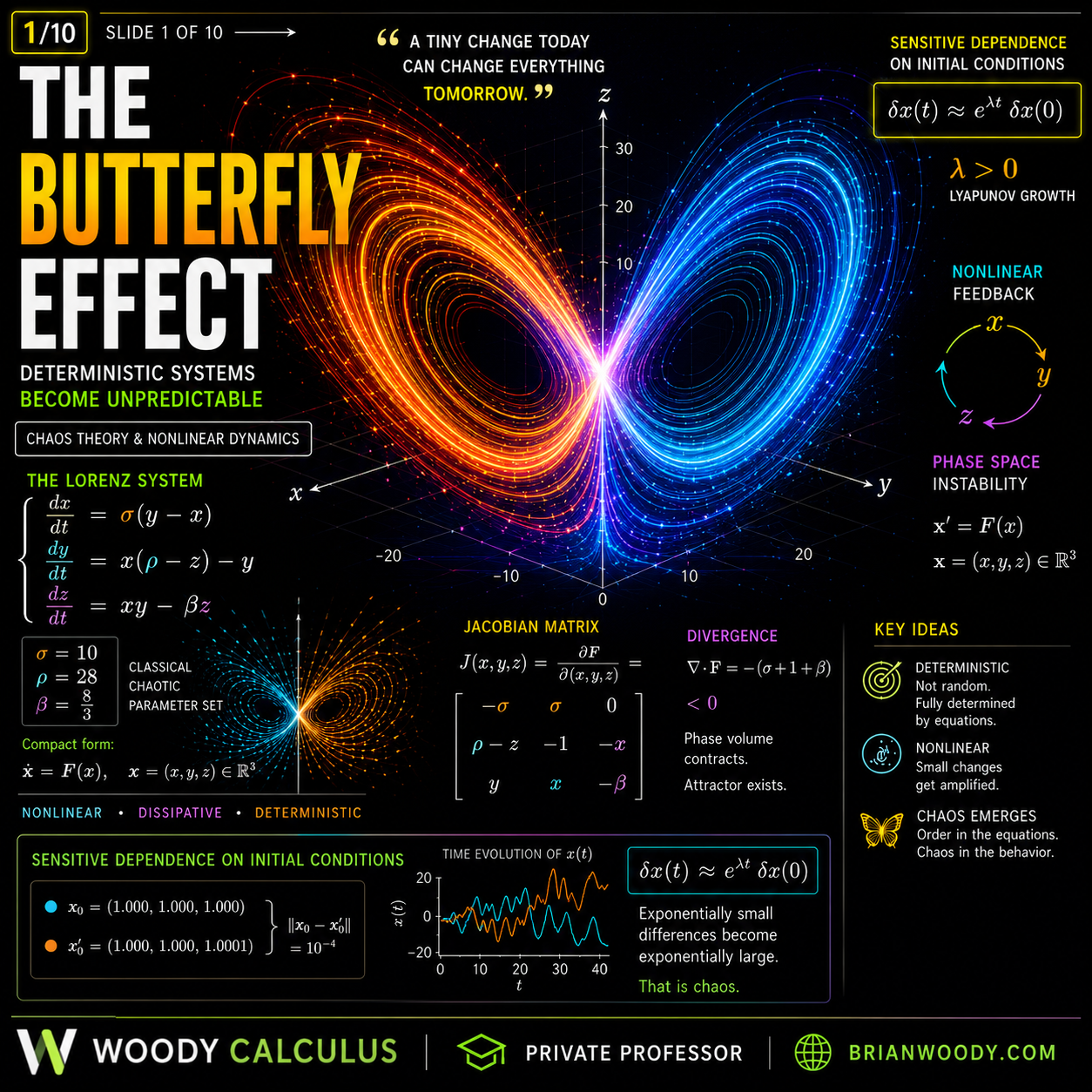
What Is the Butterfly Effect?
The Butterfly Effect describes sensitive dependence on initial conditions. In a chaotic system, two starting points that are almost identical can eventually produce completely different outcomes.
Mathematically, nearby trajectories separate approximately according to:
\[
\|\delta x(t)\| \approx e^{\lambda t}\|\delta x(0)\|
\]
Here, \( \lambda \) is a Lyapunov exponent. When \( \lambda > 0 \), small differences grow exponentially. This is the mathematical heart of chaos.
The system is still deterministic. The equations still rule everything. But prediction becomes limited because the system magnifies tiny uncertainties.
Core Idea
The Butterfly Effect does not mean the universe is random. It means that deterministic systems can become practically unpredictable when tiny uncertainties grow exponentially.
Edward Lorenz and the Discovery of Chaos
In the early 1960s, meteorologist Edward Lorenz was studying simplified weather models using nonlinear differential equations. One day, he restarted a weather simulation using rounded initial data instead of the full numerical precision from the original run.
He expected the new trajectory to stay close to the old one.
Instead, the two simulations separated dramatically.
A tiny rounding difference in the initial condition produced a completely different long-term outcome. That accidental discovery became one of the most important moments in modern applied mathematics.
It showed that even when the equations are known, and even when the system is deterministic, long-term prediction may still fail because tiny errors grow exponentially.
The Lorenz System: Simple Equations, Infinite Complexity
The most famous mathematical model connected to the Butterfly Effect is the Lorenz system:
\[
\frac{dx}{dt}=\sigma(y-x)
\]
\[
\frac{dy}{dt}=x(\rho-z)-y
\]
\[
\frac{dz}{dt}=xy-\beta z
\]
For the classical chaotic parameters
\[
\sigma=10,\qquad \rho=28,\qquad \beta=\frac{8}{3},
\]
the Lorenz system produces chaotic motion. The trajectories remain bounded, but they never repeat exactly. They spiral around a strange attractor in phase space, creating the famous butterfly-shaped geometry.
This system is also a beautiful example of why Differential Equations and Linear Algebra belong together. The nonlinear system controls the motion, while Jacobians, eigenvalues, local linearization, and stability analysis help explain what happens near equilibrium points.

Sensitive Dependence on Initial Conditions
Suppose two initial conditions differ by only a microscopic amount:
\[
x_0=(1,1,1)
\]
and
\[
x_0^{\prime}=(1.00001,1.00001,1.00001).
\]
At first, the two trajectories appear nearly identical. But as time evolves, they separate exponentially. Eventually, the paths bear almost no resemblance to one another.
This is not because the system is random. It is because the system is nonlinear.
The largest Lyapunov exponent for the classical Lorenz system is approximately:
\[
\lambda_{\max}\approx 0.9056.
\]
Since this value is positive, nearby trajectories diverge exponentially.

The Geometry of the Lorenz Attractor
The Lorenz attractor is not a point. It is not a simple cycle. It is a strange attractor: a bounded, nonperiodic, fractal structure that pulls nearby trajectories into a complex geometric pattern.
The trajectory never intersects itself. It never repeats. Yet it remains trapped inside a finite region of phase space.
This is one of the great lessons of chaos theory:
Chaos can have geometry.

Lyapunov Exponents Measure Chaos
Chaos theory is not just visual. It is measurable.
A Lyapunov exponent measures the average exponential rate at which nearby trajectories separate:
\[
\lambda=\lim_{t\to\infty}\frac{1}{t}
\ln\left(\frac{\|\delta x(t)\|}{\|\delta x(0)\|}\right).
\]
For the Lorenz system, the approximate Lyapunov spectrum is:
\[
\lambda_1\approx 0.9056,\qquad
\lambda_2\approx 0,\qquad
\lambda_3\approx -14.572.
\]
The positive exponent creates instability. The negative exponent contracts volume. Together, they produce a bounded chaotic attractor.
Notice the beautiful consistency check:
\[
\lambda_1+\lambda_2+\lambda_3
\approx 0.9056+0-14.572
\approx -13.67
\approx -\frac{41}{3}.
\]
This agrees with the divergence of the Lorenz vector field for the classical parameters:
\[
\nabla\cdot F=-(\sigma+1+\beta)
= -\left(10+1+\frac{8}{3}\right)
= -\frac{41}{3}.
\]
This is exactly the kind of hidden structure that makes chaos theory so beautiful.

The Butterfly Effect in Action
The Butterfly Effect is often explained casually as “a butterfly flaps its wings and causes a tornado.” But mathematically, the idea is more precise.
The real point is this:
In nonlinear deterministic systems, tiny differences can become massive differences.
This appears in weather systems, climate models, turbulence, economics, engineering systems, biological rhythms, and celestial mechanics.
The same laws govern the system. The same equations apply. But long-term behavior becomes impossible to predict with perfect certainty.

The Predictability Horizon
Even if we know the equations exactly, measurement error limits prediction.
Suppose the initial uncertainty is on the order of machine precision:
\[
\epsilon_{\text{mach}}\approx 2.22\times 10^{-16}.
\]
The predictability horizon is approximately:
\[
T_p\approx \frac{1}{\lambda_{\max}}
\ln\left(\frac{1}{\epsilon_{\text{mach}}}\right).
\]
For the Lorenz system:
\[
T_p\approx 39.8.
\]
After this window, prediction loses practical meaning. The future is not random. It is simply too sensitive.

Strange Attractors and Fractal Structure
The Lorenz attractor has a fractal dimension of approximately:
\[
D\approx 2.06.
\]
This means the attractor is more complex than a two-dimensional surface but less than a full three-dimensional volume.
It lives between dimensions.
A Poincaré section, which is a two-dimensional slice through the flow, has its own cross-sectional fractal structure. This helps reveal the hidden geometry inside the chaotic motion.
This is why chaos theory is so visually powerful: the motion appears unpredictable, but the structure is deeply organized.

The Hidden Order Beneath Chaos
Chaos is not the opposite of order.
Chaos is a higher level of order.
The apparent randomness hides structure, scaling laws, attractors, bifurcations, and nonlinear patterns. When we zoom out, we begin to see the geometry beneath the turbulence.
This insight transformed modern science. Chaos theory now influences weather forecasting, fluid dynamics, electrical engineering, neuroscience, economics, biology, orbital mechanics, climate modeling, and more.
The Butterfly Effect is not merely a metaphor. It is a mathematical reality.

Technical Note on Box Counting
The box-counting values shown in the visual are meant as an educational approximation of fractal scaling. A more precise numerical computation of the Lorenz attractor dimension depends on the sampling method, scale range, and fitting procedure. The commonly cited full attractor dimension is approximately \(D\approx 2.06\).
Why Chaos Theory Matters for Students
Chaos theory brings together many of the most important ideas students encounter in advanced mathematics:
- Calculus 1: limits, derivatives, rates of change, tangent behavior, and the beginning of continuous modeling.
- Calculus 2: integration, infinite series, approximation, convergence, and mathematical accumulation.
- Calculus 3: vectors, multivariable functions, gradients, vector fields, and three-dimensional geometry.
- Differential Equations: nonlinear systems, phase portraits, equilibrium points, stability, and dynamical behavior.
- Linear Algebra: matrices, eigenvalues, Jacobians, local linearization, and the structure behind stability.
- Real Analysis: limits, continuity, rigor, convergence, sensitivity, and precise mathematical reasoning.
- Abstract Algebra: structural thinking, systems, transformations, symmetry, and deeper mathematical organization.
This is why serious mathematics is not just about memorizing formulas. It is about seeing structure.
At Woody Calculus, students train to recognize patterns, rewrite perfect solutions, say the mathematics out loud, and build the kind of automatic fluency required for high-level exams.
Your Woody Calculus Mastery Task
Do not just read this page. Train it.
- Write the Lorenz system three times.
- Write the definition of a Lyapunov exponent.
- Say out loud why \( \lambda_{\max}>0 \) implies sensitive dependence on initial conditions.
- Explain the difference between randomness and deterministic chaos without looking.
- Rewrite the predictability horizon formula and explain each piece.
That is how mathematical fluency becomes automatic.
Final Thoughts: Chaos Reveals a Deeper Order
The Butterfly Effect teaches us something profound:
Determinism does not guarantee predictability.
Simple equations can generate infinite complexity. Tiny uncertainties can shape entire futures. Yet beneath the apparent disorder lies structure, geometry, and hidden mathematical beauty.
Chaos theory did not destroy our belief in order. It revealed a deeper order hiding beneath the surface. For students of mathematics, that is the real lesson: the equations are never the end of the story.

Ready to Go Beyond Surface-Level Mathematics?
Woody Calculus Private Professor on Skool is built for serious students who want structure, clarity, and mastery in advanced mathematics.
Inside Woody Calculus, students get help with:
- Calculus 1
- Calculus 2
- Calculus 3
- Differential Equations
- Linear Algebra
- Abstract Algebra
- Real Analysis
- Advanced problem-solving systems
- Exam preparation and homework support
Join Woody Calculus Private Professor on Skool
Private instruction: Apply for private mathematics tutoring
Universities supported: See universities supported by Woody Calculus
Reviews: Read Woody Calculus Google reviews
Instagram: Follow @WoodyCalculus for more advanced math visualizations
FAQ: Chaos Theory, the Butterfly Effect, and the Lorenz System
What is chaos theory?
Chaos theory studies deterministic systems that are extremely sensitive to initial conditions. These systems follow rules, but tiny differences can grow so quickly that long-term prediction becomes practically impossible.
What is the Butterfly Effect in mathematics?
The Butterfly Effect is sensitive dependence on initial conditions. In a chaotic system, two nearly identical starting points can eventually produce very different outcomes because small errors grow exponentially.
What is the Lorenz system?
The Lorenz system is a famous system of nonlinear differential equations originally developed as a simplified weather model. For classical parameters, it produces a strange attractor and chaotic behavior.
What are Lyapunov exponents?
Lyapunov exponents measure the average exponential rate at which nearby trajectories separate. A positive Lyapunov exponent is one of the clearest mathematical signs of chaos.
Is the Butterfly Effect real or just a metaphor?
The Butterfly Effect is mathematically real. The butterfly image is metaphorical, but the underlying phenomenon appears in nonlinear dynamical systems, weather models, fluid flow, engineering, biology, economics, and many other fields.
What is a strange attractor?
A strange attractor is a bounded geometric structure toward which a chaotic system evolves. It is typically fractal, nonperiodic, and deterministic, revealing hidden order inside chaotic motion.
Is chaos the same as randomness?
No. Random systems lack deterministic structure. Chaotic systems follow deterministic rules but become unpredictable long-term because tiny uncertainties are amplified by nonlinear dynamics.
How is chaos theory connected to Differential Equations?
Chaos theory often appears in nonlinear differential equations. The Lorenz system is one of the most famous examples of a deterministic differential equation system that produces chaotic behavior.