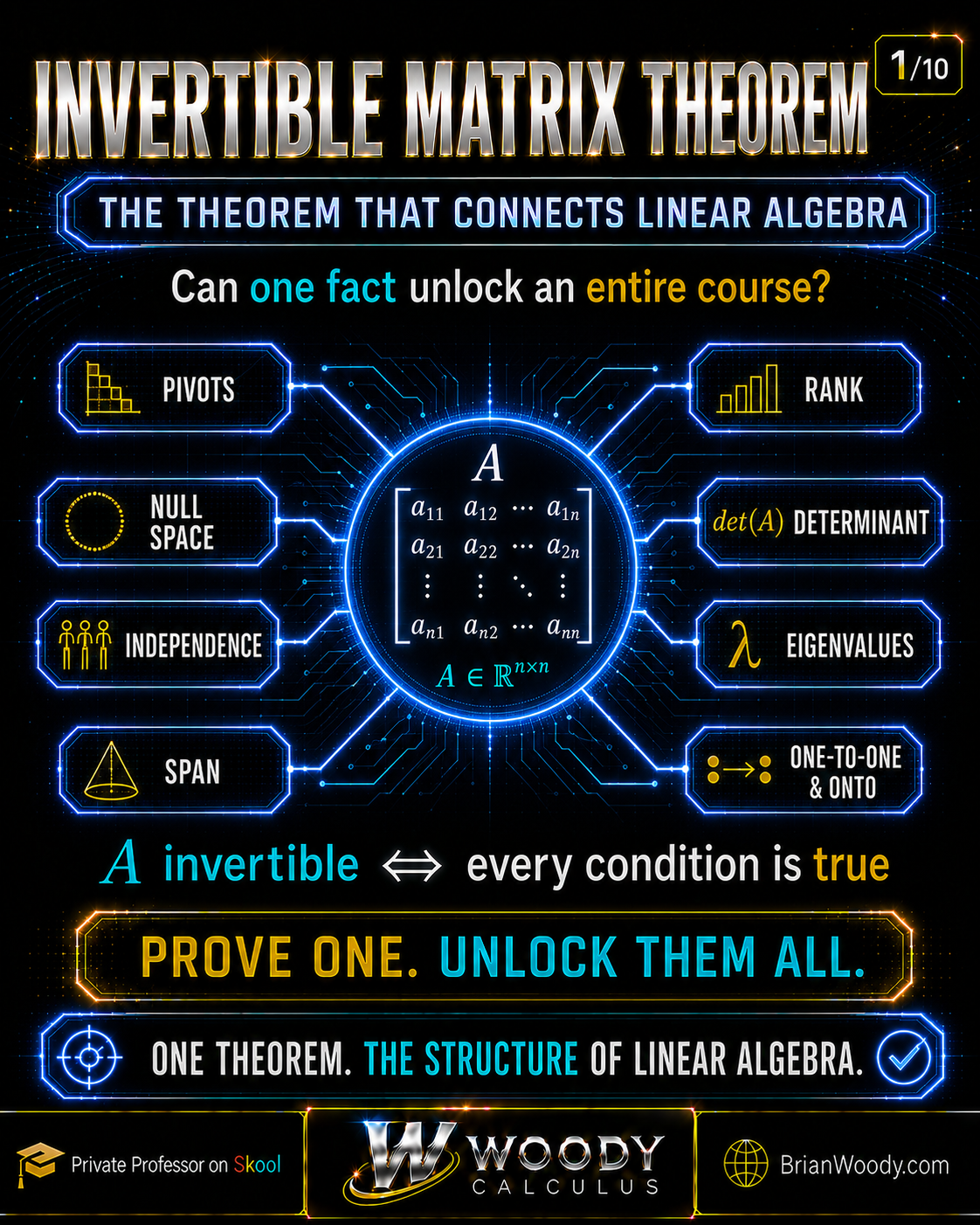
The Invertible Matrix Theorem is the master key to linear algebra. This visual lesson organizes 50 equivalent conditions connecting pivots, row reduction, rank, null spaces, bases, linear systems, one-to-one and onto transformations, determinants, eigenvalues, transposes, singular values, Gram matrices, and conditioning—with proofs, examples, and a practical mastery map.
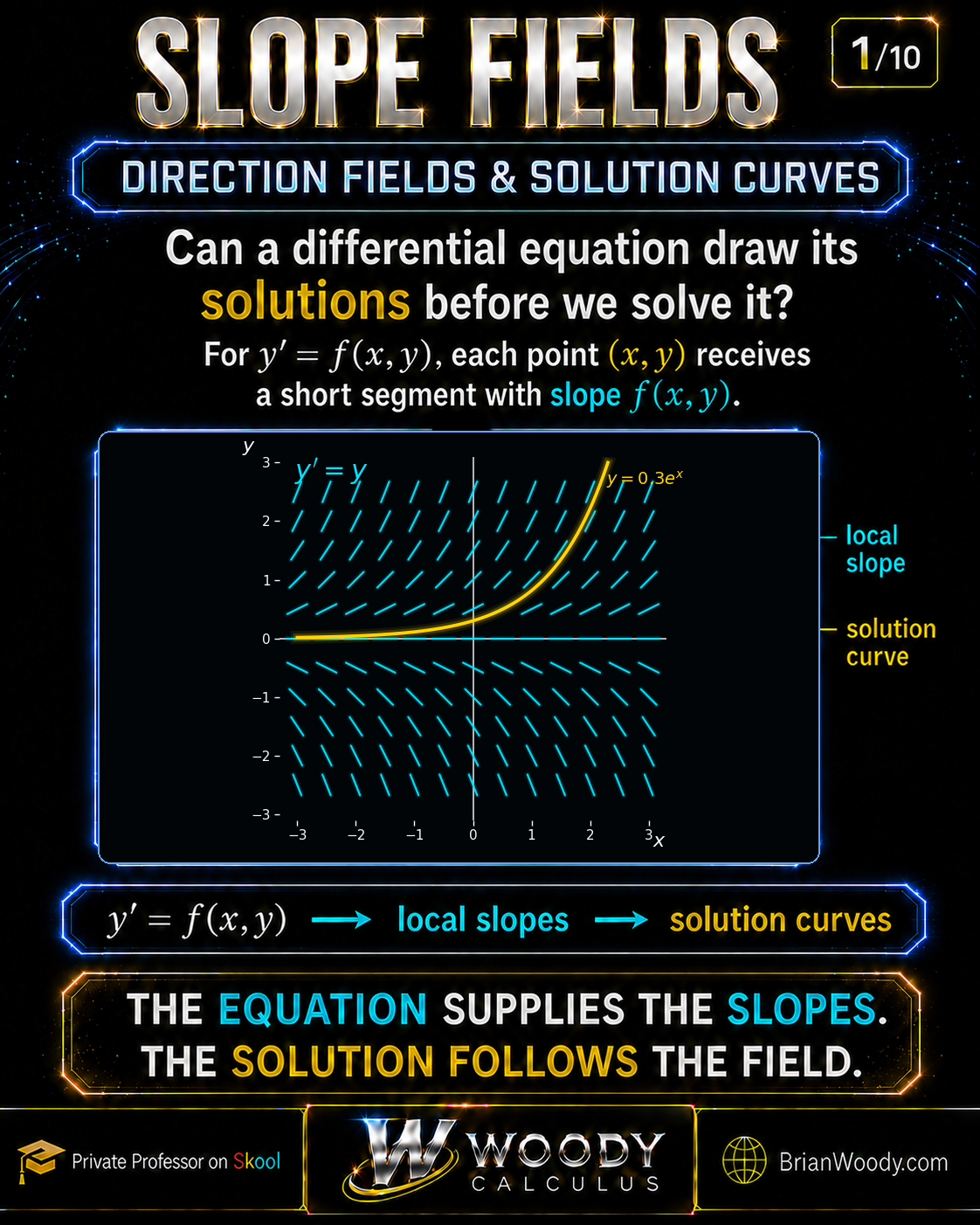
Slope fields make differential equations visible. Learn how to construct and read direction fields, use isoclines, sketch IVP solution curves, distinguish zero-slope curves from equilibria, understand uniqueness, analyze logistic stability, and apply Euler’s method through exact worked examples.
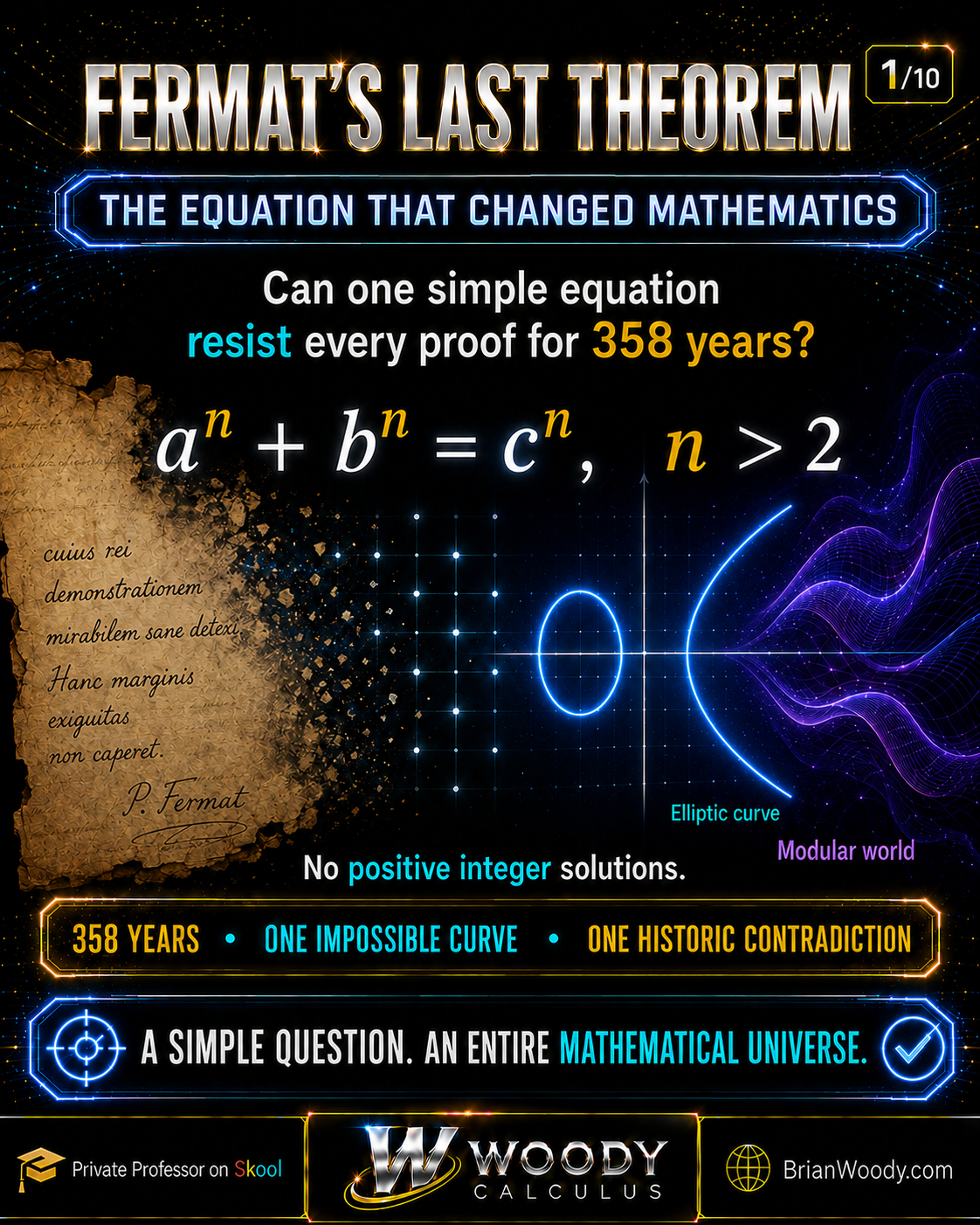
Fermat’s Last Theorem began with an equation a student can understand and ended in a proof joining number theory, ideals, elliptic curves, modular forms, Galois representations, and Taylor–Wiles patching. This visual master lesson develops the 358-year history, the complete contradiction architecture, verified worked examples, and the precise relationship to modern elliptic-curve cryptography.
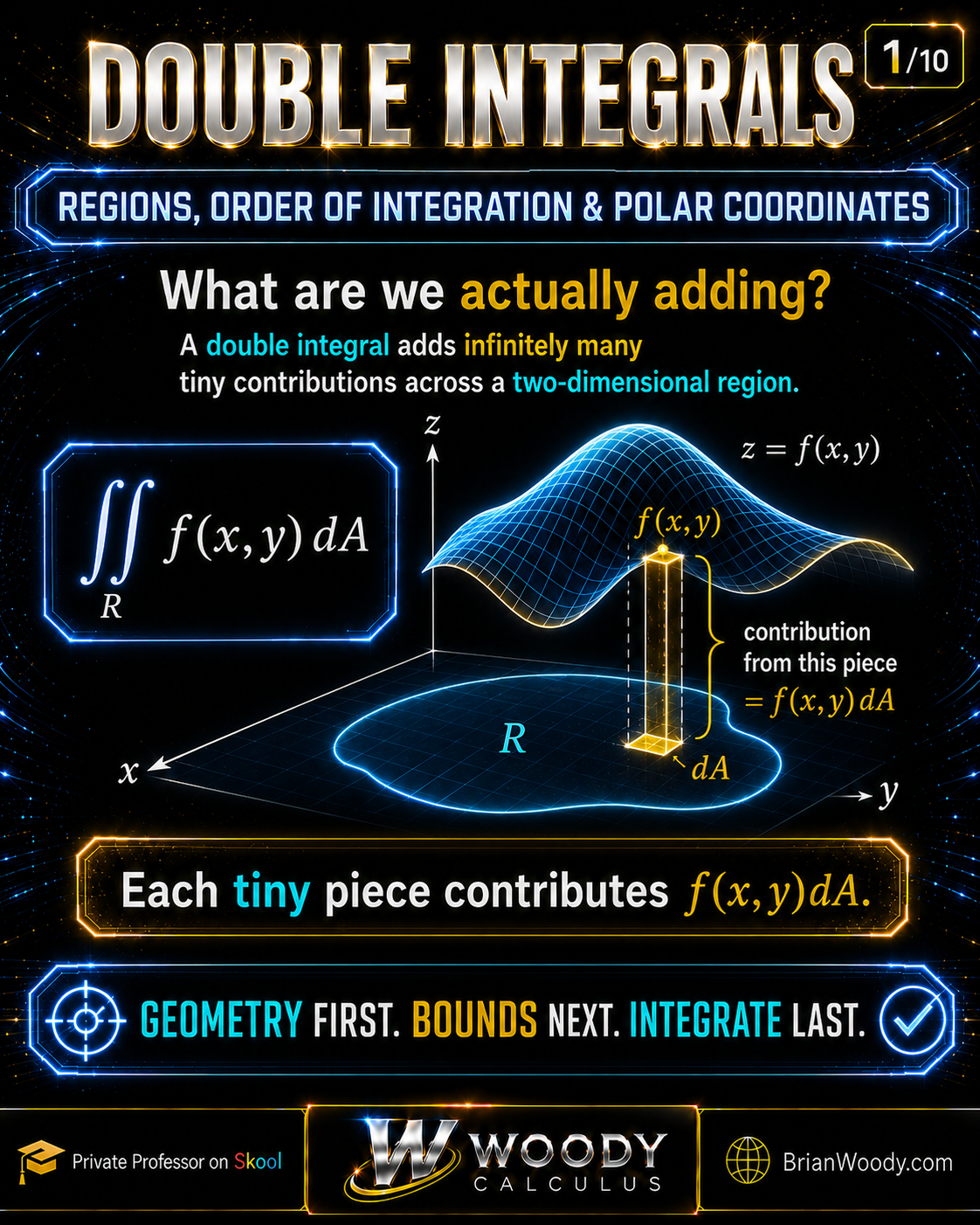
This complete Woody Calculus lesson explains double integrals from the ground up. Learn the geometric meaning of ∬R f(x,y) dA, how Fubini’s Theorem turns double integrals into iterated integrals, how to identify Type I and Type II regions, how to reverse the order of integration, and when polar coordinates make the setup easier.
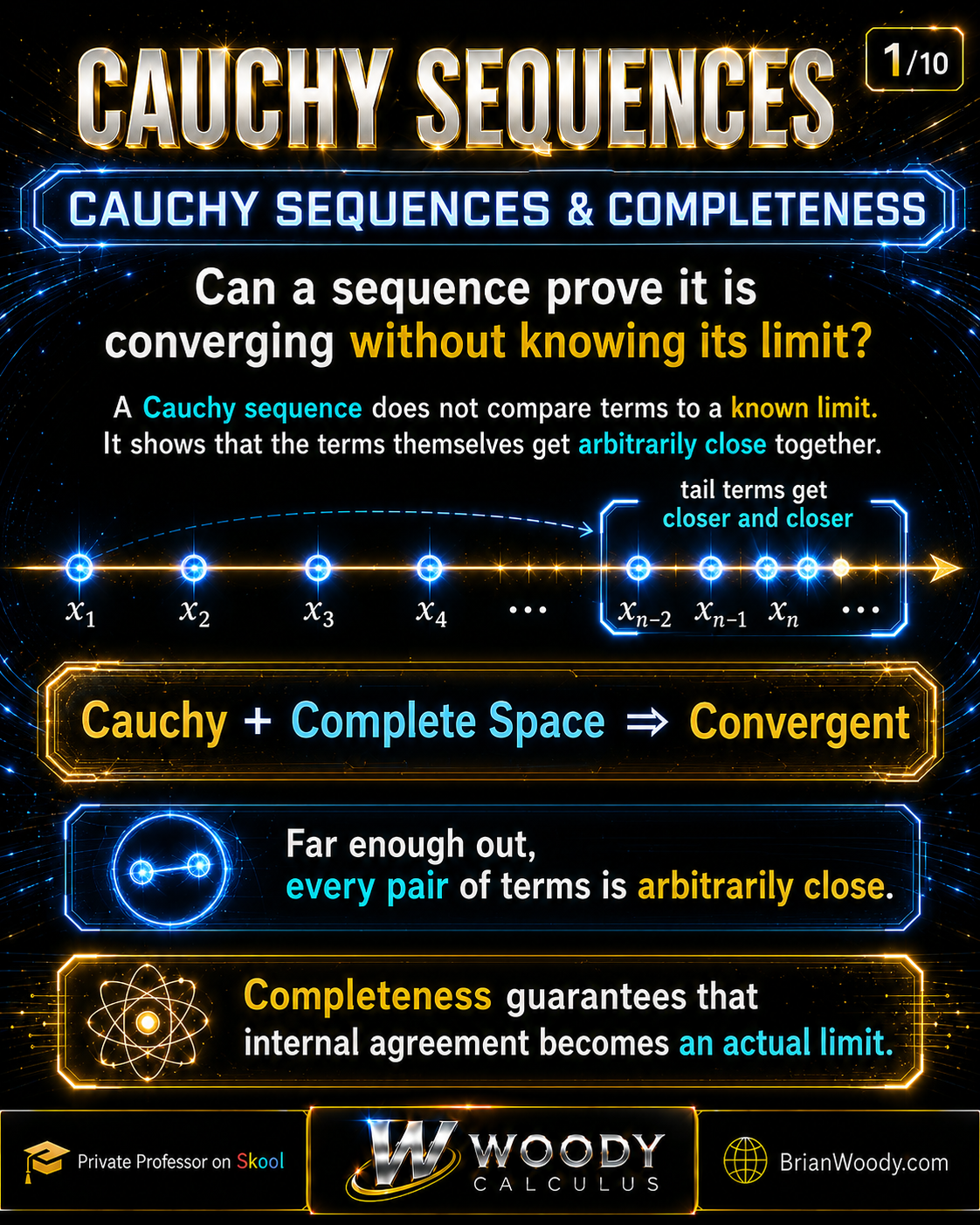
A Cauchy sequence detects convergence from inside the sequence: sufficiently late terms become arbitrarily close to one another without first knowing the limit. This complete Woody Calculus lesson develops the formal epsilon-N definition, proves that every convergent sequence is Cauchy, explains why ℚ is incomplete and ℝ is complete, and connects completeness to metric spaces, compactness, function spaces, and Banach fixed-point theory.
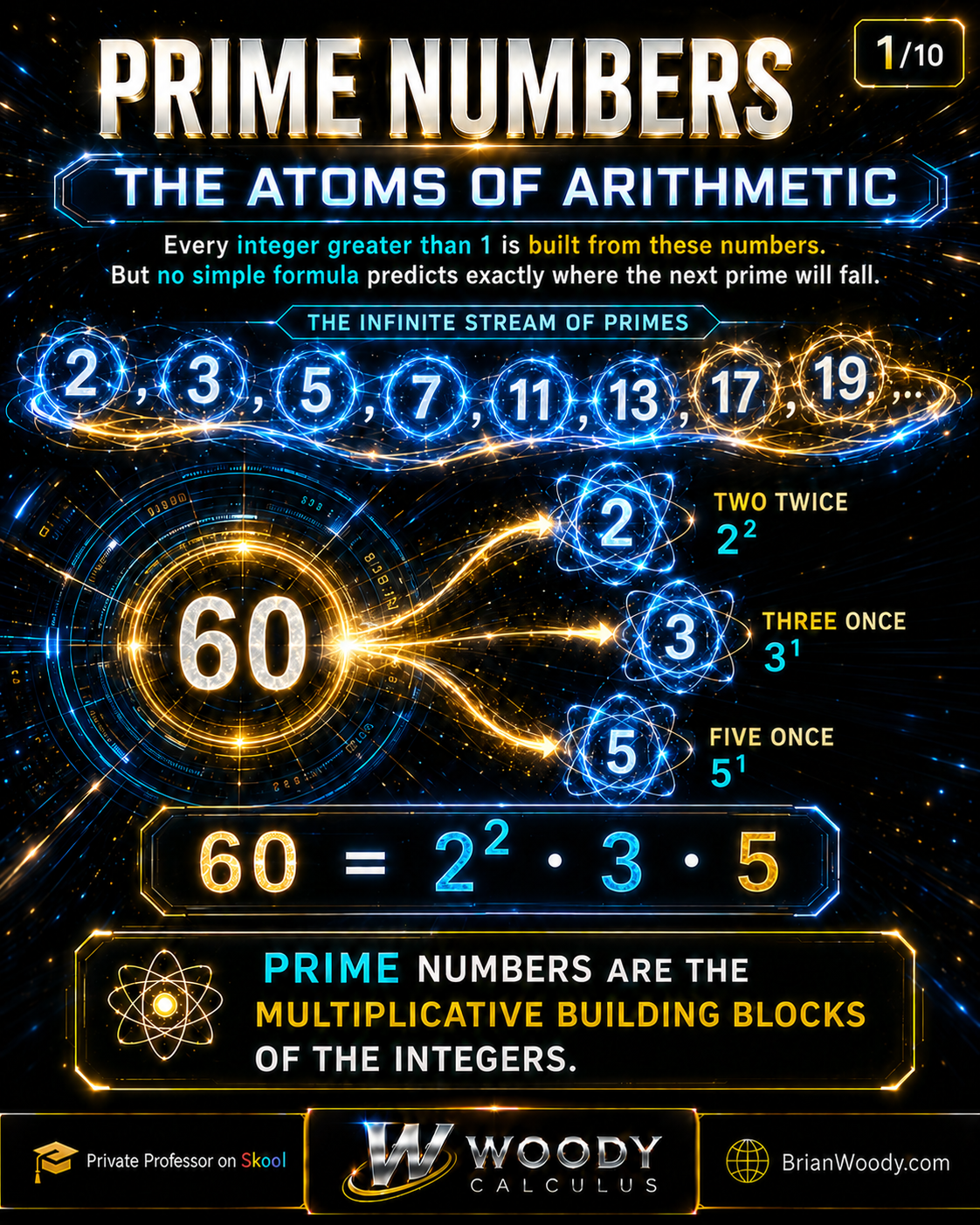
Prime numbers are the multiplicative building blocks of the integers. In this Woody Calculus lesson, learn the formal definition of a prime, why 1 is excluded, the Fundamental Theorem of Arithmetic, Euclid’s proof of infinitely many primes, the Sieve of Eratosthenes, prime patterns modulo 6, the Prime Number Theorem, modern cryptography, and the deep connection between primes and the Riemann Hypothesis.
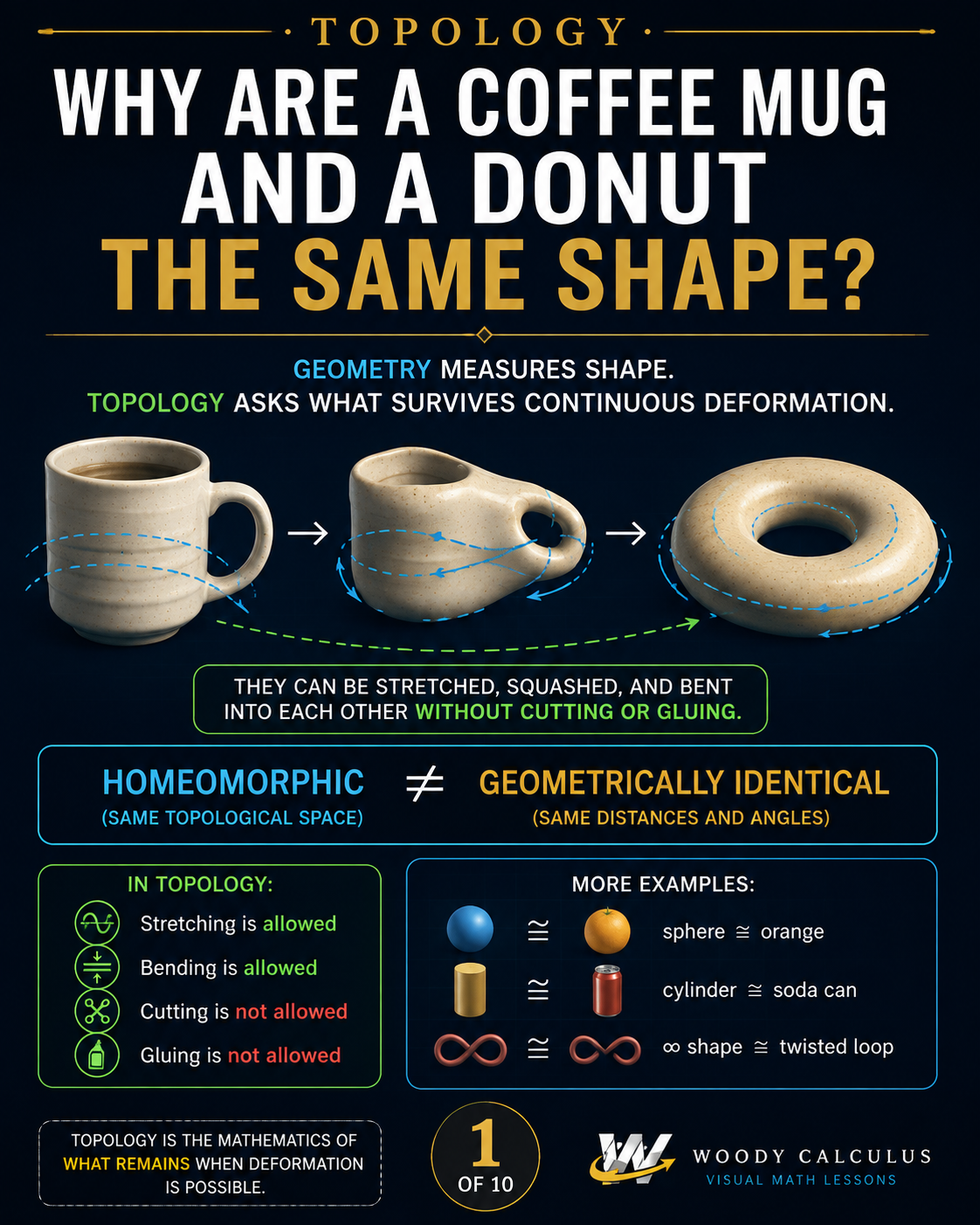
What is topology really about? Start with the famous coffee mug and donut, then learn open sets, continuity, homeomorphisms, connectedness, compactness, Euler characteristic, orientability, and the fundamental group.
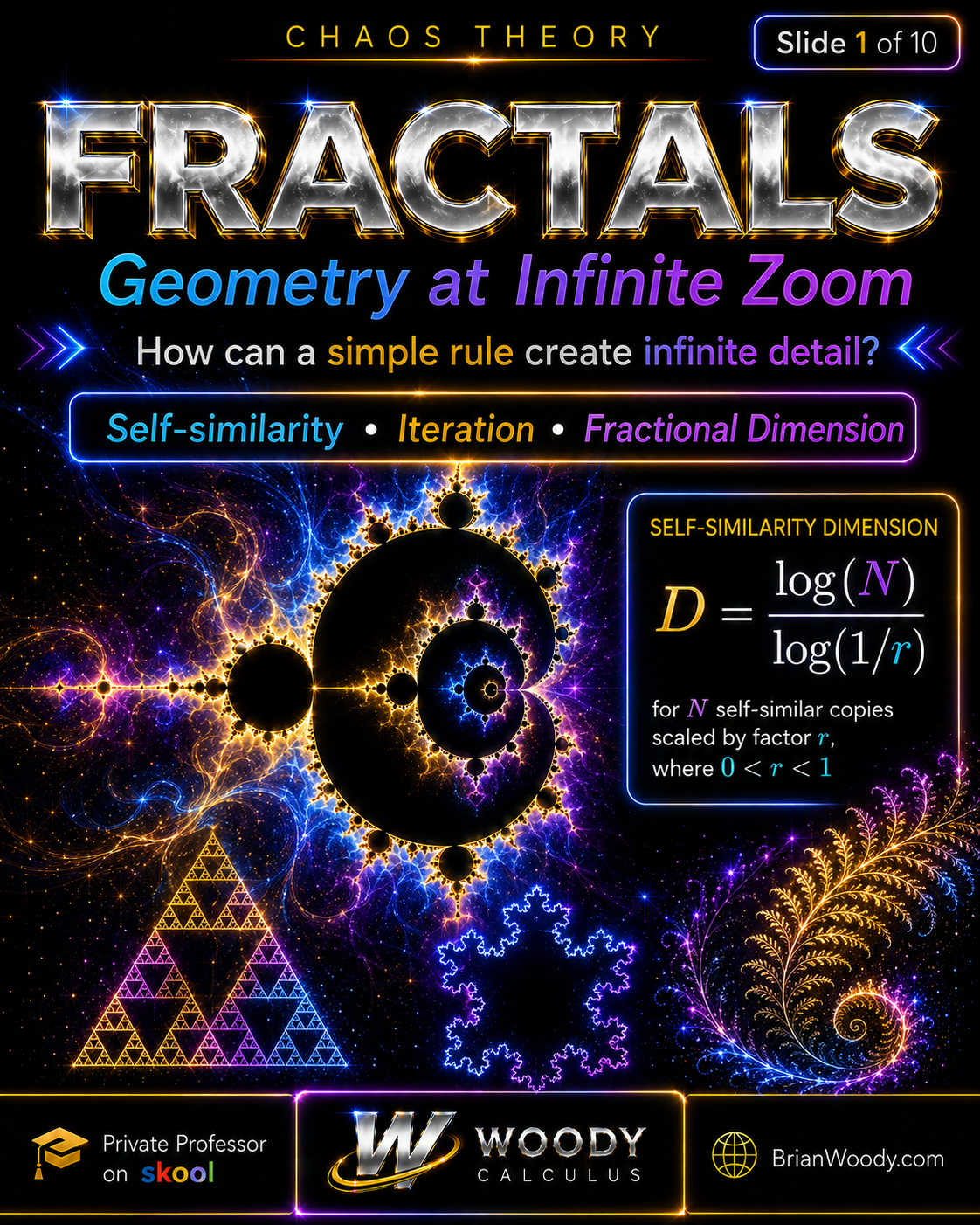
Fractals turn simple repeated rules into geometry with structure at every scale. This rigorous visual lesson explains the Mandelbrot set, escape orbits, Julia sets, fractal dimension, chaos theory, and the truth about fractals in nature.
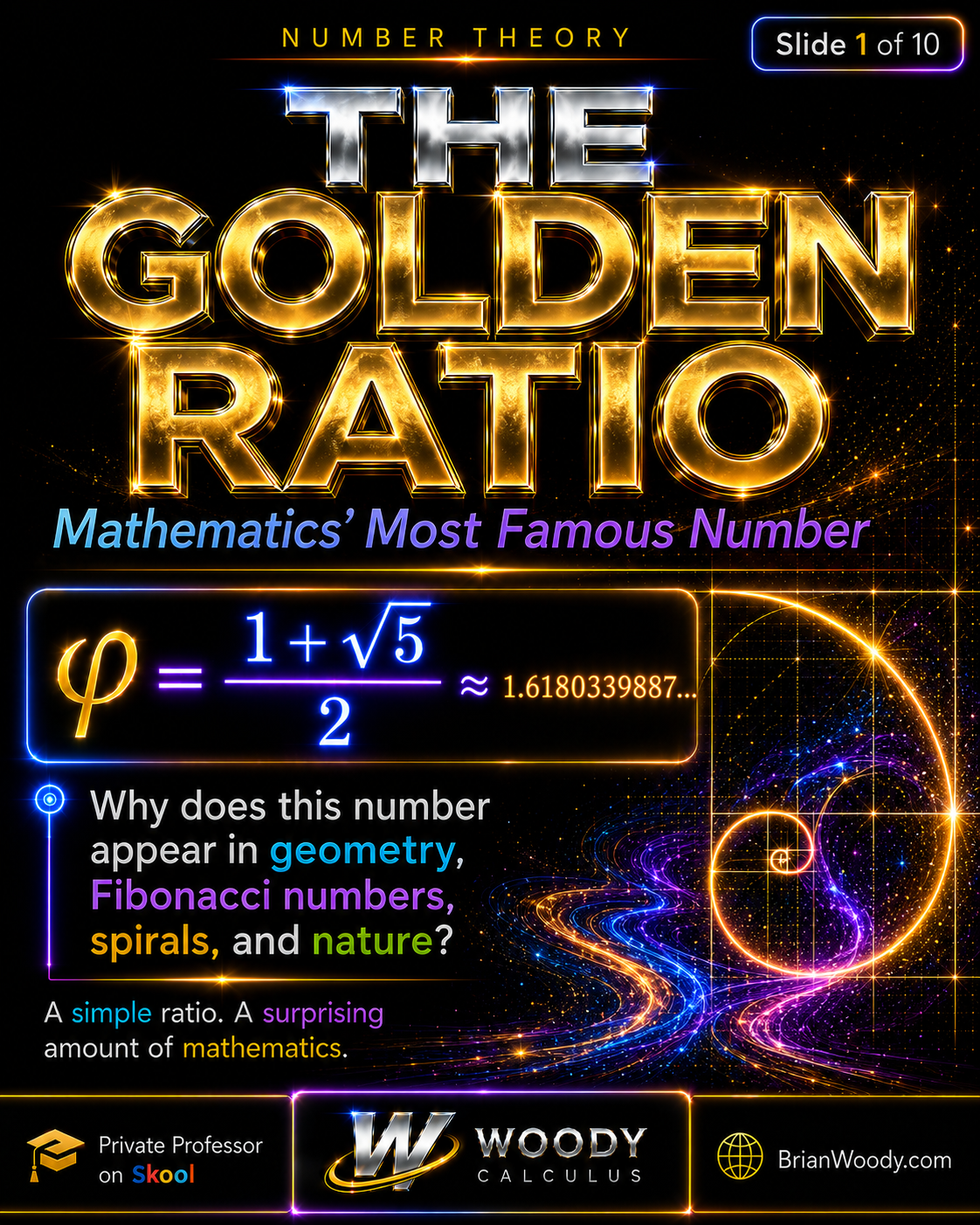
The golden ratio φ=(1+√5)/2 is where geometry, algebra, Fibonacci numbers, limits, continued fractions, pentagons, spirals, and phyllotaxis meet. This complete Woody Calculus visual lesson derives phi, proves the Fibonacci limit, distinguishes a true golden spiral from Fibonacci-style arcs, and separates real mathematics from popular mythology.