Line Integrals Explained: Vector Fields, Work, Path Dependence, and Conservative Fields
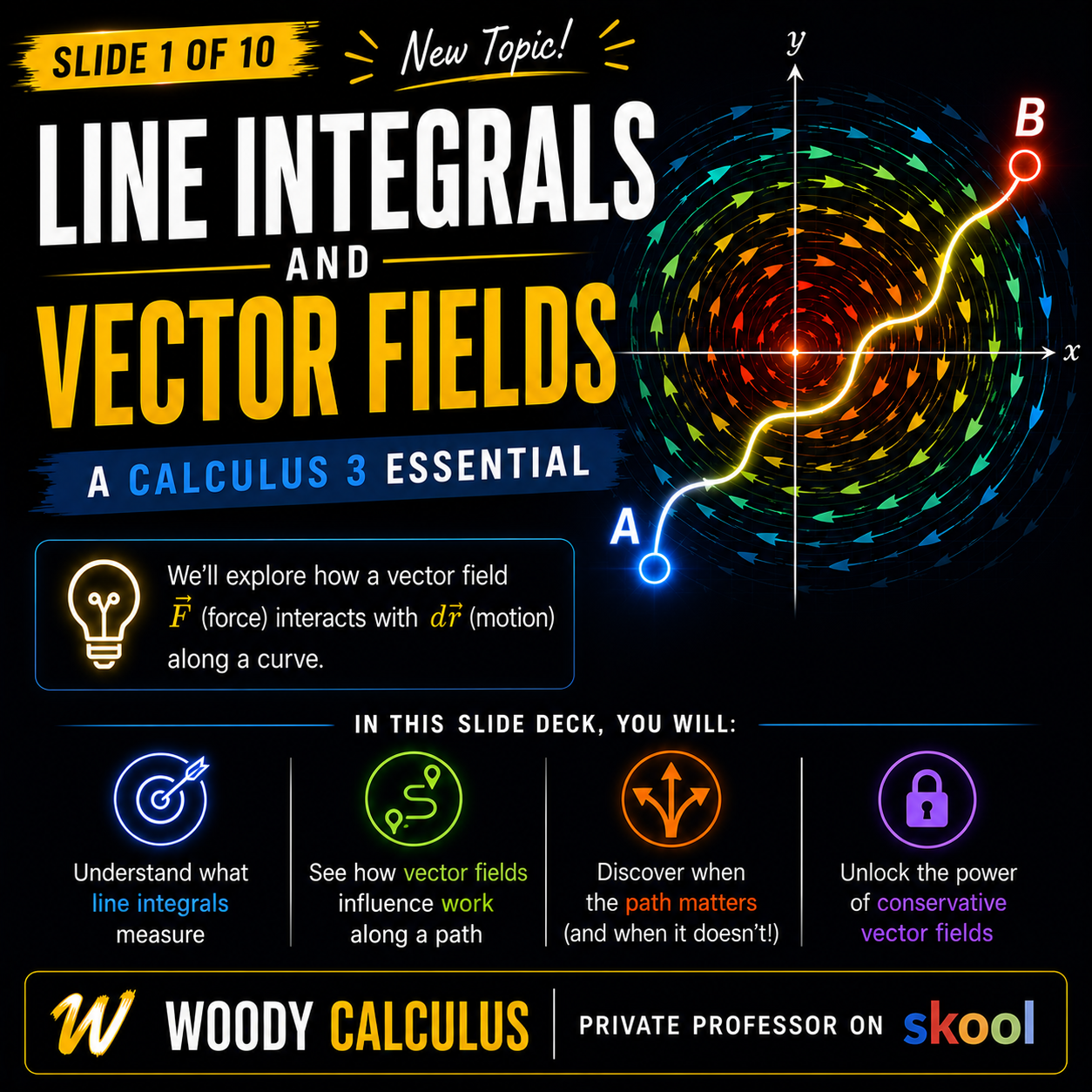
Line integrals are one of the first truly geometric ideas students encounter in
Calculus 3.
This is where vector calculus stops feeling flat and starts feeling alive.
A line integral does not simply measure “how much” of something exists. It measures how a vector field interacts with motion along a path. Every tiny displacement contributes a small amount. The line integral accumulates all of those contributions into one total effect.
This idea becomes the foundation for work, circulation, conservative vector fields, Green’s Theorem, Stokes’ Theorem, electromagnetism, fluid dynamics, and higher-dimensional geometry.
Key Takeaways
- Line integrals measure accumulated effect along a path.
- The vector line integral is written as \( \int_C \vec{F} \cdot d\vec{r} \).
- The dot product measures how aligned the vector field is with motion.
- Most vector fields are path dependent.
- Reversing direction reverses the sign of the integral.
- Conservative vector fields are special because only endpoints matter.
- Line integrals are one of the central ideas in Calculus 3 and vector calculus.
What Is a Line Integral?
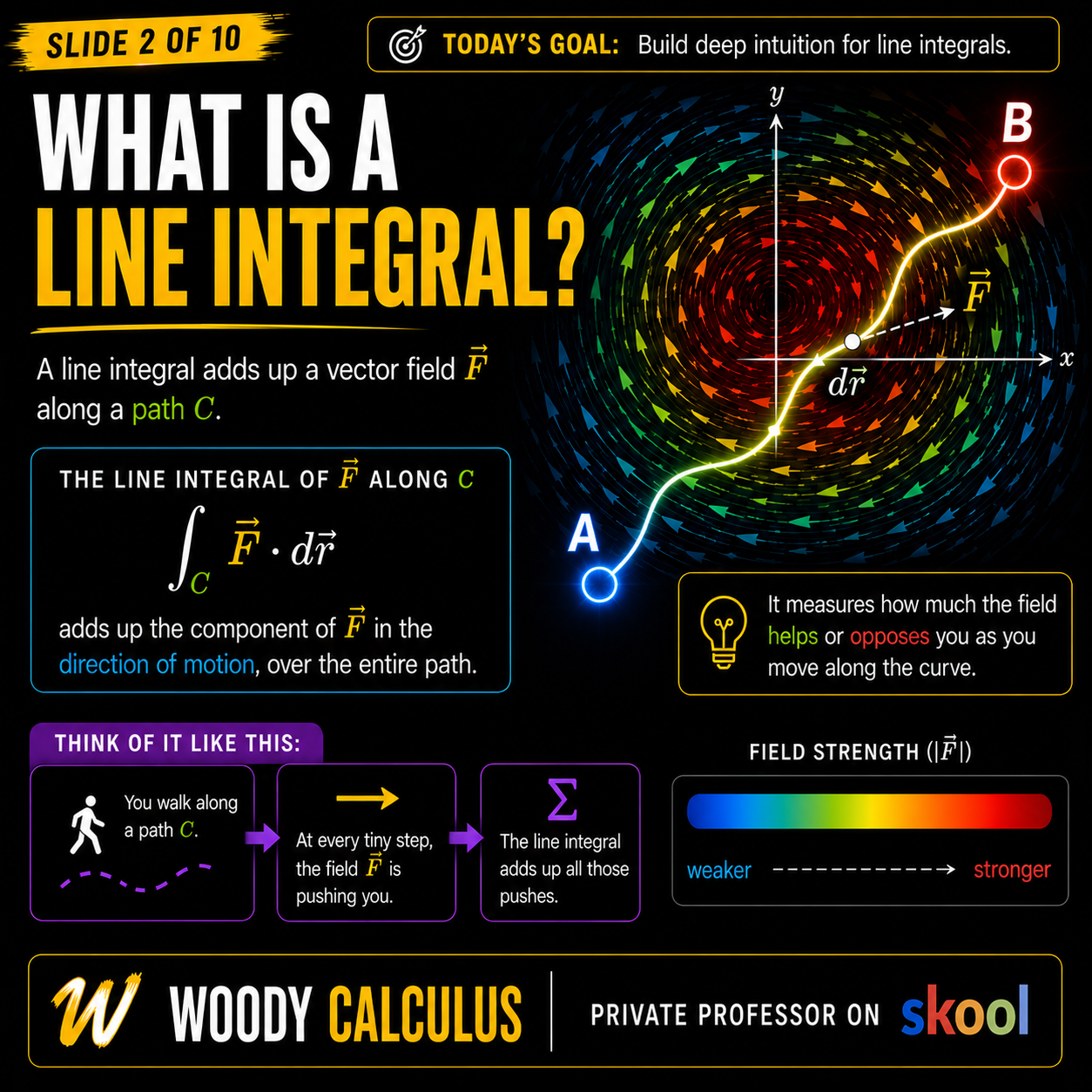
A vector line integral has the form
\[
\int_C \vec{F}\cdot d\vec{r}
\]
Here:
- \( \vec{F} \) is a vector field
- \( C \) is the path or curve
- \( d\vec{r} \) is a tiny displacement vector along the path
The dot product is the entire story.
If the field points with your motion, the contribution is positive. If the field points against your motion, the contribution is negative. If the field is perpendicular to your motion, the contribution is zero.
A line integral measures how much the vector field helps or resists movement along the path.
The Physical Meaning of a Line Integral
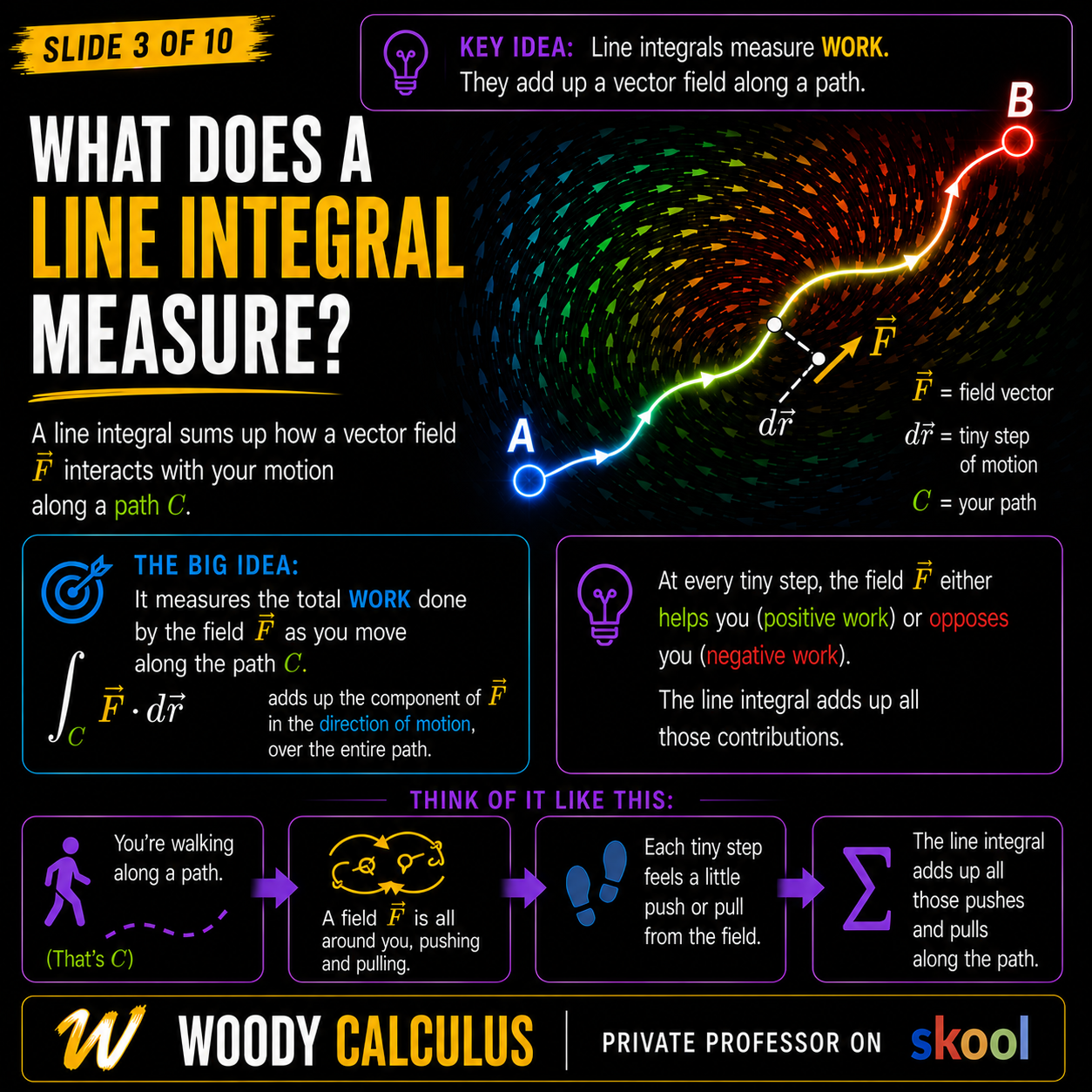
The most important interpretation is work.
If \( \vec{F} \) represents a force field, then
\[
W=\int_C \vec{F}\cdot d\vec{r}
\]
measures the total work done as an object moves through the field.
This is not just symbolic manipulation. Every tiny displacement contributes a tiny amount of work. The integral accumulates all of those tiny effects into one total quantity.
That is why line integrals appear everywhere in physics and engineering:
- Work done by force fields
- Fluid circulation
- Electromagnetic fields
- Potential energy systems
- Current flow and voltage
Why the Path Matters
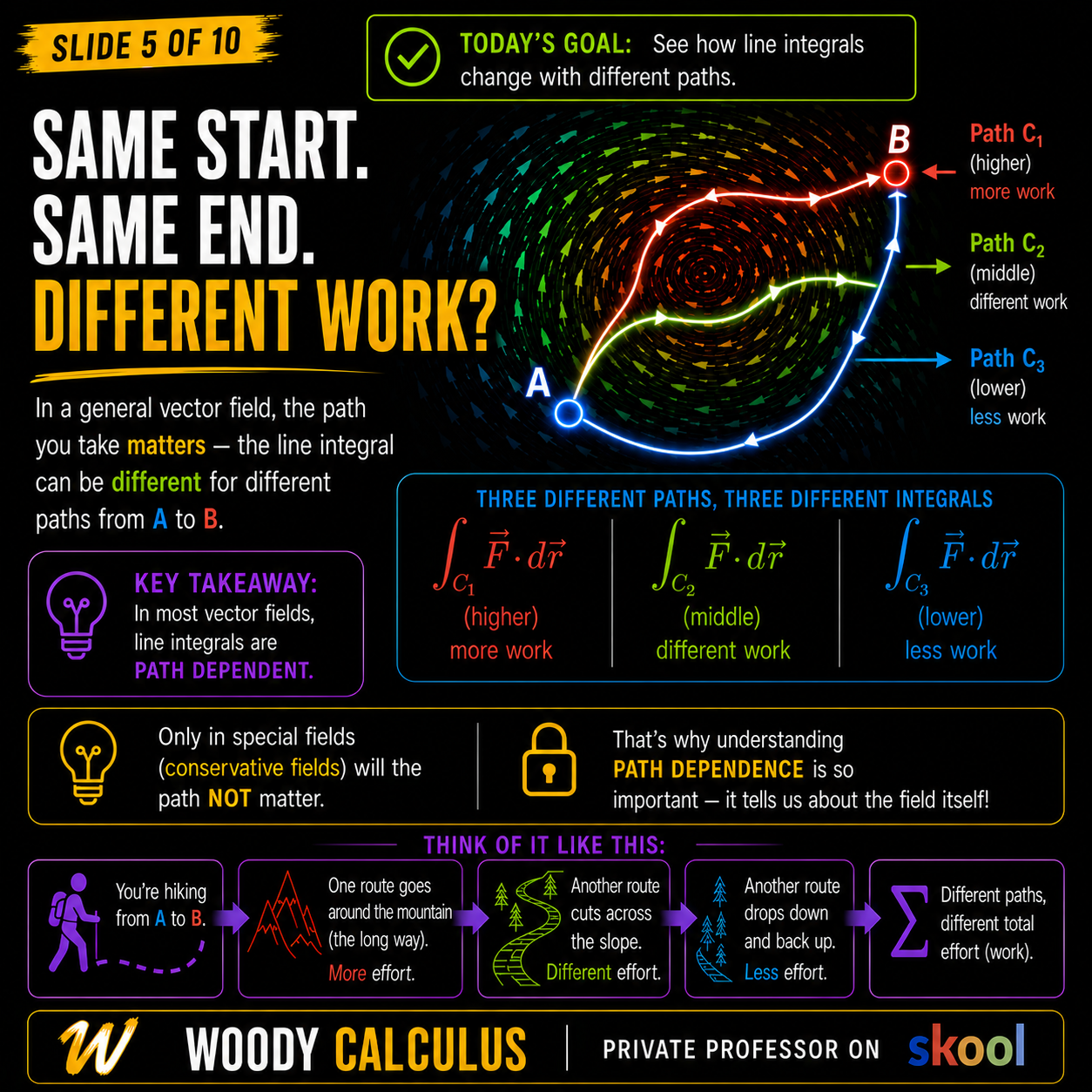
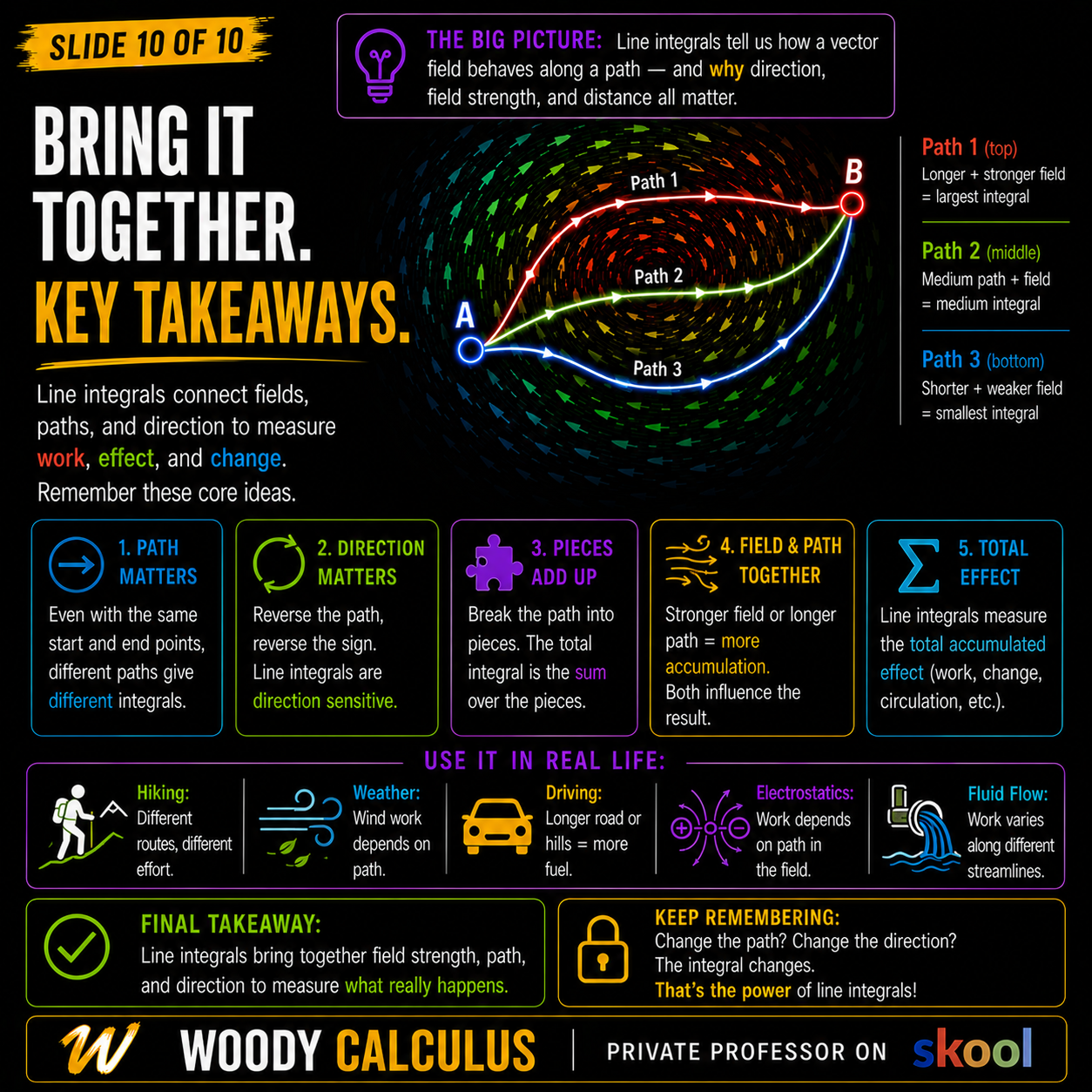
In most vector fields, the route matters.
Two different paths from the same starting point to the same ending point can produce completely different line integrals.
Why?
Because the field may be stronger, weaker, aligned differently, or opposed differently along each route.
\[
\int_{C_1}\vec{F}\cdot d\vec{r}
\neq
\int_{C_2}\vec{F}\cdot d\vec{r}
\]
This idea is called path dependence.
Deep Intuition
A line integral is not just about where you begin and where you end. It is about everything that happens along the way.
Why Direction Matters
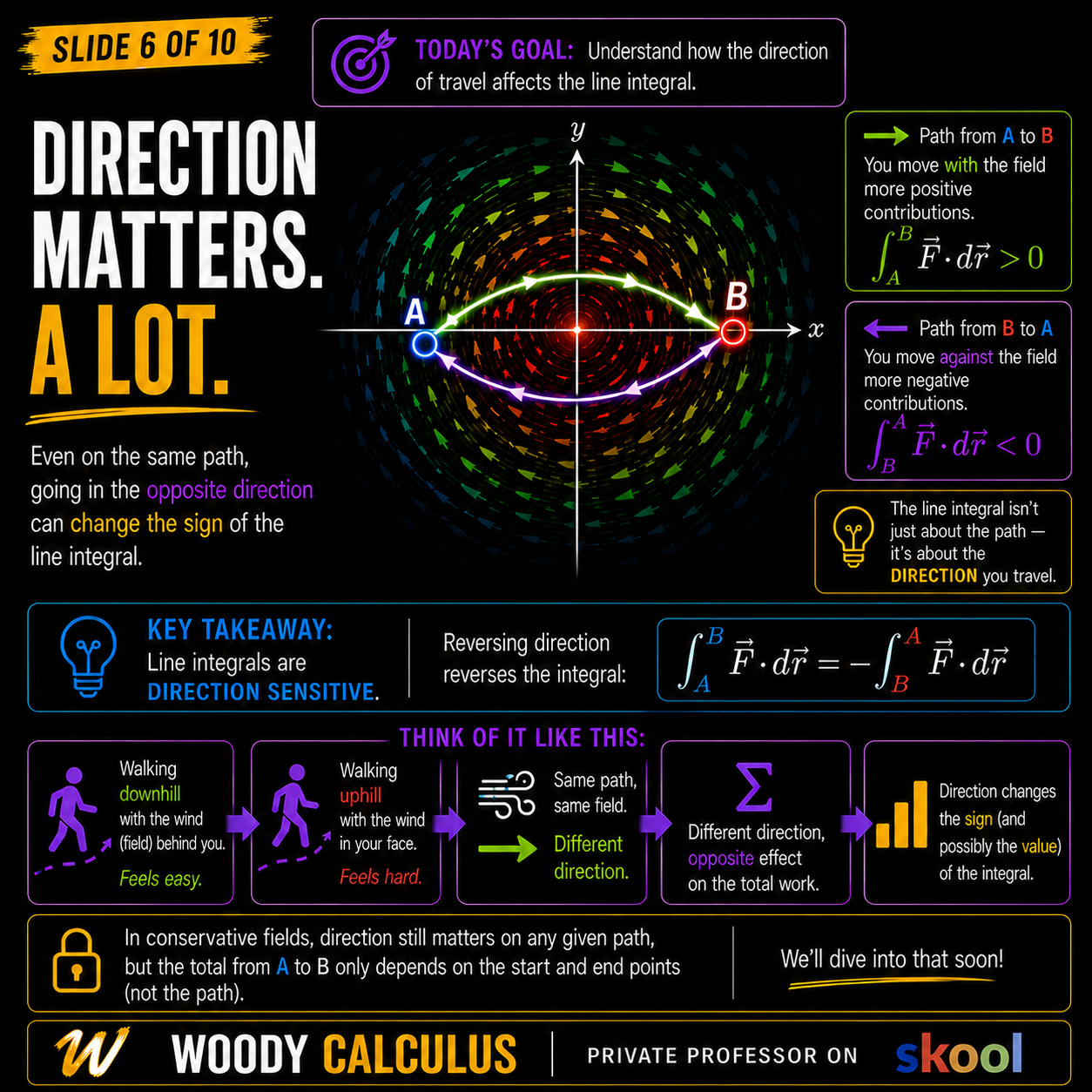
Direction matters because reversing the curve reverses the displacement vector.
\[
\int_A^B \vec{F}\cdot d\vec{r}
=
–
\int_B^A \vec{F}\cdot d\vec{r}
\]
Walking with the field produces positive work. Walking against the field produces negative work.
This is one of the most important conceptual habits in vector calculus:
A curve is not just a shape. It is an oriented path.
Conservative Vector Fields and Path Independence
Some vector fields are special.
If
\[
\vec{F}=\nabla f
\]
for some scalar potential function \(f\), then the field is conservative.
In this case:
\[
\int_C \vec{F}\cdot d\vec{r}
=
f(B)-f(A)
\]
Now the path does not matter. Only the endpoints matter.
This is the vector calculus version of the Fundamental Theorem of Calculus.
How to Compute a Line Integral
The standard workflow is:
- Parameterize the curve \( \vec{r}(t) \)
- Compute \( \vec{r}^{\prime}(t) \)
- Substitute into the field \( \vec{F}(\vec{r}(t)) \)
- Take the dot product
- Integrate over the parameter interval
\[
\int_C \vec{F}\cdot d\vec{r}
=
\int_a^b \vec{F}(\vec{r}(t))\cdot \vec{r}^{\prime}(t)\,dt
\]
This is one of the core workflows students must train repeatedly in
Calculus 3.
Worked Example
Example
Compute
\[
\int_C \vec{F}\cdot d\vec{r}
\]
where
\[
\vec{F}(x,y)=\langle x,y\rangle
\]
and
\[
\vec{r}(t)=\langle t,t^2\rangle,\qquad 0\le t\le1
\]
Step 1
\[
\vec{r}^{\prime}(t)=\langle1,2t\rangle
\]
Step 2
\[
\vec{F}(\vec{r}(t))=\langle t,t^2\rangle
\]
Step 3
\[
\vec{F}(\vec{r}(t))\cdot \vec{r}^{\prime}(t)
=
t+2t^3
\]
Step 4
\[
\int_0^1(t+2t^3)\,dt
=
\left[\frac{t^2}{2}+\frac{t^4}{2}\right]_0^1
=
1
\]
Final Answer:
\[
\boxed{1}
\]
The Woody Calculus Method
Subconscious Training Beats Passive Reading
Most students do not struggle because they are incapable of understanding Calculus 3.
They struggle because they never train the patterns deeply enough.
At Woody Calculus, we use structured repetition:
- Rewrite perfect solutions
- Say the steps out loud
- Train the workflow repeatedly
- Build mathematical instinct under pressure
Your brain learns through repetition and pattern recognition. The half hour before sleep and the first half hour after waking up are especially powerful for retention and subconscious reinforcement.
This is not random memorization. This is neurological training.
Final Thought
Line integrals are one of the first places where mathematics truly begins to feel multidimensional.
They connect geometry, physics, motion, accumulation, and vector fields into one unified idea:
Accumulated effect along a path.
That is the heart of vector calculus.
FAQ: Line Integrals and Vector Fields
What does a line integral measure?
A vector line integral measures the accumulated effect of a vector field along a path.
What is the formula for a line integral?
The standard formula is \( \int_C \vec{F}\cdot d\vec{r} \).
Why does the path matter?
Different paths move through different regions of the vector field and accumulate different effects.
What is a conservative vector field?
A conservative vector field is the gradient of a scalar potential function. In these fields, only endpoints matter.
Do line integrals appear in Calculus 3?
Yes. Line integrals are one of the central topics in Calculus 3 and vector calculus.
Ready to Go Beyond Surface-Level Mathematics?
Inside Woody Calculus Private Professor on Skool, students train advanced mathematics through structured repetition, exam systems, pattern recognition, and complete step-by-step instruction.
Get support in:
- Calculus 1
- Calculus 2
- Calculus 3
- Differential Equations
- Linear Algebra
- Abstract Algebra
- Real Analysis
This is not casual tutoring. This is mathematical training for serious students.
Also explore:
Private Math Tutoring,
Universities Supported,
and
Woody Calculus Google Reviews.
Follow @WoodyCalculus on Instagram for more advanced mathematics visualizations and carousel breakdowns.