Real Analysis · Bounds · Completeness · Complete Visual Lesson
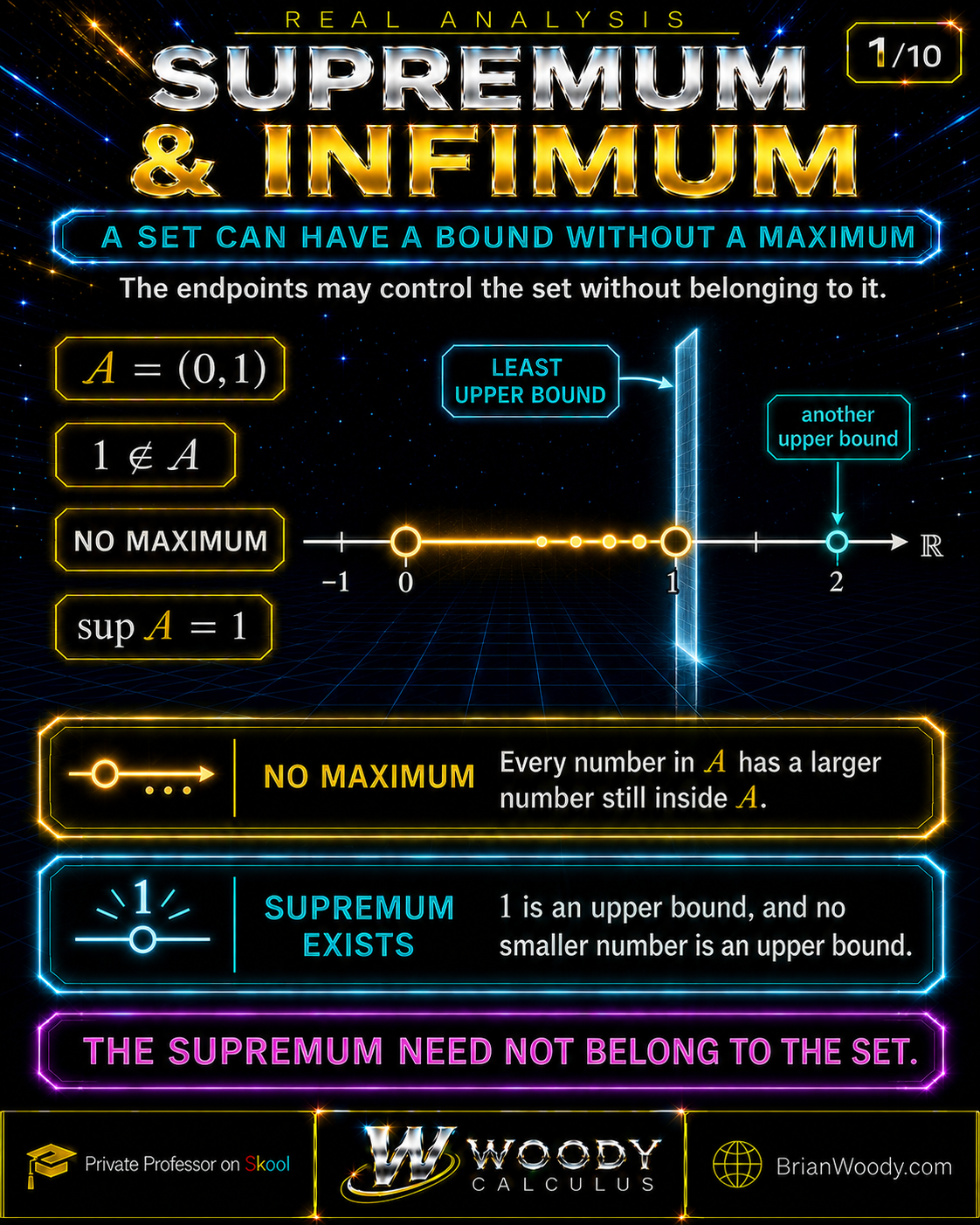
The supremum of a nonempty set bounded above is its least upper bound, and the infimum of a nonempty set bounded below is its greatest lower bound. A maximum or minimum must belong to the set; a supremum or infimum does not have to.
\[
\boxed{\sup S=\text{least upper bound of }S}
\qquad
\boxed{\inf S=\text{greatest lower bound of }S}
\]
Quick Summary
Bounds control every element of a set. Supremum and infimum select the sharpest bounds, while membership determines whether those bounds are also a maximum or minimum.
- Bound the entire set: one missed element destroys a proposed upper or lower bound.
- Separate value from membership: first identify the supremum or infimum, then ask whether it belongs to the set.
- Prove sharpness: use an epsilon argument to show that no smaller upper bound or larger lower bound can work.
What Are Supremum and Infimum?
The supremum is the smallest number that lies at or above every element of a set; the infimum is the largest number that lies at or below every element.
Let \(S\subseteq\mathbb R\). A number \(U\in\mathbb R\) is an upper bound of \(S\) when
x\le U\qquad\text{for every }x\in S.
\]
A number \(L\in\mathbb R\) is a lower bound of \(S\) when
L\le x\qquad\text{for every }x\in S.
\]
Supremum
The number \(s=\sup S\) is an upper bound of \(S\), and \(s\le U\) for every upper bound \(U\) of \(S\).
x\le s\ \text{for all }x\in S,
\qquad
s\le U\ \text{for every upper bound }U.
\]
Infimum
The number \(\ell=\inf S\) is a lower bound of \(S\), and \(L\le\ell\) for every lower bound \(L\) of \(S\).
\ell\le x\ \text{for all }x\in S,
\qquad
L\le\ell\ \text{for every lower bound }L.
\]
The direct distinction
An upper bound is any ceiling for the entire set. The supremum is the lowest possible ceiling. A lower bound is any floor for the entire set. The infimum is the highest possible floor.
Vocabulary and pronunciation
Supremum (pronounced “soo-PREE-mum”) has plural suprema and is abbreviated sup or lub, for least upper bound. Infimum (pronounced “IN-fih-mum”) has plural infima and is abbreviated inf or glb, for greatest lower bound.
How Do Sets, Membership, and Interval Notation Affect the Answer?
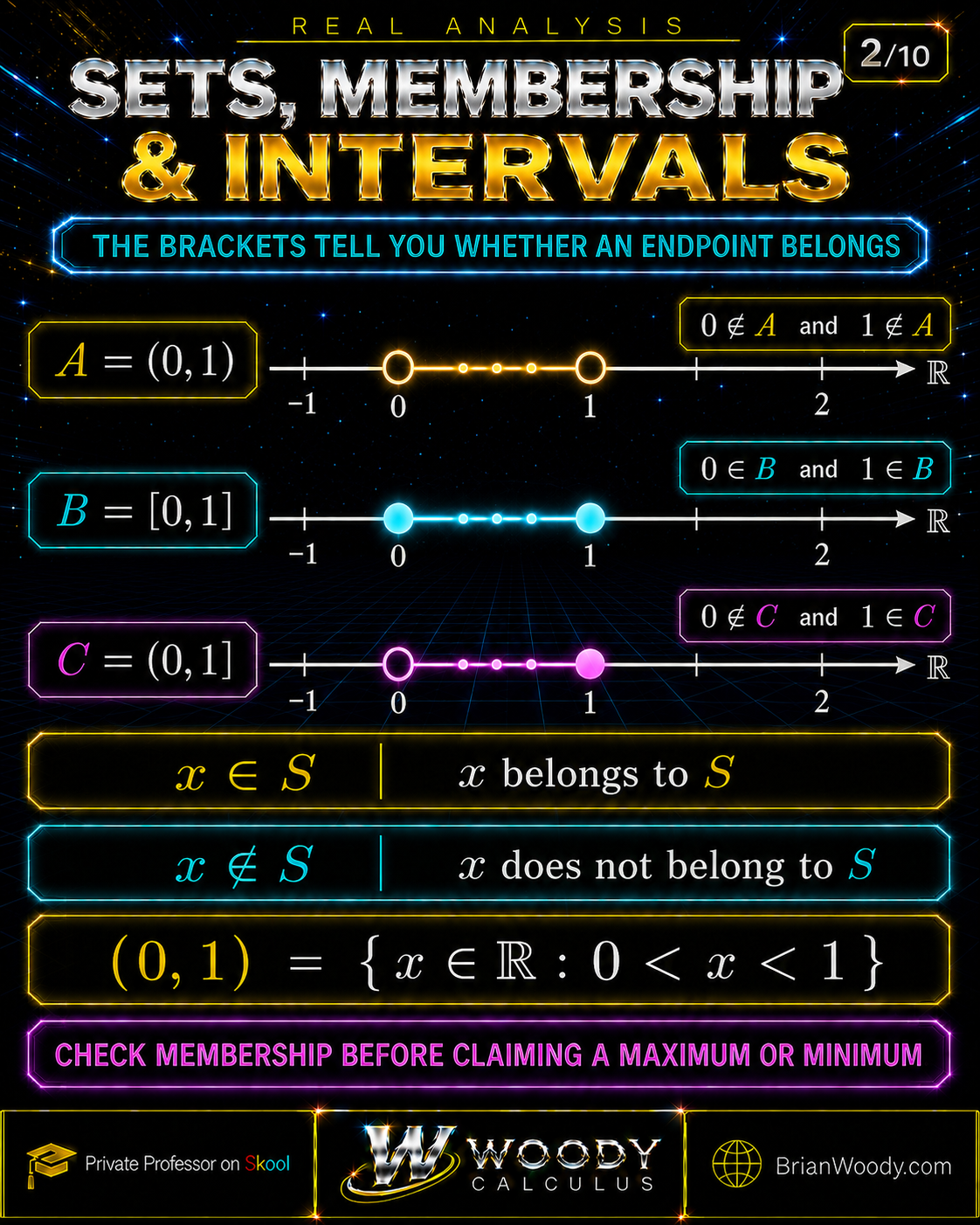
Parentheses exclude an endpoint and brackets include it, so interval notation immediately determines whether a boundary value can be a maximum or minimum.
| Set | Endpoint membership | Infimum / minimum | Supremum / maximum |
|---|---|---|---|
| \(A=(0,1)\) | \(0\notin A, 1\notin A\) | \(\inf A=0\); no minimum | \(\sup A=1\); no maximum |
| \(B=[0,1]\) | \(0\in B, 1\in B\) | \(\inf B=\min B=0\) | \(\sup B=\max B=1\) |
| \(C=(0,1]\) | \(0\notin C, 1\in C\) | \(\inf C=0\); no minimum | \(\sup C=\max C=1\) |
Set-builder notation says the same thing
The open interval \((0,1)\) can be written as \(\{x\in\mathbb R:0<x<1\}\). The strict inequalities explain why neither endpoint belongs to the set.
Upper Bounds and Lower Bounds Must Control Every Element
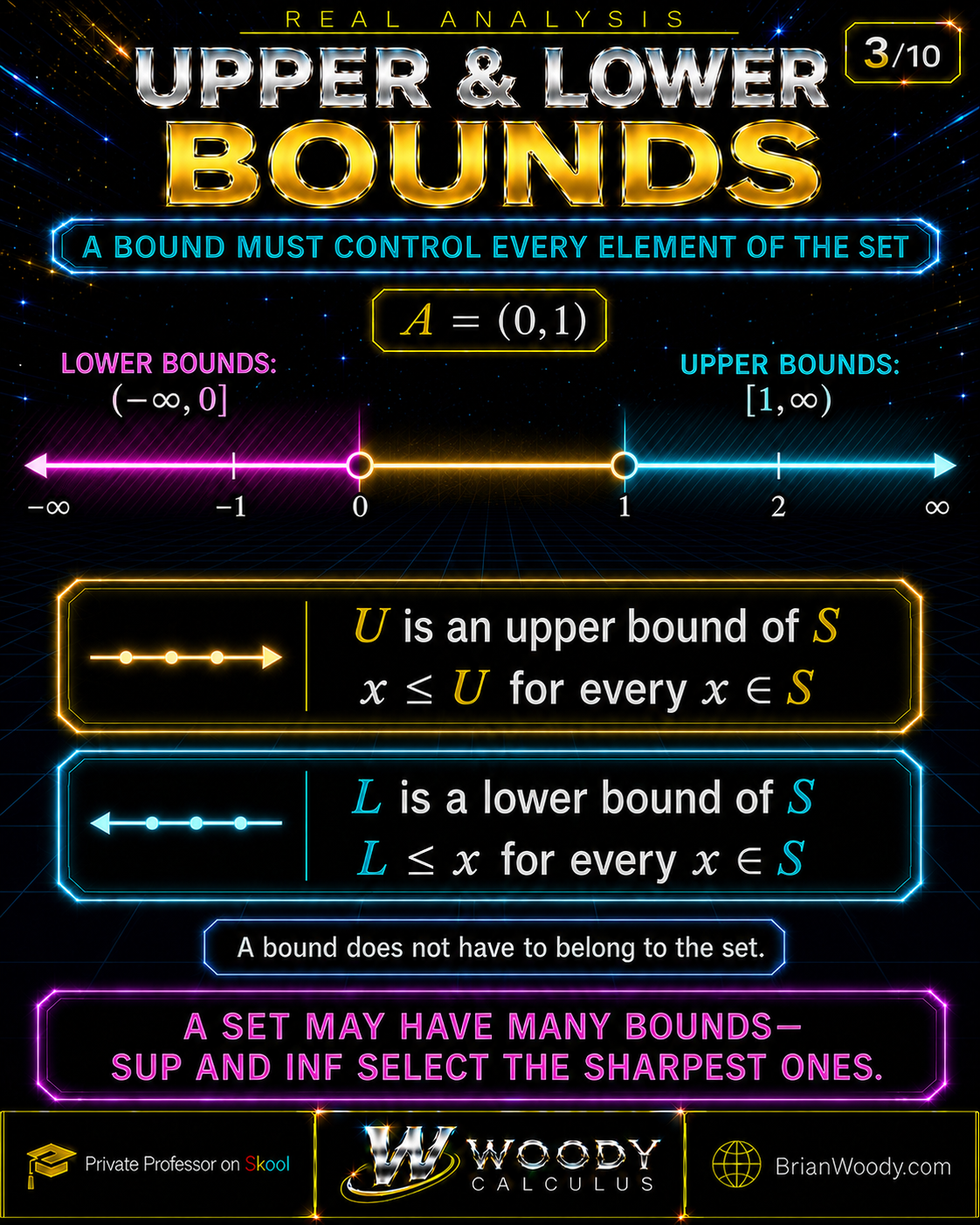
A candidate is a bound only if its inequality holds for every element of the set, not merely for many elements or for the points visible in a sketch.
For \(S=(0,1)\), every number \(U\ge1\) is an upper bound, while every number \(L\le0\) is a lower bound. Therefore the complete collections of bounds are
\{\text{lower bounds of }S\}=(-\infty,0],
\qquad
\{\text{upper bounds of }S\}=[1,\infty).
\]
Bounded above
A set is bounded above if it has at least one real upper bound.
Bounded below
A set is bounded below if it has at least one real lower bound.
Bounded
A set is bounded if it is bounded both above and below.
Do not forget the ambient number system
A bound must live in the number system under discussion. A set can have a supremum in \(\mathbb R\) but no supremum in \(\mathbb Q\). The rational square-root-of-two example later in this lesson shows exactly how this happens.
Maximum vs. Supremum and Minimum vs. Infimum
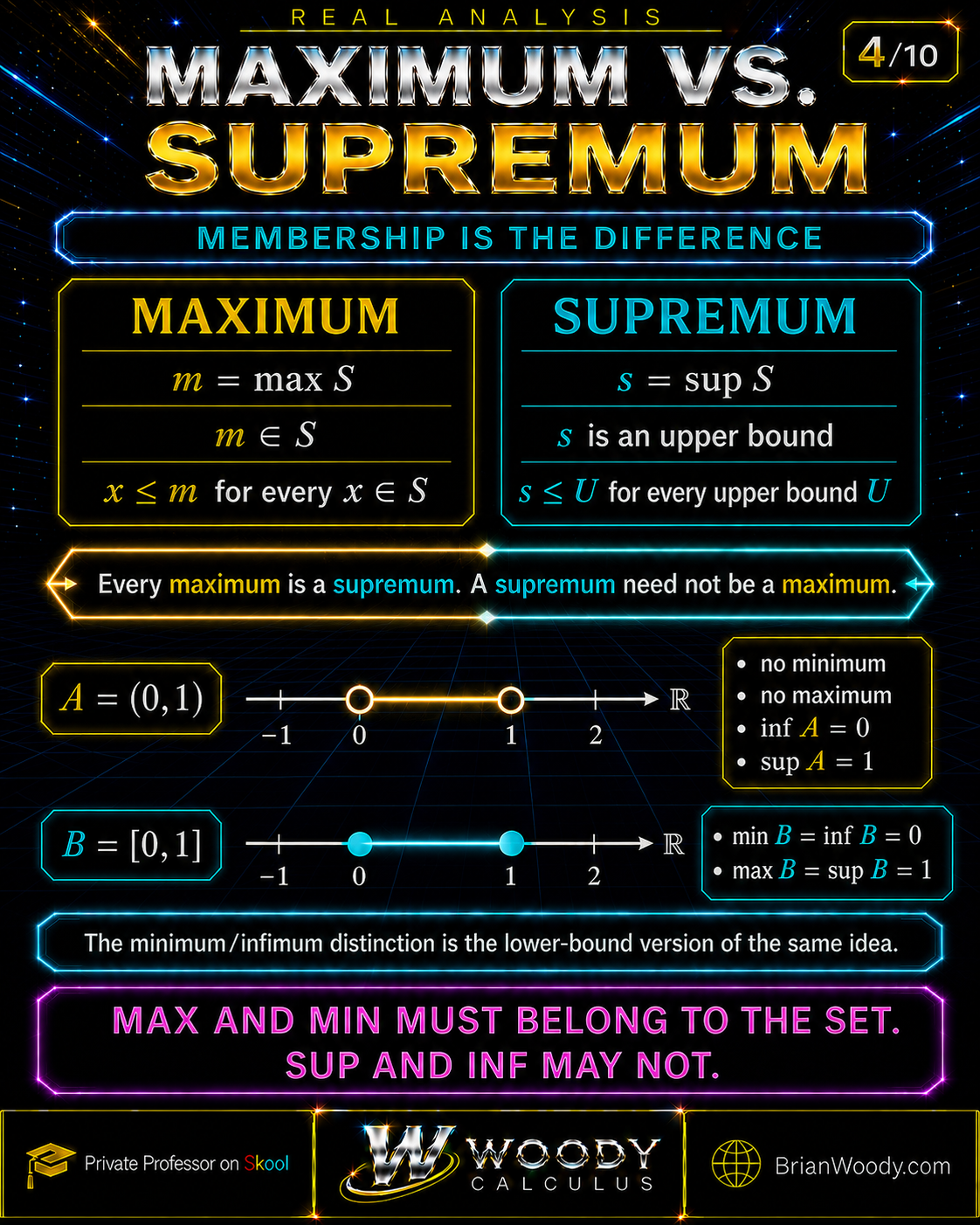
A maximum is an element of the set that dominates every other element; a supremum is the least upper bound and may sit outside the set.
| Object | Order condition | Must belong to \(S\)? |
|---|---|---|
| Maximum \(m\) | \(x\le m\) for every \(x\in S\) | Yes: \(m\in S\) |
| Supremum \(s\) | \(s\) is the least upper bound | No |
| Minimum \(n\) | \(n\le x\) for every \(x\in S\) | Yes: \(n\in S\) |
| Infimum \(\ell\) | \(\ell\) is the greatest lower bound | No |
If the supremum belongs to the set, it is the maximum
Suppose \(s=\sup S\) and \(s\in S\). Because \(s\) is an upper bound, every \(x\in S\) satisfies \(x\le s\). Since \(s\) itself belongs to \(S\), it satisfies the definition of the maximum. Therefore
\sup S\in S\quad\Longrightarrow\quad\max S=\sup S.
\]
The lower-bound version is identical: if \(\inf S\in S\), then \(\min S=\inf S\).
Conversely, if \(\sup S\notin S\), then \(S\) has no maximum; if \(\inf S\notin S\), then \(S\) has no minimum.
How Do You Prove a Number Is the Supremum?
A complete supremum proof has two logically separate parts: prove the candidate is an upper bound, then prove that elements of the set occur arbitrarily close to it from below.
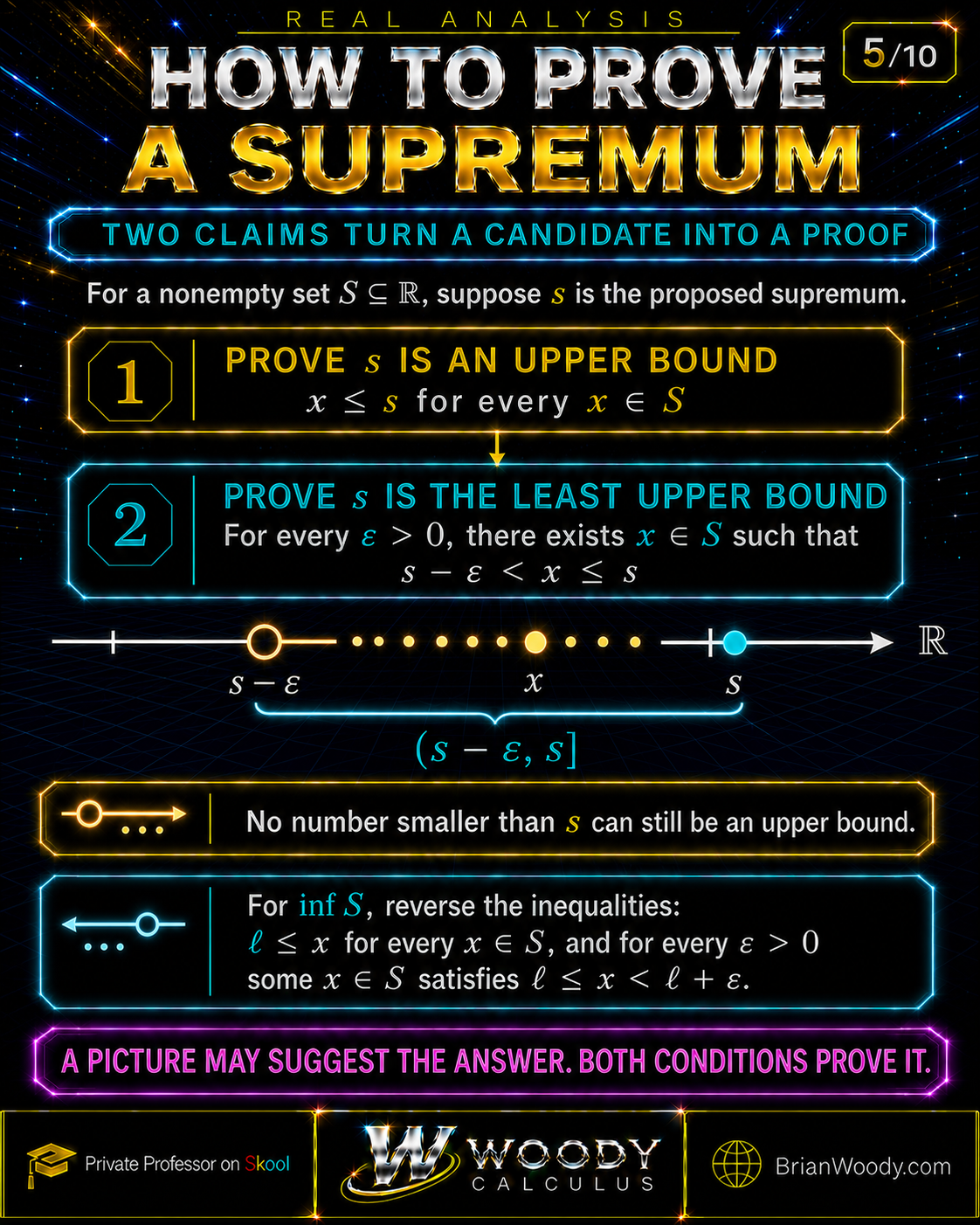
Prove \(s\) is an upper bound
x\le s\qquad\text{for every }x\in S.
\]
This establishes that \(s\) is at least a candidate.
Prove no smaller upper bound works
\text{For every }\varepsilon>0,
\text{ some }x\in S\text{ satisfies }s-\varepsilon<x\le s.
\]
The chosen element defeats \(s-\varepsilon\) as an upper bound.
Why is the epsilon condition equivalent to “least upper bound”?
Assume \(s\) is an upper bound. If every \(\varepsilon>0\) admits an \(x\in S\) with \(s-\varepsilon<x\), take any number \(v<s\) and choose \(\varepsilon=s-v>0\). Then some \(x\in S\) satisfies \(v=s-\varepsilon<x\), so \(v\) is not an upper bound. Thus no number below \(s\) is an upper bound.
Conversely, if \(s\) is the least upper bound and some \(\varepsilon>0\) produced no \(x\in S\) above \(s-\varepsilon\), then \(s-\varepsilon\) would itself be an upper bound smaller than \(s\), a contradiction.
The infimum version reverses the inequalities
To prove \(\ell=\inf S\), show \(\ell\le x\) for every \(x\in S\), and then show that for every \(\varepsilon>0\), some \(x\in S\) satisfies \(\ell\le x<\ell+\varepsilon\).
Worked Proof: Why the Supremum of (0,3) Is 3
The endpoint \(3\) is excluded from the interval, but it still bounds every element and can be approached arbitrarily closely from inside the set.
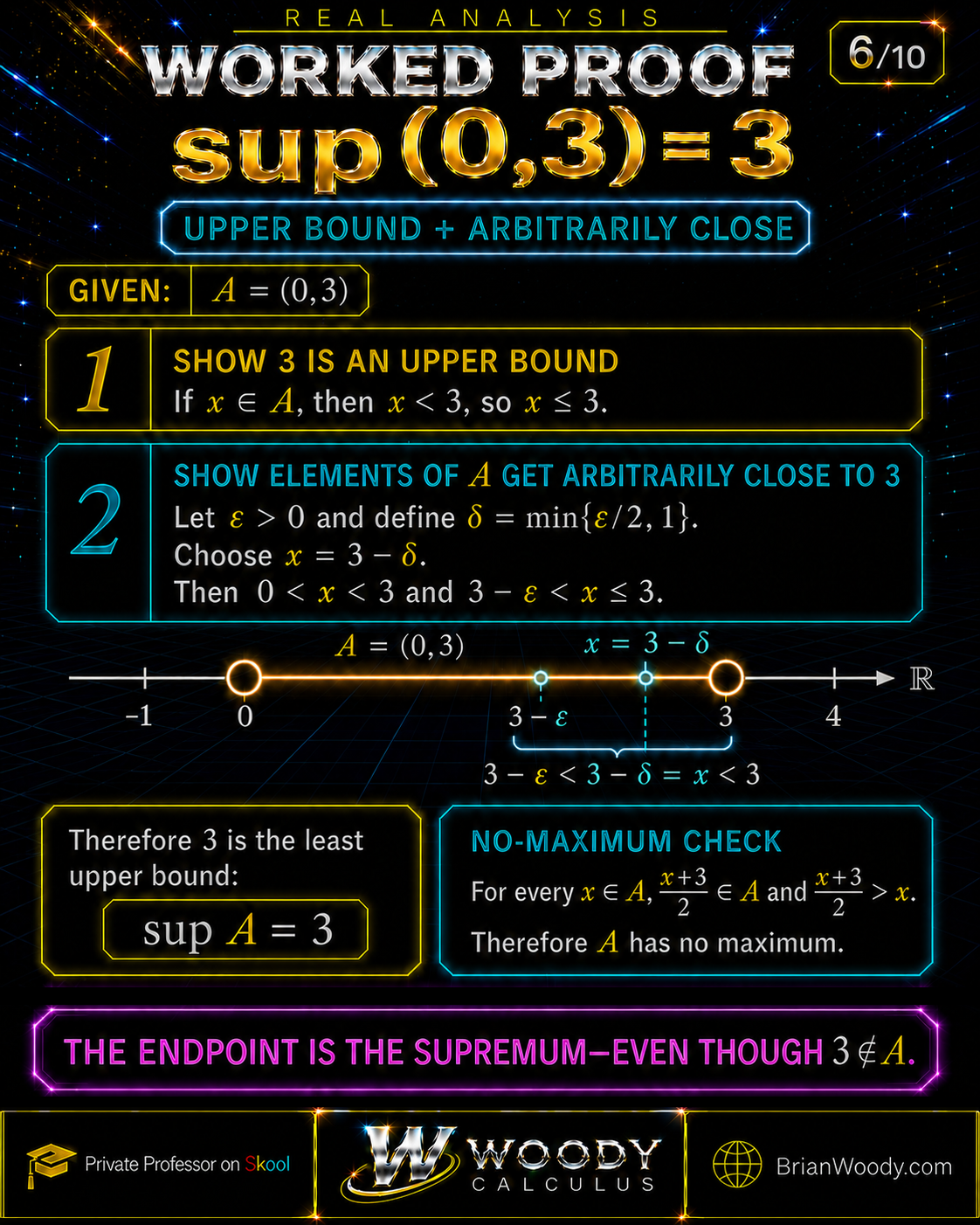
Claim
A=(0,3)\qquad\Longrightarrow\qquad\sup A=3.
\]
Part 1: prove that \(3\) is an upper bound
If \(x\in A\), then the definition of the interval gives \(0<x<3\). In particular, \(x\le3\). Therefore \(3\) is an upper bound of \(A\).
Part 2: prove that elements of \(A\) get arbitrarily close to \(3\)
Let \(\varepsilon>0\). Define
\delta=\min\!\left\{\frac{\varepsilon}{2},1\right\},
\qquad
x=3-\delta.
\]
Because \(0<\delta\le1\), we have \(2\le x<3\), so \(x\in A\). Also, \(\delta\le\varepsilon/2<\varepsilon\), and therefore
3-\varepsilon<3-\delta=x<3.
\]
Thus every interval \((3-\varepsilon,3]\) contains an element of \(A\). Together with Part 1, this proves \(\sup A=3\).
Why does \(A\) have no maximum?
For any \(x\in(0,3)\), define \(y=(x+3)/2\). Then
x<\frac{x+3}{2}<3.
\]
So \(y\in A\) and \(y>x\). Every element has a larger element still inside \(A\), which makes a maximum impossible.
Infimum Without a Minimum: The Set {1/n}
The terms \(1/n\) remain positive but become arbitrarily small, so the greatest lower bound is \(0\) even though \(0\) never occurs in the set.
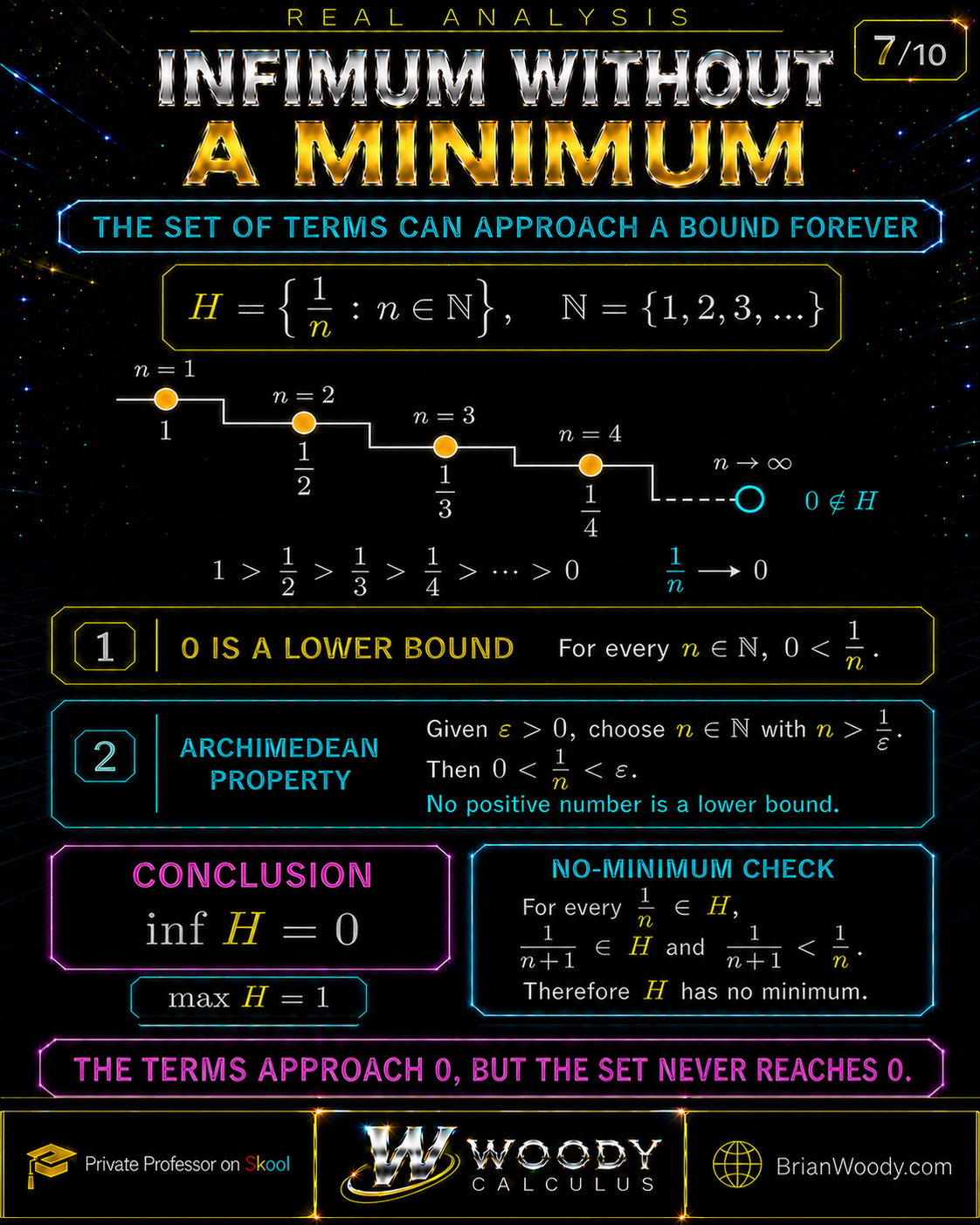
Step 1: prove that \(0\) is a lower bound
For every \(n\in\mathbb N\), \(n\ge1\), so \(1/n>0\). Hence \(0\le1/n\) for every element of \(H\).
Step 2: prove that no positive lower bound exists
Let \(\varepsilon>0\). By the Archimedean property, choose \(n\in\mathbb N\) such that \(n>1/\varepsilon\). Then
0<\frac1n<\varepsilon.
\]
Therefore every positive candidate lies above some element of \(H\) and cannot be a lower bound. Consequently, \(\inf H=0\).
Step 3: determine the maximum and minimum
Because \(1=1/1\in H\) and \(1/n\le1\) for every \(n\), \(\max H=1\). But every term has a smaller successor:
\frac1{n+1}<\frac1n.
\]
Thus \(H\) has no minimum.
What Does Completeness of the Real Numbers Mean?
Completeness means that a nonempty real set cannot be bounded above yet lack a real least upper bound; the boundary value required by the set exists inside \(\mathbb R\).
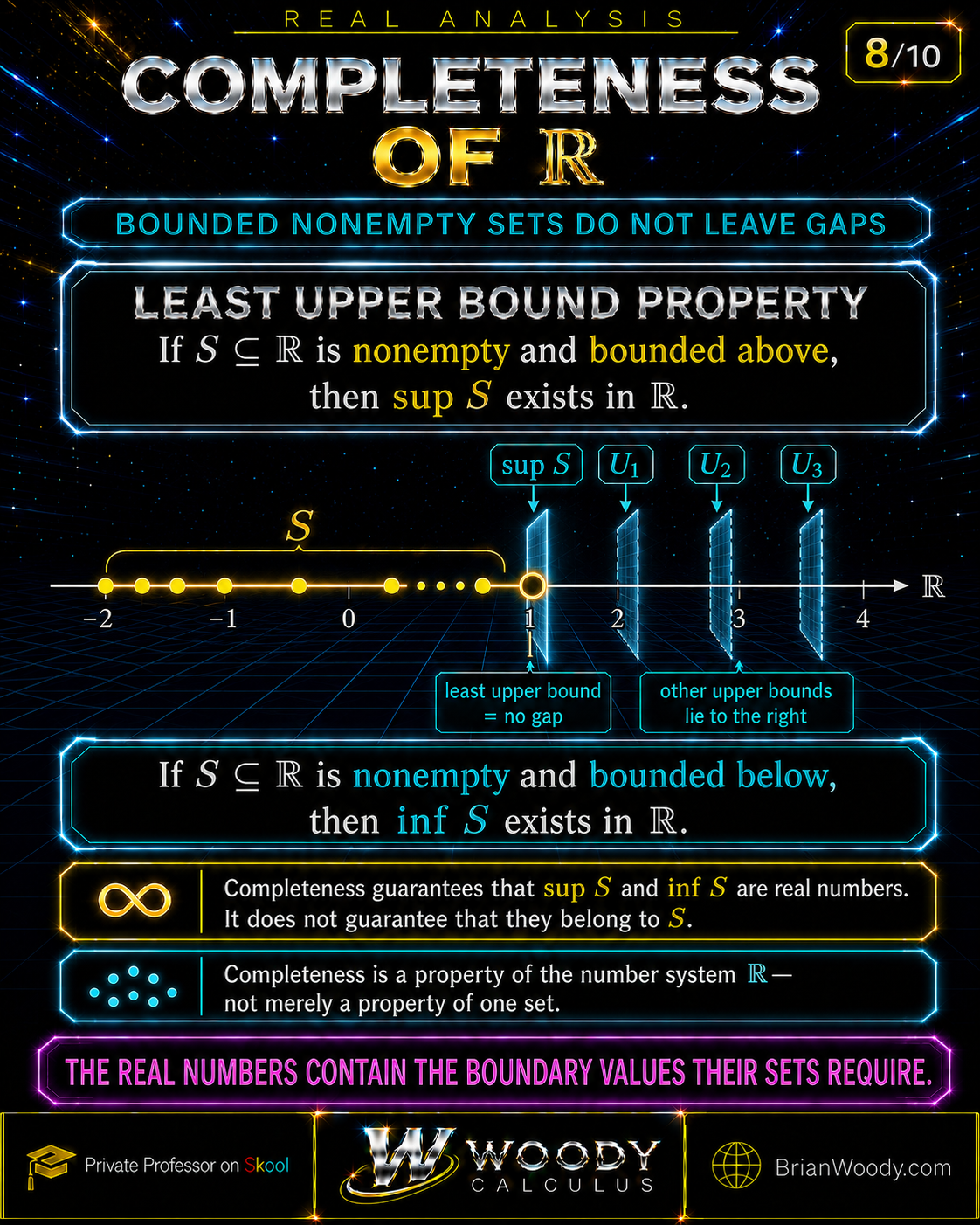
Least Upper Bound Property
If \(S\subseteq\mathbb R\) is nonempty and bounded above, then \(\sup S\) exists in \(\mathbb R\).
The greatest-lower-bound statement follows from the same property. If \(S\) is nonempty and bounded below, define \(-S=\{-x:x\in S\}\). Then \(-S\) is bounded above, so \(\sup(-S)\) exists. The infimum of \(S\) is
\boxed{\inf S=-\sup(-S)}.
\]
What completeness does—and does not—guarantee
- It guarantees a real supremum for every nonempty real set bounded above.
- It guarantees a real infimum for every nonempty real set bounded below.
- It does not guarantee that the supremum or infimum belongs to the set.
- It does not give a finite supremum to a set that is unbounded above.
- It is a property of the number system, not a claim that every individual set is closed.
Why completeness drives later Real Analysis
The bounded monotone convergence theorem, nested interval arguments, the Bolzano–Weierstrass theorem, compactness results, and many existence proofs ultimately rely on the fact that the real numbers contain their required boundary values. For example, every bounded increasing sequence converges to the supremum of its set of terms.
Why Are the Rational Numbers Not Complete?
The rational numbers contain sets that are nonempty and bounded above in \(\mathbb Q\) but whose required least upper bound is irrational and therefore missing from \(\mathbb Q\).
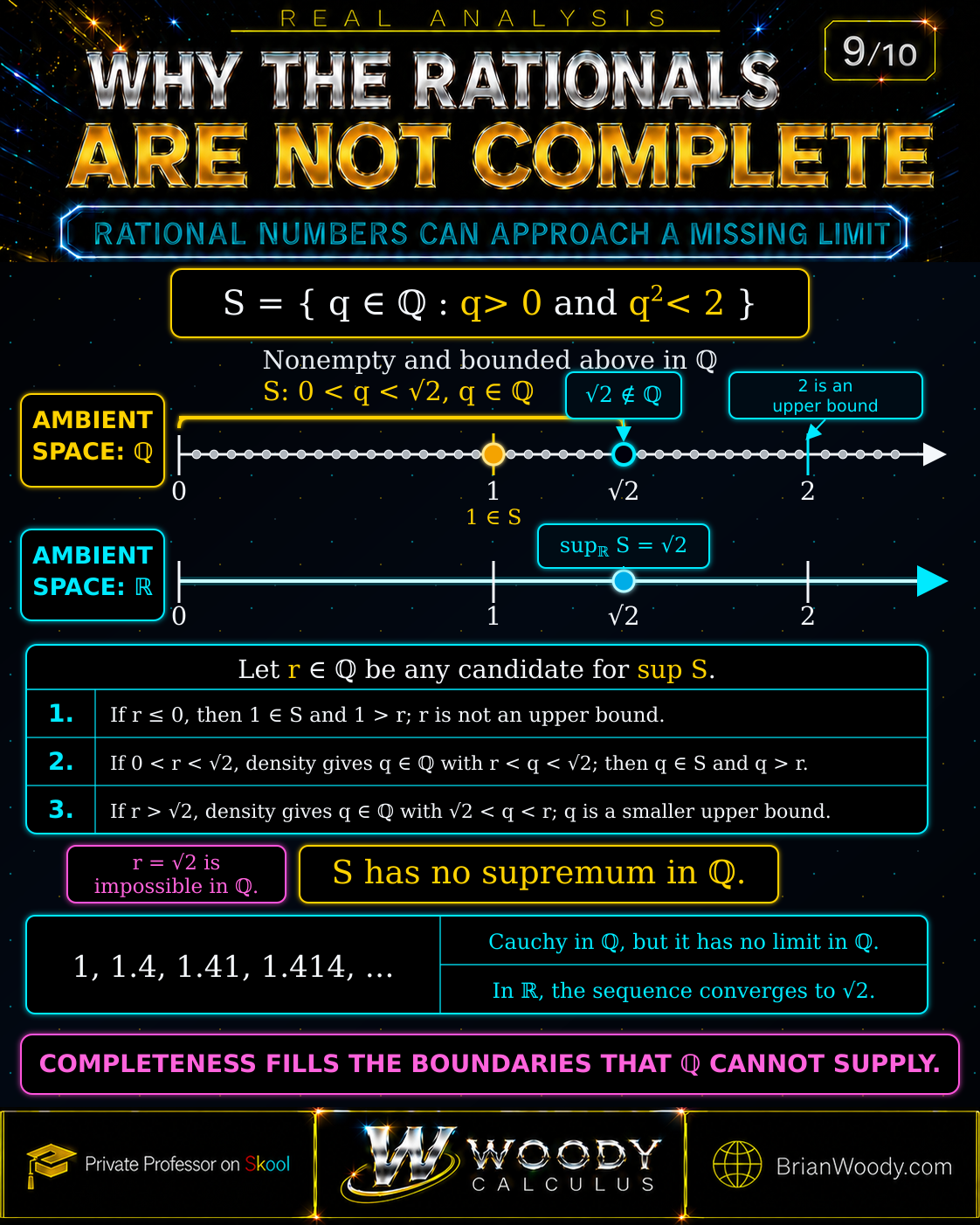
The set
S=\{q\in\mathbb Q:q>0\text{ and }q^2<2\}.
\]
The set is nonempty because \(1\in S\), and it is bounded above in \(\mathbb Q\) because \(2\) is an upper bound.
Test every rational candidate \(r\in\mathbb Q\)
- If \(r\le0\): then \(1\in S\) and \(1>r\), so \(r\) is not an upper bound.
- If \(0<r<\sqrt2\): density of \(\mathbb Q\) gives \(q\in\mathbb Q\) with \(r<q<\sqrt2\). Then \(q>0\), \(q^2<2\), and \(q\in S\), so \(r\) is not an upper bound.
- If \(r>\sqrt2\): density gives \(q\in\mathbb Q\) with \(\sqrt2<q<r\). Every element of \(S\) is less than \(\sqrt2\), so \(q\) is an upper bound smaller than \(r\). Therefore \(r\) is not the least upper bound.
The only remaining real candidate is \(r=\sqrt2\), but \(\sqrt2\notin\mathbb Q\). Therefore \(S\) has no supremum in the ambient space \(\mathbb Q\). When the same set is viewed as a subset of \(\mathbb R\), its supremum is \(\sqrt2\).
Density is not completeness
The rationals are dense in the reals: between two distinct real numbers lies a rational number. Yet \(\mathbb Q\) is not complete because it still omits limits and boundary values such as \(\sqrt2\).
Important Consequences and Edge Cases
Supremum and infimum are unique when they exist, connect directly through negation, and require careful treatment of empty or unbounded sets.
Uniqueness
If \(s\) and \(t\) were both suprema of \(S\), then \(s\le t\) because \(t\) is an upper bound, and \(t\le s\) because \(s\) is an upper bound. Hence \(s=t\).
Reflection
Negating a set reverses order:
\inf S=-\sup(-S),
\qquad
\sup S=-\inf(-S).
\]
Translation and scaling
For a nonempty bounded set \(S\) and \(c\in\mathbb R\), \(\sup(S+c)=\sup S+c\). If \(a>0\), then \(\sup(aS)=a\sup S\); if \(a<0\), order reverses and \(\sup(aS)=a\inf S\).
Where this leads: limit superior and limit inferior
For a bounded sequence \((a_n)\), the limit superior and limit inferior track the eventual upper and lower behavior of its tails:
\limsup_{n\to\infty}a_n
=\inf_n\sup\{a_k:k\ge n\},
\qquad
\liminf_{n\to\infty}a_n
=\sup_n\inf\{a_k:k\ge n\}.
\]
For \(a_n=(-1)^n\), \(\limsup a_n=1\) and \(\liminf a_n=-1\). A bounded real sequence converges exactly when its limit superior and limit inferior are equal; their common value is the limit.
| Situation | Conclusion in \(\mathbb R\) | Reason |
|---|---|---|
| Nonempty and bounded above | A real supremum exists | Completeness |
| Nonempty and bounded below | A real infimum exists | Completeness |
| Unbounded above | No real supremum | No real upper bound exists |
| Unbounded below | No real infimum | No real lower bound exists |
| Empty set | No supremum or infimum under the standard elementary definition | Every real number is vacuously both an upper bound and a lower bound, but \(\mathbb R\) has neither a least element nor a greatest element. |
Extended-real conventions come later
Some advanced texts work in \(\overline{\mathbb R}=\mathbb R\cup\{-\infty,+\infty\}\) and assign extended values to unbounded or empty sets. Unless your course explicitly adopts those conventions, answer in the ordinary real numbers and state when a real supremum or infimum does not exist.
Supremum and Infimum Decision Map
Use this six-step sequence to identify the relevant bound, distinguish it from an attained extremum, and write a proof that matches the ambient number system.
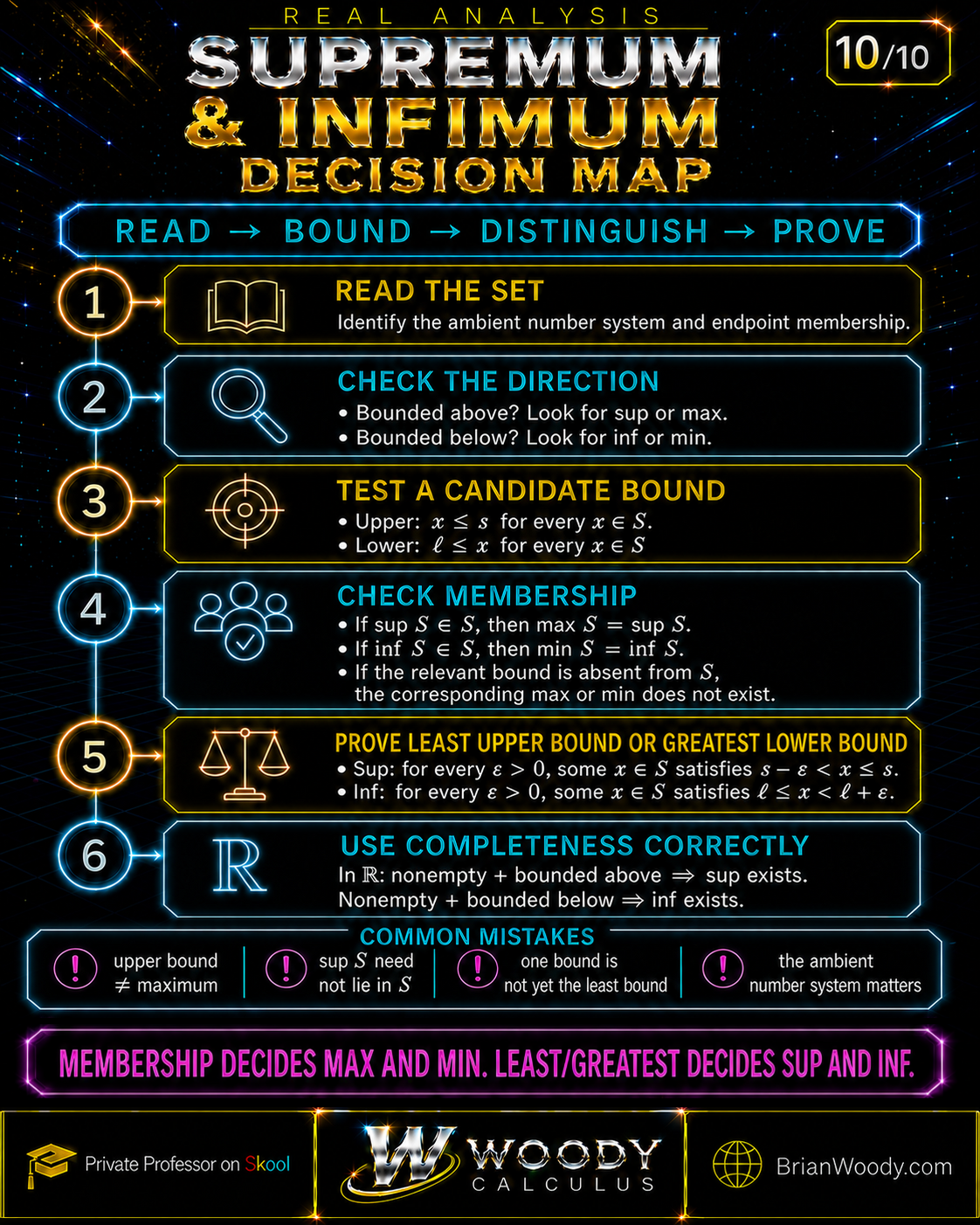
- 1
Read the set
Identify the ambient number system, the exact defining conditions, and whether any endpoints belong to the set.
- 2
Check the direction
For a supremum or maximum, test boundedness above. For an infimum or minimum, test boundedness below.
- 3
Test a candidate bound
Prove the proposed upper or lower bound controls every element of the set.
- 4
Check membership
If the supremum belongs to the set, it is the maximum; if it does not belong, no maximum exists. Likewise, membership of the infimum determines whether a minimum exists.
- 5
Prove least or greatest
Use the epsilon characterization or another rigorous argument to rule out every smaller upper bound or larger lower bound.
- 6
Use completeness correctly
In the real numbers, nonempty plus bounded above guarantees a supremum, and nonempty plus bounded below guarantees an infimum.
Common Supremum and Infimum Mistakes
Most errors come from confusing membership with boundedness, testing only part of a set, or invoking completeness without checking its hypotheses.
| Mistake | Symptom | Cause | Fix |
|---|---|---|---|
| Calling every upper bound the supremum | You identify \(2\) as \(\sup(0,1)\). | You proved “upper bound” but not “least.” | Show elements occur arbitrarily close to the candidate from below. |
| Assuming the supremum is a maximum | You claim \(\max(0,1)=1\). | You ignored endpoint membership. | After finding \(\sup S\), explicitly test whether \(\sup S\in S\). |
| Testing only sample elements | A proposed bound works for the first few terms but fails later. | A universal statement was replaced by numerical evidence. | Prove the inequality for every element using the definition of the set. |
| Using an epsilon witness outside the set | Your chosen \(x\) approaches the boundary but violates another set condition. | The witness was not checked against the full definition. | Verify both \(x\in S\) and the required epsilon inequality. |
| Ignoring the ambient space | You write \(\sup S=\sqrt2\) for a supremum required to lie in \(\mathbb Q\). | You silently changed number systems. | State whether the set is being analyzed in \(\mathbb Q\), \(\mathbb R\), or an extended system. |
| Invoking completeness too early | You claim every set has a supremum. | You omitted nonemptiness or boundedness above. | Check every theorem hypothesis before using the conclusion. |
Supremum and Infimum Practice Problems
These problems test interval membership, sequence sets, epsilon proofs, transformations, function images, set sums, ambient-space dependence, and the correct use of completeness.
1. Find the supremum, infimum, maximum, and minimum of \(A=[-2,5)\).
Solution. The left endpoint belongs to the set and the right endpoint does not. Therefore
\inf A=\min A=-2,
\qquad
\sup A=5,
\qquad
\max A\text{ does not exist}.
\]
2. Analyze \(B=\{1-1/n:n\in\mathbb N\}\), where \(\mathbb N=\{1,2,3,\ldots\}\).
Solution. The first term is \(0\), and the terms increase toward \(1\) without reaching it. Hence
\inf B=\min B=0,
\qquad
\sup B=1,
\qquad
\max B\text{ does not exist}.
\]
3. Analyze \(C=\{x\in\mathbb R:x^2<9\}\).
Solution. The inequality \(x^2<9\) is equivalent to \(-3<x<3\), so \(C=(-3,3)\). Therefore
\inf C=-3,
\qquad
\sup C=3,
\qquad
C\text{ has neither a minimum nor a maximum}.
\]
4. Prove directly that \(\sup(2,7)=7\).
Solution. Every \(x\in(2,7)\) satisfies \(x<7\), so \(7\) is an upper bound. Let \(\varepsilon>0\), set \(\delta=\min\{\varepsilon/2,1\}\), and choose \(x=7-\delta\). Then \(6\le x<7\), so \(x\in(2,7)\), and \(\delta<\varepsilon\) gives
7-\varepsilon<7-\delta=x<7.
\]
Therefore \(7\) is the least upper bound.
5. Prove directly that \(\inf\{1/n:n\in\mathbb N\}=0\).
Solution. Every \(1/n\) is positive, so \(0\) is a lower bound. Given \(\varepsilon>0\), the Archimedean property provides \(n>1/\varepsilon\). Then \(0<1/n<\varepsilon\), so no positive number is a lower bound. Hence the greatest lower bound is \(0\).
6. If \(\inf S=-4\), find \(\sup(-S)\).
Solution. Negation reverses inequalities, so
\sup(-S)=-\inf S=4.
\]
7. Let \(D=\{q\in\mathbb Q:q>0, q^2<5\}\). Compare its supremum in \(\mathbb Q\) and in \(\mathbb R\).
Solution. In \(\mathbb R\), \(\sup D=\sqrt5\). In the ambient space \(\mathbb Q\), \(D\) has no supremum because \(\sqrt5\notin\mathbb Q\), every rational below \(\sqrt5\) fails to be an upper bound, and every rational above \(\sqrt5\) has a smaller rational upper bound between it and \(\sqrt5\).
8. Decide whether each statement is true or false.
- Statement: Every supremum belongs to its set.
Answer: False. A supremum need not belong to the set; for example, \(\sup(0,1)=1\) but \(1\notin(0,1)\). - Statement: If a nonempty set has a maximum, then that maximum equals its supremum.
Answer: True. The maximum is an upper bound in the set, and no smaller upper bound can lie below it. - Statement: Every nonempty subset of \(\mathbb Q\) that is bounded above in \(\mathbb Q\) has a rational supremum.
Answer: False. The positive rationals whose squares are less than \(2\) are bounded above in \(\mathbb Q\) but have no rational supremum. - Statement: Every nonempty subset of \(\mathbb R\) bounded below has a real infimum.
Answer: True. This is the greatest-lower-bound form of completeness.
9. Analyze \(E=\{(-1)^n+1/n:n\in\mathbb N\}\), where \(\mathbb N=\{1,2,3,\ldots\}\).
Solution. For even \(n\), the terms are \(1+1/n\), whose largest value is \(1+1/2=3/2\). For odd \(n\), the terms are \(-1+1/n\), which remain greater than \(-1\) and approach \(-1\) from above. Therefore
\sup E=\max E=\frac32,
\qquad
\inf E=-1,
\qquad
\min E\text{ does not exist}.
\]
10. Find the extrema and sharp bounds of \(F=\{x^2:0<x<2\}\).
Solution. Squaring maps \((0,2)\) onto \((0,4)\). Thus \(\inf F=0\) and \(\sup F=4\), but neither endpoint belongs to \(F\). The set has no minimum and no maximum.
11. For nonempty bounded sets \(A,B\subseteq\mathbb R\), prove \(\sup(A+B)=\sup A+\sup B\), where \(A+B=\{a+b:a\in A,\ b\in B\}\).
Solution. Let \(\alpha=\sup A\) and \(\beta=\sup B\). For every \(a\in A\) and \(b\in B\), \(a\le\alpha\) and \(b\le\beta\), so \(a+b\le\alpha+\beta\). Hence \(\alpha+\beta\) is an upper bound of \(A+B\).
Given \(\varepsilon>0\), choose \(a\in A\) and \(b\in B\) such that \(\alpha-\varepsilon/2<a\le\alpha\) and \(\beta-\varepsilon/2<b\le\beta\). Then
\alpha+\beta-\varepsilon<a+b\le\alpha+\beta.
\]
Therefore elements of \(A+B\) occur arbitrarily close to \(\alpha+\beta\) from below, proving \(\sup(A+B)=\alpha+\beta\).
Supremum and Infimum Glossary
These definitions form the vocabulary needed for proofs about bounds, completeness, sequences, continuity, compactness, and convergence.
- Set
- A collection of mathematical objects considered as a single object.
- Upper bound
- A number \(U\) satisfying \(x\le U\) for every \(x\) in the set.
- Lower bound
- A number \(L\) satisfying \(L\le x\) for every \(x\) in the set.
- Bounded above
- Having at least one upper bound in the ambient number system.
- Bounded below
- Having at least one lower bound in the ambient number system.
- Maximum
- An element of the set that is greater than or equal to every element of the set.
- Minimum
- An element of the set that is less than or equal to every element of the set.
- Supremum
- The least upper bound of a set, when that bound exists in the ambient number system.
- Infimum
- The greatest lower bound of a set, when that bound exists in the ambient number system.
- Completeness
- The property that every nonempty real set bounded above has a real supremum; equivalently, every nonempty real set bounded below has a real infimum.
- Least Upper Bound Property
- The completeness axiom asserting that every nonempty subset of \(\mathbb R\) bounded above has a supremum in \(\mathbb R\).
- Epsilon characterization
- The criterion that \(s=\sup S\) exactly when \(s\) is an upper bound and elements of \(S\) lie within every positive distance below \(s\).
- Archimedean property
- The fact that for every real \(x\), some natural number \(n\) satisfies \(n>x\).
- Ambient number system
- The larger ordered system, such as \(\mathbb Q\) or \(\mathbb R\), in which bounds and suprema are required to exist.
Frequently Asked Questions About Supremum and Infimum
These answers resolve the distinctions and proof questions students most often encounter at the beginning of Real Analysis.
What is the difference between a maximum and a supremum?
A maximum must be an element of the set and must be at least as large as every other element. A supremum is the least upper bound and does not have to belong to the set.
Can a supremum exist without a maximum?
Yes. The open interval \((0,1)\) has supremum \(1\), but it has no maximum because \(1\notin(0,1)\) and every element has a larger element still inside the interval.
How do you prove that a number is the supremum?
Prove first that the candidate is an upper bound. Then prove that for every \(\varepsilon>0\), the set contains an element \(x\) satisfying \(s-\varepsilon<x\le s\). The second condition shows that no smaller number remains an upper bound.
Why is epsilon used in a supremum proof?
Epsilon represents an arbitrary positive distance below the proposed supremum. Finding an element of the set inside every such distance proves that elements approach the candidate as closely as required and defeats every smaller proposed upper bound.
What is the difference between an upper bound and the least upper bound?
An upper bound is any number at least as large as every element of the set. The least upper bound is the smallest of all upper bounds, so it is the unique supremum.
Does every set of real numbers have a supremum?
No. The Least Upper Bound Property requires the set to be nonempty and bounded above. A set that is unbounded above has no real supremum, and the empty set is excluded under the standard elementary definition.
How are infimum and supremum related?
Negation reverses order. Whenever the relevant bounds exist, \(\inf S=-\sup(-S)\) and \(\sup S=-\inf(-S)\).
What does completeness of the real numbers mean?
Completeness means that every nonempty subset of \(\mathbb R\) bounded above has a supremum in \(\mathbb R\). Equivalently, every nonempty real set bounded below has a real infimum.
Why are the rational numbers not complete?
The rational numbers omit boundary values required by some bounded rational sets. For example, the positive rationals whose squares are less than \(2\) need \(\sqrt2\) as their least upper bound, but \(\sqrt2\notin\mathbb Q\).
If the supremum belongs to the set, is it automatically the maximum?
Yes. If \(s=\sup S\) and \(s\in S\), then \(s\) is an element of the set and every \(x\in S\) satisfies \(x\le s\). Therefore \(s=\max S\).
References and Further Study
The definitions and proofs in this lesson follow the standard foundations used in undergraduate Real Analysis texts.
- Stephen Abbott, Understanding Analysis, 2nd ed., Springer, 2015.
- Walter Rudin, Principles of Mathematical Analysis, 3rd ed., McGraw-Hill, 1976.
- Robert G. Bartle and Donald R. Sherbert, Introduction to Real Analysis, 4th ed., Wiley, 2011.
- Infimum and supremum, Wikipedia, used for general entity grounding and further reading.
- Completeness of the real numbers, Wikipedia, used for general entity grounding and further reading.