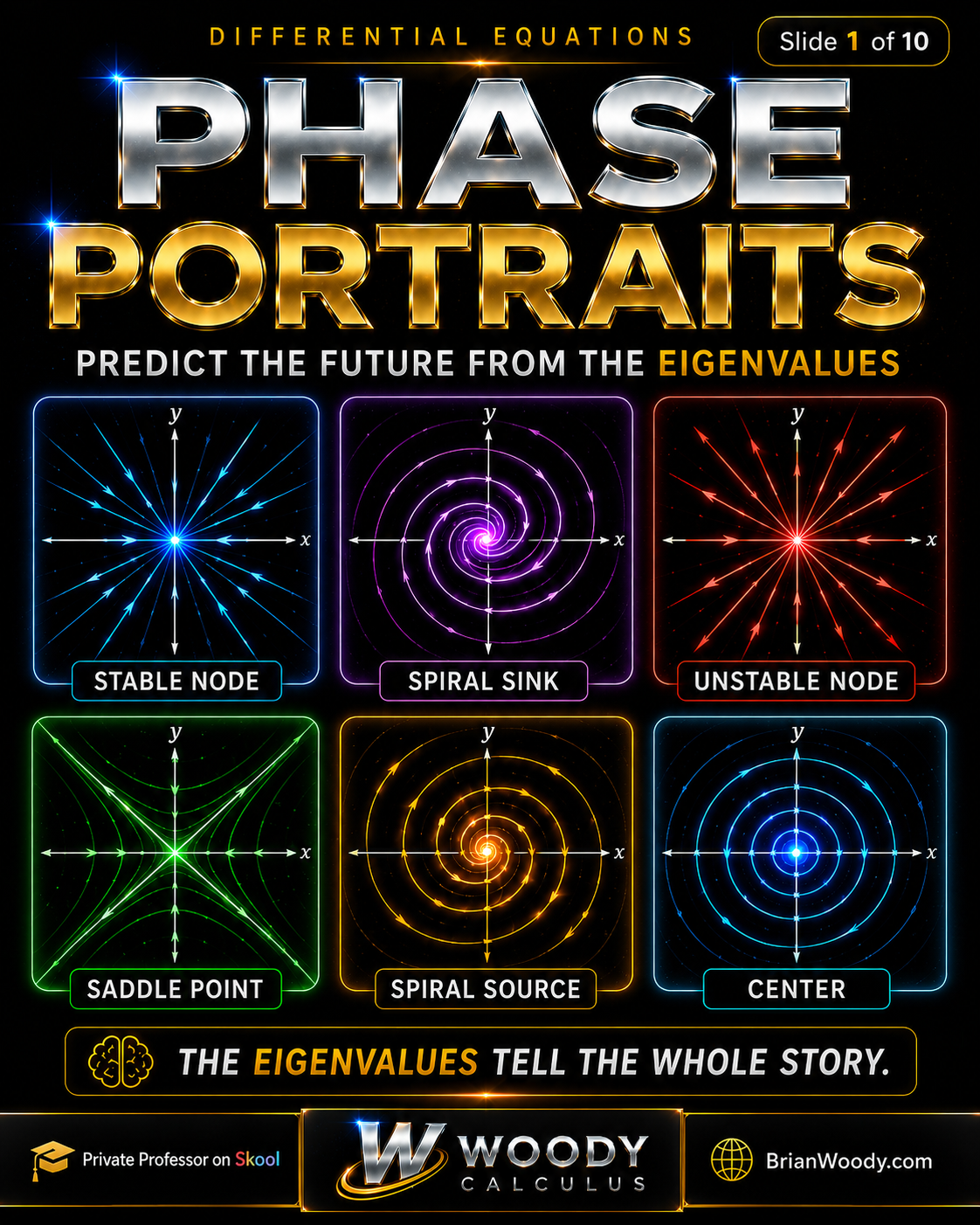

Learn how eigenvalues determine phase portraits in Differential Equations. This Woody Calculus lesson explains stable nodes, unstable nodes, saddle points, spiral sinks, spiral sources, centers, repeated eigenvalues, eigenvectors, and stability.
Learn how eigenvalues determine phase portraits in Differential Equations. This Woody Calculus lesson explains stable nodes, unstable nodes, saddle points, spiral sinks, spiral sources, centers, repeated eigenvalues, eigenvectors, and stability.
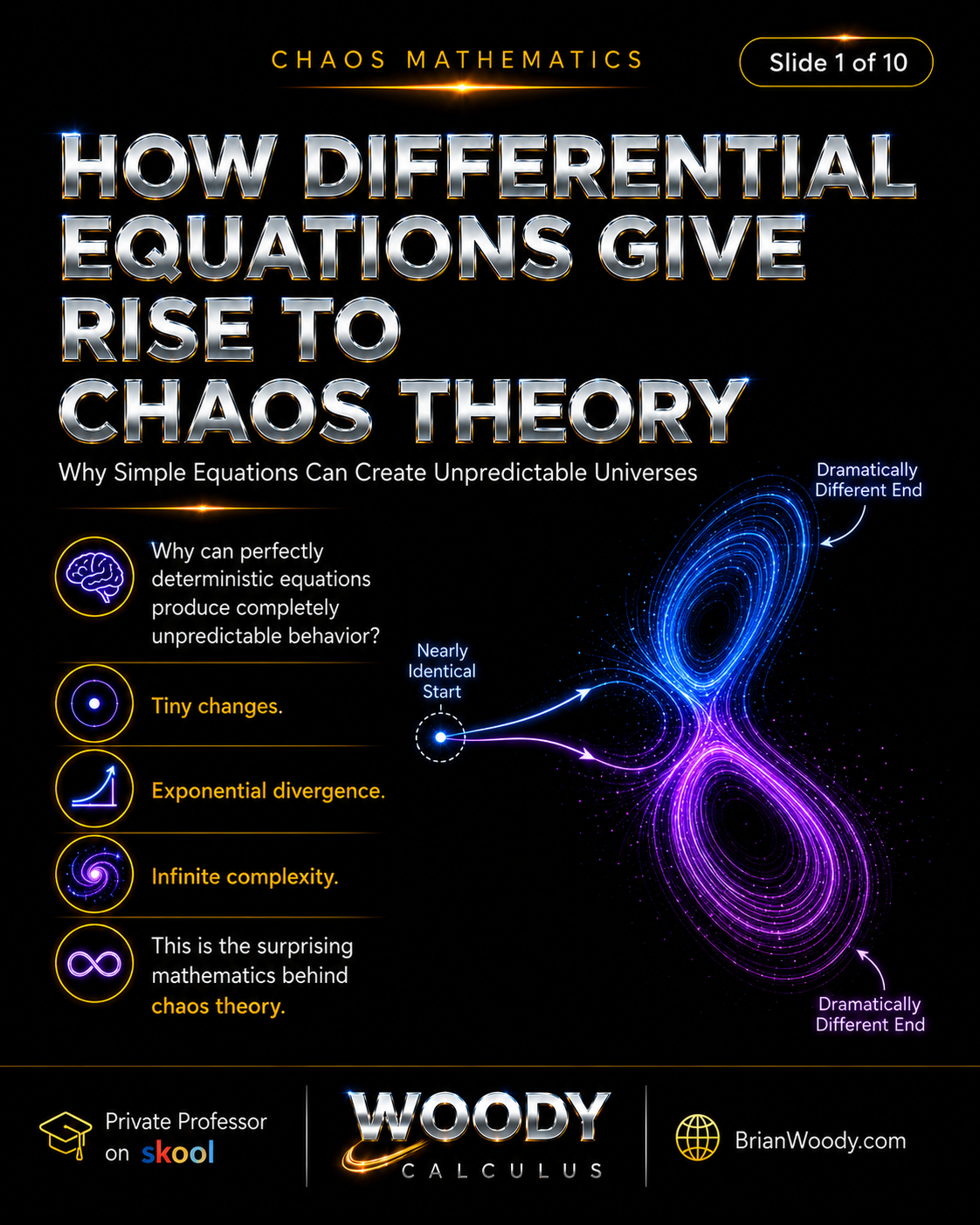
How can deterministic differential equations create unpredictable behavior? This Woody Calculus lesson explains chaos theory through sensitivity to initial conditions, nonlinear systems, phase portraits, Lyapunov exponents, and the Lorenz attractor.
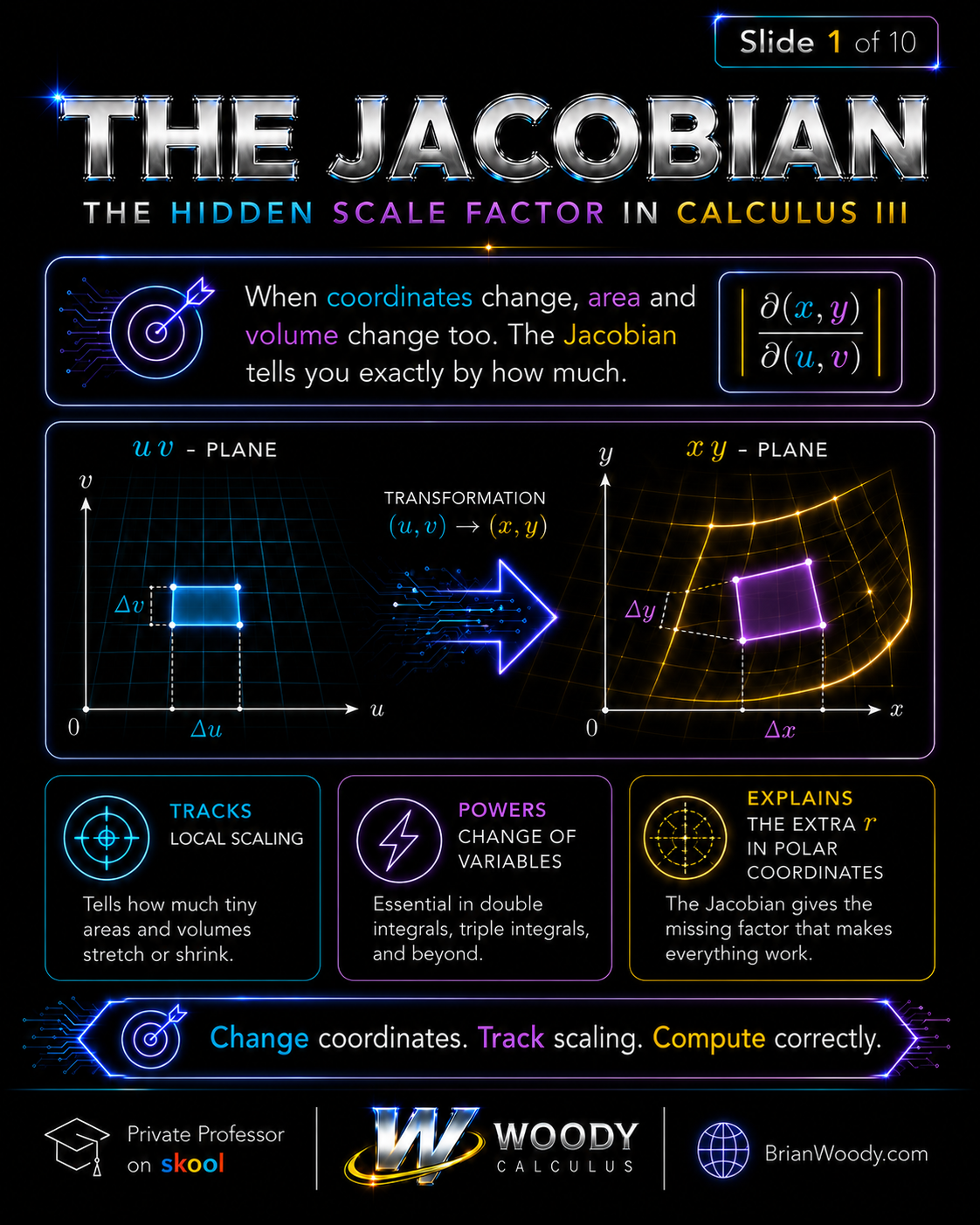
The Jacobian is the hidden scale factor behind every coordinate change in Calculus III. In this Woody Calculus visual lesson, learn how Jacobians explain area and volume scaling, change of variables, polar coordinates, cylindrical coordinates, spherical coordinates, double integrals, triple integrals, and why the mysterious extra factors r and ρ²sinφ appear.
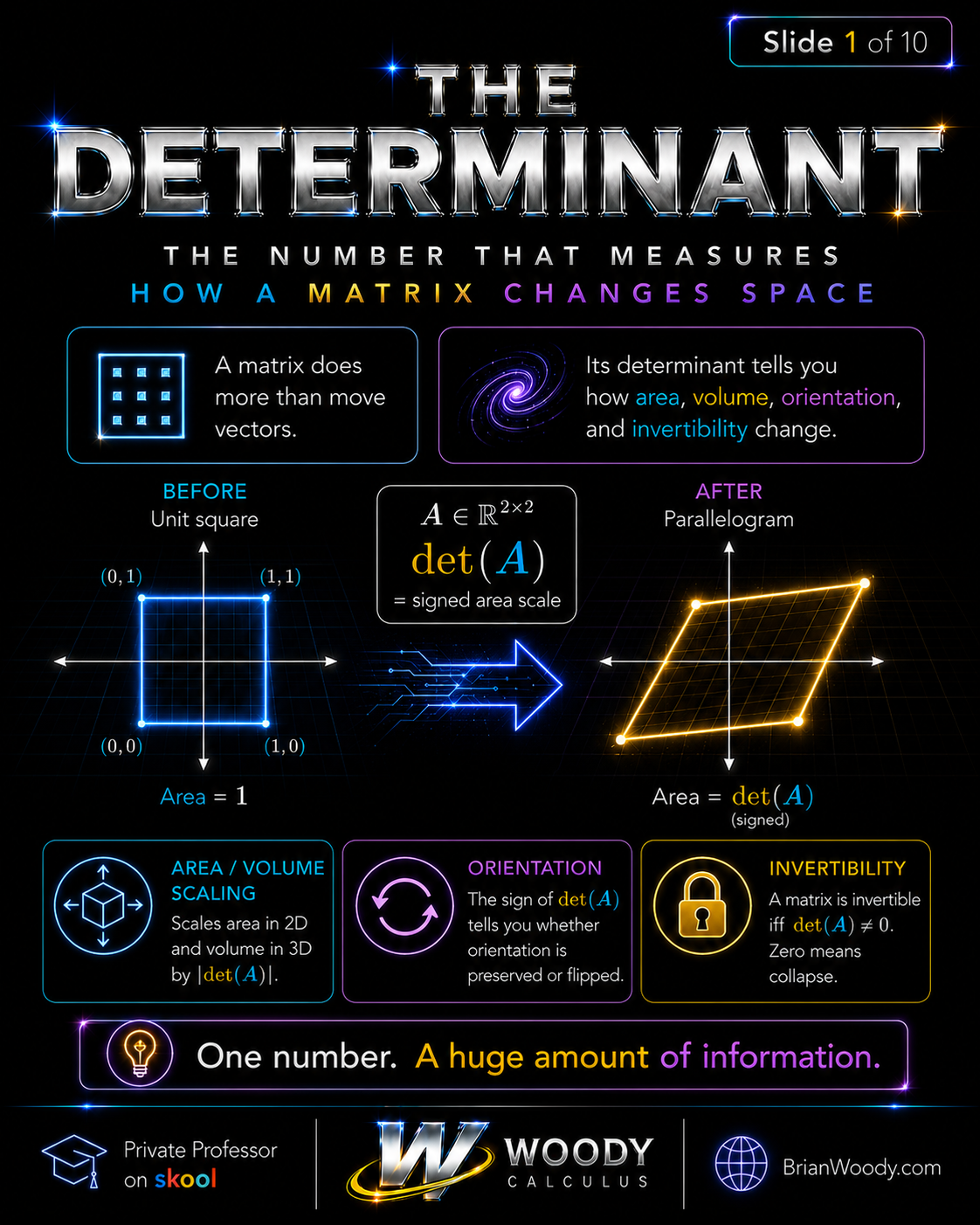
The determinant is the number that measures how a matrix changes space. In this Woody Calculus visual lesson, learn how determinants explain area and volume scaling, orientation, invertibility, matrix collapse, eigenvalues, Wronskians, and why det(A) connects Linear Algebra to Differential Equations.
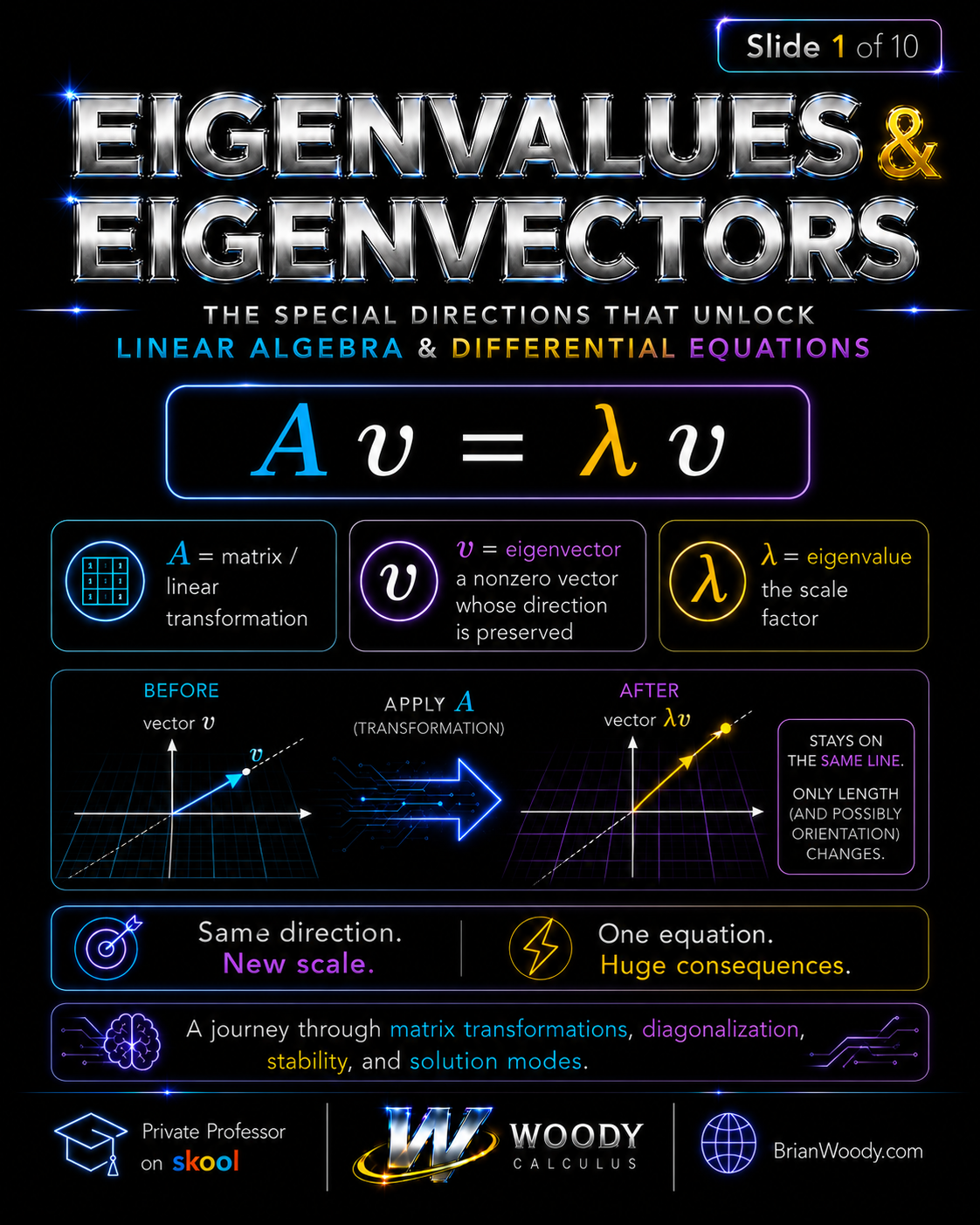
Eigenvalues and eigenvectors reveal the special directions that unlock Linear Algebra and Differential Equations. In this Woody Calculus visual lesson, learn how Av = λv explains matrix transformations, scaling, diagonalization, matrix powers, solution modes, stability, phase portraits, and why eigenvalues predict long-term behavior in systems before you even solve them.
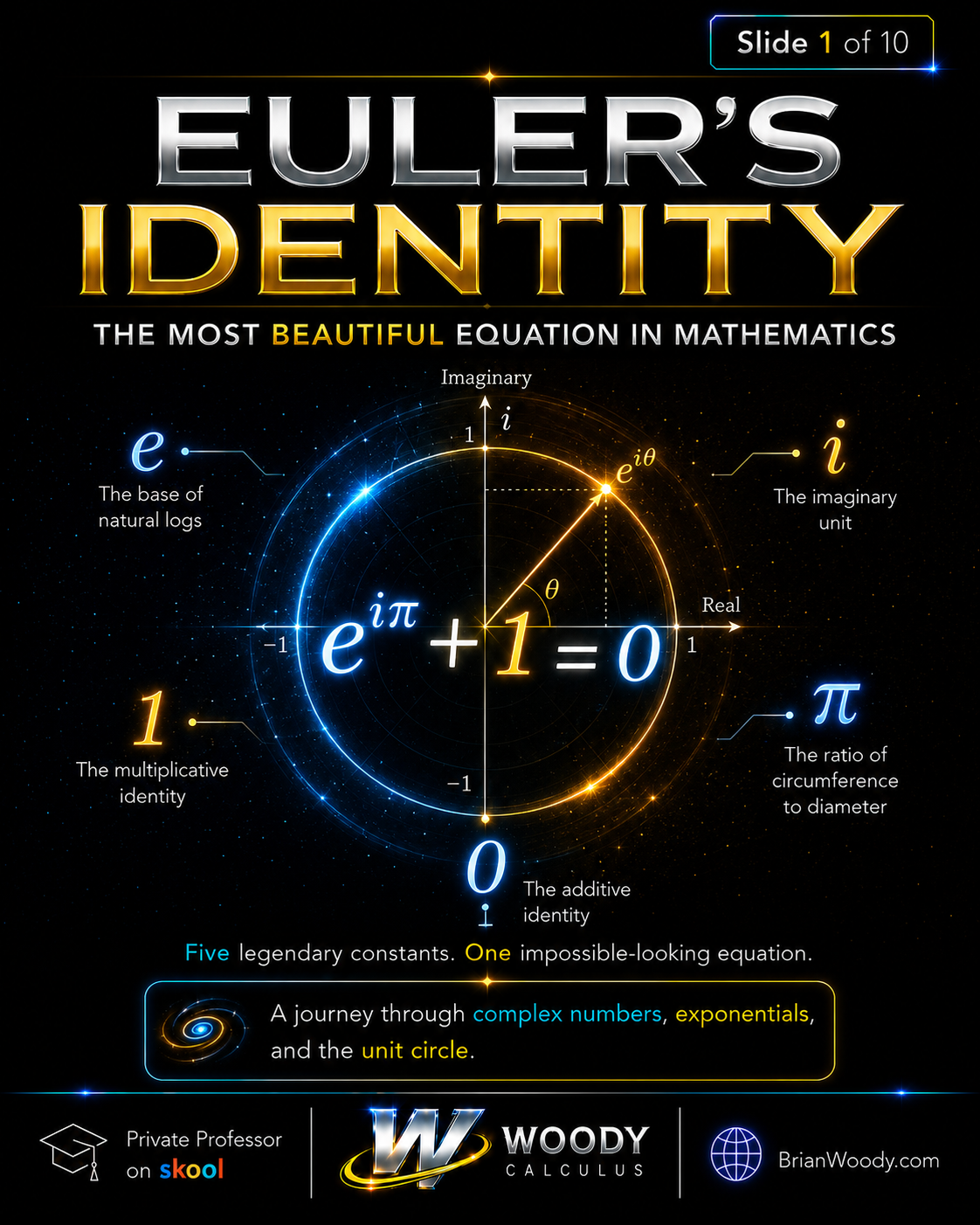
Euler’s Identity is often called the most beautiful equation in mathematics because it connects five legendary constants: e, i, π, 1, and 0. In this Woody Calculus visual lesson, we explain Euler’s formula, the complex plane, the unit circle, Taylor series, and why e^{iπ}+1=0 links algebra, geometry, analysis, waves, physics, and engineering.
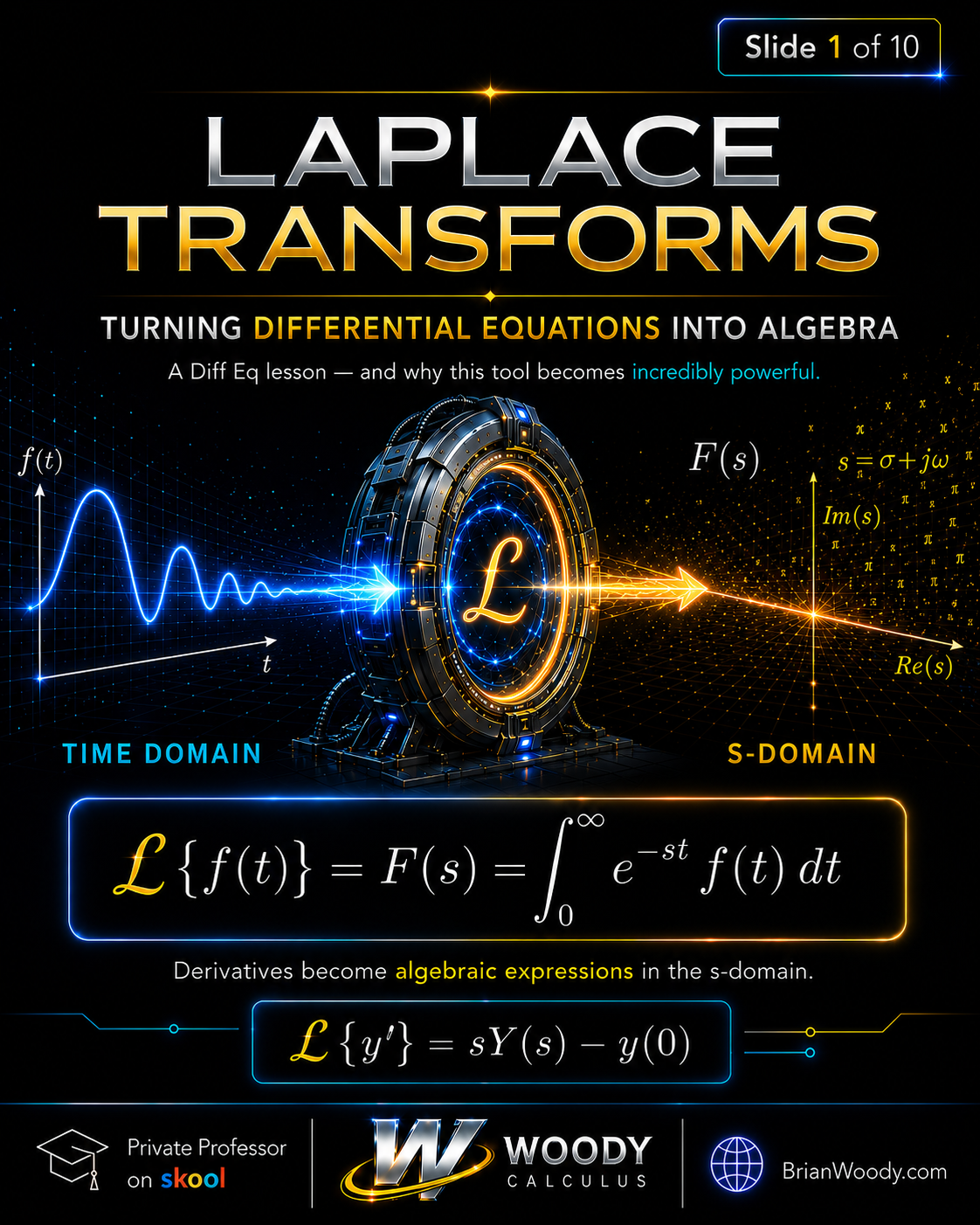
The Laplace Transform turns differential equations into algebra by moving time-domain functions into the s-domain. In this Woody Calculus visual lesson, learn the core formula, derivative rules, initial value problems, partial fractions, inverse Laplace transforms, unit step functions, and why Laplace transforms are so powerful for Differential Equations, engineering, circuits, and applied mathematics.
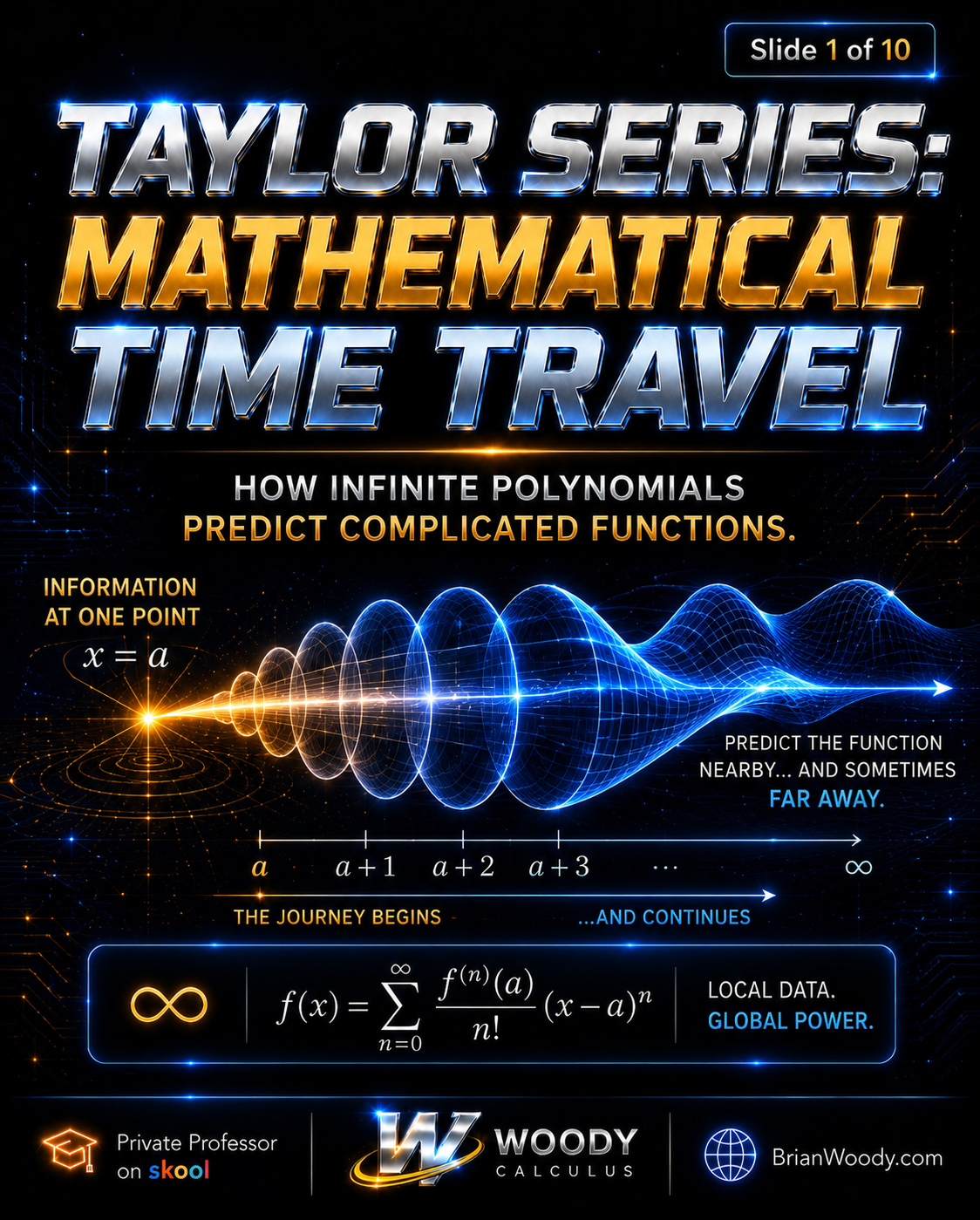
Taylor Series turn complicated functions into polynomial patterns. Learn how local derivative information at one point can build powerful approximations for e^x, sin x, ln(1+x), physics, finance, and Differential Equations.
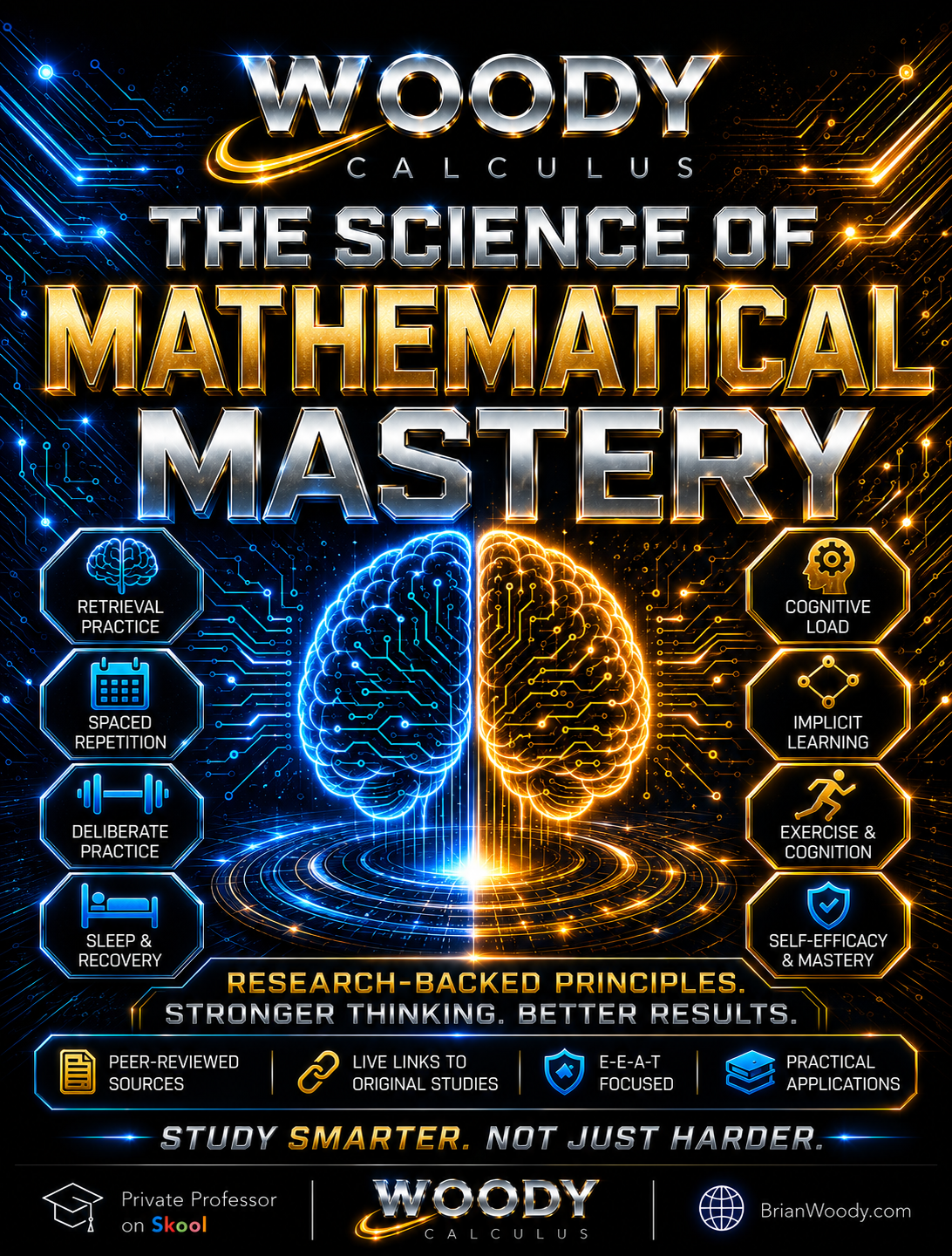
After nearly thirty years of teaching advanced mathematics, Brian M. Woody explains how to learn calculus through perfect practice, subconscious training, active recall, sleep science, and identity transformation.
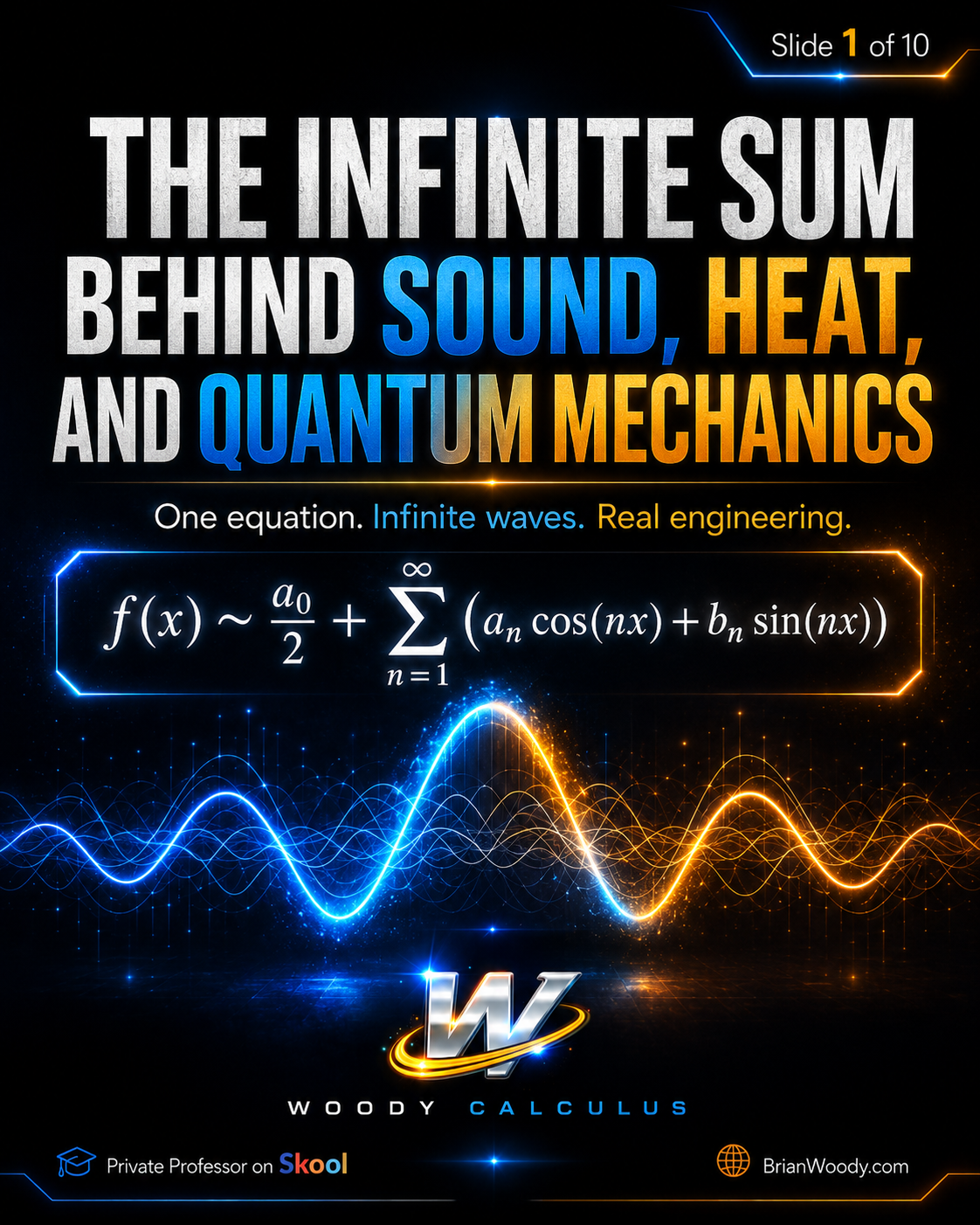
Fourier series reveal how complex periodic signals can be rebuilt from simple sine and cosine waves. Learn how harmonics, Fourier coefficients, orthogonality, partial sums, and frequency-domain thinking connect to sound, heat flow, PDEs, engineering, and quantum mechanics.