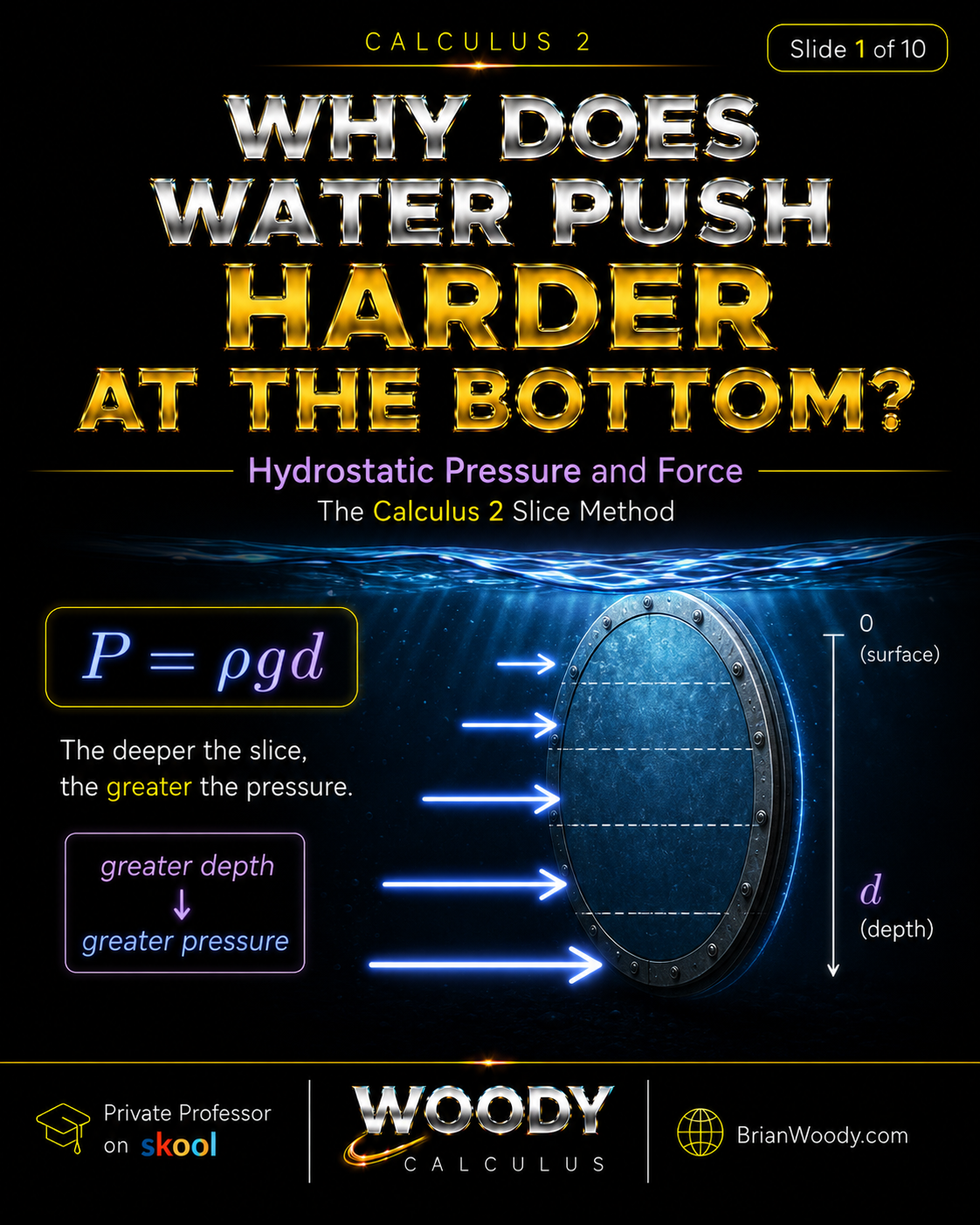
Hydrostatic force problems are Calculus 2 slice-method problems in disguise. This Woody Calculus lesson explains why force equals density times gravity times area times depth, why pressure changes with depth, and how to set up the hydrostatic force integral for a circular plate.
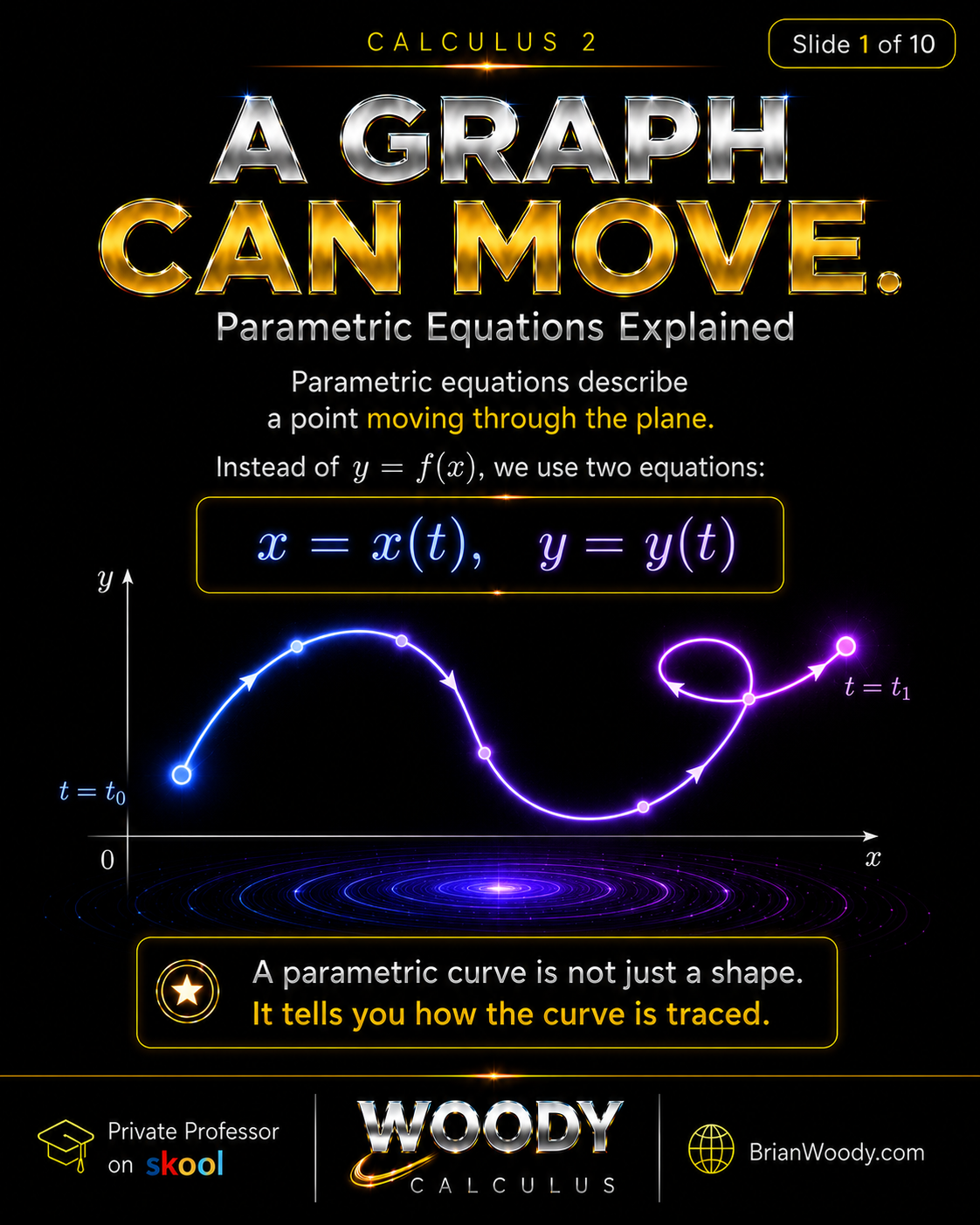
Parametric equations describe a point moving through the plane. This Woody Calculus lesson explains how \(x=x(t)\) and \(y=y(t)\) create a directed curve, how to compute \(\frac{dy}{dx}\), and how to find horizontal and vertical tangent lines.
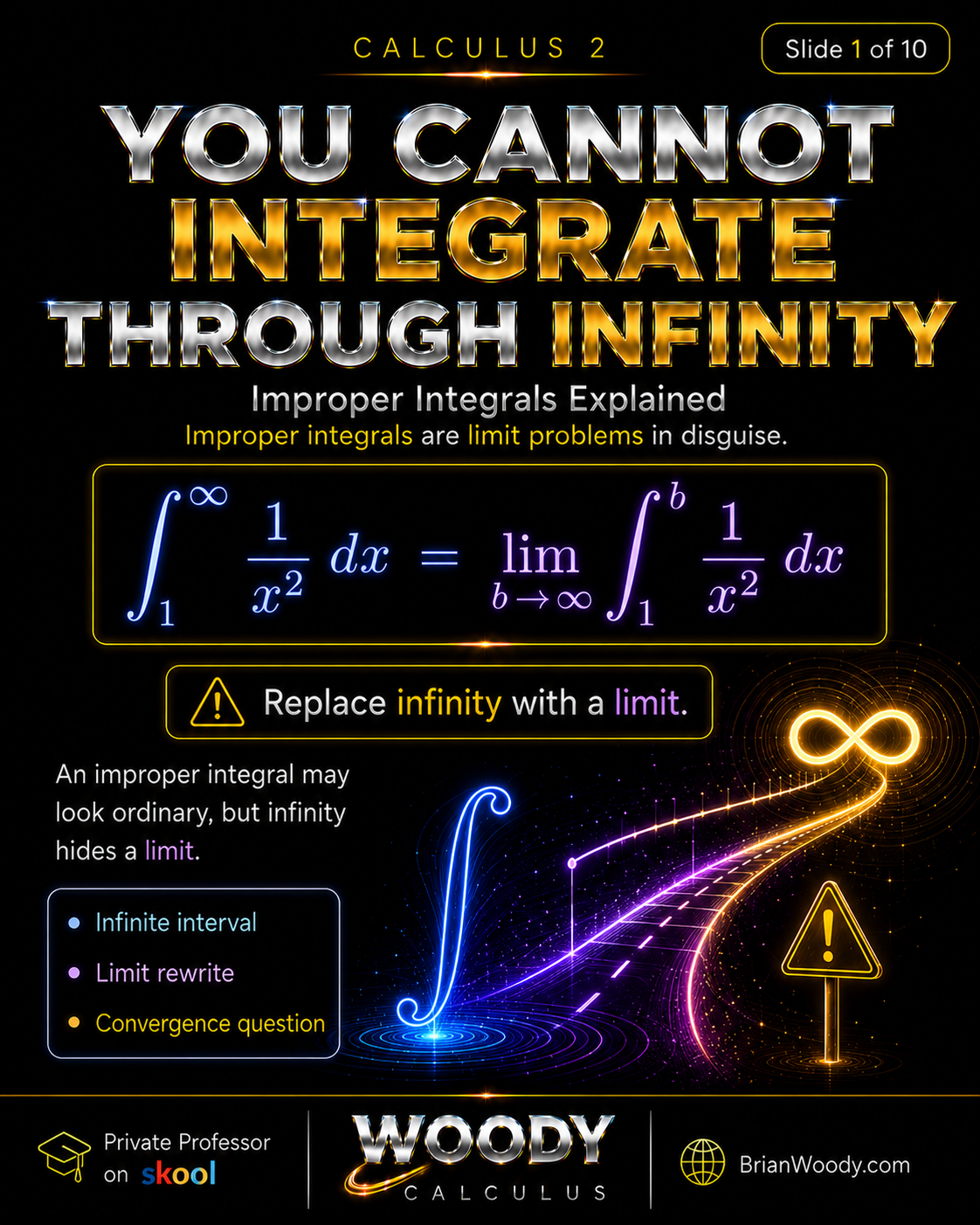
Improper integrals are Calculus 2 limit problems in disguise. This Woody Calculus lesson teaches how to handle infinite intervals, vertical asymptotes, bad points inside an interval, p-integrals, comparison tests, convergence, and divergence with a clear step-by-step system.
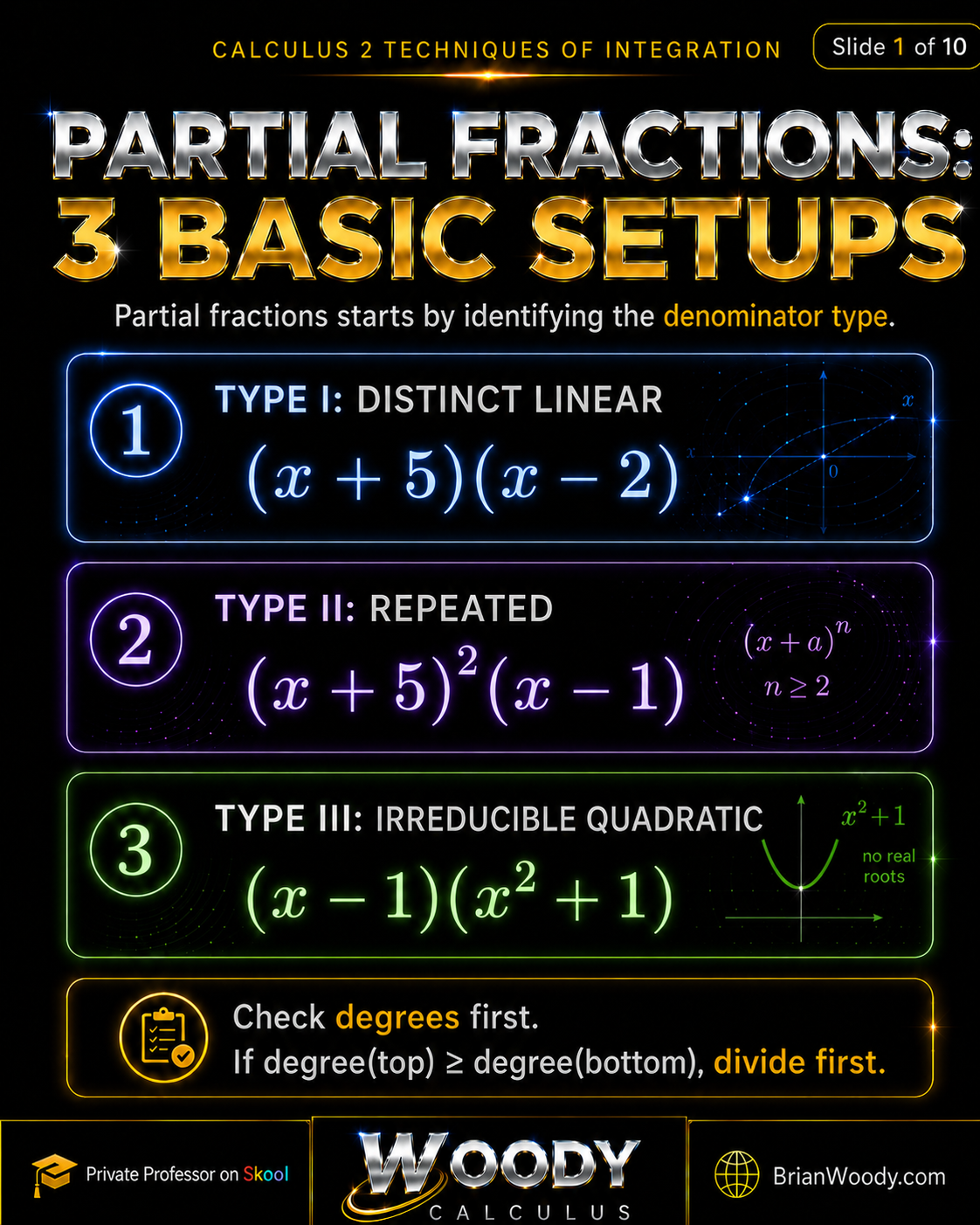
Partial fraction decomposition becomes easier when students stop guessing and identify the denominator type first. This Woody Calculus lesson teaches the complete Calculus 2 system: distinct linear factors, repeated factors, irreducible quadratics, solving for constants, and integrating each piece.
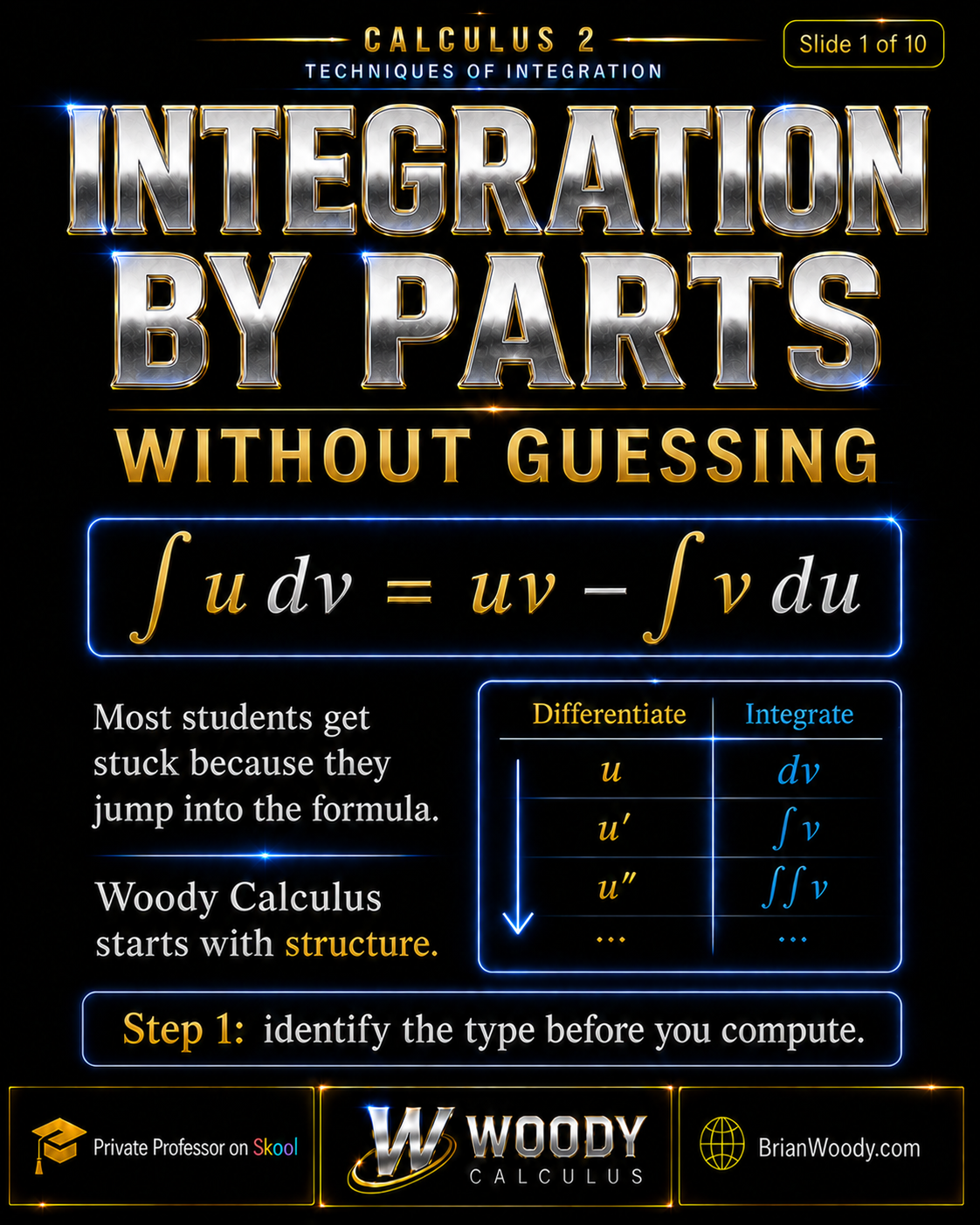
Integration by parts becomes easier when students stop guessing and identify the structure first. This Woody Calculus lesson teaches the complete 3-type IBP system for Calculus 2, including tabular integration by parts, exponential-trig loops, logarithms, inverse trig, and worked examples.
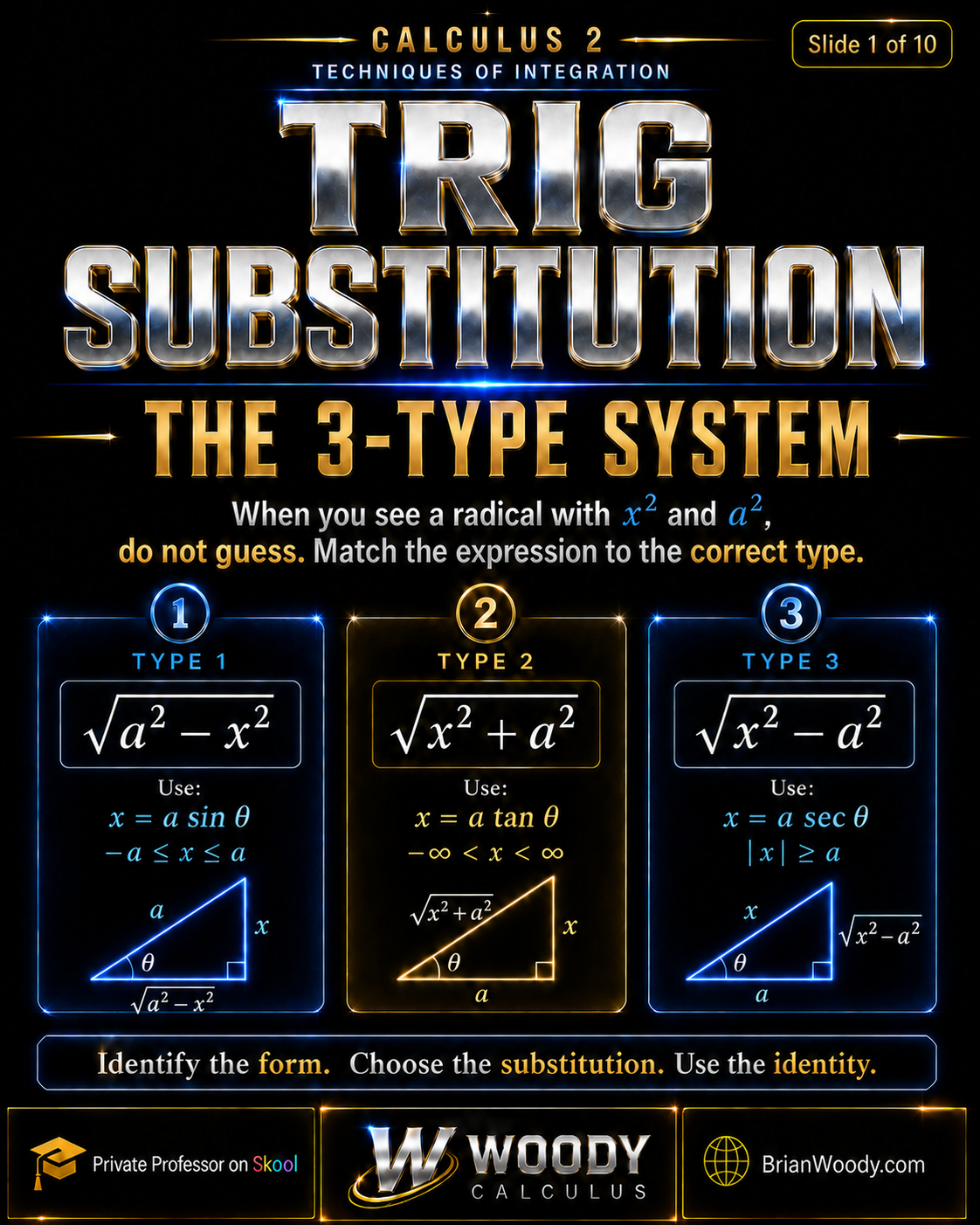
Trig substitution becomes much easier when students stop guessing and match the radical to one of three forms. This Woody Calculus lesson teaches the complete 3-type system for Calculus 2: sine for sqrt(a²−x²), tangent for sqrt(x²+a²), and secant for sqrt(x²−a²).
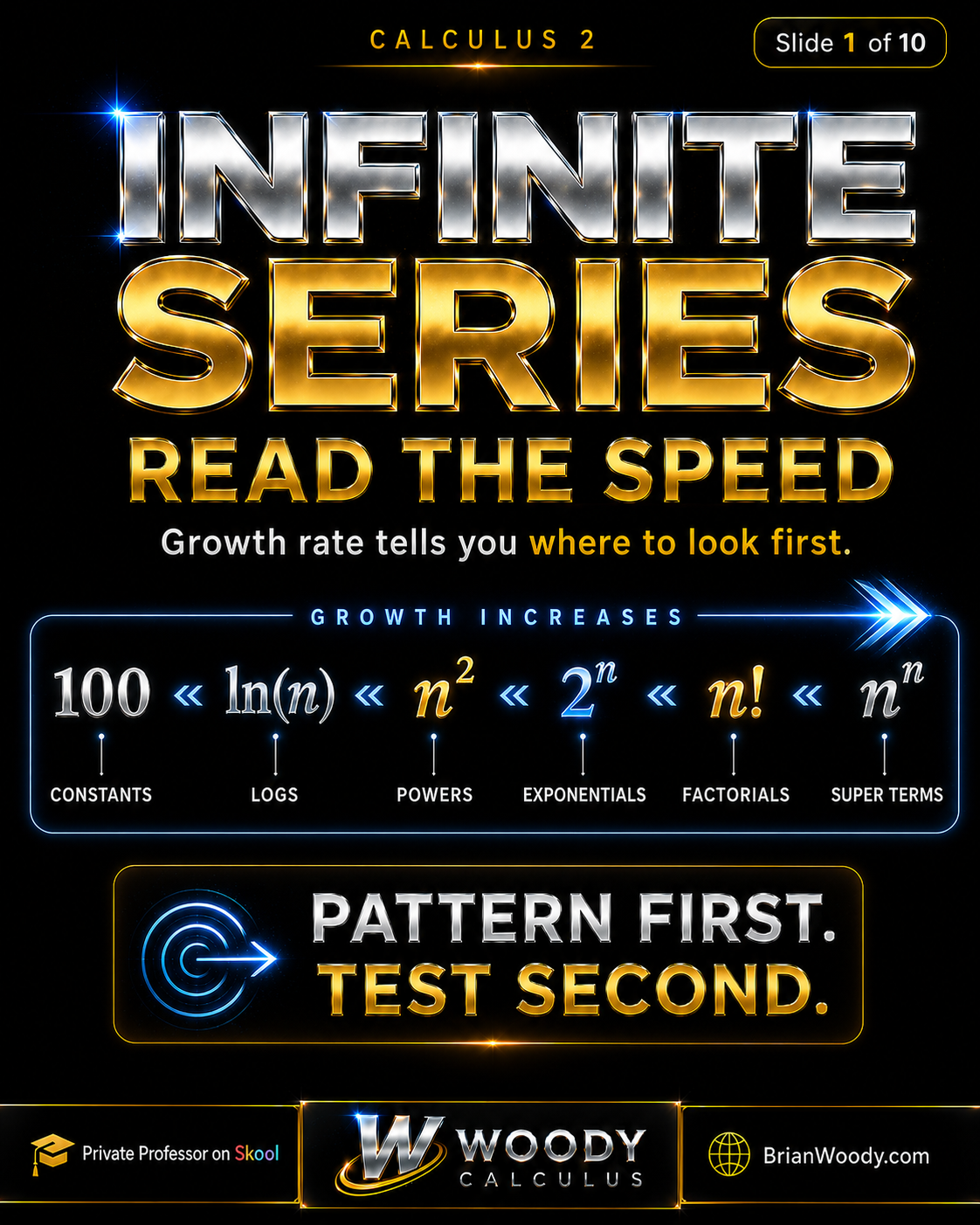
Learn how to choose the right infinite series test in Calculus 2. This Woody Calculus guide explains the Test for Divergence, p-test, geometric series, Limit Comparison Test, Direct Comparison Test, Ratio Test, Root Test, Integral Test, Alternating Series Test, and telescoping series.
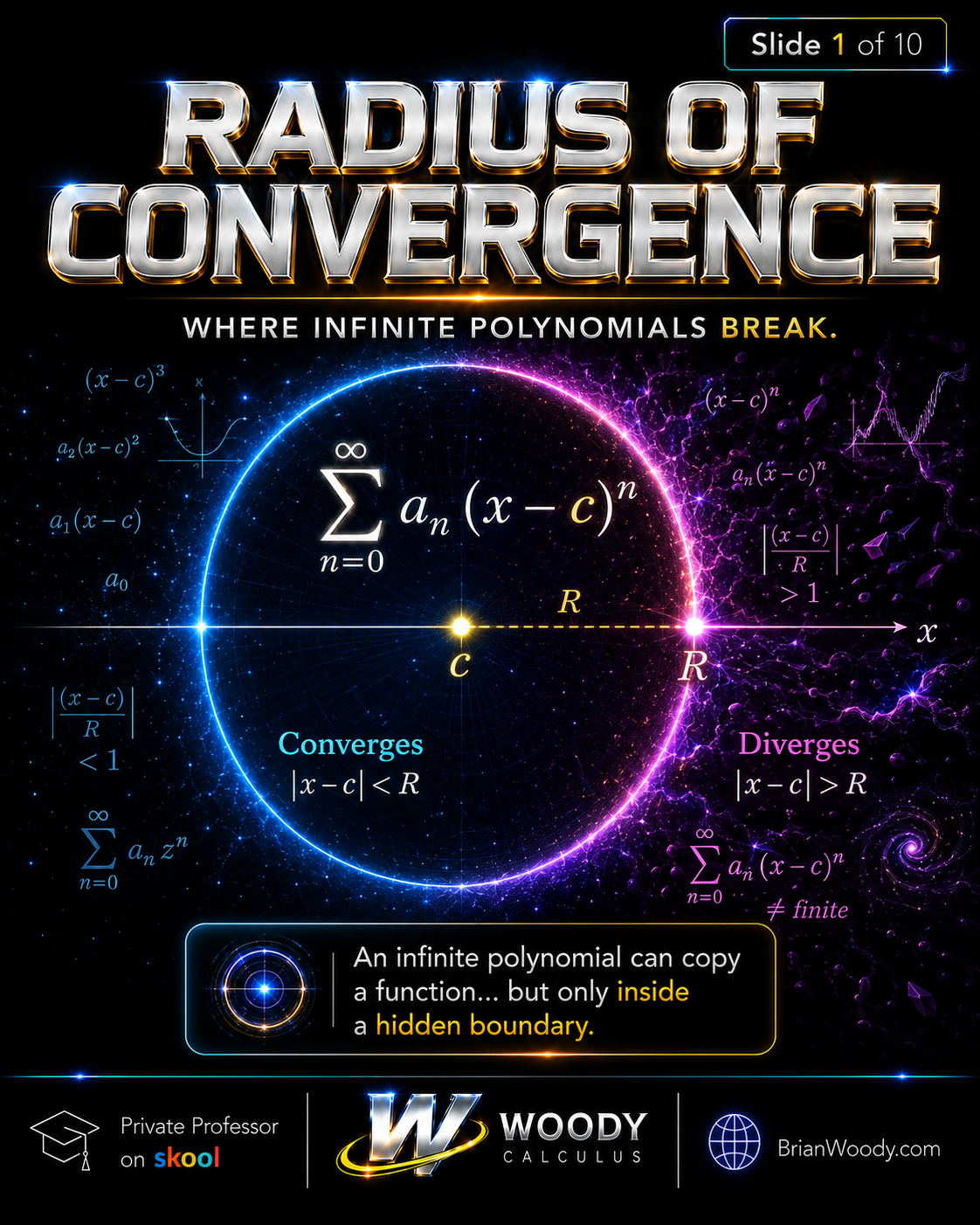
The radius of convergence is the hidden boundary where an infinite polynomial stops behaving like a function. In this Woody Calculus visual lesson, learn how power series are built around a center, how the Ratio Test finds R, why endpoints must be tested separately, and how to find the full interval of convergence.
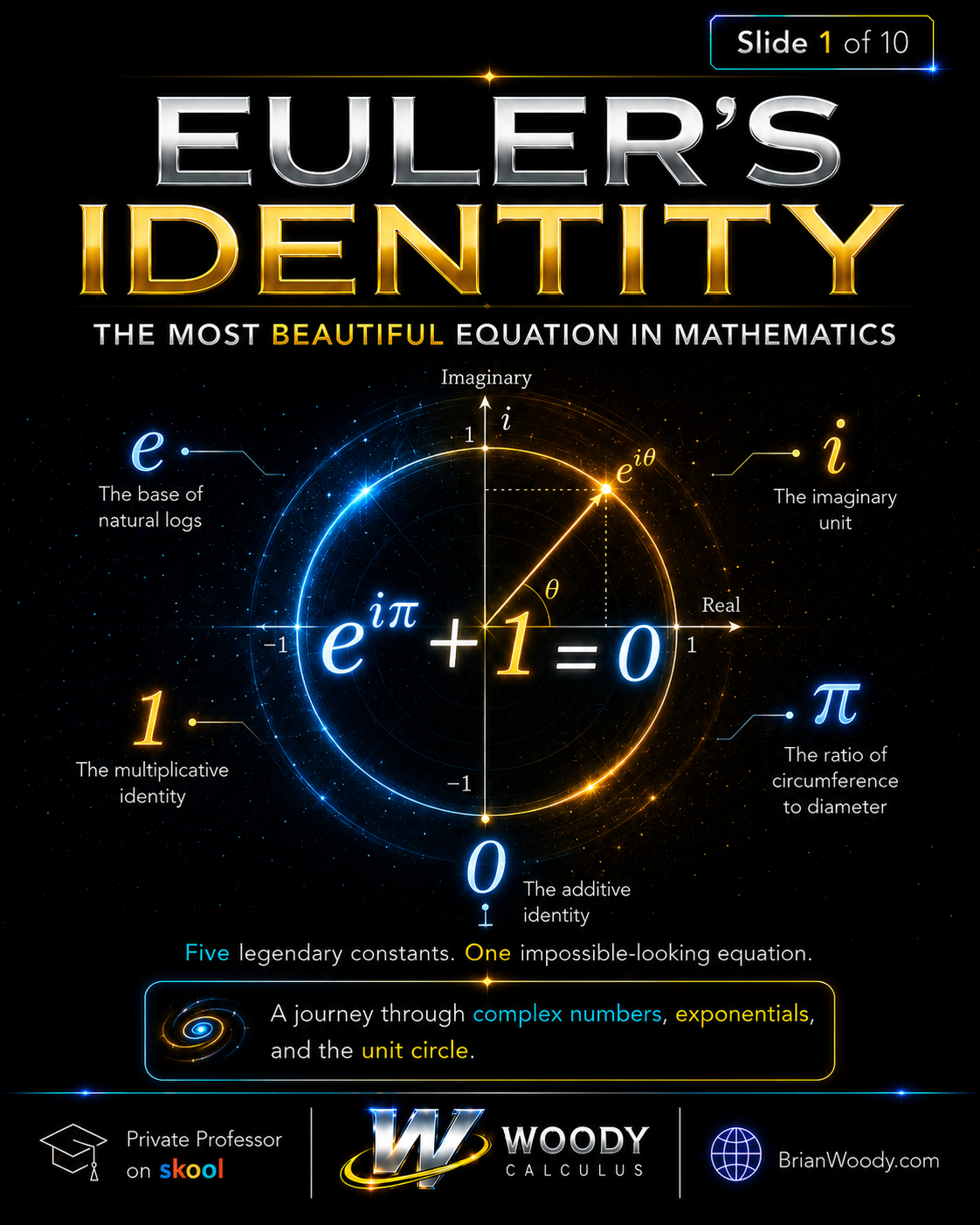
Euler’s Identity is often called the most beautiful equation in mathematics because it connects five legendary constants: e, i, π, 1, and 0. In this Woody Calculus visual lesson, we explain Euler’s formula, the complex plane, the unit circle, Taylor series, and why e^{iπ}+1=0 links algebra, geometry, analysis, waves, physics, and engineering.
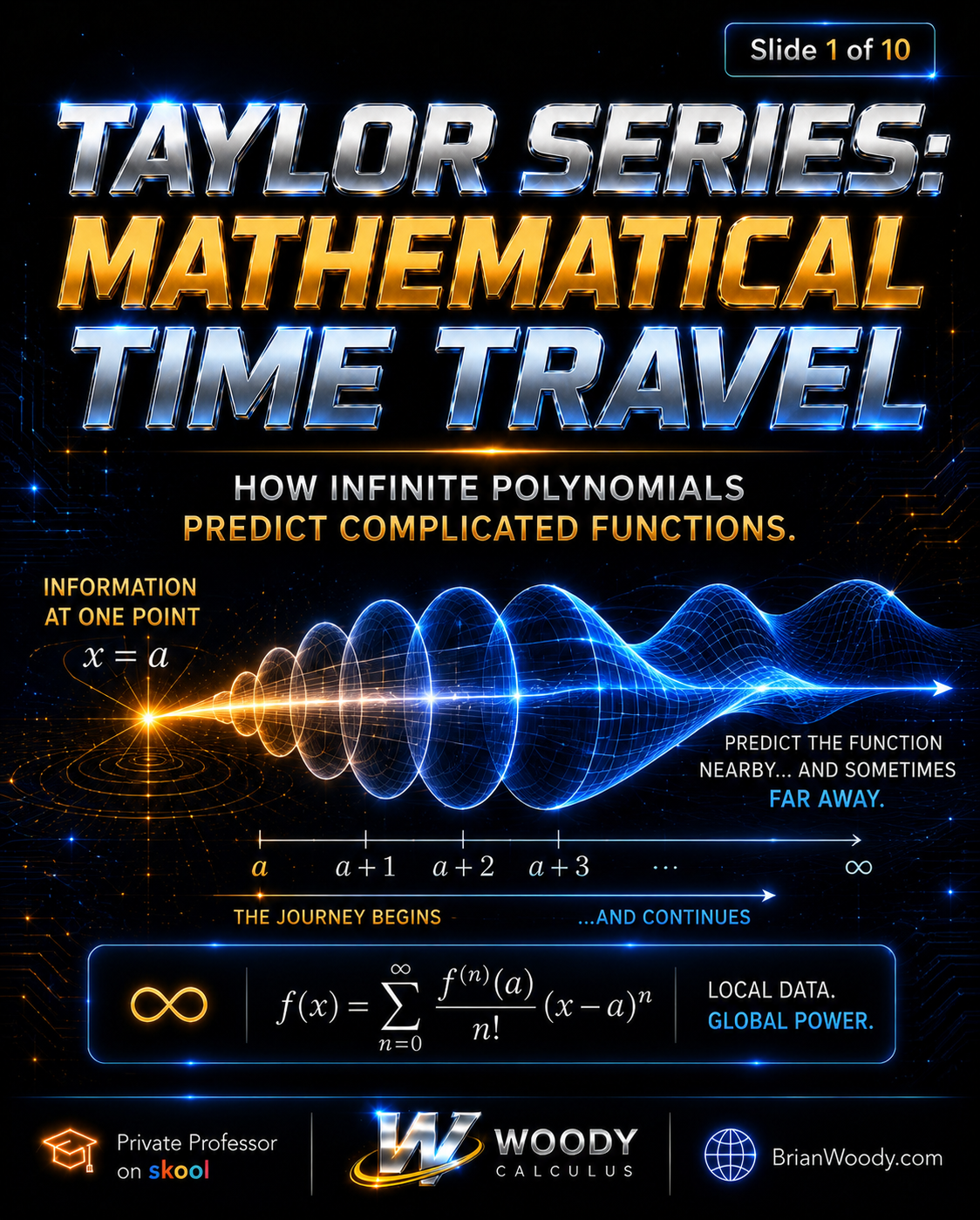
Taylor Series turn complicated functions into polynomial patterns. Learn how local derivative information at one point can build powerful approximations for e^x, sin x, ln(1+x), physics, finance, and Differential Equations.