Hydrostatic force is one of the most important applications of integration in Calculus 2. It looks like a physics problem, but the setup is pure Calculus 2: take a thin slice, find the force on that slice, and integrate.
The main idea is:
\boxed{F=(\text{density})(\text{gravity})(\text{area})(\text{depth})}
\]
More precisely, if \(\rho\) is mass density, \(g\) is gravitational acceleration, \(A\) is area, and \(d\) is depth, then the force on a flat surface at constant depth is:
F=\rho g A d.
\]
In U.S. customary units, water is usually given by its weight density:
w=\rho g=62.4\ \text{lb/ft}^3.
\]
So the same formula is written:
F=wAd.
\]
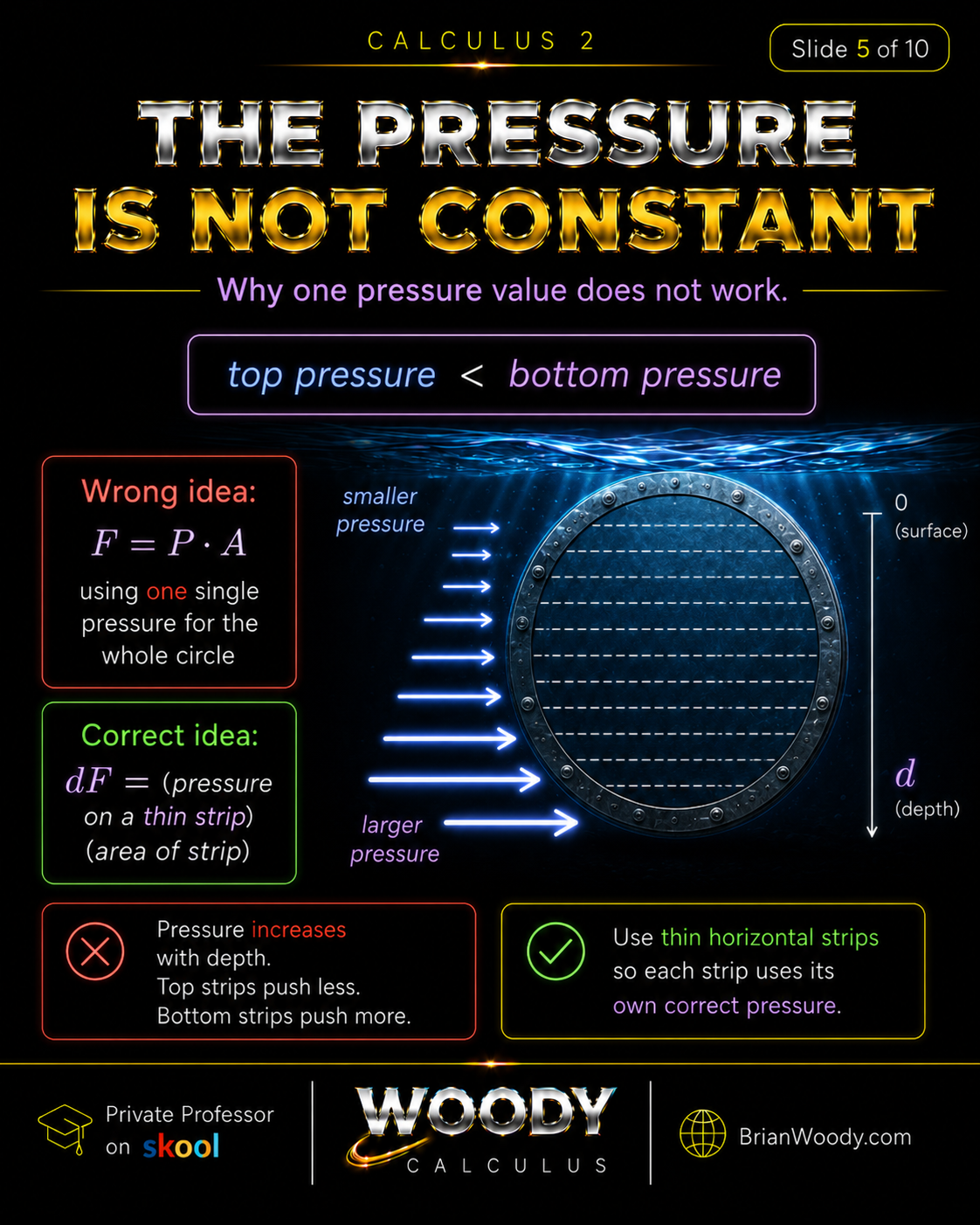
But here is the reason hydrostatic force becomes a Calculus 2 problem: on a vertical plate, the depth is not constant. The top of the plate has less pressure, and the bottom of the plate has more pressure. That means we cannot use one pressure value for the whole plate.
Hydrostatic force problems are slice problems because pressure changes with depth.
This Woody Calculus lesson explains how to derive pressure from force, why \(P=\rho g d\), why each strip needs its own pressure, and how to build the hydrostatic force integral for a circular plate.
Estimated read time: 16–20 minutes.
Last updated: .
What Is Hydrostatic Force?
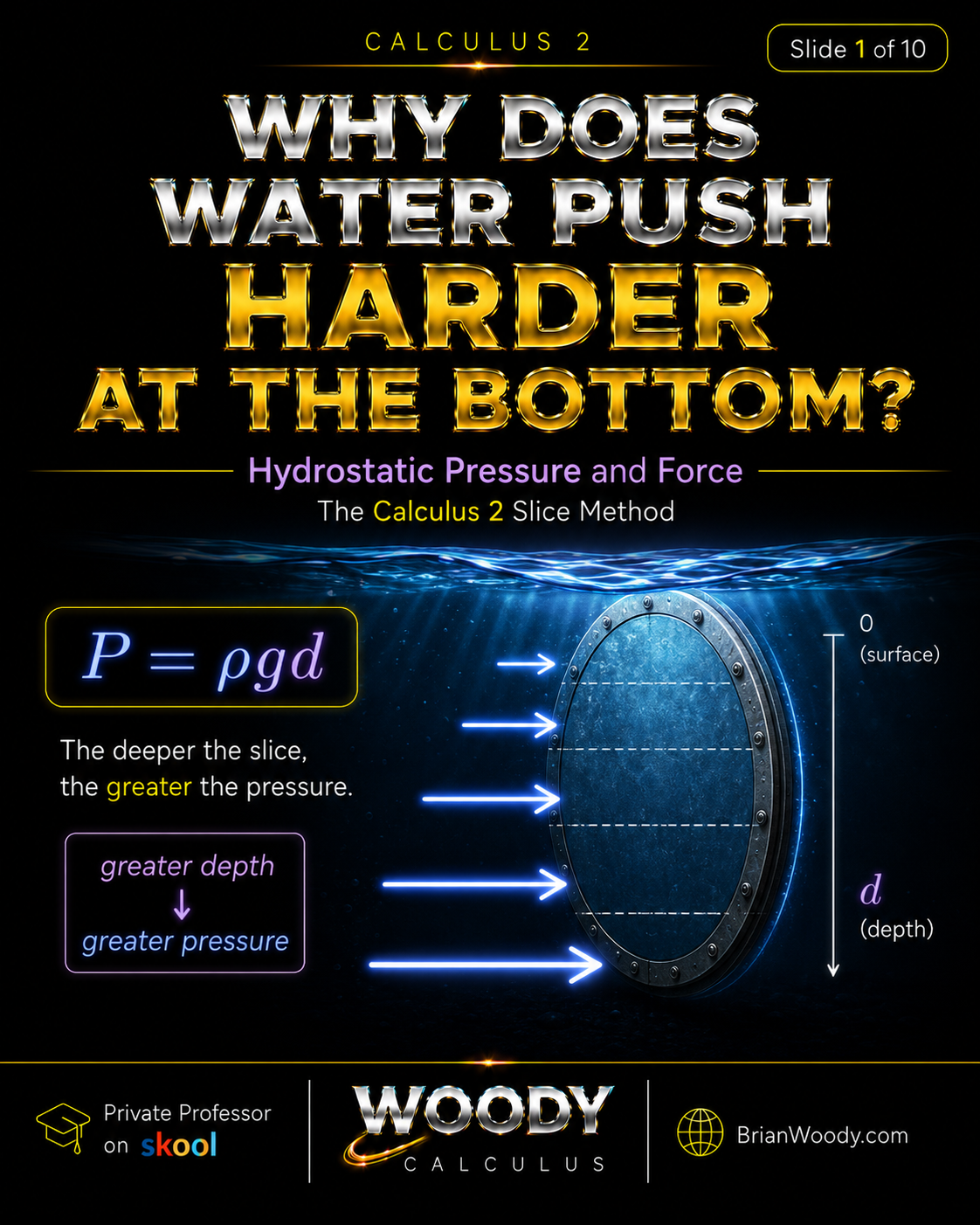
Hydrostatic force is the force exerted by a fluid at rest on a submerged surface. In Calculus 2, the surface is often a vertical plate, the end of a tank, a dam face, or the circular end of a drum.
The force comes from pressure. The deeper a point is below the water surface, the more water is above it, so the greater the pressure.
That is why hydrostatic force problems are not just geometry problems. They combine:
- fluid pressure,
- depth,
- area of thin slices,
- and integration.
The essential slice formula is:
dF=P\,dA.
\]
Since pressure depends on depth, we write:
dF=(\rho g)(\text{depth})(dA).
\]
That is the formula students should memorize. Hydrostatic force is pressure times tiny area, integrated over the whole submerged surface.
Why Force Equals Density Times Gravity Times Area Times Depth
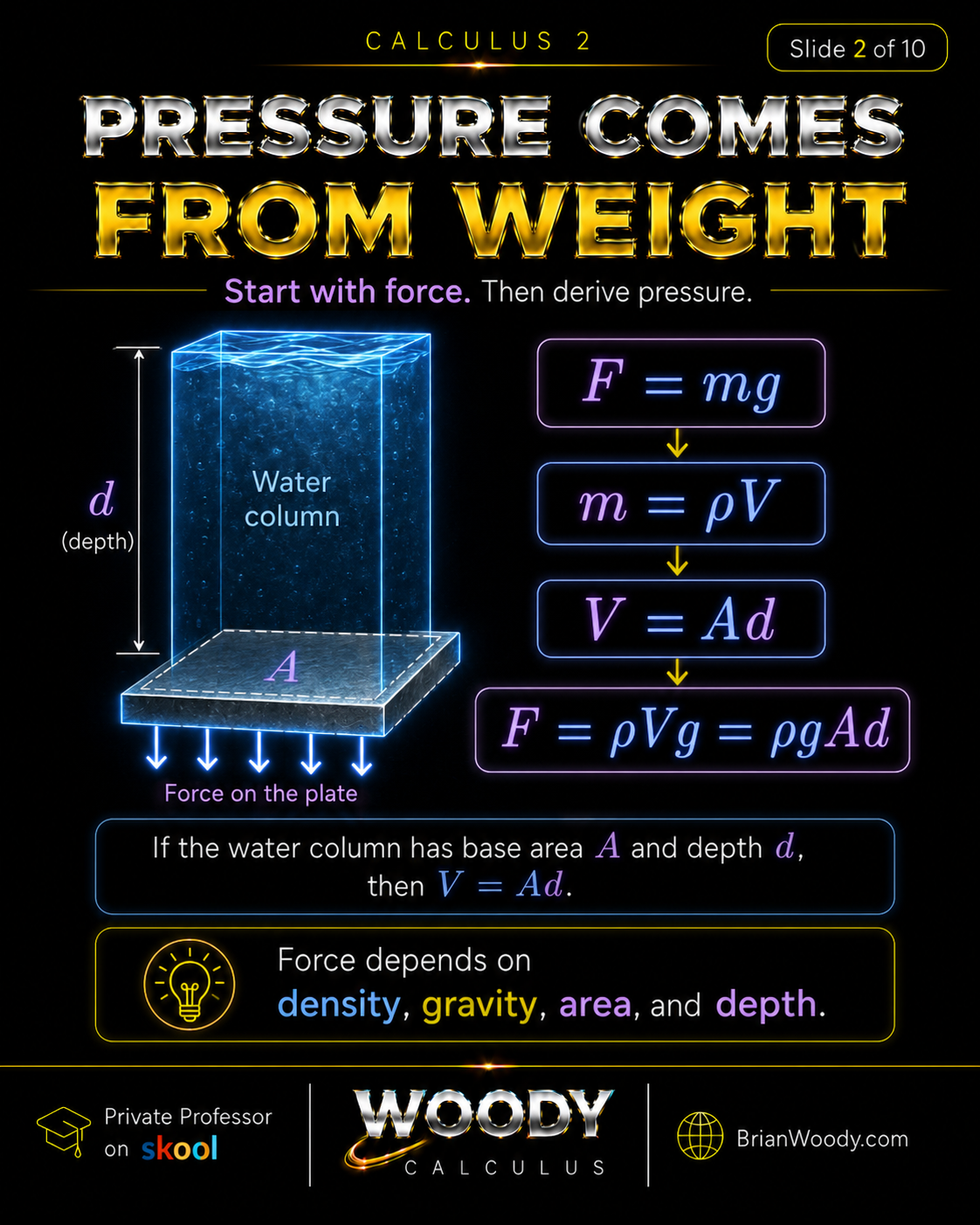
Start with ordinary force from weight:
F=mg.
\]
If \(\rho\) is mass density, then mass is density times volume:
m=\rho V.
\]
For a water column with base area \(A\) and depth \(d\), the volume is:
V=Ad.
\]
Substitute into the weight formula:
F=mg=(\rho V)g=\rho g V.
\]
Now substitute \(V=Ad\):
F=\rho g A d.
\]
So the constant-depth force formula is:
\boxed{F=(\text{density})(\text{gravity})(\text{area})(\text{depth})}.
\]
This formula is the conceptual foundation of every hydrostatic force problem. In U.S. customary units, \(\rho g\) is often already combined into the weight density \(w\), so for water:
w=62.4\ \text{lb/ft}^3,
\qquad
F=wAd.
\]
Important unit warning: when the problem gives \(62.4\ \text{lb/ft}^3\), that is already a weight density. Do not multiply by \(g\) again.
Why Pressure Is Force Per Area
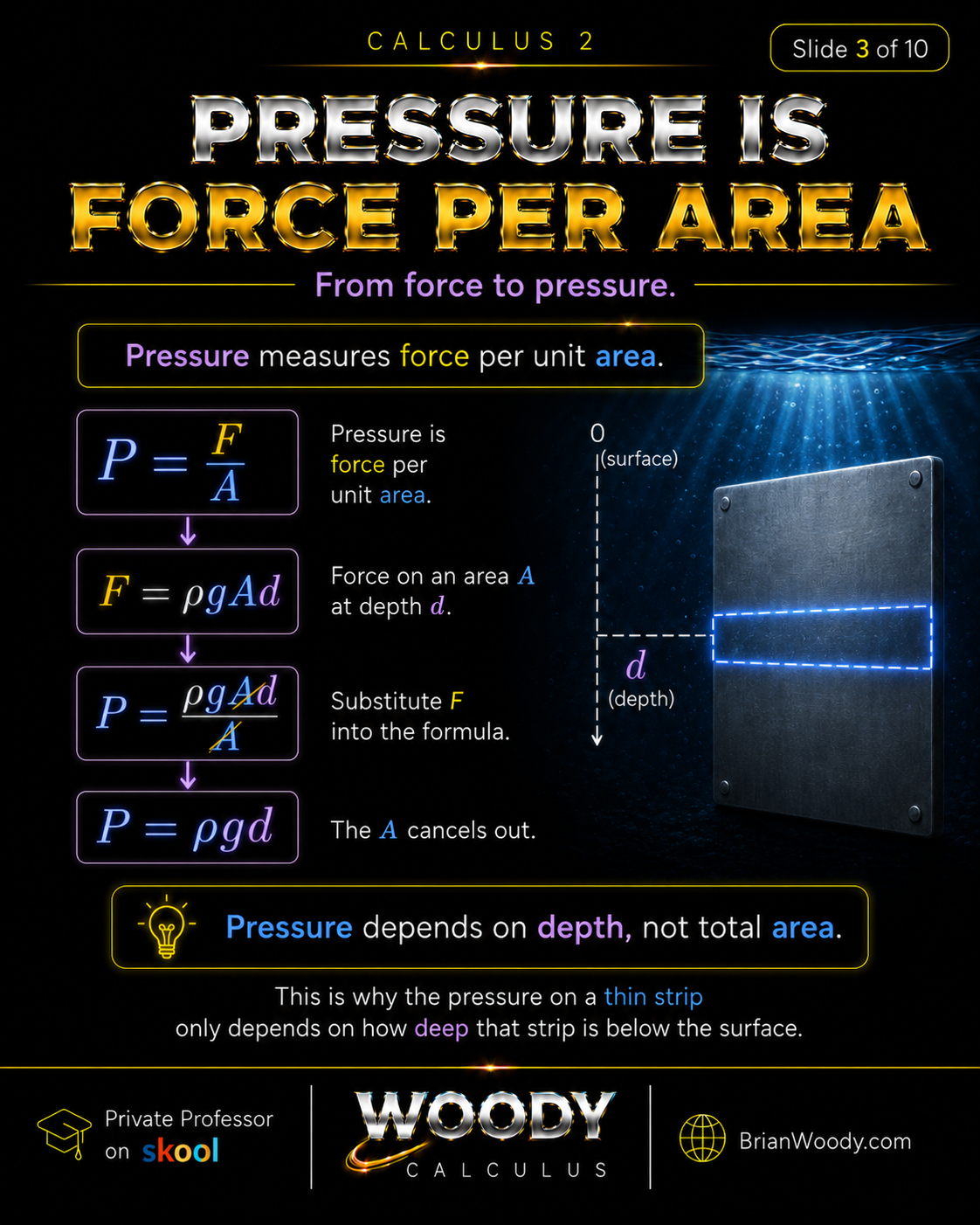
Pressure measures force per unit area:
P=\frac{F}{A}.
\]
Using the constant-depth force formula:
F=\rho g A d,
\]
we divide by \(A\):
P=\frac{\rho g A d}{A}.
\]
The area cancels:
P=\rho g d.
\]
This is the hydrostatic pressure formula:
\boxed{P=\rho g d.}
\]
If we use weight density \(w=\rho g\), then:
\boxed{P=wd.}
\]
For water in U.S. customary units:
P=62.4d.
\]
The unit is pounds per square foot, because pressure is force per area:
P=62.4d\ \text{lb/ft}^2.
\]
This is the key point: pressure depends on depth, not total area.
How to Set Up the Circular Drum Problem
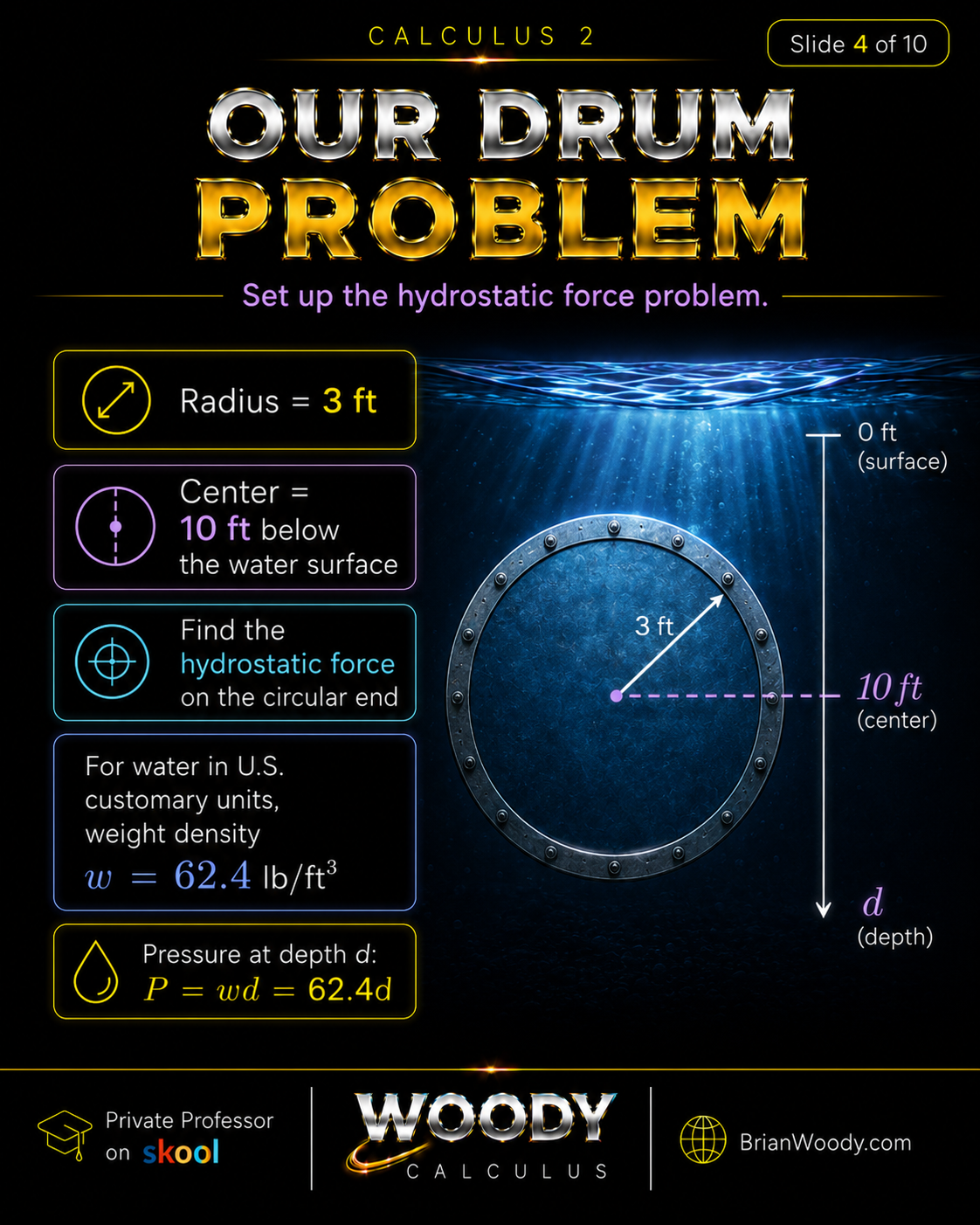
Now consider the circular end of a drum submerged vertically in water.
The data are:
- Radius of the circular end: \(3\) ft.
- Center of the circle: \(10\) ft below the water surface.
- Water weight density: \(w=62.4\ \text{lb/ft}^3\).
- Goal: find the hydrostatic force on the circular end.
Because the plate is vertical, the top is closer to the surface and the bottom is deeper. So the pressure is smaller near the top and larger near the bottom.
That means we need a slice integral.
Why Hydrostatic Pressure Is Not Constant
A common mistake is to try:
F=P\cdot A
\]
using one single pressure value for the entire circular plate.
That does not work here because pressure is not constant across the plate. The top of the circle is less deep, so it has smaller pressure. The bottom of the circle is deeper, so it has larger pressure.
The correct idea is to cut the circular plate into many thin horizontal strips. Each strip is so thin that its depth is approximately constant.
For one thin strip:
dF=P\,dA.
\]
Then we add up all the tiny strip forces by integrating:
F=\int dF.
\]
Why We Put the Origin at the Center
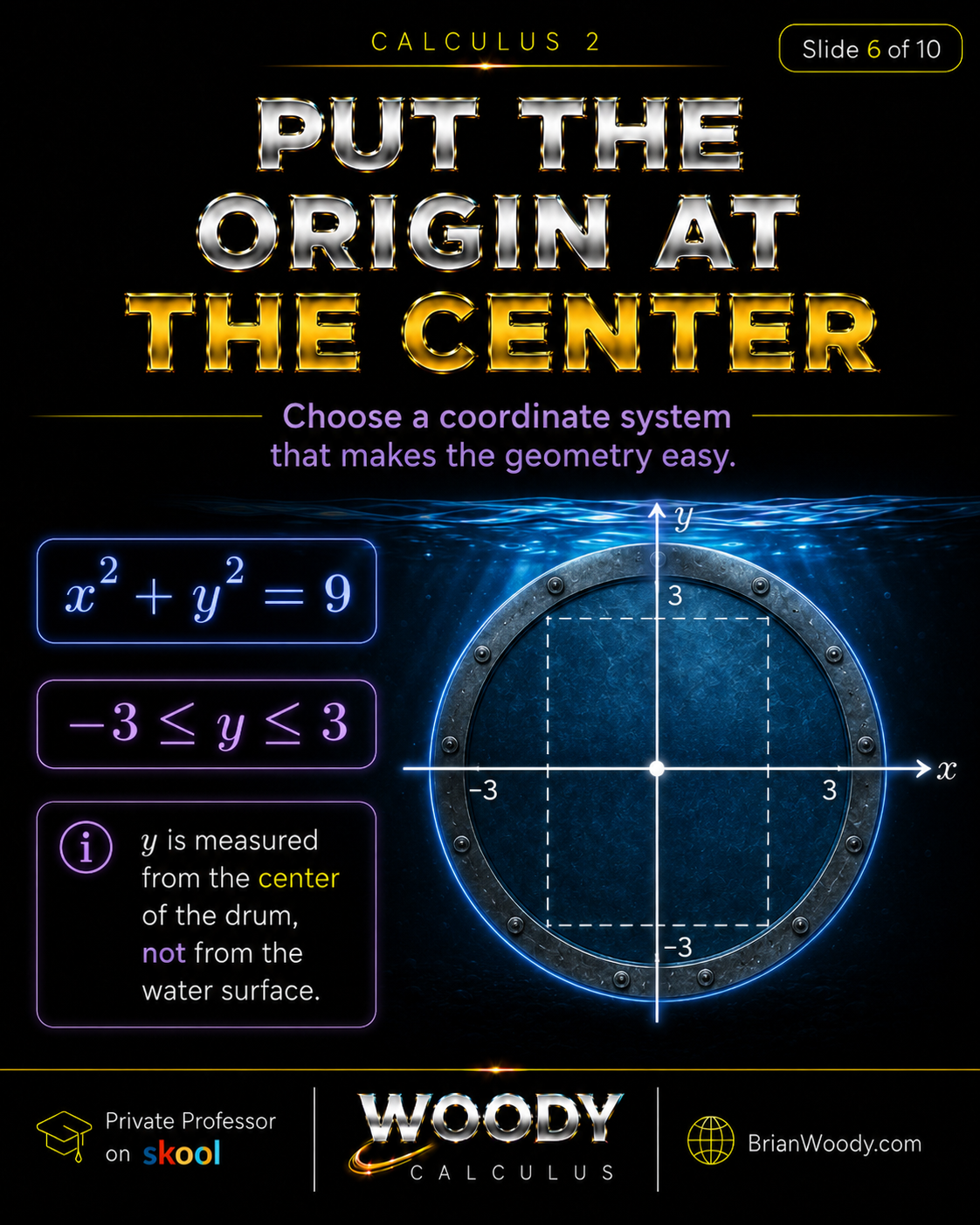
For a circular plate, the cleanest coordinate system puts the origin at the center of the circle.
Since the radius is \(3\), the circle equation is:
x^2+y^2=9.
\]
The vertical coordinate \(y\) is measured from the center of the drum, not from the water surface.
That means:
- The top of the circle is \(y=3\).
- The center is \(y=0\).
- The bottom of the circle is \(y=-3\).
This coordinate choice makes the geometry simple, but it also means we must be careful when computing depth.
How to Find the Slice Width from the Circle
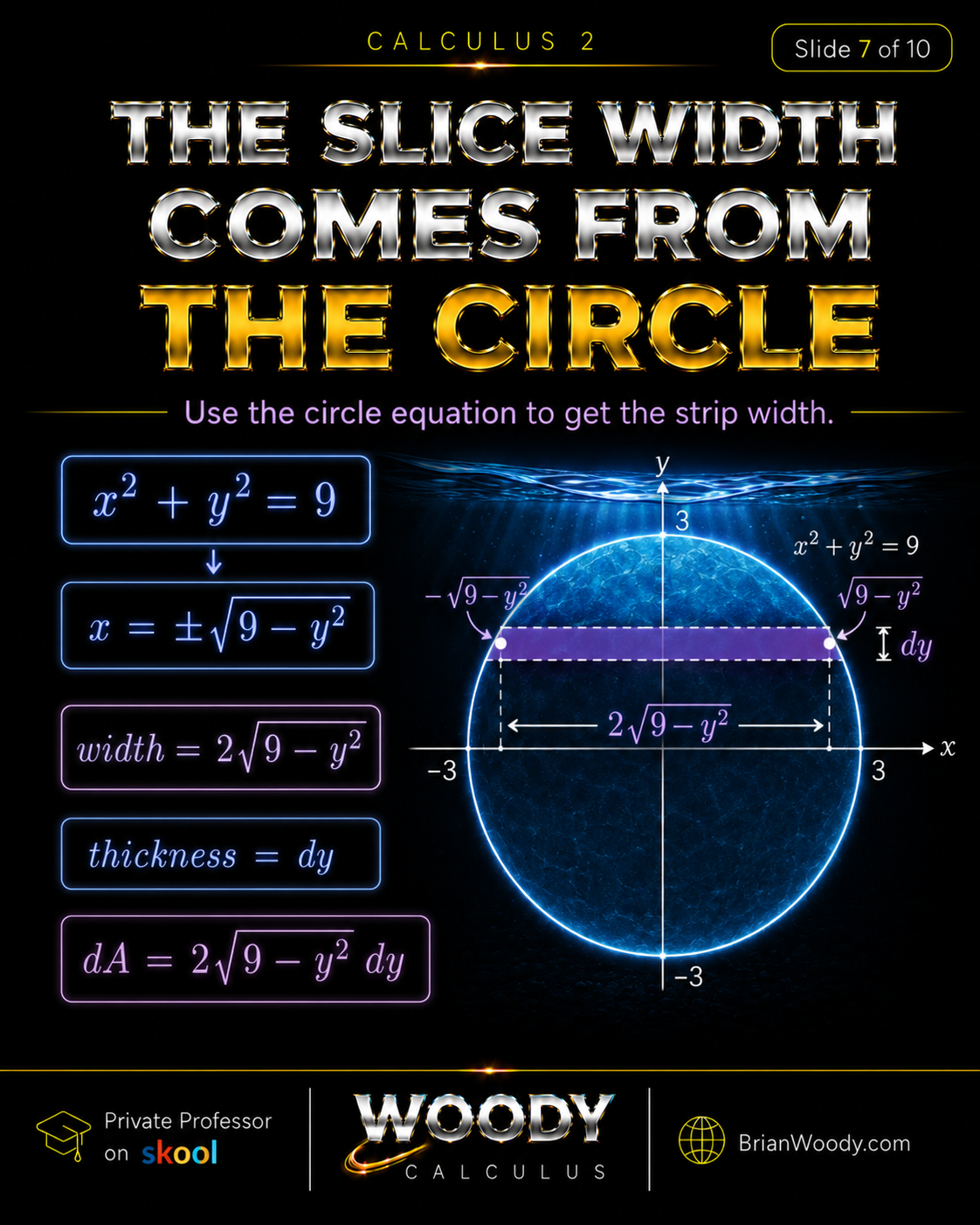
A horizontal strip at height \(y\) cuts across the circle. To find its width, solve the circle equation for \(x\):
x^2+y^2=9.
\]
Then:
x^2=9-y^2.
\]
So:
x=\pm\sqrt{9-y^2}.
\]
The left endpoint is:
-\sqrt{9-y^2},
\]
and the right endpoint is:
\sqrt{9-y^2}.
\]
Therefore, the strip width is:
\text{width}
=
2\sqrt{9-y^2}.
\]
The strip thickness is \(dy\), so the strip area is:
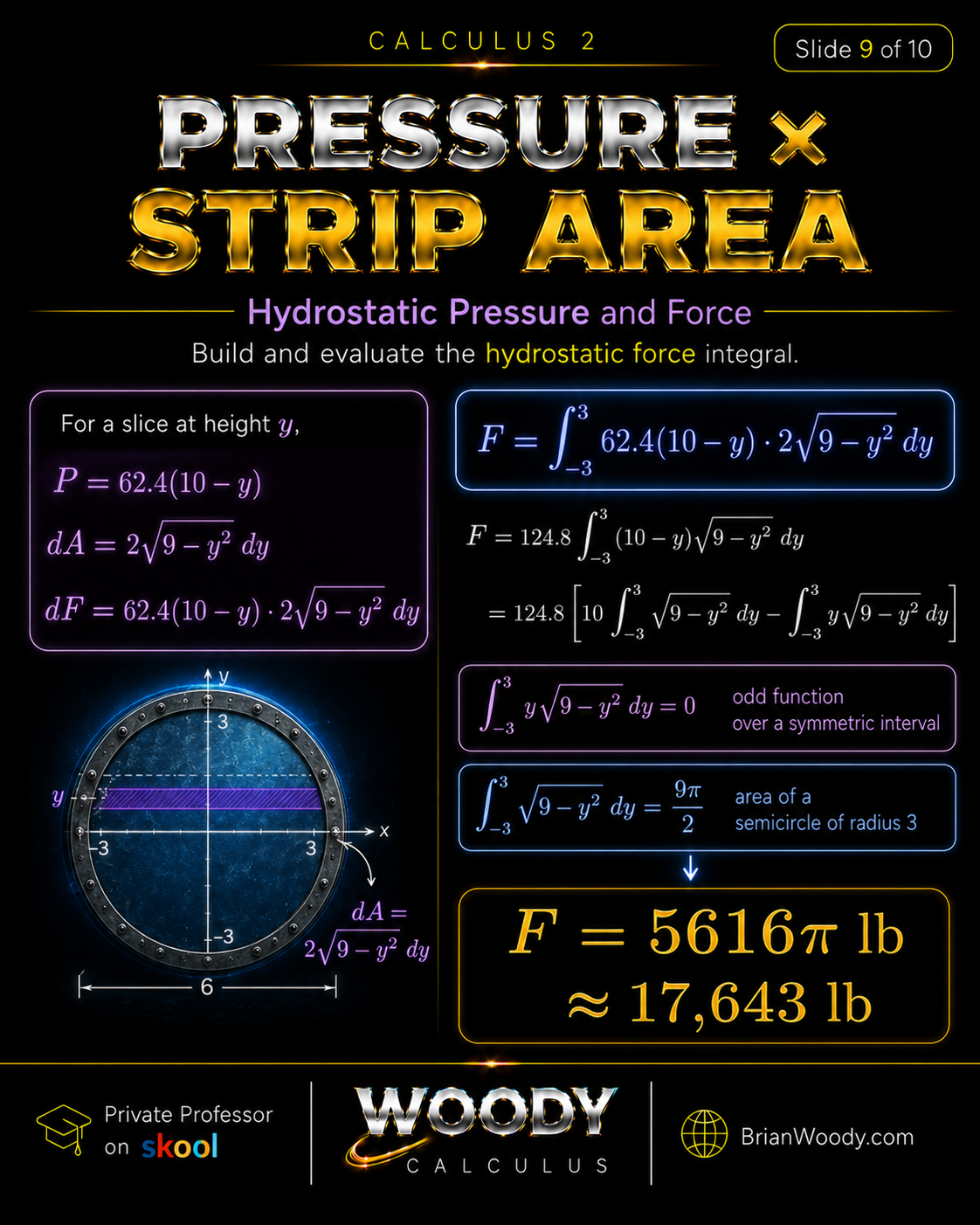
dA=2\sqrt{9-y^2}\,dy.
\]
How to Find Depth in a Hydrostatic Force Problem
This is the most important part of the problem.
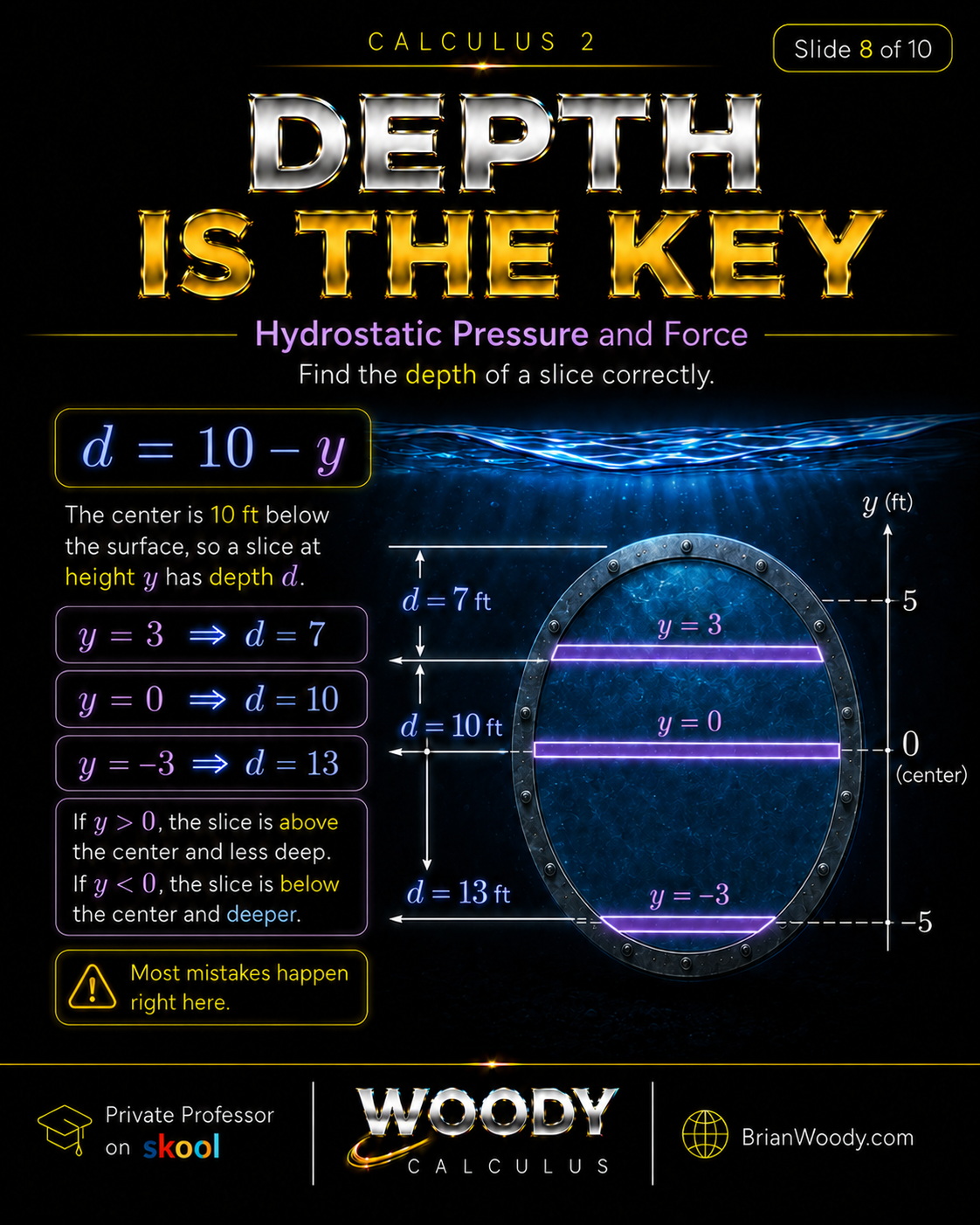
The coordinate \(y\) is measured from the center of the drum. The center is \(10\) ft below the water surface. Therefore, a slice at height \(y\) has depth:
d=10-y.
\]
Check this formula:
- If \(y=3\), the slice is near the top, so \(d=10-3=7\) ft.
- If \(y=0\), the slice is at the center, so \(d=10\) ft.
- If \(y=-3\), the slice is near the bottom, so \(d=10-(-3)=13\) ft.
That matches the geometry: slices above the center are less deep, and slices below the center are deeper.
So the pressure on a strip at height \(y\) is:
P=62.4(10-y).
\]
This is where many hydrostatic force mistakes happen. The variable \(y\) is not the depth. The depth is \(10-y\).
How to Build the Hydrostatic Force Integral
Now build the force on one thin horizontal strip.
At height \(y\), the pressure is:
P=62.4(10-y).
\]
The strip area is:
dA=2\sqrt{9-y^2}\,dy.
\]
So the force on the strip is:
dF=P\,dA.
\]
Substitute:
dF=62.4(10-y)\cdot 2\sqrt{9-y^2}\,dy.
\]
The circle runs from \(y=-3\) to \(y=3\), so the total force is:
F=\int_{-3}^{3}62.4(10-y)\cdot 2\sqrt{9-y^2}\,dy.
\]
Combine constants:
F=124.8\int_{-3}^{3}(10-y)\sqrt{9-y^2}\,dy.
\]
This is the critical Calculus 2 setup:
\boxed{
F=124.8\int_{-3}^{3}(10-y)\sqrt{9-y^2}\,dy.
}
\]
Students should be able to build this integral from scratch: pressure times strip area, integrated over the entire plate.
Split the integral:
F=124.8\left[
10\int_{-3}^{3}\sqrt{9-y^2}\,dy
–
\int_{-3}^{3}y\sqrt{9-y^2}\,dy
\right].
\]
The second integral is zero because \(y\sqrt{9-y^2}\) is odd over the symmetric interval \([-3,3]\):
\int_{-3}^{3}y\sqrt{9-y^2}\,dy=0.
\]
The first integral is the area of a semicircle of radius \(3\):
\int_{-3}^{3}\sqrt{9-y^2}\,dy=\frac{9\pi}{2}.
\]
Therefore:
F=124.8\left(10\cdot\frac{9\pi}{2}\right).
\]
So:
F=124.8(45\pi)=5616\pi.
\]
Final answer:
\boxed{F=5616\pi\ \text{lb}}
\]
\boxed{F\approx 17,643\ \text{lb}.}
\]
Plain-language answer: the hydrostatic force on the circular end of the drum is \(5616\pi\) pounds, approximately \(17,643\) pounds.
Complete Worked Example
Find the hydrostatic force on a vertical circular plate of radius \(3\) ft whose center is \(10\) ft below the water surface. Use water weight density \(w=62.4\ \text{lb/ft}^3\).
Step 1: Write the circle equation
Put the origin at the center:
x^2+y^2=9.
\]
Step 2: Find the strip width
Solve for \(x\):
x=\pm\sqrt{9-y^2}.
\]
So the width is:
2\sqrt{9-y^2}.
\]
Step 3: Find the strip area
dA=2\sqrt{9-y^2}\,dy.
\]
Step 4: Find the depth
The center is \(10\) ft below the surface, so:
d=10-y.
\]
Step 5: Find the pressure
P=wd=62.4(10-y).
\]
Step 6: Build the force element
dF=P\,dA.
\]
dF=62.4(10-y)\cdot2\sqrt{9-y^2}\,dy.
\]
Step 7: Integrate from bottom to top
F=\int_{-3}^{3}62.4(10-y)\cdot2\sqrt{9-y^2}\,dy.
\]
Step 8: Evaluate
F=5616\pi\ \text{lb}
\approx 17,643\ \text{lb}.
\]
Plain-language answer: the total hydrostatic force is about \(17,643\) pounds.
Quick Check Using the Centroid Formula
There is a useful verification shortcut for a flat submerged plate:
F=(\text{weight density})(\text{depth of centroid})(\text{area}).
\]
For this circle, the centroid is the center of the circle. Its depth is \(10\) ft, and the area is:
A=\pi r^2=9\pi.
\]
So the shortcut gives:
F=62.4(10)(9\pi)=5616\pi\ \text{lb}.
\]
This matches the slice integral. Use this as a check, not as a replacement for learning the Calculus 2 slice method.
Common Mistakes
Mistake 1: Using one pressure value for the whole plate
Pressure changes with depth. A vertical plate needs slices because the top and bottom are at different depths.
Mistake 2: Forgetting that \(y\) is not the depth
In this problem, \(y\) is measured from the center of the circle. Since the center is \(10\) ft below the surface, the depth is:
d=10-y.
\]
Mistake 3: Using the full circle area too early
The full area of the circle is not enough because pressure varies from top to bottom. Use strip area \(dA\), not total area \(A\), until after the integral is built.
Mistake 4: Forgetting the factor of 2 in the strip width
The strip runs from \(-\sqrt{9-y^2}\) to \(\sqrt{9-y^2}\), so the width is:
2\sqrt{9-y^2}.
\]
Mistake 5: Mixing mass density and weight density
If you are given mass density \(\rho\), use \(\rho g\). If you are given water weight density \(w=62.4\ \text{lb/ft}^3\), then \(w\) already includes gravity.
Hydrostatic Force Checklist
The Woody Calculus Hydrostatic Force Method
The Woody Calculus method is to turn the physical situation into one clean slice integral.
- Draw the submerged plate.
- Choose a coordinate system that makes the geometry easy.
- Find the strip width from the shape equation.
- Write the strip area \(dA\).
- Find the depth of the strip.
- Compute pressure using \(P=\rho g d\) or \(P=wd\).
- Write \(dF=P\,dA\).
- Integrate from the bottom of the plate to the top.
- Check units and interpret the answer.
Say it out loud: Force equals density times gravity times area times depth. Then remember that a vertical plate needs this formula applied strip by strip.
Reading the solution is not enough. A serious Calculus 2 student should be able to rebuild the integral
\(F=124.8\int_{-3}^{3}(10-y)\sqrt{9-y^2}\,dy\)
from scratch, explaining each piece out loud: pressure, depth, strip width, strip area, and bounds.
Hydrostatic Force FAQ
What is hydrostatic force?
Hydrostatic force is the force exerted by fluid pressure on a submerged surface. In Calculus 2, it is usually found by slicing the surface into thin strips and integrating the force on each strip.
What is the hydrostatic pressure formula?
The hydrostatic pressure formula is \(P=\rho g d\), where \(\rho\) is mass density, \(g\) is gravitational acceleration, and \(d\) is depth. If using weight density \(w=\rho g\), the formula becomes \(P=wd\).
Why is hydrostatic force \(F=\rho g A d\)?
Force comes from weight: \(F=mg\). Since mass is density times volume, \(m=\rho V\), and a water column has volume \(V=Ad\), we get \(F=\rho g A d\).
Why do hydrostatic force problems use integrals?
Hydrostatic force problems use integrals because pressure changes with depth. On a vertical plate, each horizontal strip has a different depth and therefore a different pressure.
What is \(dF=P\,dA\)?
The expression \(dF=P\,dA\) means that the tiny force on a thin strip equals the pressure on that strip times the strip’s tiny area.
Why is the depth \(d=10-y\) in the circular drum example?
The coordinate \(y\) is measured from the center of the drum, and the center is \(10\) ft below the water surface. A slice at height \(y\) is therefore \(10-y\) ft below the surface.
What is the strip area for the circular plate?
For the circle \(x^2+y^2=9\), a horizontal strip at height \(y\) has width \(2\sqrt{9-y^2}\) and thickness \(dy\), so \(dA=2\sqrt{9-y^2}\,dy\).
What is the hydrostatic force on the circular drum end?
For a radius \(3\) ft circular plate with center \(10\) ft below the water surface, using water weight density \(62.4\ \text{lb/ft}^3\), the hydrostatic force is \(5616\pi\) lb, approximately \(17,643\) lb.
Master Hydrostatic Force with Woody Calculus
Hydrostatic force is not about memorizing one final integral. It is about understanding how force, pressure, depth, and geometry work together.
The key chain is:
F=mg
\quad\Longrightarrow\quad
m=\rho V
\quad\Longrightarrow\quad
V=Ad
\quad\Longrightarrow\quad
F=\rho g A d
\quad\Longrightarrow\quad
P=\rho g d
\quad\Longrightarrow\quad
dF=P\,dA
\quad\Longrightarrow\quad
F=\int dF.
\]
For students who want structured Calculus 2 help, join the Woody Calculus Mastery Lab. The Mastery Lab helps students build skill through repetition, step-by-step lessons, written solutions, exam-focused systems, and direct support.
You can also visit Woody Calculus on Skool for the learning community.

Related Woody Calculus Mathematical Essays
Explore more Woody Calculus lessons connecting Calculus 2, applications of integration, hydrostatic force, work, improper integrals, parametric equations, infinite series, Taylor series, Differential Equations, and advanced mathematics.
- How to Learn Calculus and Advanced Mathematics: A Peak Performance Study Guide
- Trig Substitution Explained: The Woody Calculus 3-Type System
- Improper Integrals Explained: Calculus 2 Limit Problems
- Parametric Equations Explained: Motion, Direction, and Tangent Lines
- Taylor Series Explained: Mathematical Time Travel in Calculus 2
- Radius of Convergence and Interval of Convergence Explained
- Gabriel’s Horn Explained: Finite Volume and Infinite Surface Area
- Laplace Transforms Explained: Differential Equations Become Algebra
- Line Integrals Explained: Vector Fields and Calculus 3
- View All Woody Calculus Blog Posts
Private Instruction
Brian M. Woody works privately with a limited number of serious students who need one-on-one help in AP Calculus BC, Calculus II, Calculus III, Differential Equations, and advanced mathematics.
Private instruction is reserved for serious students, requires weekly sessions, requires enrollment in the Woody Calculus Mastery Lab first, and approval is not guaranteed.
Students interested in private instruction can learn more here: Private Math Tutor and Advanced Mathematics Instruction.
Related University Math Help Pages
Woody Calculus supports students at major universities with structured help in Calculus 2, Calculus 3, Differential Equations, Linear Algebra, and advanced mathematics. For the full list of supported schools, visit the University Calculus Tutor Hub.
- University Calculus Tutor Hub
- AP Calculus BC Support
- Calculus 2 Help for Purdue Students
- University of Florida Calculus 2 and AP Calculus Help
- Colorado State University Calculus Help
- UCF Calculus 2 Tutoring
- University of Nevada, Reno Calculus Support
- Auburn Calculus Tutor and Exam Prep
- University of Alabama Calculus Help
- University of Wisconsin Calculus Tutor
- University of Michigan Calculus Help
- UCLA Calculus 2 Support
- MIT Calculus Tutor
Trusted by Students Nationwide
The Woody Calculus Mastery Lab gives university students access to structured mathematics support, written solutions, video lessons, exam-focused training, and expert guidance from Brian M. Woody.
Students use Woody Calculus for Calculus II, Calculus III, Differential Equations, Linear Algebra, Abstract Algebra, and other advanced mathematics courses.