CALCULUS 3 • MULTIVARIABLE CALCULUS • VISUAL GUIDE
What Is a Triple Integral?
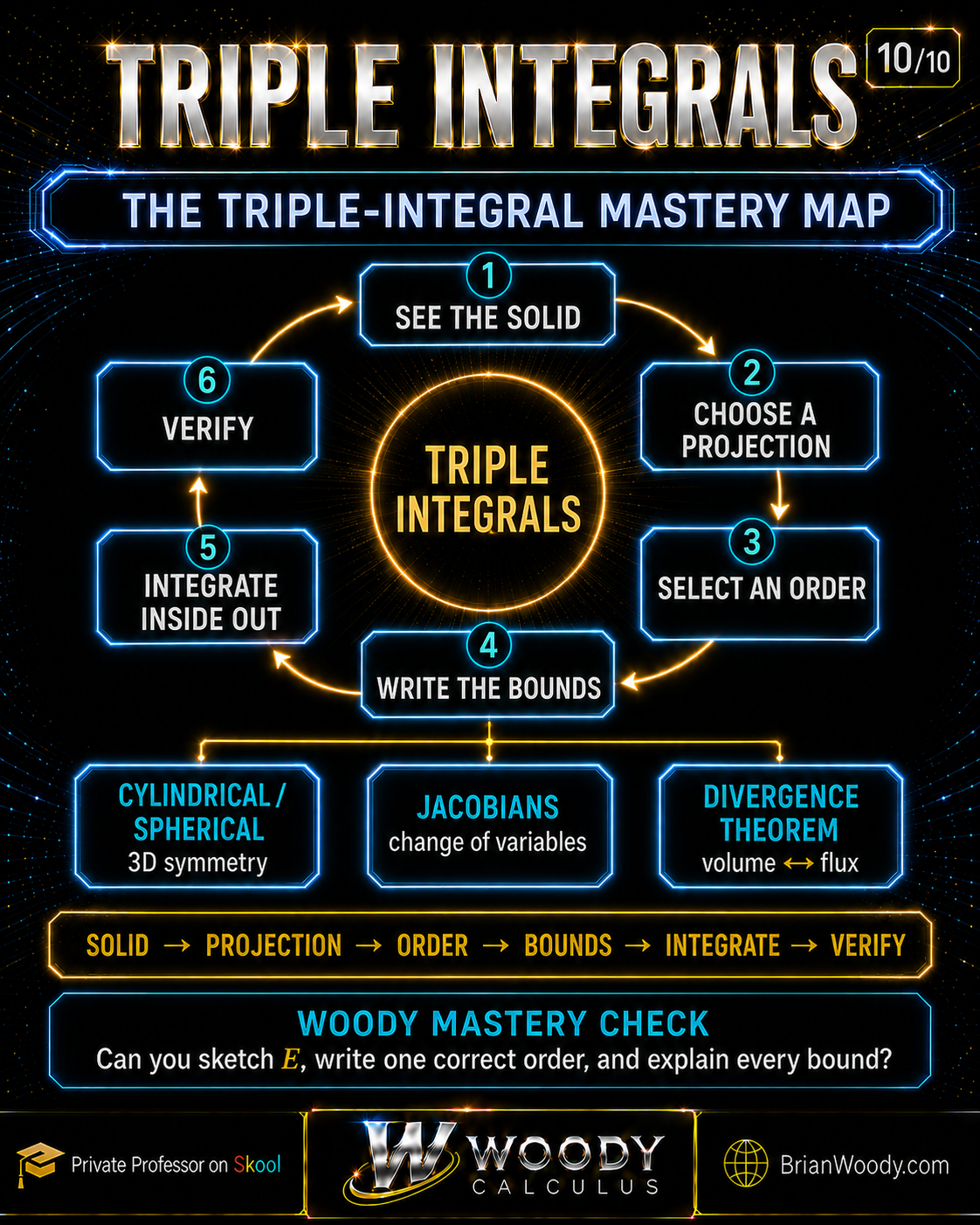
A triple integral adds infinitely many tiny contributions throughout a three-dimensional solid. To solve one reliably, see the solid first, choose a coordinate-plane projection, write bounds for the inner, middle, and outer variables, and then integrate from the inside out.
Key Takeaways
- A triple integral accumulates a quantity throughout a three-dimensional solid.
- The bounds describe that solid one coordinate direction at a time.
- The reliable workflow is solid → projection → order → bounds → integration → verification.
\iiint_E f(x,y,z)\,dV
=\lim_{\max \Delta V_k\to 0}\sum_{k=1}^{N} f(x_k^*,y_k^*,z_k^*)\,\Delta V_k.
\]
In Cartesian coordinates, \(dV=dx\,dy\,dz\) in any chosen order. The order is not cosmetic: it records how the solid is swept out one variable at a time.
Triple Integrals: The Quick Summary
See the solid
Translate every equation and inequality into surfaces and half-spaces.
Choose a projection
Drop the solid onto the coordinate plane perpendicular to the inner variable.
Write the fiber
The inner bounds are the entry and exit points along one coordinate direction.
Describe the shadow
The middle and outer bounds describe the two-dimensional projection.
Integrate inside out
Hold the other variables constant while evaluating each integral.
Verify
Check units, signs, symmetry, bounds, and geometric scale.
Woody rule: SOLID FIRST. PROJECTION NEXT. BOUNDS AFTER THAT. INTEGRATE LAST.
Estimated study time: 45–55 minutes for the complete lesson; 10 minutes for the summary, six-orders atlas, and glossary.
1. What Does a Triple Integral Actually Add?
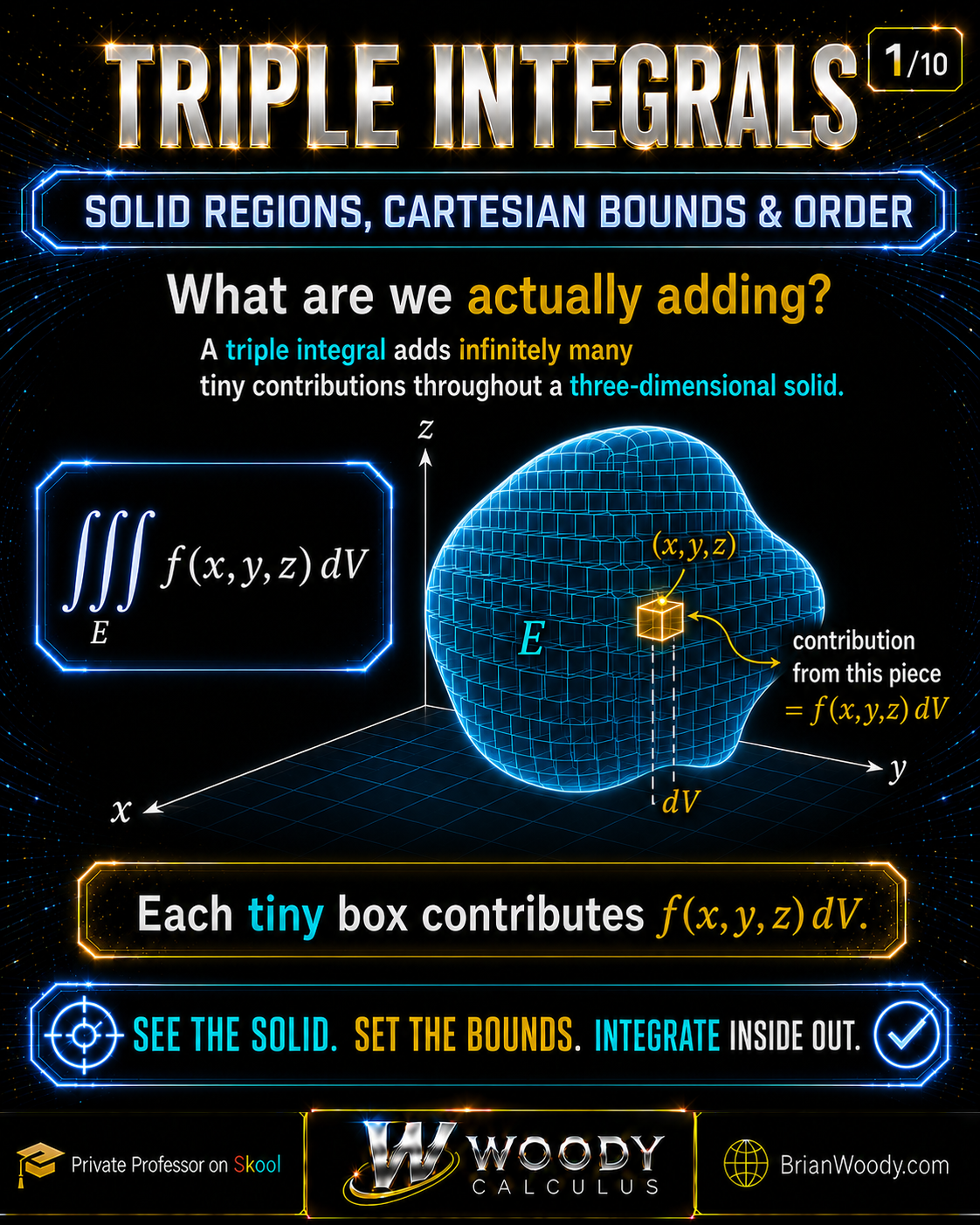
A single integral adds contributions along a one-dimensional interval. A double integral adds contributions across a two-dimensional region. A triple integral adds contributions throughout a three-dimensional solid \(E\subseteq\mathbb{R}^3\).
From a 3D Riemann Sum to an Integral
Partition the solid into many small boxes. A box with side lengths \(\Delta x\), \(\Delta y\), and \(\Delta z\) has approximate volume \(\Delta V=\Delta x\,\Delta y\,\Delta z\). Sample the function inside each box, multiply the sample value by the box volume, and add.
\sum_{k=1}^{N} f(x_k^*,y_k^*,z_k^*)\,\Delta V_k
\longrightarrow
\iiint_E f(x,y,z)\,dV.
\]
If \(f=1\), each contribution is simply a tiny volume, so the triple integral equals the volume of \(E\). If \(f=\delta\) is mass density, each contribution is a tiny mass \(\delta\,dV\).
| Integral | Domain | Tiny element | Typical quantity when integrand is 1 |
|---|---|---|---|
| \(\int_a^b f(x)\,dx\) | Interval in \(\mathbb{R}\) | \(dx\) | Length |
| \(\iint_D f(x,y)\,dA\) | Region in \(\mathbb{R}^2\) | \(dA\) | Area |
| \(\iiint_E f(x,y,z)\,dV\) | Solid in \(\mathbb{R}^3\) | \(dV\) | Volume |
2. How Does Fubini’s Theorem Turn a Triple Integral into Ordinary Integrals?
For a continuous function on a rectangular box, Fubini’s Theorem lets us evaluate the triple integral as three nested ordinary integrals. If
B=[a,b]\times[c,d]\times[e,h],
\]
then every Cartesian order uses constant bounds, and all six orders have the same value.
![Fubini’s Theorem for the rectangular box B = [a,b] × [c,d] × [e,h]. Two equivalent triple-integral orders are displayed, together with x, y, and z interval labels and diagrams of yz, xz, and xy cross-sections corresponding to dx, dy, and dz as the outer differential.](https://k3p6r8v3.delivery.rocketcdn.me/wp-content/uploads/2026/08/Triple_Integrals_Slide_02.png)
\iiint_B f\,dV
=\int_a^b\int_c^d\int_e^h f(x,y,z)\,dz\,dy\,dx
=\int_e^h\int_c^d\int_a^b f(x,y,z)\,dx\,dy\,dz.
\]
What “outer” means geometrically
If \(dx\) is outermost, the solid can be viewed as a stack of \(yz\) cross-sections. If \(dy\) is outermost, use \(xz\) cross-sections. If \(dz\) is outermost, use \(xy\) cross-sections.
For nonrectangular solids, Fubini still permits iterated integration under standard hypotheses, but the bounds usually depend on variables farther outside. That geometry is the real work.
When is changing the order legitimate?
In a standard Calculus 3 problem, continuity on a bounded solid is a sufficient classroom condition. More generally, Fubini applies when the function is absolutely integrable, while Tonelli’s Theorem permits order changes for nonnegative measurable functions. With an improper, sign-changing integral that is not absolutely integrable, changing order can change the answer or expose divergence.
3. How Do You Read an Iterated Triple Integral?
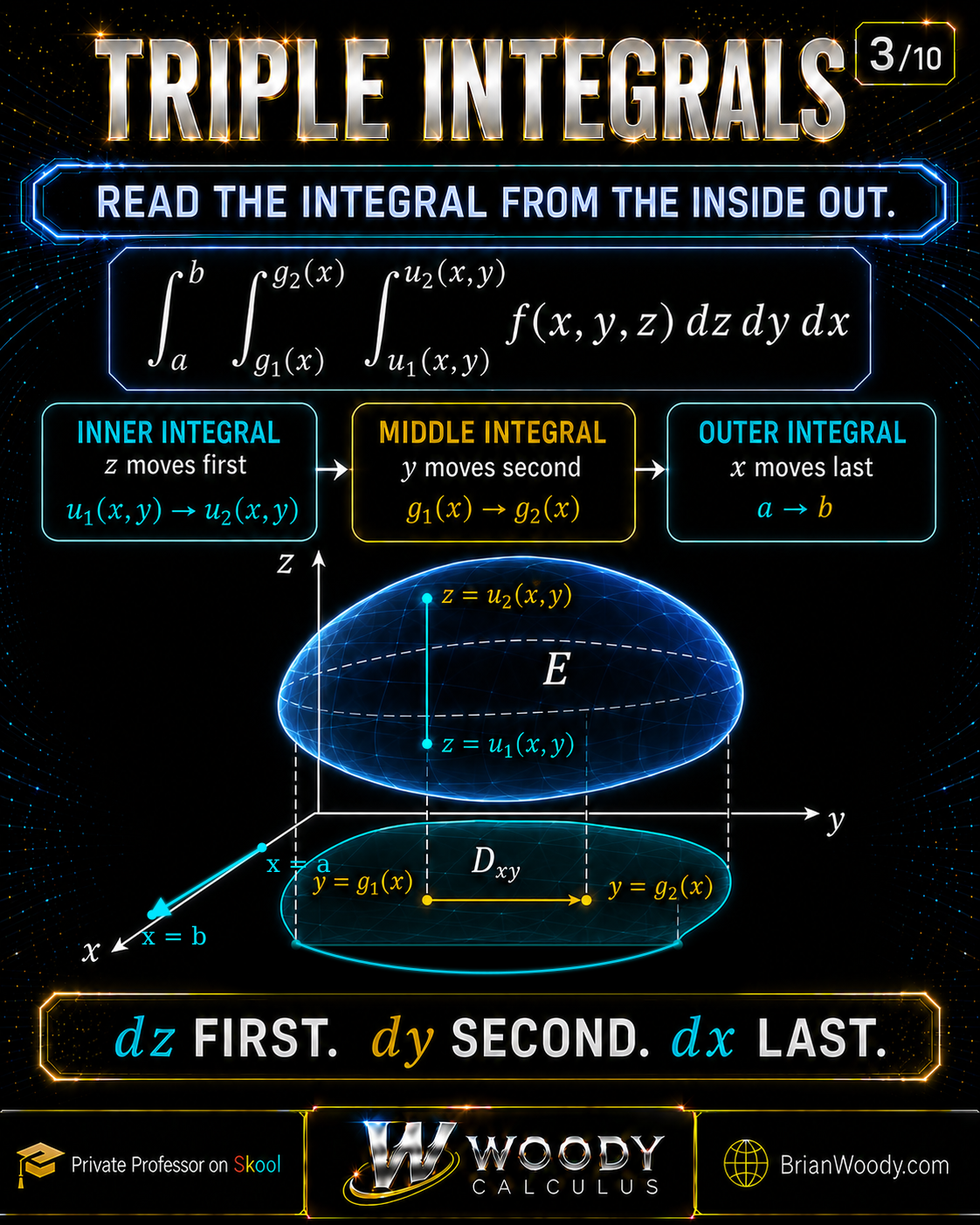
Read from the inside out. The differential nearest the integrand moves first. In
\int_a^b\int_{g_1(x)}^{g_2(x)}\int_{u_1(x,y)}^{u_2(x,y)}
f(x,y,z)\,dz\,dy\,dx,
\]
the order is \(dz\,dy\,dx\). First, \(z\) runs from the lower surface \(u_1(x,y)\) to the upper surface \(u_2(x,y)\). Next, \(y\) runs across the projection from \(g_1(x)\) to \(g_2(x)\). Finally, \(x\) runs from \(a\) to \(b\).
| Level | Variable | What stays fixed | Geometric action |
|---|---|---|---|
| Inner | \(z\) | \(x,y\) | Travel along one vertical fiber from entry to exit |
| Middle | \(y\) | \(x\) | Sweep a fixed-\(x\) slice across the projection |
| Outer | \(x\) | Nothing | Move across the full projected region |
4. Why Should You Project the Solid Before Writing Bounds?
A three-dimensional picture becomes manageable when you reduce it to a two-dimensional shadow. If \(z\) is the inner variable, project onto the \(xy\)-plane. The projected region supplies the \(x\)– and \(y\)-bounds; the lower and upper surfaces supply the \(z\)-bounds.
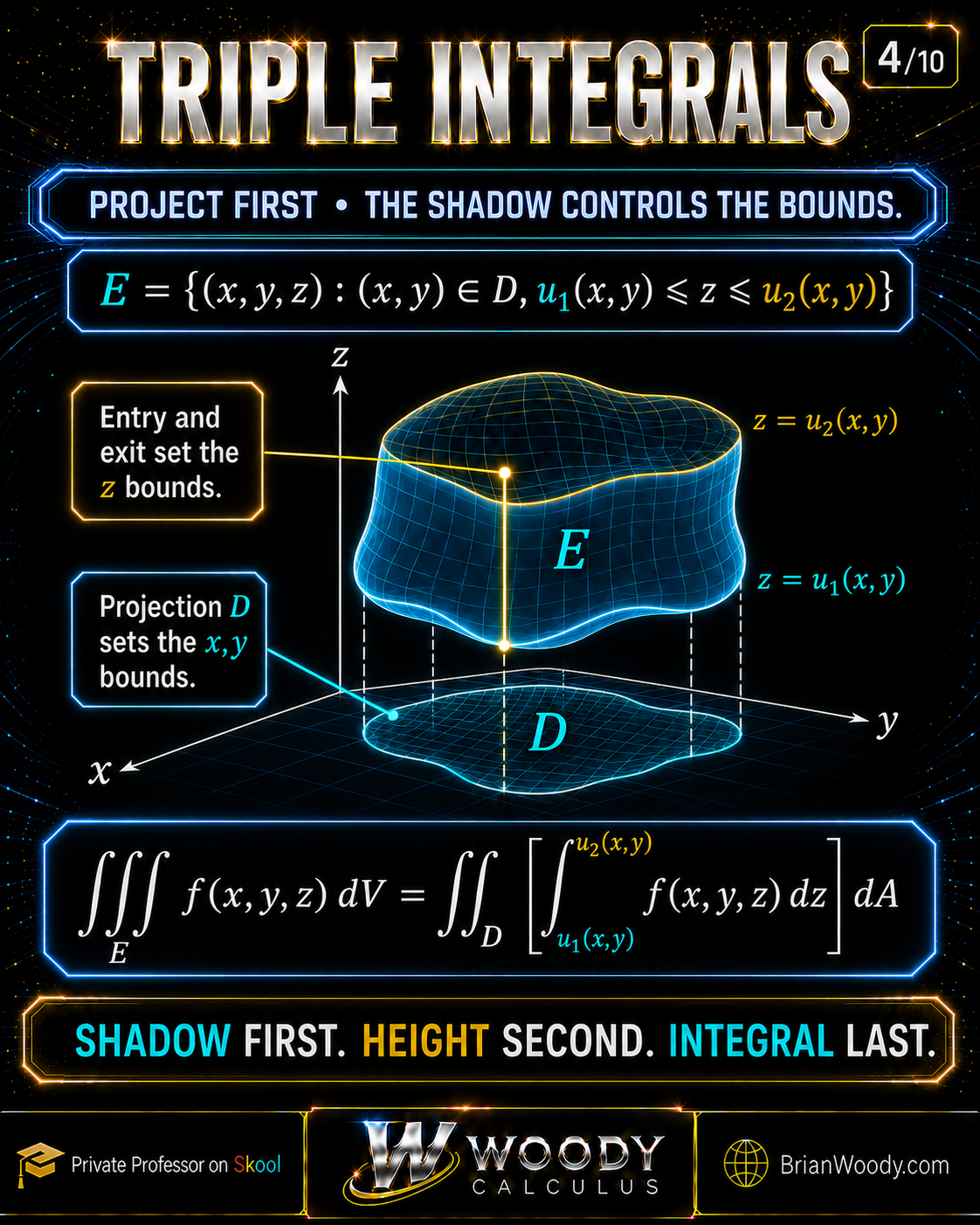
E=\{(x,y,z):(x,y)\in D_{xy},\ u_1(x,y)\le z\le u_2(x,y)\},
\]
\[
\iiint_E f\,dV
=\iint_{D_{xy}}\left[\int_{u_1(x,y)}^{u_2(x,y)}f(x,y,z)\,dz\right]dA.
\]
Z-Simple, Y-Simple, and X-Simple Solids
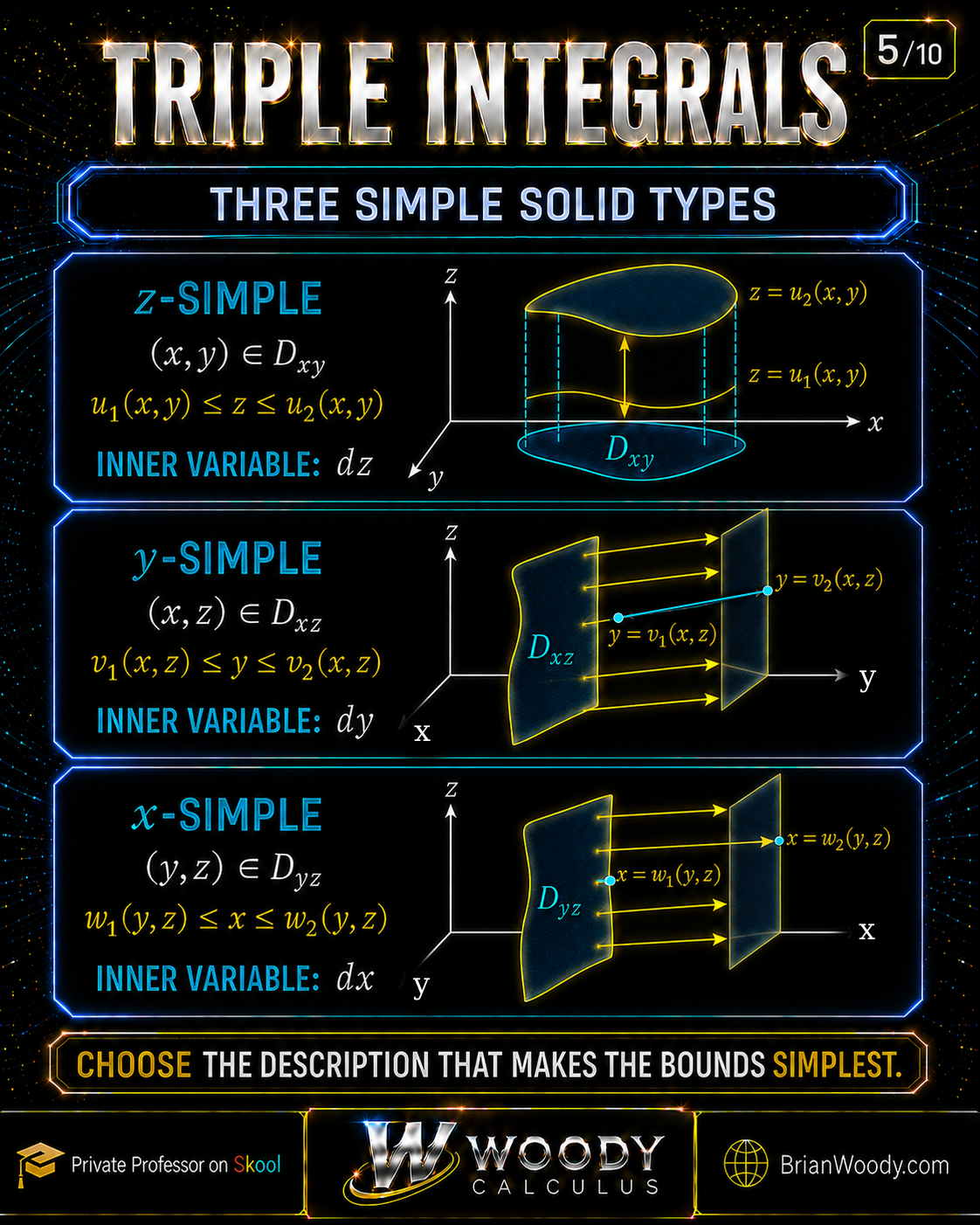
A solid is simple in a variable when every line parallel to that coordinate axis intersects the solid in one interval or not at all. This is the three-dimensional analogue of Type I and Type II regions from the Double Integrals guide.
| Solid type | Projection | Inner bounds | Natural inner differential |
|---|---|---|---|
| z-simple | \(D_{xy}\) | \(u_1(x,y)\le z\le u_2(x,y)\) | \(dz\) |
| y-simple | \(D_{xz}\) | \(v_1(x,z)\le y\le v_2(x,z)\) | \(dy\) |
| x-simple | \(D_{yz}\) | \(w_1(y,z)\le x\le w_2(y,z)\) | \(dx\) |
If a coordinate-parallel line enters, leaves, and later reenters the solid, that description is not simple. Split the projection or choose another order.
5. What Is the Best Step-by-Step Method for Setting Up Triple Integrals?
Use the same sequence every time. Do not begin by guessing differentials. Begin with the geometry.
-
See and name the solid.
Translate each equation or inequality into a boundary surface or half-space, identify intersections, and sketch the solid.
-
Choose the inner variable.
Look for the coordinate direction in which a line passes through the solid in one easy interval from entry to exit.
-
Project onto the perpendicular coordinate plane.
For inner dz use the xy-projection; for inner dy use the xz-projection; for inner dx use the yz-projection.
-
Write the inner bounds.
Hold the two outer variables fixed and solve for the inner variable from its entry surface to its exit surface.
-
Describe the two-dimensional projection.
Use the double-integral skills of vertical or horizontal slicing to write the middle and outer bounds.
-
Insert the integrand and integrate inside out.
Treat the outer variables as constants until their turns, and substitute bounds carefully at every stage.
-
Verify the result.
Check the region, units, sign, symmetry, order of magnitude, and an independent geometric or numerical benchmark when possible.
6. Complete Example: Set Up and Evaluate a Triple Integral Over a Tetrahedron
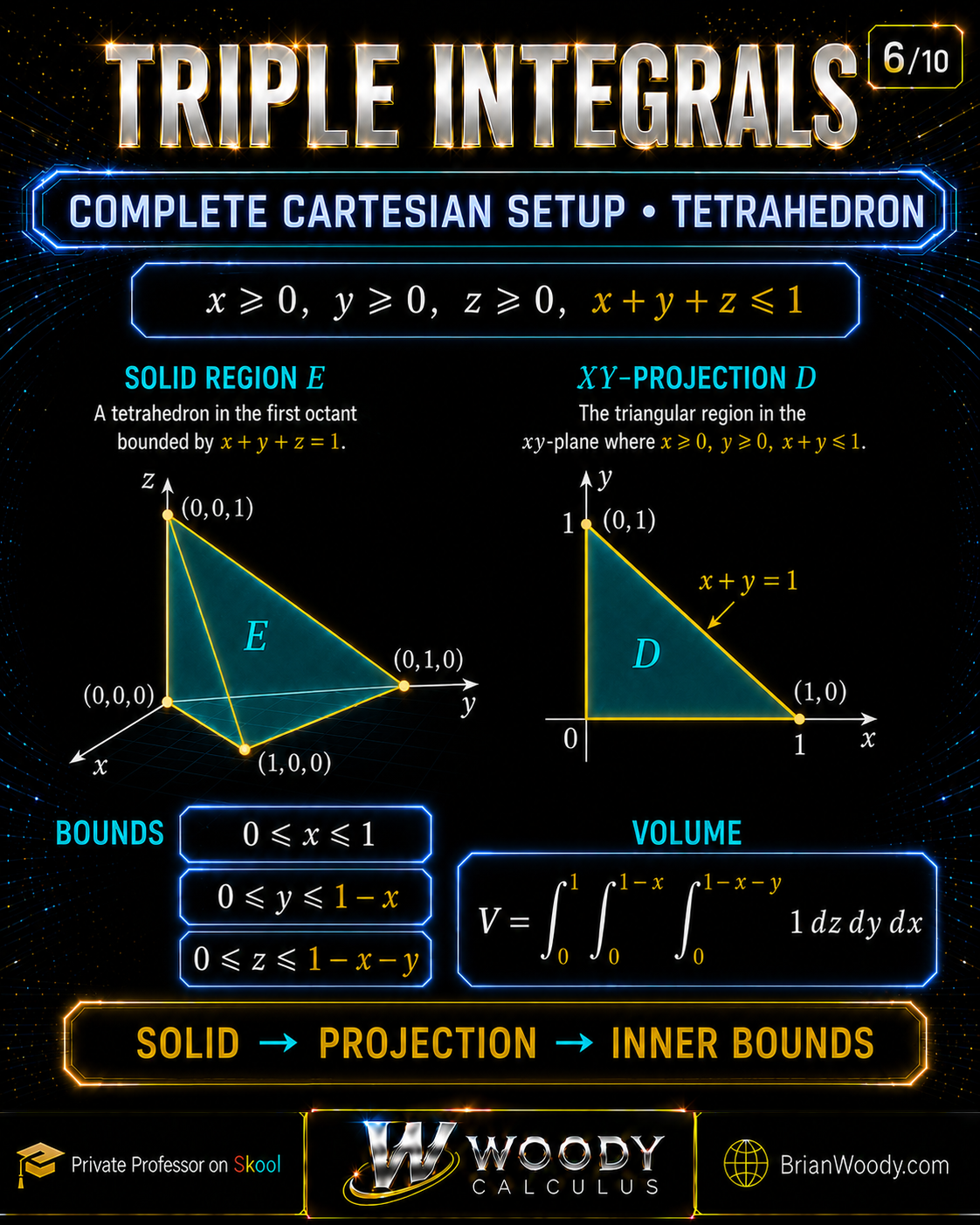
Let \(E\) be the first-octant tetrahedron bounded by the coordinate planes and \(x+y+z=1\):
E=\{(x,y,z):x\ge0,\ y\ge0,\ z\ge0,\ x+y+z\le1\}.
\]
Step A: Choose \(z\) as the inner variable
A vertical line enters at the \(xy\)-plane, \(z=0\), and exits at the plane \(z=1-x-y\). Therefore
0\le z\le1-x-y.
\]
Step B: Project onto the \(xy\)-plane
Set \(z=0\) in the slanted plane. The shadow is the triangle
D_{xy}=\{(x,y):x\ge0,\ y\ge0,\ x+y\le1\}.
\]
\[
0\le x\le1,
\qquad
0\le y\le1-x.
\]
Step C: Write the volume integral
V=\iiint_E 1\,dV
=\int_0^1\int_0^{1-x}\int_0^{1-x-y}1\,dz\,dy\,dx.
\]
Read it aloud: z runs from 0 to the plane 1 minus x minus y; y then runs from 0 to 1 minus x; x finally runs from 0 to 1.
Step D: Integrate from the inside out
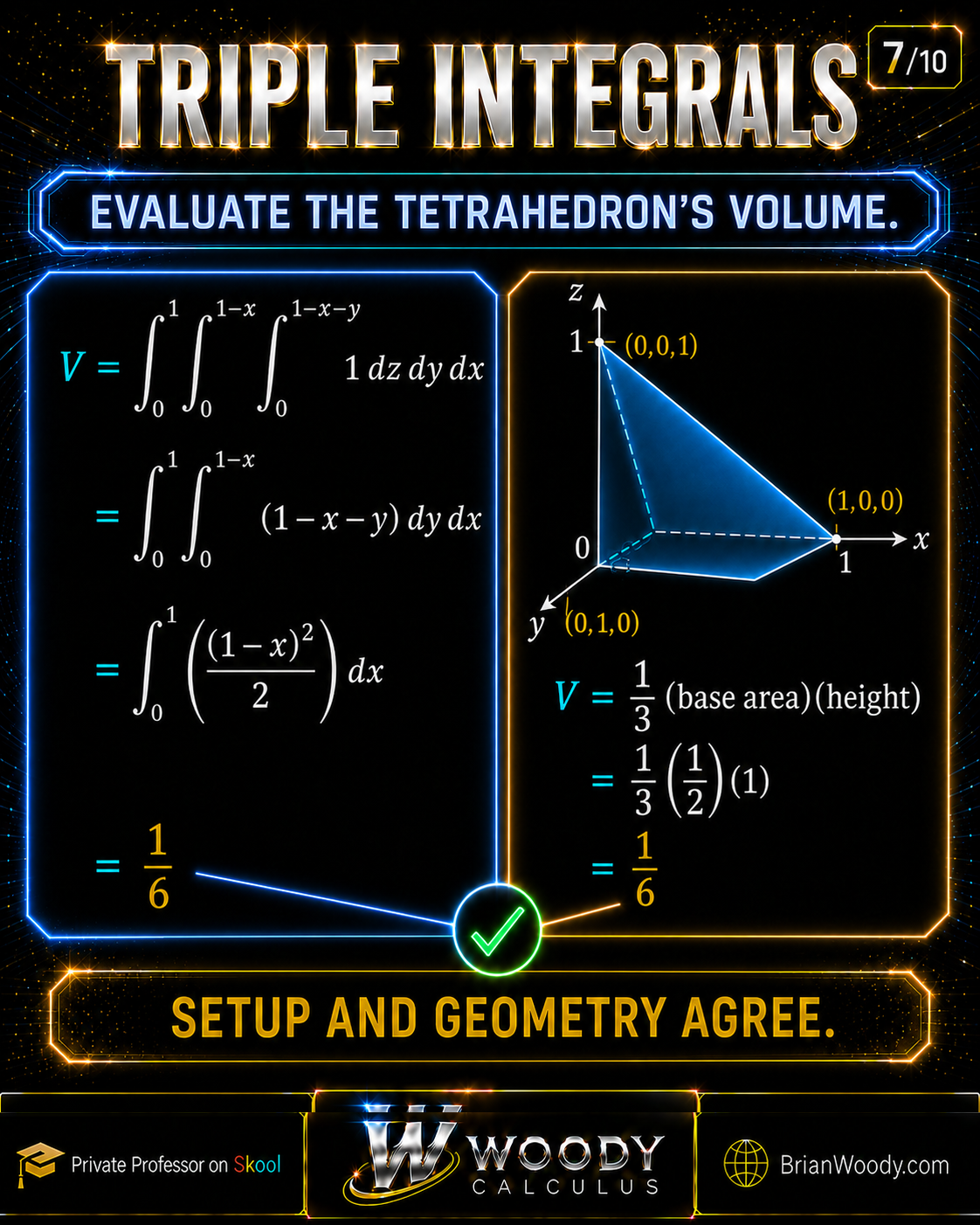
\begin{aligned}
V
&=\int_0^1\int_0^{1-x}\left[z\right]_{0}^{1-x-y}\,dy\,dx\\
&=\int_0^1\int_0^{1-x}(1-x-y)\,dy\,dx\\
&=\int_0^1\frac{(1-x)^2}{2}\,dx\\
&=\frac12\left[x-x^2+\frac{x^3}{3}\right]_0^1\\
&=\boxed{\frac16}.
\end{aligned}
\]
Step E: Verify geometrically
The base in the \(xy\)-plane is a right triangle with area \(1/2\), and the height is \(1\). The pyramid formula gives
V=\frac13(\text{base area})(\text{height})
=\frac13\cdot\frac12\cdot1
=\frac16.
\]
7. What Are All Six Orders of Integration for the Tetrahedron?
This is a complete, verified atlas of all six orders of integration for the standard coordinate tetrahedron. Three variables create \(3!=6\) Cartesian orders, and the symmetry of \(x,y,z\) gives every order a clean description.
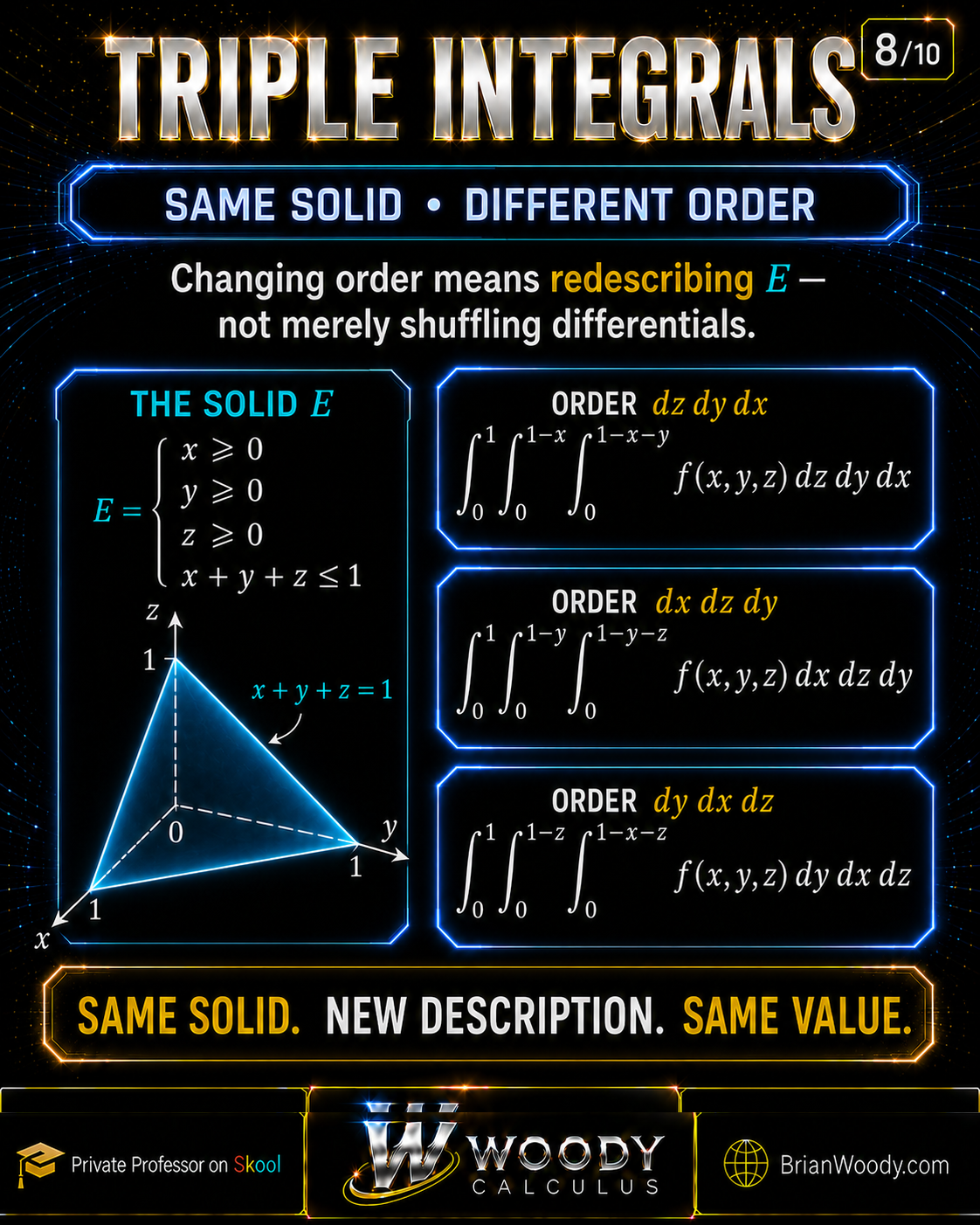
| Order | Correct iterated integral for \(\iiint_E f\,dV\) |
|---|---|
| dz dy dx | \(\displaystyle\int_0^1\int_0^{1-x}\int_0^{1-x-y} f\,dz\,dy\,dx\) |
| dy dz dx | \(\displaystyle\int_0^1\int_0^{1-x}\int_0^{1-x-z} f\,dy\,dz\,dx\) |
| dz dx dy | \(\displaystyle\int_0^1\int_0^{1-y}\int_0^{1-x-y} f\,dz\,dx\,dy\) |
| dx dz dy | \(\displaystyle\int_0^1\int_0^{1-y}\int_0^{1-y-z} f\,dx\,dz\,dy\) |
| dy dx dz | \(\displaystyle\int_0^1\int_0^{1-z}\int_0^{1-x-z} f\,dy\,dx\,dz\) |
| dx dy dz | \(\displaystyle\int_0^1\int_0^{1-z}\int_0^{1-y-z} f\,dx\,dy\,dz\) |
All six produce \(1/6\) when \(f=1\). As a stronger check, all six produce \(1/720\) when \(f=xyz\).
8. When Does Changing the Order Make a Triple Integral Easier?
Changing order is valuable when the original inner antiderivative is difficult or nonelementary. The goal is not to permute symbols; it is to describe the same solid so that a better variable moves first.
Worked Example: Reverse the Order to Rescue the Integral
Consider the solid
E=\{(x,y,z):0\le x\le y\le1,\ 0\le z\le1\}.
\]
With order \(dz\,dy\,dx\), the integral is
I=\int_0^1\int_x^1\int_0^1 e^{y^2}\,dz\,dy\,dx
=\int_0^1\int_x^1 e^{y^2}\,dy\,dx.
\]
The next antiderivative would require integrating \(e^{y^2}\) with respect to \(y\), which has no elementary antiderivative. The projected triangle \(0\le x\le y\le1\) can instead be written as \(0\le y\le1\) and \(0\le x\le y\). Therefore
\begin{aligned}
I
&=\int_0^1\int_0^y\int_0^1 e^{y^2}\,dz\,dx\,dy\\
&=\int_0^1\int_0^y e^{y^2}\,dx\,dy\\
&=\int_0^1 y e^{y^2}\,dy\\
&=\boxed{\frac{e-1}{2}}.
\end{aligned}
\]
Read it aloud: after reordering, z crosses the unit height, x runs from 0 to y, and the x-integration creates the factor y needed for the substitution \(u=y^2\).
Geometric Procedure for Any Order Change
Changing order means describing the same set of points with a different nesting. Use this procedure:
- Recover the solid from the original inequalities.
- Choose the new inner variable and draw a line parallel to its axis.
- Identify the entry and exit surfaces for that line.
- Project the solid onto the plane of the two outer variables.
- Describe the projection with the desired middle and outer variables.
- Check that every bound uses only variables farther outside.
9. When Must You Split a Triple Integral?
A chosen order must be split when one pair of bounding surfaces cannot describe every inner fiber. A clean example is
E=\{(x,y,z):0\le x\le1,\ 0\le y\le1,\ 0\le z\le\min(x,y)\}.
\]
With \(z\) innermost, the upper surface is \(z=y\) below the line \(y=x\) and \(z=x\) above it. The square projection must therefore be split along \(y=x\):
\iiint_E f\,dV
=\int_0^1\int_0^x\int_0^y f\,dz\,dy\,dx
+\int_0^1\int_x^1\int_0^x f\,dz\,dy\,dx.
\]
For volume, set \(f=1\). Each piece has volume \(1/6\), so
V=\frac16+\frac16=\boxed{\frac13}.
\]
Can a Better Order Avoid the Split?
Yes. Solve \(z\le\min(x,y)\) as the pair of inequalities \(z\le x\) and \(z\le y\). With \(z\) outermost, both remaining variables simply run from \(z\) to \(1\):
V=\int_0^1\int_z^1\int_z^1 1\,dx\,dy\,dz
=\int_0^1(1-z)^2\,dz
=\boxed{\frac13}.
\]
Read it aloud: at a fixed height z, both x and y must be at least z, so the horizontal cross-section is the square \([z,1]\times[z,1]\).
10. What Can Triple Integrals Calculate?
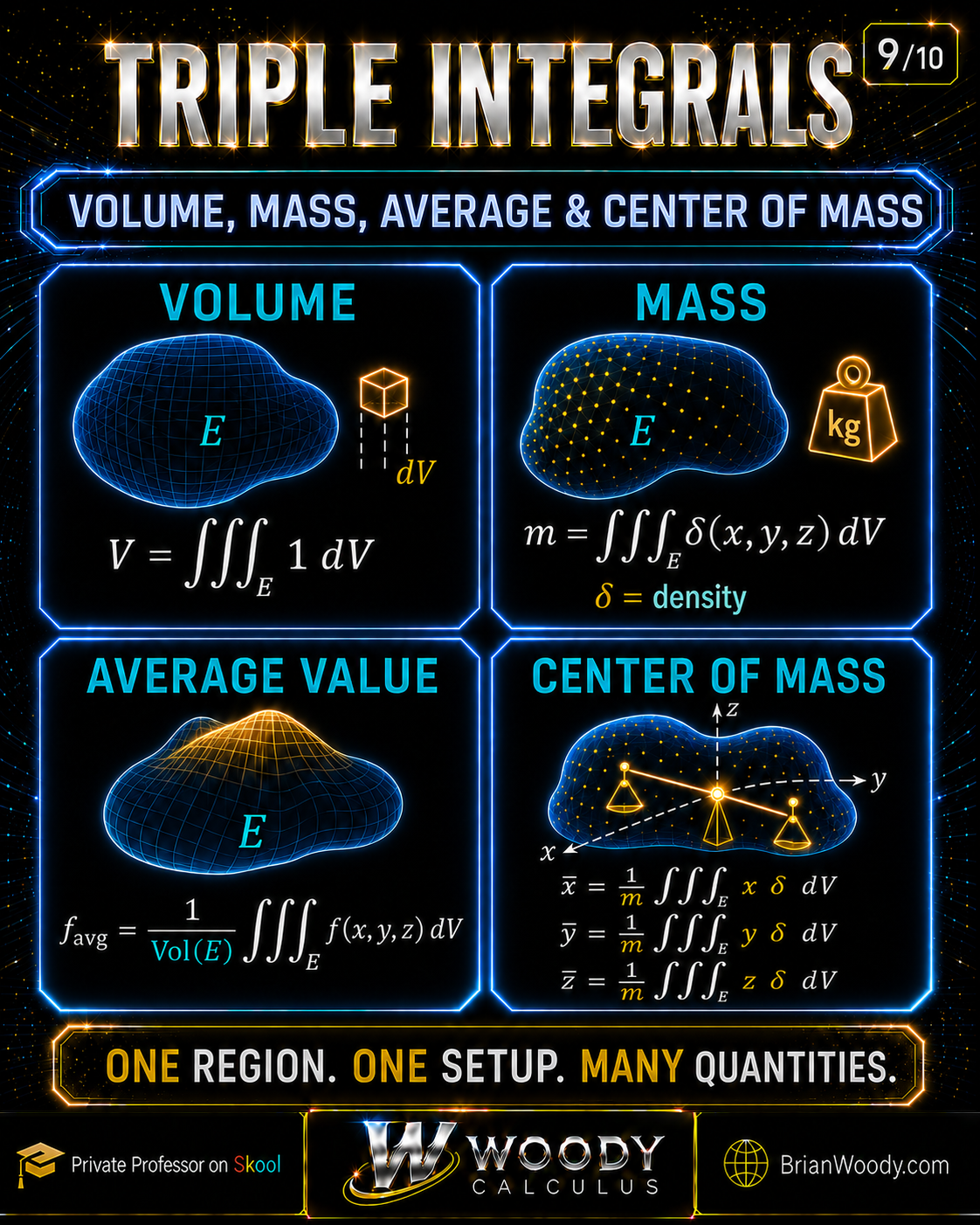
The geometry and bounds stay the same; the integrand tells you what is being accumulated.
| Quantity | Formula | Interpretation |
|---|---|---|
| Volume | \(\displaystyle V=\iiint_E 1\,dV\) | Add tiny volumes |
| Mass | \(\displaystyle m=\iiint_E \delta(x,y,z)\,dV\) | Add density times tiny volume |
| Average value | \(\displaystyle f_{\mathrm{avg}}=\frac{1}{\operatorname{Vol}(E)}\iiint_E f\,dV\) | Total weighted value divided by volume |
| First moments | \(\displaystyle M_{yz}=\iiint_E x\delta\,dV\), \(\displaystyle M_{xz}=\iiint_E y\delta\,dV\), \(\displaystyle M_{xy}=\iiint_E z\delta\,dV\) | Mass weighted by distance from a coordinate plane |
| Center of mass | \(\displaystyle(\bar x,\bar y,\bar z)=\left(\frac{M_{yz}}m,\frac{M_{xz}}m,\frac{M_{xy}}m\right)\) | Balance point of the solid |
| Moment of inertia about the \(z\)-axis | \(\displaystyle I_z=\iiint_E(x^2+y^2)\delta\,dV\) | Rotational resistance about the \(z\)-axis |
Notation note: here \(\delta(x,y,z)\) denotes spatial mass density, not the Dirac delta used in differential equations.
Average Value on the Tetrahedron
For \(f(x,y,z)=x+y+z\) on the tetrahedron, symmetry gives equal contributions from \(x\), \(y\), and \(z\). Direct integration gives
\iiint_E(x+y+z)\,dV=\frac18,
\qquad
\operatorname{Vol}(E)=\frac16,
\]
\[
f_{\mathrm{avg}}=\frac{1/8}{1/6}=\boxed{\frac34}.
\]
Centroid of the Uniform Tetrahedron
With constant density, symmetry implies \(\bar x=\bar y=\bar z\). Since the centroid of this coordinate tetrahedron lies one-quarter of the way along each coordinate axis,
(\bar x,\bar y,\bar z)=\boxed{\left(\frac14,\frac14,\frac14\right)}.
\]
A Short Variable-Density Check
If \(\delta(x,y,z)=1+z\) on the same tetrahedron, then
m=\iiint_E(1+z)\,dV
=\frac16+\frac1{24}
=\boxed{\frac5{24}}.
\]
11. How Do You Evaluate a Triple Integral in Cylindrical Coordinates?
Use cylindrical coordinates when the geometry is rotationally symmetric around the \(z\)-axis. Find the volume below the paraboloid \(z=4-x^2-y^2\) and above the plane \(z=0\).
The surfaces meet where \(x^2+y^2=4\), so the \(xy\)-projection is the disk \(0\le r\le2\). Since \(x^2+y^2=r^2\) and \(dV=r\,dz\,dr\,d\theta\),
\begin{aligned}
V
&=\int_0^{2\pi}\int_0^2\int_0^{4-r^2} r\,dz\,dr\,d\theta\\
&=\int_0^{2\pi}\int_0^2(4-r^2)r\,dr\,d\theta\\
&=\int_0^{2\pi}\left[2r^2-\frac{r^4}{4}\right]_0^2\,d\theta\\
&=\int_0^{2\pi}4\,d\theta
=\boxed{8\pi}.
\end{aligned}
\]
Read it aloud: theta makes one full revolution, r crosses the disk from 0 to 2, and z rises from the plane to the paraboloid. The factor r is the cylindrical Jacobian.
This example establishes the triple-integral structure without duplicating the full coordinate-conversion lesson. For region recognition, conversions, and additional examples, use Cylindrical vs. Spherical Coordinates.
12. How Do You Derive the Volume of a Ball with a Spherical Triple Integral?
For the ball \(x^2+y^2+z^2\le R^2\), spherical coordinates match the boundary exactly: \(0\le\rho\le R\), \(0\le\phi\le\pi\), and \(0\le\theta\le2\pi\). The spherical volume element is \(dV=\rho^2\sin\phi\,d\rho\,d\phi\,d\theta\).
\begin{aligned}
V
&=\int_0^{2\pi}\int_0^\pi\int_0^R
\rho^2\sin\phi\,d\rho\,d\phi\,d\theta\\
&=\left[\theta\right]_0^{2\pi}
\left[-\cos\phi\right]_0^\pi
\left[\frac{\rho^3}{3}\right]_0^R\\
&=(2\pi)(2)\left(\frac{R^3}{3}\right)
=\boxed{\frac{4}{3}\pi R^3}.
\end{aligned}
\]
Read it aloud: rho moves from the origin to the sphere, phi sweeps from the positive z-axis to the negative z-axis, and theta rotates once around the z-axis. The factor \(\rho^2\sin\phi\) is the spherical Jacobian.
The calculation is short because the coordinate surfaces match the ball. For a full comparison of angle conventions, bounds, and solid types, continue to Cylindrical vs. Spherical Coordinates.
13. When Should You Use Cartesian, Cylindrical, or Spherical Coordinates?
Coordinate choice should match the symmetry of the solid and the integrand. This lesson owns the Cartesian foundation; the full conversion process belongs in the related Cylindrical vs. Spherical Coordinates guide.
| Coordinates | Best geometric signals | Volume element | Typical boundaries |
|---|---|---|---|
| Cartesian | Planes, boxes, wedges, tetrahedra, coordinate-aligned solids | \(dV=dx\,dy\,dz\) in any order | \(x+y+z=1\), \(z=g(x,y)\) |
| Cylindrical | Rotational symmetry around an axis; circles and cylinders in projection | \(dV=r\,dr\,d\theta\,dz\) in a suitable order | \(x^2+y^2=R^2\), paraboloids, cones |
| Spherical | Spheres, balls, spherical shells, cones through the origin | \(dV=\rho^2\sin\phi\,d\rho\,d\phi\,d\theta\) in a suitable order | \(x^2+y^2+z^2=R^2\), \(\phi=\text{constant}\) |
The factors \(r\) and \(\rho^2\sin\phi\) are Jacobians. They correct for how coordinate boxes stretch in physical space. For the broader theory, see The Jacobian Explained.
14. How Can You Check a Triple Integral Before Trusting the Answer?
| Check | Question to ask | What it catches |
|---|---|---|
| Dependency | Does each bound use only variables farther outside? | Invalid nesting |
| Entry and exit | Does the lower bound come before the upper bound along the positive axis direction? | Reversed bounds and sign errors |
| Projection | Do the middle and outer bounds cover exactly the solid’s shadow? | Missing or extra volume |
| Units | What are the units of the integrand times cubic length? | Wrong physical quantity |
| Sign | If the integrand is nonnegative, is the answer nonnegative? | Arithmetic and bound reversal errors |
| Scale | Is the value plausible compared with a containing box or known geometry? | Large setup or arithmetic mistakes |
| Symmetry | Should odd terms cancel or coordinate moments agree? | Missed simplifications and inconsistent results |
For example, the tetrahedron lies inside the unit cube, so its volume must be between \(0\) and \(1\). The exact result \(1/6\) passes that test and matches the pyramid formula.
15. What Are the Most Common Triple-Integral Mistakes?
Guessing bounds before seeing the solid
Fix: identify every surface, sketch the solid, and find intersections first.
Reading outside in
Fix: start at the differential nearest the integrand and move outward.
Using an illegal bound
Fix: an inner bound cannot contain its own variable, and a middle bound cannot contain the middle variable.
Projecting onto the wrong plane
Fix: project perpendicular to the inner direction.
Changing differentials without changing bounds
Fix: redescribe the full solid for the new order.
Forgetting the integrand \(1\) for volume
Fix: write \(V=\iiint_E 1\,dV\) explicitly.
Forgetting a Jacobian
Fix: use \(r\) in cylindrical coordinates and \(\rho^2\sin\phi\) in spherical coordinates.
Refusing to split a solid
Fix: if a fiber changes entry or exit surfaces, split the projection or choose a better order.
Practice Problems
- Evaluate \(\displaystyle\iiint_{[0,1]^3}(x+2y+3z)\,dV\).
- Set up, but do not evaluate, \(\displaystyle\iiint_E f\,dV\) over \(E=\{x,y,z\ge0:x+2y+z\le2\}\) in the order \(dz\,dy\,dx\).
- Rewrite the tetrahedron integral in the order \(dx\,dy\,dz\).
- Find the average value of \(x+y+z\) on the tetrahedron \(x,y,z\ge0\), \(x+y+z\le1\).
- Decide whether Cartesian, cylindrical, or spherical coordinates are most natural for a ball \(x^2+y^2+z^2\le9\).
Open the concise answer key
- \(3\).
- \(\displaystyle\int_0^2\int_0^{(2-x)/2}\int_0^{2-x-2y}f(x,y,z)\,dz\,dy\,dx\).
- \(\displaystyle\int_0^1\int_0^{1-z}\int_0^{1-y-z}f(x,y,z)\,dx\,dy\,dz\).
- \(3/4\).
- Spherical coordinates; the boundary is \(\rho=3\).
Woody Mastery Check
You are ready to move on when you can do all six without notes:
- Explain \(f(x,y,z)dV\) as a tiny contribution.
- Identify the inner, middle, and outer variables immediately.
- Choose the correct coordinate-plane projection.
- Classify a solid as z-simple, y-simple, or x-simple.
- Redescribe one solid in a different order without shuffling differentials blindly.
- Check a result using units, sign, symmetry, or known geometry.
16. Triple-Integral Glossary
Use these definitions as a fast reference while setting up and checking problems.
- Triple integral
- An integral that accumulates a function throughout a three-dimensional solid.
- Volume element
- An infinitesimal piece of volume, written dV; in Cartesian coordinates it is a product of dx, dy, and dz in a chosen order.
- Iterated integral
- A multiple integral evaluated as nested one-variable integrals from the inside out.
- Projection
- The two-dimensional shadow of a solid on a coordinate plane.
- Z-simple solid
- A solid whose intersection with each line parallel to the z-axis is one interval or empty.
- Y-simple solid
- A solid whose intersection with each line parallel to the y-axis is one interval or empty.
- X-simple solid
- A solid whose intersection with each line parallel to the x-axis is one interval or empty.
- Order of integration
- The sequence of inner, middle, and outer variables in an iterated integral.
- Spatial density
- Mass per unit volume as a function of position inside a solid.
- Average value over a solid
- The triple integral of a function divided by the volume of its solid domain.
- Center of mass
- The balance point found by dividing each first moment by total mass.
- Jacobian
- The scale factor that corrects a volume element when coordinates change.
Triple Integrals: Frequently Asked Questions
What is a triple integral?
A triple integral adds infinitely many tiny contributions throughout a three-dimensional solid. In Cartesian coordinates, each contribution has the form \(f(x,y,z)\,dx\,dy\,dz\).
What does dV mean in a triple integral?
The symbol dV represents an infinitesimal volume element. In Cartesian coordinates it is \(dx\,dy\,dz\) in a chosen order.
How do you set up a triple integral?
Sketch the solid, choose an inner variable, project onto the perpendicular coordinate plane, write entry and exit bounds, describe the projection, and integrate inside out.
How do you choose the order of integration?
Choose the order that makes the solid simple, keeps the bounds clean, avoids splitting, and makes the inner antiderivative manageable.
Do you read a triple integral from left to right?
No. Read an iterated triple integral from the inside out, beginning with the differential closest to the integrand.
What is the inner variable in a triple integral?
The inner variable is the variable named by the differential nearest the integrand. It moves first while the other two variables are held constant.
What is the outer variable in a triple integral?
The outer variable is named by the final differential. Its bounds are usually constants and it completes the sweep across the projected region.
What is a projection of a solid?
A projection is the two-dimensional shadow of a solid on a coordinate plane. It supplies the bounds for the two variables outside the inner integral.
Which projection goes with dz as the inner differential?
Use the xy-projection. Vertical z-fibers rise from the lower z-surface to the upper z-surface above points in that projection.
What is a z-simple solid?
A solid is z-simple when every vertical line intersects it in one interval or not at all, so it can be written with bounds \(u_1(x,y)\le z\le u_2(x,y)\).
What is a y-simple solid?
A solid is y-simple when every line parallel to the y-axis intersects it in one interval or not at all, so y has lower and upper bounds depending on x and z.
What is an x-simple solid?
A solid is x-simple when every line parallel to the x-axis intersects it in one interval or not at all, so x has lower and upper bounds depending on y and z.
What does Fubini’s Theorem say for triple integrals?
Under standard integrability conditions, Fubini’s Theorem allows a triple integral to be evaluated as nested one-variable integrals. For a continuous function on a box, all six Cartesian orders agree.
How many orders of integration are possible with three variables?
There are six Cartesian orders because three variables have \(3!=6\) permutations.
Can you change the order by rearranging the differentials?
No. You must redescribe the same solid, derive new entry and exit surfaces, and write new bounds for the chosen order.
When must a triple integral be split?
Split it when one set of bounds cannot describe the entire solid, such as when a fiber changes entry or exit surfaces or intersects the solid in separate intervals.
How do triple integrals calculate volume?
Set the integrand equal to 1. Then \(\iiint_E 1\,dV\) adds all infinitesimal volume elements in the solid.
How do triple integrals calculate mass?
Integrate the spatial density over the solid: \(m=\iiint_E \delta(x,y,z)\,dV\).
How do you find the average value of a function over a solid?
Divide the triple integral of the function by the volume of the solid: \(f_{\mathrm{avg}}=\operatorname{Vol}(E)^{-1}\iiint_E f\,dV\).
How do you find a center of mass with triple integrals?
First integrate density to find total mass. Then divide each first moment by the mass to obtain \(\bar x\), \(\bar y\), and \(\bar z\).
What is the volume of the tetrahedron x + y + z ≤ 1 in the first octant?
The volume is \(1/6\). A Cartesian setup is \(\int_0^1\int_0^{1-x}\int_0^{1-x-y}1\,dz\,dy\,dx\).
What is the centroid of the unit coordinate tetrahedron?
For uniform density, the centroid is \((1/4,1/4,1/4)\).
When should you use cylindrical coordinates?
Use cylindrical coordinates when the solid or integrand has rotational symmetry around an axis, especially when circles, cylinders, cones, or paraboloids appear.
When should you use spherical coordinates?
Use spherical coordinates for balls, spheres, spherical shells, and solids naturally described by distance from the origin and angular bounds.
What is the Jacobian in cylindrical coordinates?
The cylindrical volume element contains the Jacobian factor r: \(dV=r\,dr\,d\theta\,dz\) in a suitable order.
What is the Jacobian in spherical coordinates?
The spherical volume element contains the Jacobian factor \(\rho^2\sin\phi\).
How are double integrals and triple integrals connected?
A triple integral often reduces first to a double integral over a projection. The same region-sketching, slicing, and order-selection skills used for double integrals control the outer two bounds.
How can you check triple-integral bounds?
Test representative points, verify entry comes before exit, confirm the projection covers exactly the shadow, and ensure every bound uses only variables farther outside.
Can a nonnegative triple integral have a negative answer?
No. If the integrand is nonnegative and the bounds describe the solid with the correct orientation, the value must be nonnegative.
What should I learn after Cartesian triple integrals?
Next study cylindrical and spherical coordinates, Jacobians and change of variables, then volume integrals in the Divergence Theorem.
Want Triple Integrals to Feel Mechanical?
Use the six-part loop until it becomes automatic: solid, projection, order, bounds, integration, verification. For guided practice and personalized feedback, explore the Woody Calculus Mastery Lab or private mathematics instruction.