Visual lesson • Proof strategy • Worked examples • Estimated study time: 35–40 minutes
When Can a Polynomial Be Factored—and When Is It Irreducible?
In ordinary algebra, factoring can feel like a collection of tricks. In Abstract Algebra, factoring becomes a structural question:
over which ring or field are we allowed to factor?
The expression \(x^2-2\) does not change when we move from \(\mathbb Q[x]\) to \(\mathbb R[x]\),
but its factorization behavior changes completely. That is the first major idea of the lesson:
irreducibility belongs to a polynomial together with its coefficient ring or field.
Direct Answers
- Polynomial ring \(R[x]\): What is it?
- It is the ring of all finite polynomials in \(x\) whose coefficients belong to the ring \(R\).
- Irreducible polynomial over a field \(F\): What does irreducible mean?
- A nonconstant \(f(x)\in F[x]\) is irreducible if it cannot be written as a product of two positive-degree polynomials in \(F[x]\).
- Polynomial irreducibility test: How do you prove a polynomial is irreducible?
- Use the coefficient field and degree to choose a justified test: roots for degree \(2\) or \(3\), Rational Root Theorem and Gauss’s Lemma over \(\mathbb Q\), Eisenstein’s Criterion, reduction modulo \(p\), or finite-field factor-degree tests.
- Quotient-field criterion: When is \(F[x]/(p(x))\) a field?
- For a field \(F\), the quotient \(F[x]/(p(x))\) is a field exactly when \(p(x)\) is irreducible over \(F\).
Prerequisites: What You Need Before Irreducibility
This lesson connects ideas that are often taught separately. You only need working familiarity with these foundations.
Know that a field allows division by every nonzero element, while a general ring may not.
Remember the Factor Theorem: \(f(a)=0\) exactly when \(x-a\) divides \(f(x)\).
Over an integral domain, nonzero products satisfy \(\deg(fg)=\deg f+\deg g\).
Reduction modulo a prime sends integer coefficients into the finite field \(\mathbb F_p\).

reducible polynomials split into nontrivial factors; irreducible polynomials do not over the chosen coefficient field.
What Is a Polynomial Ring?
If \(R\) is a commutative ring with identity, then \(R[x]\) is the ring of polynomials in the symbol \(x\)
whose coefficients lie in \(R\).
Swipe formula horizontally if needed →
f(x)=a_0+a_1x+\cdots+a_nx^n,
\qquad a_i\in R.
\]
The notation tells you the coefficient world. That world is not decoration—it changes which factorizations are legal.
| Ring | Allowed coefficients | Typical coefficient |
|---|---|---|
| \(\mathbb Z[x]\) | Integers | \(-7\) |
| \(\mathbb Q[x]\) | Rational numbers | \(\frac35\) |
| \(\mathbb R[x]\) | Real numbers | \(\sqrt2\) |
| \(\mathbb C[x]\) | Complex numbers | \(i\) |
| \(\mathbb F_p[x]\) | Elements of a finite field of prime order | A residue class modulo \(p\) |
The Same Polynomial Can Change Status
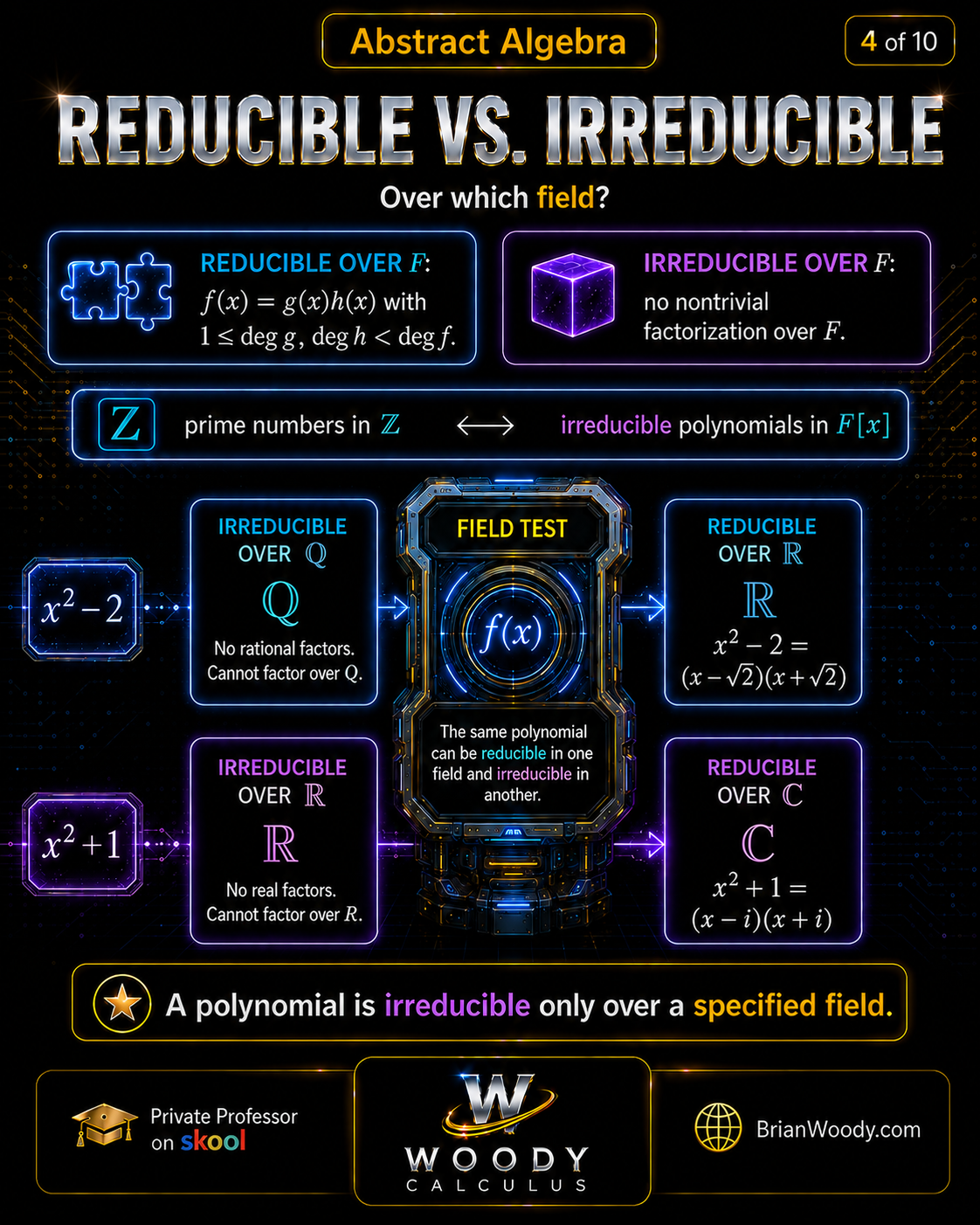
Consider \(f(x)=x^2-2\).
It is irreducible because \(\sqrt2\notin\mathbb Q\), so the quadratic has no rational root.
It becomes reducible because \(x^2-2=(x-\sqrt2)(x+\sqrt2)\).
Mental Model: Change the Lens, Change the Allowed Factors
Think of the coefficient field as a mathematical lens. Through the rational-number lens,
\(x^2-2\) looks solid because \(\sqrt2\) is unavailable. Through the real-number lens,
those missing coefficients become visible and the polynomial splits into two linear pieces.
never say only “\(f(x)\) is irreducible.” Say irreducible over what ring or field?
![Polynomial ring R[x] infographic showing Z[x], Q[x], R[x], C[x], and F_p[x], with x squared minus 2 irreducible over the rationals but factorable over the reals.](https://k3p6r8v3.delivery.rocketcdn.me/wp-content/uploads/2026/08/Polynomial-Rings-Slide-2.png)
Why Arithmetic in \(F[x]\) Works So Well
Polynomial rings exist over general rings, but the cleanest irreducibility theory appears when the coefficients come from a
field \(F\). Then \(F[x]\) is a Euclidean domain.
The units are exactly the nonzero constant polynomials.
For \(f,g\in F[x]\) with \(g\neq0\), there are unique \(q,r\in F[x]\) such that \(f=qg+r\), with \(r=0\) or \(\deg r<\deg g\).
Repeated polynomial division computes \(\gcd(f,g)\), just as repeated integer division computes an integer gcd.
For nonzero \(f,g\in F[x]\), multiplication adds degrees:
\(\deg(fg)=\deg f+\deg g\).
Addition behaves differently:
\(\deg(f+g)\leq\max\{\deg f,\deg g\}\),
because leading terms can cancel.
Every nonzero nonunit polynomial factors into irreducibles, uniquely up to multiplication by units and reordering.
Do Not Confuse \(F[x]\) with \(\mathbb Z[x]\)
The ring \(\mathbb Z[x]\) is extremely important, but \(\mathbb Z\) is not a field.
Its only units are \(\pm1\), and arbitrary polynomial division does not always stay inside \(\mathbb Z[x]\).
This is exactly why Gauss’s Lemma matters when we move between \(\mathbb Z[x]\) and \(\mathbb Q[x]\).
![Polynomial arithmetic in F[x] infographic showing nonzero constant units, the polynomial division algorithm, greatest common divisors, degree under multiplication, factorization, and irreducibility over a field.](https://k3p6r8v3.delivery.rocketcdn.me/wp-content/uploads/2026/08/Polynomial-Rings-Slide-3.png)
Reducible, Irreducible, and Prime: Do Not Confuse Them
Let \(F\) be a field and let \(f(x)\in F[x]\) be nonconstant. The polynomial is
reducible over \(F\) if there are \(g,h\in F[x]\) with
f(x)=g(x)h(x),
\qquad
1\le \deg g,\deg h<\deg f. \]
If no such factorization exists, \(f\) is irreducible over \(F\).
Prime vs. Irreducible
An irreducible element cannot be factored into two nonunits. A prime element has the stronger divisibility property:
if it divides a product, it must divide at least one factor.
In \(F[x]\), these notions coincide because \(F[x]\) is a PID and therefore a UFD.
But they do not coincide in every integral domain.
For example, in \(\mathbb Z[\sqrt{-5}]\), the element \(2\) is irreducible but not prime:
\[
2\mid(1+\sqrt{-5})(1-\sqrt{-5})=6,
\]
while \(2\) divides neither \(1+\sqrt{-5}\) nor \(1-\sqrt{-5}\).
Irreducible over \(\mathbb Q\), reducible over \(\mathbb R\).
Irreducible over \(\mathbb R\), reducible over \(\mathbb C\) because \(x^2+1=(x-i)(x+i)\).
The Complete Root Test for Degree \(2\) and \(3\)
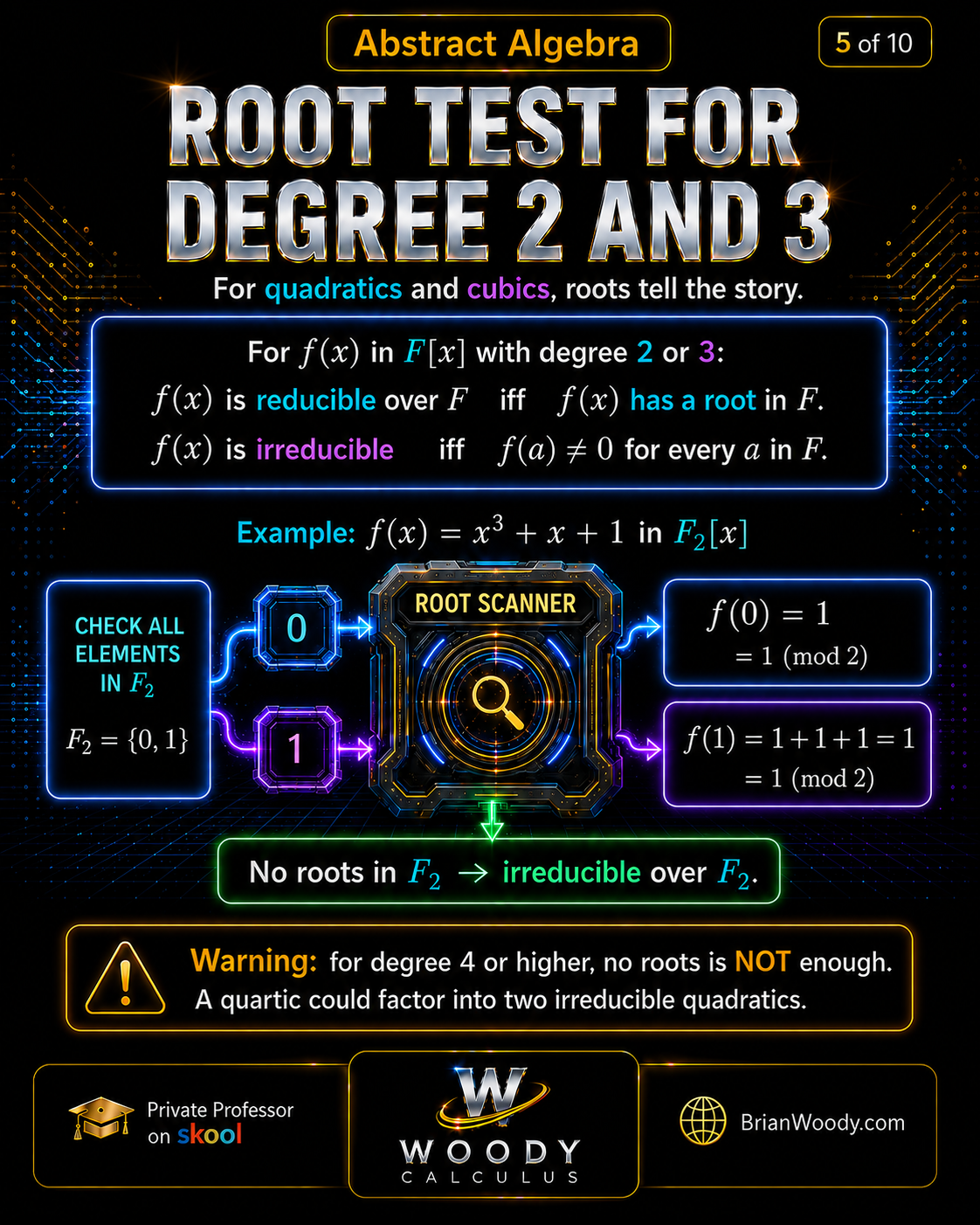
Degree-2/3 Root Criterion. For quadratics and cubics, irreducibility has a beautifully simple criterion.
Swipe formula horizontally if needed →
\boxed{
\deg f\in\{2,3\}
\quad\Longrightarrow\quad
f \text{ irreducible over }F
\iff
f \text{ has no root in }F
}.
\]
Why It Works
If \(f(a)=0\), the Factor Theorem gives a linear factor \(x-a\), so \(f\) is reducible.
Conversely, if a polynomial of degree \(2\) or \(3\) factors nontrivially, the degree equation
\(\deg f=\deg g+\deg h\) forces at least one factor to have degree \(1\), producing a root in \(F\).
Example Over \(\mathbb F_2\)
Consider \(f(x)=x^3+x+1\in\mathbb F_2[x]\). Since \(\mathbb F_2=\{0,1\}\), only two values need checking:
f(0)=1,
\qquad
f(1)=1+1+1=1
\quad\text{in }\mathbb F_2.
\]
There are no roots, and the polynomial has degree \(3\), so it is irreducible over \(\mathbb F_2\).
The Degree-\(4\) Trap
“No roots” is not enough once the degree reaches \(4\). A quartic can factor as quadratic times quadratic without having any root in the field.
x^4+5x^2+4=(x^2+1)(x^2+4)
\quad\text{in }\mathbb Q[x].
\]
This quartic has no rational roots but is reducible over \(\mathbb Q\).
Testing Irreducibility Over \(\mathbb Q\)
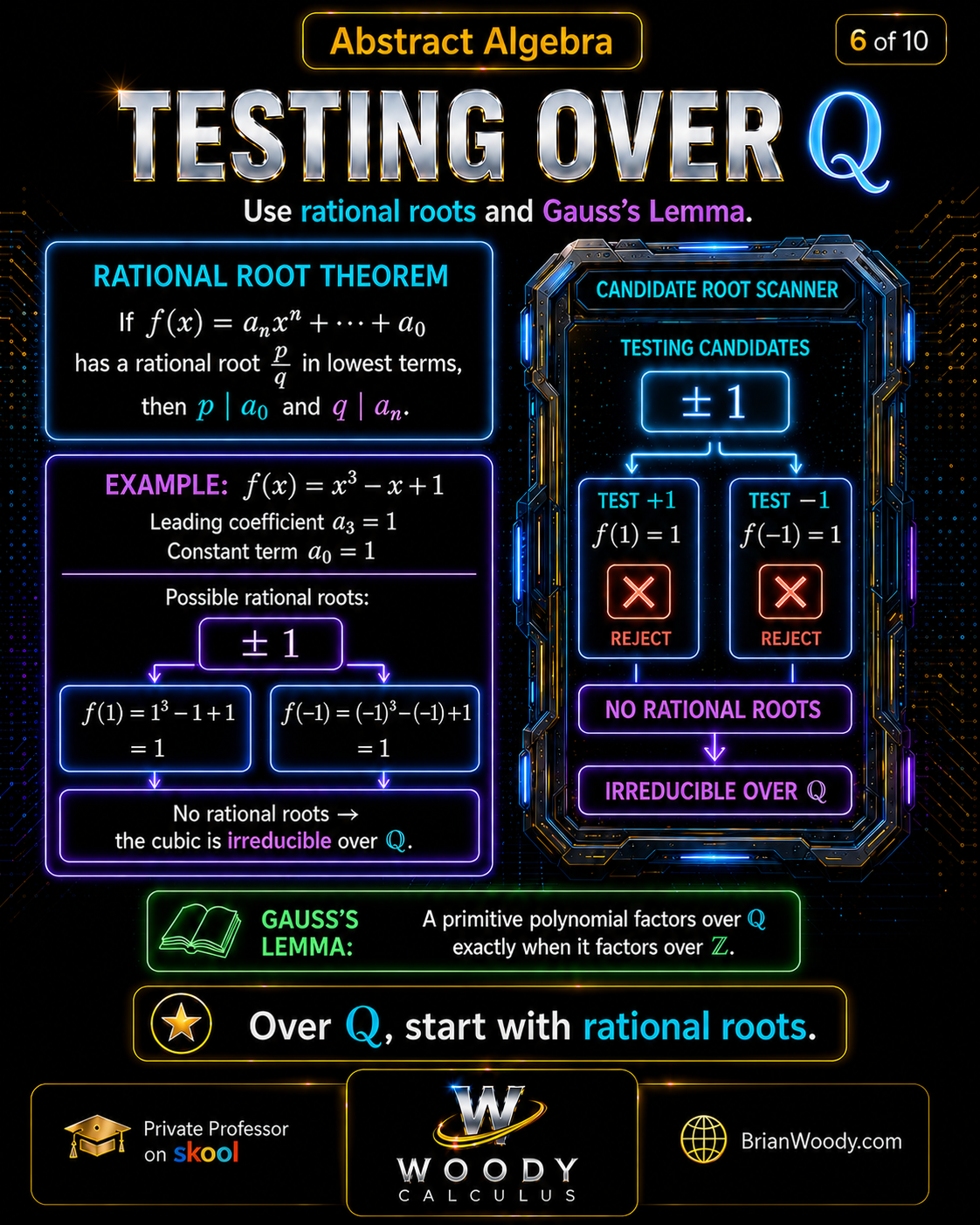
Over the rationals, two tools appear constantly: Gauss’s Lemma and the Rational Root Theorem.
Gauss’s Lemma
Gauss’s Lemma.
A polynomial in \(\mathbb Z[x]\) is primitive when the gcd of all its coefficients is \(1\).
Gauss’s Lemma implies that a primitive integer polynomial is reducible over \(\mathbb Q\) exactly when it is reducible over \(\mathbb Z\),
apart from multiplication by nonzero rational constants.
for primitive integer polynomials, integer arithmetic can answer an irreducibility question over \(\mathbb Q\).
First Remove the Content
If an integer polynomial is not primitive, factor out the gcd of its coefficients first.
That gcd is called the content of the polynomial.
6x^3-6x+6
=
6(x^3-x+1).
\]
Over \(\mathbb Q[x]\), the nonzero scalar \(6\) is a unit, so the original polynomial and
its primitive part \(x^3-x+1\) are associates and have the same irreducibility status.
Operational rule: factor out the content, then test the primitive part.
Rational Root Theorem
Let \(f(x)=a_nx^n+\cdots+a_0\in\mathbb Z[x]\). If \(p/q\) is a rational root in lowest terms, then
p\mid a_0,
\qquad
q\mid a_n.
\]
Worked Example: \(x^3-x+1\)
Because the polynomial is monic with constant term \(1\), the only rational root candidates are \(\pm1\):
f(1)=1,
\qquad
f(-1)=1.
\]
There are no rational roots. Since the polynomial has degree \(3\), the degree-\(2/3\) theorem finishes the proof:
\(x^3-x+1\) is irreducible over \(\mathbb Q\).
the Rational Root Theorem eliminates rational linear factors. For degree \(4\) or higher, eliminating linear factors may leave a quadratic-by-quadratic factorization.
Eisenstein’s Criterion: When One Prime Locks the Polynomial
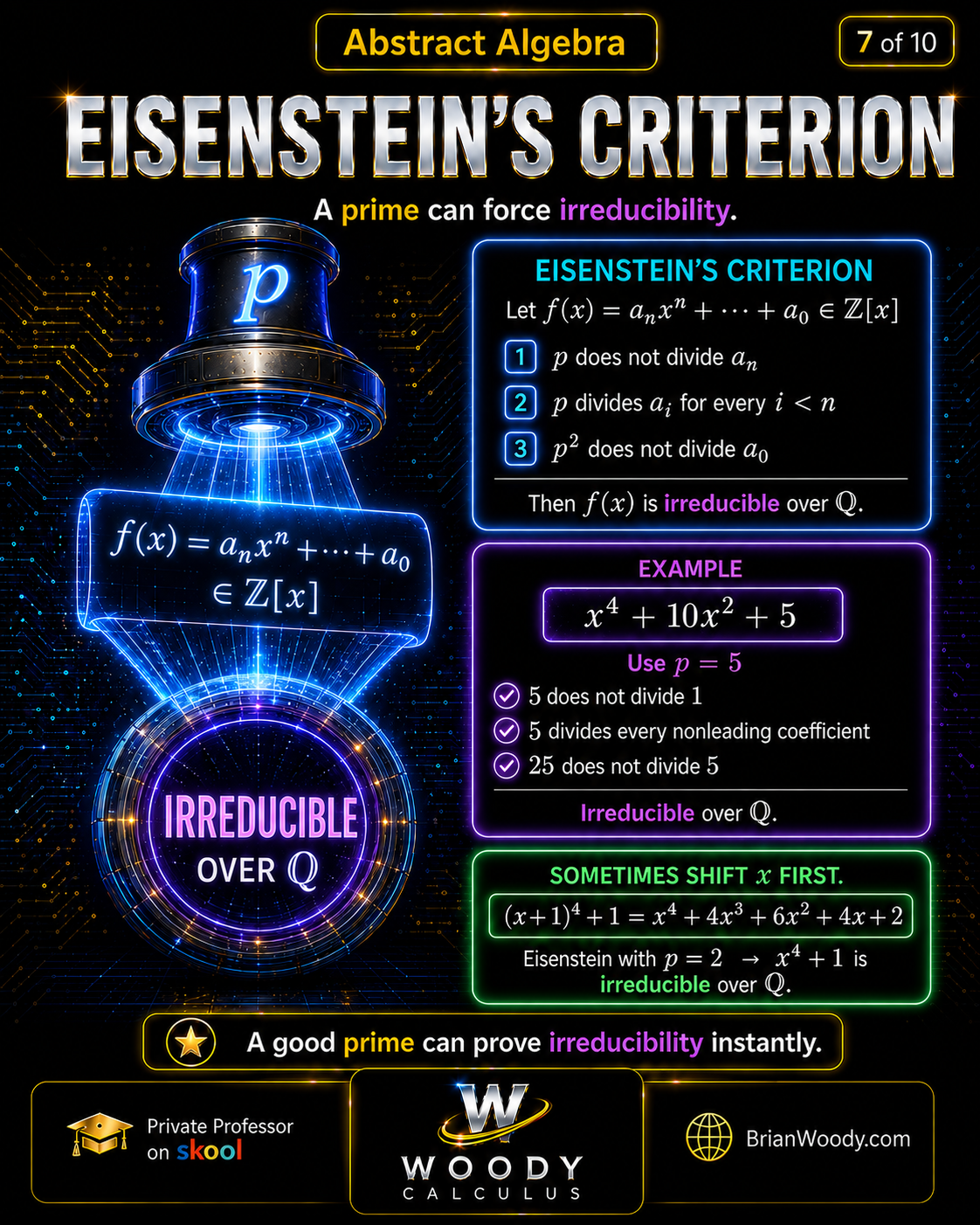
Let \(f(x)=a_nx^n+\cdots+a_0\in\mathbb Z[x]\). Suppose there is a prime \(p\) with the following pattern.
\(p\nmid a_n\).
\(p\mid a_i\) for every \(i
\(p^2\nmid a_0\).
\boxed{f(x)\text{ is irreducible over }\mathbb Q.}
\]
Example: \(x^4+10x^2+5\)
Choose \(p=5\). The leading coefficient \(1\) is not divisible by \(5\).
Every nonleading coefficient—including the zero coefficients of \(x^3\) and \(x\)—is divisible by \(5\).
Finally, \(25\nmid5\).
\boxed{x^4+10x^2+5\text{ is irreducible over }\mathbb Q.}
\]
The Shift Trick: \(x^4+1\)
Eisenstein does not apply directly to \(x^4+1\). Replace \(x\) by \(x+1\):
(x+1)^4+1=x^4+4x^3+6x^2+4x+2.
\]
The shifted polynomial is Eisenstein at \(p=2\). Since \(x\mapsto x+1\) is an automorphism of \(\mathbb Q[x]\),
it preserves reducibility and irreducibility.
\boxed{x^4+1\text{ is irreducible over }\mathbb Q.}
\]
Eisenstein is a divisibility criterion in an integral domain such as \(\mathbb Z\), paired with its fraction field.
Inside a field, every nonzero coefficient is already a unit.
Eisenstein uses one prime’s divisibility pattern in \(\mathbb Z\) to prevent a polynomial from splitting in \(\mathbb Q[x]\).
Reduction Modulo \(p\): Make the Coefficients Smaller
A difficult polynomial over \(\mathbb Q\) can sometimes become much easier after reducing its integer coefficients modulo a prime.
Reduction Modulo \(p\) Irreducibility Criterion.
Let \(f(x)\in\mathbb Z[x]\) be primitive and choose a prime \(p\) that does not divide the leading coefficient.
Reduce every coefficient modulo \(p\) to obtain \(\overline f(x)\in\mathbb F_p[x]\).
Swipe formula horizontally if needed →
\boxed{
\overline f(x)\text{ irreducible in }\mathbb F_p[x]
\Longrightarrow
f(x)\text{ irreducible in }\mathbb Q[x].
}
\]
Worked Example: \(x^4+x+1\)
Reduce modulo \(2\). The polynomial remains \(\overline f(x)=x^4+x+1\in\mathbb F_2[x]\).
\overline f(0)=1,
\qquad
\overline f(1)=1.
\]
Because the degree is \(4\), no roots alone are not enough. A reducible quartic with no linear factor would have to split as quadratic times quadratic.
Over \(\mathbb F_2\), the only monic irreducible quadratic is \(x^2+x+1\).
x^4+x+1=(x^2+x+1)(x^2+x)+1
\quad\text{in }\mathbb F_2[x].
\]
The remainder is \(1\), so the irreducible quadratic does not divide \(\overline f\). Therefore
\boxed{x^4+x+1\text{ is irreducible over }\mathbb Q.}
\]
A Famous Surprise: \(x^4+1\) Defeats Every Mod-\(p\) Attempt
The polynomial \(x^4+1\)—the same polynomial we just proved irreducible over \(\mathbb Q\) with the shifted Eisenstein trick—
is reducible modulo every prime.
This is exactly why reduction modulo \(p\) is a powerful sufficient test rather than a complete characterization:
some irreducible polynomials over \(\mathbb Q\) have no prime at which the reduction is irreducible.
Advanced Galois connection: why does this happen for \(x^4+1\)?
The splitting field of \(x^4+1\) is
\(\mathbb Q(\zeta_8)=\mathbb Q(i,\sqrt2)\), whose Galois group is the Klein four-group
\(V_4\).
In its action on the four roots, \(V_4\) contains no 4-cycle.
For an unramified prime, an irreducible degree-4 reduction would require the Frobenius permutation
to act as a 4-cycle. Since that cycle type is absent, no odd unramified prime can make
\(x^4+1\) irreducible modulo \(p\). The remaining prime \(p=2\) is checked directly.
This is an advanced preview of a major Galois-Theory theme:
factorization patterns modulo primes reflect cycle types in the Galois group.
The Mod-\(p\) Test Is One-Way
If a reduction is reducible modulo one prime, you have not proved the original polynomial is reducible over \(\mathbb Q\).
Try another prime or another theorem.
One good prime can prove irreducibility. A bad prime does not disprove it.
reduction modulo \(p\) can certify irreducibility with one successful prime, but a reducible reduction is only an inconclusive test result.
![Reduction mod p irreducibility test infographic reducing x to the fourth plus x plus 1 modulo 2, proving it irreducible in F_2[x], and lifting the conclusion back to Q.](https://k3p6r8v3.delivery.rocketcdn.me/wp-content/uploads/2026/08/Polynomial-Rings-Slide-8.png)
Not Sure Your Irreducibility Proof Would Earn Full Credit?
Irreducibility problems are difficult because several theorems may look plausible but only one actually finishes the proof.
Bring the exact polynomial, coefficient field, and your attempted argument into the Woody Calculus community for
professor-guided proof verification: theorem choice, missing hypotheses, logical gaps, notation, and whether the argument would earn full credit on a university exam.
How Do You Test Irreducibility Over a Finite Field?
Finite fields turn roots and factor searches into finite computations. The key degree observation is simple.
If a degree-\(n\) polynomial is reducible, then at least one nonconstant factor has degree at most
\(\lfloor n/2\rfloor\).
Check every field element for a root.
Rule out linear factors and irreducible quadratic factors.
Rule out irreducible factors of degrees \(1\), \(2\), and \(3\).
For larger degrees, gcd tests involving \(x^{q^d}-x\) turn this idea into efficient finite-field irreducibility algorithms.
The polynomial \(x^{q^d}-x\) is the product of all monic irreducible polynomials over \(\mathbb F_q\) whose degrees divide \(d\).
This is the bridge from classroom irreducibility tests to
finite-field theory,
coding theory, cryptography, and computational algebra.
Why Irreducible Polynomials Build New Fields
This is the structural payoff that makes irreducibility central to Abstract Algebra.
\boxed{
F[x]/(p(x))
\text{ is a field}
\iff
p(x)\text{ is irreducible over }F
}.
\]
When \(p\) is irreducible, the ideal \((p)\) is maximal in \(F[x]\). Passing to the quotient forces \(p(x)=0\),
so the residue class of \(x\) behaves like a root of \(p\).
Build \(\mathbb Q(\sqrt2)\)
Since \(x^2-2\) is irreducible over \(\mathbb Q\),
K=\mathbb Q[x]/(x^2-2)
\]
is a field. If \(\alpha=x+(x^2-2)\), then \(\alpha^2=2\), and every element has the form \(a+b\alpha\).
\boxed{\mathbb Q[x]/(x^2-2)\cong\mathbb Q(\sqrt2).}
\]
Build the Four-Element Field
The polynomial \(x^2+x+1\) has no root in \(\mathbb F_2\), so it is irreducible. Therefore
\mathbb F_2[x]/(x^2+x+1)
\]
is a field. If \(\alpha\) is the residue class of \(x\), then \(\alpha^2+\alpha+1=0\), so \(\alpha^2=\alpha+1\).
\boxed{\mathbb F_4=\{0,1,\alpha,\alpha+1\}.}
\]
More generally, if \(p(x)\in\mathbb F_q[x]\) is irreducible of degree \(n\), then
\[
\mathbb F_q[x]/(p(x))
\]
is a field with exactly \(q^n\) elements.
irreducibility is the gatekeeper that turns a polynomial quotient ring into a field and turns a missing root into a new algebraic number system.
![Irreducible polynomials build fields infographic showing F[x] modulo p(x), Q[x] modulo x squared minus 2 producing Q of square root 2, and F_2[x] modulo x squared plus x plus 1 producing F_4.](https://k3p6r8v3.delivery.rocketcdn.me/wp-content/uploads/2026/08/Polynomial-Rings-Slide-9.png)
Try It Yourself: Three Irreducibility Challenges
Attempt each proof before opening the solution. Each problem is designed to trigger a different theorem-selection decision.
Practice A: Prove \(x^4+6x^2+3\) is irreducible over \(\mathbb Q\)
Choose \(p=3\). The leading coefficient is not divisible by \(3\); every lower coefficient is divisible by \(3\); and \(9\nmid3\).
\boxed{x^4+6x^2+3\text{ is irreducible over }\mathbb Q}
\]
by Eisenstein’s Criterion.
Practice B: Is \(x^4+4\) irreducible over \(\mathbb Q\)?
It has no rational root, but degree \(4\) means that does not settle the problem.
Use the Sophie Germain identity:
x^4+4
=
x^4+4x^2+4-4x^2
=
(x^2-2x+2)(x^2+2x+2).
\]
Therefore \(x^4+4\) is reducible over \(\mathbb Q\).
Practice C hint: check \(f(0)\) and \(f(1)\) before you attempt any polynomial division. Eliminate linear factors first.
Practice C: Is \(x^4+x^3+x^2+x+1\) irreducible over \(\mathbb F_2\)?
Check roots first:
f(0)=1,
\qquad
f(1)=1
\quad\text{in }\mathbb F_2.
\]
There is no linear factor. A reducible quartic with no linear factor would have to contain an irreducible quadratic factor.
The only monic irreducible quadratic over \(\mathbb F_2\) is \(x^2+x+1\).
x^4+x^3+x^2+x+1
=
x^2(x^2+x+1)+(x+1).
\]
The remainder is nonzero, so \(x^2+x+1\) does not divide \(f\). There are no possible factor degrees left.
\boxed{x^4+x^3+x^2+x+1\text{ is irreducible over }\mathbb F_2.}
\]
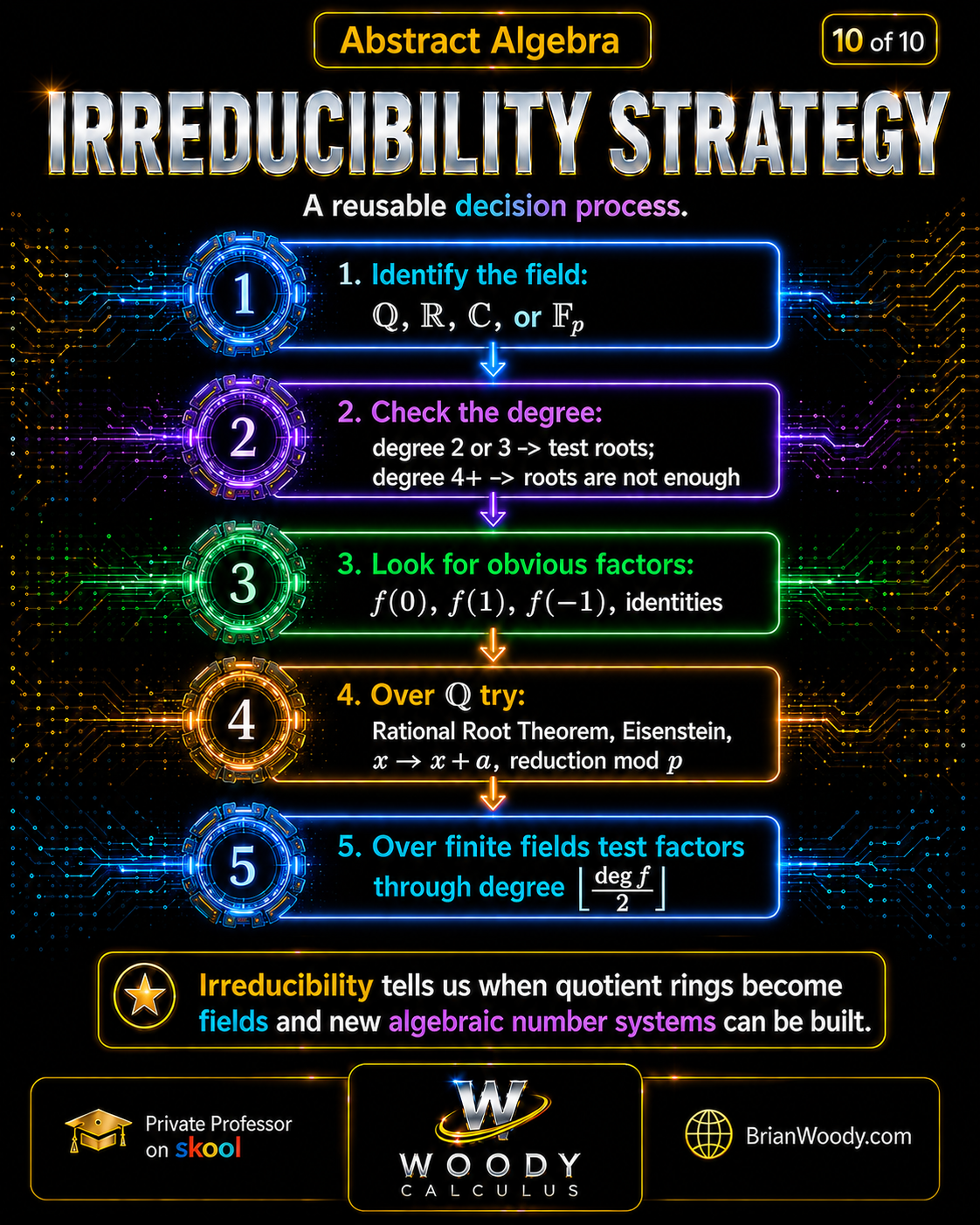
Professor Woody’s Irreducibility Strategy
Irreducibility problems become much easier when you stop trying random tests and let the field, degree, and coefficient pattern choose the theorem.
Write down whether you are in \(\mathbb Z[x]\), \(\mathbb Q[x]\), \(\mathbb R[x]\), \(\mathbb C[x]\), or \(\mathbb F_q[x]\). The answer can change when the field changes.
For degree \(2\) or \(3\), a root test is complete. For degree \(4\) or higher, roots alone are not enough.
Check \(f(0)\), \(f(1)\), \(f(-1)\), common factors, and recognizable algebraic identities.
Try rational roots, scan for an Eisenstein prime, try a small shift \(x\mapsto x+a\), or reduce modulo a useful prime.
A reducible degree-\(n\) polynomial has a factor of degree at most \(\lfloor n/2\rfloor\). Test only what the degree actually allows.
State exactly why your computation proves irreducibility over the specified field. Do not stop at an unexplained calculation.
Eisenstein vs. Reduction Mod \(p\)
| Feature | Eisenstein’s Criterion | Reduction Mod \(p\) |
|---|---|---|
| Leading coefficient | Need \(p\nmid a_n\) | Choose \(p\nmid a_n\) so the degree does not drop |
| Nonleading coefficients | Every one must be divisible by \(p\) | Reduce all coefficients modulo \(p\); no divisibility pattern is required |
| Constant term | Need \(p^2\nmid a_0\) | No special constant-term condition |
| What you prove | Direct irreducibility over \(\mathbb Q\) | Irreducibility over \(\mathbb Q\) if the reduction is irreducible |
| If the test fails | Inconclusive; try another prime or a shift | Inconclusive; try another prime or another method |
| Best visual clue | A strong common prime-divisibility pattern | Coefficients become dramatically simpler modulo a small prime |
Quick-Reference Exam Table
| Situation | Strong first tool | Critical warning |
|---|---|---|
| Degree \(2\) or \(3\) over \(F\) | Check roots in \(F\) | No root is enough only in degrees \(2\) and \(3\) |
| Primitive polynomial over \(\mathbb Q\) | Gauss’s Lemma + integer methods | First remove any common coefficient factor |
| Possible rational linear factor | Rational Root Theorem | No rational roots does not settle degree \(4+\) |
| Coefficients share a prime pattern | Eisenstein’s Criterion | Check \(p^2\nmid a_0\) |
| Eisenstein almost works | Try \(x\mapsto x+a\) | Apply the shift to the entire polynomial |
| Integer polynomial looks messy | Reduction modulo a small prime | Keep the degree; reducible mod \(p\) is inconclusive |
| Polynomial over \(\mathbb F_q\) | Test factors through degree \(\lfloor n/2\rfloor\) | Do not stop at roots for degree \(4+\) |
| Quotient \(F[x]/(p)\) | Test whether \(p\) is irreducible | The quotient is a field exactly when \(p\) is irreducible |
Common Polynomial Irreducibility Mistakes
“Irreducible” is incomplete unless the coefficient ring or field is understood.
A quartic can factor into two quadratics and have no roots in the base field.
It only eliminates rational linear factors.
Factor out the content before applying the clean primitive-polynomial version of Gauss’s Lemma.
If the degree drops, you lose the standard irreducibility-lifting argument you intended to use.
The useful implication goes from irreducible mod \(p\) to irreducible over \(\mathbb Q\), not the other way around.
Eisenstein is a divisibility criterion in rings such as \(\mathbb Z\), not a prime-divisibility test inside \(\mathbb F_p\).
On a proof-based exam, connect the computation to the exact theorem that finishes the argument.
Why This Topic Matters Beyond One Chapter
Polynomial irreducibility is the gateway from ring theory into field theory. Once this topic clicks, field extensions,
finite fields, splitting fields, minimal polynomials, and Galois Theory become one connected story.
An irreducible polynomial tells you what new algebraic root must be adjoined and controls the degree of a simple extension.
Irreducible degree-\(n\) polynomials over \(\mathbb F_q\) construct fields with \(q^n\) elements.
Once finite fields are built, Frobenius reveals the symmetry, conjugates, trace, norm, and cyclic Galois structure of finite extensions.
Irreducible polynomials lead to minimal polynomials, splitting fields, conjugates, automorphisms, and Galois groups.
A concrete cubic shows how irreducibility, splitting fields, roots of unity, and permutation symmetry come together.
See how finite fields, permutation polynomials, reciprocal quadrinomials, character sums, and computational verification extend these undergraduate ideas into active research.
Connection to Finite-Field Research
Irreducible polynomials are part of the infrastructure behind finite-field extensions, permutation polynomials,
coding theory, cryptography, and computational algebra. Brian M. Woody’s current research includes finite fields,
permutation polynomials, reciprocal quadrinomials, Dickson trace curves, and classification problems over \(\mathbb F_{q^2}\).
Polynomial Rings and Irreducibility FAQ
What is a polynomial ring?
A polynomial ring \(R[x]\) is the set of all finite polynomials in \(x\) whose coefficients lie in the ring \(R\), with ordinary polynomial addition and multiplication.
What does it mean for a polynomial to be irreducible?
A nonconstant polynomial is irreducible over a field \(F\) if it cannot be written as a product of two positive-degree polynomials in \(F[x]\).
Can the same polynomial be irreducible over one field and reducible over another?
Yes. For example, \(x^2-2\) is irreducible over \(\mathbb Q\) but reducible over \(\mathbb R\), and \(x^2+1\) is irreducible over \(\mathbb R\) but reducible over \(\mathbb C\).
How do you test a quadratic or cubic for irreducibility?
Over a field \(F\), a degree-\(2\) or degree-\(3\) polynomial is irreducible exactly when it has no root in \(F\).
Does having no roots prove a quartic is irreducible?
No. A quartic can factor as the product of two irreducible quadratics and therefore have no root in the base field.
What does Gauss’s Lemma do?
For a primitive polynomial in \(\mathbb Z[x]\), Gauss’s Lemma lets us study reducibility over \(\mathbb Q\) by studying factorization over \(\mathbb Z\), apart from multiplication by nonzero rational constants.
What does the Rational Root Theorem prove?
It gives a finite list of possible rational roots of an integer polynomial. Eliminating those roots eliminates rational linear factors, but for degree \(4\) or higher it does not by itself prove irreducibility.
What is Eisenstein’s Criterion?
Eisenstein gives sufficient prime-divisibility conditions on the coefficients of an integer polynomial that guarantee irreducibility over \(\mathbb Q\).
Why does reduction modulo p help prove irreducibility over Q?
If a primitive integer polynomial retains its degree and becomes irreducible in \(\mathbb F_p[x]\), a factorization over \(\mathbb Q\) would lead through Gauss’s Lemma to a factorization modulo \(p\). The contradiction proves irreducibility over \(\mathbb Q\).
If a polynomial is reducible modulo p, is it reducible over Q?
Not necessarily. Reducibility modulo one prime is generally inconclusive. The useful direction is that irreducibility modulo one suitable prime implies irreducibility over \(\mathbb Q\).
When is F[x]/(p(x)) a field?
If \(F\) is a field and \(p(x)\) is nonconstant, then \(F[x]/(p(x))\) is a field exactly when \(p(x)\) is irreducible over \(F\).
How do irreducible polynomials construct finite fields?
If \(p(x)\) is irreducible of degree \(n\) over \(\mathbb F_q\), then \(\mathbb F_q[x]/(p(x))\) is a field with \(q^n\) elements.
Are irreducible polynomials the same thing as prime polynomials?
In \(F[x]\), yes: because \(F[x]\) is a principal ideal domain, irreducible polynomials are prime elements. In a general integral domain, irreducible elements need not be prime.
University and Reference Resources
UConn — Keith Conrad: Irreducibility Tests in Q[T]
Detailed proofs of Gauss’s Lemma, reduction modulo \(p\), Eisenstein’s Criterion, and the limitations of these tests.
Northern Illinois University — Polynomial Rings
Division, gcds, irreducibility, unique factorization, and the quotient-field theorem.
UC San Diego — Graduate Algebra Course Notes
Includes root criteria, the quartic warning, polynomial factorization, and Rational Root Theorem material in a UFD framework.
Clemson University — The Structure of F[x]/(p)
Develops the equivalence between irreducibility of \(p\) and \(F[x]/(p)\) being a field.
West Chester University — Irreducible Polynomials Reducible Modulo Every Prime
Discusses the striking example \(x^4+1\), irreducible over the integers but reducible modulo every prime.
Turn Six Irreducibility Theorems Into One Decision System
The goal is not to memorize isolated tests. The goal is to look at the field, degree, and coefficient pattern and know which theorem can actually finish the proof.
Image Rights and Educational Use
The original Woody Calculus lesson graphics on this page are © 2026 Woody Calculus Consulting & Associates.
For permission, licensing, classroom use beyond ordinary linking or citation, or media requests,
contact Woody Calculus.