Number Theory • Modular Arithmetic • Complete Visual Lesson
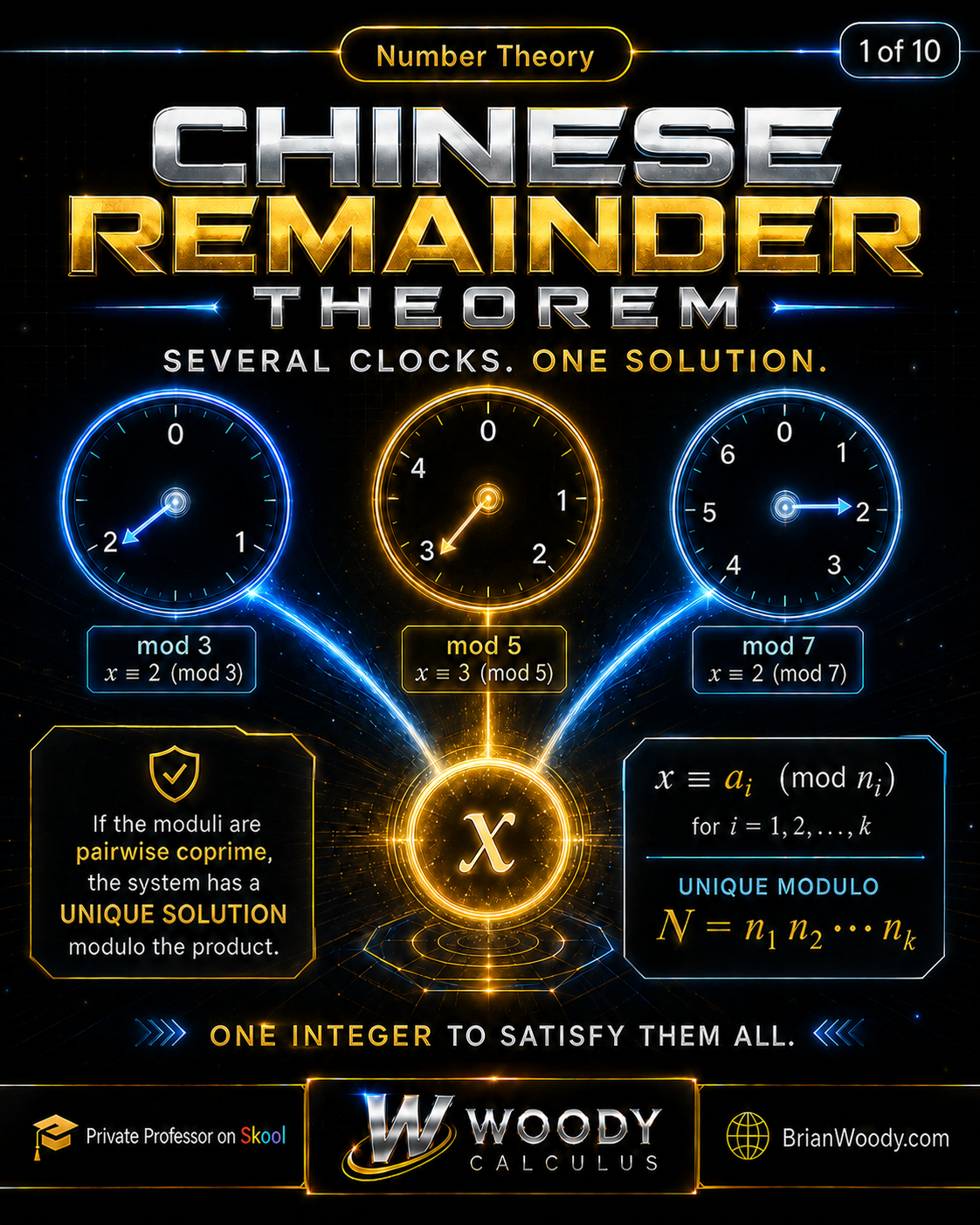
The Chinese Remainder Theorem combines several congruence conditions into one residue class. When the moduli are pairwise coprime, there is a solution, and that solution is unique modulo the product of the moduli. For the system
x\equiv2\pmod 3,\qquad
x\equiv3\pmod 5,\qquad
x\equiv2\pmod 7,
\]
the complete answer is
\boxed{x\equiv23\pmod{105}}
\qquad\Longleftrightarrow\qquad
\boxed{x=23+105k,\ k\in\mathbb Z}.
\]
Plain-language answer: each modulus acts like a clock. The theorem finds one integer that makes every clock display its required remainder at the same time—and then identifies every other integer that will do the same.
What should you know before studying the Chinese Remainder Theorem?
You should be comfortable with integer division, remainders, greatest common divisors, congruence notation, and basic modular inverses.
Essential prerequisites
- Meaning of \(a\equiv b\pmod n\)
- How to compute a remainder
- Greatest common divisors and coprimality
- How to solve a simple linear congruence
- Meaning of a multiplicative inverse modulo \(n\)
Best preparation
Review the Woody Calculus Number Theory pathway for congruences, modular arithmetic, the Euclidean Algorithm, and proof strategy. The finite-fields lesson provides a deeper algebraic connection to modular computation.
Quick Summary: What does the Chinese Remainder Theorem do?
It converts a system of compatible congruences into one congruence whose modulus describes the full repeating pattern.
Input
Several conditions of the form \(x\equiv a_i\pmod{n_i}\).
Classical hypothesis
The moduli \(n_1,\ldots,n_k\) are pairwise coprime.
Output
One unique residue class modulo \(N=n_1n_2\cdots n_k\).
Key Facts About the Chinese Remainder Theorem
The theorem is about existence, uniqueness, construction, and periodicity.
- Existence: pairwise-coprime moduli guarantee a simultaneous solution.
- Uniqueness: any two solutions differ by a multiple of the total product.
- Construction: modular inverses build a solution explicitly.
- Verification: reduce the final number modulo every original modulus.
- Canonical representative: reduce to \(0\le r<N\).
- All integers: write \(x=r+kN\), where \(k\in\mathbb Z\).
- Noncoprime systems: may still work, but compatibility must be checked.
- Generalized period: compatible noncoprime systems repeat modulo the least common multiple.
- Prime moduli are not required: composite moduli such as 8, 9, and 25 work because they are pairwise coprime.
What does the notation in the Chinese Remainder Theorem mean?
The notation separates the target remainders, the moduli, the total product, the partial products, and the inverses used to construct the solution.
| Symbol | Meaning | Student checkpoint |
|---|---|---|
| \(x\equiv a_i\pmod{n_i}\) | Dividing \(x\) by \(n_i\) leaves remainder congruent to \(a_i\). | The residue \(a_i\) may be replaced by any congruent integer. |
| \(\gcd(n_i,n_j)=1\) | The two moduli share no positive divisor larger than 1. | Check every pair, not only the gcd of the full list. |
| \(N=n_1n_2\cdots n_k\) | The total modulus in the pairwise-coprime theorem. | The full solution pattern repeats every \(N\) integers. |
| \(N_i=N/n_i\) | The product of all moduli except \(n_i\). | It is divisible by every other modulus. |
| \(M_i\) | An inverse satisfying \(N_iM_i\equiv1\pmod{n_i}\). | The inverse is taken modulo the omitted modulus \(n_i\). |
| \(x_0\) | One particular solution. | Usually choose the least nonnegative representative. |
| \(x=x_0+kN\) | Every integer solution. | Adding \(N\) preserves all original remainders. |
What does the Chinese Remainder Theorem say?
For pairwise-coprime positive moduli, every choice of target remainders determines exactly one residue class modulo the product.
Let \(n_1,n_2,\ldots,n_k\) be positive integers that are pairwise coprime. For arbitrary integers \(a_1,a_2,\ldots,a_k\), the system
x\equiv a_i\pmod{n_i},\qquad i=1,2,\ldots,k,
\]
has a solution. Moreover, that solution is unique modulo
N=n_1n_2\cdots n_k.
\]
“Unique modulo \(N\)” does not mean there is only one integer. It means every integer solution belongs to the same congruence class modulo \(N\).
How does the modular-clock model explain the theorem?
Each modulus tracks a separate repeating cycle, and the unknown integer must land on the required position in every cycle simultaneously.
In the main example, the mod-3 clock must display 2, the mod-5 clock must display 3, and the mod-7 clock must display 2. We are not solving three unrelated problems. We are finding one integer whose three remainders match all three targets.
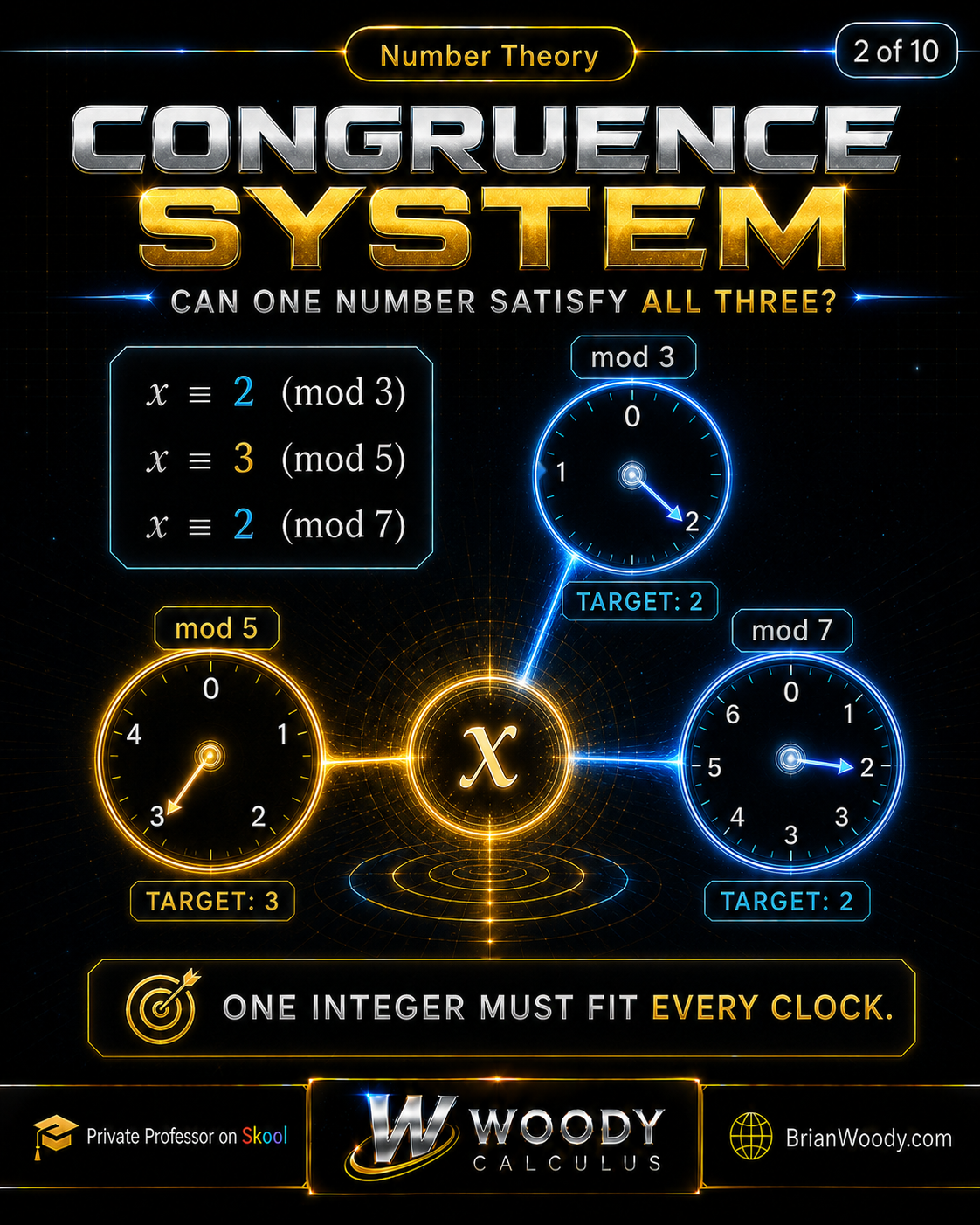
If a problem asks for one integer with several prescribed remainders, then test whether the Chinese Remainder Theorem applies before searching by trial and error.
Why do we check that the moduli are pairwise coprime?
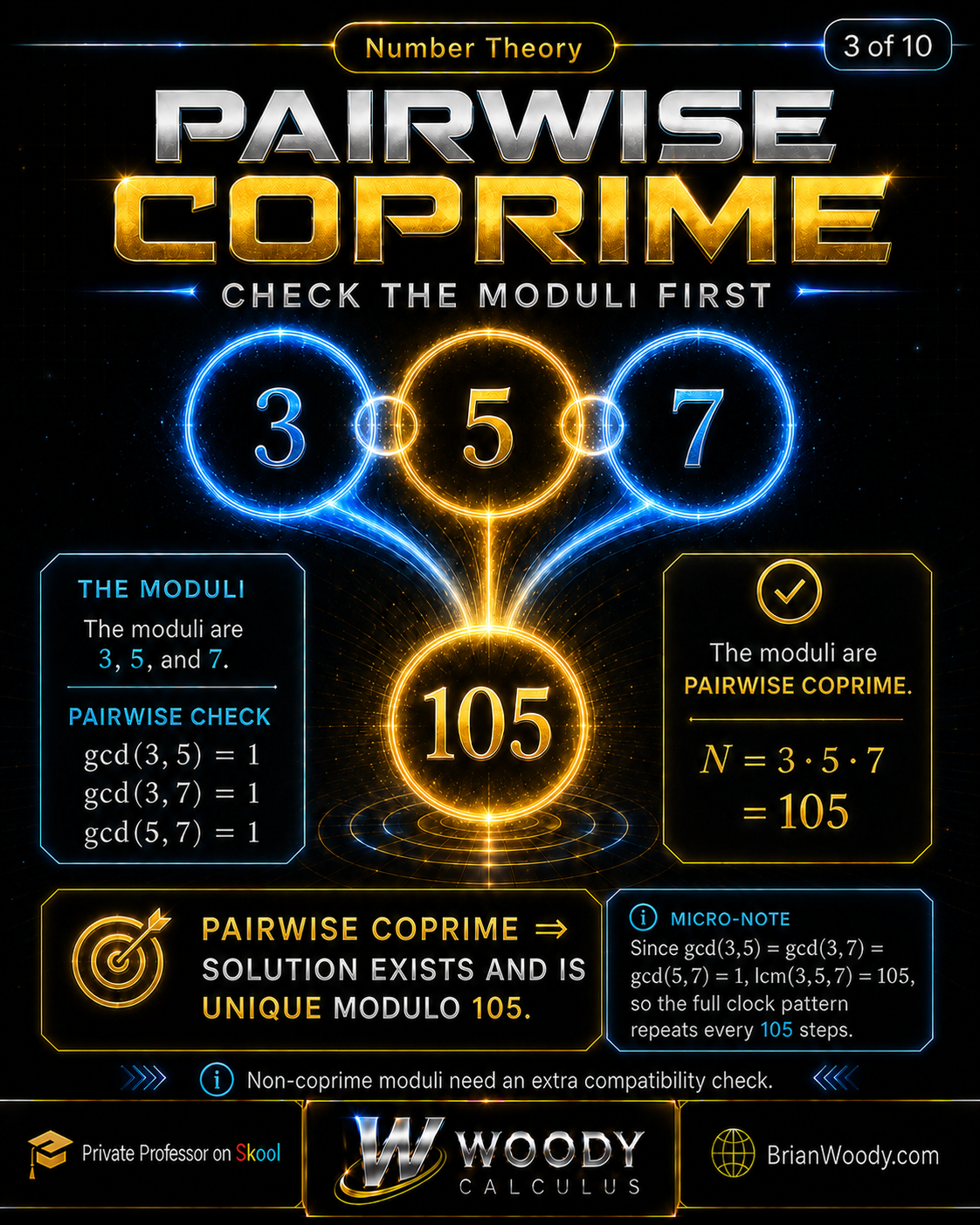
Pairwise coprimality guarantees that the classical CRT construction works and that the final solution is unique modulo the full product.
\gcd(3,5)=1,\qquad
\gcd(3,7)=1,\qquad
\gcd(5,7)=1.
\]
Therefore \(3,5,7\) are pairwise coprime, and the total modulus is
N=3\cdot5\cdot7=105.
\]
Checking only \(\gcd(n_1,n_2,n_3)=1\) is not enough. For example, \(\gcd(6,10,15)=1\), but the moduli are not pairwise coprime because each pair shares a factor.
The standard theorem requires pairwise coprimality, not primality. For example, \(8,9,25\) are all composite, and
\gcd(8,9)=\gcd(8,25)=\gcd(9,25)=1.
\]
Therefore a CRT system with moduli 8, 9, and 25 has a unique solution modulo \(8\cdot9\cdot25=1800\) for every choice of residues.
How do you solve a Chinese Remainder Theorem system step by step?
Use the five-step framework: Check, Build, Invert, Combine, Reduce.
How do you build the total product and partial products?
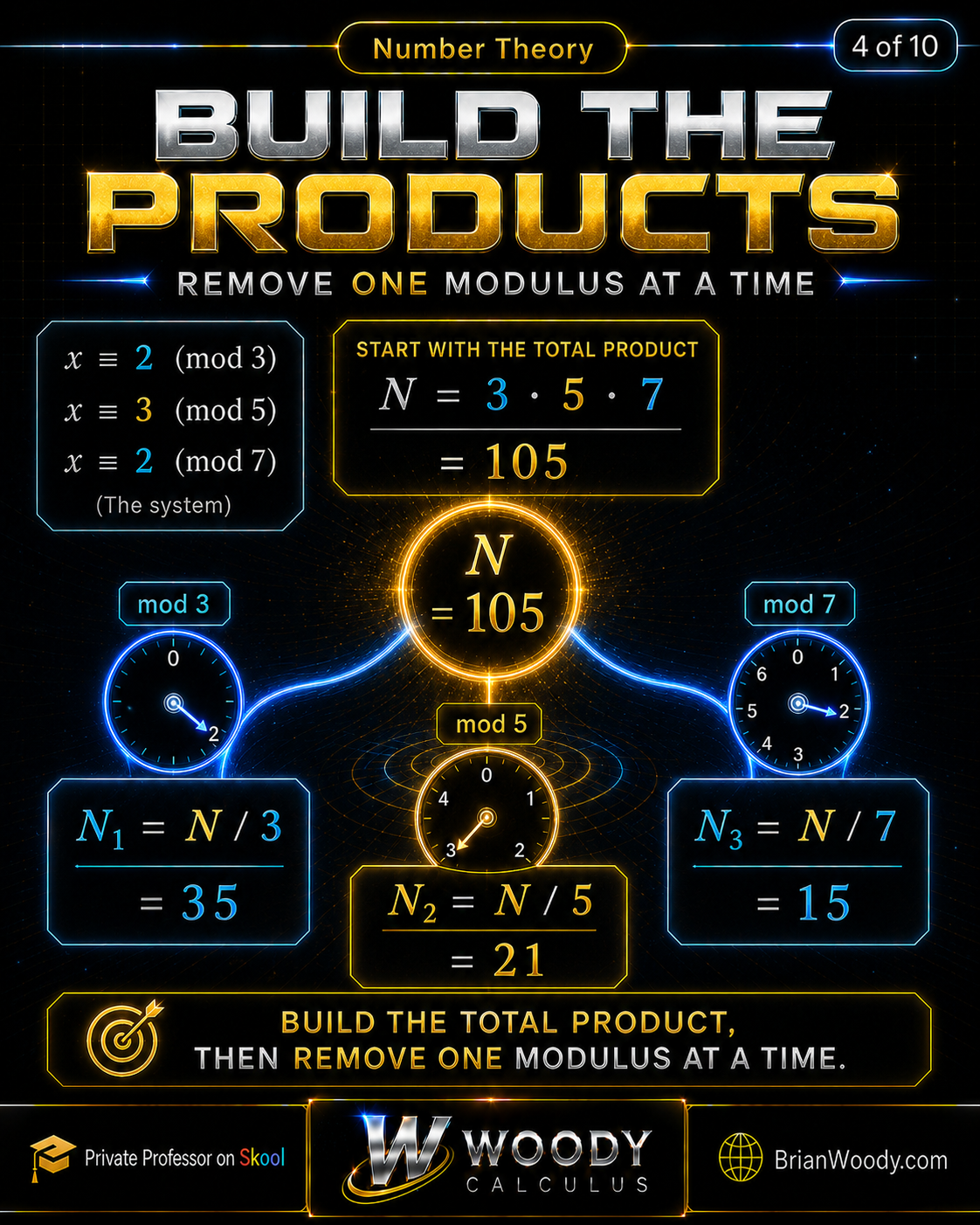
Multiply all moduli to obtain \(N\), then remove one modulus at a time to obtain each \(N_i\).
N=3\cdot5\cdot7=105.
\]
Remove 3
Remove 5
Remove 7
The design is deliberate: \(N_i\) is divisible by every modulus except \(n_i\). That makes the \(i\)-th CRT term vanish on every clock except the one it is meant to control.
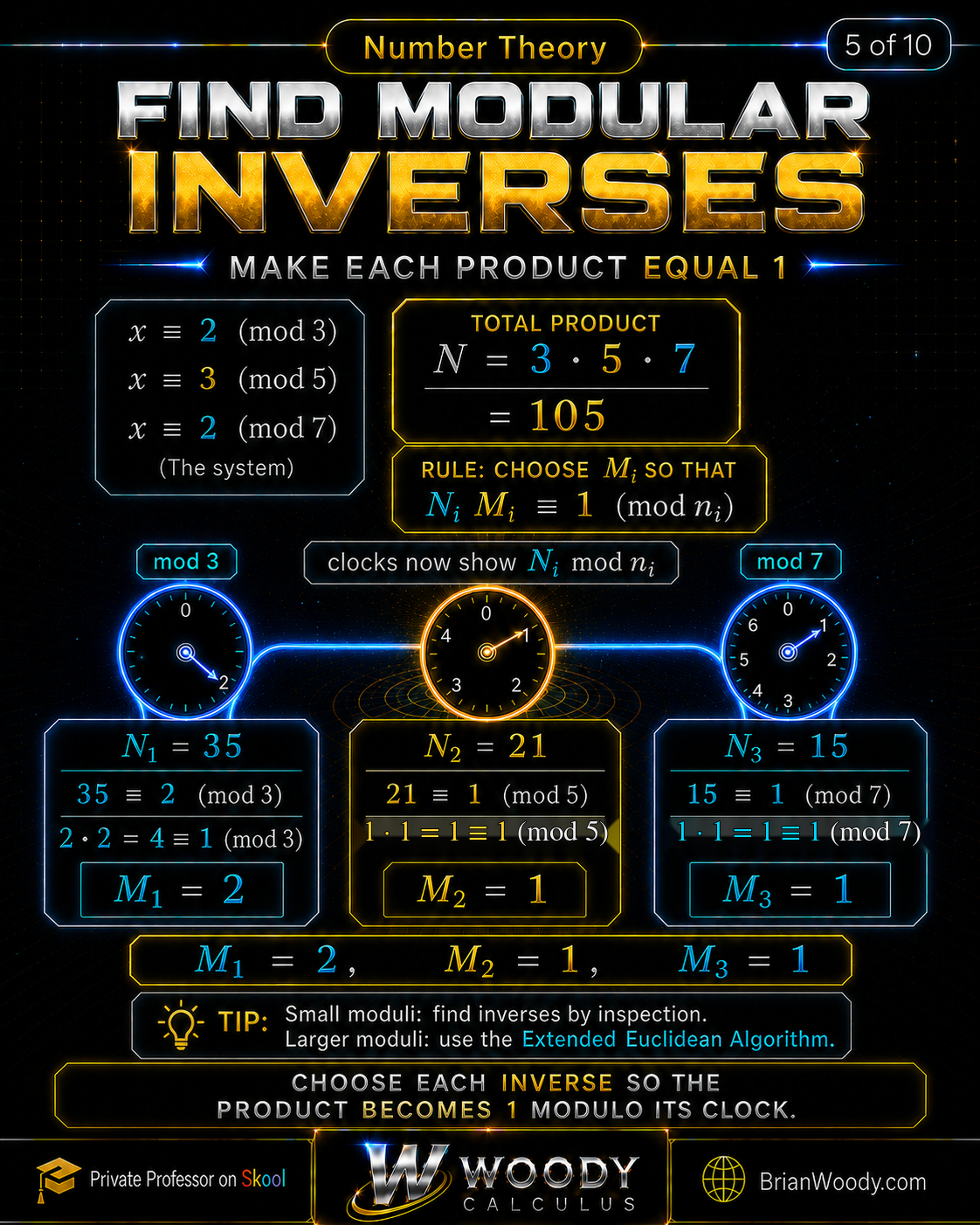
How do you find the modular inverses in the CRT formula?
For each \(i\), reduce \(N_i\) modulo \(n_i\), then find a multiplier \(M_i\) that makes the product congruent to 1.
Modulo 3
35\equiv2\pmod3,
\qquad 2\cdot2\equiv1\pmod3.
\]
Therefore \(M_1=2\).
Modulo 5
21\equiv1\pmod5,
\qquad 1\cdot1\equiv1\pmod5.
\]
Therefore \(M_2=1\).
Modulo 7
15\equiv1\pmod7,
\qquad 1\cdot1\equiv1\pmod7.
\]
Therefore \(M_3=1\).
For larger numbers, solve \(N_iM_i+n_iq=1\) with the Extended Euclidean Algorithm. Bézout’s identity produces the inverse because \(\gcd(N_i,n_i)=1\).
How do you use the Extended Euclidean Algorithm to find a modular inverse?
Run Euclid’s algorithm until the remainder is 1, then back-substitute to write 1 as a linear combination of the number and the modulus.
Inspection is convenient for tiny moduli, but a general CRT method needs a reliable way to compute inverses. Suppose a larger problem requires
\[
17^{-1}\pmod{43}.
\]
We are looking for an integer \(u\) such that \(17u\equiv1\pmod{43}\).
Step 1: Run Euclid’s algorithm
\[
\begin{aligned}
43&=2(17)+9,\\
17&=1(9)+8,\\
9&=1(8)+1.
\end{aligned}
\]
The last nonzero remainder is 1, so \(\gcd(17,43)=1\) and the inverse exists.
Step 2: Back-substitute
\[
\begin{aligned}
1&=9-8\\
&=9-(17-9)\\
&=2(9)-17\\
&=2(43-2\cdot17)-17\\
&=2(43)-5(17).
\end{aligned}
\]
Therefore \(-5(17)+2(43)=1\).
The coefficient of 17 is \(-5\), so
\[
17^{-1}\equiv-5\equiv38\pmod{43}.
\]
Verify before moving on:
\[
17\cdot38=646=15(43)+1,
\]
so \(17\cdot38\equiv1\pmod{43}\).
| What you obtain | What it means | What to do in CRT |
|---|---|---|
| \(17(-5)+43(2)=1\) | The coefficient of 17 is an inverse modulo 43. | Use \(-5\), or reduce it to the standard representative 38. |
| \(\gcd(17,43)=1\) | A multiplicative inverse exists. | Continue with the CRT construction. |
| A gcd larger than 1 | No inverse exists modulo that modulus. | Recheck the pairwise-coprime hypothesis or use the generalized CRT. |
If the inverse is not immediate, do not guess. Write the Euclidean divisions, back-substitute carefully, reduce the coefficient modulo the target modulus, and verify the product is congruent to 1.
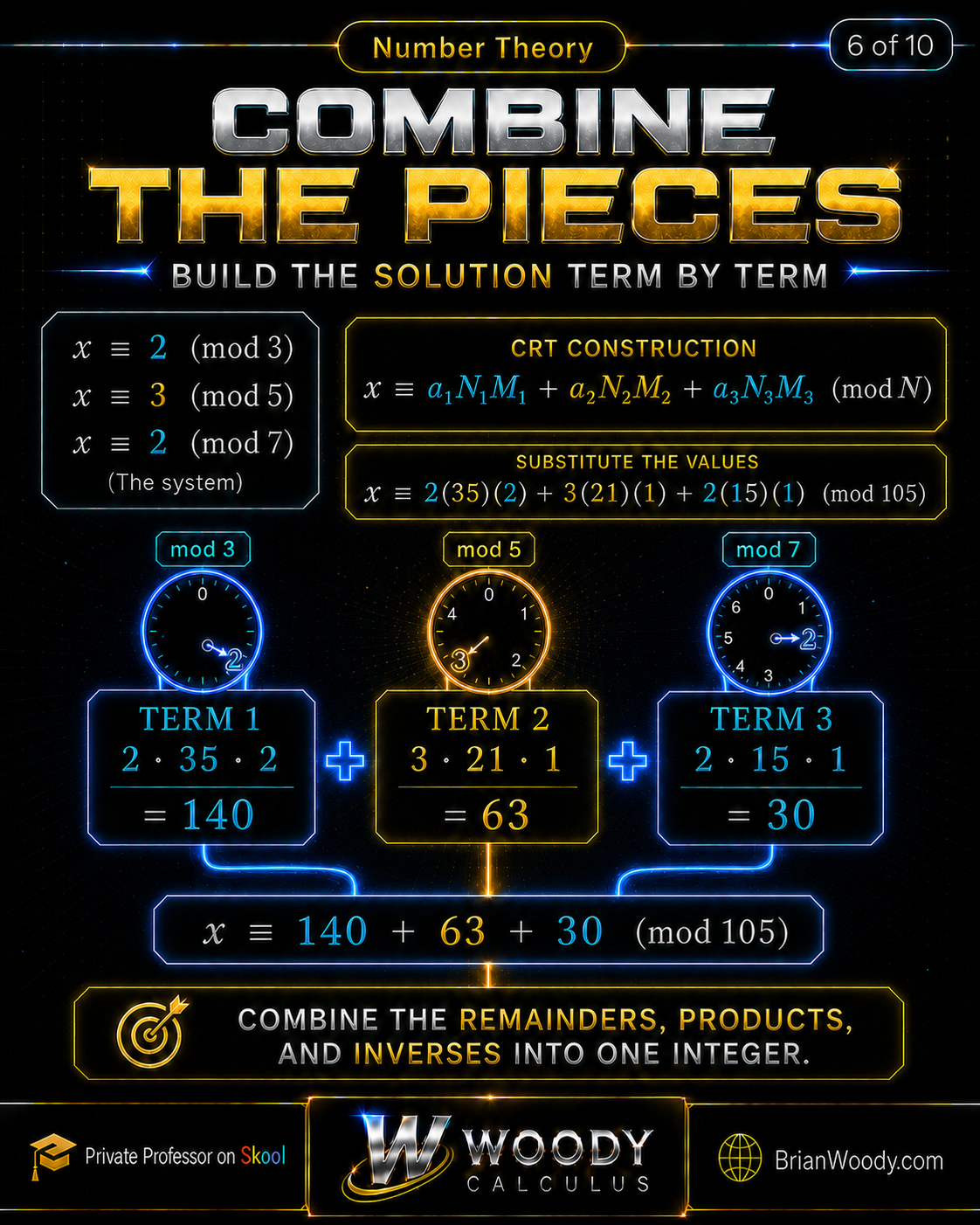
How do you combine the CRT pieces?
Multiply each target remainder by its partial product and modular inverse, then add the resulting terms.
x\equiv a_1N_1M_1+a_2N_2M_2+a_3N_3M_3\pmod N.
\]
Substitute the values:
\begin{aligned}
x
&\equiv2(35)(2)+3(21)(1)+2(15)(1)\pmod{105}\\
&\equiv140+63+30\pmod{105}\\
&\equiv233\pmod{105}.
\end{aligned}
\]
Why does each term control only one congruence?
Consider the first basis term \(N_1M_1=35\cdot2=70\). It satisfies
70\equiv1\pmod3,
\qquad
70\equiv0\pmod5,
\qquad
70\equiv0\pmod7.
\]
So multiplying it by \(a_1=2\) installs the desired remainder on the mod-3 clock while contributing zero to the other two clocks. The other basis terms work the same way.
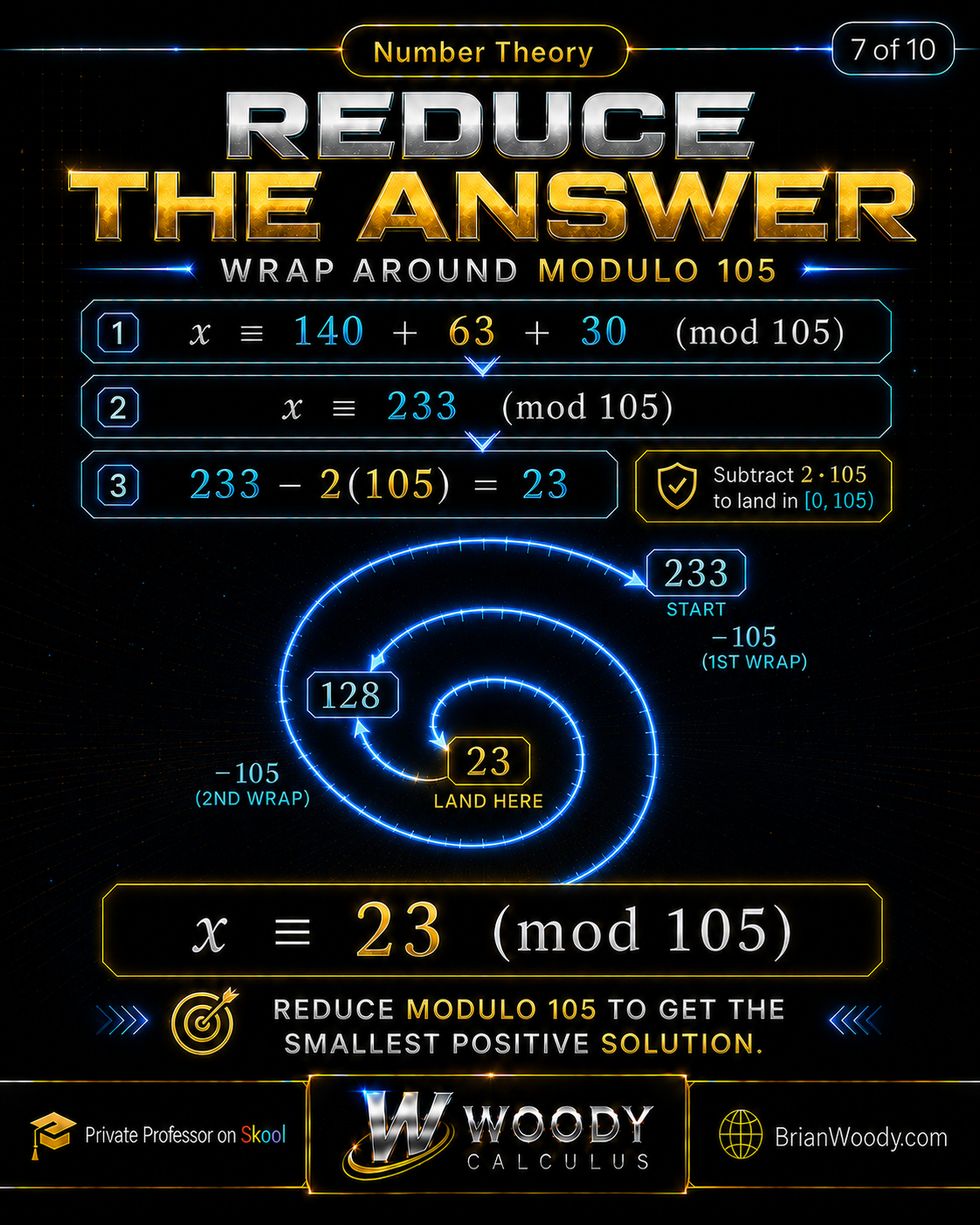
How do you reduce the CRT answer to its canonical representative?
Subtract multiples of the total modulus until the result lies in the half-open interval \(0\le r<N\).
233-2(105)=23.
\]
Therefore
\boxed{x\equiv23\pmod{105}}.
\]
The standard canonical interval is \([0,N)\), not \([0,N]\). The half-open interval contains exactly one representative from each residue class; including both 0 and \(N\) would duplicate the zero class.
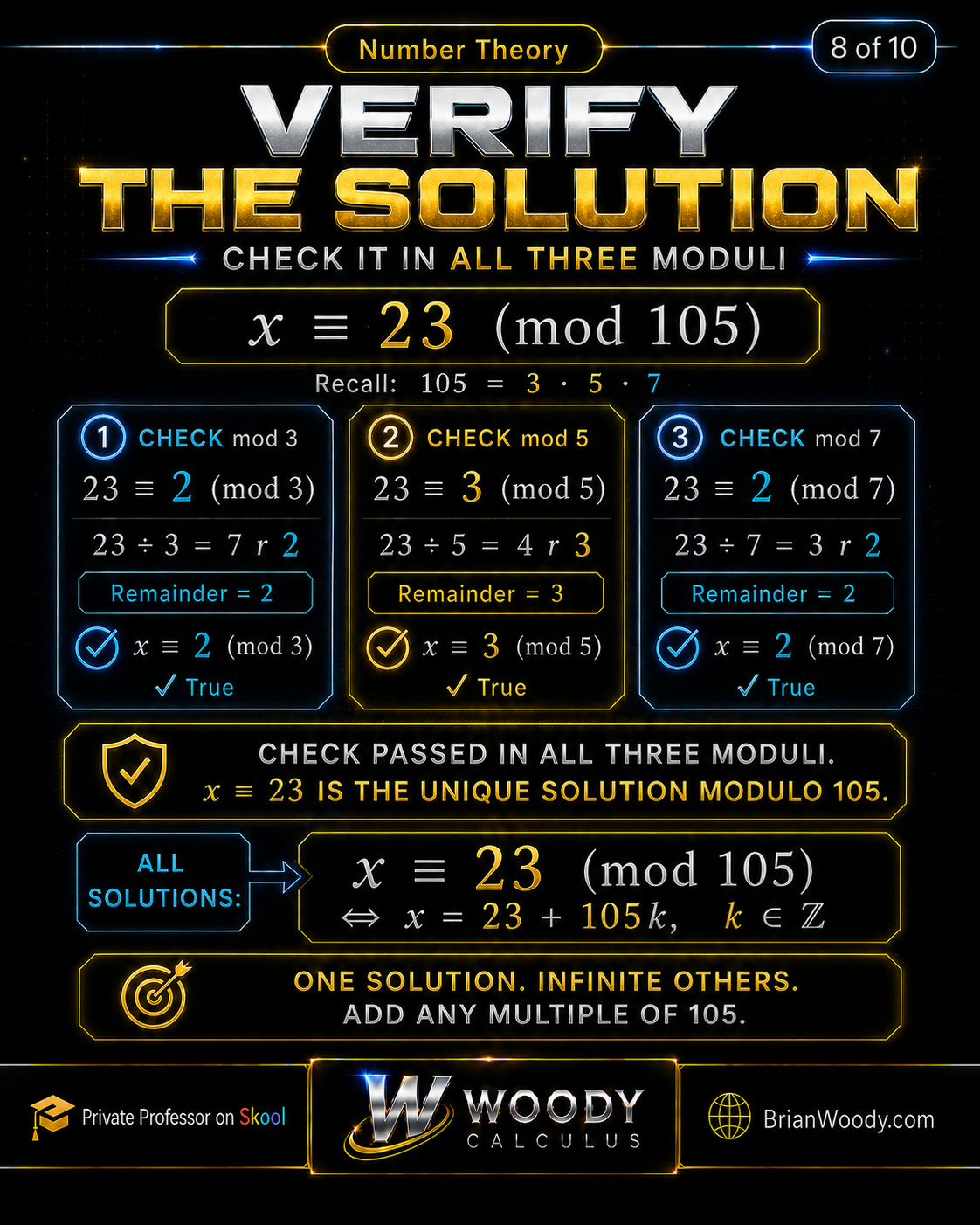
How do you verify a Chinese Remainder Theorem solution?
Reduce the proposed answer modulo every original modulus and compare the remainders with the targets.
Check mod 3
Check mod 5
Check mod 7
Every check passes, so the construction is correct.
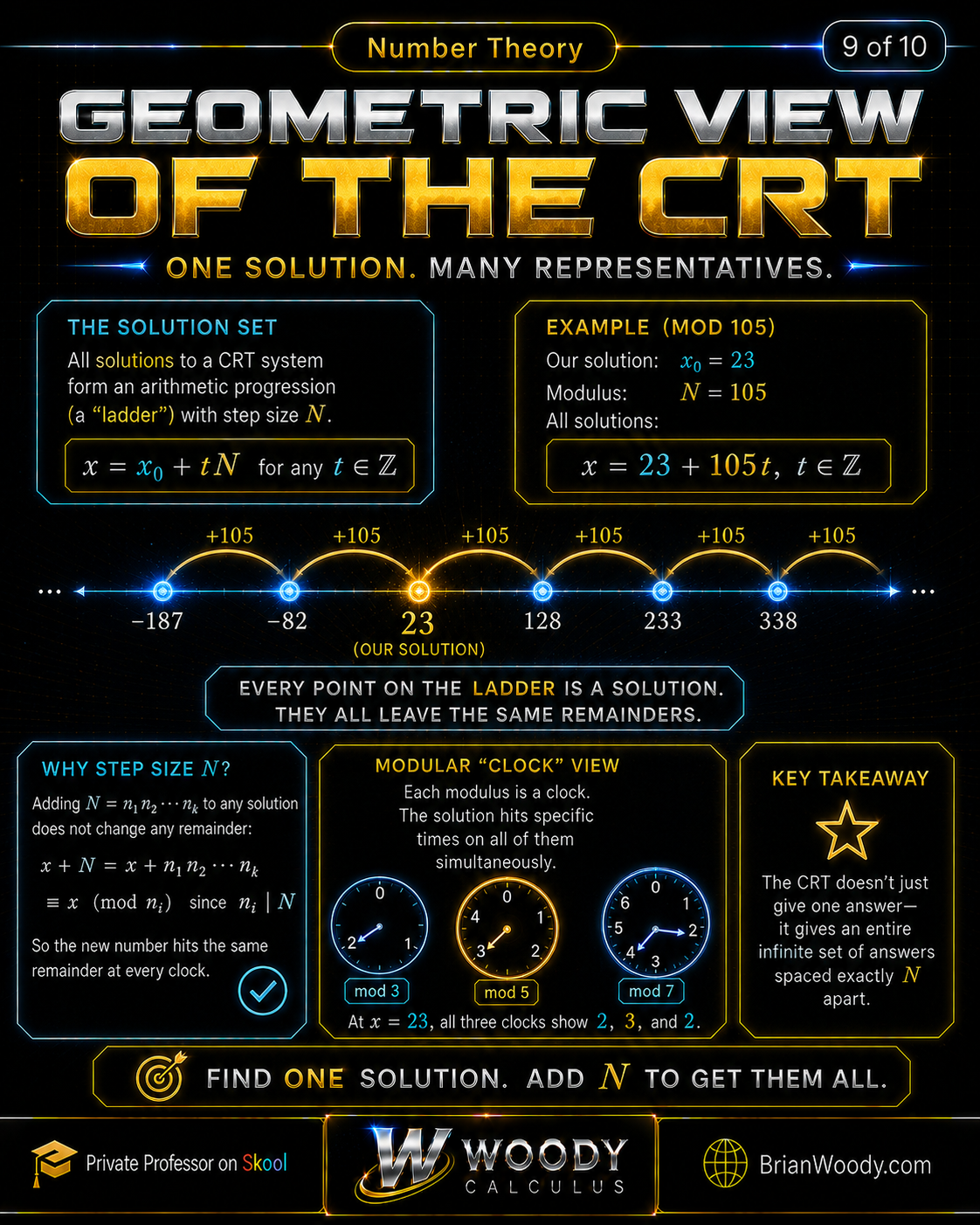
Why does one CRT solution generate infinitely many integer solutions?
Adding the total product \(N\) does not change any remainder because every original modulus divides \(N\).
x=23+105k,\qquad k\in\mathbb Z.
\]
Indeed, for each \(n_i\in\{3,5,7\}\),
23+105k\equiv23\pmod{n_i}
\]
because \(n_i\mid105\). The numbers
\ldots,-187,-82,23,128,233,338,\ldots
\]
are different integer representatives of the same residue class modulo 105.
Why is the Chinese Remainder Theorem true?
The construction proves existence by building selector terms, and divisibility proves uniqueness.
Let
Because the moduli are pairwise coprime, \(\gcd(N_i,n_i)=1\). Therefore \(N_i\) has a multiplicative inverse \(M_i\) modulo \(n_i\):
Define the selector element \(e_i=N_iM_i\). Then
e_i\equiv1\pmod{n_i},
\qquad
e_i\equiv0\pmod{n_j}\quad(j\ne i).
\]
The second relation holds because \(n_j\mid N_i\) whenever \(j\ne i\). Now set
Modulo \(n_j\), every term vanishes except the \(j\)-th term, so
Thus a simultaneous solution exists.
Suppose \(x\) and \(y\) both solve the system. Then
Hence every \(n_i\) divides \(x-y\). Because the moduli are pairwise coprime, their product divides \(x-y\):
Therefore \(x\equiv y\pmod N\), proving uniqueness modulo \(N\).
Turn the theorem into a repeatable exam method
The Woody Calculus Mastery Lab is the required starting point for students who want professor-led lessons, complete homework and exam solutions, direct guidance, and a structured system for advanced mathematics.
Can you solve the same CRT system by successive substitution?
Yes. For a small system, successive substitution can be faster than the full construction and provides an independent verification.
Start with the first congruence:
Impose the second congruence:
2+3a\equiv3\pmod5
\quad\Longrightarrow\quad
3a\equiv1\pmod5.
\]
Since \(3^{-1}\equiv2\pmod5\), we get \(a\equiv2\pmod5\). Write \(a=2+5b\). Then
Impose the final congruence:
8+15b\equiv2\pmod7
\quad\Longrightarrow\quad
1+b\equiv2\pmod7
\quad\Longrightarrow\quad
b\equiv1\pmod7.
\]
Write \(b=1+7k\). Therefore
x=8+15(1+7k)=23+105k.
\]
If the moduli are small and there are only two or three congruences, then successive substitution may be efficient. If the system is larger, repeated, or used algorithmically, then the CRT construction formula is usually cleaner.
How do you solve a second Chinese Remainder Theorem example?
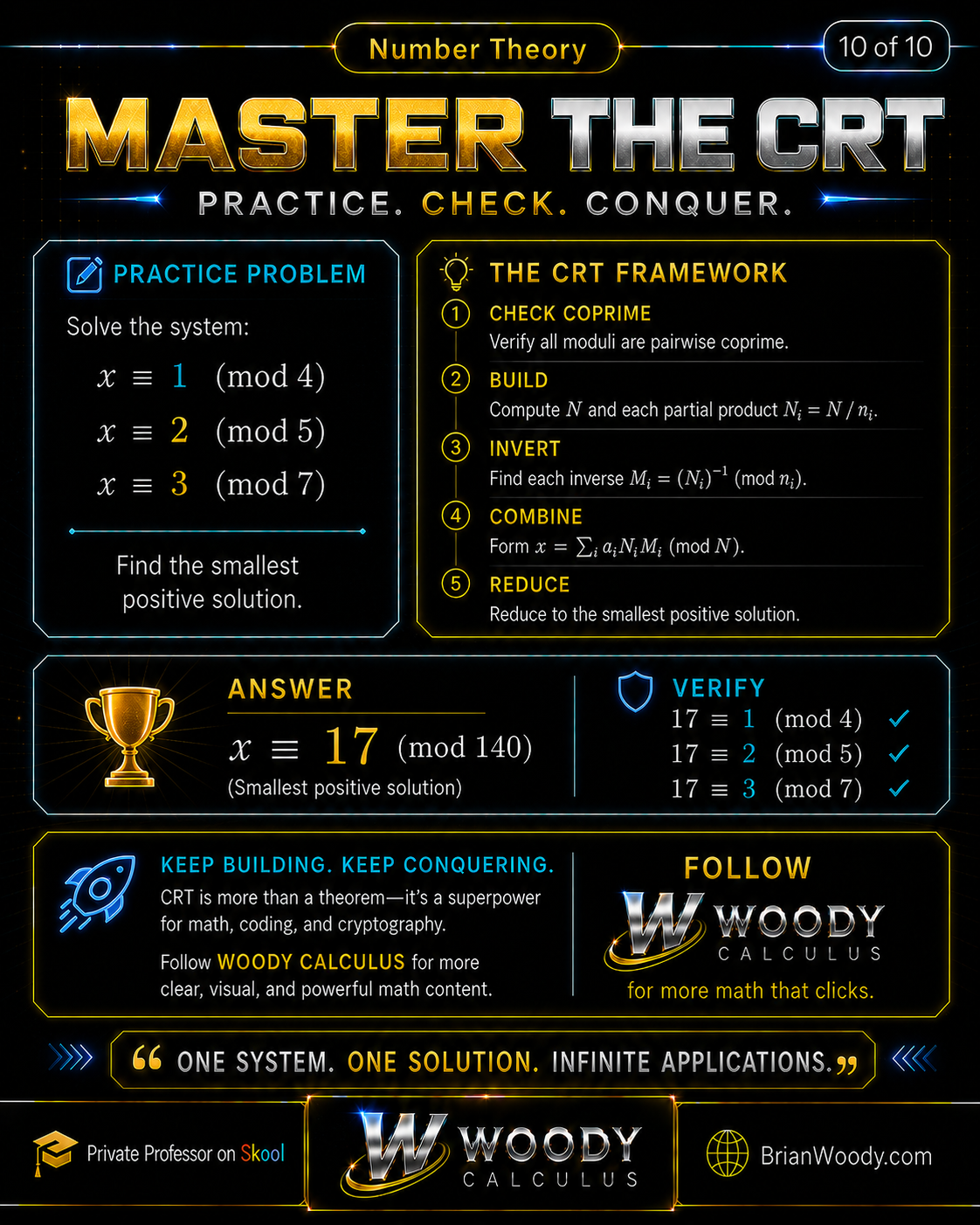
Apply the same five-step framework to the practice system from Slide 10.
x\equiv1\pmod4,
\qquad
x\equiv2\pmod5,
\qquad
x\equiv3\pmod7.
\]
Step 1: Check
The moduli \(4,5,7\) are pairwise coprime.
Step 2: Build
N=4\cdot5\cdot7=140,
\qquad
N_1=35,\quad N_2=28,\quad N_3=20.
\]
Step 3: Invert
\begin{aligned}
35M_1&\equiv1\pmod4 &&\Longrightarrow M_1=3,\\
28M_2&\equiv1\pmod5 &&\Longrightarrow M_2=2,\\
20M_3&\equiv1\pmod7 &&\Longrightarrow M_3=6.
\end{aligned}
\]
Step 4: Combine
\begin{aligned}
x
&\equiv1(35)(3)+2(28)(2)+3(20)(6)\pmod{140}\\
&\equiv105+112+360\pmod{140}\\
&\equiv577\pmod{140}.
\end{aligned}
\]
Step 5: Reduce and verify
577-4(140)=17,
\qquad
\boxed{x\equiv17\pmod{140}}.
\]
17\equiv1\pmod4,
\qquad
17\equiv2\pmod5,
\qquad
17\equiv3\pmod7.
\]
Thus all integer solutions are \(x=17+140k\), where \(k\in\mathbb Z\).
Does the Chinese Remainder Theorem work with noncoprime moduli?
Sometimes. A noncoprime system has a solution exactly when the target residues agree modulo every shared gcd.
The system \(x\equiv a_i\pmod{n_i}\) is solvable exactly when
a_i\equiv a_j\pmod{\gcd(n_i,n_j)}
\qquad\text{for every pair }i,j.
\]
When a solution exists, it is unique modulo \(\operatorname{lcm}(n_1,\ldots,n_k)\).
Compatible noncoprime example
x\equiv1\pmod4,
\qquad
x\equiv3\pmod6.
\]
Since \(\gcd(4,6)=2\) and \(1\equiv3\pmod2\), the conditions are compatible. The solution is
Inconsistent noncoprime example
x\equiv1\pmod4,
\qquad
x\equiv2\pmod6.
\]
Modulo the shared gcd 2, the first condition requires an odd integer while the second requires an even integer. No solution exists.
This is why “the moduli are not coprime” does not automatically mean “no solution.” It means the classical guarantee is unavailable and compatibility must be tested.
Where is the Chinese Remainder Theorem used?
The CRT is used whenever a large modular problem can be decomposed into smaller modular problems, solved locally, and reconstructed without losing information.
Computer arithmetic
Residue-number systems represent a large integer by several smaller remainders. Independent modular operations can then be performed in parallel.
RSA-CRT cryptography
RSA private-key operations can be computed separately modulo the secret primes \(p\) and \(q\), then recombined with the CRT.
Scheduling and cycles
Recurring events with different periods can be synchronized by translating each timing requirement into a congruence.
Abstract algebra
For coprime \(m,n\), the ring \(\mathbb Z/(mn)\mathbb Z\) decomposes into a product of smaller residue-class rings.
Polynomial rings
The same reconstruction principle works for relatively prime polynomial moduli and, more generally, for comaximal ideals.
Coding and signal reconstruction
CRT-based methods appear in residue codes, frequency estimation, phase unwrapping, and reconstruction from modular measurements.
When \(m\) and \(n\) are coprime, the map
\[
[x]_{mn}\longmapsto([x]_m,[x]_n)
\]
is a ring isomorphism
\[
\mathbb Z/(mn)\mathbb Z
\cong
\mathbb Z/m\mathbb Z\times\mathbb Z/n\mathbb Z.
\]
This connects the CRT to homomorphisms, quotient structures, and the larger language of Abstract Algebra.
Why does RSA use the Chinese Remainder Theorem?
RSA uses the CRT to replace one private-key exponentiation modulo \(n=pq\) with two smaller exponentiations modulo \(p\) and \(q\), followed by one exact reconstruction step.
Let \(n=pq\), where \(p\) and \(q\) are the secret RSA primes. Instead of computing a private operation directly modulo the full modulus \(n\), an implementation can compute
\[
m_p\equiv c^{d_P}\pmod p,
\qquad
m_q\equiv c^{d_Q}\pmod q,
\]
where
\[
d_P\equiv d\pmod{p-1},
\qquad
d_Q\equiv d\pmod{q-1}.
\]
The two residues determine one value modulo \(pq\), so the CRT reconstructs the same final message representative or signature representative that the full-size computation would produce.
Why it is faster
The primes \(p\) and \(q\) have roughly half as many bits as \(n\). Modular exponentiation grows much more expensive as operand size increases, so two half-size exponentiations are usually far cheaper than one full-size exponentiation.
Under the usual classical arithmetic model, RSA-CRT is often described as providing roughly a fourfold speedup. The exact gain depends on key size, multiplication algorithms, hardware, and implementation.
What the private key stores
A CRT-form RSA private key commonly stores \(p\), \(q\), the reduced exponents \(d_P\) and \(d_Q\), and a recombination coefficient such as \(q^{-1}\pmod p\).
Those are the CRT parameters listed in the official PKCS #1 RSA specification, RFC 8017.
The mathematics is exact, but production cryptography also requires protections against timing, fault, and side-channel attacks. Students should use established cryptographic libraries rather than implementing RSA-CRT for real security systems.
What mistakes do students make with the Chinese Remainder Theorem?
Most CRT errors come from hypothesis checks, inverse notation, modulus mismatches, endpoint choices, or incomplete final answers.
Mistake: Checking only one gcd
- Symptom
- The student computes \(\gcd(n_1,n_2,n_3)=1\) and declares the moduli pairwise coprime.
- Cause
- “Collectively coprime” was confused with “pairwise coprime.”
- Fix
- Check \(\gcd(n_i,n_j)=1\) for every distinct pair.
Mistake: Inverting the wrong quantity
- Symptom
- The student tries to invert \(n_i\) modulo \(N_i\), or inverts the remainder \(a_i\).
- Cause
- The roles of the partial product and omitted modulus were reversed.
- Fix
- Always solve \(N_iM_i\equiv1\pmod{n_i}\).
Mistake: Forgetting to reduce before finding an inverse
- Symptom
- A large inverse calculation becomes unnecessarily difficult.
- Cause
- The student works with \(N_i\) instead of its small remainder modulo \(n_i\).
- Fix
- Reduce first: for example, replace \(35\) by \(2\) modulo 3.
Mistake: Mixing the moduli across terms
- Symptom
- An inverse is correct, but for the wrong modulus.
- Cause
- The subscripts were treated as decoration rather than bookkeeping.
- Fix
- Keep each row together: \((a_i,n_i,N_i,M_i)\).
Mistake: Using \([0,N]\) as a complete residue interval
- Symptom
- Both 0 and \(N\) are listed as distinct canonical residues.
- Cause
- The right endpoint was included.
- Fix
- Use \(0\le r<N\), equivalently \([0,N)\).
Mistake: Reporting only the smallest representative
- Symptom
- The answer is written as \(x=23\) with no modulus or integer parameter.
- Cause
- A residue-class solution was confused with one ordinary equation solution.
- Fix
- Write \(x\equiv23\pmod{105}\) or \(x=23+105k\), \(k\in\mathbb Z\).
Mistake: Assuming noncoprime moduli always fail
- Symptom
- A compatible system is rejected immediately.
- Cause
- The sufficient pairwise-coprime hypothesis was mistaken for a necessary condition for all solvability.
- Fix
- Check \(a_i\equiv a_j\pmod{\gcd(n_i,n_j)}\) for every pair.
Mistake: Skipping verification
- Symptom
- A polished calculation contains one wrong inverse or multiplication error.
- Cause
- The construction was trusted without returning to the original system.
- Fix
- Reduce the final representative modulo every original modulus.
What is the exam checklist for the Chinese Remainder Theorem?
Protect the theorem hypotheses first, then use disciplined bookkeeping and finish with a complete residue-class statement.
- Write the congruence system clearly.
- Normalize negative or oversized remainders when helpful.
- Check all pairwise gcd values.
- Compute the correct total modulus.
- Build every partial product \(N_i=N/n_i\).
- Find \(M_i\) from \(N_iM_i\equiv1\pmod{n_i}\).
- Keep \(a_i,N_i,M_i,n_i\) in one indexed row.
- Substitute into \(x\equiv\sum a_iN_iM_i\pmod N\).
- Reduce to \(0\le r<N\).
- Verify the answer in every original congruence.
- State all solutions as \(x=r+kN\), \(k\in\mathbb Z\).
- For noncoprime moduli, replace the standard guarantee with the compatibility test.
How do you master the Chinese Remainder Theorem?
Mastery means being able to recognize the structure, construct the selector terms, explain why they work, and verify the entire solution without copying a template.
The CRT mastery framework
Check → Build → Invert → Combine → Reduce → Verify → Generalize.
Say each verb aloud while solving. The labels prevent the steps from collapsing into an unstructured block of arithmetic.
Blank-page reconstruction
Redo both worked examples from a blank page. Then prove existence and uniqueness without looking. Finally, create one compatible and one inconsistent noncoprime system and explain the difference.
Do not stop when you can follow the solution. Repeat it until you can rebuild the full argument, explain the purpose of \(N_iM_i\), and catch an incorrect modulus before it reaches the final line.
Frequently Asked Questions About the Chinese Remainder Theorem
What is the Chinese Remainder Theorem?
When can the Chinese Remainder Theorem be used?
What does unique modulo N mean?
How do you solve a CRT system step by step?
How do you find modular inverses in the CRT?
Why must the moduli be pairwise coprime in the standard theorem?
Does the Chinese Remainder Theorem work with noncoprime moduli?
How do you verify a Chinese Remainder Theorem solution?
What is the smallest positive solution to x congruent to 2 mod 3, 3 mod 5, and 2 mod 7?
Why are there infinitely many integer solutions?
What is the difference between the CRT construction and successive substitution?
Where is the Chinese Remainder Theorem used?
Do the CRT moduli have to be prime?
How do you find a modular inverse with the Extended Euclidean Algorithm?
Why does RSA use the Chinese Remainder Theorem?
Need help with Number Theory or proof-based mathematics?
The Woody Calculus Mastery Lab is the required starting point for students seeking a professor-led system for Number Theory, Abstract Algebra, Real Analysis, Calculus, Differential Equations, and advanced university mathematics.
Students receive visual lessons, complete worked solutions, method-selection guidance, proof-writing support, exam preparation, and direct interaction inside the learning community. Limited private instruction may be considered after Mastery Lab enrollment; availability is selective and not guaranteed.
University Number Theory and advanced mathematics help
Woody Calculus supports students in demanding proof-based and computational mathematics courses across universities in the United States and Canada.
Harvard mathematics supportBuild definition fluency, theorem recognition, proof structure, and exam-ready reasoning.
Purdue mathematics supportSupport for Calculus, Differential Equations, Abstract Algebra, Real Analysis, and advanced mathematics.
UCF mathematics supportProfessor-led pathways for computational and proof-based university mathematics.
UF mathematics supportStrengthen method selection, modular reasoning, proof writing, and exam performance.
University Math Tutor HubFind school-specific Woody Calculus pages across the United States and Canada.
Reviews, trust, and continued learning
Read Woody Calculus student reviews and learn why the program is built around long-term mathematical mastery rather than disconnected answers.
To help Woody Calculus appear more prominently in eligible Google search and AI experiences, you may also add BrianWoody.com as a preferred source.
For educational reuse or image-licensing inquiries concerning the Woody Calculus slides, use the Woody Calculus contact page.
Woody Calculus rule: Check the hypotheses. Build the selectors. Combine carefully. Reduce canonically. Verify every clock. Then explain why the answer is unique.