Laplace Transforms for Differential Equations
The Laplace Transform is one of the most powerful tools in Differential Equations. It takes a function of time, moves it into the \(s\)-domain, and turns a differential equation into an algebra problem.
That is the magic of the method. Instead of fighting derivatives directly, we transform the entire equation, solve for \(Y(s)\), and then use the inverse Laplace transform to return to \(y(t)\). For students in engineering, physics, circuits, systems, and applied mathematics, this is where Calculus II, Calculus III, Linear Algebra, and Differential Equations start to feel connected.
This visual lesson walks through the entire idea step by step: the formula, derivative rules, initial value problems, partial fractions, inverse Laplace transforms, unit step functions, and the big-picture framework that makes Laplace transforms so useful.
What Is the Laplace Transform?
The Laplace Transform of a function \(f(t)\) is defined by
\[
\mathcal{L}\{f(t)\}=F(s)=\int_{0}^{\infty} e^{-st} f(t)\,dt.
\]
This formula takes a time function \(f(t)\) and builds a new function \(F(s)\). The exponential factor \(e^{-st}\) acts as a weighting factor. The integral accumulates the contribution of \(f(t)\) from \(t=0\) to infinity.
The result is a new function in the variable \(s\). This new function often behaves much more simply than the original time-domain expression, especially when derivatives are involved.
In many engineering, signal processing, circuits, and systems applications, the Laplace variable is complex and is often written as \(s=\sigma+j\omega\). This is why the \(s\)-domain can capture both growth or decay and oscillation.
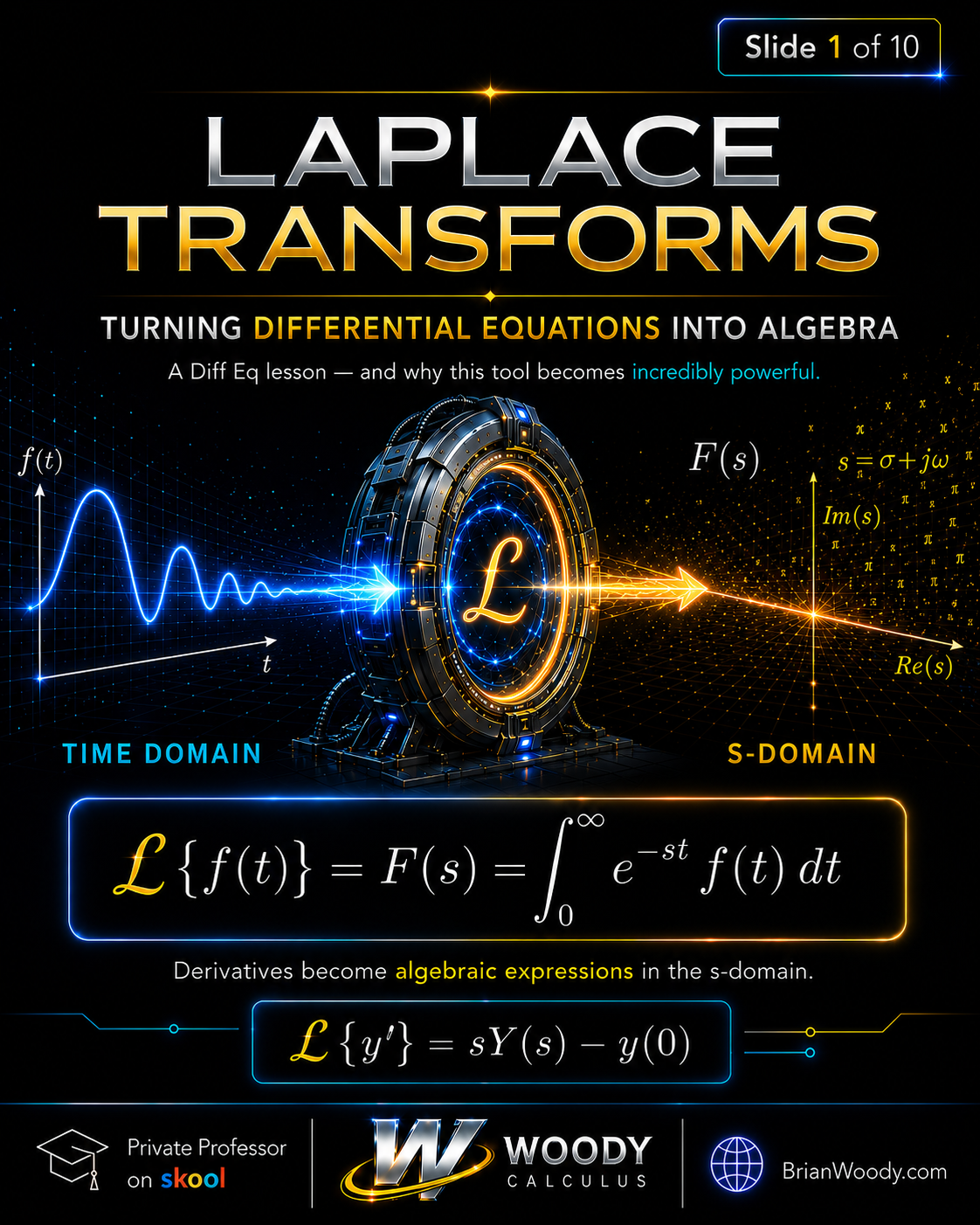
The basic idea is:
\[
f(t)\quad \xrightarrow{\mathcal{L}}\quad F(s).
\]
Then, after solving in the \(s\)-domain, we return using
\[
F(s)\quad \xrightarrow{\mathcal{L}^{-1}}\quad f(t).
\]
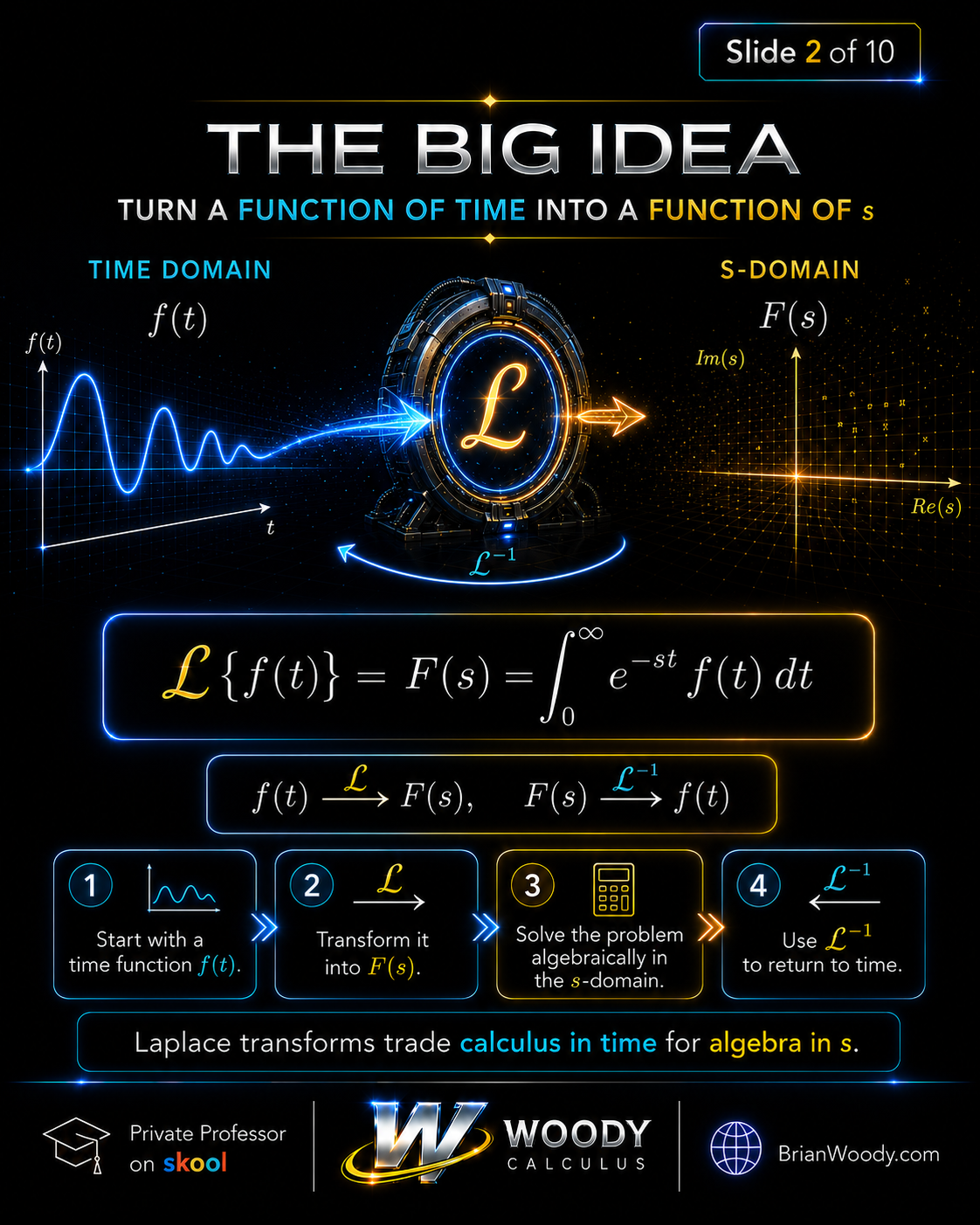
The Big Idea: Time Domain to \(s\)-Domain
In the time domain, we work with functions like \(f(t)\), \(y(t)\), \(y^{\prime}(t)\), and \(y^{\prime\prime}(t)\). These objects describe change over time. Differential equations are built from these derivatives, which is why they often feel complicated.
The Laplace Transform moves the problem into the \(s\)-domain. In the \(s\)-domain, derivatives become powers of \(s\), plus terms involving initial conditions.
That means a differential equation can become an algebraic equation. This is the key reason students love the method:
\[
\text{Differential Equation in }t
\quad \longrightarrow \quad
\text{Algebraic Equation in }s.
\]
Once the equation is algebraic, we solve for \(Y(s)\). Then we apply \(\mathcal{L}^{-1}\) to return to \(y(t)\).
The Formula: What the Laplace Transform Actually Does
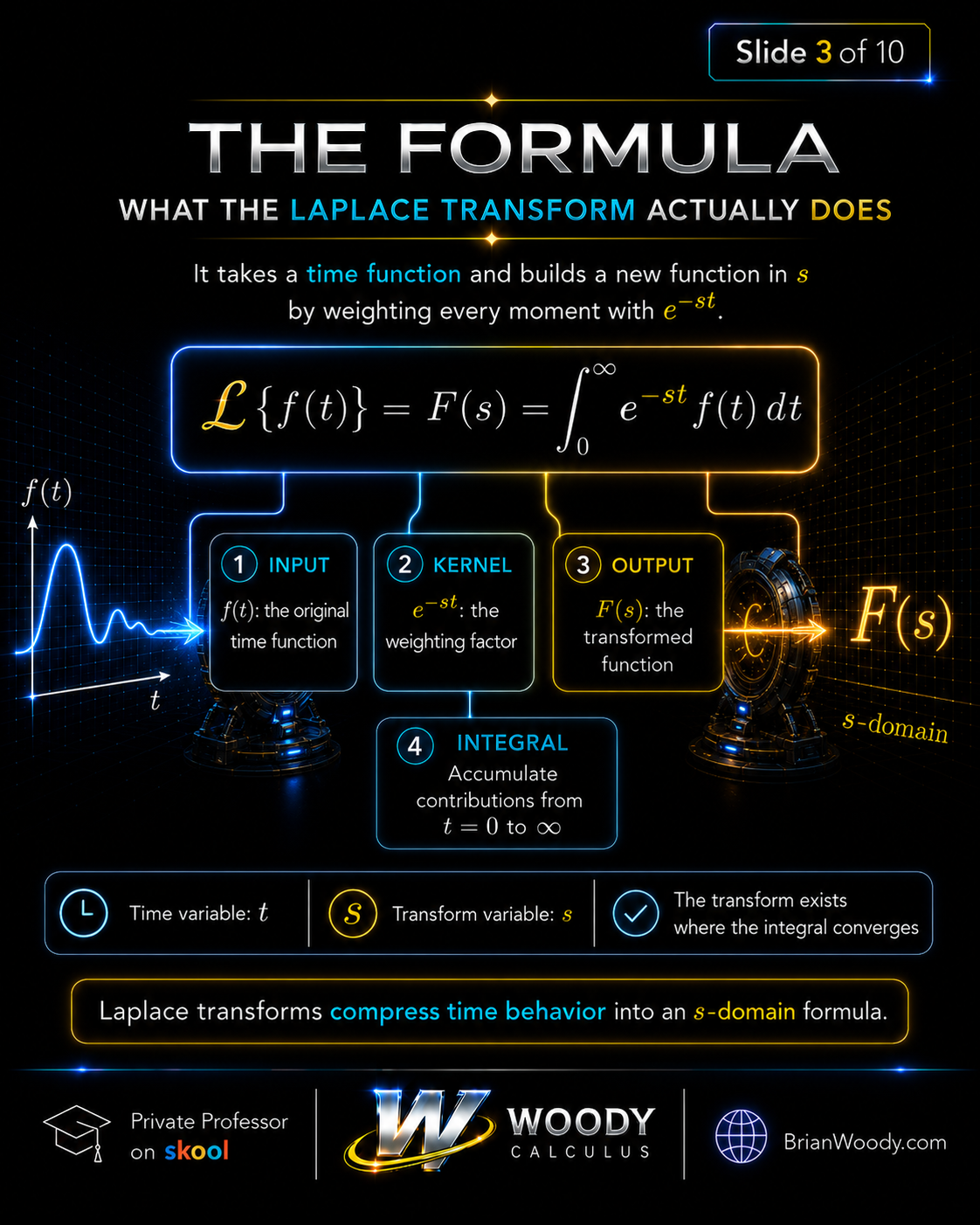
The formula
\[
\mathcal{L}\{f(t)\}=F(s)=\int_{0}^{\infty} e^{-st} f(t)\,dt
\]
has three main pieces:
- Input: \(f(t)\), the original time function.
- Kernel: \(e^{-st}\), the exponential weighting factor.
- Output: \(F(s)\), the transformed function.
The transform exists where the improper integral converges. In many standard Differential Equations problems, the functions are chosen so that the transform exists in a useful region of the \(s\)-domain.
Conceptually, the Laplace Transform compresses time behavior into an \(s\)-domain formula. It does not destroy the original information. It reorganizes it into a form that is easier to manipulate algebraically.
Laplace Transform Derivative Rules for Differential Equations
The real power of the Laplace Transform appears when we transform derivatives. The most important first derivative rule is
\[
\mathcal{L}\{y^{\prime}(t)\}=sY(s)-y(0).
\]
The second derivative rule is
\[
\mathcal{L}\{y^{\prime\prime}(t)\}=s^2Y(s)-sy(0)-y^{\prime}(0).
\]
More generally,
\[
\mathcal{L}\{y^{(n)}(t)\}
=
s^nY(s)-s^{n-1}y(0)-s^{n-2}y^{\prime}(0)-\cdots-y^{(n-1)}(0).
\]
This is why initial value problems fit so naturally with Laplace transforms. The initial conditions \(y(0)\), \(y^{\prime}(0)\), and higher derivative values automatically appear when the derivatives are transformed.
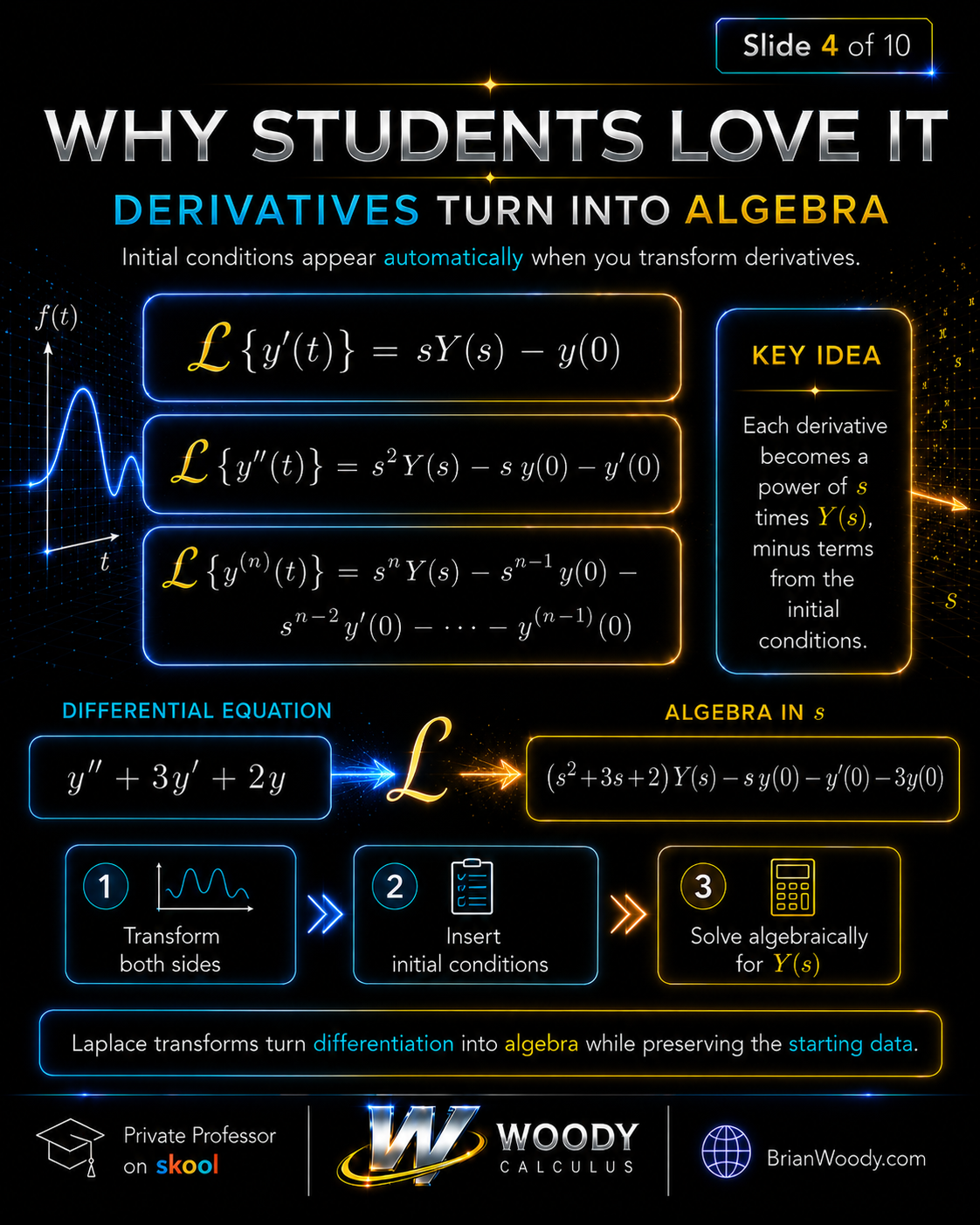
Suppose a differential equation contains \(y^{\prime\prime}\), \(y^{\prime}\), and \(y\). Applying the Laplace Transform to both sides changes the problem from a differential equation into an equation involving \(Y(s)\).
For example, transforming the left side of
\[
y^{\prime\prime}+3y^{\prime}+2y
\]
gives
\[
\mathcal{L}\{y^{\prime\prime}\}+3\mathcal{L}\{y^{\prime}\}+2\mathcal{L}\{y\}.
\]
Using the derivative rules:
\[
\mathcal{L}\{y^{\prime\prime}\}=s^2Y(s)-sy(0)-y^{\prime}(0),
\]
\[
\mathcal{L}\{y^{\prime}\}=sY(s)-y(0),
\]
and
\[
\mathcal{L}\{y\}=Y(s).
\]
So the transformed expression becomes
\[
(s^2Y(s)-sy(0)-y^{\prime}(0))+3(sY(s)-y(0))+2Y(s).
\]
Now we collect \(Y(s)\) terms and solve algebraically. That is the whole strategy.
Initial Value Problems With Laplace Transforms
Laplace Transform Initial Value Problem Example
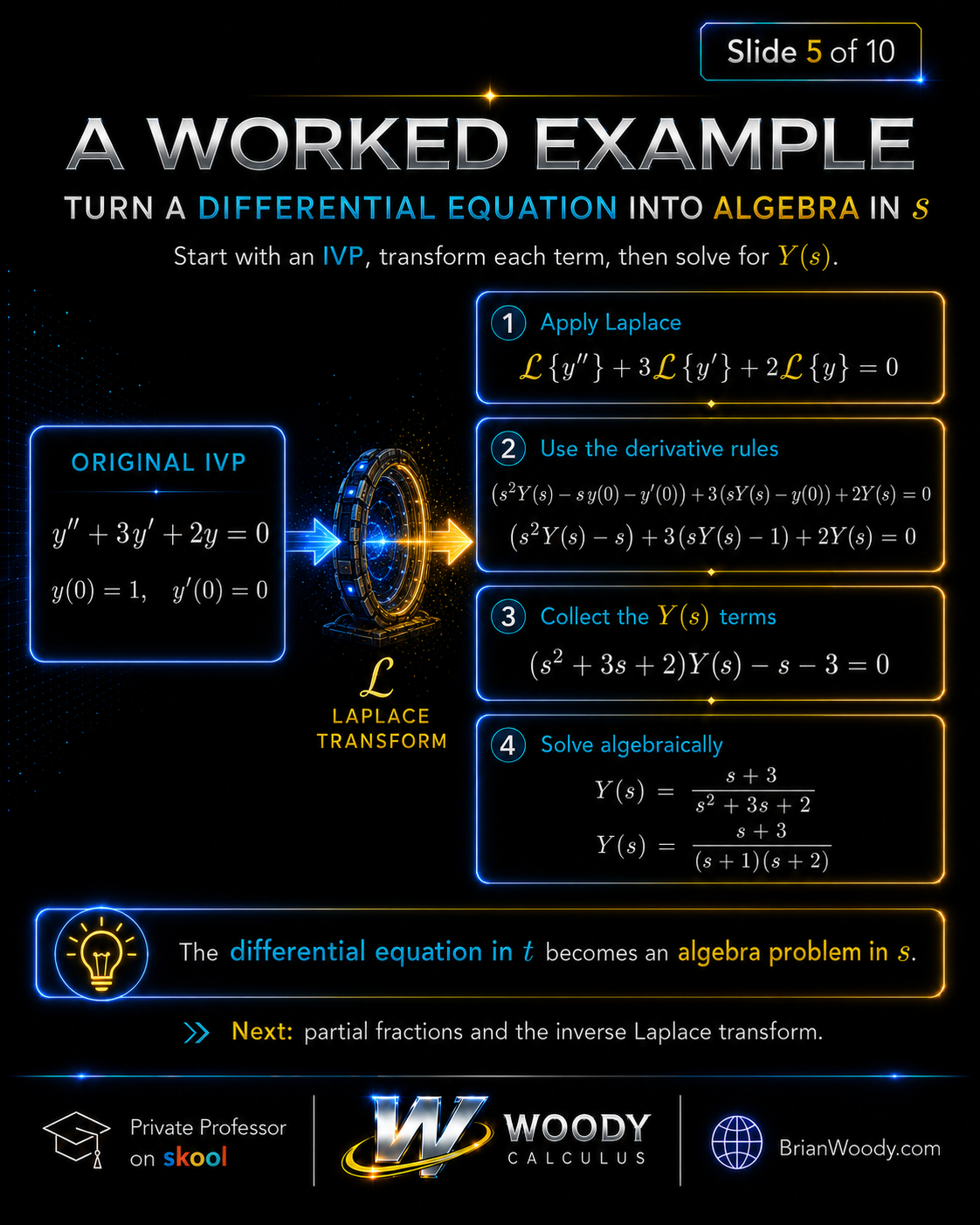
Consider the initial value problem
\[
y^{\prime\prime}+3y^{\prime}+2y=0,\qquad y(0)=1,\qquad y^{\prime}(0)=0.
\]
Apply the Laplace Transform to both sides:
\[
\mathcal{L}\{y^{\prime\prime}\}+3\mathcal{L}\{y^{\prime}\}+2\mathcal{L}\{y\}=0.
\]
Using the derivative rules:
\[
(s^2Y(s)-sy(0)-y^{\prime}(0))+3(sY(s)-y(0))+2Y(s)=0.
\]
Substitute the initial conditions \(y(0)=1\) and \(y^{\prime}(0)=0\):
\[
(s^2Y(s)-s)+3(sY(s)-1)+2Y(s)=0.
\]
Collect the \(Y(s)\) terms:
\[
(s^2+3s+2)Y(s)-s-3=0.
\]
So
\[
(s^2+3s+2)Y(s)=s+3.
\]
Therefore,
\[
Y(s)=\frac{s+3}{s^2+3s+2}.
\]
Since
\[
s^2+3s+2=(s+1)(s+2),
\]
we get
\[
Y(s)=\frac{s+3}{(s+1)(s+2)}.
\]
Inverse Laplace Transform and Partial Fractions
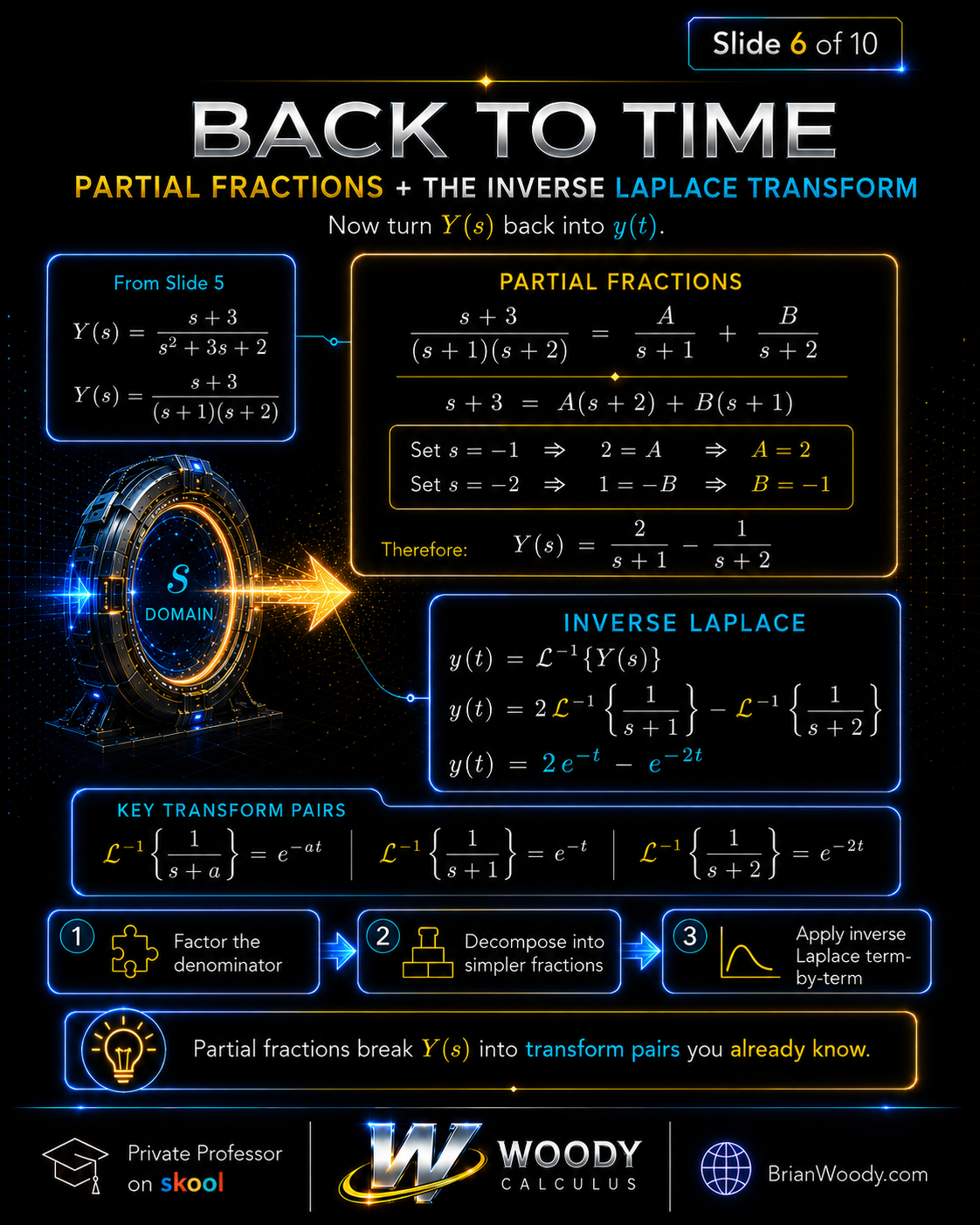
Now we need to return from \(Y(s)\) to \(y(t)\). We start with
\[
Y(s)=\frac{s+3}{(s+1)(s+2)}.
\]
Use partial fractions:
\[
\frac{s+3}{(s+1)(s+2)}=\frac{A}{s+1}+\frac{B}{s+2}.
\]
Multiply through by \((s+1)(s+2)\):
\[
s+3=A(s+2)+B(s+1).
\]
Set \(s=-1\):
\[
2=A.
\]
Set \(s=-2\):
\[
1=-B,
\]
so
\[
B=-1.
\]
Therefore,
\[
Y(s)=\frac{2}{s+1}-\frac{1}{s+2}.
\]
Now use the basic inverse transform pair
\[
\mathcal{L}^{-1}\left\{\frac{1}{s+a}\right\}=e^{-at}.
\]
Thus,
\[
y(t)=2e^{-t}-e^{-2t}.
\]
This is the solution to the original initial value problem.
Partial fractions are not just an algebra trick. In Laplace transform problems, partial fractions are often the bridge back to time.
The goal is to rewrite a complicated rational expression \(Y(s)\) as a sum of simpler pieces whose inverse Laplace transforms are known.
For example:
\[
\frac{2}{s+1}-\frac{1}{s+2}
\]
is easy to invert because each piece matches a standard transform pair:
\[
\frac{1}{s+1}\quad \longleftrightarrow \quad e^{-t},
\]
\[
\frac{1}{s+2}\quad \longleftrightarrow \quad e^{-2t}.
\]
That is why students in Differential Equations must be strong with algebra, factoring, and partial fractions. The transform method is powerful, but the algebra must be clean.
Unit Step Function Laplace Transform: Switches and Delays
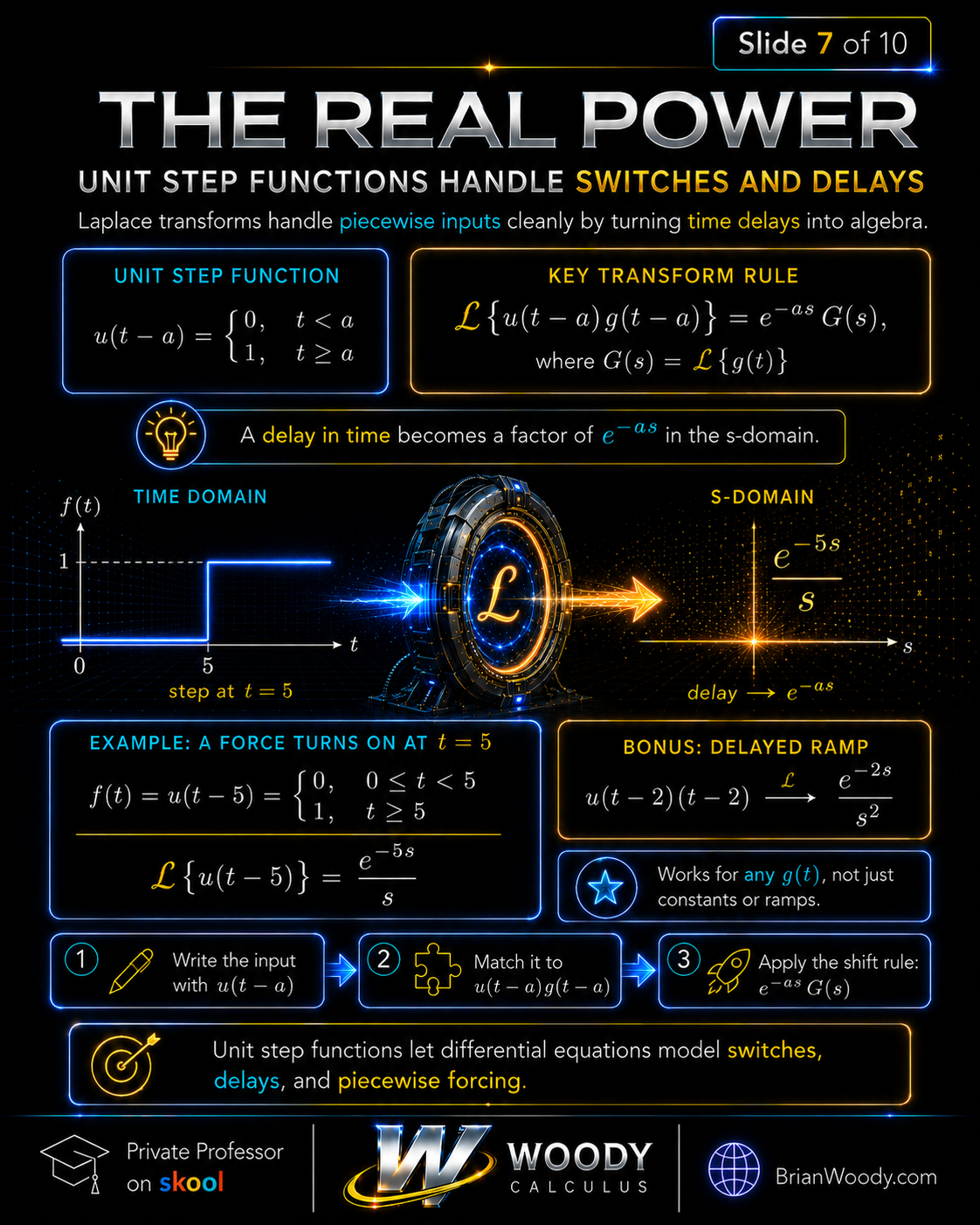
The Laplace Transform becomes even more powerful when the input changes suddenly. This is where the unit step function appears.
The unit step function \(u(t-a)\) is defined by
\[
This function models a switch that turns on at \(t=a\).
The key shift rule is
\[
where
\[
This tells us that a delay in time becomes a factor of \(e^{-as}\) in the \(s\)-domain.
For example,
\[
represents a force or signal that turns on at \(t=5\). Its Laplace Transform is
\[
A delayed ramp such as
\[
has transform
\[
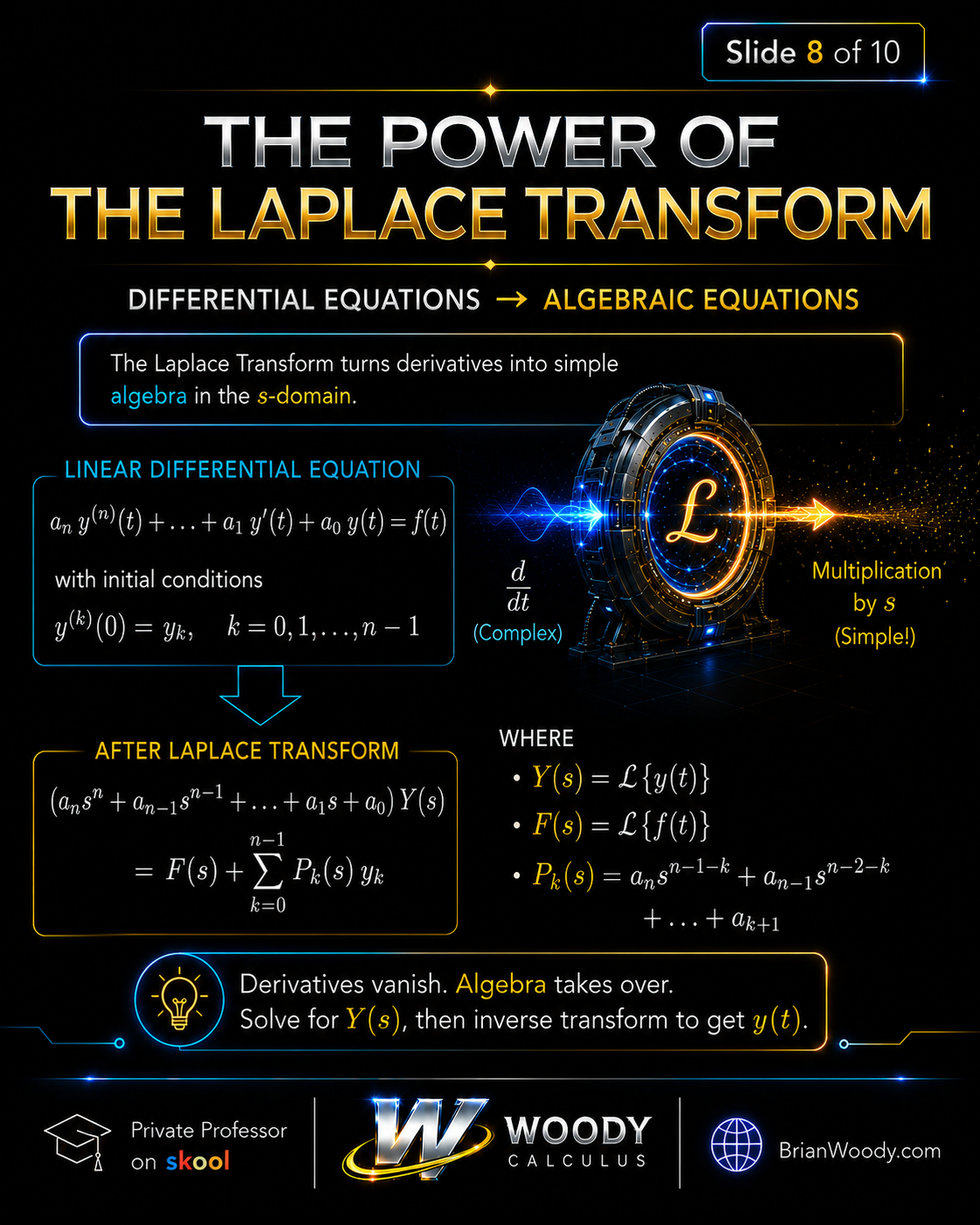
For a general linear differential equation
\[
with initial conditions
\[
the Laplace Transform turns the equation into an algebraic equation involving \(Y(s)\).
The transformed structure is
\[
where
\[
\[
and
\[
This compact formula summarizes the main advantage of the Laplace Transform. Derivatives become algebraic powers of \(s\), initial conditions become algebraic terms, and the unknown function becomes \(Y(s)\).
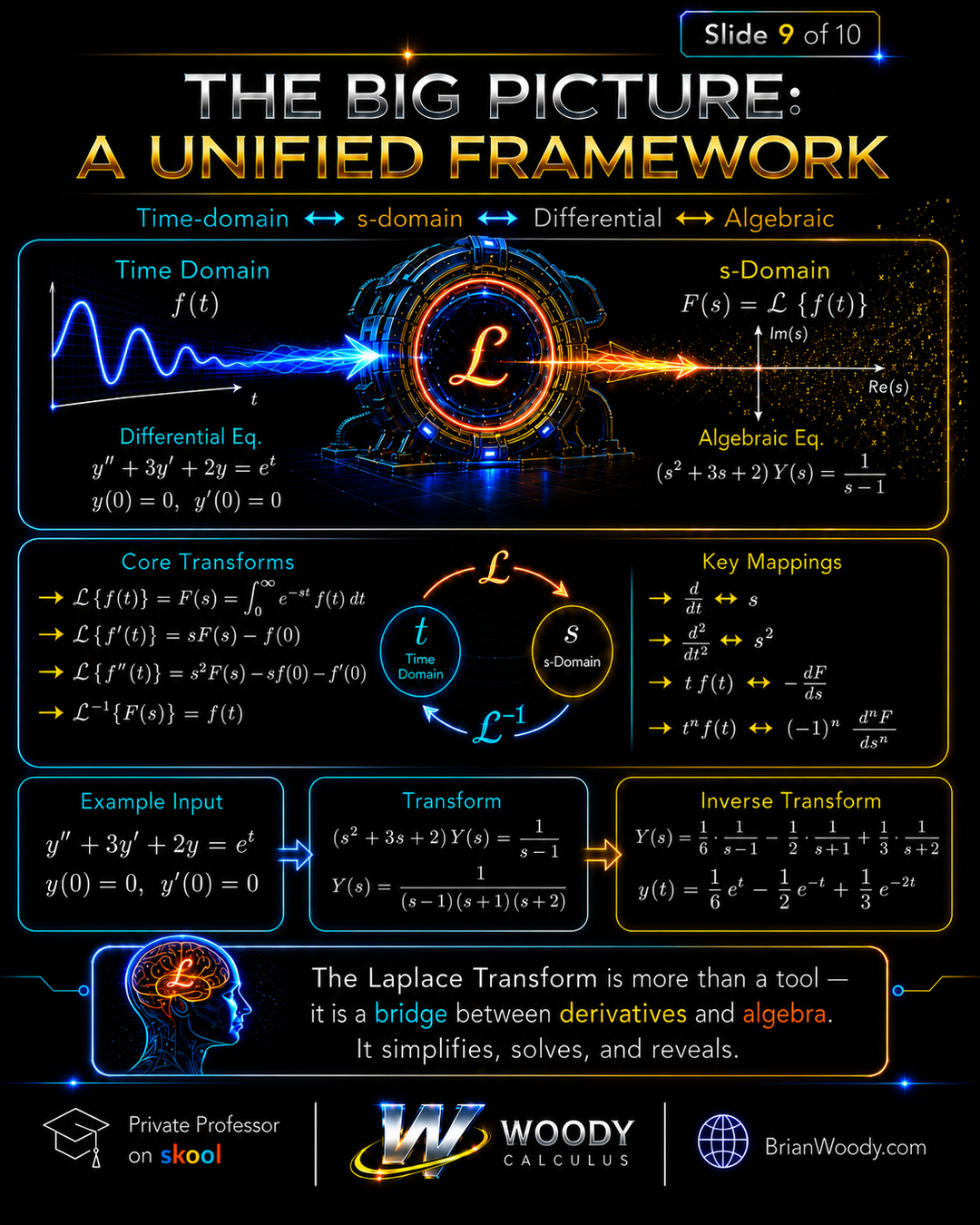
The Laplace Transform is not just another technique. It is a framework that connects time-domain behavior, differential equations, algebraic equations, inverse transforms, and applications.
The main movement is:
\[
Some of the most important mappings are:
\[
\[
\[
\[
Other useful mappings include:
\[
and more generally,
\[
These identities show that the Laplace Transform does more than solve one kind of problem. It builds a dictionary between operations in time and operations in the \(s\)-domain.
Now consider the example shown in the bottom panel of Slide 9:
\[
Taking the Laplace Transform gives
\[
Therefore,
\[
Using partial fractions,
\[
So the inverse Laplace transform gives
\[
This example shows the full workflow: transform, solve algebraically, decompose into known pieces, and return to time.
Laplace transforms appear throughout applied mathematics, engineering, circuits, control systems, signals, mechanical systems, physics, and mathematical modeling.
They matter because they turn difficult dynamic behavior into something manageable:
This is exactly the kind of topic where the Woody Calculus method helps. You do not want to improvise these problems during an exam. You want to recognize the pattern, write the transform rules correctly, collect terms cleanly, solve for \(Y(s)\), use partial fractions, and return to \(y(t)\).
That is how a complicated Differential Equations problem becomes a repeatable exam workflow.
Laplace transforms are not just concepts to vaguely understand. They are a structured way of thinking that requires disciplined repetition. The goal is to train the pattern until the process becomes automatic under exam pressure:
At Woody Calculus, success comes from expert-guided repetition: memorize the essential formulas, rewrite perfect solutions, say every step out loud, and repeat the correct patterns until the mechanics become automatic.
This is why Woody Calculus is not just homework help. It is a training system built around clean setup, formula fluency, pattern recognition, and expert solution keys. The goal is not to guess your way through Differential Equations. The goal is to know exactly what to do when the exam problem appears.
If you are studying Differential Equations, Calculus II, Calculus III, Linear Algebra, Abstract Algebra, or Real Analysis, the same principle applies: mathematics becomes easier when the patterns become automatic.
To go deeper, join the Woody Calculus Mastery Lab or visit the community directly here:
Join Woody Calculus Private Professor on Skool
You can also explore more lessons, mathematical essays, and advanced math support at BrianWoody.com.
Explore more Woody Calculus visual lessons and mathematical essays connecting Calculus II, Calculus III, Differential Equations, Abstract Algebra, Real Analysis, Fourier series, Taylor series, topology, chaos theory, Galois theory, and advanced mathematics.
Woody Calculus also supports students at major universities with structured help in Calculus, Differential Equations, Linear Algebra, Abstract Algebra, Real Analysis, and advanced mathematics.
The Woody Calculus Mastery Lab gives university students access to structured mathematics support, written solutions, video lessons, exam-focused training, and expert guidance from Brian M. Woody.
Students use Woody Calculus for Calculus II, Calculus III, Differential Equations, Linear Algebra, Abstract Algebra, Real Analysis, AP Calculus BC, and other advanced mathematics courses.
Students from universities across the United States use Woody Calculus for help with Calculus, Differential Equations, Linear Algebra, Abstract Algebra, Real Analysis, and advanced mathematics.
u(t-a)=
\begin{cases}
0, & t
\mathcal{L}\{u(t-a)g(t-a)\}=e^{-as}G(s),
\]
G(s)=\mathcal{L}\{g(t)\}.
\]
f(t)=u(t-5)
\]
\mathcal{L}\{u(t-5)\}=\frac{e^{-5s}}{s}.
\]
u(t-2)(t-2)
\]
\mathcal{L}\{u(t-2)(t-2)\}=\frac{e^{-2s}}{s^2}.
\]
The General Power of the Laplace Transform
a_n y^{(n)}(t)+\cdots+a_1y^{\prime}(t)+a_0y(t)=f(t),
\]
y^{(k)}(0)=y_k,\qquad k=0,1,\ldots,n-1,
\]
(a_ns^n+a_{n-1}s^{n-1}+\cdots+a_1s+a_0)Y(s)
=
F(s)+\sum_{k=0}^{n-1}P_k(s)y_k,
\]
Y(s)=\mathcal{L}\{y(t)\},
\]
F(s)=\mathcal{L}\{f(t)\},
\]
P_k(s)=a_ns^{\,n-1-k}+a_{n-1}s^{\,n-2-k}+\cdots+a_{k+1}.
\]
The Big Picture: A Unified Framework
\text{time domain}
\quad \longleftrightarrow \quad
s\text{-domain}
\quad \longleftrightarrow \quad
\text{differential}
\quad \longleftrightarrow \quad
\text{algebraic}.
\]
\mathcal{L}\{f(t)\}=F(s),
\]
\mathcal{L}\{f^{\prime}(t)\}=sF(s)-f(0),
\]
\mathcal{L}\{f^{\prime\prime}(t)\}=s^2F(s)-sf(0)-f^{\prime}(0),
\]
\mathcal{L}^{-1}\{F(s)\}=f(t).
\]
\mathcal{L}\{t f(t)\}=-\frac{dF}{ds},
\]
\mathcal{L}\{t^n f(t)\}=(-1)^n\frac{d^nF}{ds^n}.
\]
Another Example: A Forced Differential Equation
y^{\prime\prime}+3y^{\prime}+2y=e^t,\qquad y(0)=0,\qquad y^{\prime}(0)=0.
\]
(s^2+3s+2)Y(s)=\frac{1}{s-1}.
\]
Y(s)=\frac{1}{(s-1)(s+1)(s+2)}.
\]
Y(s)=\frac{1}{6}\cdot\frac{1}{s-1}
-\frac{1}{2}\cdot\frac{1}{s+1}
+\frac{1}{3}\cdot\frac{1}{s+2}.
\]
y(t)=\frac{1}{6}e^t-\frac{1}{2}e^{-t}+\frac{1}{3}e^{-2t}.
\]
Why Laplace Transforms Matter for Differential Equations Students
Master Laplace Transforms With Woody Calculus
Differential Equations Study Method for Laplace Transforms
Related Woody Calculus Mathematical Essays
Related University Math Help Pages
Trusted by Students Nationwide
Universities Supported by Woody Calculus
1 thought on “Laplace Transforms Explained: Turning Differential Equations Into Algebra”