Original Woody Calculus Lesson
CALCULUS 3 · VECTOR ALGEBRA · GEOMETRY
What Is the Difference Between the Dot Product and Cross Product?
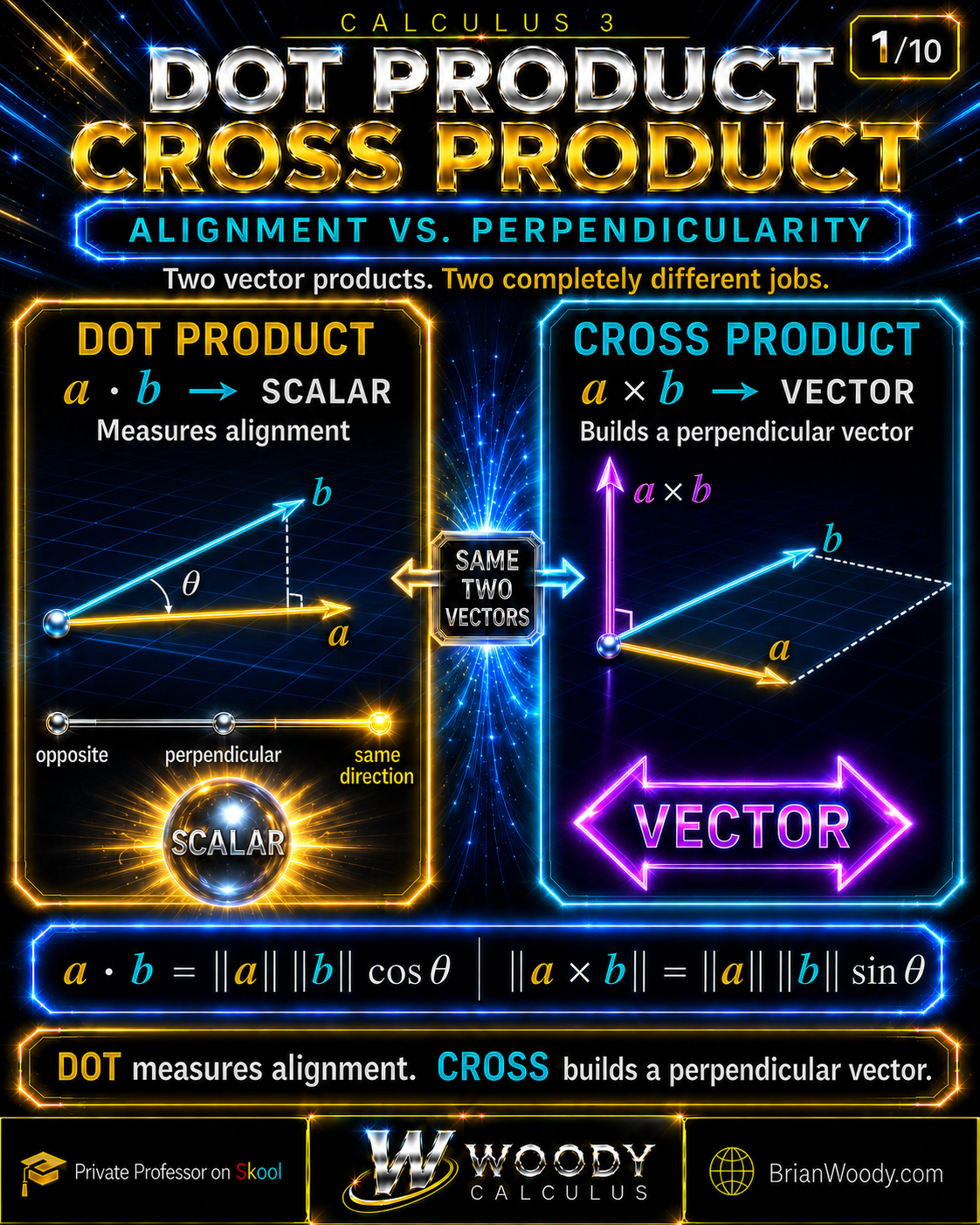
The dot product multiplies two vectors and returns a scalar that measures alignment. The cross product multiplies two three-dimensional vectors and returns a vector perpendicular to both. Use the dot product for angles, projections, orthogonality, and work. Use the cross product for normals, area, torque, and orientation.
The dot product of vectors a and b equals the magnitude of a times the magnitude of b times the cosine of the angle between them. The magnitude of the cross product equals the magnitude of a times the magnitude of b times the sine of the angle.
\boxed{\mathbf a\cdot\mathbf b=\lVert\mathbf a\rVert\lVert\mathbf b\rVert\cos\theta}
\qquad
\boxed{\lVert\mathbf a\times\mathbf b\rVert=\lVert\mathbf a\rVert\lVert\mathbf b\rVert\sin\theta}
\]
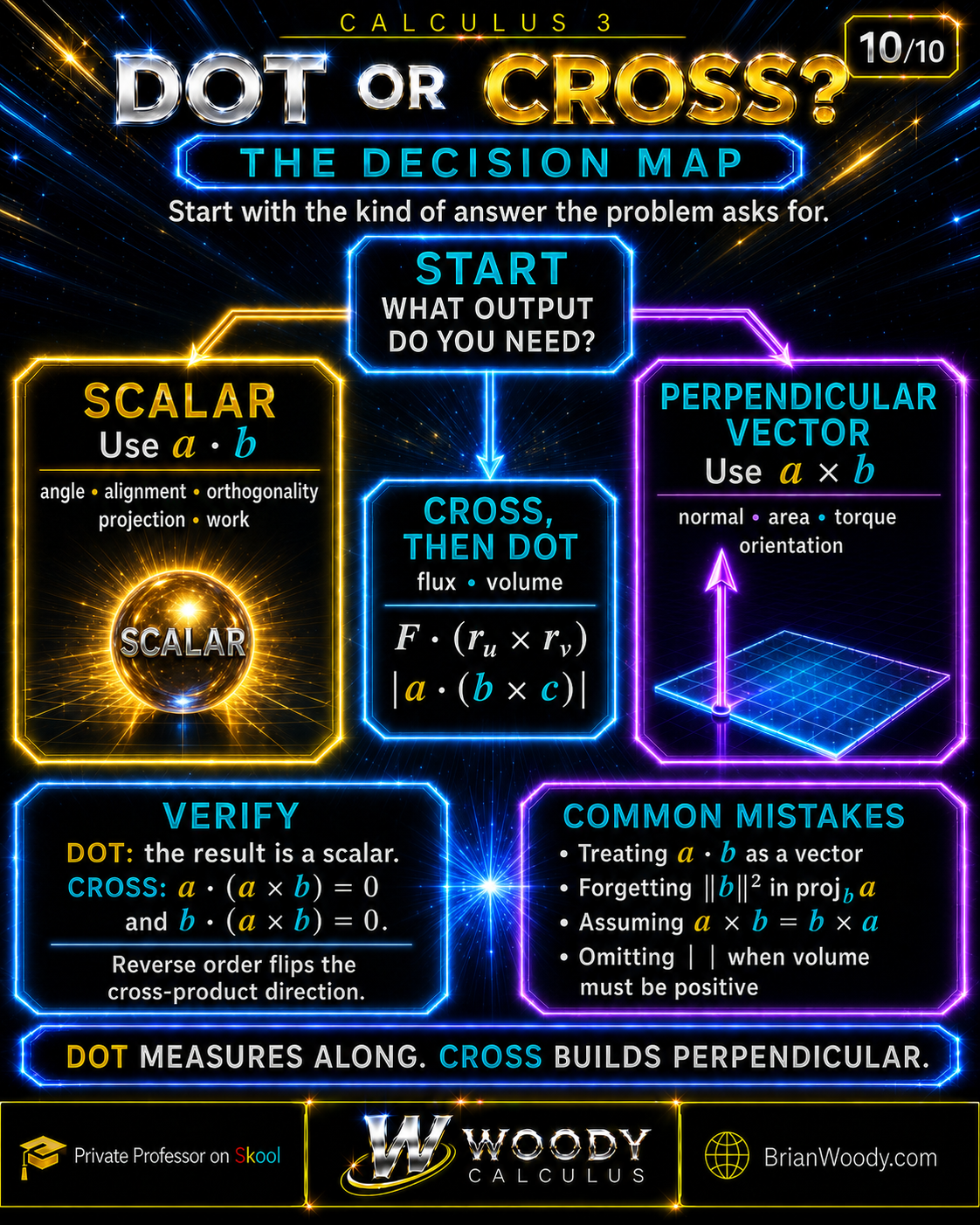
Direct answer: ask what kind of output the problem needs. A scalar suggests the dot product. A perpendicular vector suggests the cross product. Then compute, interpret the geometry, and verify that the output has the correct type.
Key Takeaways
- Dot product: returns a scalar and measures alignment through cosine.
- Cross product: returns a perpendicular vector whose magnitude measures area through sine.
- Decision rule: identify the required output before choosing the operation.
Estimated study time: 45–55 minutes.
Dot Product vs. Cross Product at a Glance
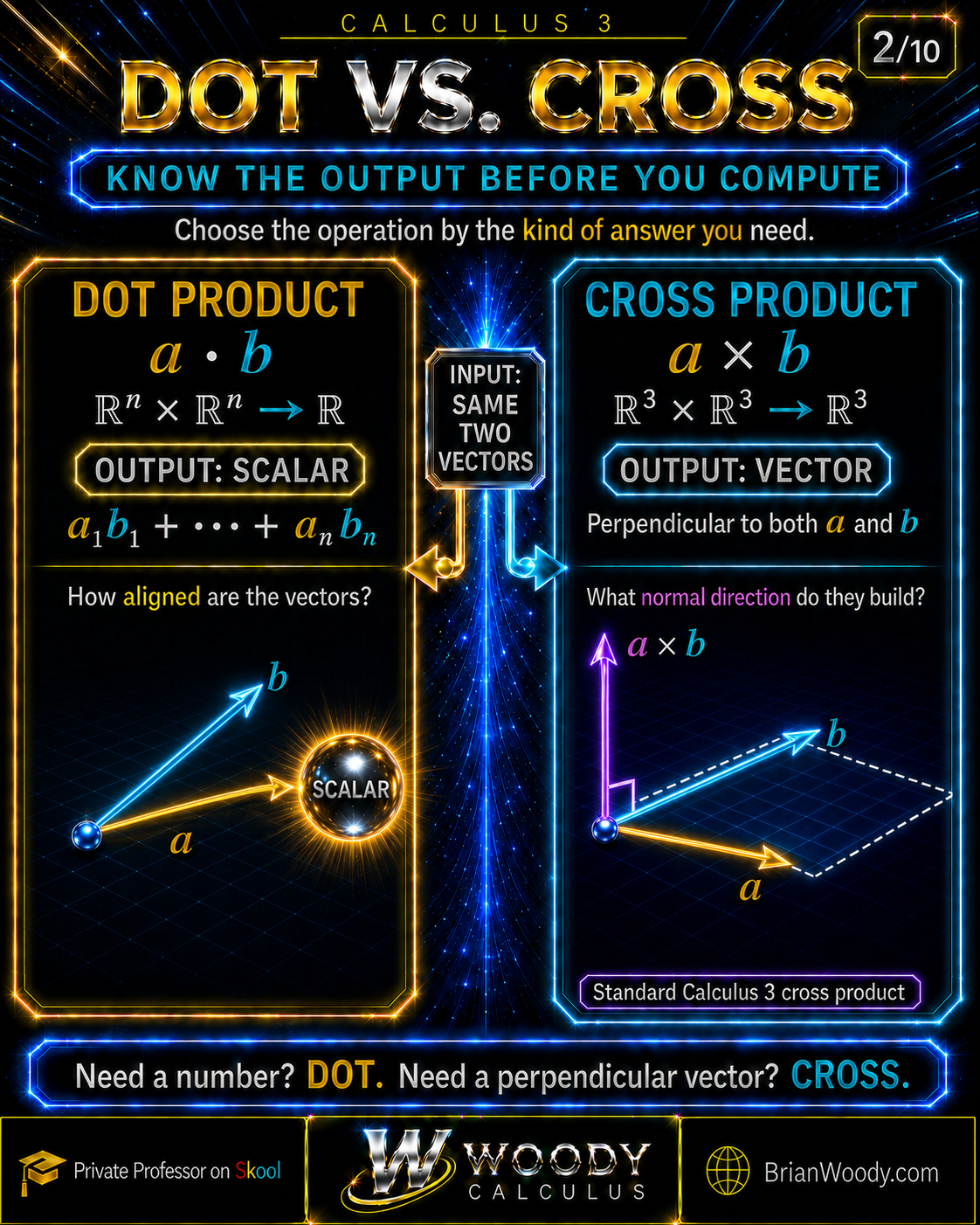
The fastest way to choose the correct vector product is to identify the required output. Although both operations begin with two vectors, they produce fundamentally different mathematical objects.
| Feature | Dot product | Cross product |
|---|---|---|
| Notation | \(\mathbf a\cdot\mathbf b\) | \(\mathbf a\times\mathbf b\) |
| Standard mapping | \(\mathbb R^n\times\mathbb R^n\to\mathbb R\) | \(\mathbb R^3\times\mathbb R^3\to\mathbb R^3\) |
| Output | Scalar | Vector perpendicular to both inputs |
| Geometry | Alignment through \(\cos\theta\) | Area and orientation through \(\sin\theta\) |
| Common uses | Angles, projection, orthogonality, work | Area, normals, torque, orientation |
| Order | \(\mathbf a\cdot\mathbf b=\mathbf b\cdot\mathbf a\) | \(\mathbf b\times\mathbf a=-(\mathbf a\times\mathbf b)\) |
Output-first recognition rule
If the answer should be one number, consider the dot product. If the answer should be a vector normal to a plane or perpendicular to two directions, consider the cross product.
The Dot Product: Formula, Geometry, and Sign
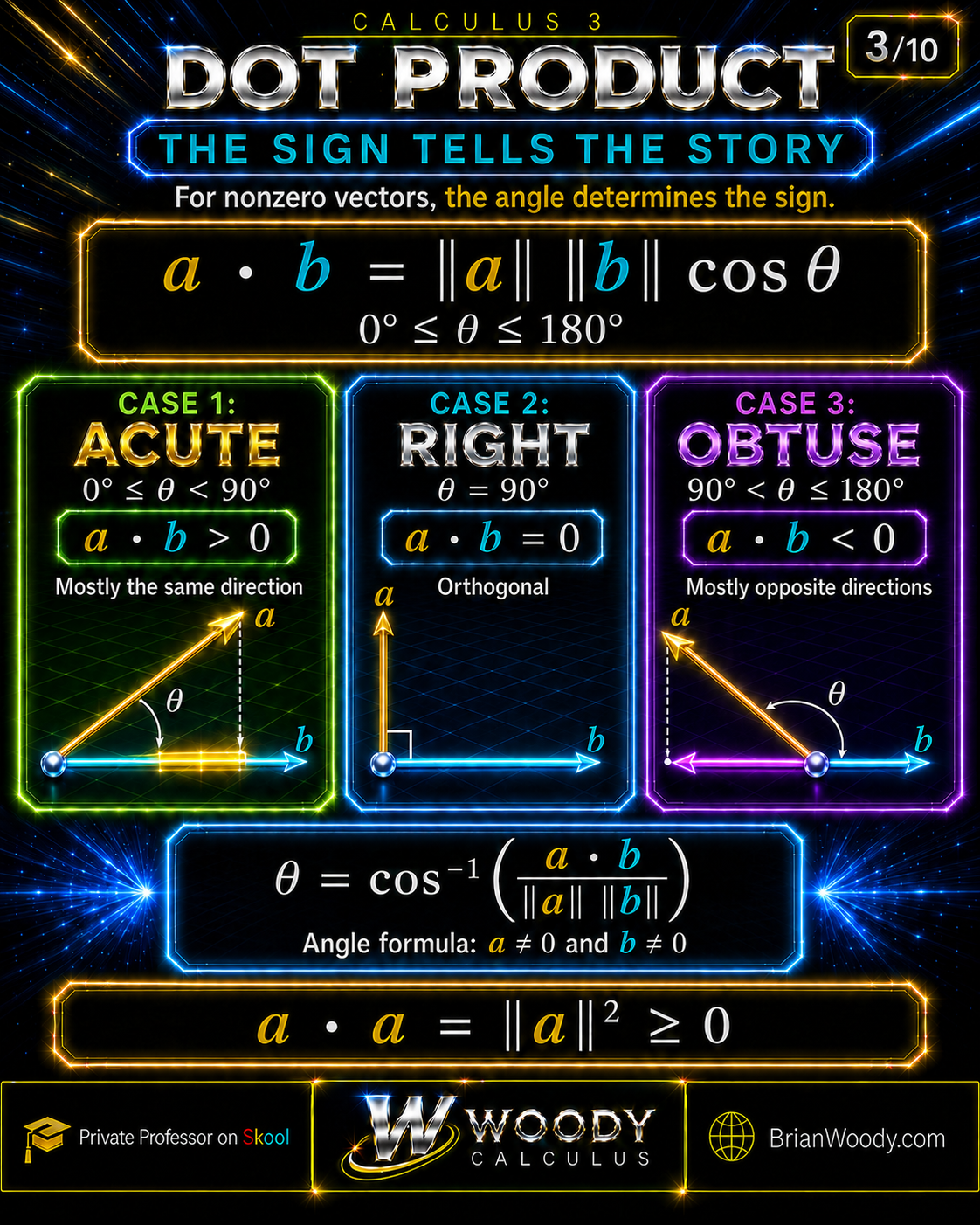
The dot product compresses two equal-dimensional vectors into one scalar. Its component formula makes computation fast, while its geometric formula explains angles, alignment, projection, and work.
Component formula
\mathbf a\cdot\mathbf b
=a_1b_1+a_2b_2+\cdots+a_nb_n.
\]
Geometric formula
\mathbf a\cdot\mathbf b
=\lVert\mathbf a\rVert\lVert\mathbf b\rVert\cos\theta,
\qquad 0^\circ\le \theta\le 180^\circ.
\]
For nonzero vectors, solve for the angle by dividing by both magnitudes:
\boxed{
\theta=\cos^{-1}\!\left(
\frac{\mathbf a\cdot\mathbf b}
{\lVert\mathbf a\rVert\lVert\mathbf b\rVert}
\right)}.
\]
| Dot product | Angle | Geometric interpretation |
|---|---|---|
| \(\mathbf a\cdot\mathbf b>0\) | Acute | The vectors point partly in the same direction. |
| \(\mathbf a\cdot\mathbf b=0\) | Right | The vectors are perpendicular. |
| \(\mathbf a\cdot\mathbf b<0\) | Obtuse | The vectors point partly in opposite directions. |
Zero-vector warning
The equation \(\mathbf a\cdot\mathbf b=0\) is also true if either vector is the zero vector, but the angle formula is then undefined because one magnitude is zero. State the nonzero hypothesis when interpreting a zero dot product as a right angle.
Worked Dot Product Example: Find the Angle Between Two Vectors
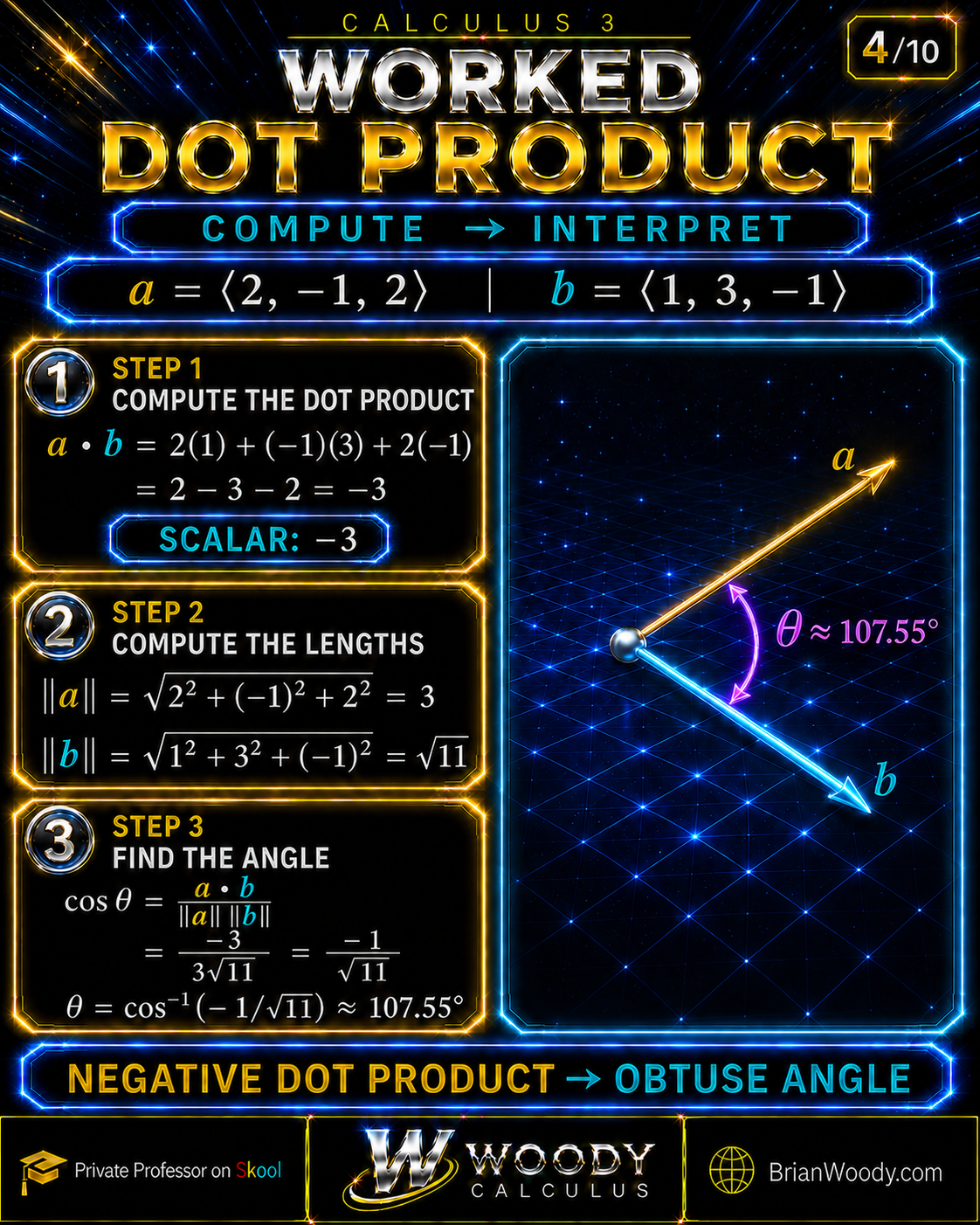
Let \(\mathbf a=\langle2,-1,2\rangle\) and \(\mathbf b=\langle1,3,-1\rangle\). We will compute the dot product, calculate both magnitudes, find the angle, and interpret its sign.
Step 1: Compute the dot product
\mathbf a\cdot\mathbf b
=(2)(1)+(-1)(3)+(2)(-1)
=2-3-2=-3.
\]
Step 2: Compute the magnitudes
\lVert\mathbf a\rVert
=\sqrt{2^2+(-1)^2+2^2}=3,
\]
\[
\lVert\mathbf b\rVert
=\sqrt{1^2+3^2+(-1)^2}=\sqrt{11}.
\]
Step 3: Find and interpret the angle
\cos\theta
=\frac{-3}{3\sqrt{11}}
=-\frac1{\sqrt{11}},
\]
\[
\theta=\cos^{-1}\!\left(-\frac1{\sqrt{11}}\right)
\approx107.55^\circ.
\]
Conclusion: The angle is obtuse, exactly as the negative dot product predicts.
Dot Product Applications: Orthogonality, Projection, and Work
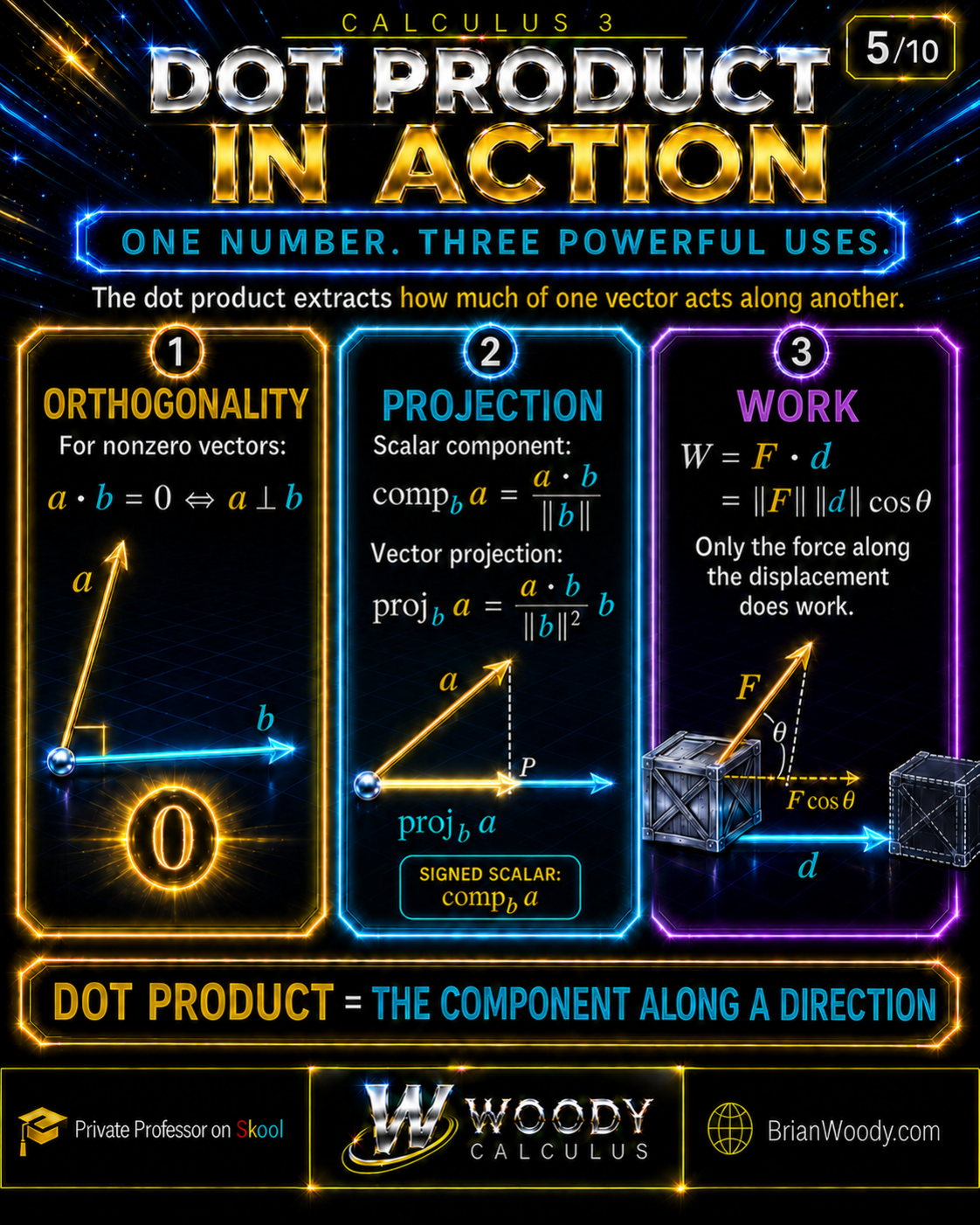
The dot product is valuable because it extracts the part of one vector lying along another direction. That single idea powers orthogonality tests, scalar components, vector projections, and mechanical work.
Orthogonality
For nonzero vectors,
\mathbf a\perp\mathbf b
\iff \mathbf a\cdot\mathbf b=0.
\]
Scalar component
The signed length of the component of \(\mathbf a\) along \(\mathbf b\) is
\operatorname{comp}_{\mathbf b}\mathbf a
=\frac{\mathbf a\cdot\mathbf b}{\lVert\mathbf b\rVert}.
\]
Vector projection
The actual vector component of \(\mathbf a\) along \(\mathbf b\) is
\operatorname{proj}_{\mathbf b}\mathbf a
=\frac{\mathbf a\cdot\mathbf b}{\lVert\mathbf b\rVert^2}\mathbf b.
\]
Projection of the worked-example vector
For the same vectors from the previous section, \(\mathbf a\cdot\mathbf b=-3\) and \(\lVert\mathbf b\rVert^2=11\). Therefore,
\operatorname{comp}_{\mathbf b}\mathbf a=-\frac3{\sqrt{11}},
\]
\[
\operatorname{proj}_{\mathbf b}\mathbf a
=-\frac3{11}\langle1,3,-1\rangle
=\left\langle-\frac3{11},-\frac9{11},\frac3{11}\right\rangle.
\]
The negative scalar component is not an error. It records that the projection points against the direction of \(\mathbf b\), consistent with the obtuse angle.
Work performed by a constant force
W=\mathbf F\cdot\mathbf d
=\lVert\mathbf F\rVert\lVert\mathbf d\rVert\cos\theta.
\]
If \(\mathbf F=\langle4,-1,2\rangle\) newtons and \(\mathbf d=\langle3,2,-1\rangle\) meters, then
\boxed{W=(4)(3)+(-1)(2)+(2)(-1)=8\text{ J}.}
\]
Directional derivatives: a central Calculus 3 dot product
For a unit vector \(\mathbf u\), the directional derivative is \(D_{\mathbf u}f=\nabla f\cdot\mathbf u\). This dot product measures the component of the gradient in the chosen direction—the instantaneous rate at which \(f\) changes as you move along \(\mathbf u\).
The Cross Product: Formula, Magnitude, and Direction
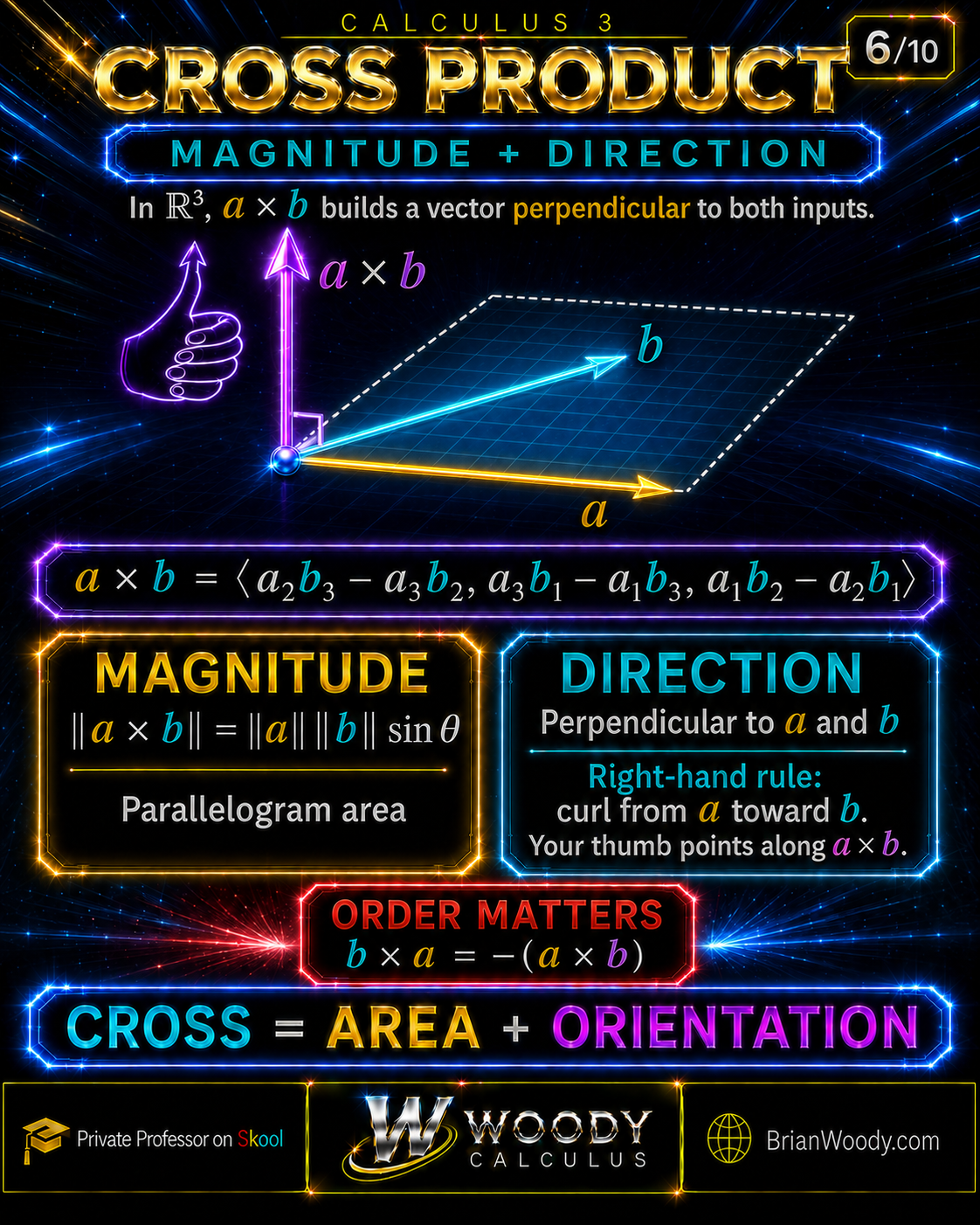
The standard cross product takes two vectors in three-dimensional space and constructs a vector perpendicular to both. Its component formula determines the coordinates, its magnitude determines area, and the right-hand rule determines orientation.
Component formula
\mathbf a\times\mathbf b
=\left\langle
a_2b_3-a_3b_2,
\ a_3b_1-a_1b_3,
\ a_1b_2-a_2b_1
\right\rangle.
\]
Magnitude and geometric meaning
\lVert\mathbf a\times\mathbf b\rVert
=\lVert\mathbf a\rVert\lVert\mathbf b\rVert\sin\theta.
\]
This magnitude equals the area of the parallelogram spanned by \(\mathbf a\) and \(\mathbf b\). It is zero precisely when the vectors are parallel, antiparallel, or one input is the zero vector.
Right-hand rule
Place both vectors tail-to-tail. Curl the fingers of your right hand through the smaller rotation from \(\mathbf a\) toward \(\mathbf b\). Your thumb points in the direction of \(\mathbf a\times\mathbf b\).
Why order matters
\boxed{\mathbf b\times\mathbf a=-(\mathbf a\times\mathbf b)}.
\]
Swapping the inputs preserves the magnitude but reverses the direction. On an exam, a correct component computation with the wrong order produces the opposite normal vector.
Worked Cross Product Example: Compute and Verify
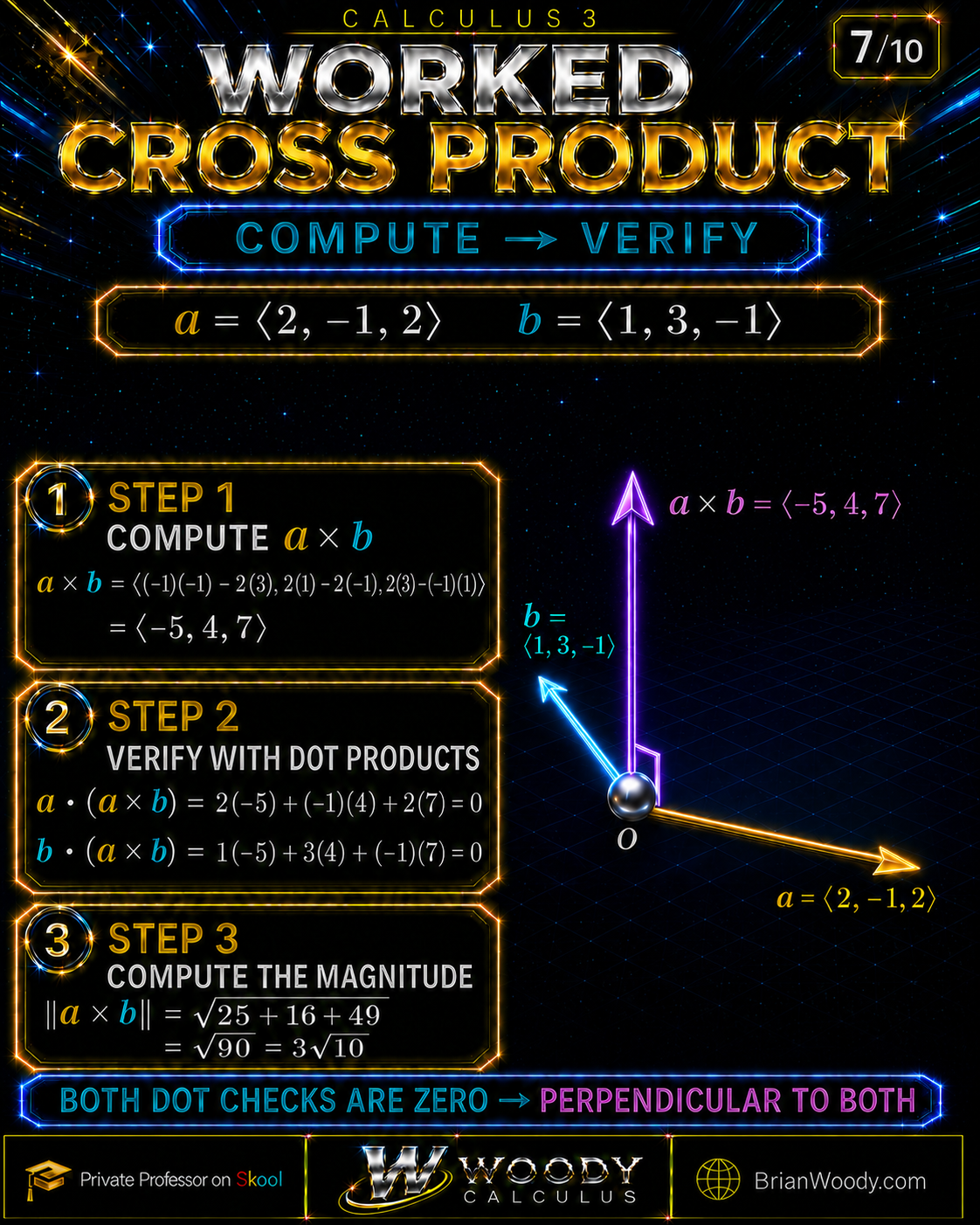
Use the same vectors \(\mathbf a=\langle2,-1,2\rangle\) and \(\mathbf b=\langle1,3,-1\rangle\). After computing the cross product, verify it by taking two dot products.
Step 1: Compute the cross product
\begin{aligned}
\mathbf a\times\mathbf b
&=\left\langle
(-1)(-1)-(2)(3),
\ (2)(1)-(2)(-1),
\ (2)(3)-(-1)(1)
\right\rangle\\
&=\langle-5,4,7\rangle.
\end{aligned}
\]
Step 2: Verify perpendicularity
\mathbf a\cdot(\mathbf a\times\mathbf b)
=(2)(-5)+(-1)(4)+(2)(7)=0,
\]
\[
\mathbf b\cdot(\mathbf a\times\mathbf b)
=(1)(-5)+(3)(4)+(-1)(7)=0.
\]
Step 3: Compute the magnitude
\boxed{
\lVert\mathbf a\times\mathbf b\rVert
=\sqrt{(-5)^2+4^2+7^2}
=\sqrt{90}=3\sqrt{10}.}
\]
The result has three independent checks: it is a vector, it is orthogonal to both inputs, and its magnitude is positive.
Cross Product Applications: Area, Plane Normals, and Torque
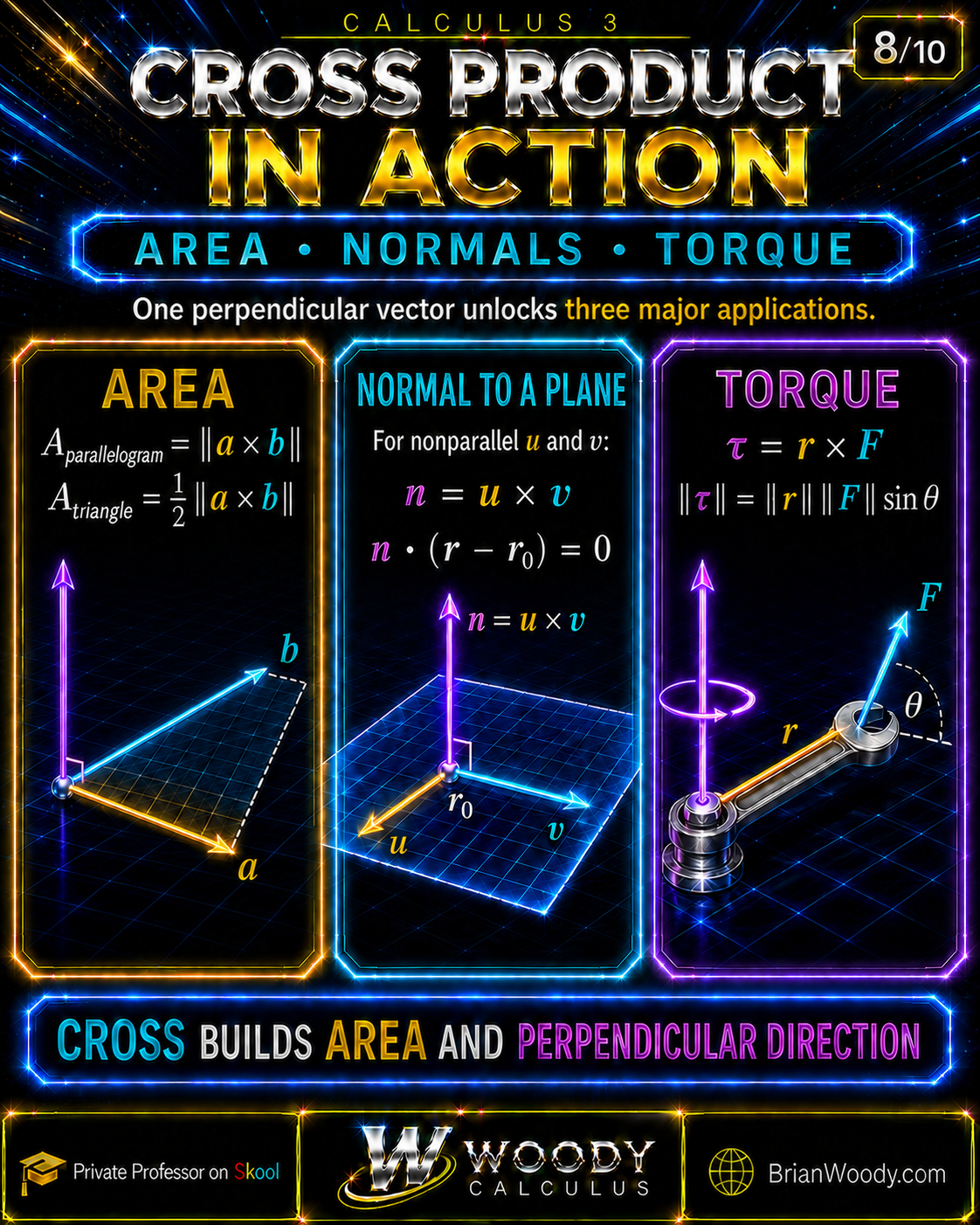
The same perpendicular vector created by the cross product solves several different-looking Calculus 3 problems. Its magnitude measures area, its direction supplies a plane normal, and its orientation records rotational effect.
Parallelogram and triangle area
A_{\mathrm{parallelogram}}=\lVert\mathbf a\times\mathbf b\rVert,
\qquad
A_{\mathrm{triangle}}=\frac12\lVert\mathbf a\times\mathbf b\rVert.
\]
For the worked-example vectors, the parallelogram area is \(3\sqrt{10}\), and the triangle area is \(3\sqrt{10}/2\).
Equation of a plane
If nonparallel vectors \(\mathbf u\) and \(\mathbf v\) lie in a plane, then \(\mathbf n=\mathbf u\times\mathbf v\) is a normal vector. A plane through position vector \(\mathbf r_0\) satisfies
\mathbf n\cdot(\mathbf r-\mathbf r_0)=0.
\]
Using \(\mathbf n=\langle-5,4,7\rangle\) and the point \(P_0=(1,0,2)\),
\boxed{-5(x-1)+4y+7(z-2)=0}
\]
\[
\boxed{-5x+4y+7z-9=0.}
\]
Torque
\boldsymbol\tau=\mathbf r\times\mathbf F,
\qquad
\lVert\boldsymbol\tau\rVert
=\lVert\mathbf r\rVert\lVert\mathbf F\rVert\sin\theta.
\]
For \(\mathbf r=\langle2,0,0\rangle\) meters and \(\mathbf F=\langle0,3,0\rangle\) newtons,
\boxed{\boldsymbol\tau=\langle0,0,6\rangle\text{ N·m}.}
\]
How Dot and Cross Products Work Together in Calculus 3
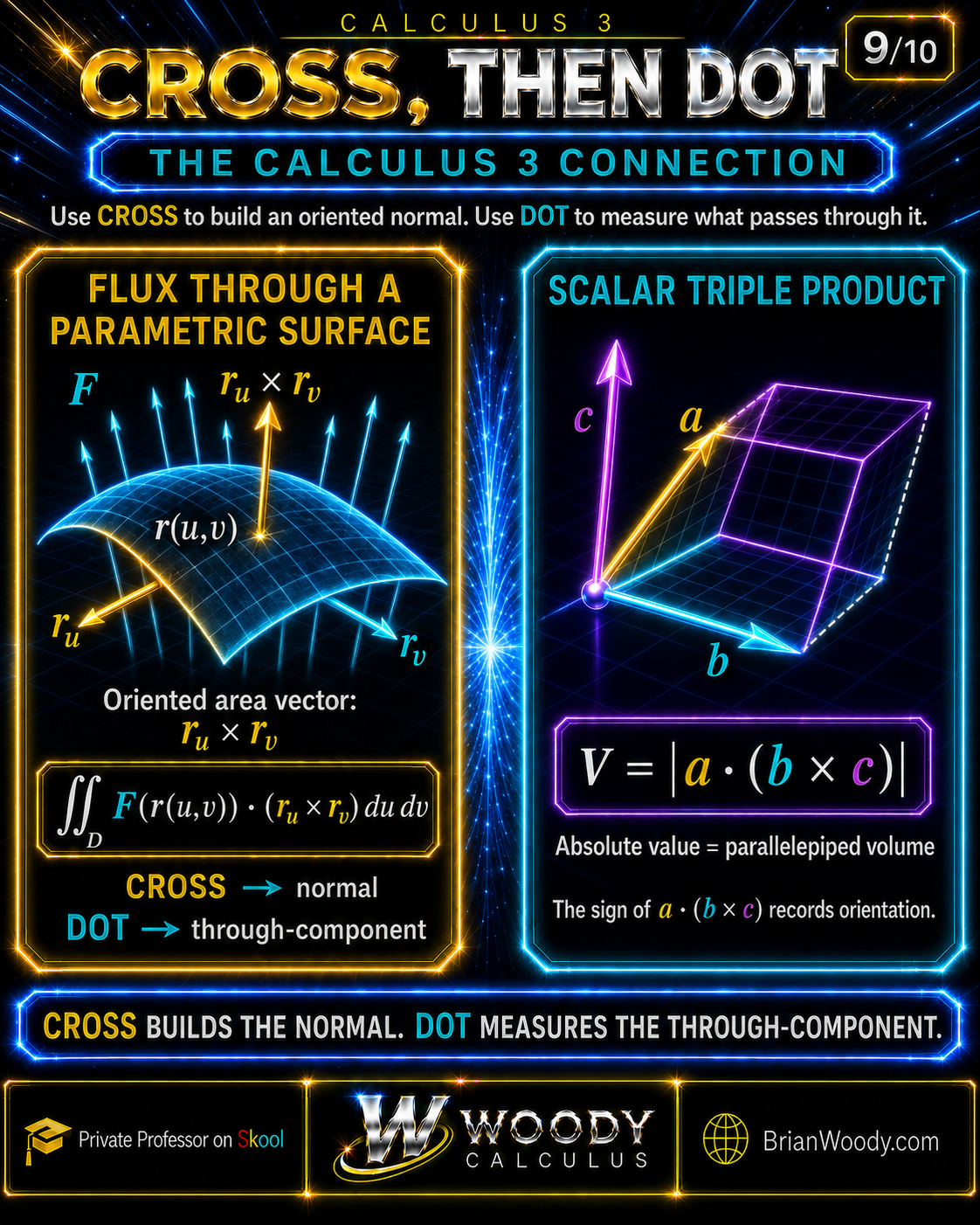
Later vector-calculus formulas often use the cross product to create an oriented normal and then use the dot product to measure how strongly a vector field points through that normal.
Flux through a parametrized surface
For a parametrized surface \(\mathbf r(u,v)\), the cross product \(\mathbf r_u\times\mathbf r_v\) is an oriented vector area element. The flux of a vector field \(\mathbf F\) through the surface is
\iint_D
\mathbf F(\mathbf r(u,v))\cdot
(\mathbf r_u\times\mathbf r_v)\,du\,dv.
\]
Reversing the orientation reverses \(\mathbf r_u\times\mathbf r_v\) and therefore changes the sign of the flux.
Scalar triple product and volume
The cross product \(\mathbf b\times\mathbf c\) creates a normal whose magnitude is the base area. Dotting with \(\mathbf a\) extracts the signed height contribution:
\boxed{V=\left|\mathbf a\cdot(\mathbf b\times\mathbf c)\right|.}
\]
The absolute value gives geometric volume. Without the absolute value, the scalar triple product records orientation.
Lagrange’s Identity Unifies Dot and Cross Products
The dot and cross products are not unrelated formulas. Their squared sizes split the same quantity into cosine and sine contributions:
\boxed{
(\mathbf a\cdot\mathbf b)^2
+\lVert\mathbf a\times\mathbf b\rVert^2
=\lVert\mathbf a\rVert^2\lVert\mathbf b\rVert^2.}
\]
This follows immediately from \(\cos^2\theta+\sin^2\theta=1\):
\begin{aligned}
(\mathbf a\cdot\mathbf b)^2
+\lVert\mathbf a\times\mathbf b\rVert^2
&=\lVert\mathbf a\rVert^2\lVert\mathbf b\rVert^2
(\cos^2\theta+\sin^2\theta)\\
&=\lVert\mathbf a\rVert^2\lVert\mathbf b\rVert^2.
\end{aligned}
\]
Verification with the lesson’s vectors
For \(\mathbf a=\langle2,-1,2\rangle\) and \(\mathbf b=\langle1,3,-1\rangle\),
(\mathbf a\cdot\mathbf b)^2=9,
\qquad
\lVert\mathbf a\times\mathbf b\rVert^2=90,
\]
\[
9+90=99
=\lVert\mathbf a\rVert^2\lVert\mathbf b\rVert^2
=(9)(11).
\]
This identity provides an independent check that the dot product, cross product, and magnitudes computed in the two worked examples agree.
How to Choose Dot Product or Cross Product in Six Steps
Use this decision process before writing a formula. It prevents the most common error: performing a correct calculation with the wrong operation.
-
1
Identify the required output
Decide whether the problem asks for a scalar measurement or a vector perpendicular to two directions.
-
2
Choose dot for a scalar
Use the dot product for angles, alignment, orthogonality, scalar components, vector projections, and work.
-
3
Choose cross for a perpendicular vector
Use the cross product for normals, oriented area, torque, and three-dimensional orientation.
-
4
Compute with the correct formula and order
Match corresponding components for the dot product; preserve component signs and input order for the cross product.
-
5
Interpret the geometry
Connect the result to angle, projection, area, perpendicular direction, orientation, work, torque, flux, or volume.
-
6
Verify the result
Check the output type, signs, units, magnitude, and any required orthogonality or orientation conditions.
Common Dot Product and Cross Product Mistakes
Most vector-product errors come from choosing the wrong operation, overlooking a sign, or forgetting what kind of object the calculation should produce.
Returning the wrong output type
A dot product must be a scalar. A cross product must be a vector in the standard three-dimensional setting.
Forgetting the magnitudes
The angle formula divides the dot product by \(\lVert\mathbf a\rVert\lVert\mathbf b\rVert\). The dot product alone is not generally the cosine.
Ignoring cross-product order
Swapping the inputs reverses the direction: \(\mathbf b\times\mathbf a=-(\mathbf a\times\mathbf b)\).
Losing the middle-component sign
Use the direct component formula consistently. When using a determinant mnemonic, remember that the middle cofactor carries a minus sign.
Calling every zero dot product a right angle
If either input is the zero vector, the angle is undefined. The perpendicular interpretation requires nonzero vectors.
Omitting absolute value for volume
The scalar triple product is signed. Geometric volume is \(\left|\mathbf a\cdot(\mathbf b\times\mathbf c)\right|\).
Dot Product and Cross Product Practice with Complete Solutions
Work each problem before opening its solution. For stronger retention, rewrite the solution and say the purpose of each step aloud: compute, interpret, and verify.
1. Classify an angle using the dot product.
Let \(\mathbf u=\langle3,-2,1\rangle\) and \(\mathbf v=\langle1,4,2\rangle\). Determine whether the angle between them is acute, right, or obtuse.
Solution
\mathbf u\cdot\mathbf v=(3)(1)+(-2)(4)+(1)(2)=3-8+2=-3.
\]
Because the dot product is negative and both vectors are nonzero, the angle is obtuse.
2. Find an exact angle between two vectors.
Find the angle between \(\mathbf p=\langle1,1,0\rangle\) and \(\mathbf q=\langle1,0,1\rangle\).
Solution
\mathbf p\cdot\mathbf q=1,
\qquad
\lVert\mathbf p\rVert=\lVert\mathbf q\rVert=\sqrt2,
\]
\[
\cos\theta=\frac1{(\sqrt2)(\sqrt2)}=\frac12.
\]
\boxed{\theta=60^\circ.}
\]
3. Find a scalar component and vector projection.
Let \(\mathbf a=\langle4,1,-2\rangle\) and \(\mathbf b=\langle2,-1,2\rangle\). Find \(\operatorname{comp}_{\mathbf b}\mathbf a\) and \(\operatorname{proj}_{\mathbf b}\mathbf a\).
Solution
\mathbf a\cdot\mathbf b=8-1-4=3,
\qquad
\lVert\mathbf b\rVert=3,
\qquad
\lVert\mathbf b\rVert^2=9.
\]
\[
\operatorname{comp}_{\mathbf b}\mathbf a=\frac33=1,
\]
\[
\operatorname{proj}_{\mathbf b}\mathbf a
=\frac39\mathbf b
=\left\langle\frac23,-\frac13,\frac23\right\rangle.
\]
4. Compute work from force and displacement.
A constant force \(\mathbf F=\langle5,-2,1\rangle\) newtons moves an object through displacement \(\mathbf d=\langle3,4,-1\rangle\) meters. Find the work.
Solution
\boxed{W=\mathbf F\cdot\mathbf d=15-8-1=6\text{ J}.}
\]
5. Compute and verify a cross product.
Let \(\mathbf u=\langle1,2,0\rangle\) and \(\mathbf v=\langle3,-1,4\rangle\). Find \(\mathbf u\times\mathbf v\) and verify orthogonality.
Solution
\mathbf u\times\mathbf v
=\langle(2)(4)-(0)(-1),\ (0)(3)-(1)(4),\ (1)(-1)-(2)(3)\rangle
=\langle8,-4,-7\rangle.
\]
\[
\mathbf u\cdot(\mathbf u\times\mathbf v)=8-8=0,
\]
\[
\mathbf v\cdot(\mathbf u\times\mathbf v)=24+4-28=0.
\]
Both zero dot products verify that \(\langle8,-4,-7\rangle\) is perpendicular to the two input vectors.
6. Find the area of a triangle in three-dimensional space.
A triangle has adjacent side vectors \(\mathbf u=\langle2,0,1\rangle\) and \(\mathbf v=\langle1,3,-1\rangle\). Find its area.
Solution
\mathbf u\times\mathbf v=\langle-3,3,6\rangle,
\]
\[
\lVert\mathbf u\times\mathbf v\rVert
=\sqrt{9+9+36}=\sqrt{54}=3\sqrt6.
\]
\boxed{A_{\mathrm{triangle}}=\frac12(3\sqrt6)=\frac{3\sqrt6}{2}.}
\]
7. Build the equation of a plane from two direction vectors.
Find the plane through \(P_0=(1,2,-1)\) containing the direction vectors \(\mathbf u=\langle1,0,2\rangle\) and \(\mathbf v=\langle0,3,1\rangle\).
Solution
\mathbf n=\mathbf u\times\mathbf v=\langle-6,-1,3\rangle.
\]
\[
-6(x-1)-(y-2)+3(z+1)=0.
\]
\boxed{-6x-y+3z+11=0.}
\]
Substitution of \((1,2,-1)\) gives zero, so the plane contains the required point.
8. Find a parallelepiped volume with the scalar triple product.
Find the volume generated by \(\mathbf a=\langle1,0,2\rangle\), \(\mathbf b=\langle2,1,0\rangle\), and \(\mathbf c=\langle0,3,1\rangle\).
Solution
\mathbf b\times\mathbf c=\langle1,-2,6\rangle,
\]
\[
\mathbf a\cdot(\mathbf b\times\mathbf c)=1+12=13.
\]
\boxed{V=|13|=13.}
\]
9. Compute a torque vector.
Let \(\mathbf r=\langle2,0,0\rangle\) meters and \(\mathbf F=\langle0,5,0\rangle\) newtons. Find the torque.
Solution
\boxed{\boldsymbol\tau=\mathbf r\times\mathbf F
=\langle0,0,10\rangle\text{ N·m}.}
\]
The positive \(z\)-direction agrees with the right-hand rule from \(\mathbf r\) toward \(\mathbf F\).
10. Choose the correct product before computing.
Which product should be used for each task?
- Find the angle between two vectors.
- Find a vector normal to a plane.
- Find the work done by a force.
- Find the area of a parallelogram.
Solution
- Dot product because the angle formula uses cosine.
- Cross product because the output must be perpendicular to two directions.
- Dot product because work is a scalar.
- Cross product because its magnitude gives parallelogram area.
Dot Product and Cross Product Glossary
These definitions collect the central vocabulary used throughout vector algebra and Calculus 3.
- Vector
- A mathematical object with magnitude and direction, represented by components such as \(\langle a_1,a_2,a_3\rangle\).
- Dot product
- A scalar-valued product obtained by multiplying corresponding components and adding. Geometrically, it measures alignment through cosine.
- Scalar product
- Another name for the dot product, emphasizing that its output is a scalar.
- Cross product
- A three-dimensional vector product that returns a vector perpendicular to both input vectors.
- Vector product
- Another name for the cross product, emphasizing that its output is a vector.
- Orthogonal vectors
- Nonzero vectors meeting at a right angle; equivalently, their dot product is zero.
- Scalar component
- The signed length of the projection of one vector along another direction.
- Vector projection
- The vector component of one vector lying parallel to another vector.
- Normal vector
- A vector perpendicular to a line, plane, or surface at the relevant point.
- Right-hand rule
- The orientation convention used to determine the direction of a cross product.
- Scalar triple product
- The scalar \(\mathbf a\cdot(\mathbf b\times\mathbf c)\), whose absolute value gives parallelepiped volume.
- Flux
- A scalar measurement of how much of a vector field passes through an oriented surface.
Frequently Asked Questions About Dot and Cross Products
These concise answers address the questions students most often ask when deciding between the two vector products.
What is the main difference between the dot product and cross product?
The dot product returns a scalar that measures alignment. The cross product returns a vector perpendicular to two three-dimensional input vectors.
When should I use the dot product?
Use the dot product for angles, orthogonality, scalar components, vector projections, work, and other problems requiring a scalar measure of alignment.
When should I use the cross product?
Use the cross product for perpendicular vectors, plane normals, parallelogram or triangle area, torque, surface orientation, and scalar triple products.
Can a dot product be negative?
Yes. For nonzero vectors, a negative dot product means the angle between them is obtuse, so the vectors point partly in opposite directions.
When is a cross product equal to the zero vector?
The cross product is zero when the input vectors are parallel or antiparallel, or when at least one input is the zero vector.
Why does order matter in the cross product?
The cross product records orientation. Swapping the input order preserves the magnitude but reverses the direction, so b cross a is the negative of a cross b.
How do I find the angle between two vectors?
For nonzero vectors, divide their dot product by the product of their magnitudes, then apply inverse cosine. The result lies between zero and 180 degrees.
What is the difference between a scalar component and a vector projection?
The scalar component is the signed length along the chosen direction. The vector projection is the actual vector lying along that direction.
How are dot and cross products used together in Calculus 3?
The cross product often creates an oriented surface normal, and the dot product then measures how much of a vector field passes through that direction, as in flux integrals.
How can I verify a cross product calculation?
Dot the result with each original vector. Both dot products should be zero. Also check that reversing the input order reverses the result.
References and Further Reading
This lesson was independently developed and mathematically verified by Woody Calculus. The following authoritative sources provide additional textbook treatments of vectors and vector calculus.
- OpenStax, Calculus Volume 3, Section 2.3: The Dot Product (2016).
- OpenStax, Calculus Volume 3, Section 2.4: The Cross Product (2016).
- James Stewart, Daniel K. Clegg, and Saleem Watson, Calculus: Early Transcendentals, 9th edition, Cengage, 2020.
- Jerrold E. Marsden and Anthony J. Tromba, Vector Calculus, 6th edition, W. H. Freeman/Macmillan Learning, 2013.
- H. M. Schey, Div, Grad, Curl, and All That, 4th edition, W. W. Norton, 2005.