The radius of convergence is one of the most important ideas in Calculus 2. It tells you where an infinite polynomial behaves like a function and where it breaks.
A power series can look like a polynomial that never ends:
\[
\sum_{n=0}^{\infty} a_n(x-c)^n.
\]
But unlike an ordinary polynomial, an infinite power series does not automatically work for every value of \(x\). It usually converges only inside a hidden boundary around its center \(c\).
That hidden boundary is called the radius of convergence, usually written as \(R\).
Radius of Convergence Key Facts
- A power series has the form \(\sum_{n=0}^{\infty} a_n(x-c)^n\).
- The number \(c\) is the center of the series.
- The radius of convergence \(R\) measures how far from \(c\) the series converges.
- If \(|x-c| < R\), the series converges.
- If \(|x-c| > R\), the series diverges.
- If \(|x-c|=R\), each endpoint must be tested separately.
- The Ratio Test is usually the fastest way to find \(R\).
This Woody Calculus visual lesson explains the radius of convergence in order: what power series are, why the center matters, what the hidden boundary means, how the Ratio Test finds \(R\), how endpoint testing works, and why Taylor series can be powerful near the center but useless outside the radius.
What Is the Radius of Convergence?
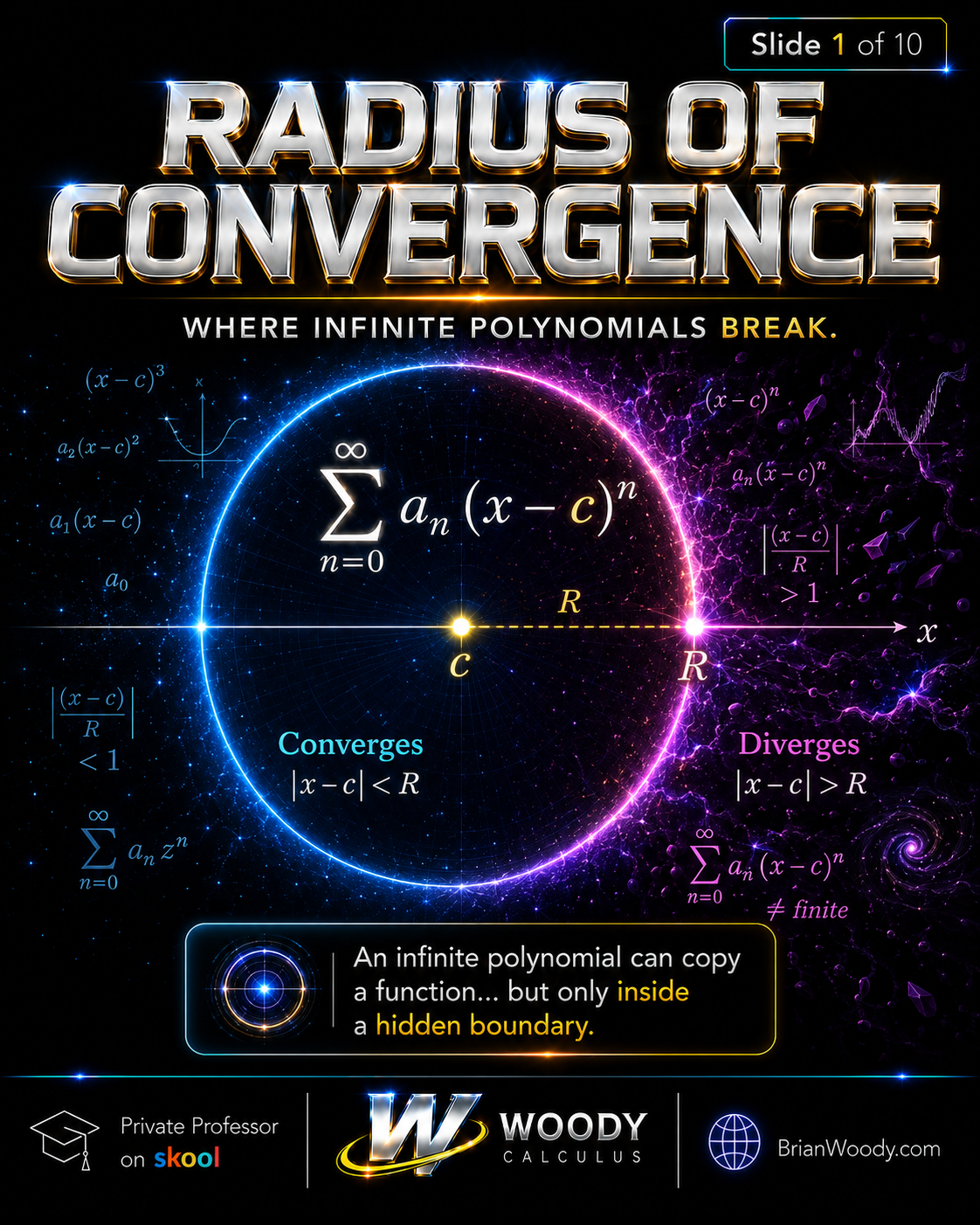
The radius of convergence is the distance from the center of a power series to the boundary where the series stops converging.
A power series centered at \(c\) has the form
\[
\sum_{n=0}^{\infty} a_n(x-c)^n.
\]
The radius of convergence \(R\) creates three regions:
- If \(|x-c| < R\), the series converges.
- If \(|x-c| > R\), the series diverges.
- If \(|x-c|=R\), the endpoints must be tested separately.
This is why the radius of convergence is a boundary. Inside the boundary, the infinite polynomial behaves. Outside the boundary, it breaks.
There are three possible kinds of radius:
- \(R=0\): the series converges only at the center.
- \(0<R<\infty\): the series converges inside a finite interval around the center.
- \(R=\infty\): the series converges for all real numbers.
What Is a Power Series?
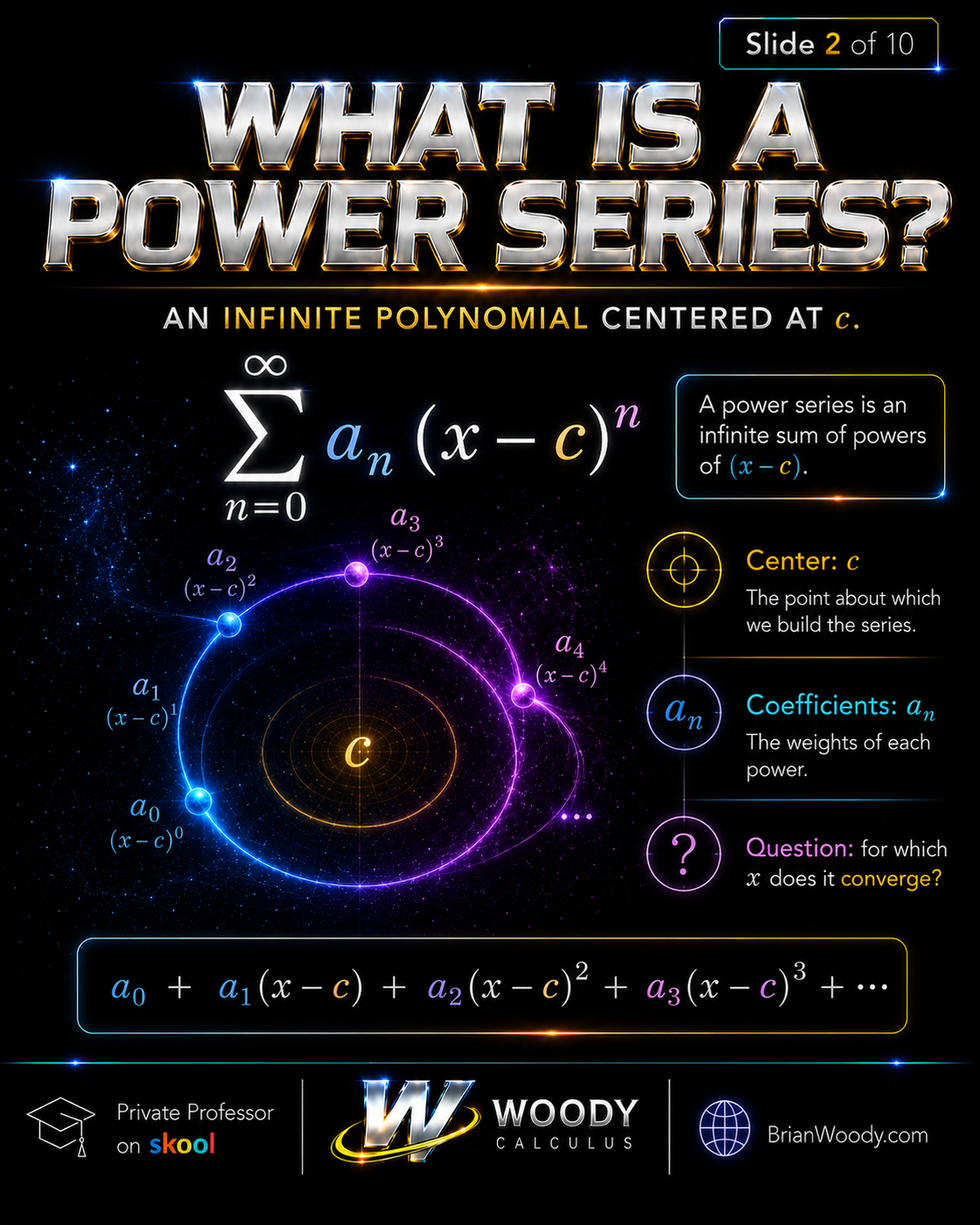
A power series is an infinite sum of powers of \((x-c)\):
\[
\sum_{n=0}^{\infty} a_n(x-c)^n.
\]
Expanded, this looks like
\[
a_0+a_1(x-c)+a_2(x-c)^2+a_3(x-c)^3+\cdots.
\]
There are three important pieces:
- \(c\) is the center.
- \(a_n\) are the coefficients.
- \((x-c)^n\) are the powers built around the center.
A power series is like an infinite polynomial centered at \(c\). The main question is:
For which values of \(x\) does this infinite sum converge?
That question leads directly to the radius of convergence.
The Hidden Center of a Power Series
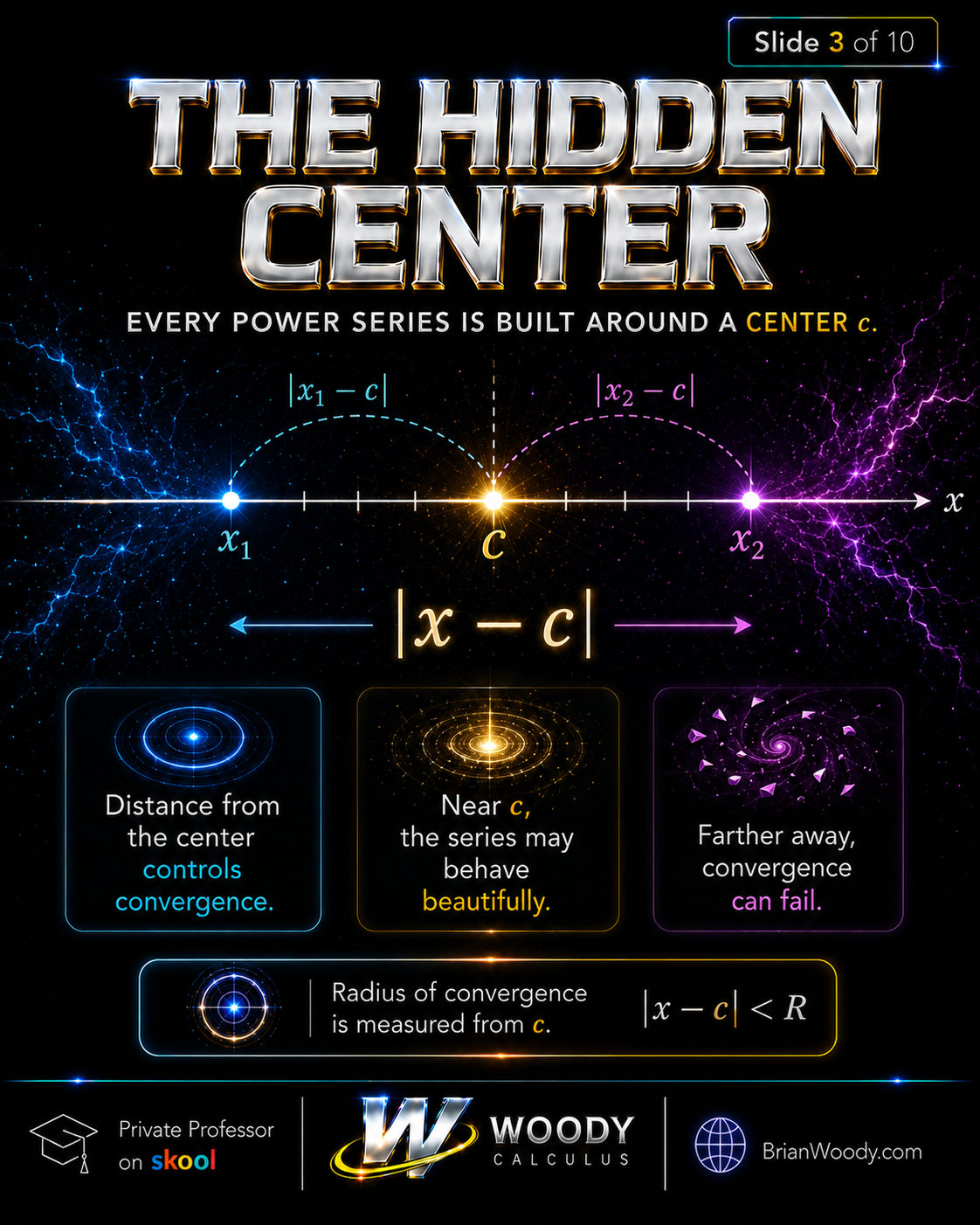
Every power series is built around a center \(c\).
The expression \(|x-c|\) measures how far \(x\) is from the center.
That distance controls convergence.
Near the center, a power series often behaves beautifully. Farther away, the terms may stop shrinking fast enough, and the series can fail to converge.
This is why the radius of convergence is measured from \(c\):
\[
|x-c|<R.
\]
If \(c=0\), then the series is centered at the origin, and the convergence condition becomes \(|x|<R\).
If \(c=3\), then the convergence interval is centered at \(3\), not at \(0\). This is a common place where students lose points.
The Hidden Boundary Around the Center
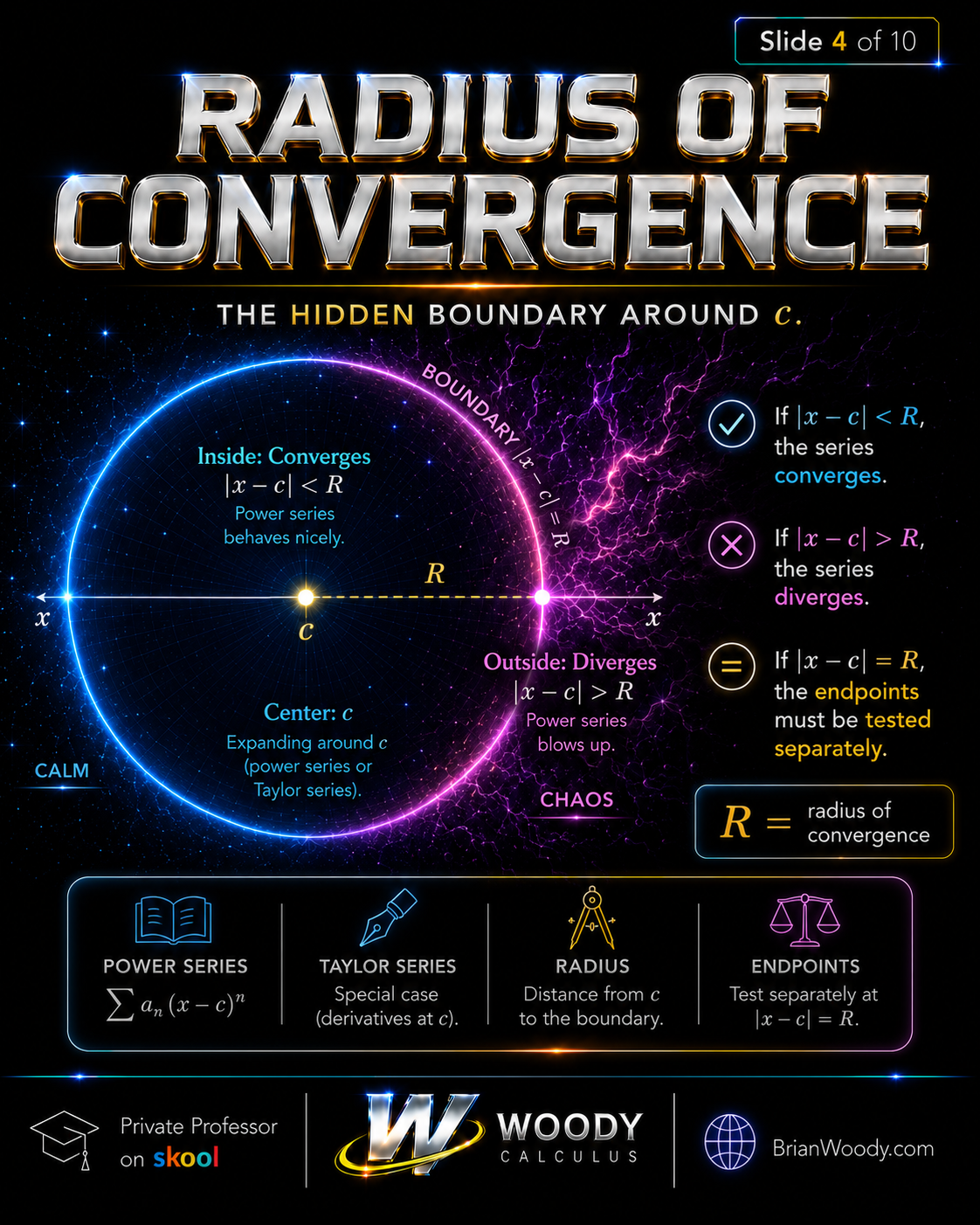
The radius of convergence creates a hidden boundary around the center \(c\).
Inside the boundary,
\[
|x-c|<R,
\]
the power series converges.
Outside the boundary,
\[
|x-c|>R,
\]
the power series diverges.
At the boundary,
\[
|x-c|=R,
\]
the Ratio Test usually becomes inconclusive, so the endpoints must be tested separately.
That last sentence is critical. The radius of convergence does not automatically tell you whether the endpoints are included.
The radius gives the open interval:
\[
(c-R,c+R).
\]
Then you test \(x=c-R\) and \(x=c+R\) separately to find the full interval of convergence.
Using the Ratio Test to Find the Radius of Convergence
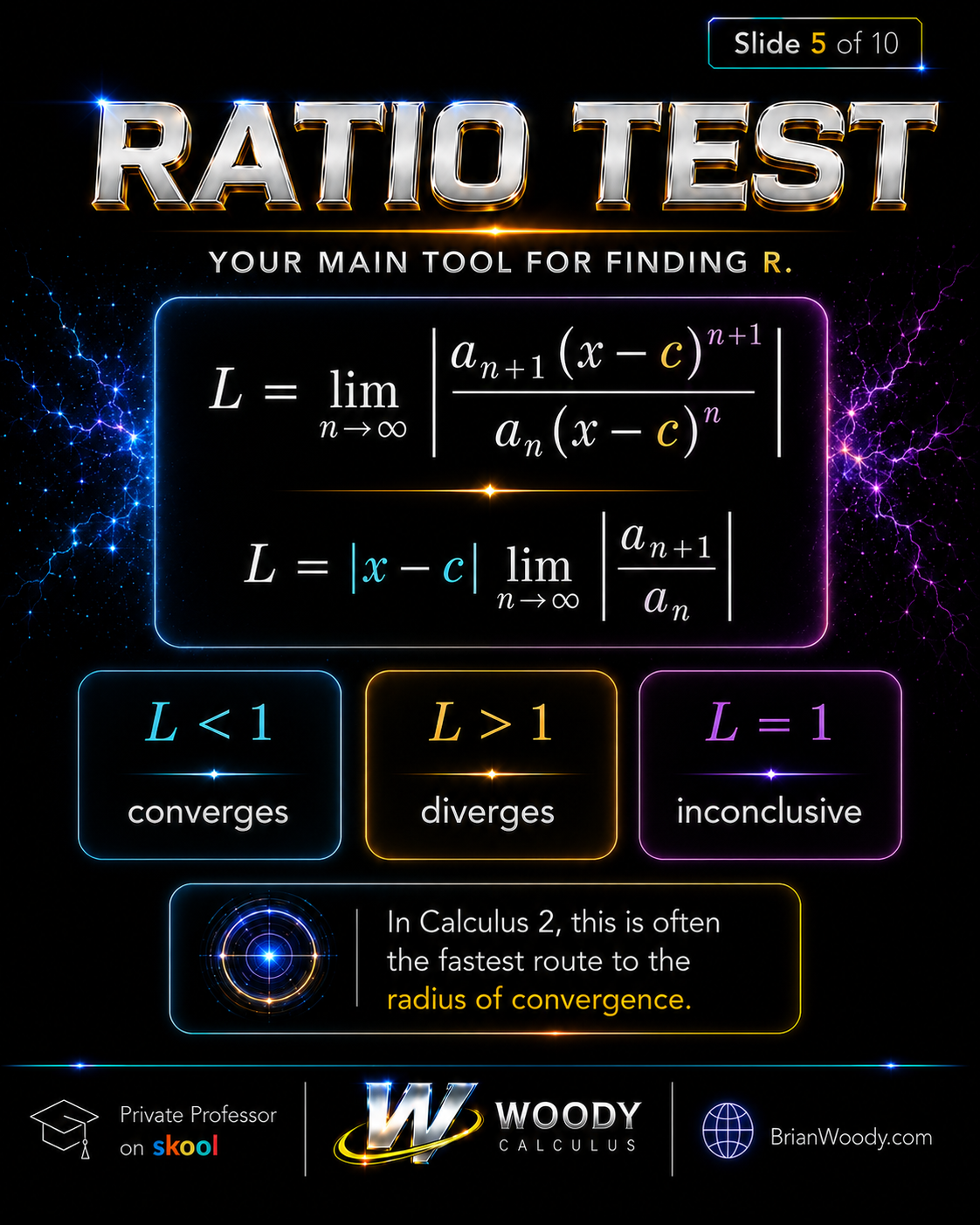
The Ratio Test is usually the fastest way to find the radius of convergence.
For a power series
\[
\sum_{n=0}^{\infty} a_n(x-c)^n,
\]
form the limit
\[
L=\lim_{n\to\infty}\left|
\frac{a_{n+1}(x-c)^{n+1}}{a_n(x-c)^n}
\right|.
\]
Simplify the powers of \((x-c)\):
\[
L=|x-c|\lim_{n\to\infty}\left|\frac{a_{n+1}}{a_n}\right|.
\]
The Ratio Test says:
- If \(L<1\), the series converges.
- If \(L>1\), the series diverges.
- If \(L=1\), the test is inconclusive.
To find the radius of convergence, solve the inequality
\[
|x-c|\lim_{n\to\infty}\left|\frac{a_{n+1}}{a_n}\right|<1.
\]
If
\[
A=\lim_{n\to\infty}\left|\frac{a_{n+1}}{a_n}\right|,
\]
then the radius is
\[
R=\frac{1}{A},
\]
as long as \(A\) is positive and finite.
Worked Example: Find the Radius of Convergence
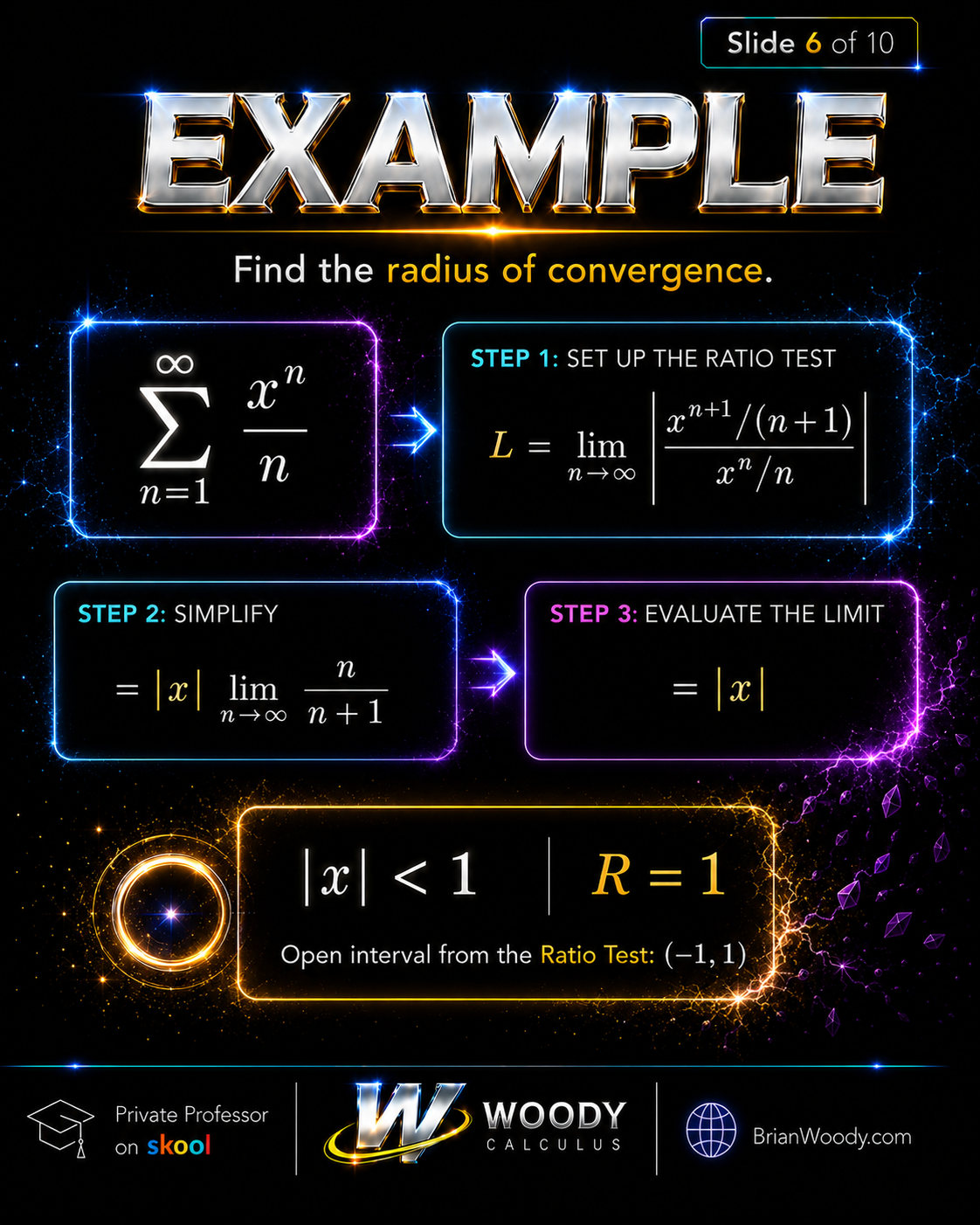
Consider the power series
\[
\sum_{n=1}^{\infty}\frac{x^n}{n}.
\]
Here the center is \(c=0\). We want to find the radius of convergence.
Use the Ratio Test. Let
\[
a_n=\frac{x^n}{n}.
\]
Then
\[
a_{n+1}=\frac{x^{n+1}}{n+1}.
\]
Now compute
\[
L=\lim_{n\to\infty}\left|
\frac{x^{n+1}/(n+1)}{x^n/n}
\right|.
\]
Simplify the fraction:
\[
L=\lim_{n\to\infty}\left|
x\cdot \frac{n}{n+1}
\right|.
\]
Since
\[
\lim_{n\to\infty}\frac{n}{n+1}=1,
\]
we get
\[
L=|x|.
\]
The Ratio Test requires \(L<1\), so
\[
|x|<1.
\]
Therefore,
\[
R=1.
\]
The Ratio Test gives the open interval
\[
(-1,1).
\]
Now the endpoints must be tested separately.
Endpoint Testing and Interval of Convergence
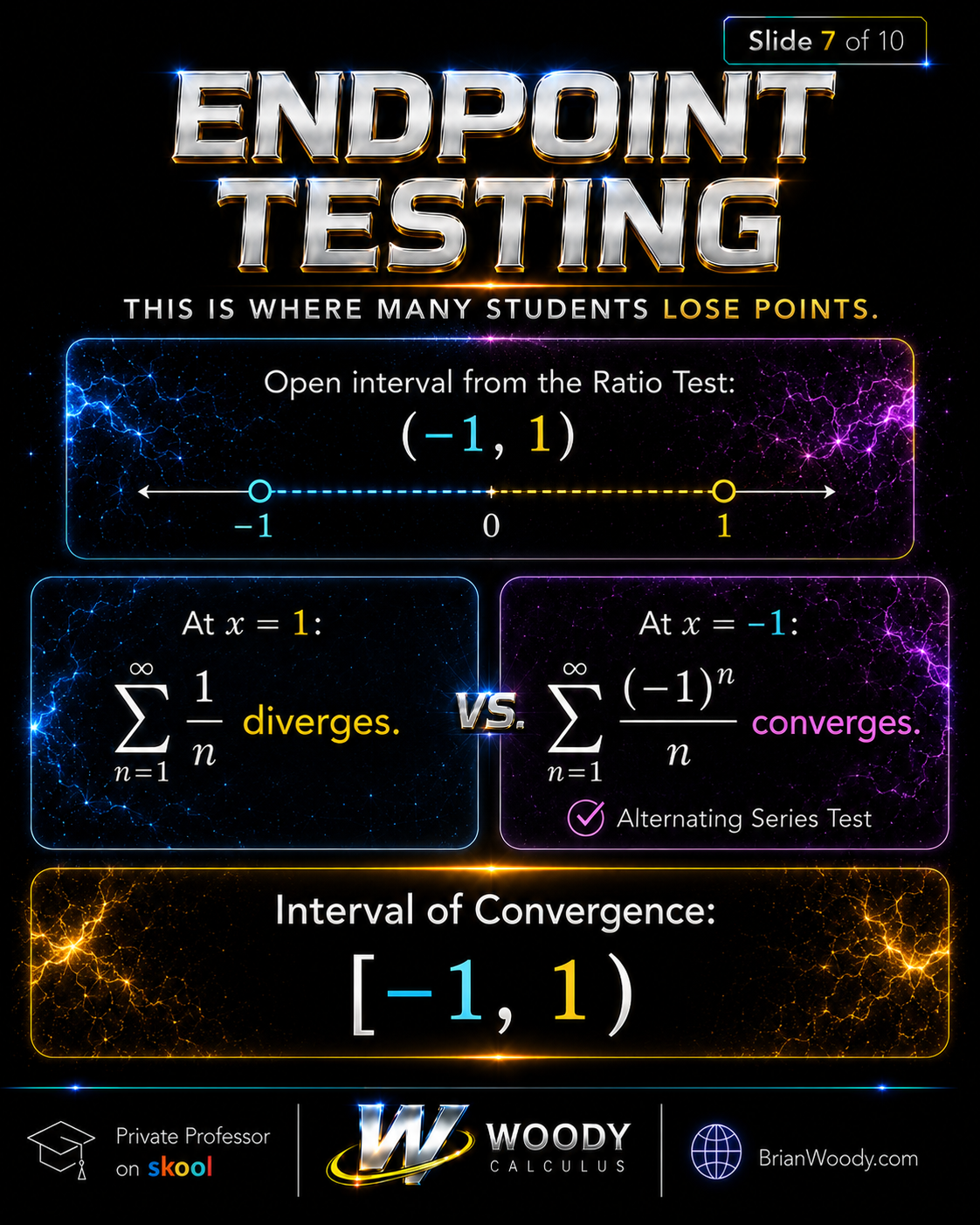
Endpoint testing is where many students lose points.
For the example
\[
\sum_{n=1}^{\infty}\frac{x^n}{n},
\]
the Ratio Test gave the open interval
\[
(-1,1).
\]
Now test both endpoints.
Endpoint \(x=1\)
Substitute \(x=1\):
\[
\sum_{n=1}^{\infty}\frac{1^n}{n}
=
\sum_{n=1}^{\infty}\frac{1}{n}.
\]
This is the harmonic series, so it diverges.
Therefore, \(x=1\) is not included.
Endpoint \(x=-1\)
Substitute \(x=-1\):
\[
\sum_{n=1}^{\infty}\frac{(-1)^n}{n}.
\]
This is an alternating harmonic series. By the Alternating Series Test, it converges.
Therefore, \(x=-1\) is included.
So the full interval of convergence is
\[
[-1,1).
\]
This is the difference between the radius of convergence and the interval of convergence:
- The radius is \(R=1\).
- The open interval is \((-1,1)\).
- The full interval of convergence is \([-1,1)\).
Why the Radius of Convergence Matters
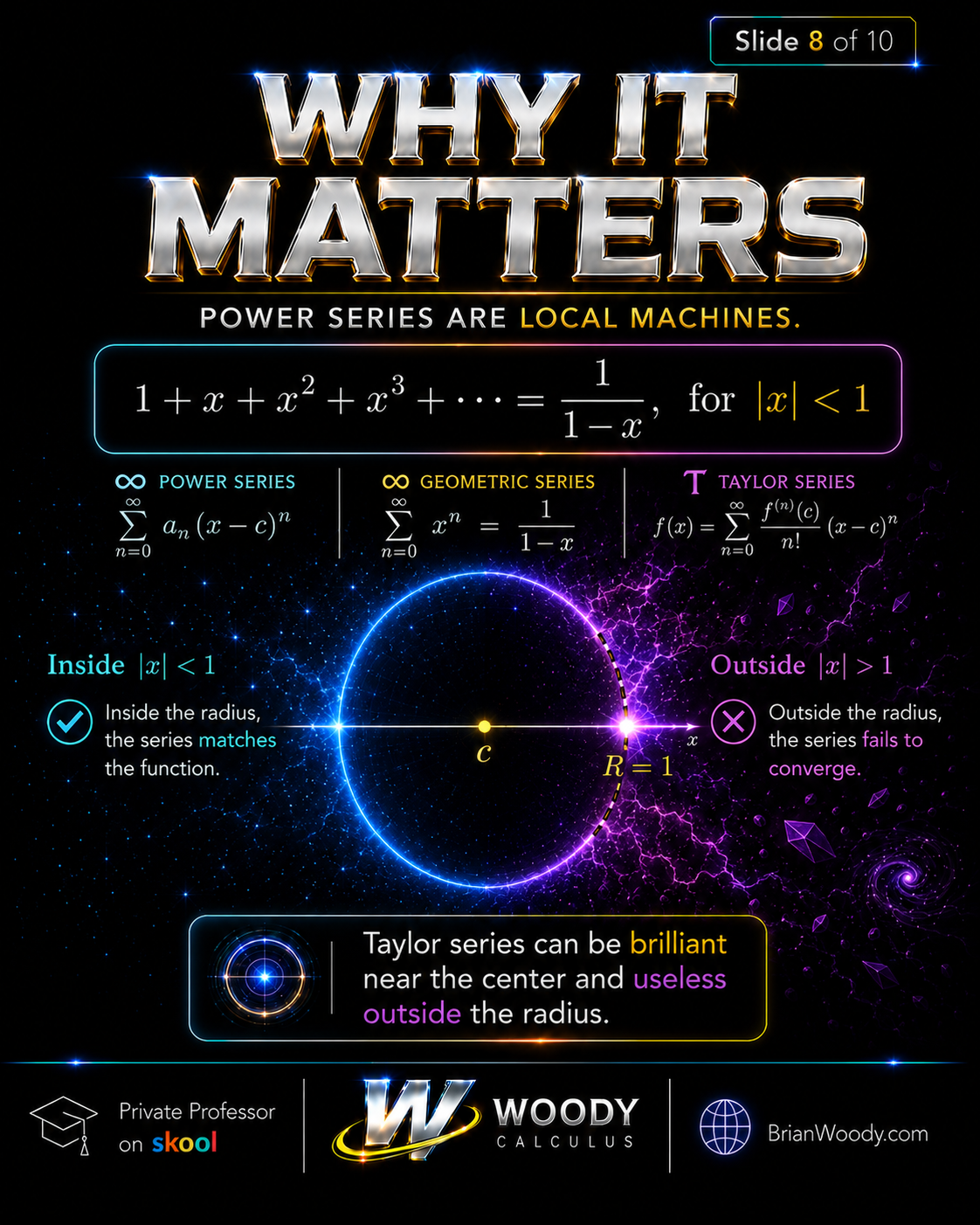
Power series are local machines.
A famous example is the geometric series:
\[
1+x+x^2+x^3+\cdots=\frac{1}{1-x},
\]
but only when
\[
|x|<1.
\]
Inside the radius, the series matches the function. Outside the radius, the series fails to converge.
This is why the radius of convergence matters so much for Taylor series. A Taylor series may represent a function beautifully near the center, but it can become useless outside the radius.
For example, a Taylor series centered at \(c\) may approximate a function extremely well when \(x\) is close to \(c\), but if \(x\) is too far away, the infinite series may diverge.
The radius of convergence tells you where the formula is valid.
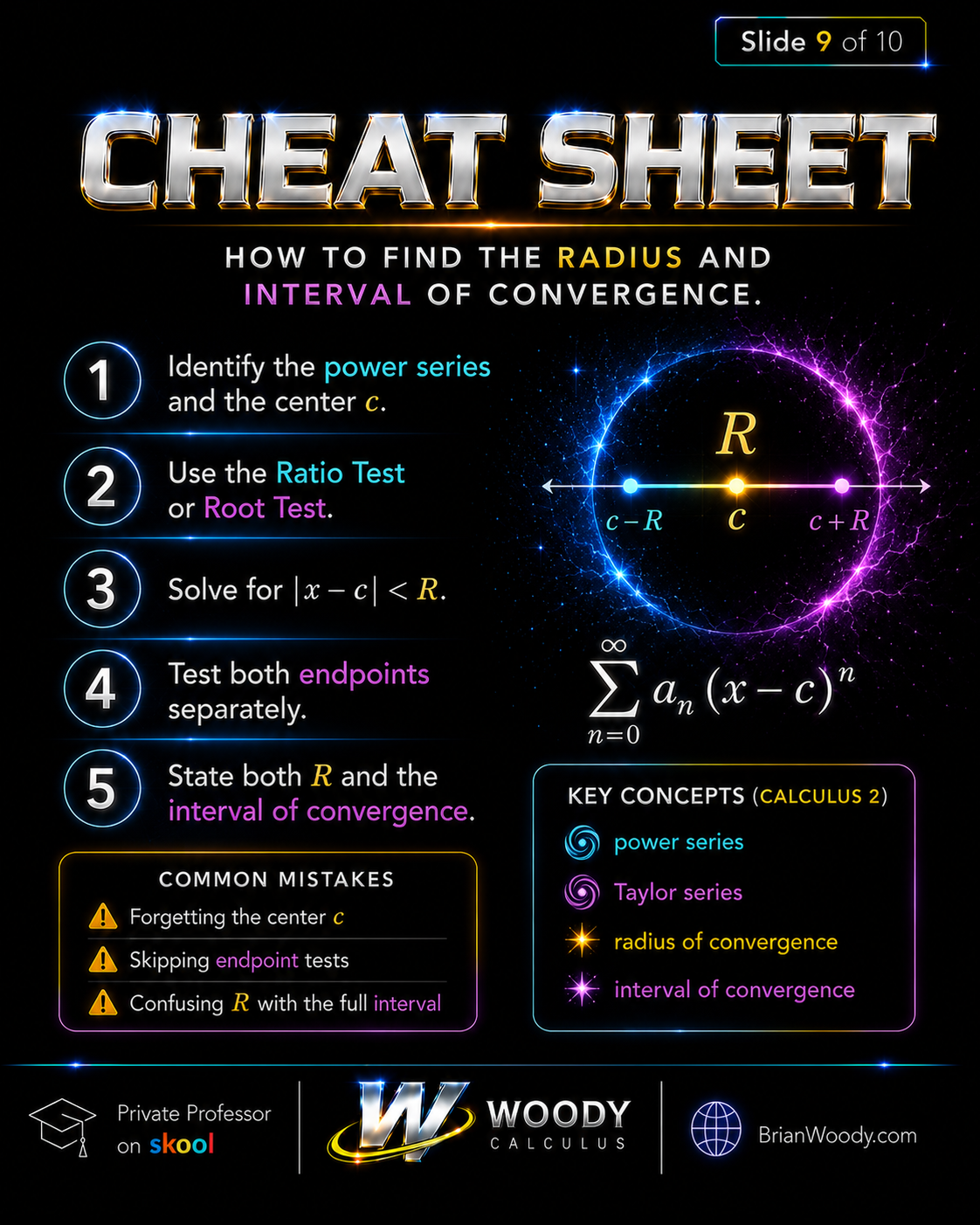
Radius and Interval of Convergence Cheat Sheet
Here is the main workflow for finding the radius and interval of convergence.
- Identify the power series and the center \(c\).
- Use the Ratio Test or Root Test.
- Solve for \(|x-c|<R\).
- Test both endpoints separately.
- State both \(R\) and the full interval of convergence.
The most common mistakes are:
- Forgetting the center \(c\).
- Skipping endpoint tests.
- Confusing the radius \(R\) with the full interval of convergence.
Remember:
\[
R \text{ is a distance.}
\]
The interval of convergence is an interval.
They are related, but they are not the same thing.
Key Takeaways
- A power series is an infinite polynomial centered at \(c\).
- The radius of convergence \(R\) measures how far from \(c\) the series converges.
- If \(|x-c|<R\), the series converges.
- If \(|x-c|>R\), the series diverges.
- If \(|x-c|=R\), endpoints must be tested separately.
- The Ratio Test is usually the fastest way to find \(R\).
- The radius of convergence is a distance, not the full interval.
- The interval of convergence includes endpoint behavior.
Radius of Convergence FAQ
What is the radius of convergence?
The radius of convergence is the distance \(R\) from the center \(c\) of a power series where the series converges for \(|x-c|<R\) and diverges for \(|x-c|>R\).
How do you find the radius of convergence?
The most common method is the Ratio Test. Set up the limit of the absolute value of consecutive terms, simplify, solve the inequality \(L<1\), and identify the radius \(R\).
What is the difference between radius of convergence and interval of convergence?
The radius of convergence is a distance from the center. The interval of convergence is the actual set of \(x\)-values where the series converges, including any endpoints that pass separate tests.
Why do endpoints need to be tested separately?
At endpoints, the Ratio Test usually gives \(L=1\), which is inconclusive. Each endpoint must be substituted into the original series and tested with another convergence test.
What is the radius of convergence of \(\sum x^n/n\)?
The radius of convergence is \(R=1\). The interval of convergence is \([-1,1)\), because the series converges at \(x=-1\) and diverges at \(x=1\).
Master Power Series and Radius of Convergence
The radius of convergence is not just a formula. It is the boundary that tells you where an infinite polynomial actually works.
To master radius and interval of convergence problems, students need to connect:
- Power series: \(\sum a_n(x-c)^n\)
- Center: the point \(c\) around which the series is built
- Ratio Test: the main tool for finding \(R\)
- Endpoint testing: the step that determines the full interval
- Taylor series: local representations that work only inside their convergence boundary
At Woody Calculus, students build fluency through clean setup, repeated perfect solutions, formula memorization, pattern recognition, and saying every step out loud until the process becomes automatic.
The radius of convergence is where an infinite polynomial stops pretending it works everywhere.
— Brian M. Woody
If you are studying Calculus 2, infinite series, Taylor series, power series, or advanced mathematics, radius of convergence is one of the ideas you want to master deeply.
Join Woody Calculus Mastery Lab on Skool
Related Woody Calculus Mathematical Essays
Explore more Woody Calculus visual lessons and deep-dive mathematical essays connecting
Calculus 2,
Calculus 3,
Differential Equations,
Linear Algebra,
Abstract Algebra,
Real Analysis,
Fourier Series,
Laplace Transforms,
and peak performance study methods and advanced problem-solving.
- How to Learn Calculus and Advanced Mathematics: A Peak Performance Study Guide
- Taylor Series Explained: Mathematical Time Travel in Calculus 2
- Euler’s Identity Explained: The Most Beautiful Equation in Mathematics
- Fourier Series Explained: Harmonics, Sound, Heat, and Quantum Mechanics
- Laplace Transforms Explained: Turning Differential Equations Into Algebra
- The Jacobian Explained: The Hidden Scale Factor in Calculus III
- The Determinant Explained: The Number That Measures How a Matrix Changes Space
- Eigenvalues and Eigenvectors Explained: The Special Directions That Unlock Linear Algebra
- View All Woody Calculus Blog Posts
Related University Math Help Pages
Woody Calculus supports students at major universities with structured help in Calculus II, Calculus III, Differential Equations, Linear Algebra, Abstract Algebra, Real Analysis, and advanced mathematics. For a full list of supported schools, visit the University Calculus Tutor Hub.
- University Calculus Tutor Hub
- Purdue University Calculus Tutor
- University of Florida Calculus Tutor
- Colorado State University Calculus Help
- UCF Calculus Tutor
- Auburn University Calculus Tutor
- University of Nevada, Reno Calculus Tutor
Trusted by Students Nationwide
The Woody Calculus Mastery Lab gives university students access to structured mathematics support, written solutions, video lessons, exam-focused training, and expert guidance from Brian M. Woody.
Students use Woody Calculus for Calculus II, Calculus III, Differential Equations, Linear Algebra, Abstract Algebra, Real Analysis, and other advanced mathematics courses.