Calculus 2 · Volumes of revolution · Method selection
Choose the slice. Build the integral.
You know the formulas. Now learn how to decide which one fits the picture. Follow one rectangle through four volume setups, choose \(dx\) or \(dy\), and measure every radius from the axis of rotation.
Watch the lesson · 6 min 53 sec
Washer or shell method: choose the right slice
Keep learning below the video: the full 10-slide carousel lesson, complete worked solutions, practice problems, method checklist, FAQs, and study resources continue on this page.
Jump to a video chapter (opens YouTube)
Watch on YouTube or open captions →
Video and written lesson: the video teaches how to set up four volume integrals without evaluating them. The written lesson below carries the same examples through to the final volumes, then adds three practice problems with solutions. The video has nine teaching sections; the carousel has ten slides.
The decision in one sentence
When do you use washers or shells?
Use washers when your slice is perpendicular to the axis of rotation; use shells when it is parallel. A vertical slice uses \(dx\); a horizontal slice uses \(dy\). Choose the direction that makes the region easiest to describe, then write all radii, heights, and bounds in that variable.
A disk is a washer with inner radius zero. The axis name alone does not choose the method: a horizontal axis can produce either washers or shells, depending on your slice.
The complete visual lesson
Explore the 10-slide washer and shell carousel
Swipe through the slides, select a number, or focus the slide area and use your arrow keys. Open any slide full size to study its details. Full written explanations and worked solutions continue below.
Build the geometry before the computation
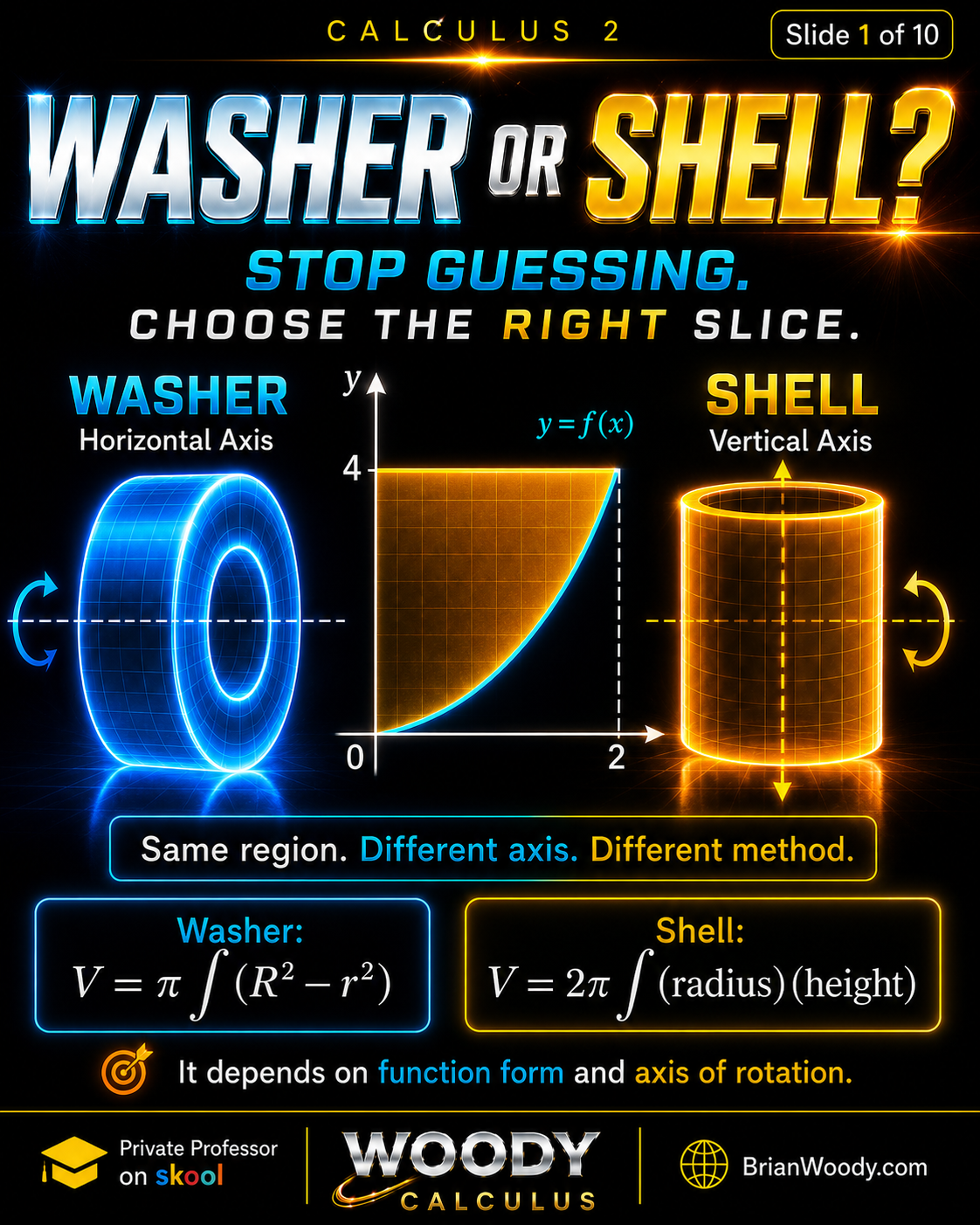
Washer method or shell method? This is one of the biggest decision points in Calculus 2 volumes of revolution.
A volume of revolution problem is not solved by guessing a formula. It is solved by understanding the region, the axis of rotation, and the slice.
Formula memorization is a strict requirement. Students must know the washer formula and the shell formula cold:
But memorizing the formulas is not enough. To apply them correctly, you must first choose the right slice.
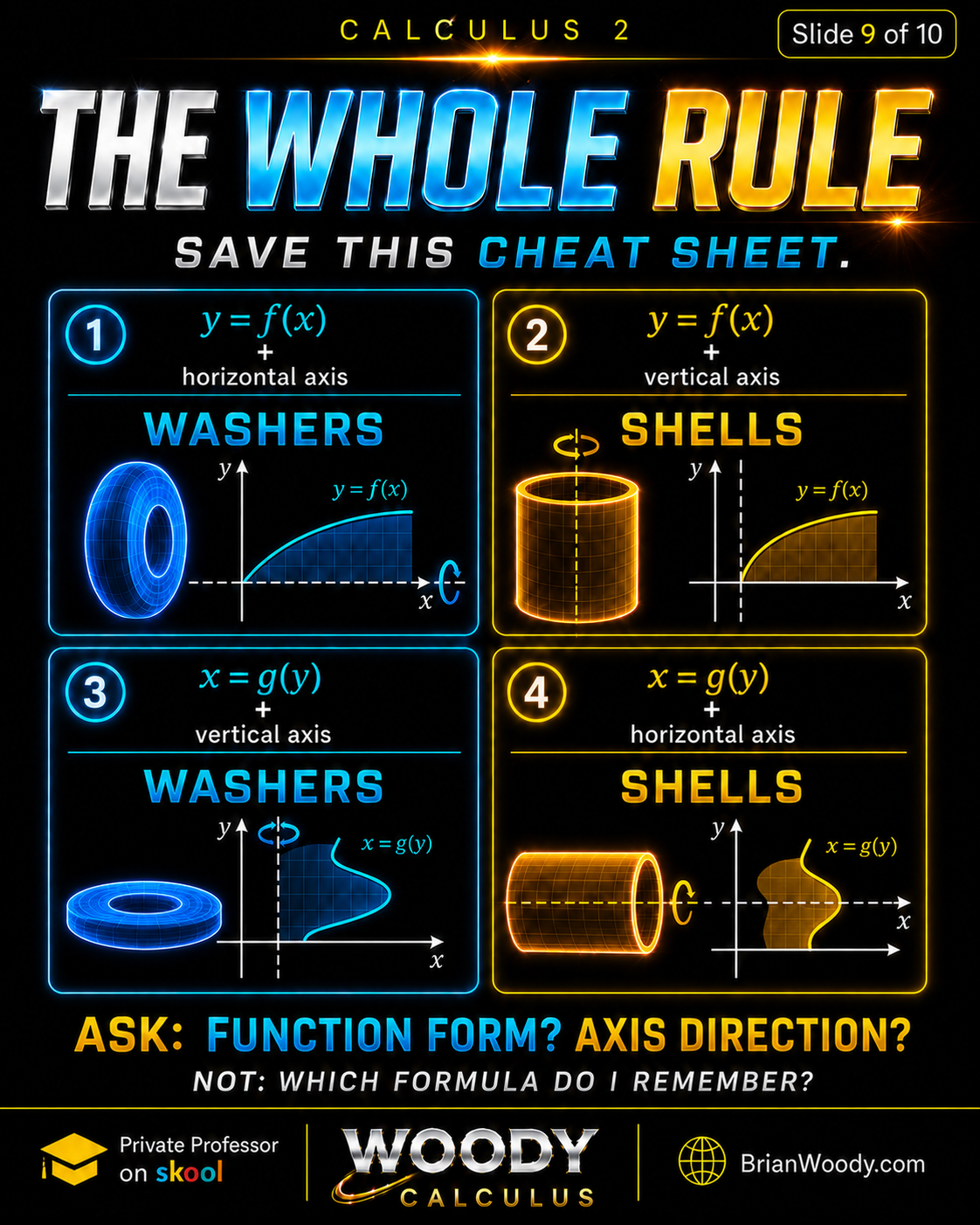
The method depends on the function form and the axis of rotation.
This Woody Calculus lesson teaches the full washer-or-shell decision rule for Calculus 2 students. You will learn when to use washers, when to use shells, how the axis of rotation changes the method, and why the same style of region can lead to different volume integrals depending on the slice.
Estimated read time: 16–20 minutes.
What Are Volumes of Revolution?
A volume of revolution is created when a two-dimensional region is rotated around an axis. The region sweeps out a three-dimensional solid.
In Calculus 2, the goal is to find the volume of that solid using an integral.
There are two major methods:
- Washer method: slices rotate into disks or washers.
- Shell method: slices rotate into cylindrical shells.
The key is not to ask, “Which formula do I remember first?” The key is to ask:
What slice does the region naturally want?
Once the slice is chosen, the method becomes much more obvious.
The Washer or Shell Decision Rule
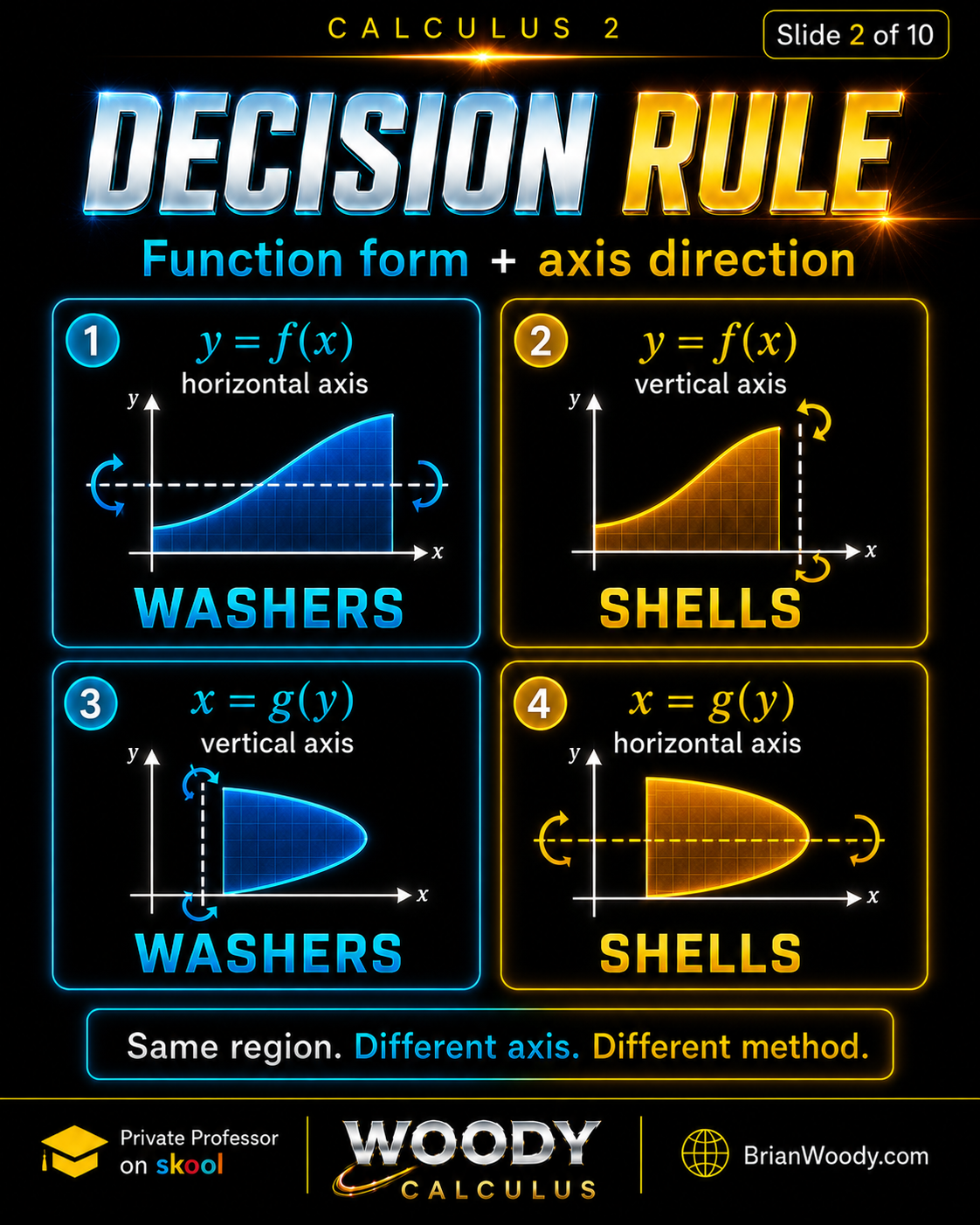
The cleanest decision rule uses two pieces of information:
- Function form: Is the region naturally written as \(y=f(x)\) or \(x=g(y)\)?
- Axis direction: Is the axis of rotation horizontal or vertical?
The universal geometric rule is:
When the region is naturally written as \(y=f(x)\), vertical \(dx\)-slices are usually easiest. When the region is naturally written as \(x=g(y)\), horizontal \(dy\)-slices are usually easiest.
| Function Form | Axis Direction | Natural Slice | Method |
|---|---|---|---|
| \(y=f(x)\) | Horizontal axis | Vertical \(dx\)-slice | Washers |
| \(y=f(x)\) | Vertical axis | Vertical \(dx\)-slice | Shells |
| \(x=g(y)\) | Vertical axis | Horizontal \(dy\)-slice | Washers |
| \(x=g(y)\) | Horizontal axis | Horizontal \(dy\)-slice | Shells |
This is the Woody Calculus decision rule:
Ask for function form and axis direction first. The formula comes second.
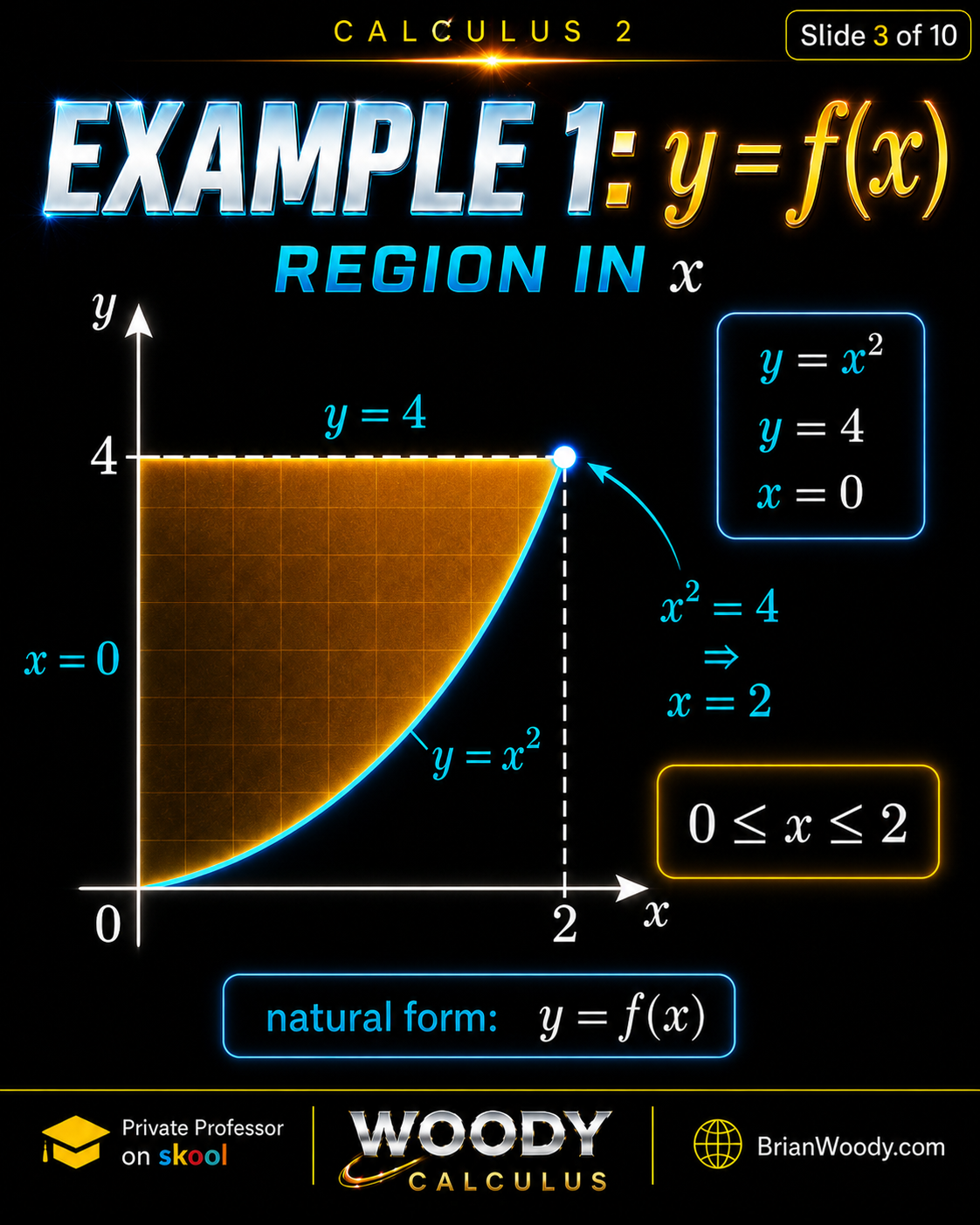
Example 1: Region Written as \(y=f(x)\)
Start with the first-quadrant region bounded by:
Since \(x^2=4\), the right endpoint is:
So the natural \(x\)-range is:
For each \(x\), the region runs vertically from:
That is why this is naturally a \(y=f(x)\) region. The natural slice is vertical, with thickness \(dx\).
Rotate Example 1 Around the x-axis: Washers
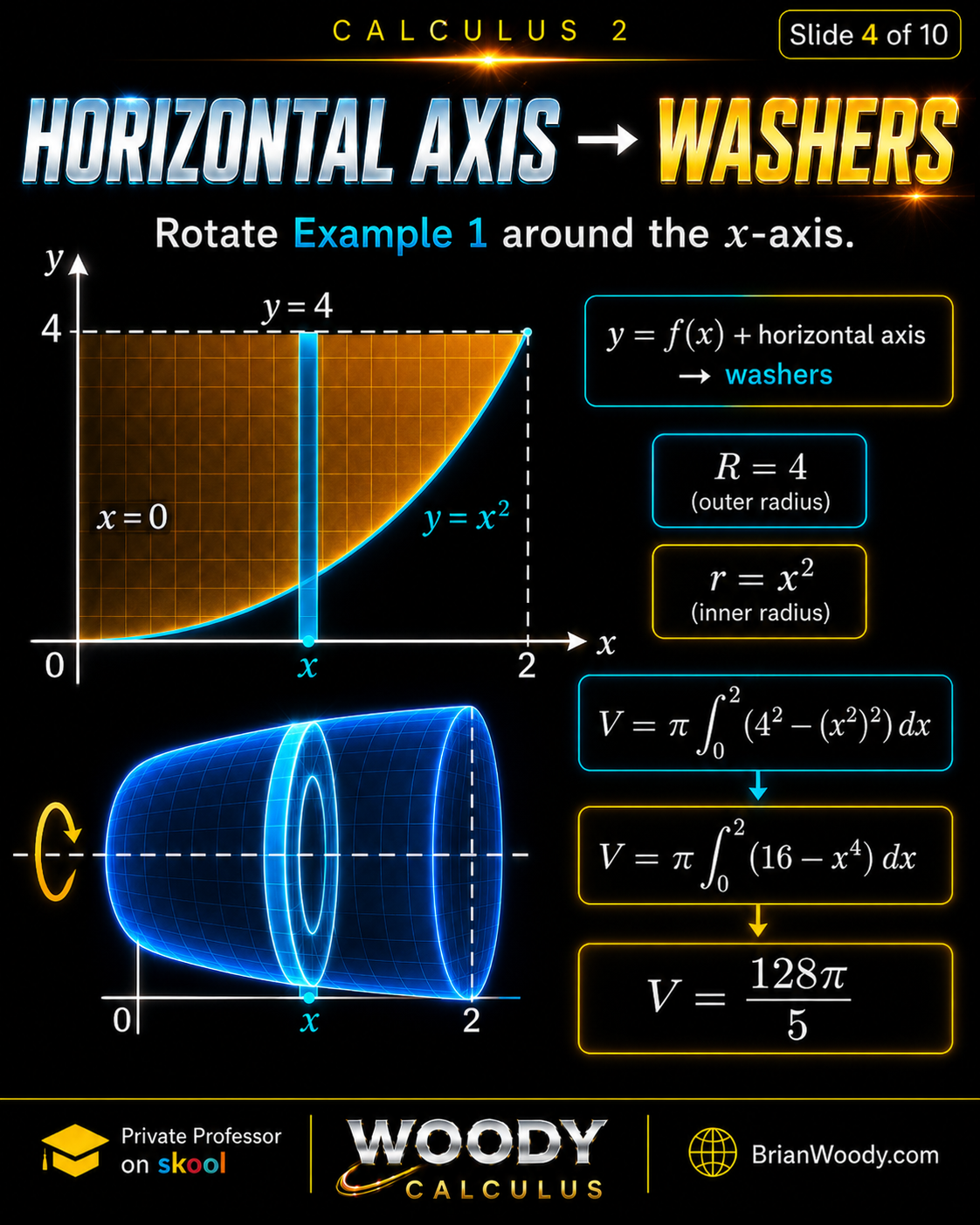
Now rotate the region around the \(x\)-axis.
The region is written as \(y=f(x)\), and the axis of rotation is horizontal. The natural vertical slice is perpendicular to the horizontal axis, so it creates washers.
The outer radius is the distance from the \(x\)-axis to \(y=4\):
The inner radius is the distance from the \(x\)-axis to \(y=x^2\):
The washer formula is:
Substitute \(R=4\) and \(r=x^2\):
Simplify:
Evaluate:
Final answer:
Plain-language answer: rotating this region around the \(x\)-axis produces a washer integral with volume \(128\pi/5\).
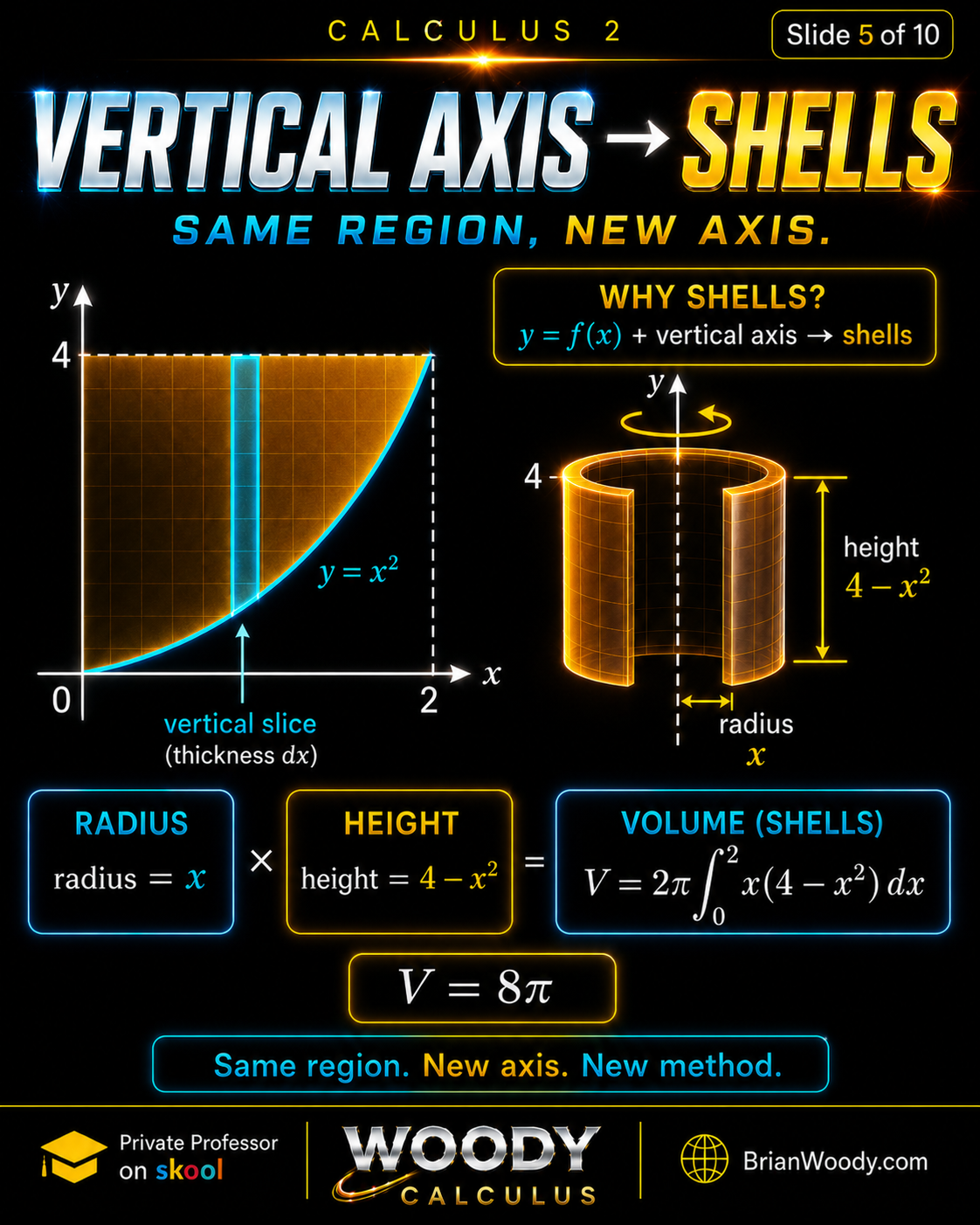
Rotate Example 1 Around the y-axis: Shells
Now rotate the same region around the \(y\)-axis.
The region is still naturally written as \(y=f(x)\), so the natural slice is still vertical. But the axis of rotation is now vertical. A vertical slice is parallel to a vertical axis, so it creates a cylindrical shell.
For a vertical shell:
- The radius is the distance from the \(y\)-axis to the slice: \(x\).
- The height is top minus bottom: \(4-x^2\).
- The thickness is \(dx\).
The shell formula is:
Substitute:
Evaluate:
Final answer:
Plain-language answer: rotating this region around the \(y\)-axis produces a shell integral with volume \(8\pi\).
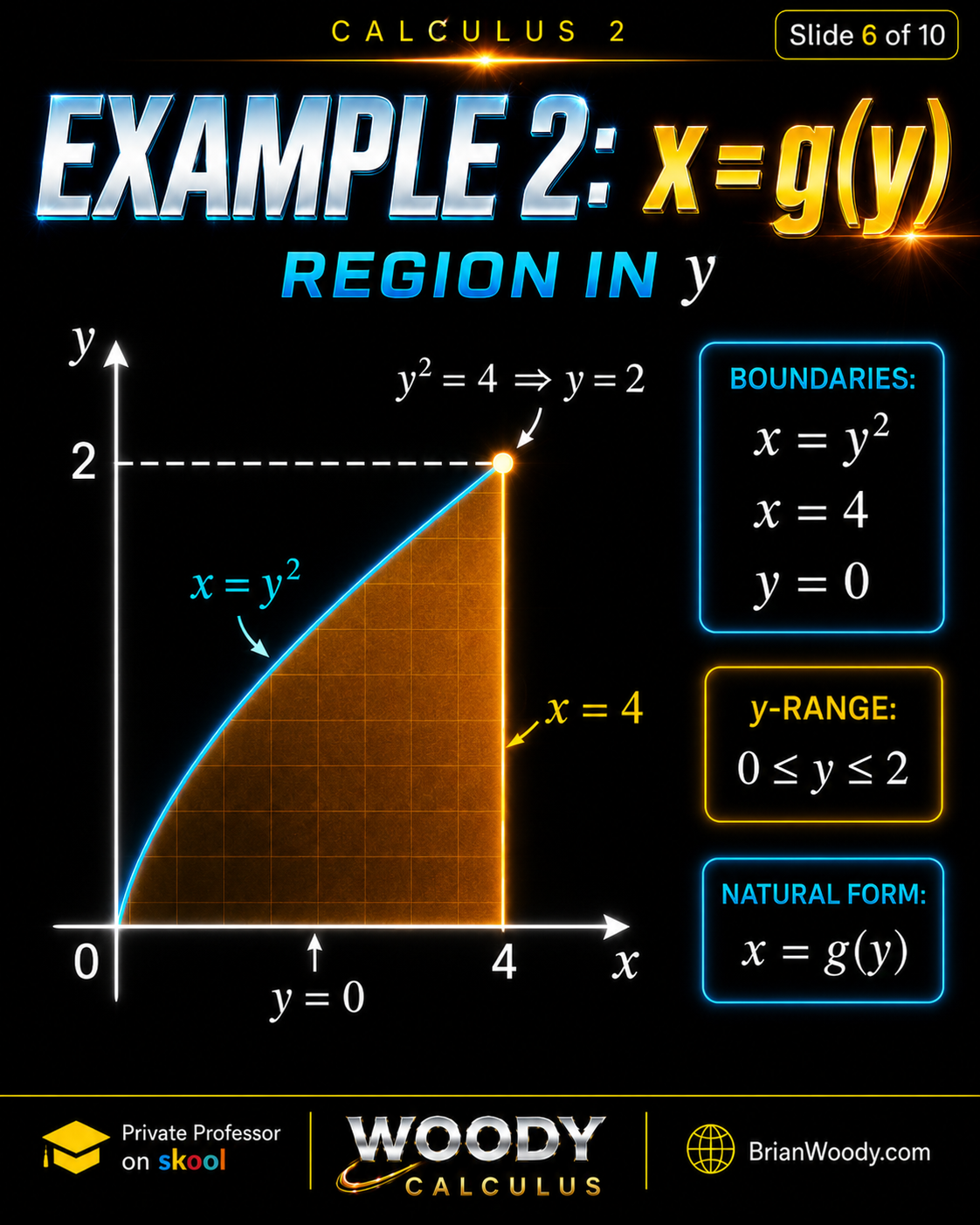
Example 2: Region Written as \(x=g(y)\)
Now switch to a region that is naturally written using \(y\).
Consider the region bounded by:
The top occurs when:
Since this region is above \(y=0\), we use:
So the \(y\)-range is:
For each \(y\), the region runs horizontally from:
That is why this is naturally an \(x=g(y)\) region. The natural slice is horizontal, with thickness \(dy\).
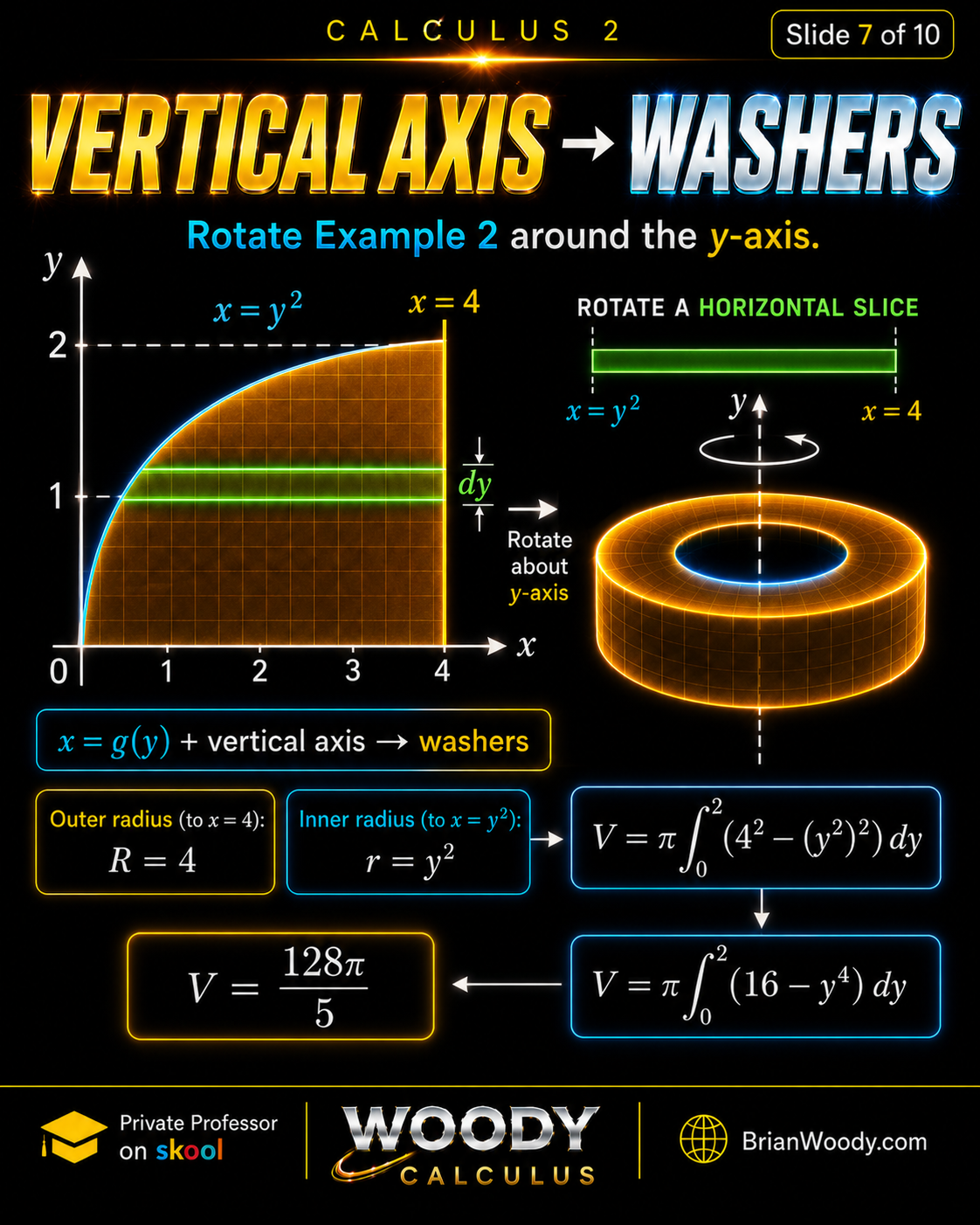
Rotate Example 2 Around the y-axis: Washers
Now rotate Example 2 around the \(y\)-axis.
The region is naturally written as \(x=g(y)\), so the natural slice is horizontal. The axis of rotation is vertical. A horizontal slice is perpendicular to a vertical axis, so it creates washers.
The outer radius is the distance from the \(y\)-axis to \(x=4\):
The inner radius is the distance from the \(y\)-axis to \(x=y^2\):
The washer formula is:
Substitute:
Simplify:
Evaluate:
Final answer:
Plain-language answer: rotating this \(x=g(y)\) region around the \(y\)-axis produces washers.
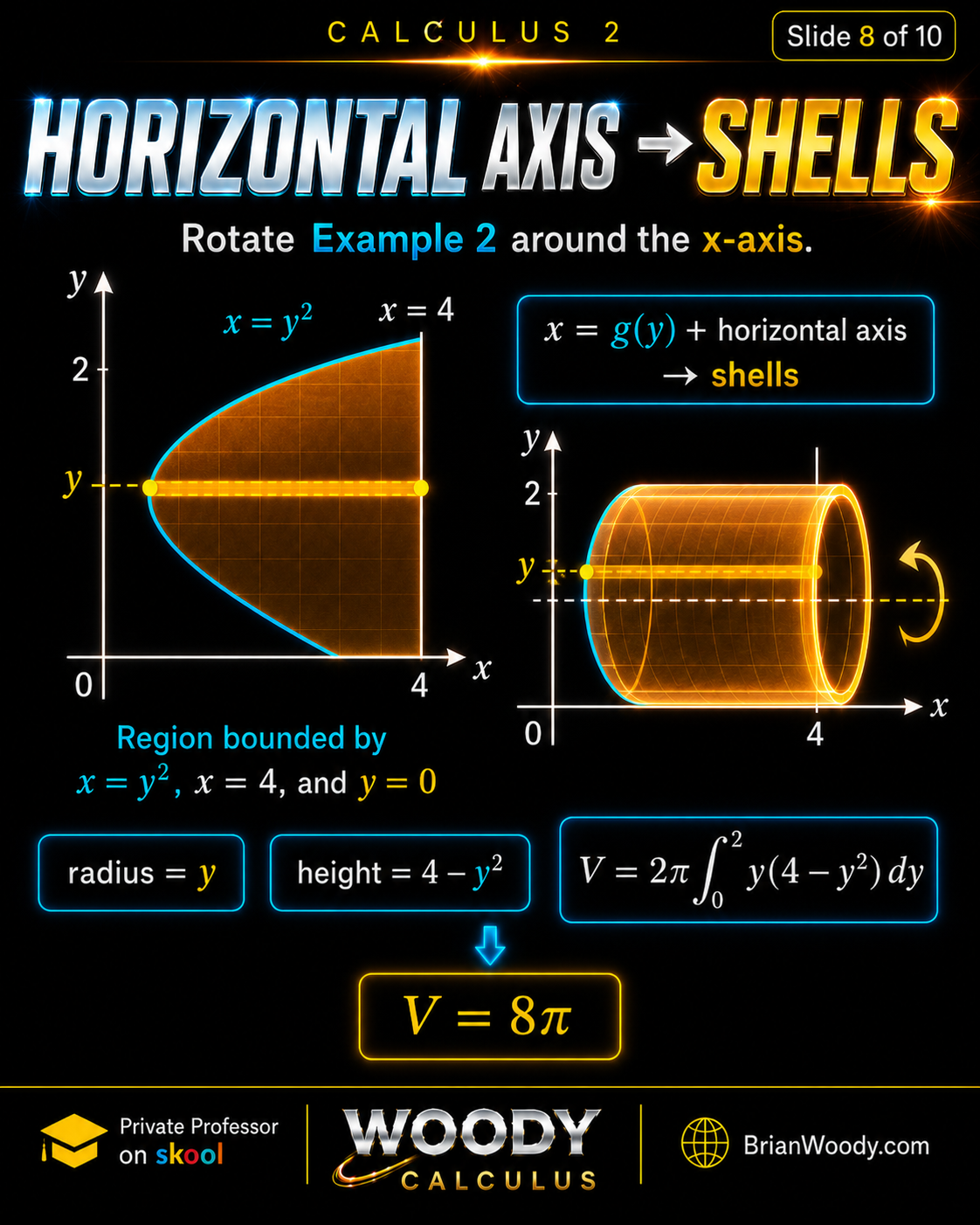
Rotate Example 2 Around the x-axis: Shells
Now rotate Example 2 around the \(x\)-axis.
The region is naturally written as \(x=g(y)\), so the natural slice is horizontal. The axis of rotation is also horizontal. A horizontal slice is parallel to a horizontal axis, so it creates a shell.
For a horizontal shell:
- The radius is the distance from the \(x\)-axis to the slice: \(y\).
- The height is right minus left: \(4-y^2\).
- The thickness is \(dy\).
The shell formula is:
Substitute:
Evaluate:
Final answer:
Plain-language answer: rotating this \(x=g(y)\) region around the \(x\)-axis produces shells.
The Whole Washer or Shell Rule
The whole decision rule is not “always use washers for the \(x\)-axis” or “always use shells for the \(y\)-axis.”
That is too shallow.
The real rule is:
Function form plus axis direction determines the natural slice. The slice determines washer or shell.
| Case | Function Form | Axis Direction | Natural Slice | Method |
|---|---|---|---|---|
| 1 | \(y=f(x)\) | Horizontal axis | Vertical \(dx\)-slice | Washers |
| 2 | \(y=f(x)\) | Vertical axis | Vertical \(dx\)-slice | Shells |
| 3 | \(x=g(y)\) | Vertical axis | Horizontal \(dy\)-slice | Washers |
| 4 | \(x=g(y)\) | Horizontal axis | Horizontal \(dy\)-slice | Shells |
Say it out loud:
Ask function form. Ask axis direction. Choose the slice. Then apply the formula.
Complete Worked Summary
Example 1 Region: \(y=x^2,\ y=4,\ x=0\)
Natural form:
Around the \(x\)-axis:
Plain-language formula: rotating the region bounded by \(y=x^2\), \(y=4\), and \(x=0\) around the \(x\)-axis gives \(V=128\pi/5\).
Around the \(y\)-axis:
Plain-language formula: rotating the same region around the \(y\)-axis gives \(V=8\pi\).
Example 2 Region: \(x=y^2,\ x=4,\ y=0\)
Natural form:
Around the \(y\)-axis:
Plain-language formula: rotating the region bounded by \(x=y^2\), \(x=4\), and \(y=0\) around the \(y\)-axis gives \(V=128\pi/5\).
Around the \(x\)-axis:
Plain-language formula: rotating the same region around the \(x\)-axis gives \(V=8\pi\).
Changing the axis can change whether the same slice produces a washer or a shell. In each pair above, the slice direction stays the same while its relationship to the axis changes.
Common Mistakes
Mistake 1: Choosing a formula before choosing a slice
Do not start with a formula. Start with the region, the function form, the axis of rotation, and the slice direction.
Mistake 2: Thinking the \(x\)-axis always means washers
A horizontal axis gives washers when the natural slice is vertical. But if the region is naturally written as \(x=g(y)\), horizontal slices around a horizontal axis create shells.
Mistake 3: Thinking the \(y\)-axis always means shells
A vertical axis gives shells when the natural slice is vertical. But if the region is naturally written as \(x=g(y)\), horizontal slices around a vertical axis create washers.
Mistake 4: Forgetting inner radius
If the rotated slice creates a hole, the washer formula needs both \(R\) and \(r\):
Mistake 5: Mixing up shell radius and shell height
For shells:
The radius is the distance from the slice to the axis of rotation. The height is the length of the slice inside the region.
Connect the video to the written setup
Measure every radius from the axis
Rotate Example 1 around \(y=-1\) instead of the x-axis. The region stays the same, so the vertical-slice bounds remain \(0\le x\le2\). Both distances grow by one:
The complete washer setup is:
The video explains these changed radii. The integral above makes that setup explicit. When the axis lies above or to the right of a region, reverse the subtraction as needed so each radius remains a nonnegative distance.
Washer or Shell Checklist
The Woody Calculus Washer or Shell Method
The Woody Calculus method is to memorize the formulas, then make the volume decision before doing algebra.
- Draw the region.
- Identify the function form: \(y=f(x)\) or \(x=g(y)\).
- Identify the axis of rotation: horizontal or vertical.
- Choose the natural slice: vertical \(dx\) or horizontal \(dy\).
- Ask whether the slice is perpendicular or parallel to the axis.
- Use washers for perpendicular slices.
- Use shells for parallel slices.
- Write the radius, height, outer radius, or inner radius carefully.
- Build the integral before simplifying.
Reading the solution is not enough. A serious Calculus 2 student should be able to rewrite the perfect solution from start to finish while saying each step out loud: function form, axis direction, slice direction, washer or shell, radius or height, bounds, integral, and final answer.
The goal is not just to recognize the formula. The goal is to make the decision process automatic.
Practice the decision
Three more setups to try
These exercises extend the written lesson. Try each setup before opening its solution; they are not additional worked examples in the video. Use the same region as Example 2, written either as \(y=\sqrt{x}\) or \(x=y^2\).
1. A disk around the x-axis
Rotate the region bounded by \(y=\sqrt{x}\), \(y=0\), and \(x=4\) around the \(x\)-axis. Use a vertical rectangle.
Show the disk setup and check
The vertical rectangle is perpendicular to the horizontal axis, so use washers with \(dx\). Here the inner radius is zero: the washer is a disk. The bounds are \(0\le x\le4\), with \(R=\sqrt{x}-0\) and \(r=0\).
This is the same solid produced by the horizontal shells in Example 2 around the x-axis. Two valid methods give the same volume.
2. Shells around a vertical line
Rotate that same region around \(x=4\). Use a vertical rectangle and measure the radius from the axis.
Show the shifted-axis shell setup
The rectangle is parallel to the axis, so use shells. For \(0\le x\le4\), the axis lies to the right: \(r=4-x\), while \(h=\sqrt{x}-0\).
The radius is nonnegative throughout the interval. Measuring from the axis prevents a sign error.
3. Horizontal shells below the region
Write the region as \(x=y^2\), \(x=4\), \(y=0\), and rotate it around \(y=-1\). Use a horizontal rectangle.
Show the horizontal shell setup
The horizontal rectangle is parallel to the horizontal axis. Use \(dy\), with \(0\le y\le2\). The radius is \(r=y-(-1)=y+1\), and the height is the horizontal length \(h=4-y^2\).
Say the setup aloud: bounds, radius from the axis, height of the rectangle, then the integral.
Perfect practice makes perfect. Rewrite a correct setup 3–5 times while explaining each step confidently aloud. Then change the axis or try a new region to check that you can choose the method yourself.
Washer and Shell Method FAQ
How do I choose washer or shell method?
Choose the method by identifying the function form and the axis of rotation. Washers come from slices perpendicular to the axis. Shells come from slices parallel to the axis.
What is the washer method formula?
The washer method formula is \(V=\pi\int(R^2-r^2)\,d(\text{slice variable})\), where \(R\) is the outer radius and \(r\) is the inner radius.
What is the shell method formula?
The shell method formula is \(V=2\pi\int(\text{radius})(\text{height})\,d(\text{slice variable})\), where the radius is the distance from the slice to the axis of rotation.
When does \(y=f(x)\) use washers?
If the region is naturally written as \(y=f(x)\) and rotated around a horizontal axis, vertical \(dx\)-slices are perpendicular to the axis, so the natural method is washers.
When does \(y=f(x)\) use shells?
If the region is naturally written as \(y=f(x)\) and rotated around a vertical axis, vertical \(dx\)-slices are parallel to the axis, so the natural method is shells.
When does \(x=g(y)\) use washers?
If the region is naturally written as \(x=g(y)\) and rotated around a vertical axis, horizontal \(dy\)-slices are perpendicular to the axis, so the natural method is washers.
When does \(x=g(y)\) use shells?
If the region is naturally written as \(x=g(y)\) and rotated around a horizontal axis, horizontal \(dy\)-slices are parallel to the axis, so the natural method is shells.
Can the same volume problem be solved by both washers and shells?
Yes. Many volume problems can be solved with either method if you rewrite the region correctly. The best method is usually the one that matches the natural function form and avoids unnecessary algebra or piecewise setup.
Master Volumes of Revolution with Woody Calculus
Volumes of revolution are not about guessing formulas. They are about visual structure.
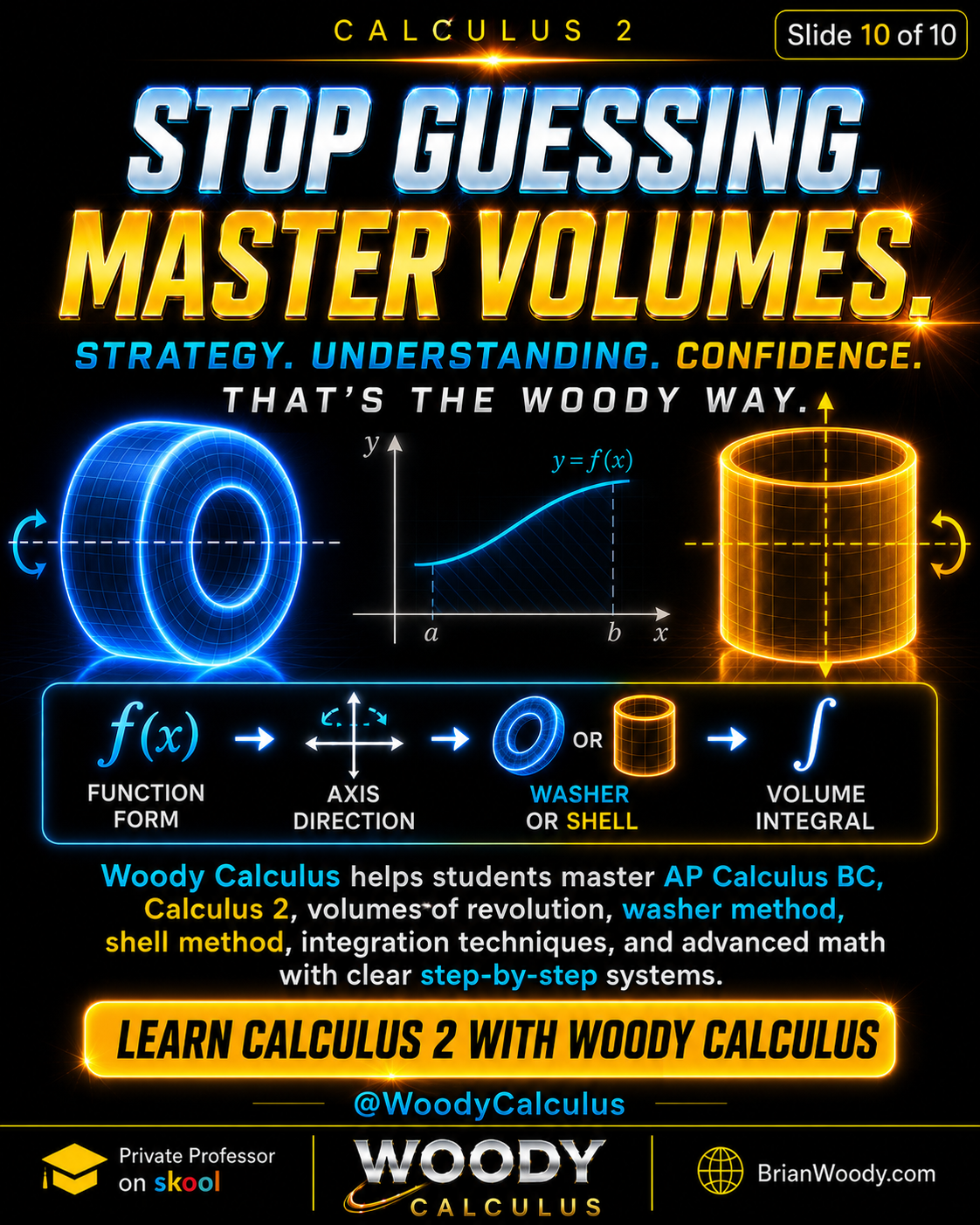
The core chain is:
If you follow that chain, the formulas stop feeling random.
Keep learning with Woody
Make the next volume problem feel familiar
If you understand a worked example but hesitate when the axis changes, keep practicing the decision process with Woody inside the Woody Calculus & Advanced Mathematics Mastery Lab.
Build on this lesson with structured mathematics lessons, written solutions, homework and exam walkthroughs, and direct teaching support. Practice recognizing the pattern, setting up the problem, and explaining each step.
Explore how the Mastery Lab works →
Learn the patterns. Learn the game. Solve with confidence.
Related Woody Calculus Mathematical Essays
Explore more Woody Calculus lessons connecting Calculus 2, volumes of revolution, washer method, shell method, applications of integration, hydrostatic force, improper integrals, parametric equations, infinite series, and advanced mathematics.
- How to Learn Calculus and Advanced Mathematics: A Peak Performance Study Guide
- Hydrostatic Force Explained: Calculus 2 Pressure, Depth, and the Slice Method
- Trig Substitution Explained: The Woody Calculus 3-Type System
- Improper Integrals Explained: Calculus 2 Limit Problems
- Parametric Equations Explained: Motion, Direction, and Tangent Lines
- Taylor Series Explained: Mathematical Time Travel in Calculus 2
- Radius of Convergence and Interval of Convergence Explained
- Gabriel’s Horn Explained: Finite Volume and Infinite Surface Area
- Laplace Transforms Explained: Differential Equations Become Algebra
- View All Woody Calculus Blog Posts
Private Instruction
Brian M. Woody works privately with a limited number of serious students who need one-on-one help in AP Calculus BC, Calculus II, Calculus III, Differential Equations, and advanced mathematics.
Private instruction is reserved for serious students, requires weekly sessions, requires enrollment in the Woody Calculus Mastery Lab first, and approval is not guaranteed.
Students interested in private instruction can learn more here: Private Math Tutor and Advanced Mathematics Instruction.
Related University Math Help Pages
Woody Calculus supports students at major universities with structured help in Calculus 2, Calculus 3, Differential Equations, Linear Algebra, and advanced mathematics. For the full list of supported schools, visit the University Calculus Tutor Hub.
- University Calculus Tutor Hub
- AP Calculus BC Support
- Pass Calculus 2 at Purdue
- University of Florida Calculus 2 and AP Calculus Help
- Colorado State University Calculus Help
- UCF Volumes of Revolution and Calculus 2 Prep
- University of Nevada, Reno Math Support
- Auburn Volumes of Revolution Prep
- University of Alabama Calculus Help
- University of Wisconsin Calculus Tutor
- University of Michigan Calculus Help
- UCLA Calculus 2 Support
- MIT Calculus Tutor
Trusted by Students Nationwide
The Woody Calculus Mastery Lab gives university students access to structured mathematics support, written solutions, video lessons, exam-focused training, and expert guidance from Brian M. Woody.
Students use Woody Calculus for Calculus II, Calculus III, Differential Equations, Linear Algebra, Abstract Algebra, and other advanced mathematics courses.