Fourier Series Explained: Harmonics, Heat Equations, Sound Waves & Quantum Mechanics
A complex waveform is not noise. It is structure.
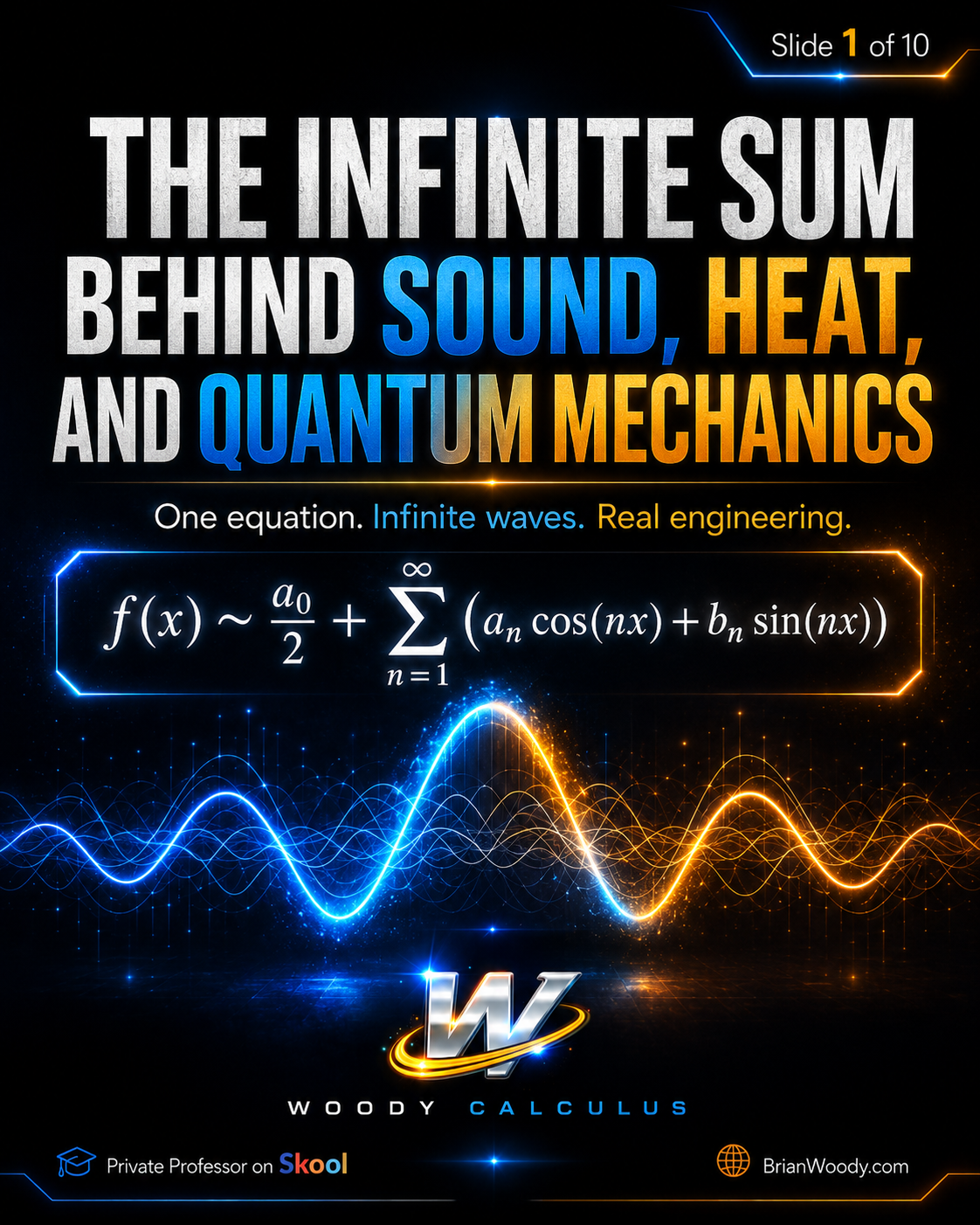
That is the power of the Fourier series. A signal that looks messy, sharp, jagged, or complicated can often be rebuilt from simple waves. The vibration of a string, the tone of a musical instrument, the temperature in a heated rod, the frequency content of an electrical signal, and the wave states of quantum mechanics all share one hidden idea:
Break the complicated object into simple modes. Understand each mode separately. Rebuild the full solution.
This is one of the most important ideas in advanced mathematics. It begins with infinite series, becomes essential in Differential Equations, and later becomes the language of PDEs, engineering mathematics, signal processing, heat flow, vibrations, and quantum mechanics.
Students who want the full Differential Equations picture should also study resonance and forced oscillations, Laplace transforms, and eigenvalues and eigenvectors. Fourier series, resonance, Laplace transforms, and linear systems are all part of the same larger structure: decompose the problem, understand each mode, then rebuild the solution.
Key Takeaways
- A Fourier series represents a periodic function as a sum of sine and cosine waves.
- The sine and cosine terms are called harmonics.
- Higher harmonics oscillate faster and capture finer details of the signal.
- Fourier coefficients measure how much of each harmonic is present.
- Orthogonality allows Fourier coefficients to isolate one frequency at a time.
- Fourier partial sums approximate functions better as more terms are added.
- The Gibbs phenomenon creates a persistent overshoot near jump discontinuities.
- The same mathematics appears in sound waves, heat equations, PDEs, vibrations, circuits, signal processing, resonance, forced oscillations, and quantum mechanics.
What Is a Fourier Series?
A Fourier series is an infinite sum that represents a periodic function using sine and cosine waves.
The core idea is not merely that sine and cosine waves are useful. The deeper idea is that sine and cosine waves behave like a coordinate system for periodic functions. Just as a vector in ordinary space can be broken into components along coordinate axes, a periodic function can be broken into components along harmonic directions.
That is why Fourier series appear in so many places. They give us coordinates for waves.
The Core Idea
A Fourier series turns a complicated periodic function into a weighted sum of simple waves. The waves are the building blocks. The coefficients are the recipe. Orthogonality is what lets the recipe be measured precisely.
Fourier Series Formula
For a \(2\pi\)-periodic function, the standard real Fourier series formula is:
f(x)\sim \frac{a_0}{2}+\sum_{n=1}^{\infty}\left(a_n\cos(nx)+b_n\sin(nx)\right).
\]
The term \(a_0/2\) captures the average or constant part of the function. The \(a_n\cos(nx)\) terms measure cosine content. The \(b_n\sin(nx)\) terms measure sine content.
The index \(n\) counts the harmonics. When \(n=1\), we have the fundamental frequency. When \(n=2,3,4,\ldots\), we have higher harmonics, which oscillate faster and capture finer structure.
For functions with period \(2L\), the formula is commonly written as:
f(x)\sim \frac{a_0}{2}+\sum_{n=1}^{\infty}\left(a_n\cos\left(\frac{n\pi x}{L}\right)+b_n\sin\left(\frac{n\pi x}{L}\right)\right).
\]
This version is especially common in boundary value problems and partial differential equations, such as heat flow on a finite rod.
Fourier Series Convergence and Dirichlet Conditions
The symbol \( \sim \) is often used instead of \( = \) because Fourier series convergence must be interpreted carefully.
A standard convergence theorem says that if a periodic function satisfies the Dirichlet conditions — roughly, if it is piecewise smooth, has only finitely many jump discontinuities, and has only finitely many local extrema over a period — then its Fourier series converges to the function at points of continuity and to the midpoint of the jump at discontinuities.
If \(f\) has a jump at \(x=c\), then the Fourier series converges to:
\frac{f(c^-)+f(c^+)}{2}.
\]
This detail matters. Fourier series are powerful, but they are not magic. They come with convergence rules, and those rules are part of the mathematics students need to understand.
Fourier Series vs. Fourier Transform
A Fourier series is used for periodic functions. It decomposes a repeating signal into a discrete collection of harmonics: \(n=1,2,3,\ldots\). That is why Fourier series produce sums.
A Fourier transform is used more broadly for non-periodic functions on an infinite interval. Instead of decomposing into a discrete set of harmonics, it decomposes into a continuous spectrum of frequencies. That is why Fourier transforms produce integrals over frequency.
Quick Distinction
Fourier series: periodic signal, discrete frequencies, infinite sum.
Fourier transform: non-periodic or infinite-domain signal, continuous frequencies, integral transform.
Periodic Signals and Simple Harmonics
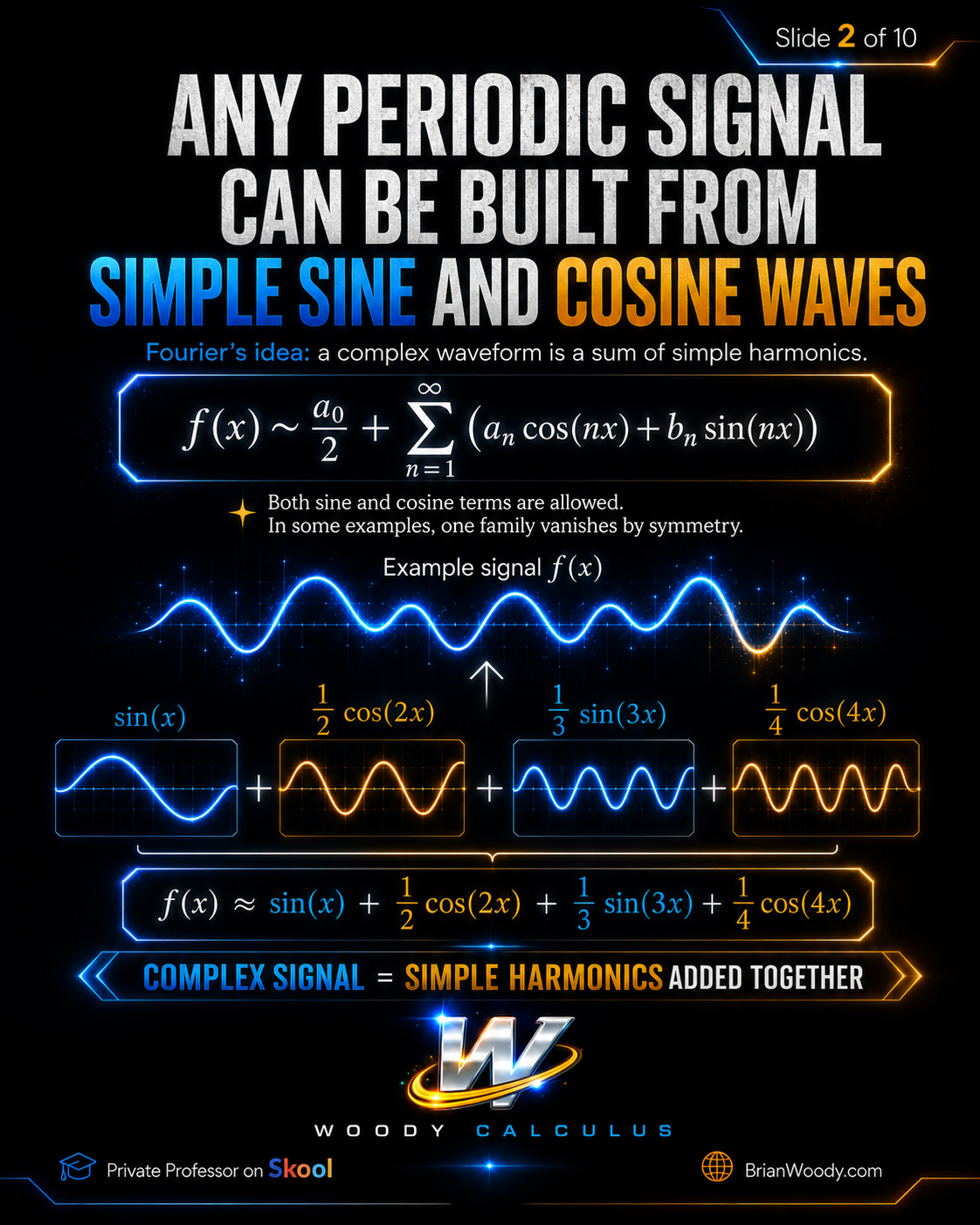
Fourier’s idea was revolutionary: a complex waveform can be decomposed into simple harmonics.
This matters because periodic signals appear everywhere. Sound waves repeat. Alternating current repeats. Vibrating systems repeat. Heat distributions on fixed intervals can be expanded into spatial modes. Quantum states can be expanded into eigenfunctions. Fourier series gives a language for all of it.
Sine Waves, Cosine Waves, and Harmonics
The first harmonic is called the fundamental. It carries the lowest basic frequency.
For a \(2\pi\)-periodic sine series, the fundamental sine harmonic is:
\sin(x).
\]
The higher harmonics are:
\sin(2x),\quad \sin(3x),\quad \sin(4x),\quad \ldots
\]
The same is true for cosine terms:
\cos(x),\quad \cos(2x),\quad \cos(3x),\quad \cos(4x),\quad \ldots
\]
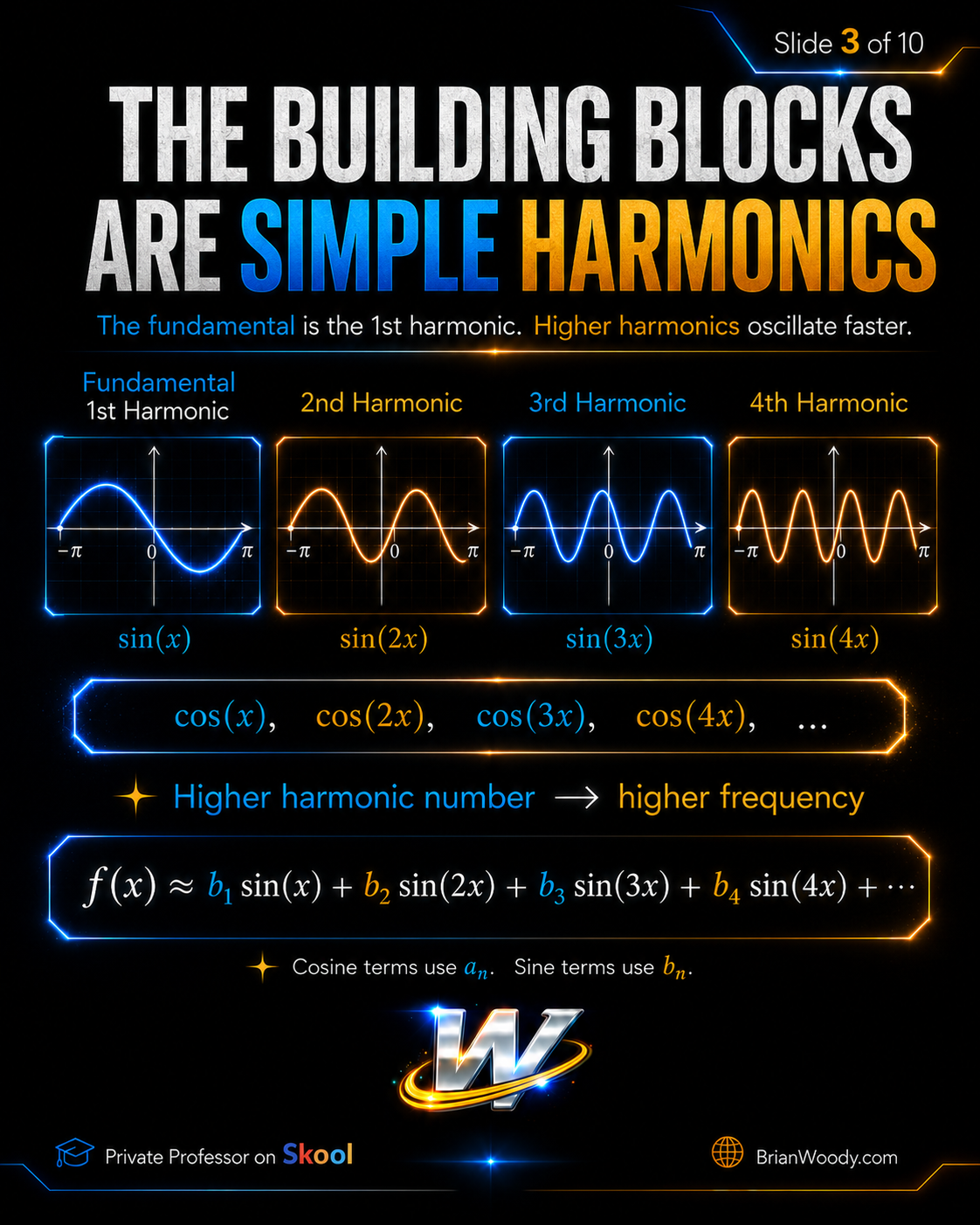
The higher the harmonic number, the higher the frequency. These high-frequency terms capture finer details, sharper transitions, and faster oscillations.
Symmetry Shortcut
A full Fourier series usually contains both sine and cosine terms. But symmetry can remove entire families. Odd functions produce sine series. Even functions produce cosine series. This is why many exam problems become much easier once you recognize symmetry.
Square Waves and Odd Harmonics
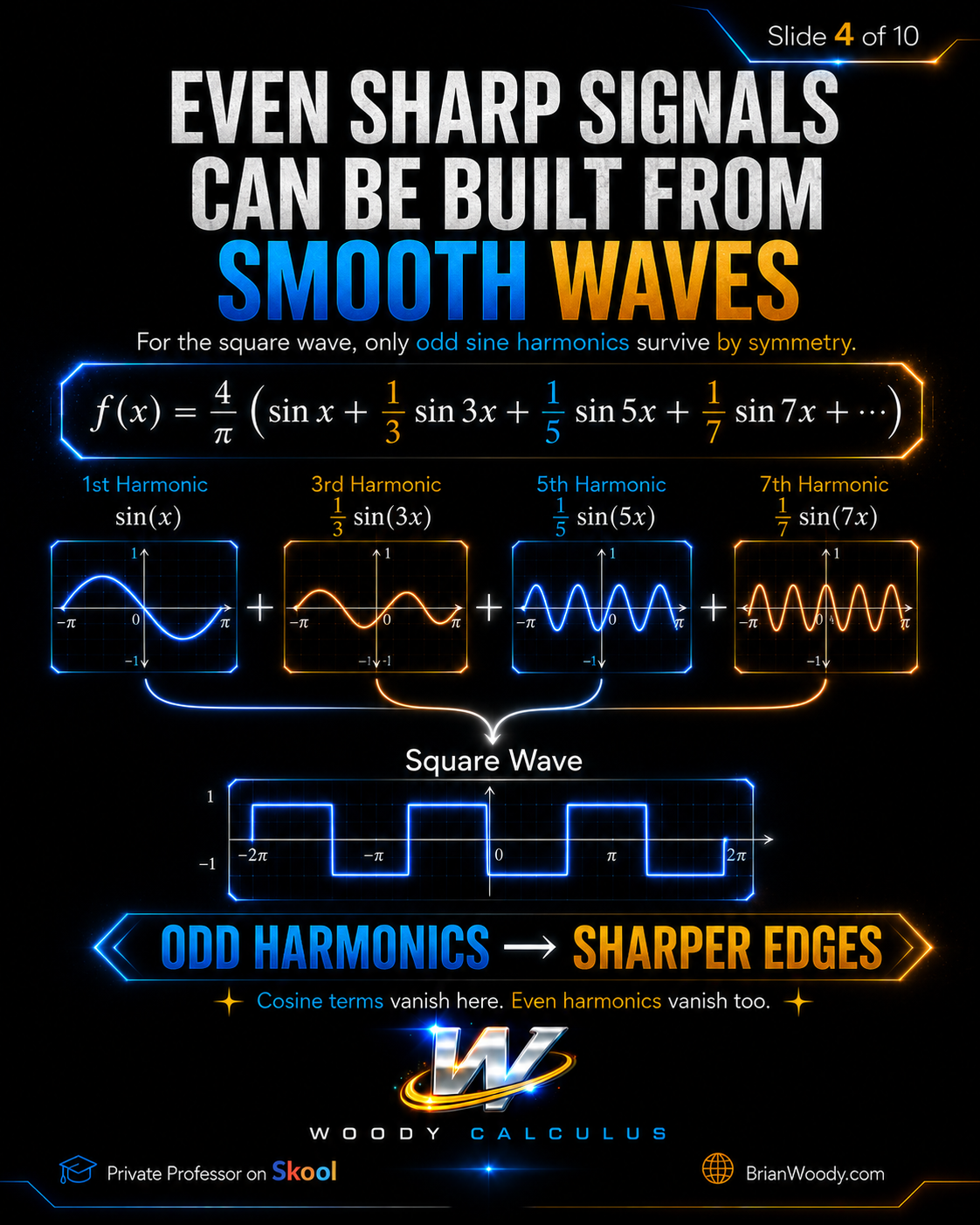
One of the most famous Fourier series examples is the square wave.
A square wave looks sharp, discontinuous, and almost impossible to build from smooth curves. But Fourier series shows something surprising: sharp signals can be approximated by smooth sine waves.
For a standard odd square wave, the Fourier series is:
f(x)=\frac{4}{\pi}\left(\sin x+\frac{1}{3}\sin 3x+\frac{1}{5}\sin 5x+\frac{1}{7}\sin 7x+\cdots\right).
\]
Partial Sums and the Gibbs Phenomenon
Since a Fourier series is infinite, we often approximate it with partial sums. A partial sum takes only finitely many terms from the series.
For the square wave, the first few odd partial sums are:
S_1(x)=\frac{4}{\pi}\sin x,
\]
S_3(x)=\frac{4}{\pi}\left(\sin x+\frac{1}{3}\sin 3x\right),
\]
S_5(x)=\frac{4}{\pi}\left(\sin x+\frac{1}{3}\sin 3x+\frac{1}{5}\sin 5x\right).
\]
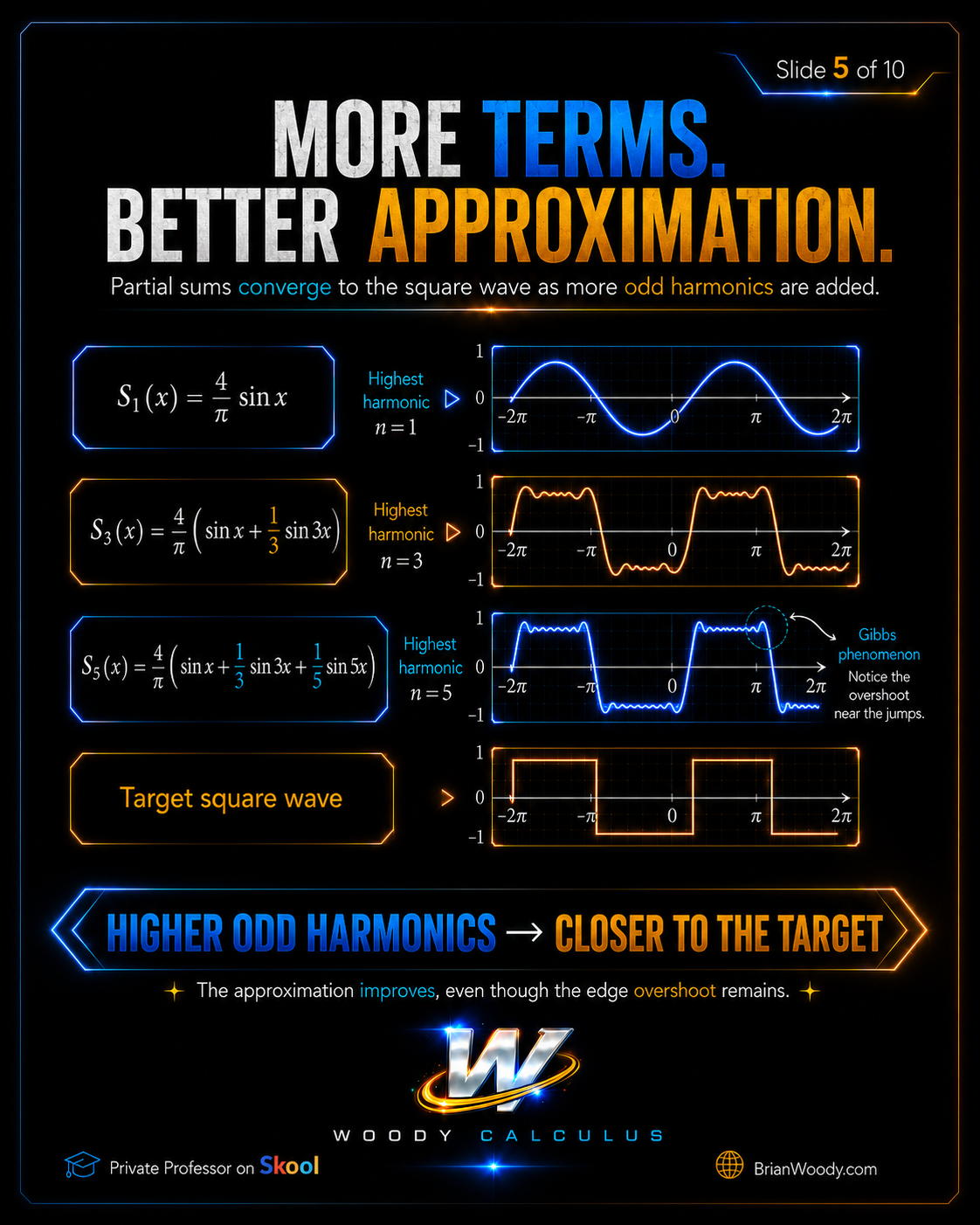
The overshoot near the jump is called the Gibbs phenomenon. Adding more terms improves the approximation overall, but a persistent overshoot remains near discontinuities. For the classic Fourier approximation to a jump discontinuity, the overshoot approaches about \(8.9\%\) of the jump height.
Why This Matters
The Gibbs phenomenon is not a graphing error. It is a real feature of Fourier approximation near jump discontinuities. This is one reason Fourier series are mathematically subtle and practically important.
How to Find Fourier Coefficients
The Fourier coefficients are the hidden recipe. They tell us how much of each harmonic is present in the signal.
For a \(2\pi\)-periodic function, the coefficient formulas are:
a_0=\frac{1}{\pi}\int_{-\pi}^{\pi}f(x)\,dx,
\]
a_n=\frac{1}{\pi}\int_{-\pi}^{\pi}f(x)\cos(nx)\,dx,
\]
and
b_n=\frac{1}{\pi}\int_{-\pi}^{\pi}f(x)\sin(nx)\,dx.
\]
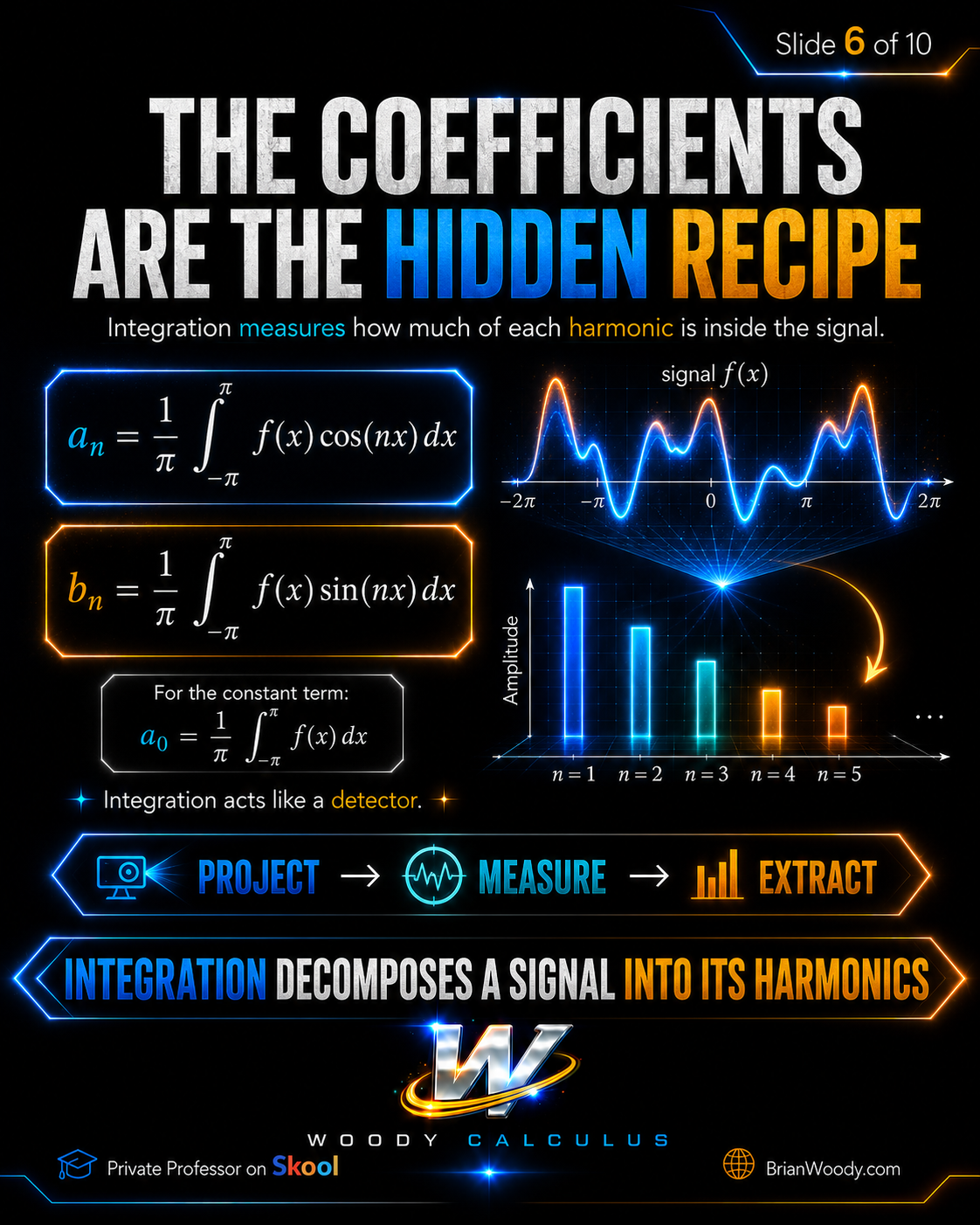
Integration acts like a detector. When we multiply the signal by a harmonic and integrate over a full period, we measure how much of that harmonic is inside the signal.
This connects Fourier series directly to Linear Algebra: basis vectors, projections, orthogonality, and coordinates. The difference is that now the “vectors” are functions.
Orthogonality: Why Fourier Series Work
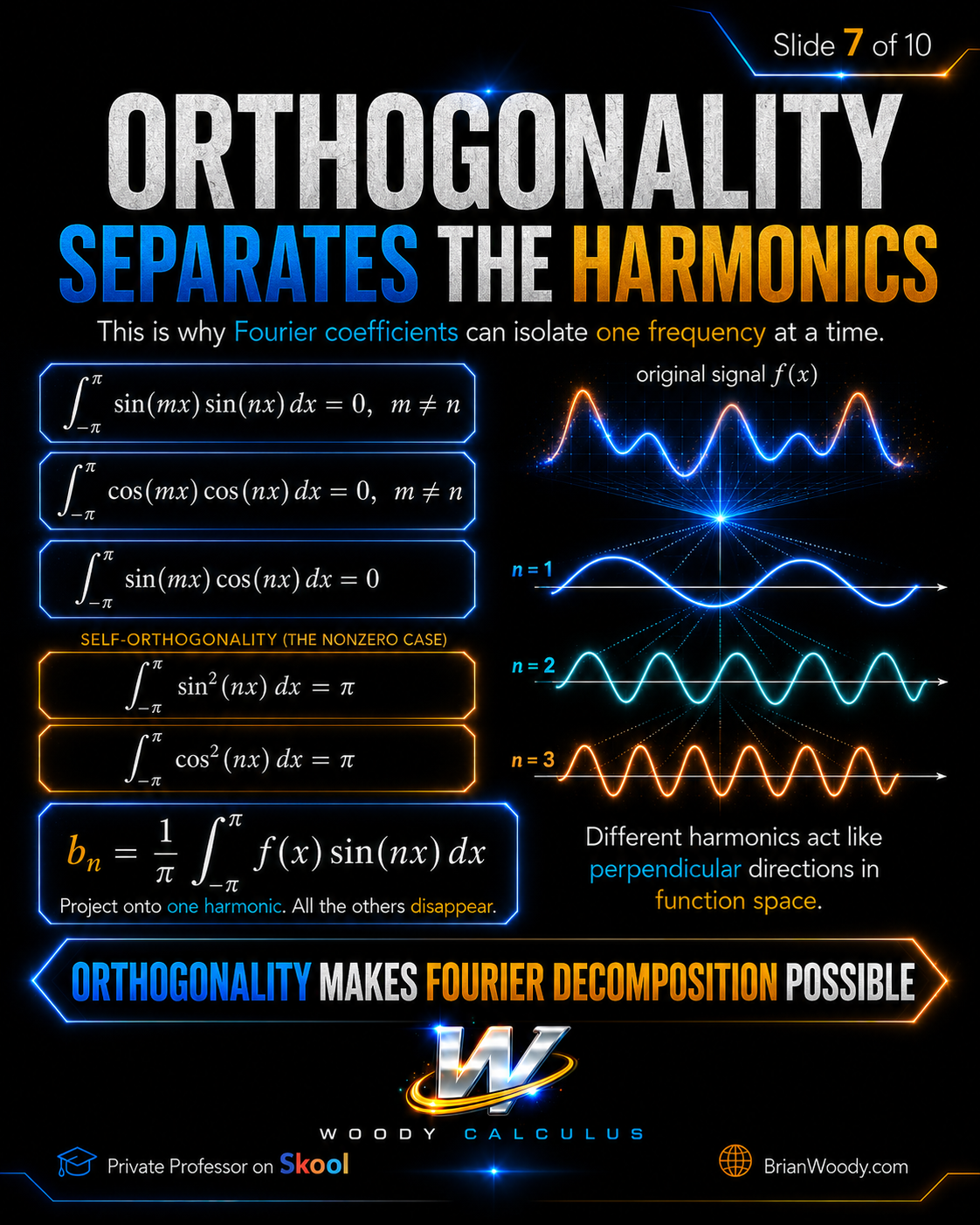
The reason Fourier coefficients work is orthogonality.
For integers \(m\neq n\), we have:
\int_{-\pi}^{\pi}\sin(mx)\sin(nx)\,dx=0,
\]
\int_{-\pi}^{\pi}\cos(mx)\cos(nx)\,dx=0,
\]
and
\int_{-\pi}^{\pi}\sin(mx)\cos(nx)\,dx=0.
\]
The self-orthogonality cases are:
\int_{-\pi}^{\pi}\sin^2(nx)\,dx=\pi,
\]
\int_{-\pi}^{\pi}\cos^2(nx)\,dx=\pi.
\]
The Function Space View
Fourier series treat functions like vectors. The harmonics are the directions. The Fourier coefficients are the coordinates. Orthogonality is what lets each coordinate be measured independently.
Worked Example 1: Orthogonality and Fourier Coefficients
Example Problem
Find the Fourier coefficients for:
f(x)=\sin(3x)
\]
on the interval \( -\pi\leq x\leq \pi \).
Solution
The sine coefficients are:
b_n=\frac{1}{\pi}\int_{-\pi}^{\pi}\sin(3x)\sin(nx)\,dx.
\]
By orthogonality, this integral is \(0\) when \(n\neq 3\). When \(n=3\),
\int_{-\pi}^{\pi}\sin^2(3x)\,dx=\pi.
\]
Therefore,
b_3=1,
\]
and all other \(b_n\) values are zero. Since \(\sin(3x)\) is odd, all cosine coefficients vanish:
a_0=0,\qquad a_n=0.
\]
Final Answer
\boxed{b_3=1}
\]
All other Fourier coefficients are zero.
Worked Example 2: Fourier Series for \(f(x)=x\)
Example Problem
Find the Fourier series for:
f(x)=x,\qquad -\pi<x<\pi.
\]
Step 1: Use Symmetry
The function \(f(x)=x\) is odd. Therefore, its Fourier series contains only sine terms.
a_0=0,\qquad a_n=0.
\]
Step 2: Compute \(b_n\)
b_n=\frac{1}{\pi}\int_{-\pi}^{\pi}x\sin(nx)\,dx.
\]
Since \(x\sin(nx)\) is even,
b_n=\frac{2}{\pi}\int_0^\pi x\sin(nx)\,dx.
\]
Step 3: Integrate by Parts
Let
u=x,\qquad dv=\sin(nx)\,dx.
\]
Then
du=dx,\qquad v=-\frac{\cos(nx)}{n}.
\]
So
\int_0^\pi x\sin(nx)\,dx
=
\left[-\frac{x\cos(nx)}{n}\right]_0^\pi
+
\frac{1}{n}\int_0^\pi \cos(nx)\,dx.
\]
The remaining integral is zero, so
\int_0^\pi x\sin(nx)\,dx
=
-\frac{\pi\cos(n\pi)}{n}
=
\frac{\pi(-1)^{n+1}}{n}.
\]
Therefore,
b_n=\frac{2(-1)^{n+1}}{n}.
\]
Final Fourier Series
\boxed{
x\sim 2\left(\sin x-\frac{1}{2}\sin(2x)+\frac{1}{3}\sin(3x)-\frac{1}{4}\sin(4x)+\cdots\right)
}
\]
Frequency Domain Thinking in Engineering
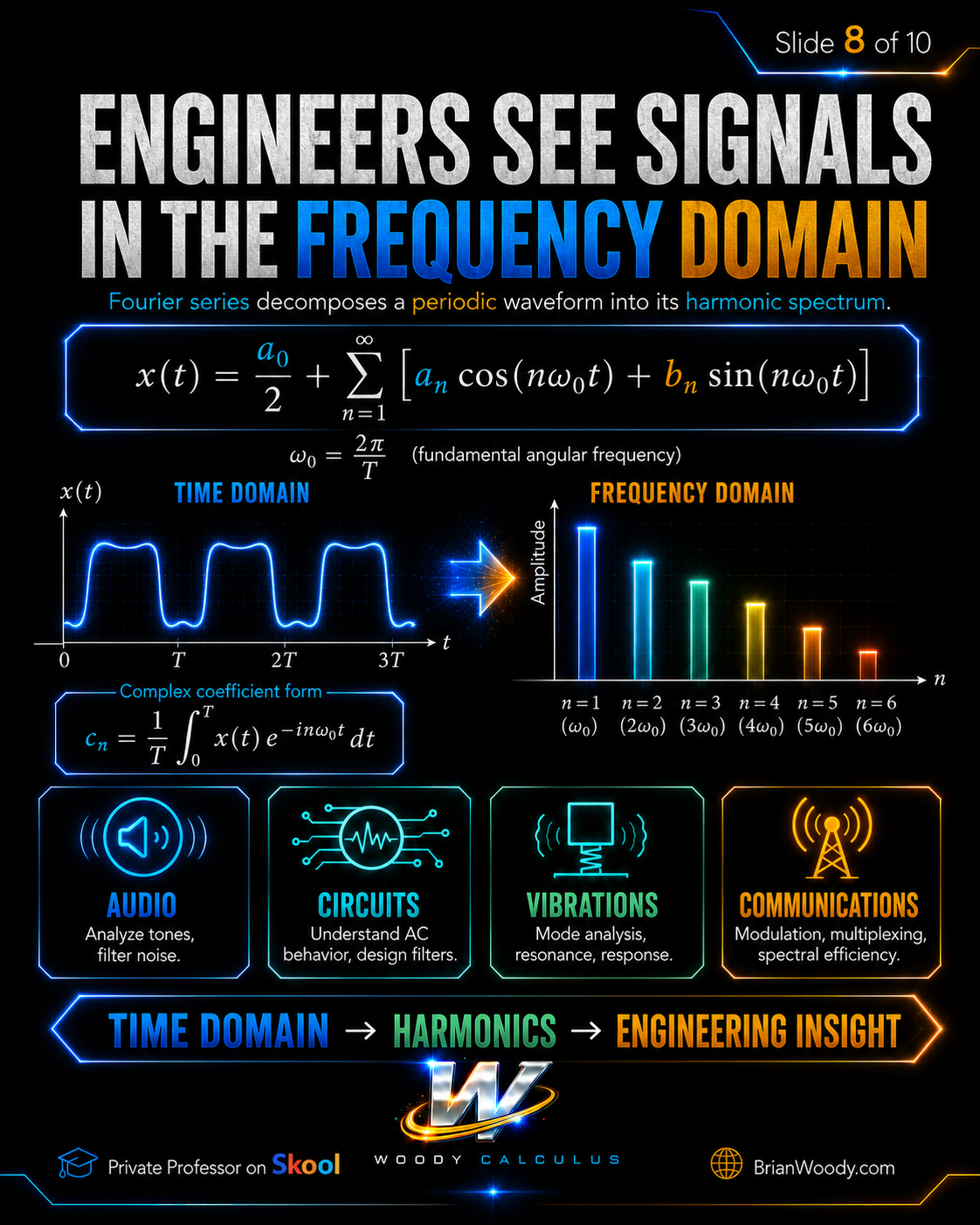
Engineers often think of Fourier series as a way to move from the time domain into the frequency domain.
In the time domain, you see the signal as it changes over time. In the frequency domain, you see which harmonics are present and how large they are.
For a periodic time signal, one common form is:
x(t)=\frac{a_0}{2}+\sum_{n=1}^{\infty}\left[a_n\cos(n\omega_0t)+b_n\sin(n\omega_0t)\right],
\]
where
\omega_0=\frac{2\pi}{T}
\]
is the fundamental angular frequency.
Heat Equations, PDEs, and Quantum Mechanics
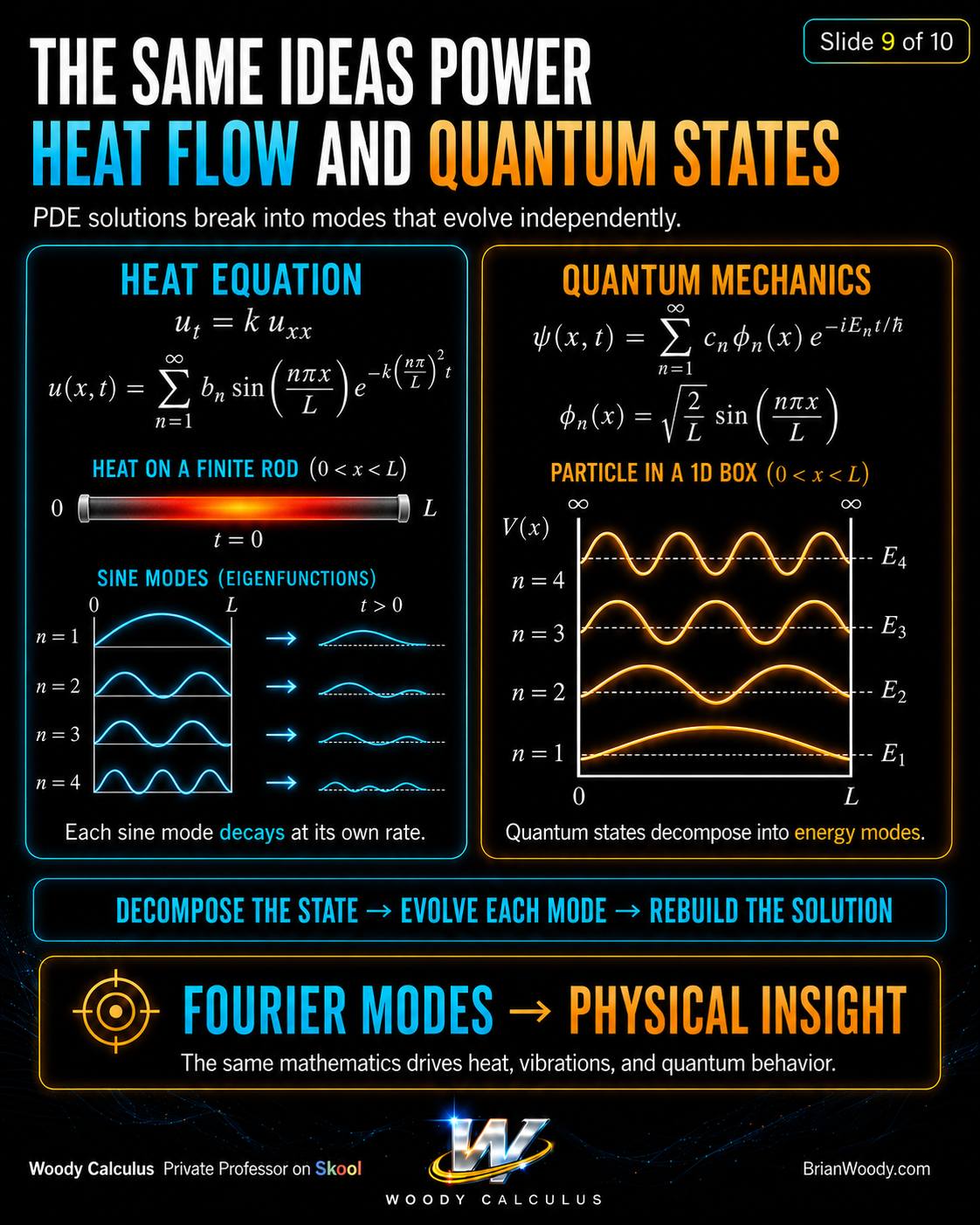
The same ideas power heat flow and quantum mechanics.
For the heat equation
u_t=ku_{xx},
\]
on a finite rod \(0<x<L\), one classic Fourier sine series solution has the form:
u(x,t)=\sum_{n=1}^{\infty}b_n\sin\left(\frac{n\pi x}{L}\right)e^{-k\left(\frac{n\pi}{L}\right)^2t}.
\]
Each sine mode evolves independently. Higher modes decay faster because the exponential decay rate contains \( \left(\frac{n\pi}{L}\right)^2 \).
In quantum mechanics, a particle in a one-dimensional box has energy eigenfunctions such as:
\phi_n(x)=\sqrt{\frac{2}{L}}\sin\left(\frac{n\pi x}{L}\right).
\]
A quantum state can be decomposed into energy modes:
\psi(x,t)=\sum_{n=1}^{\infty}c_n\phi_n(x)e^{-iE_nt/\hbar}.
\]
The Big Picture: Decompose, Evolve, Rebuild
Fourier series give students a repeatable way to attack complicated systems:
- Decompose the function or state into modes.
- Understand how each mode behaves.
- Evolve, scale, filter, or analyze each mode separately.
- Rebuild the full solution by adding the modes back together.
This is why Fourier series are so important in advanced mathematics. They create order out of complexity. They let us turn a difficult object into simple parts with clear behavior.
That is also why Fourier series are a perfect example of the Woody Calculus philosophy. We do not merely stare at formulas. We train patterns. We rewrite perfect solutions. We say the steps out loud. We build automatic mastery until the structure becomes visible.
FAQ: Fourier Series and Harmonics
What is a Fourier series?
A Fourier series represents a periodic function as an infinite sum of sine and cosine waves. It decomposes a complicated waveform into simple harmonic components.
What is the Fourier series formula?
For a \(2\pi\)-periodic function, the Fourier series formula is \( f(x)\sim \frac{a_0}{2}+\sum_{n=1}^{\infty}(a_n\cos(nx)+b_n\sin(nx)) \).
What are harmonics in a Fourier series?
Harmonics are sine and cosine waves whose frequencies are integer multiples of the fundamental frequency. Higher harmonics oscillate faster and capture finer details of the signal.
Why do Fourier series use sine and cosine?
Sine and cosine functions form an orthogonal family over intervals such as \( [-\pi,\pi] \). Orthogonality allows us to isolate coefficients and decompose periodic functions into independent frequency components.
How are Fourier series used in Differential Equations?
Fourier series are used to solve partial differential equations such as the heat equation and wave equation. The solution is decomposed into modes, each mode evolves according to the differential equation, and the full solution is rebuilt from the modes.
How are Fourier series connected to quantum mechanics?
Quantum states can be decomposed into eigenfunctions or energy modes, much like Fourier modes. Each mode evolves in time, and the total quantum state is built from the sum of these modes.
Woody Calculus Mastery Task
Train Fourier Series Until the Pattern Becomes Automatic
Fourier series are not mastered by staring at the formula. They are mastered through repetition, structure, and active recall.
- Write the full Fourier series formula five times:
\( f(x)\sim \frac{a_0}{2}+\sum_{n=1}^{\infty}(a_n\cos(nx)+b_n\sin(nx)) \). - Say out loud: “Cosine coefficients use \(a_n\). Sine coefficients use \(b_n\). Integration measures how much of each harmonic is present.”
- Rewrite the coefficient formulas for \(a_0\), \(a_n\), and \(b_n\) until they are automatic.
- Practice the orthogonality identities until you can explain why nonmatching harmonics disappear.
- Rewrite the \(f(x)=x\) example perfectly and say every integration by parts step out loud.
That is subconscious training. You are not hoping to recognize Fourier series during an exam. You are training the pattern until recognition becomes automatic.
Final Thought: Fourier Series Reveal the Hidden Order Inside Complexity
Fourier series teach one of the most powerful lessons in advanced mathematics: the complicated object may not be random. It may be structured.
A waveform that looks messy can be decomposed into harmonics. A heat distribution can be decomposed into sine modes. A quantum state can be decomposed into energy modes. A signal can be transformed from the time domain into the frequency domain.
Decompose. Understand the pieces. Rebuild the whole.
That is the real power of Fourier series.
Ready to Go Beyond Surface-Level Mathematics?
Woody Calculus Private Professor on Skool is built for serious students who want structure, clarity, and mastery in advanced mathematics.
Inside the Woody Calculus Mastery Lab, students train through complete step-by-step explanations, exam preparation, homework support, pattern recognition, and mathematical fluency.
Get support in Calculus 1, Calculus 2, Calculus 3, Differential Equations, Linear Algebra, Abstract Algebra, Real Analysis, Fourier series, PDEs, and advanced university mathematics.
This is not casual tutoring. This is structured mathematical training.