What Is a Cauchy Sequence?
A Cauchy sequence is a sequence whose terms eventually become arbitrarily close to one another.
Formally, for every \(\varepsilon\gt0\), there is an index \(N\) such that whenever \(m,n\ge N\),
the distance between \(x_m\) and \(x_n\) is less than \(\varepsilon\).
Every convergent sequence is Cauchy. The converse holds in complete metric spaces, which is why every Cauchy
sequence of real numbers converges in \(\mathbb R\), while a Cauchy sequence of rational numbers can fail
to converge in \(\mathbb Q\).

A Cauchy sequence detects internal agreement among late terms, and completeness guarantees that agreement produces a limit in the space.
Key Takeaways
- Cauchy sequences compare sufficiently late terms with one another, not with a known limit.
- Every convergent sequence is Cauchy in every metric space.
- A metric space is complete exactly when every Cauchy sequence in it converges to a point of that same space.
- \(\mathbb R\) is complete, while \(\mathbb Q\) is not complete with the usual metric.
- Every Cauchy sequence is bounded, but Cauchy does not imply monotone.
- Completeness is central to metric spaces, compactness, function spaces, Banach spaces, and fixed-point methods.
The Definition of a Cauchy Sequence
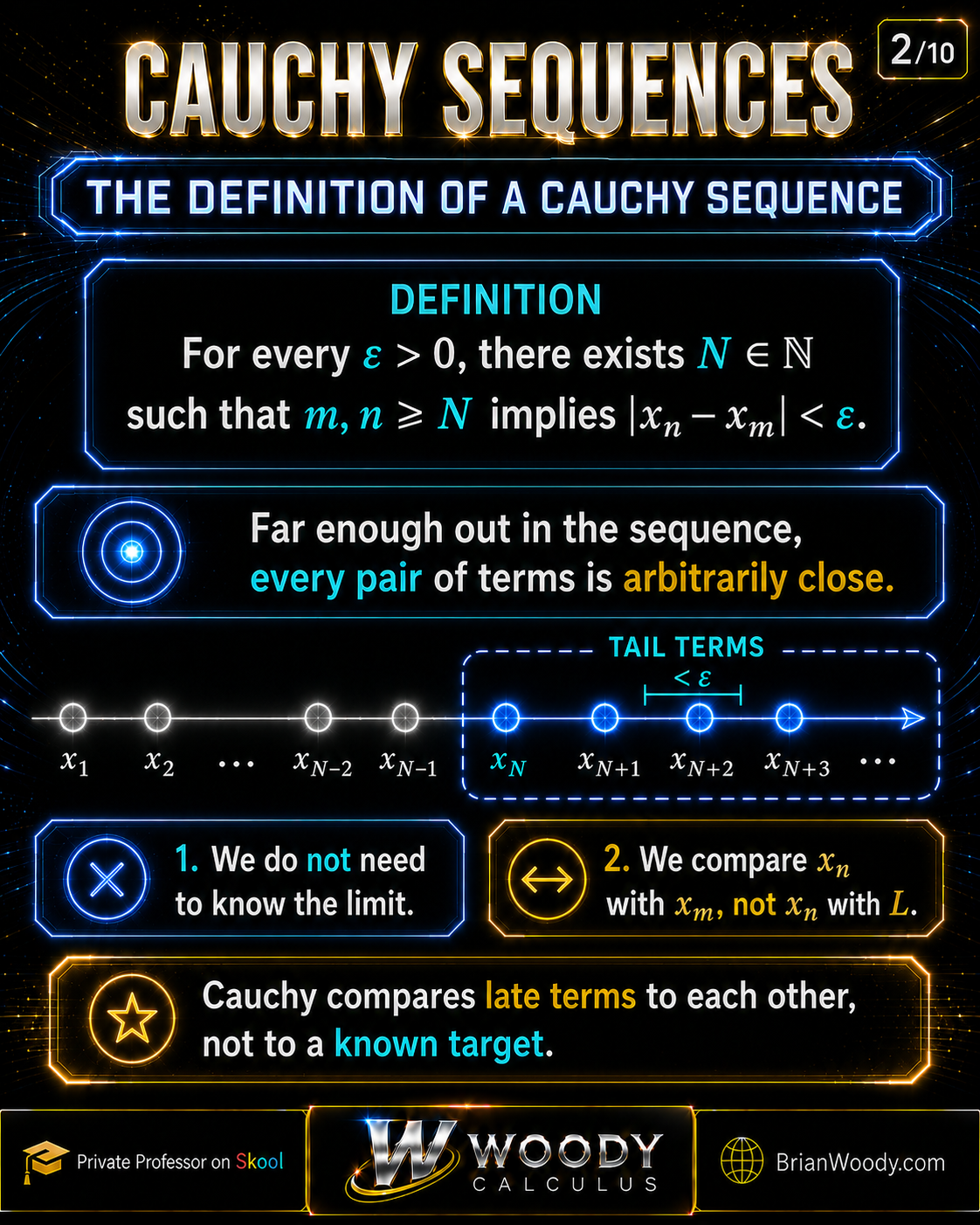
Far enough out in a Cauchy sequence, every pair of terms is arbitrarily close.
Let \((x_n)\) be a sequence of real numbers. We say that \((x_n)\) is a Cauchy sequence if
\[
\boxed{
\forall\varepsilon\gt0,\
\exists N\in\mathbb N
\text{ such that }
m,n\ge N
\Longrightarrow
|x_n-x_m|\lt\varepsilon
}.
\]
The order of the quantifiers matters. We first choose an arbitrary tolerance \(\varepsilon\gt0\).
Then we must find one index \(N\) that works for every pair \(m,n\ge N\).
The Key Idea
A convergence proof compares \(x_n\) with a target \(L\).
A Cauchy proof does not need a target. It asks whether the sequence tail has become internally tight enough
that any two sufficiently late terms are close.
Why the Tail Begins at \(x_N\)
The guarantee begins exactly at the threshold \(N\). Terms before \(x_N\) are irrelevant to the definition.
A sequence may behave wildly at first and still be Cauchy if its tail eventually satisfies the pairwise-distance condition.
Convergence vs. Cauchy
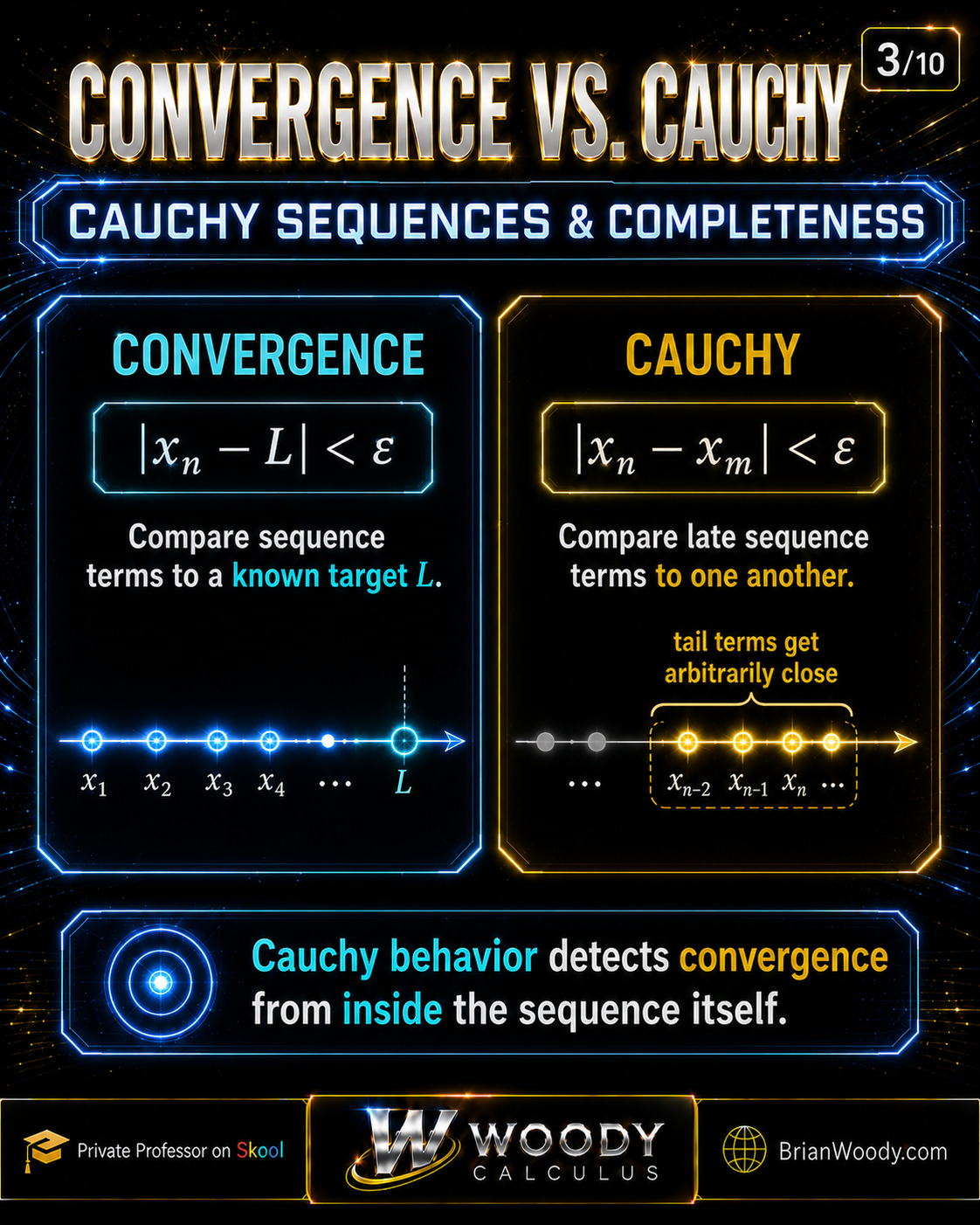
Convergence compares terms with a limit; the Cauchy condition compares sufficiently late terms with one another.
| Concept | Condition | What Is Being Compared? |
|---|---|---|
| Convergence | \(|x_n-L|\lt\varepsilon\) | The term \(x_n\) with a limit \(L\) |
| Cauchy | \(|x_n-x_m|\lt\varepsilon\) | Two sufficiently late sequence terms |
This distinction is one of the conceptual turning points in Real Analysis.
A Cauchy sequence can signal that convergence should occur without first naming the limit.
Whether that expected limit actually belongs to the space is a separate question. That is exactly what completeness answers.
Every Convergent Sequence Is Cauchy
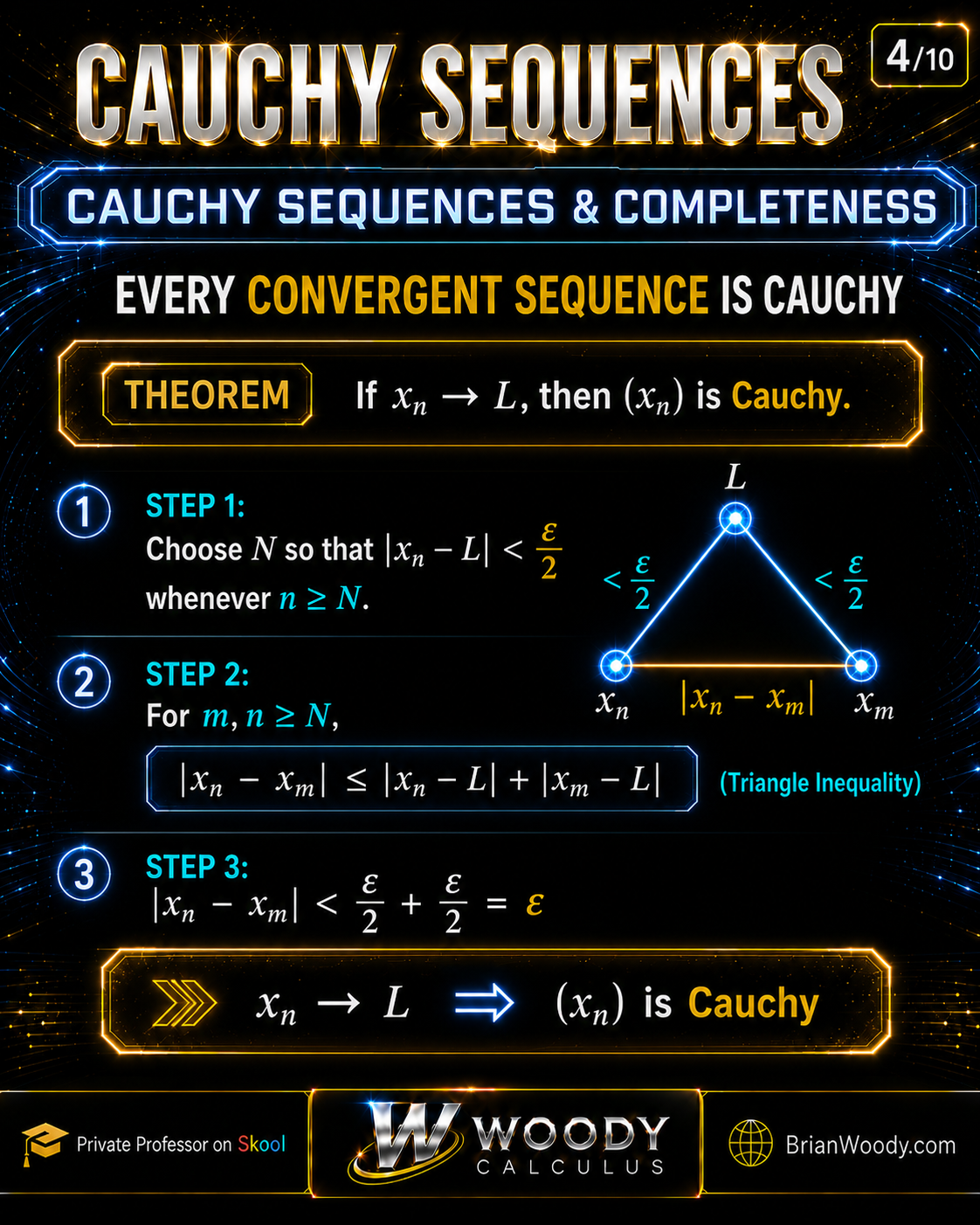
Every convergent sequence is Cauchy, proved with the triangle inequality and an epsilon-over-two argument.
Suppose \(x_n\to L\). The proof has three clean steps.
-
Choose the convergence tolerance.
Let \(\varepsilon\gt0\). Since \(x_n\to L\), there exists \(N\) such that
\[
|x_n-L|\lt\frac{\varepsilon}{2}
\qquad\text{whenever }n\ge N.
\] -
Compare two late terms through the common limit.
If \(m,n\ge N\), then the triangle inequality gives
\[
|x_n-x_m|
\le
|x_n-L|+|x_m-L|.
\] -
Add the two error bounds.
\[
|x_n-x_m|
\lt
\frac{\varepsilon}{2}
+
\frac{\varepsilon}{2}
=
\varepsilon.
\]
Therefore,
\[
\boxed{
x_n\to L
\Longrightarrow
(x_n)\text{ is Cauchy}
}.
\]
Why \(\varepsilon/2\)?
The triangle inequality creates two error terms. Making each smaller than \(\varepsilon/2\)
guarantees that their sum is smaller than \(\varepsilon\).
This error-splitting pattern appears repeatedly throughout rigorous analysis.
But Does Every Cauchy Sequence Converge?
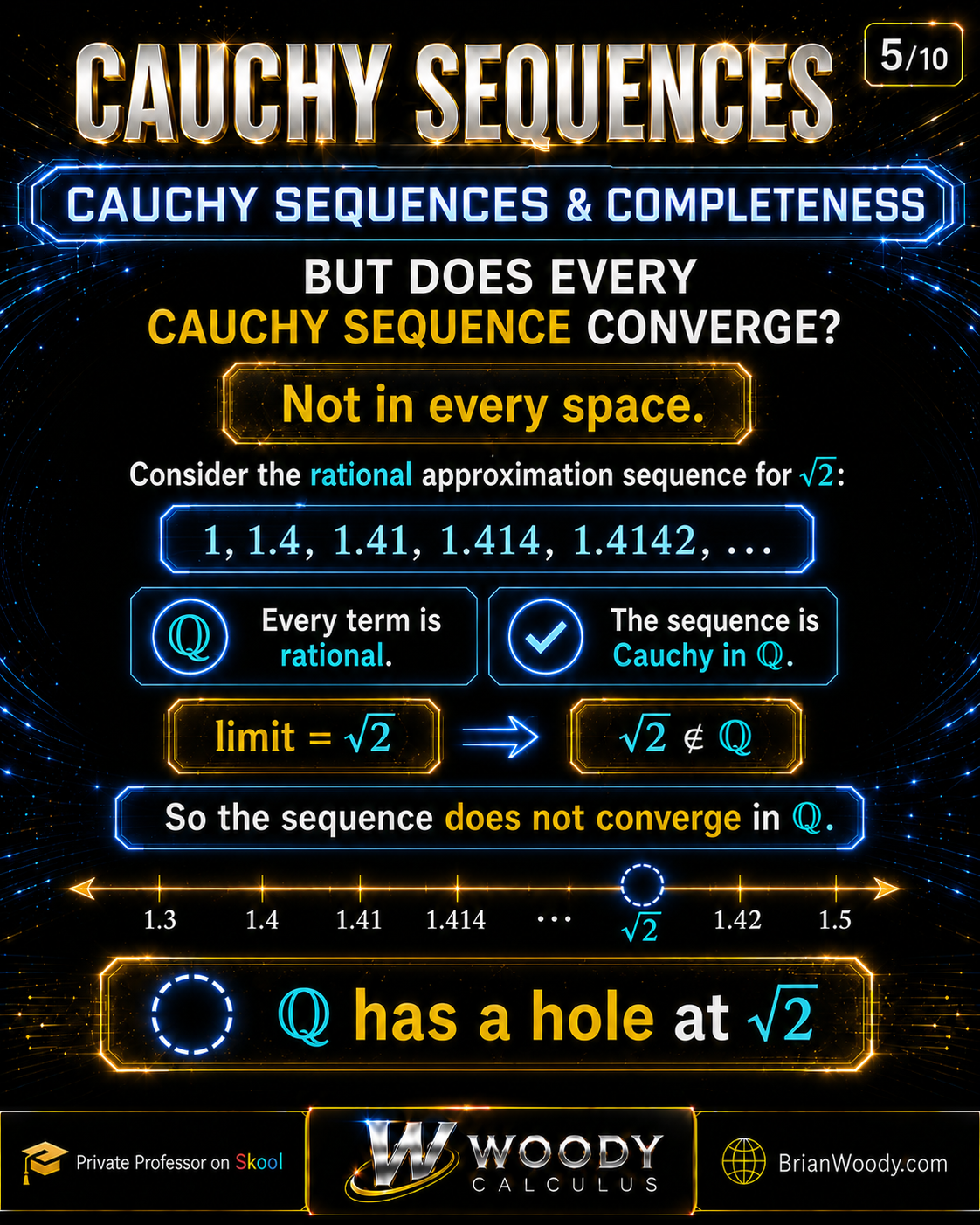
A Cauchy sequence need not converge inside an incomplete space; rational approximations to \(\sqrt2\) give the standard example in \(\mathbb Q\).
No. The converse depends on the space. Consider rational decimal truncations of \(\sqrt2\):
\[
1,\ 1.4,\ 1.41,\ 1.414,\ 1.4142,\ldots
\]
Every term is rational. Viewed in \(\mathbb R\), the sequence converges to \(\sqrt2\), so it is Cauchy.
The pairwise distances are the same when we regard the sequence as living in \(\mathbb Q\), so it is Cauchy there as well.
\[
\sqrt2\notin\mathbb Q.
\]
Therefore this Cauchy sequence has no limit in \(\mathbb Q\).
Informally, \(\mathbb Q\) has a “hole” at \(\sqrt2\).
The Lesson
A Cauchy sequence can tell us that the terms are trying to settle down.
Completeness tells us whether the space contains the point they are trying to settle down to.
What Does Complete Mean?

A metric space is complete when every Cauchy sequence converges to a point of that same space.
Let \((X,d)\) be a metric space. We call \(X\) complete if every Cauchy sequence in \(X\)
converges to a point of \(X\):
\[
\boxed{
X\text{ is complete}
\iff
\text{every Cauchy sequence in }X
\text{ converges to a point of }X
}.
\]
The phrase to a point of \(X\) is essential.
A sequence may converge in a larger ambient space while failing to converge in the space under discussion.
| Space | Metric | Complete? |
|---|---|---|
| \(\mathbb R\) | \(|x-y|\) | Yes |
| \(\mathbb Q\) | \(|x-y|\) | No |
| \([0,1]\) | \(|x-y|\) | Yes |
| \((0,1)\) | \(|x-y|\) | No |
| \(\mathbb R^n\) | Euclidean metric | Yes |
Completeness is a property of the metric space, not of an individual sequence.
In more advanced analysis, even the choice of metric or norm matters.
Why the Real Numbers Are Special
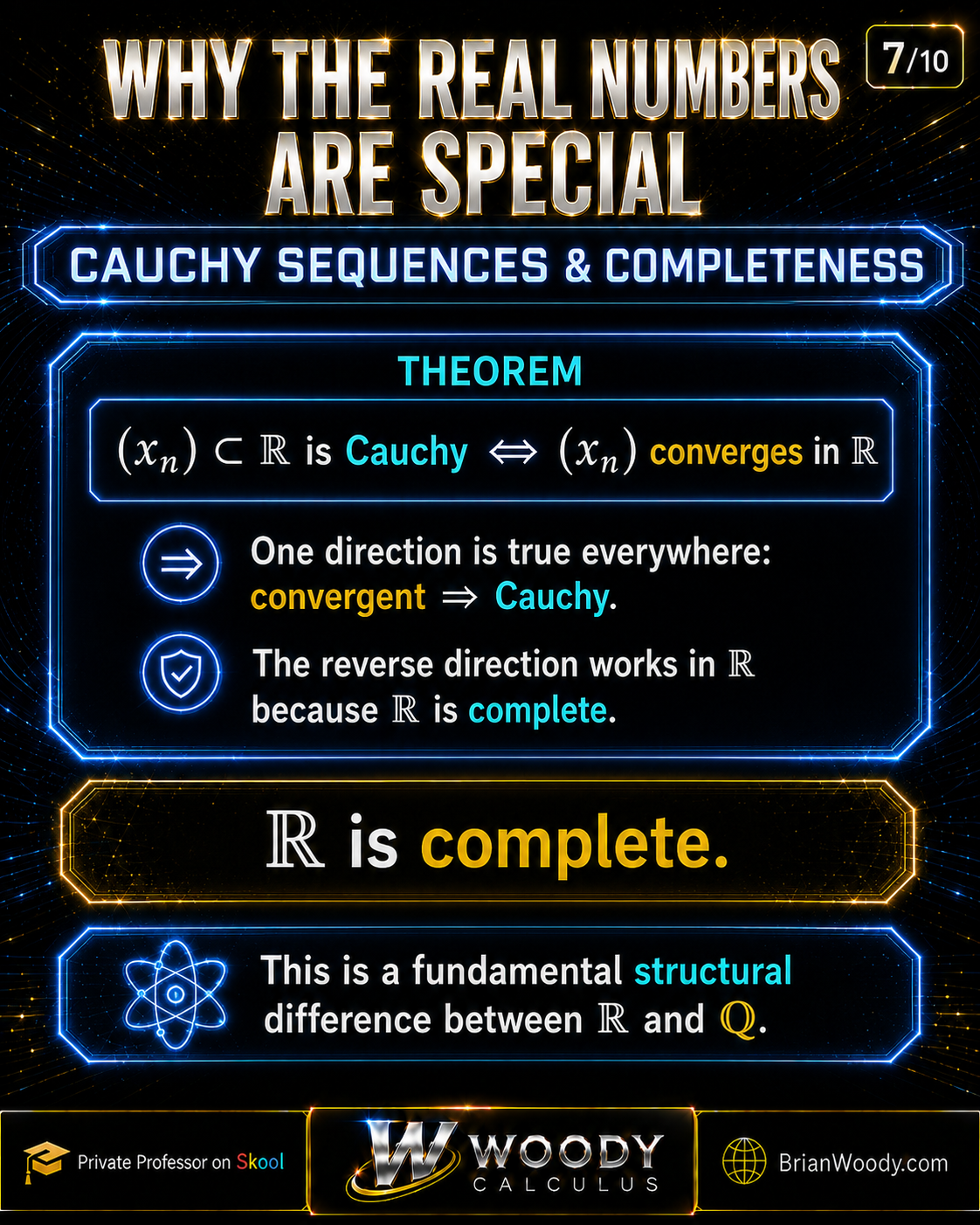
In the real numbers, Cauchy and convergent are equivalent because \(\mathbb R\) is complete.
In \(\mathbb R\), the Cauchy condition is not merely necessary for convergence. It is also sufficient:
\[
\boxed{
(x_n)\subseteq\mathbb R
\text{ is Cauchy}
\iff
(x_n)\text{ converges in }\mathbb R
}.
\]
One Standard Proof Route Using Bolzano–Weierstrass
Once the Bolzano–Weierstrass Theorem has been established, it gives a clean proof of the Cauchy criterion in \(\mathbb R\).
Let \((x_n)\) be Cauchy. Every Cauchy sequence is bounded, so Bolzano–Weierstrass gives a subsequence
\((x_{n_k})\) and a real number \(L\) such that
\[
x_{n_k}\to L.
\]
Given \(\varepsilon\gt0\), choose \(N\) so that \(m,n\ge N\) implies
\(|x_m-x_n|\lt\varepsilon/2\). Then choose \(k\) large enough that
\(n_k\ge N\) and \(|x_{n_k}-L|\lt\varepsilon/2\). For every \(n\ge N\),
\[
|x_n-L|
\le
|x_n-x_{n_k}|
+
|x_{n_k}-L|
\lt
\varepsilon.
\]
Thus \(x_n\to L\). This proof route also illustrates an important structural fact:
the standard completeness principles for \(\mathbb R\) are deeply interconnected.
Cauchy Does Not Mean Monotone—but Every Cauchy Sequence Is Bounded
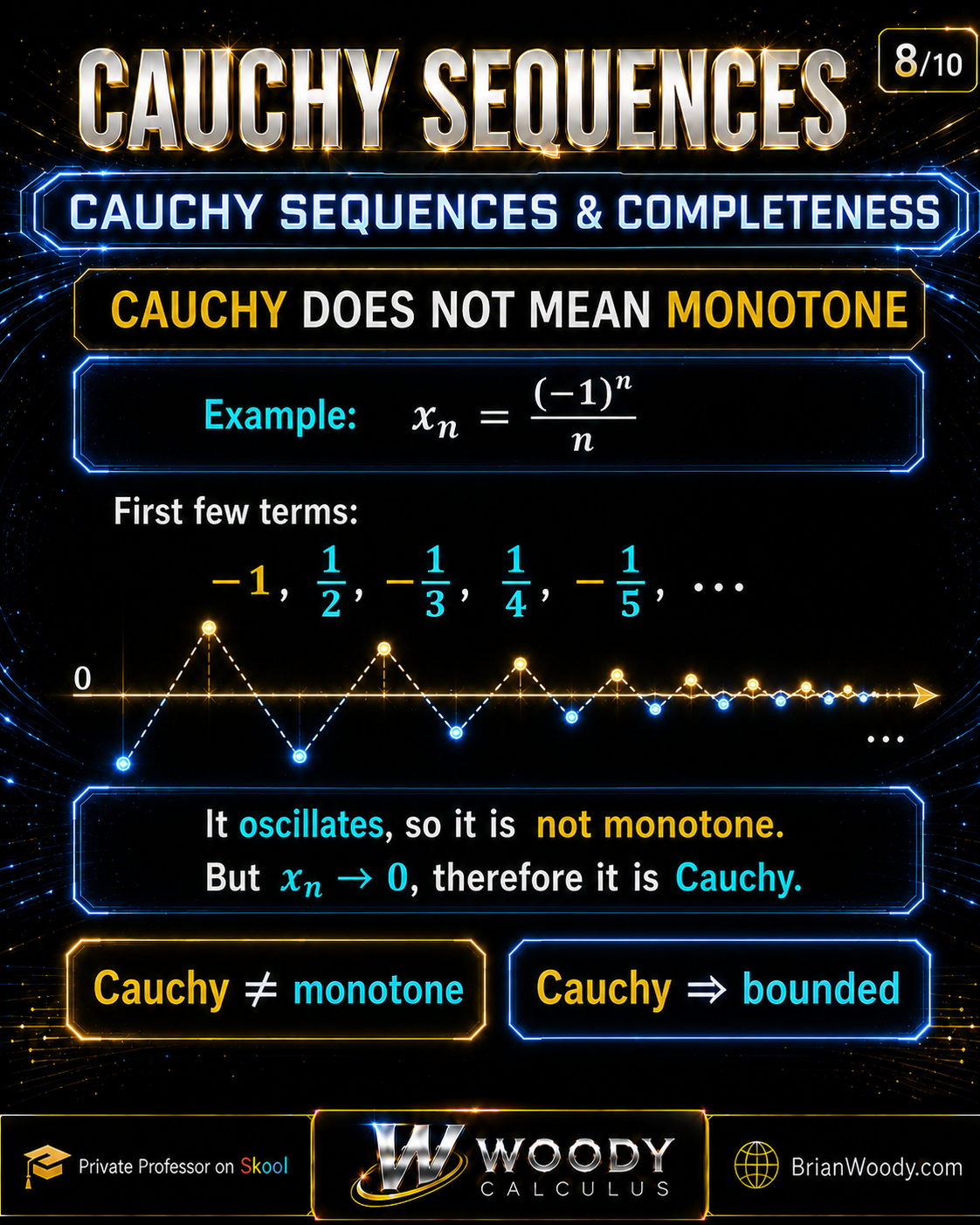
A Cauchy sequence need not be monotone; \(x_n=(-1)^n/n\) oscillates toward zero and is Cauchy.
Consider
\[
x_n=\frac{(-1)^n}{n}.
\]
Its signs alternate, so the sequence is not monotone. But \(x_n\to0\), and every convergent sequence is Cauchy.
Therefore Cauchy does not imply monotone.
Theorem: Every Cauchy Sequence in a Metric Space Is Bounded
Let \((x_n)\) be Cauchy in a metric space \((X,d)\). Use \(\varepsilon=1\).
There exists \(N\) such that
\[
d(x_n,x_N)\lt1
\qquad(n\ge N).
\]
The tail therefore lies inside the ball of radius \(1\) centered at \(x_N\).
The finitely many earlier terms \(x_1,\ldots,x_{N-1}\) have finite distances from \(x_N\), so the entire sequence lies in one sufficiently large ball.
Hence every Cauchy sequence is bounded.
The converse is false. For example, \((-1)^n\) is bounded in \(\mathbb R\) but not Cauchy.
Cauchy Sequences in Metric Spaces
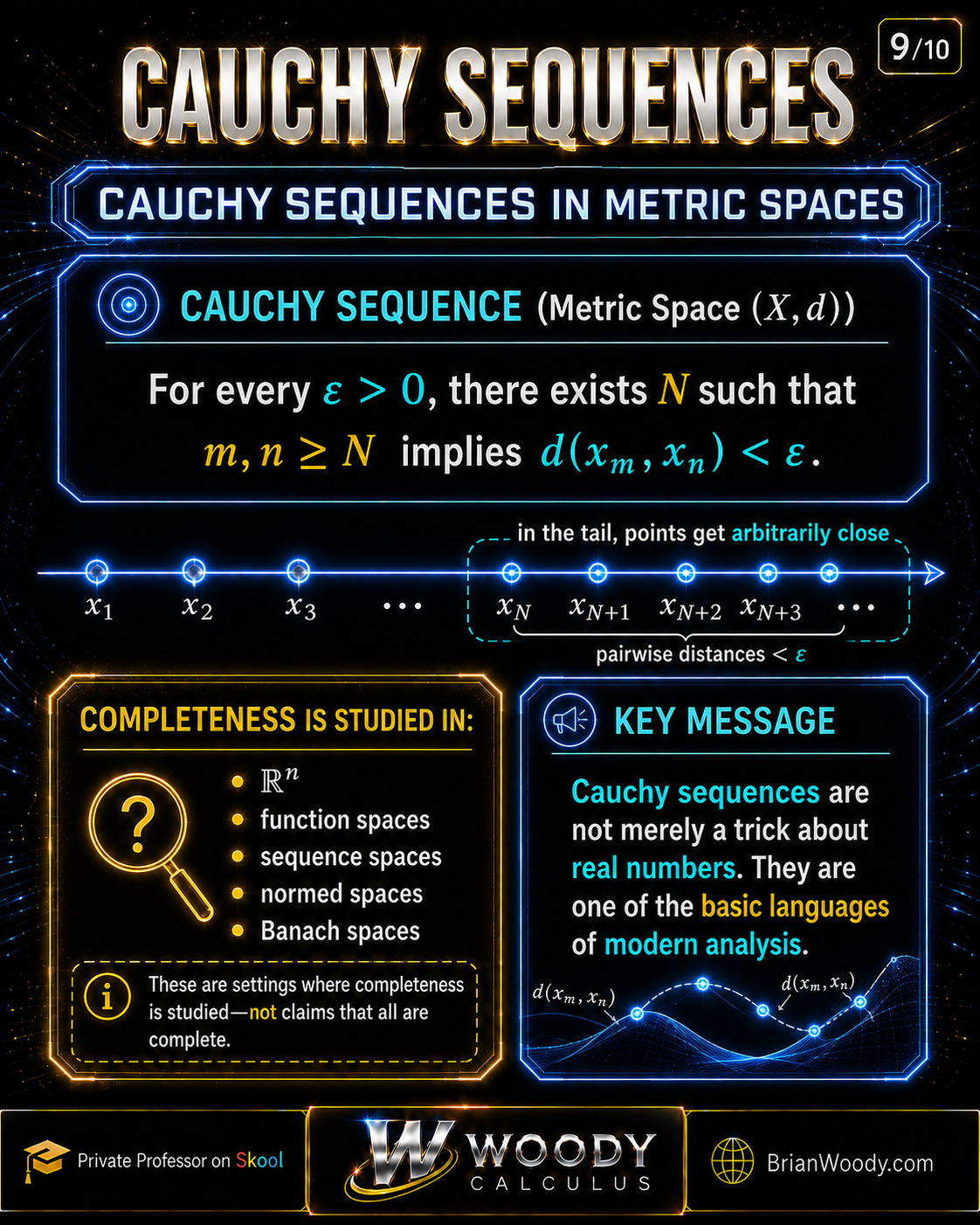
The Cauchy definition generalizes from absolute value to a metric \(d(x_m,x_n)\), making completeness a central question across modern analysis.
Let \((X,d)\) be a metric space. A sequence \((x_n)\subseteq X\) is Cauchy if
\[
\boxed{
\forall\varepsilon\gt0,\
\exists N,\
m,n\ge N
\Longrightarrow
d(x_m,x_n)\lt\varepsilon
}.
\]
Absolute value on \(\mathbb R\) is simply the metric \(d(x,y)=|x-y|\).
Once absolute value is replaced by an abstract distance, the same idea works in much richer spaces.
Where Completeness Becomes a Question
- \(\mathbb R^n\) with Euclidean distance
- spaces of continuous functions
- sequence spaces such as \(\ell^p\)
- general normed vector spaces
- Banach spaces
A crucial warning: completeness is studied in all of these settings,
but not every normed space or function space is complete.
A Banach space is, by definition, a normed vector space that is complete.
Closed Subsets of Complete Spaces Are Complete
\[
\boxed{
X\text{ complete},\
F\subseteq X\text{ closed}
\Longrightarrow
F\text{ complete}
}.
\]
Let \((x_n)\) be Cauchy in \(F\). It is also Cauchy in \(X\).
Since \(X\) is complete, \(x_n\to x\) for some \(x\in X\).
Because \(F\) is closed and every \(x_n\in F\), the limit \(x\) belongs to \(F\).
Thus \(F\) is complete.
Why \((0,1)\) Is Not Complete
\[
x_n=\frac{1}{n+1}.
\]
Every \(x_n\in(0,1)\), and the sequence is Cauchy, but
\[
x_n\to0,
\qquad
0\notin(0,1).
\]
Therefore \((0,1)\) is not complete with the usual metric.
By contrast, \([0,1]\) is closed in the complete space \(\mathbb R\), so \([0,1]\) is complete.
Completion: How Missing Limits Are Added
Every metric space can be placed densely and isometrically inside a complete metric space called a completion.
The idea is to add precisely the limit points needed so that Cauchy sequences no longer “fall out” of the space.
\[
X
\hookrightarrow
\widehat X,
\qquad
\overline{X}^{\,\widehat X}
=
\widehat X.
\]
The classic example is the passage from \(\mathbb Q\) to \(\mathbb R\).
One construction of the real numbers uses equivalence classes of Cauchy sequences of rational numbers:
irrational limits are exactly the points that must be added to complete \(\mathbb Q\).
Conceptual Picture
Cauchy sequences reveal where a space is trying to have points.
Completion supplies the missing points so that every Cauchy sequence actually converges inside the enlarged space.
Equivalent Faces of Completeness in \(\mathbb R\)
In a standard development of the real numbers, several major completeness principles are equivalent.
Depending on the textbook, one may be taken as an axiom or theorem and the others derived from it.
- Least-upper-bound property: every nonempty set bounded above has a supremum.
- Monotone convergence theorem for sequences: every bounded monotone real sequence converges.
- Nested interval property: suitable nested closed intervals have a common point.
- Bolzano–Weierstrass: every bounded real sequence has a convergent subsequence.
- Cauchy completeness: every Cauchy sequence of real numbers converges in \(\mathbb R\).
These are not unrelated tricks. They are different manifestations of the same fundamental fact:
\(\mathbb R\) has no missing limit points of the kind that appear in \(\mathbb Q\).
Completeness vs. Compactness
Completeness and compactness are closely related but are not the same property.
\[
\boxed{
\text{compact metric space}
\Longrightarrow
\text{complete}
}.
\]
The converse fails: \(\mathbb R\) is complete but not compact.
In metric spaces,
\[
\boxed{
\text{compact}
\iff
\text{complete and totally bounded}
}.
\]
In \(\mathbb R^n\), the Heine–Borel Theorem gives the familiar special case:
a subset is compact exactly when it is closed and bounded.
Continue with
Compactness in Real Analysis
.
Banach Spaces: Completeness in Linear Analysis
A Banach space is a normed vector space complete with respect to the metric induced by its norm:
\[
d(x,y)=\|x-y\|.
\]
Completeness matters because analysis constantly constructs approximations:
partial sums, successive functions, numerical iterations, and fixed-point sequences.
Completeness guarantees that a Cauchy approximation process has a limit that remains inside the space.
Example: \(C([a,b])\) with the Sup Norm
\[
\|f\|_\infty
=
\max_{x\in[a,b]}|f(x)|.
\]
The space \(C([a,b])\) equipped with this norm is a Banach space.
A Cauchy sequence in the sup norm converges uniformly to a continuous function.
Continue with
Pointwise vs. Uniform Convergence
.
Banach Fixed-Point Theory
The Banach Fixed-Point Theorem says that a contraction mapping \(T:X\to X\) on a nonempty complete metric space
has a unique fixed point, and iteration from any starting point in \(X\) converges to that fixed point.
Completeness prevents the iterative process from converging toward a missing point outside the space.
The Completeness Map of Real Analysis

Completeness connects Cauchy sequences to several central structures and theorems across Real Analysis.
- Cauchy sequences: completeness turns internal tail agreement into actual convergence.
- Suprema: the least-upper-bound property is a standard completeness principle for \(\mathbb R\).
- Nested intervals: another manifestation of real-number completeness under the usual hypotheses.
- Bolzano–Weierstrass: bounded real sequences have convergent subsequences.
- Compactness: compact metric spaces are complete.
- Function and sequence spaces: completeness determines whether limiting objects remain inside the space.
- Banach fixed-point theory: completeness guarantees contraction iterations converge inside the space.
The Big Takeaway
A Cauchy sequence says that sufficiently late terms agree with one another to arbitrary precision.
A complete space guarantees that this agreement corresponds to an actual point in the space.
Analysis works because limits have somewhere to live.
Common Cauchy Sequence and Completeness Mistakes
- Comparing \(x_n\) with a limit in the Cauchy definition. Cauchy compares \(x_n\) with \(x_m\).
- Getting the quantifier order wrong. One \(N\) must work for every pair \(m,n\ge N\).
- Including pre-\(N\) terms in the guaranteed tail. The condition begins at \(x_N\).
- Assuming Cauchy always implies convergent. The space must be complete.
- Saying a sequence itself is complete. Completeness is a property of a metric space.
- Assuming Cauchy means monotone. Cauchy sequences may oscillate.
- Assuming bounded implies Cauchy. Boundedness alone does not control pairwise tail distances.
- Confusing complete with compact. Completeness alone does not imply compactness.
- Assuming every normed or function space is complete. Completeness must be established for the particular space and norm.
- Forgetting where the limit must live. A sequence converges in \(X\) only if its limit belongs to \(X\).
Woody Mastery Check
Close the lesson before attempting these. If you can explain each item aloud without looking,
you are beginning to own the concept.
- State the formal Cauchy definition.
- Explain why the tail begins at \(x_N\).
- Compare convergent and Cauchy sequences.
- Prove convergent \(\Longrightarrow\) Cauchy.
- Explain why \(\mathbb Q\) is incomplete.
- Define a complete metric space.
- Prove every Cauchy sequence is bounded.
- Give a Cauchy sequence that is not monotone.
- Explain why \((0,1)\) is incomplete.
- Describe what a completion does.
- Distinguish completeness from compactness.
- Define a Banach space.
- Explain why completeness matters for iterative methods.
Cauchy Sequences & Completeness FAQ
What is a Cauchy sequence?
A Cauchy sequence is a sequence whose terms eventually become arbitrarily close to one another. Formally, for every epsilon greater than zero there is an N such that m and n at least N imply the distance between x_m and x_n is less than epsilon.
How is a Cauchy sequence different from a convergent sequence?
A convergent sequence compares its terms with a limit L, while the Cauchy condition compares sufficiently late terms with one another. A Cauchy sequence does not need a known limit in its definition.
Is every convergent sequence Cauchy?
Yes. In every metric space, convergence implies the Cauchy property. The standard proof uses the triangle inequality and an epsilon-over-two argument.
Does every Cauchy sequence converge?
Not in every metric space. A metric space is complete precisely when every Cauchy sequence in the space converges to a point of that space.
What is a complete metric space?
A metric space is complete if every Cauchy sequence in the space converges to a point that also belongs to the space.
Why are the real numbers complete?
The real numbers are complete because every Cauchy sequence of real numbers converges to a real number. This Cauchy completeness is equivalent to other standard completeness principles for the real numbers.
Why are the rational numbers not complete?
The rational numbers contain Cauchy sequences whose real limits are irrational. Rational approximations to square root of 2 are a standard example.
What is a Cauchy sequence in Q that does not converge in Q?
The rational truncations 1, 1.4, 1.41, 1.414, 1.4142, and so on form a Cauchy sequence in Q, but their real limit is square root of 2, which is not rational.
Is every Cauchy sequence bounded?
Yes. Every Cauchy sequence in a metric space is bounded.
Is every bounded sequence Cauchy?
No. For example, the sequence \((-1)^n\) is bounded but not Cauchy because sufficiently late terms still alternate between -1 and 1.
Does a Cauchy sequence have to be monotone?
No. The sequence \(x_n=(-1)^n/n\) is Cauchy because it converges to 0, but it oscillates and is not monotone.
Do you need to know the limit to prove a sequence is Cauchy?
No. The Cauchy definition only requires control of the distance between sufficiently late terms.
How do you prove a sequence is Cauchy?
Start with an arbitrary epsilon greater than zero and find N so that whenever m and n are at least N, the distance between x_m and x_n is less than epsilon.
Why does the proof convergent implies Cauchy use epsilon over 2?
The triangle inequality produces two error terms. Bounding each by epsilon over 2 makes their sum less than epsilon.
What is the Cauchy definition in a metric space?
A sequence \((x_n)\) in a metric space \((X,d)\) is Cauchy if for every epsilon greater than zero there exists N such that m and n at least N imply \(d(x_m,x_n)\) is less than epsilon.
Is the open interval (0,1) complete with the usual metric?
No. The sequence \(x_n=1/(n+1)\) lies in \((0,1)\) and is Cauchy, but it converges to 0, which is not in \((0,1)\).
Are closed subsets of complete metric spaces complete?
Yes. With the inherited metric, every closed subset of a complete metric space is complete.
Is completeness the same as compactness?
No. Every compact metric space is complete, but a complete metric space need not be compact. For example, the real line is complete but not compact.
What is a Banach space?
A Banach space is a normed vector space that is complete with respect to the metric induced by its norm.
What is the completion of a metric space?
A completion of a metric space is a complete metric space containing an isometric copy of the original space as a dense subset. The real numbers can be constructed as a completion of the rational numbers.
Why is completeness important in analysis?
Completeness guarantees that Cauchy approximation processes converge to objects that remain inside the space. This principle supports fixed-point methods, function spaces, sequence spaces, and many existence arguments in analysis.
References and Further Study
For authoritative reference definitions and broader context, see:
- Encyclopedia of Mathematics — Cauchy Sequence
- Encyclopedia of Mathematics — Complete Space
- Encyclopedia of Mathematics — Metric Space
Standard textbook references include Stephen Abbott’s Understanding Analysis
and Walter Rudin’s Principles of Mathematical Analysis.
Related Woody Calculus Lessons
Need Help With Real Analysis and Proof Writing?
Cauchy sequences are where Real Analysis starts to reveal its deeper structure.
If you want help with epsilon arguments, sequence proofs, compactness, uniform convergence,
metric spaces, or exam preparation, continue with the Woody Calculus Real Analysis resources and Mastery Lab.