Pumping water problems are Calculus 2 work problems in which different layers of liquid must be lifted different distances.
That changing lift distance is why the elementary work formula \(W=Fd\) cannot be applied to the entire tank at once. Different layers of liquid must be lifted different distances, so the total work must be calculated with an integral.
Pumping water is not one work calculation. It is infinitely many tiny work calculations added together.
The central differential-work formula is:
\boxed{
dW=\delta A(y)(H-y)\,dy
}
\]
Therefore, if the liquid occupies \(a\le y\le b\):
\boxed{
W=\delta\int_a^b A(y)(H-y)\,dy.
}
\]
Here \(\delta\) is the fluid’s weight density, \(A(y)\) is the horizontal cross-sectional area of a slice, \(H\) is the absolute outlet height, and \(H-y\) is the distance the slice must be lifted.
This Woody Calculus lesson develops that formula carefully and then solves a complete cylindrical-tank example with:
- tank radius \(2\) ft,
- water depth \(3\) ft,
- a spout \(1\) ft above the tank,
- water weight density \(62.4\text{ lb/ft}^3\).
Published: .
Last updated: .
Estimated read time: 16–20 minutes.
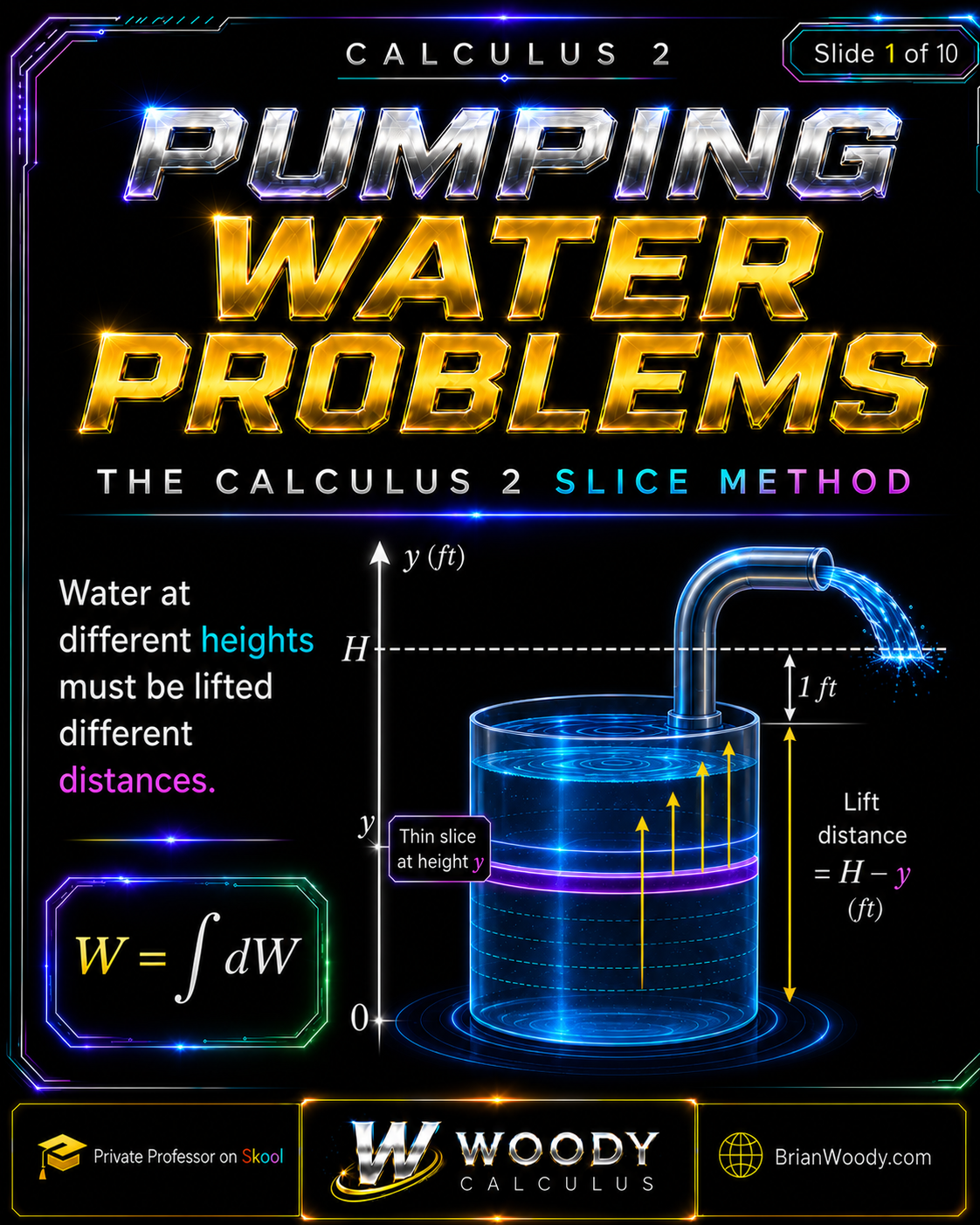
What Is a Pumping Water Problem in Calculus 2?
A pumping water problem asks for the work required to lift a liquid from a tank to a specified outlet height.
Different layers of water begin at different heights. A layer near the bottom must travel farther than a layer near the surface. Because the travel distance changes continuously with height, the work must be calculated slice by slice.
The mathematical structure is:
\text{total work}
=
\text{sum of the work on all thin slices}.
\]
In integral notation:
\boxed{W=\int dW.}
\]
Why Does Work Become an Integral?
The formula \(W=Fd\) applies directly only when the force and distance are constant.
For a constant force \(F\) acting through a constant distance \(d\):
W=Fd.
\]
In a pumping problem, each thin layer of liquid can have:
- a different weight, if the tank width changes with height,
- a different lift distance,
- and therefore a different amount of work.
For one small slice:
dW=(\text{force on slice})(\text{distance lifted}).
\]
Adding all of those tiny work contributions gives:
\boxed{W=\int dW.}
\]
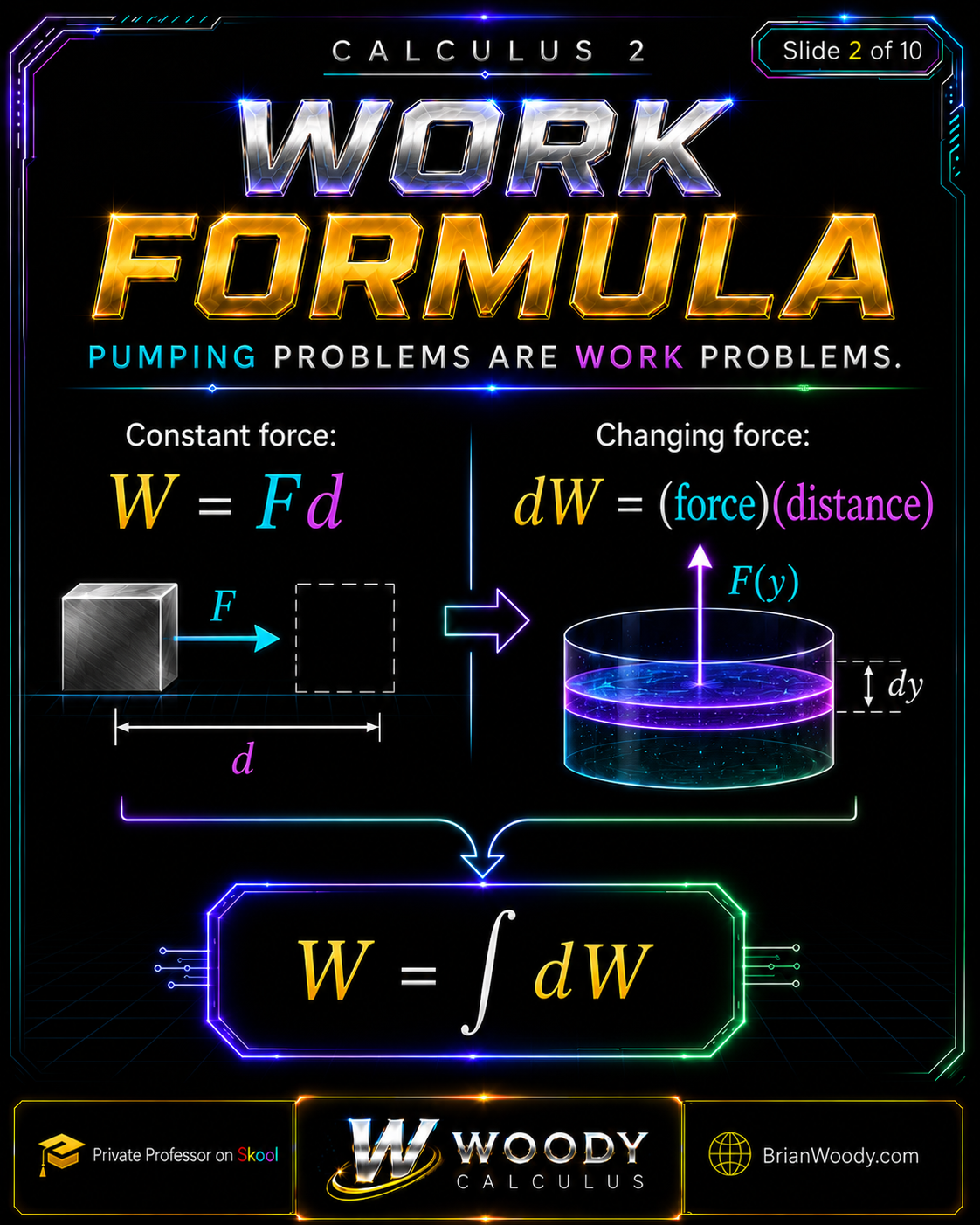
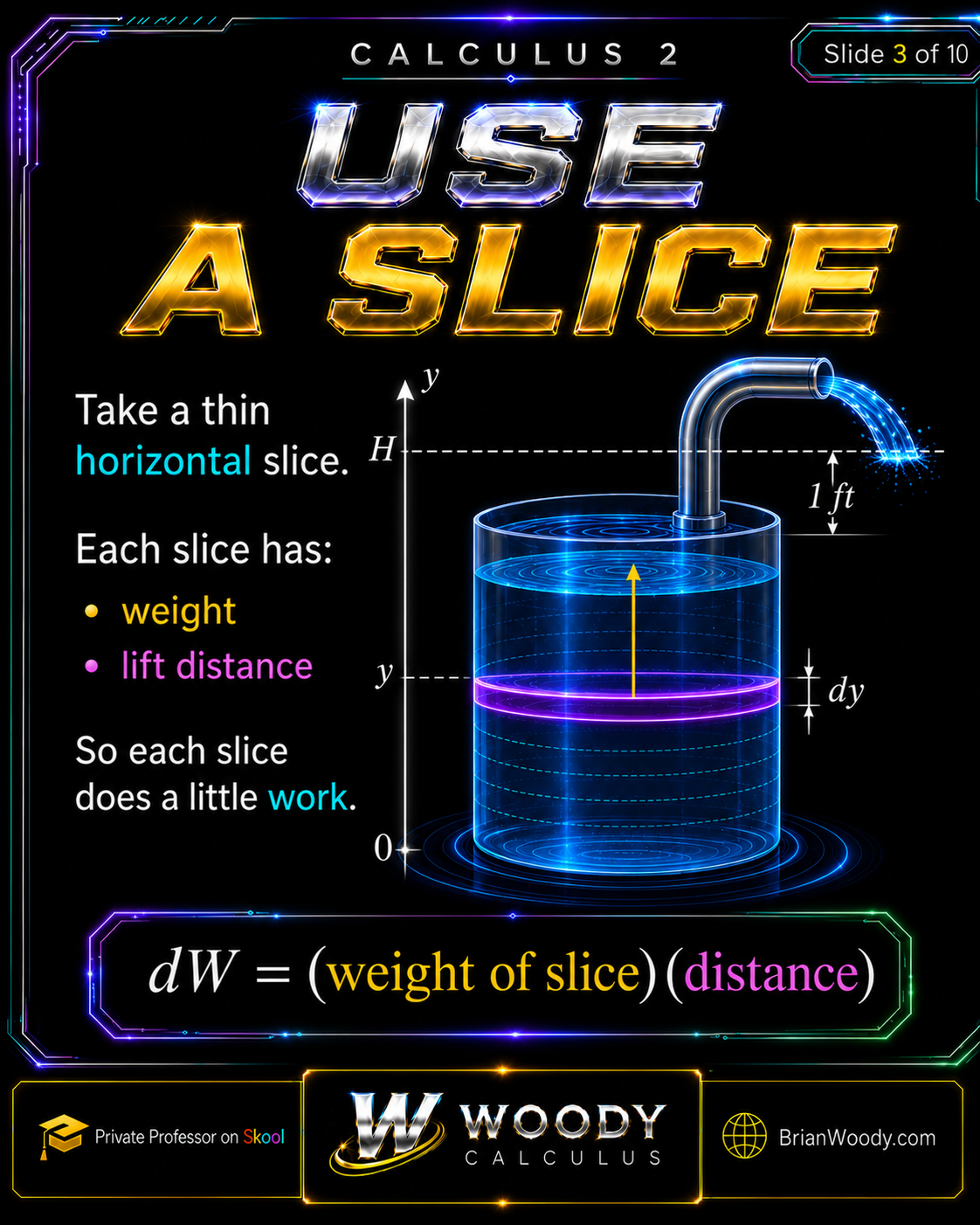
Why Use a Horizontal Slice in Pumping Water Problems?
A thin horizontal slice is the natural element because every point in that slice is approximately at the same height and travels the same distance.
Place a slice at height \(y\) with thickness \(dy\). The slice has:
- a cross-sectional area \(A(y)\),
- a volume \(dV\),
- a weight \(dF\),
- a lift distance,
- and a small work contribution \(dW\).
The slice volume is:
\boxed{dV=A(y)\,dy.}
\]
The entire pumping model is built from this one thin layer.
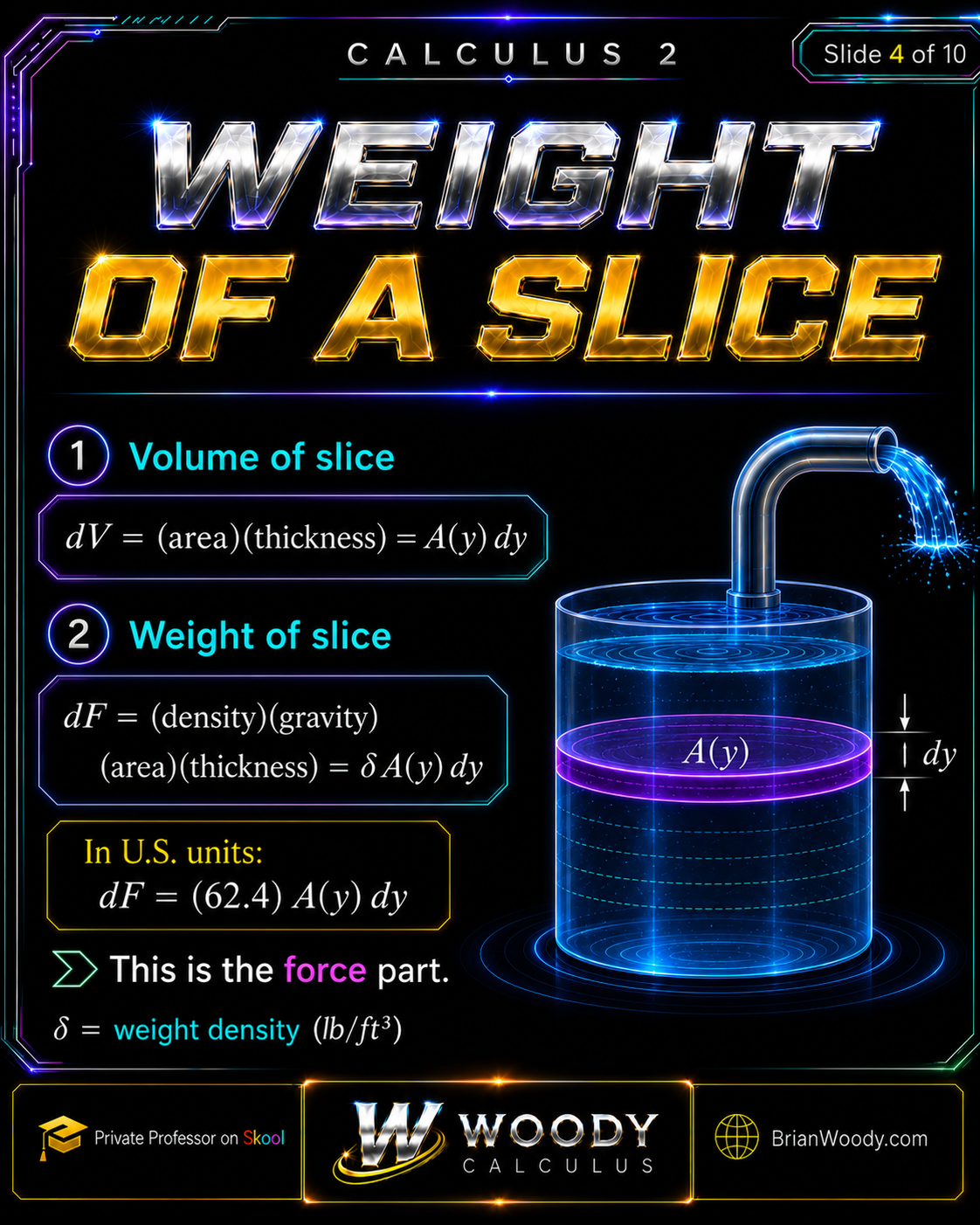
How to Find the Weight of a Water Slice
The weight of a slice equals the fluid’s weight density multiplied by the slice volume.
Let \(\delta\) denote weight density. Since:
dV=A(y)\,dy,
\]
the slice weight is:
\boxed{
dF=\delta A(y)\,dy.
}
\]
For water in U.S. customary units:
\boxed{
\delta=62.4\text{ lb/ft}^3.
}
\]
Therefore:
dF=(62.4)A(y)\,dy.
\]
In SI units, one typically uses:
\delta=\rho g,
\]
where \(\rho\) is mass density and \(g\) is gravitational acceleration.
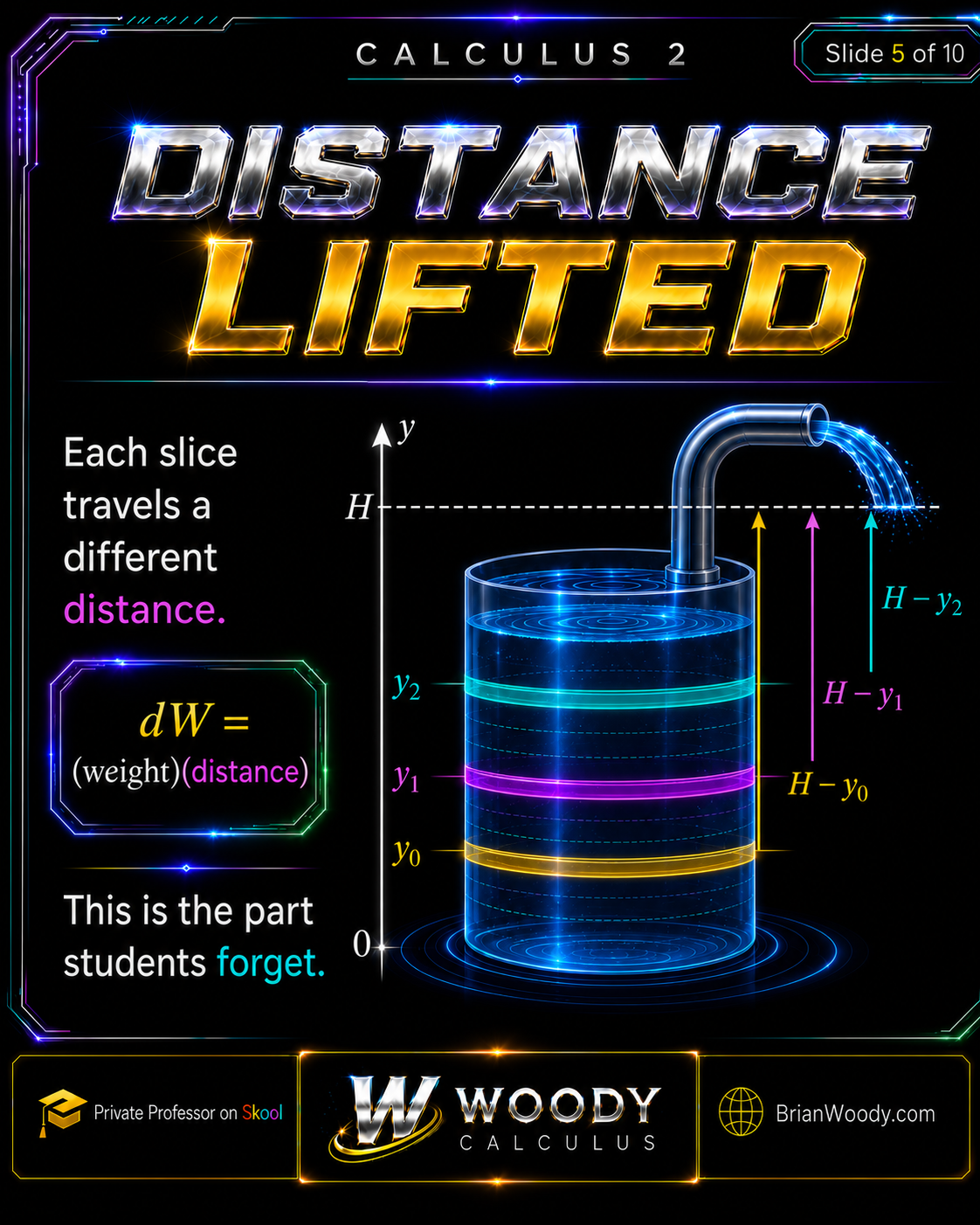
How to Find the Lift Distance \(H-y\)
If a slice is at height \(y\) and the outlet is at height \(H\), then the slice must be lifted \(H-y\) units.
\boxed{
\text{lift distance}=H-y.
}
\]
This is the part students most frequently forget.
A slice near the bottom has a small \(y\)-value and a large lift distance. A slice near the top has a larger \(y\)-value and a smaller lift distance.
| Slice Height | Outlet Height | Lift Distance |
|---|---|---|
| \(y_0\) | \(H\) | \(H-y_0\) |
| \(y_1\) | \(H\) | \(H-y_1\) |
| \(y_2\) | \(H\) | \(H-y_2\) |
The General Pumping-Water Work Formula
The work performed on one slice equals its weight multiplied by its lift distance.
Slice weight:
dF=\delta A(y)\,dy.
\]
Lift distance:
H-y.
\]
Therefore:
\boxed{
dW=\delta A(y)(H-y)\,dy.
}
\]
If the fluid occupies \(a\le y\le b\), then:
\boxed{
W=\delta\int_a^b A(y)(H-y)\,dy.
}
\]
This is the master formula for pumping a fluid vertically to a fixed outlet height.
| Symbol | Meaning | Typical Units |
|---|---|---|
| \(y\) | Height of the slice | ft or m |
| \(dy\) | Thickness of the slice | ft or m |
| \(A(y)\) | Cross-sectional area of the slice | \(\text{ft}^2\) or \(\text{m}^2\) |
| \(\delta\) | Weight density | \(\text{lb/ft}^3\) or \(\text{N/m}^3\) |
| \(H\) | Absolute outlet height | ft or m |
| \(H-y\) | Lift distance | ft or m |
| \(dW\) | Work performed on one slice | \(\text{ft}\cdot\text{lb}\) or J |
Cylindrical Tank Pumping-Water Example Setup
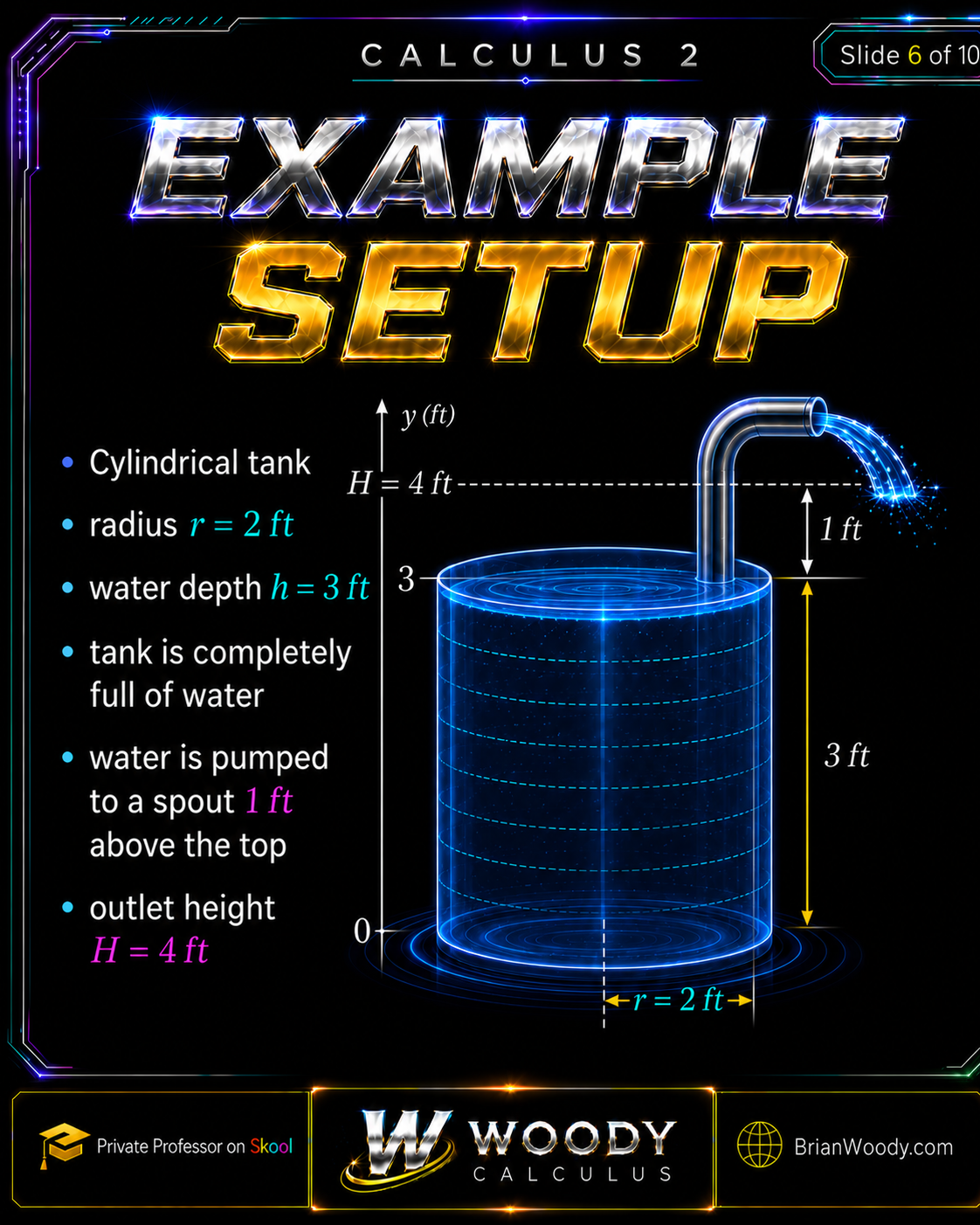
Find the work required to pump all the water from a full cylindrical tank through a spout one foot above the tank.
The tank has:
- radius \(r=2\) ft,
- water depth \(3\) ft,
- a spout \(1\) ft above the top,
- water weight density \(62.4\text{ lb/ft}^3\).
Measure \(y\) upward from the bottom of the tank.
The tank bottom is at:
y=0.
\]
The top of the water is at:
y=3.
\]
Because the spout is one foot above the top:
\boxed{H=3+1=4\text{ ft}.}
\]
Coordinates and Slice Volume for the Cylindrical Tank
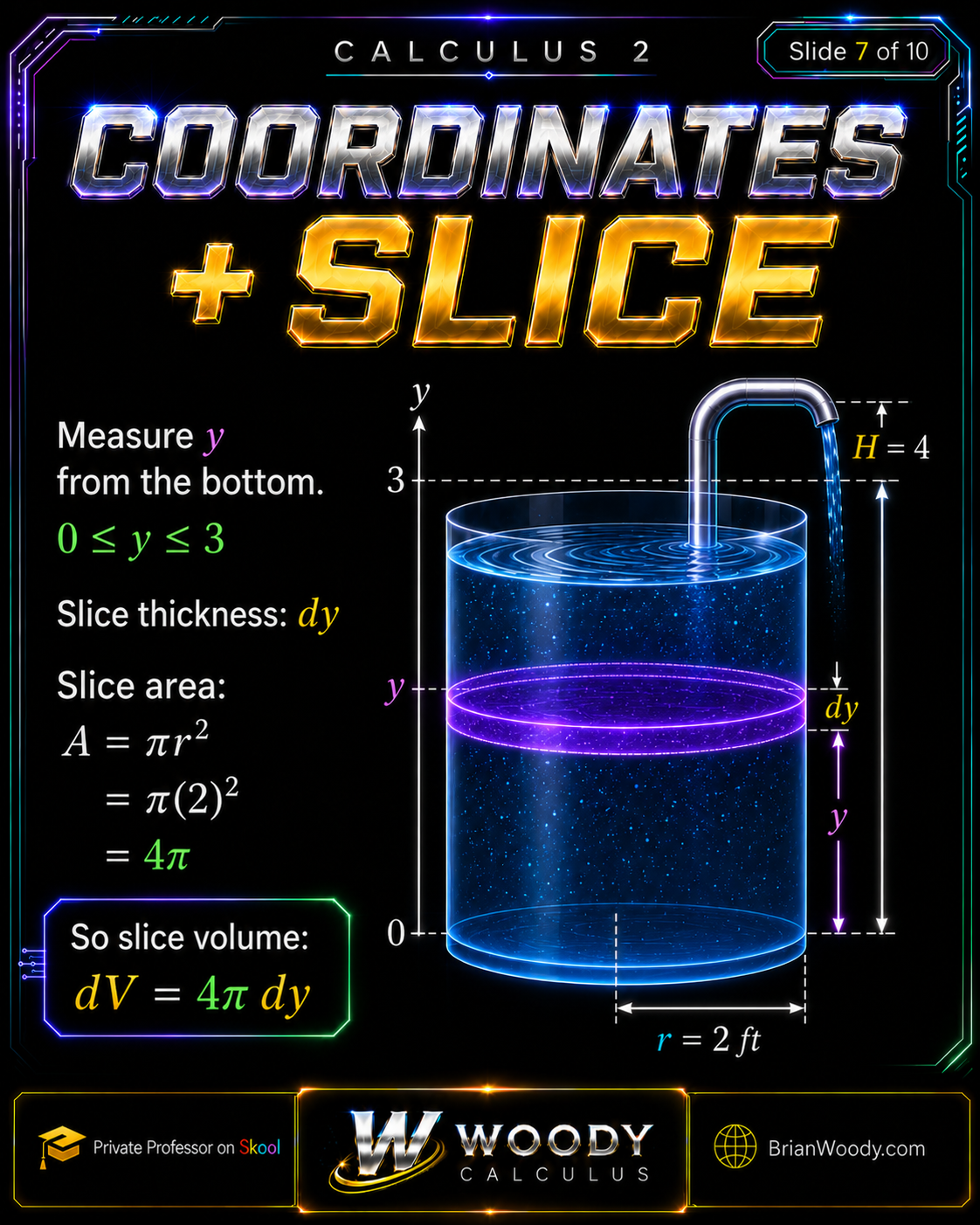
Because the tank is cylindrical, every horizontal slice has the same circular area.
The slice radius is:
r=2\text{ ft}.
\]
Therefore:
A=\pi r^2=\pi(2)^2=4\pi\text{ ft}^2.
\]
The slice thickness is \(dy\), so:
\boxed{
dV=4\pi\,dy\text{ ft}^3.
}
\]
The liquid occupies:
\boxed{0\le y\le3.}
\]
Build the Differential Work \(dW\)
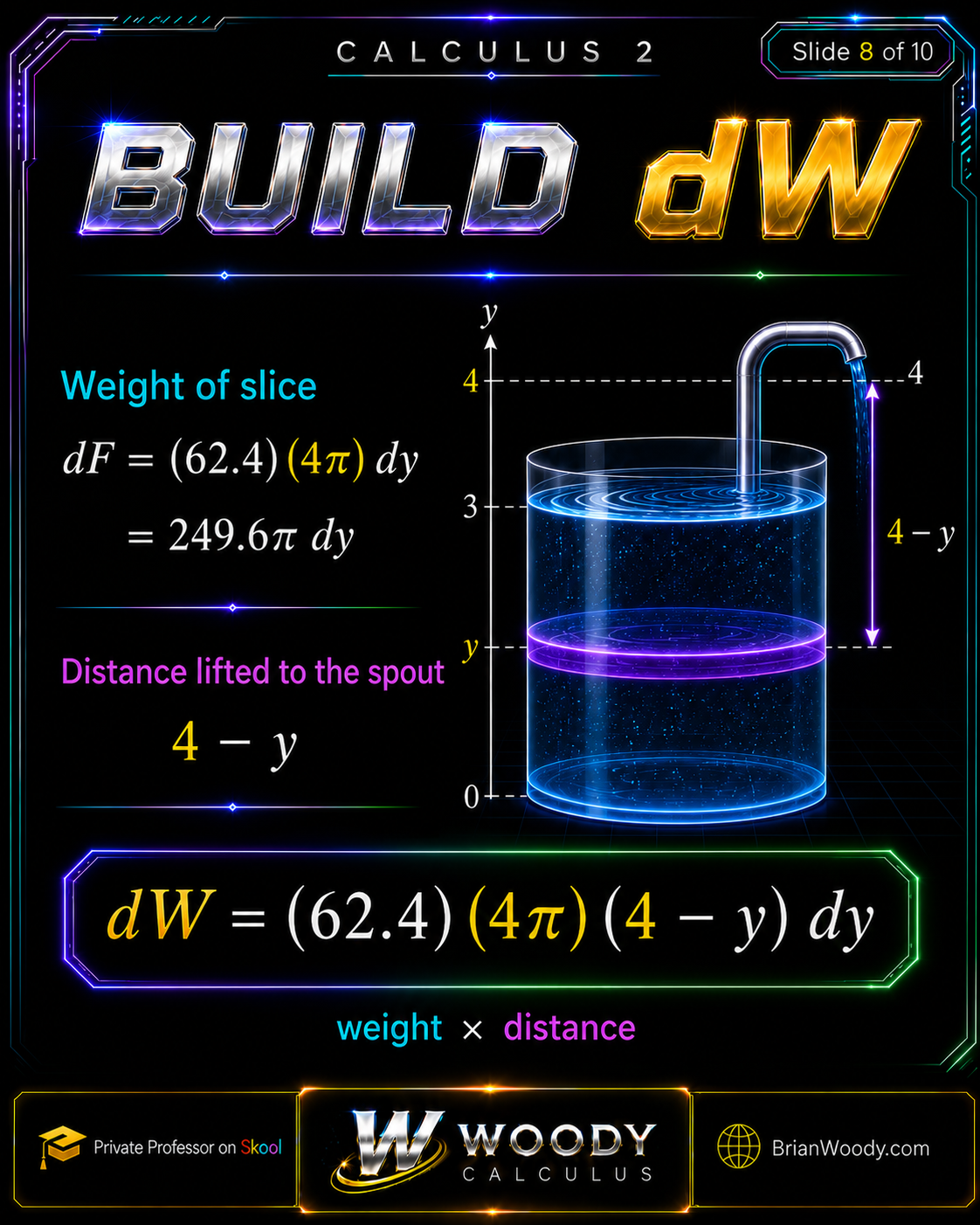
Multiply the weight of one slice by the distance that slice must be lifted.
Step 1: Find the Slice Weight
dF=(62.4)(4\pi)\,dy.
\]
\boxed{
dF=249.6\pi\,dy\text{ lb}.
}
\]
Step 2: Find the Lift Distance
The outlet is at \(H=4\), while the slice is at height \(y\). Therefore:
\boxed{
\text{lift distance}=4-y.
}
\]
Step 3: Multiply Weight by Distance
\boxed{
dW=(62.4)(4\pi)(4-y)\,dy.
}
\]
Equivalently:
dW=249.6\pi(4-y)\,dy.
\]
Calculate the Total Work
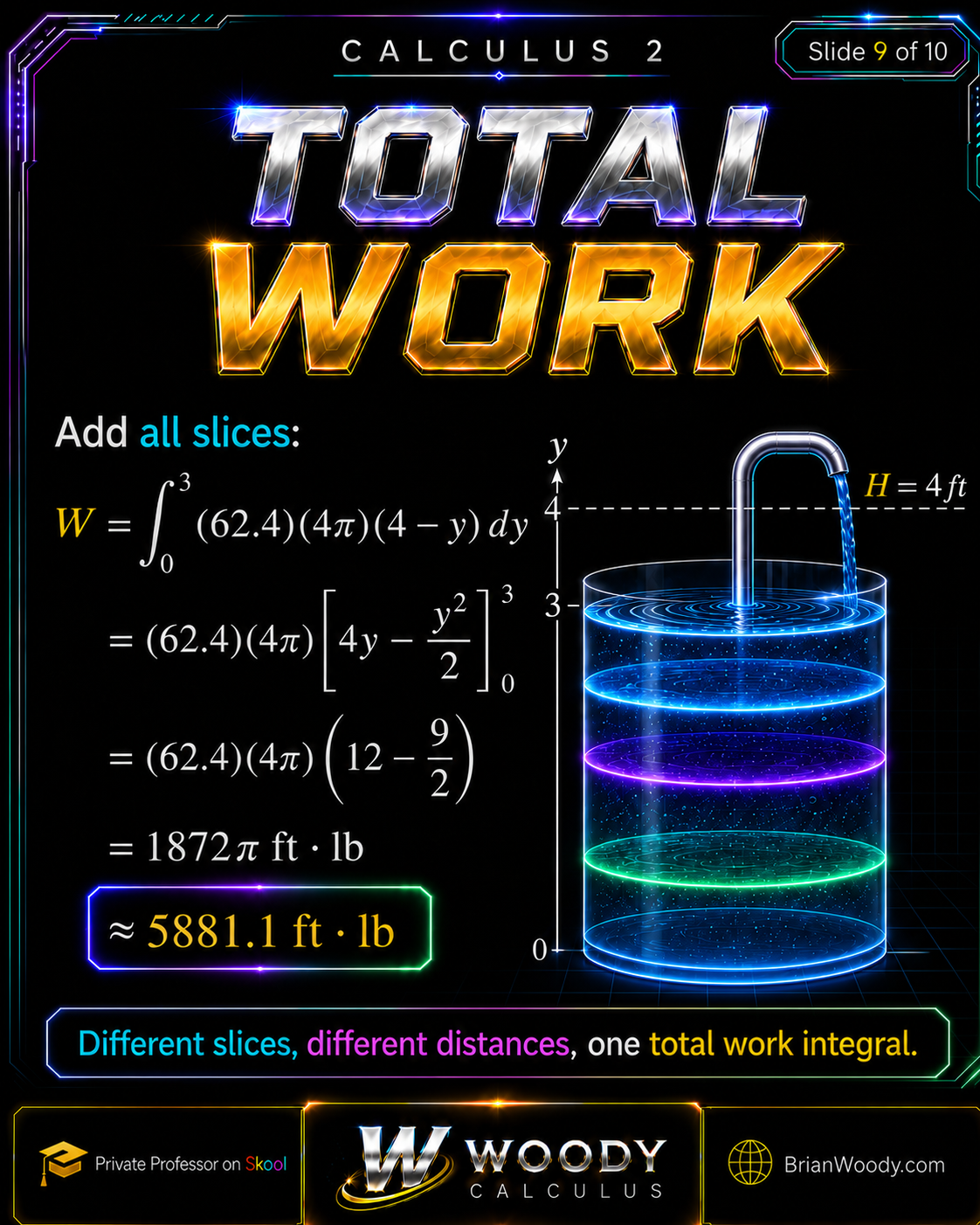
Add the work performed on every slice from the bottom \(y=0\) to the water surface \(y=3\).
W=
\int_0^3
(62.4)(4\pi)(4-y)\,dy.
\]
Factor out the constants:
W=
(62.4)(4\pi)
\int_0^3(4-y)\,dy.
\]
Integrate:
W=
(62.4)(4\pi)
\left[
4y-\frac{y^2}{2}
\right]_0^3.
\]
Evaluate the bounds:
W=
(62.4)(4\pi)
\left(
12-\frac92
\right).
\]
W=
(62.4)(4\pi)
\left(
\frac{15}{2}
\right).
\]
Simplify:
\boxed{
W=1872\pi\text{ ft}\cdot\text{lb}.
}
\]
Decimal approximation:
\boxed{
W\approx5881.1\text{ ft}\cdot\text{lb}.
}
\]
Plain-language answer: approximately \(5881.1\) foot-pounds of work are required to pump all of the water through the spout.
Unit and Reasonableness Check
Dimensional analysis confirms that the final unit must be force multiplied by distance.
\left(\frac{\text{lb}}{\text{ft}^3}\right)
(\text{ft}^2)
(\text{ft})
(\text{ft})
=
\text{ft}\cdot\text{lb}.
\]
The four factors are:
- weight density: \(\text{lb/ft}^3\),
- slice area: \(\text{ft}^2\),
- slice thickness: \(\text{ft}\),
- lift distance: \(\text{ft}\).
The result is therefore measured in foot-pounds, as required.
Quick Check Using the Water’s Center of Mass
Because the tank has constant cross-sectional area, the result can be checked by multiplying the total water weight by the distance traveled by its center of mass.
The total water volume is:
V=\pi(2)^2(3)=12\pi\text{ ft}^3.
\]
The total water weight is:
F=(62.4)(12\pi)=748.8\pi\text{ lb}.
\]
The water’s center of mass begins halfway up the tank:
\bar y=\frac32\text{ ft}.
\]
It must be lifted to \(H=4\), so its average lift distance is:
4-\frac32=\frac52\text{ ft}.
\]
Therefore:
W=(748.8\pi)\left(\frac52\right)
=
1872\pi\text{ ft}\cdot\text{lb}.
\]
This independently confirms the integral.
Cross-Sectional Areas for Common Tank Shapes
The main geometric challenge in a pumping problem is usually finding the horizontal slice area \(A(y)\).
| Tank Shape | Slice Area \(A(y)\) | Main Geometry Tool |
|---|---|---|
| Vertical cylinder | \(\pi r^2\) | Constant circular area |
| Vertical cone | \(\pi[r(y)]^2\) | Similar triangles |
| Sphere of radius \(R\) | \(\pi\left(R^2-(y-c)^2\right)\) | Circle equation, where \(c\) is the height of the sphere’s center |
| Rectangular tank | \((\text{length})(\text{width})\) | Constant rectangular area |
| Triangular trough | \((\text{length})(\text{width at height }y)\) | Similar triangles |
Once \(A(y)\) is known, the work formula remains:
W=\delta\int A(y)(H-y)\,dy.
\]
Advanced Extension: What If the Fluid Density Changes?
If weight density varies with height, replace the constant \(\delta\) with a function \(\delta(y)\).
The slice weight becomes:
dF=\delta(y)A(y)\,dy.
\]
The total work becomes:
\boxed{
W=
\int_a^b
\delta(y)A(y)(H-y)\,dy.
}
\]
Most introductory Calculus 2 problems assume constant fluid density, but this generalized formula shows why the slice method extends naturally to layered or nonuniform fluids.
Pumping Water Problems vs. Hydrostatic Force Problems
Pumping-water problems calculate the work required to move a fluid, while hydrostatic-force problems calculate the force exerted by a stationary fluid on a submerged surface.
| Feature | Pumping Water | Hydrostatic Force |
|---|---|---|
| Main Question | How much work moves the liquid? | How much force does the liquid exert? |
| Slice Type | Horizontal liquid slice | Usually a horizontal strip of a submerged plate |
| Key Distance | Lift distance to the outlet | Depth below the fluid surface |
| Core Formula | \(dW=(\text{slice weight})(\text{lift distance})\) | \(dF=(\text{pressure})(\text{strip area})\) |
| Final Unit | Foot-pounds or joules | Pounds or newtons |
Study the companion lesson: Hydrostatic Force Explained: Pressure, Depth, and the Slice Method.
Common Pumping-Water Problem Mistakes
Mistake 1: Using \(W=Fd\) with One Distance
Different slices travel different distances. Use \(dW\) and integrate.
Mistake 2: Measuring Only to the Top of the Tank
If the spout extends above the tank, the water must be lifted to the outlet height.
Mistake 3: Using \(y\) and \(H\) from Different Origins
Both heights must be measured from the same zero level before using \(H-y\).
Mistake 4: Forgetting Slice Thickness
The slice volume is:
dV=A(y)\,dy,
\]
not merely \(A(y)\).
Mistake 5: Confusing Weight Density and Mass Density
In U.S. customary units, \(62.4\text{ lb/ft}^3\) is already weight density.
Mistake 6: Integrating Over the Entire Tank Instead of the Water
The bounds must describe the portion of the tank actually occupied by liquid.
Mistake 7: Using the Wrong Slice Area
In cones, spheres, and troughs, \(A(y)\) changes with \(y\). Use geometry before building the work formula.
Mistake 8: Reporting Pounds Instead of Foot-Pounds
Pounds measure force. Work requires force multiplied by distance.
The Woody Calculus Pumping-Water Checklist
- Draw the tank and outlet.
- Choose a vertical coordinate \(y\).
- Mark the water interval \(a\le y\le b\).
- Mark the absolute outlet height \(H\).
- Take a thin horizontal slice of thickness \(dy\).
- Find the slice area \(A(y)\).
- Write \(dV=A(y)\,dy\).
- Write \(dF=\delta A(y)\,dy\).
- Write the lift distance \(H-y\).
- Build \(dW=\delta A(y)(H-y)\,dy\).
- Integrate from \(a\) to \(b\).
- Check the units and reasonableness.
- Rewrite the complete solution from memory.
Formula memorization matters, but the diagram controls the setup. Coordinate first. Slice second. Weight third. Distance fourth. Integral last.
Pumping Water Problems FAQ
What is a pumping water problem in Calculus 2?
A pumping water problem asks for the work required to lift liquid from a tank to a specified outlet. Because different layers travel different distances, the work is calculated with an integral.
Why are pumping-water problems work problems?
Work equals force multiplied by distance. Each liquid slice has weight and must travel a lift distance, so \(dW=(\text{slice weight})(\text{lift distance})\).
What is the general pumping-water formula?
If \(y\) is measured vertically and the outlet is at height \(H\), then \(W=\delta\int_a^b A(y)(H-y)\,dy\).
Why do pumping problems use horizontal slices?
Every point in a thin horizontal slice is approximately at the same height, so the entire slice has one cross-sectional area and one lift distance.
What does \(62.4\text{ lb/ft}^3\) mean?
It is the approximate weight density of water in U.S. customary units. Multiplying it by a water volume gives the water’s weight in pounds.
Why is the lift distance \(H-y\)?
A slice begins at height \(y\) and must reach the outlet at height \(H\). Final height minus initial height gives \(H-y\).
How do I choose the bounds in a pumping problem?
The bounds are the lowest and highest \(y\)-values occupied by the liquid, not necessarily the full dimensions of the tank.
What changes if the tank is only partially full?
Use the same slice formula, but integrate only over the interval containing liquid.
What if the fluid density changes with height?
If weight density varies with height, replace the constant \(\delta\) with \(\delta(y)\) and use \(W=\int_a^b\delta(y)A(y)(H-y)\,dy\).
What is the difference between pumping water and hydrostatic force?
Pumping-water problems calculate work required to move fluid. Hydrostatic-force problems calculate the force exerted by stationary fluid on a submerged surface.
What units should a pumping-water answer have?
In U.S. customary units, work is measured in foot-pounds. In SI units, work is measured in joules.
How much work is required in the cylindrical-tank example?
For a tank of radius \(2\) ft, water depth \(3\) ft, and outlet height \(4\) ft, the required work is \(1872\pi\text{ ft}\cdot\text{lb}\), approximately \(5881.1\text{ ft}\cdot\text{lb}\).
Master Pumping Water Problems with Woody Calculus
Pumping-water problems become manageable when students stop searching for one giant formula and instead build the work one slice at a time.
The complete chain is:
A(y)\,dy
\longrightarrow
dV
\longrightarrow
\delta\,dV
\longrightarrow
dF
\longrightarrow
dF(H-y)
\longrightarrow
dW
\longrightarrow
\int dW.
\]
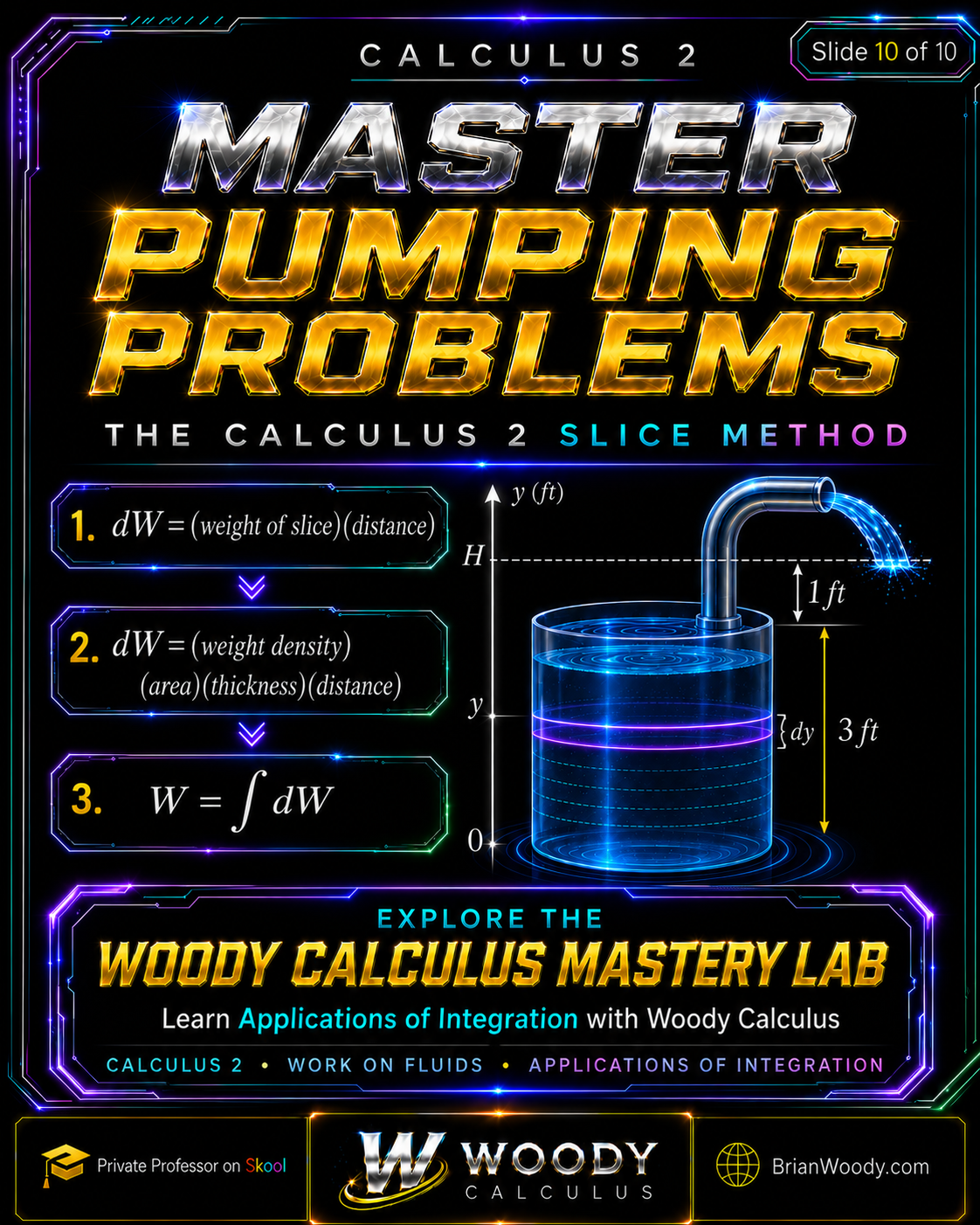
For students who want structured help with pumping water, hydrostatic force, arc length, surface area, volumes of revolution, integration techniques, and exam preparation, join the Woody Calculus Mastery Lab.
The Mastery Lab includes professor-led video lessons, homework solutions, exam solutions, live Q&A, direct chat support, and the Woody Calculus problem-solving system.
Private Instruction
Brian M. Woody works privately with a limited number of serious students who need one-on-one help in Calculus II, Calculus III, Differential Equations, Abstract Algebra, Real Analysis, and advanced mathematics.
Private instruction is selective, requires weekly sessions, and requires enrollment in the Woody Calculus Mastery Lab first. Approval is not guaranteed.
Learn more through the Private Math Tutor and Advanced Mathematics Instruction page.
Related University Math Help Pages
Woody Calculus supports students at major universities with Calculus 2, Calculus 3, Differential Equations, and advanced mathematics. Explore the complete University Calculus Tutor Hub.
- Purdue Applications of Integration and Calculus 2 Help
- University of Florida Calculus 2 Support
- UCF Work Problems and Calculus Help
- Colorado State University Calculus Help
- University of Nevada, Reno Math Support
- Auburn Calculus Tutor and Exam Prep
- University of Alabama Calculus Help
- University of Wisconsin Calculus Tutor
- University of Michigan Calculus Help
- UCLA Calculus 2 Support
- MIT Calculus Tutor
- Caltech Calculus Support
Trusted by Students Nationwide
Woody Calculus helps students build structure, confidence, and exam-ready mathematical skill in demanding STEM courses.
Read Woody Calculus 5-star Google reviews
and view Brian M. Woody’s
5.0 RateMyProfessors rating.