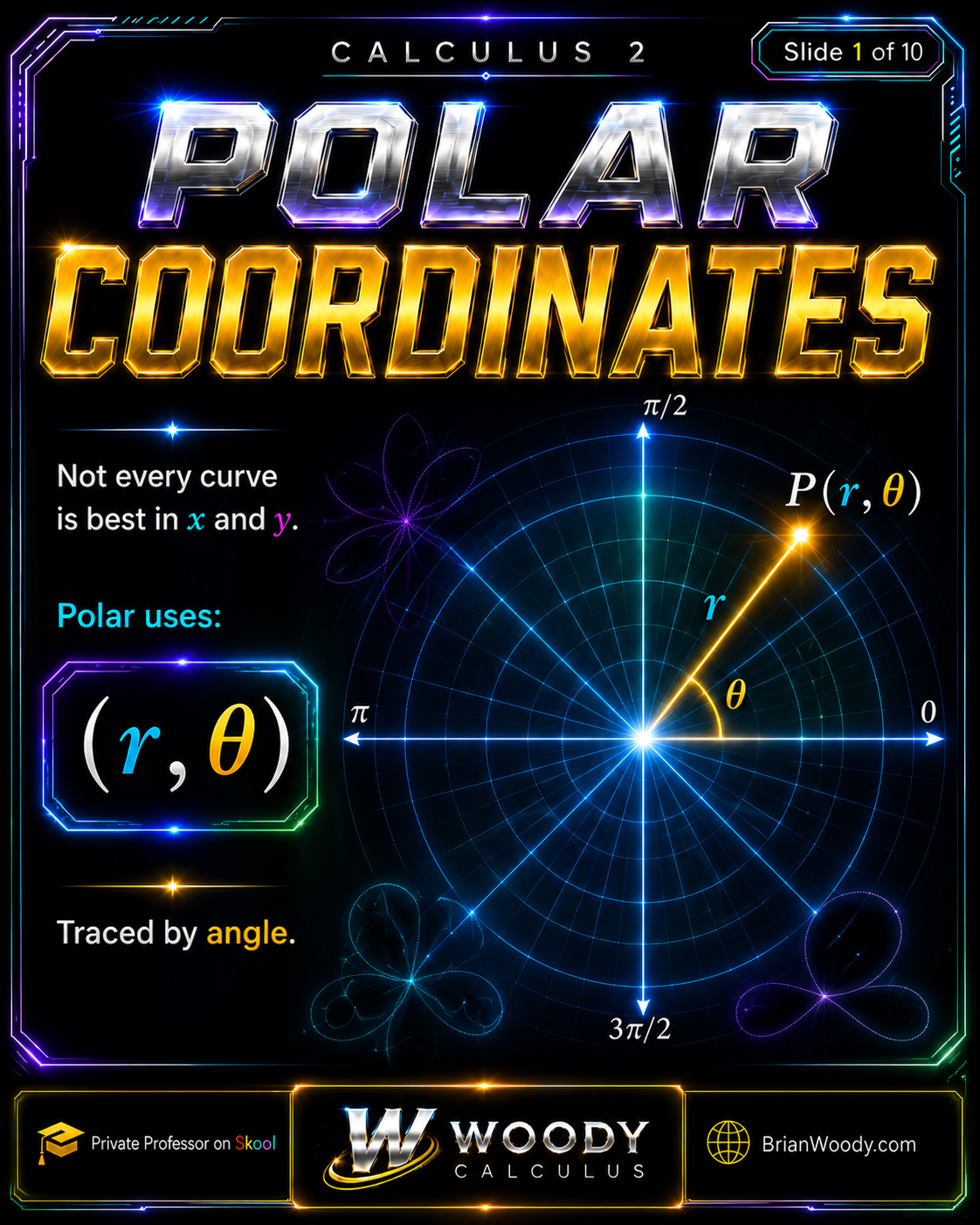
Polar coordinates describe a point using a directed distance \(r\) from the origin, called the pole, and an angle \(\theta\) measured from the positive \(x\)-axis, called the polar axis.
This coordinate system provides a powerful alternative to rectangular coordinates in Calculus 2 and AP Calculus BC.
Rectangular coordinates locate a point by moving horizontally and vertically. Polar coordinates locate a point by choosing a direction and then moving a directed distance in that direction.
Rectangular coordinates ask, “How far right and how far up?” Polar coordinates ask, “Which direction and how far?”
A point in polar coordinates is written:
P(r,\theta),
\]
where \(r\) is the directed distance from the pole and \(\theta\) is the angle measured from the polar axis.
Polar coordinates are especially useful for curves built from rotation, symmetry, petals, loops, and circular geometry. Rose curves, cardioids, limaçons—often typed as limacons—spirals, and many engineering paths are easier to describe in polar form than in rectangular form.
This Woody Calculus lesson develops the complete system: the meaning of \(r\) and \(\theta\), negative radius, coordinate conversion, graphing strategy, symmetry tests, rose curves, cardioids and limaçons, polar area, the area between polar curves, polar slope, polar arc length, and the exact area of the cardioid \(r=1+\cos\theta\).
Published: .
Last updated: .
Estimated read time: 18–22 minutes.
Polar Coordinates Glossary
- Pole
- The origin of the polar coordinate system.
- Polar axis
- The positive \(x\)-axis from which \(\theta\) is measured.
- Directed radius
- The coordinate \(r\), which may be positive, zero, or negative.
- Polar curve
- A curve defined by an equation relating \(r\) and \(\theta\), usually \(r=f(\theta)\).
- Polar sector
- A wedge-shaped region used to build the polar area formula.
What Are Polar Coordinates?
Polar coordinates locate a point by specifying a direction angle and a directed distance from the origin.
The two coordinates are:
- \(r\): directed distance from the origin.
- \(\theta\): angle measured from the positive \(x\)-axis.
The origin is called the pole. The positive \(x\)-axis is called the polar axis.
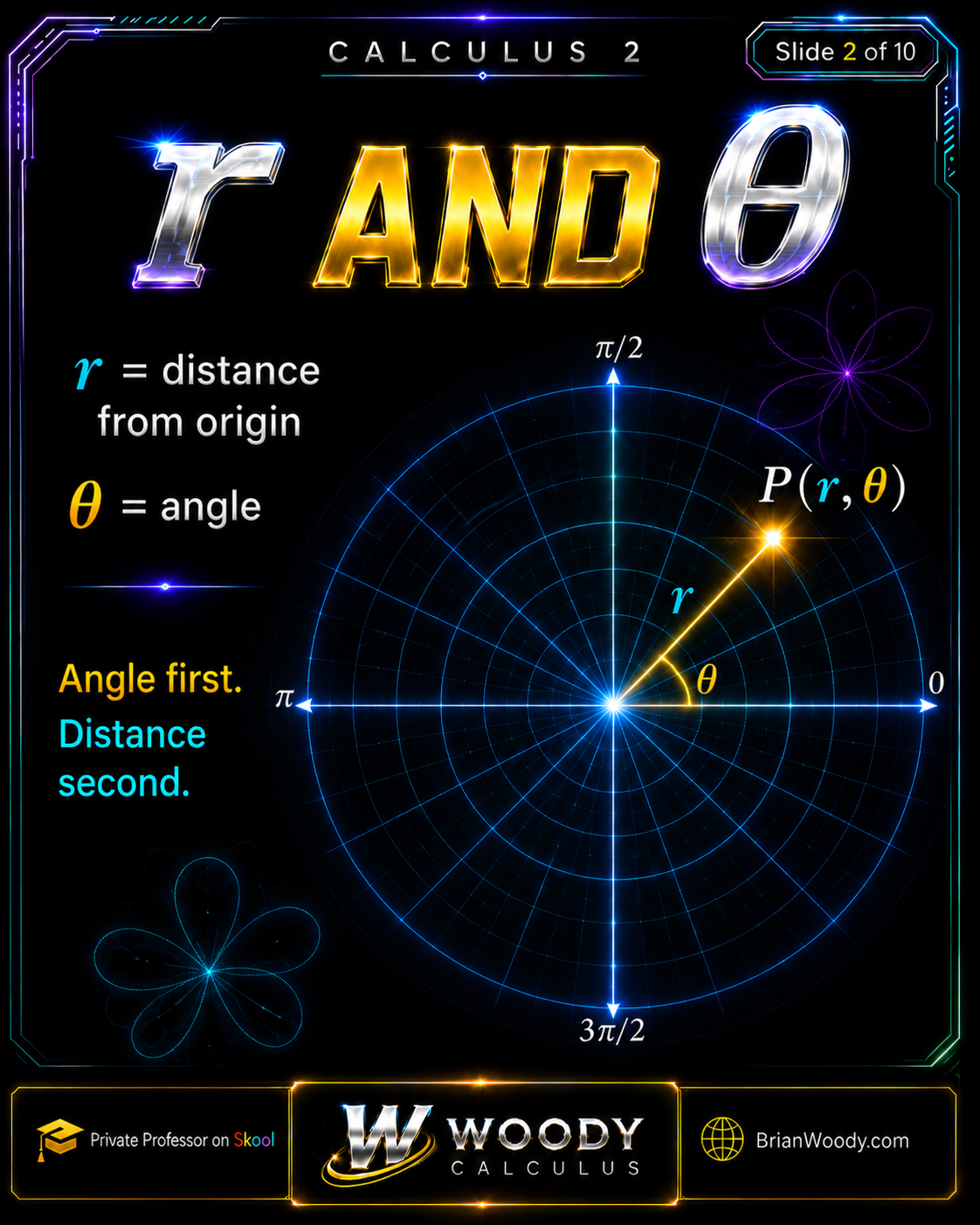
To plot \(P(r,\theta)\):
- Begin at the pole.
- Rotate through the angle \(\theta\).
- Move the directed distance \(r\) along that ray.
Angle first. Distance second.
For example, the point:
\left(3,\frac{\pi}{4}\right)
\]
lies three units from the pole in the direction \(\theta=\pi/4\).
Polar to Rectangular Conversion
Convert a polar point to rectangular coordinates by resolving the directed radius into horizontal and vertical components.
\boxed{x=r\cos\theta}
\]
\boxed{y=r\sin\theta}
\]
Therefore:
(r,\theta)
\quad\longrightarrow\quad
(r\cos\theta,r\sin\theta).
\]
Numeric Example: Convert \(\left(2,\frac{\pi}{6}\right)\) to Rectangular Coordinates
Use \(x=r\cos\theta\):
x=2\cos\left(\frac{\pi}{6}\right)
=
2\left(\frac{\sqrt3}{2}\right)
=
\sqrt3.
\]
Use \(y=r\sin\theta\):
y=2\sin\left(\frac{\pi}{6}\right)
=
2\left(\frac12\right)
=
1.
\]
Final answer:
\boxed{
\left(2,\frac{\pi}{6}\right)_{\text{polar}}
=
(\sqrt3,1)_{\text{rectangular}}.
}
\]
Plain-language answer: the polar point \(\left(2,\frac{\pi}{6}\right)\) is the rectangular point \((\sqrt3,1)\).
Rectangular to Polar Conversion
Convert a rectangular point to polar coordinates by finding its distance from the origin and then selecting the correct quadrant for its angle.
\boxed{r^2=x^2+y^2}
\]
\tan\theta=\frac{y}{x}.
\]
The tangent equation alone does not determine the quadrant. Choose \(\theta\) using the actual location of \((x,y)\), or use a quadrant-aware angle function.
Numeric Example: Convert \((1,1)\) to Polar Coordinates
First find \(r\):
r=\sqrt{1^2+1^2}=\sqrt2.
\]
Next find \(\theta\):
\tan\theta=\frac11=1.
\]
Since \((1,1)\) lies in Quadrant I:
\theta=\frac{\pi}{4}.
\]
Final answer:
\boxed{
(1,1)_{\text{rectangular}}
=
\left(\sqrt2,\frac{\pi}{4}\right)_{\text{polar}}.
}
\]
Plain-language answer: the rectangular point \((1,1)\) has polar radius \(\sqrt2\) and angle \(\pi/4\).
Equation Conversion Example: Convert \(r=2\cos\theta\) to Rectangular Form
Multiply both sides by \(r\):
r^2=2r\cos\theta.
\]
Use \(r^2=x^2+y^2\) and \(r\cos\theta=x\):
x^2+y^2=2x.
\]
Complete the square:
(x-1)^2+y^2=1.
\]
Plain-language answer: the polar equation \(r=2\cos\theta\) represents a circle centered at \((1,0)\) with radius \(1\).
What Does a Negative Radius Mean in Polar Coordinates?
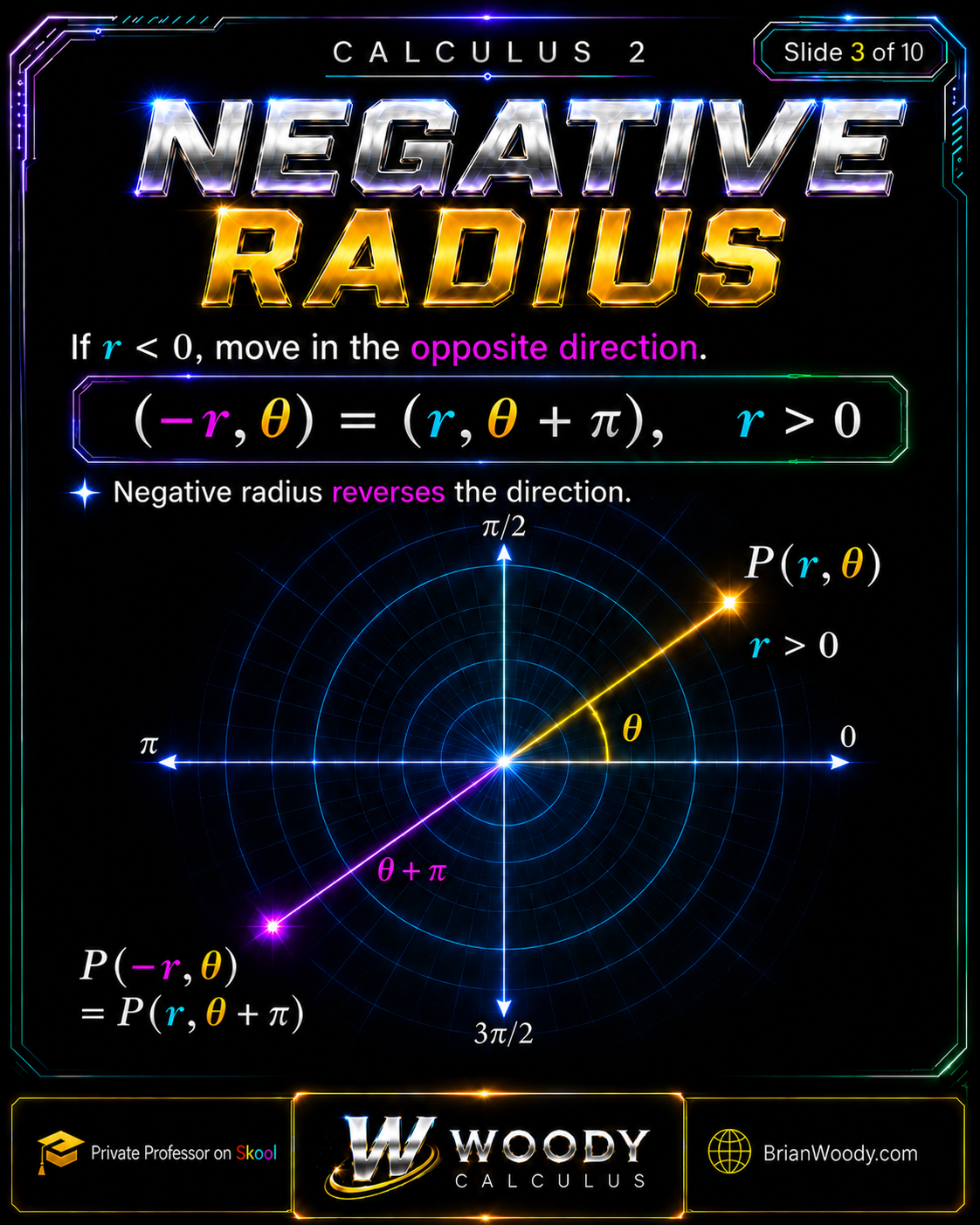
A negative polar radius means move in the direction opposite the stated angle.
A negative radius does not mean that ordinary geometric distance is negative. It changes the direction of travel.
If \(r<0\), move \(|r|\) units in the direction opposite \(\theta\).
\boxed{(-r,\theta)=(r,\theta+\pi)}
\qquad (r>0).
\]
For example:
\left(-2,\frac{\pi}{3}\right)
=
\left(2,\frac{4\pi}{3}\right).
\]
Both coordinate pairs describe the same point.
More generally, for any integer \(k\):
(r,\theta)
=
(r,\theta+2\pi k)
=
(-r,\theta+(2k+1)\pi).
\]
How to Graph Polar Curves
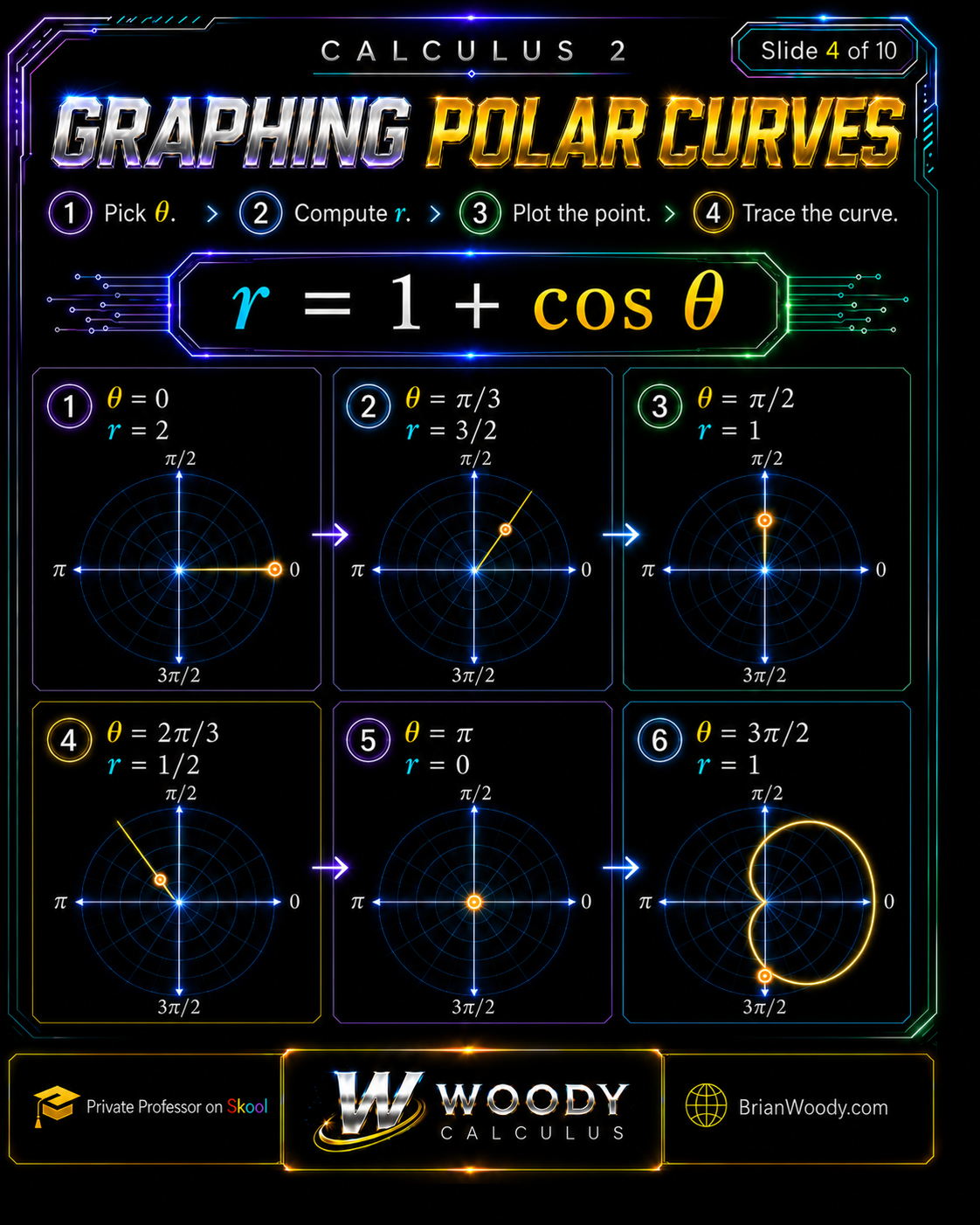
Graph a polar curve by choosing strategic angles, computing the corresponding radii, plotting the points, and tracing the path in increasing-\(\theta\) order.
A rectangular curve is often traced by changing \(x\). A polar curve is traced by changing the angle \(\theta\).
Use this four-step system:
- Choose an angle \(\theta\).
- Compute the corresponding radius \(r\).
- Plot the point \(P(r,\theta)\).
- Continue changing \(\theta\) and trace the curve.
Example: Graph \(r=1+\cos\theta\)
| \(\theta\) | \(\cos\theta\) | \(r=1+\cos\theta\) | Location |
|---|---|---|---|
| \(0\) | \(1\) | \(2\) | Two units on the polar axis |
| \(\pi/3\) | \(1/2\) | \(3/2\) | First quadrant |
| \(\pi/2\) | \(0\) | \(1\) | One unit upward |
| \(2\pi/3\) | \(-1/2\) | \(1/2\) | Second quadrant |
| \(\pi\) | \(-1\) | \(0\) | The curve reaches the pole |
| \(4\pi/3\) | \(-1/2\) | \(1/2\) | Third quadrant |
| \(3\pi/2\) | \(0\) | \(1\) | One unit downward |
| \(5\pi/3\) | \(1/2\) | \(3/2\) | Fourth quadrant |
| \(2\pi\) | \(1\) | \(2\) | Returns to the starting point |
The resulting curve is a right-facing cardioid.
Graph first. Trace the curve. Then choose the interval for calculus.
Polar Symmetry Tests
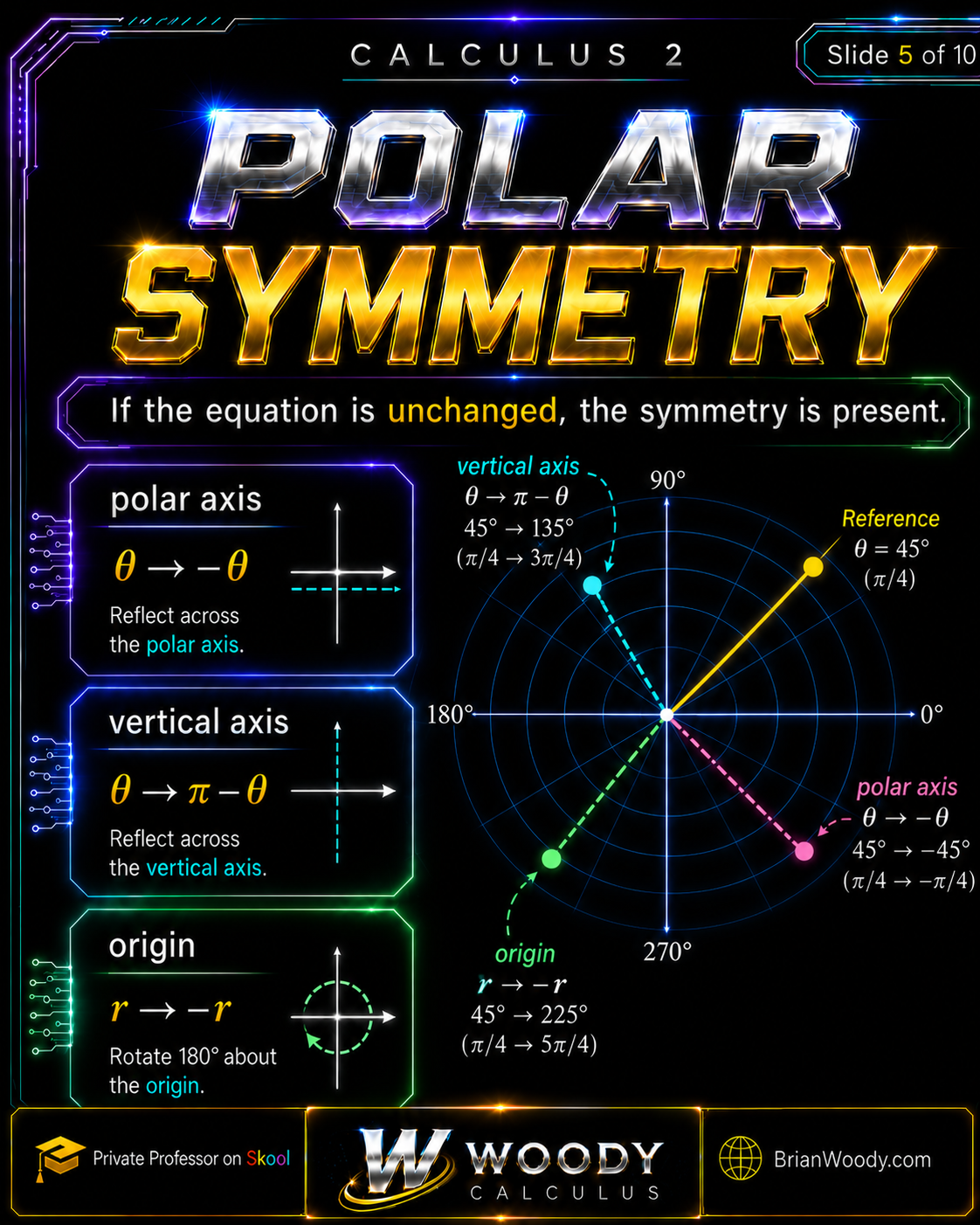
Polar symmetry tests determine whether a curve is reflected across the polar axis, reflected across the vertical axis, or symmetric about the pole.
The substitution must produce the same equation or an equivalent equation.
Symmetry About the Polar Axis
Replace:
\boxed{\theta\longrightarrow-\theta}.
\]
If the equation remains equivalent, the graph is symmetric about the polar axis.
Symmetry About the Vertical Axis
Replace:
\boxed{\theta\longrightarrow\pi-\theta}.
\]
If the equation remains equivalent, the graph is symmetric about the line \(\theta=\pi/2\).
Symmetry About the Pole
Replace:
\boxed{r\longrightarrow-r}.
\]
An equivalent pole-symmetry test is:
\theta\longrightarrow\theta+\pi.
\]
Rose Curves and Petal Count
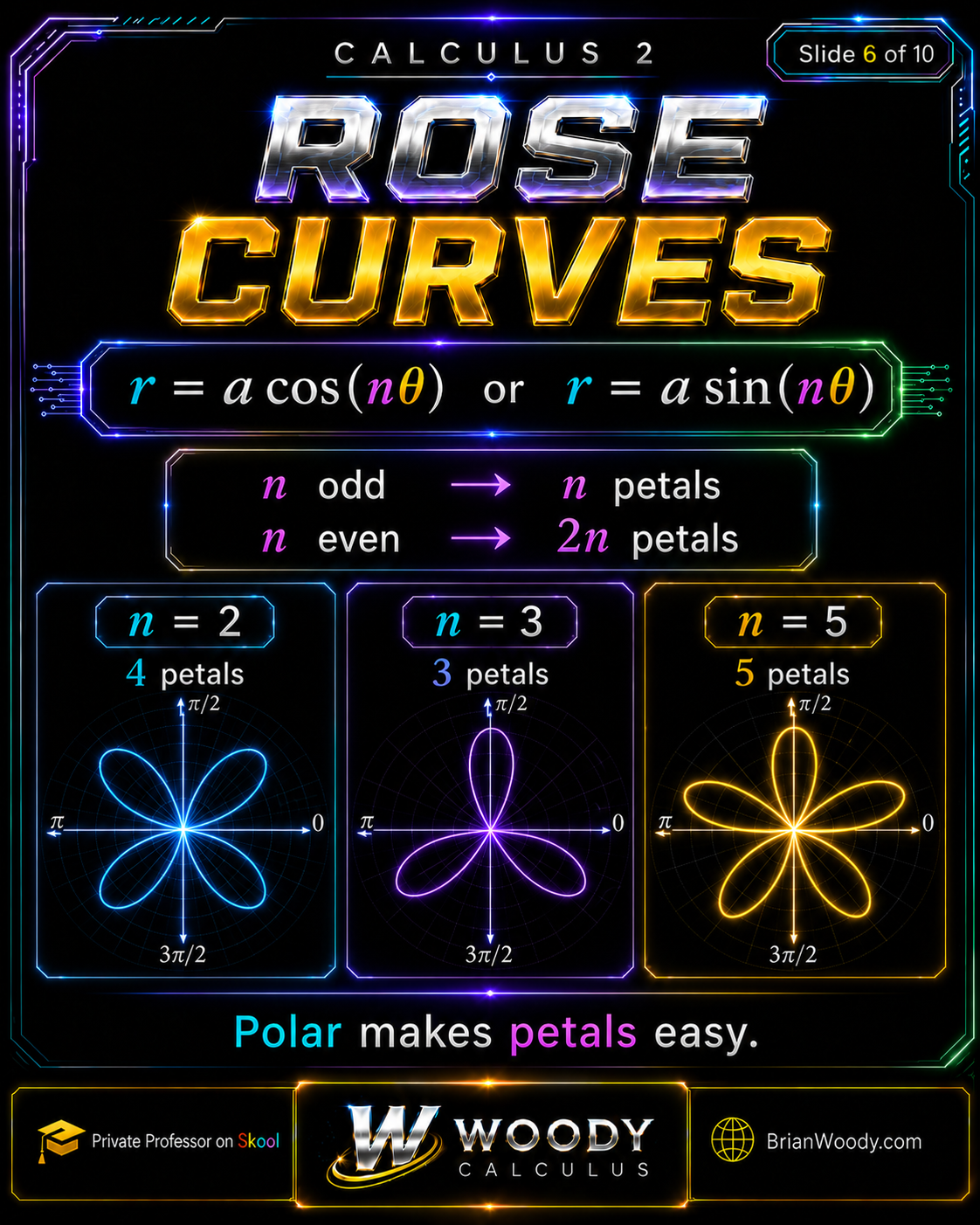
A rose curve is a polar curve with petals generated by an equation of the form \(r=a\cos(n\theta)\) or \(r=a\sin(n\theta)\).
r=a\cos(n\theta)
\qquad\text{or}\qquad
r=a\sin(n\theta),
\]
where \(n\) is a positive integer.
The number of petals follows one of the cleanest rules in polar graphing:
\boxed{
\begin{aligned}
n\text{ odd} &\Longrightarrow n\text{ petals},\\
n\text{ even} &\Longrightarrow 2n\text{ petals}.
\end{aligned}
}
\]
| Equation Type | Value of \(n\) | Petal Count |
|---|---|---|
| \(r=a\cos(2\theta)\) or \(a\sin(2\theta)\) | Even | Four petals |
| \(r=a\cos(3\theta)\) or \(a\sin(3\theta)\) | Odd | Three petals |
| \(r=a\cos(5\theta)\) or \(a\sin(5\theta)\) | Odd | Five petals |
The coefficient \(|a|\) controls the maximum petal length. The sine or cosine choice changes the orientation.
A reliable graphing strategy is to find angles where:
- \(r=0\),
- \(|r|\) is largest,
- the curve begins repeating.
Plain-language answer: odd \(n\) gives \(n\) petals, while even \(n\) gives \(2n\) petals.
Cardioids and Limacons in Polar Coordinates
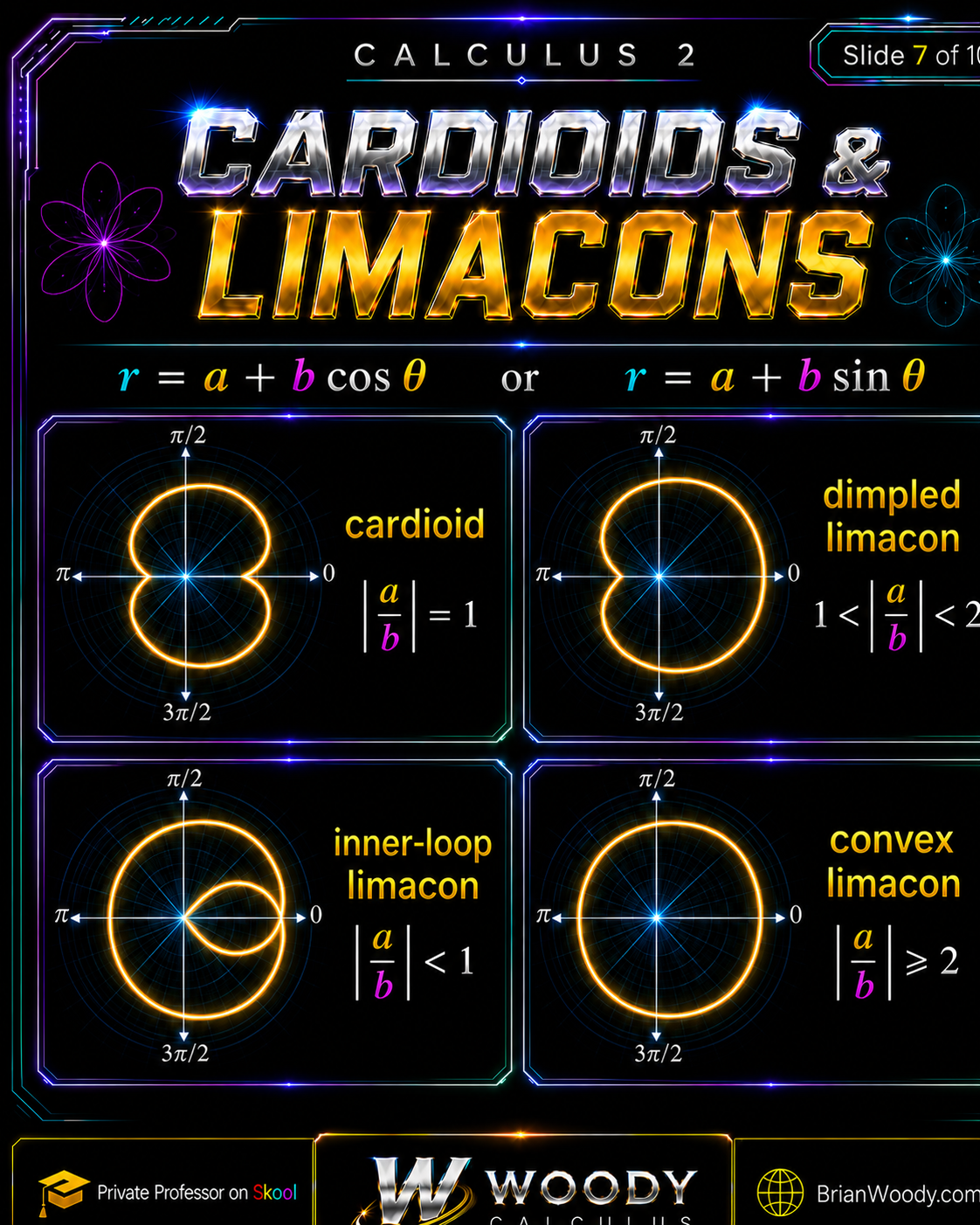
A cardioid is a heart-shaped polar curve with a cusp at the pole, while a limaçon is a related curve that may be convex, dimpled, or contain an inner loop.
Cardioids and limaçons usually have the form:
r=a+b\cos\theta
\qquad\text{or}\qquad
r=a+b\sin\theta.
\]
The ratio \(\left|\frac{a}{b}\right|\) determines the basic shape, assuming \(b\ne0\).
| Ratio | Curve Type | Visual Feature |
|---|---|---|
| \(\left|\frac{a}{b}\right|<1\) | Inner-loop limaçon | The radius becomes negative and creates an inner loop. |
| \(\left|\frac{a}{b}\right|=1\) | Cardioid | The curve has a cusp at the pole. |
| \(1<\left|\frac{a}{b}\right|<2\) | Dimpled limaçon | The curve has an indentation but no inner loop. |
| \(\left|\frac{a}{b}\right|\ge2\) | Convex limaçon | The curve has no indentation or inner loop. |
The trigonometric function determines orientation:
- Cosine forms are oriented primarily left or right.
- Sine forms are oriented primarily up or down.
- The sign of \(b\) determines the specific direction.
Examples:
r=1+\cos\theta
\]
is a right-facing cardioid, while:
r=1-\sin\theta
\]
is a cardioid with its cusp in the upward direction.
Where the Polar Area Formula Comes From
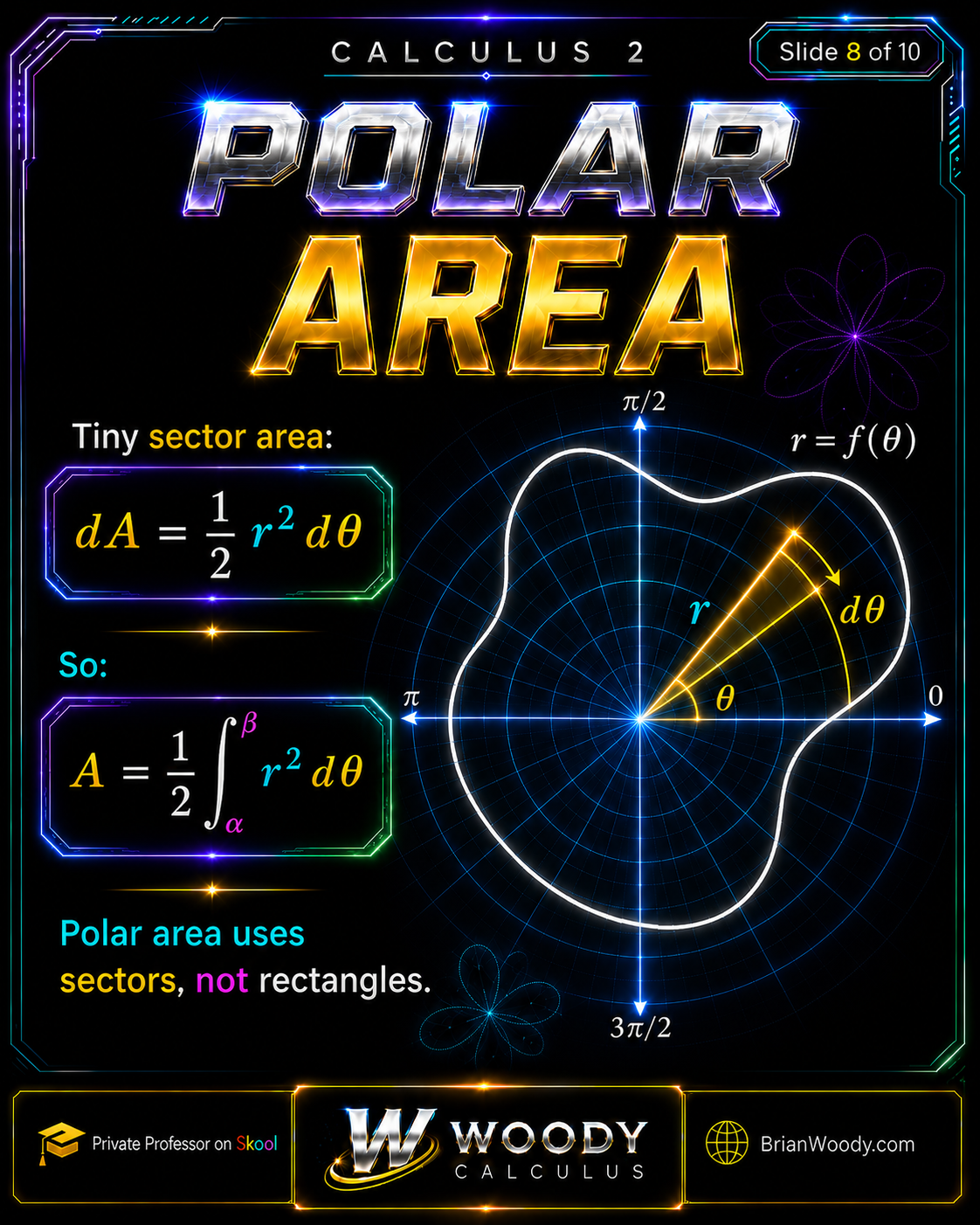
The polar area formula comes from adding the areas of infinitely many thin circular sectors.
Rectangular area is built from thin rectangles. Polar area is built from thin sectors.
The area of a sector with radius \(r\) and small central angle \(d\theta\) is approximately:
dA=\frac12r^2\,d\theta.
\]
Add all the tiny sectors from \(\theta=\alpha\) to \(\theta=\beta\):
\boxed{
A=\frac12\int_\alpha^\beta r^2\,d\theta.
}
\]
If the curve is \(r=f(\theta)\), then:
\boxed{
A=\frac12\int_\alpha^\beta [f(\theta)]^2\,d\theta.
}
\]
The formula itself is usually easy. The real challenge is choosing an interval that traces the intended region exactly once.
Polar area uses sectors, not rectangles.
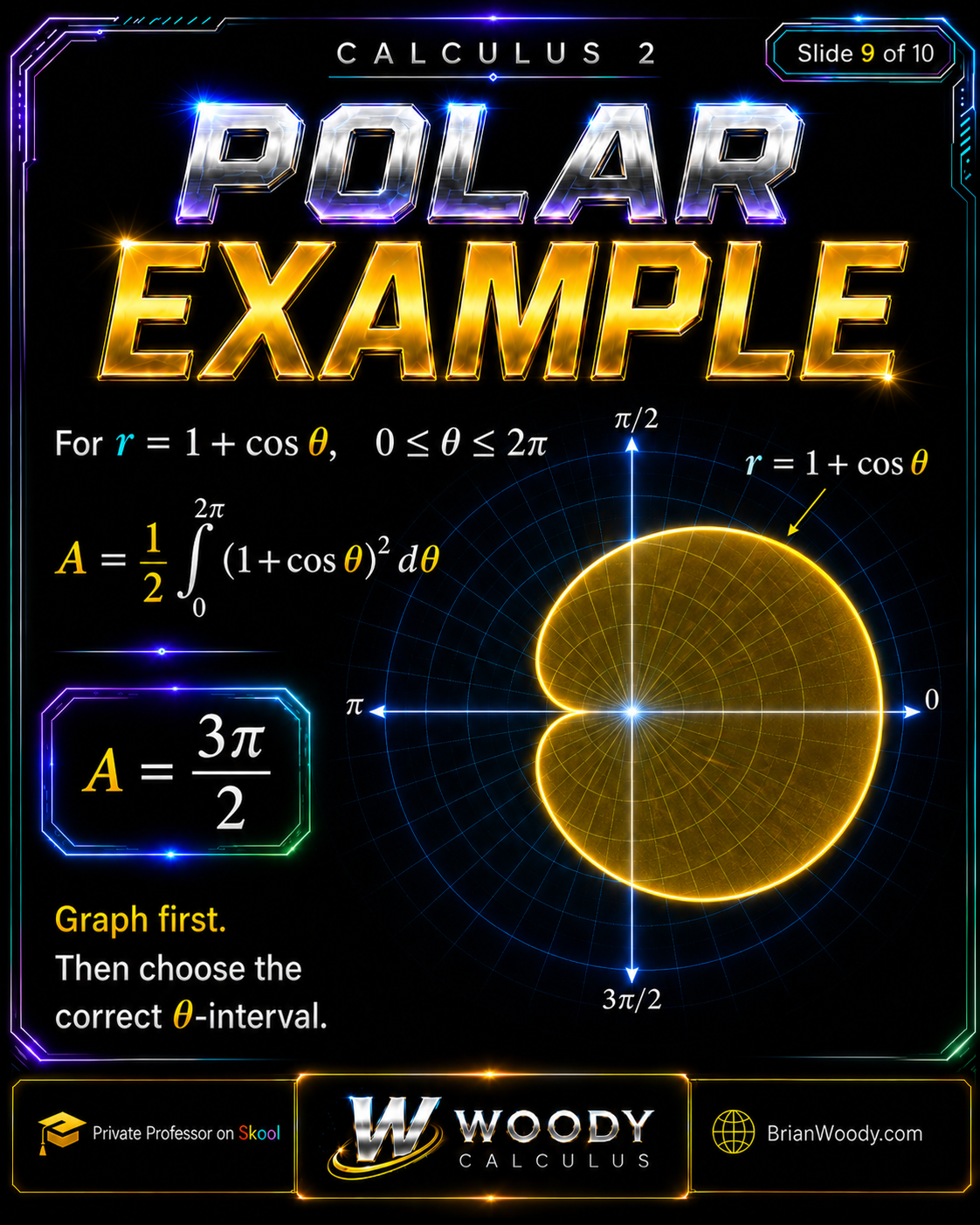
Polar Area Example: Find the Area Inside \(r=1+\cos\theta\)
The full area inside the cardioid \(r=1+\cos\theta\) is found by integrating \(\frac12r^2\) from \(0\) to \(2\pi\).
The interval \(0\le\theta\le2\pi\) traces the entire cardioid exactly once.
Step 1: Write the Polar Area Formula
A=\frac12\int_0^{2\pi}r^2\,d\theta.
\]
Step 2: Substitute the Polar Equation
A=\frac12\int_0^{2\pi}(1+\cos\theta)^2\,d\theta.
\]
Step 3: Expand the Square
A=\frac12\int_0^{2\pi}
\left(1+2\cos\theta+\cos^2\theta\right)\,d\theta.
\]
Step 4: Use the Power-Reduction Identity
\cos^2\theta=\frac{1+\cos(2\theta)}{2}.
\]
Substitute this identity:
A=
\frac12
\int_0^{2\pi}
\left(
1+2\cos\theta+
\frac12+
\frac12\cos(2\theta)
\right)
d\theta.
\]
Step 5: Evaluate the Substituted Terms
\int_0^{2\pi}1\,d\theta=2\pi,
\]
\int_0^{2\pi}2\cos\theta\,d\theta=0,
\]
\int_0^{2\pi}\frac12\,d\theta=\pi,
\]
\int_0^{2\pi}\frac12\cos(2\theta)\,d\theta=0.
\]
Therefore:
A=\frac12(2\pi+\pi).
\]
Final answer:
\boxed{A=\frac{3\pi}{2}.}
\]
Plain-language answer: the exact area inside the cardioid \(r=1+\cos\theta\) is \(\frac{3\pi}{2}\) square units.
How to Find the Area Between Two Polar Curves
Find the area between two polar curves by subtracting the squared inner radius from the squared outer radius.
Suppose \(r_{\text{outer}}(\theta)\) lies outside \(r_{\text{inner}}(\theta)\) on \([\alpha,\beta]\). Then:
\boxed{
A=
\frac12
\int_\alpha^\beta
\left(
r_{\text{outer}}^2-r_{\text{inner}}^2
\right)
d\theta.
}
\]
This is the polar version of outer area minus inner area.
Before integrating:
- Graph both curves.
- Find their intersection angles.
- Determine which radius is larger on the interval.
- Check whether either curve passes through the pole.
- Make sure the region is traced exactly once.
Solving \(r_1=r_2\) finds many intersections, but polar curves can also meet at the pole through different angles. The graph must be part of the solution.
Polar Slope and Arc Length
Polar slope and arc length come from treating \(\theta\) as a parameter.
x=r(\theta)\cos\theta,
\qquad
y=r(\theta)\sin\theta.
\]
Differentiate with respect to \(\theta\):
\frac{dx}{d\theta}
=
r^{\prime}(\theta)\cos\theta-r(\theta)\sin\theta,
\]
\frac{dy}{d\theta}
=
r^{\prime}(\theta)\sin\theta+r(\theta)\cos\theta.
\]
Therefore, when \(\frac{dx}{d\theta}\ne0\):
\boxed{
\frac{dy}{dx}
=
\frac{
r^{\prime}(\theta)\sin\theta+r(\theta)\cos\theta
}{
r^{\prime}(\theta)\cos\theta-r(\theta)\sin\theta
}.
}
\]
The polar arc-length formula is:
\boxed{
L=
\int_\alpha^\beta
\sqrt{
r^2+
\left(\frac{dr}{d\theta}\right)^2
}
\,d\theta.
}
\]
These formulas connect polar coordinates to parametric equations and arc length.
Common Polar Coordinate Mistakes
Mistake 1: Treating \(r\) as an Ordinary Nonnegative Distance
In polar coordinates, \(r\) is directed. Negative values reverse the direction by \(\pi\).
Mistake 2: Using \(\tan^{-1}(y/x)\) Without Checking the Quadrant
The tangent ratio alone does not determine the correct angle. Use the signs of \(x\) and \(y\) to select the quadrant.
Mistake 3: Assuming a Point Has Only One Polar Representation
A single point has infinitely many equivalent polar representations.
Mistake 4: Using the Rose-Curve Petal Rule Backward
Odd \(n\) gives \(n\) petals. Even \(n\) gives \(2n\) petals.
Mistake 5: Integrating Before Graphing
The wrong interval can trace a curve twice, cover only part of it, or calculate the wrong loop.
Mistake 6: Forgetting the Factor of \(\frac12\) in Polar Area
A=\frac12\int r^2\,d\theta.
\]
Mistake 7: Forgetting to Square the Entire Radius
If \(r=1+\cos\theta\), then:
r^2=(1+\cos\theta)^2,
\]
not \(1+\cos^2\theta\).
The Woody Calculus Polar Coordinates Checklist
- Identify the curve family: rose, cardioid, limaçon, circle, spiral, or another polar curve.
- Check symmetry.
- Find where \(r=0\).
- Find where \(|r|\) is largest.
- Build a strategic table of \(\theta\)-values.
- Plot negative-radius points correctly.
- Trace the curve and identify its repeating interval.
- Choose bounds that trace the desired region exactly once.
- For area, use \(\frac12\int r^2\,d\theta\).
- Rewrite the complete solution and say each step out loud.
Formula memorization is required, but a formula cannot choose the correct interval for you. Graph, trace, interpret, and then integrate.
Polar Coordinates FAQ
What are polar coordinates?
Polar coordinates describe a point using a directed distance \(r\) from the origin and an angle \(\theta\) measured from the positive \(x\)-axis.
What do \(r\) and \(\theta\) mean?
The coordinate \(r\) is the directed distance from the origin, and \(\theta\) is the direction angle measured from the polar axis.
What does a negative radius mean?
A negative radius means move in the direction opposite \(\theta\). The points \((-r,\theta)\) and \((r,\theta+\pi)\) are equivalent.
How do you convert polar coordinates to rectangular coordinates?
Use \(x=r\cos\theta\) and \(y=r\sin\theta\).
How do you convert rectangular coordinates to polar coordinates?
Use \(r^2=x^2+y^2\), then determine \(\theta\) from the location of the point and the ratio \(\tan\theta=y/x\).
How do you graph a polar curve?
Choose an angle \(\theta\), compute \(r\), plot \(P(r,\theta)\), repeat for strategic angles, and trace the curve while watching for negative radii, symmetry, and repetition.
What are the three polar symmetry tests?
Test symmetry about the polar axis with \(\theta\to-\theta\), about the vertical axis with \(\theta\to\pi-\theta\), and about the pole with \(r\to-r\) or \(\theta\to\theta+\pi\).
How many petals does a rose curve have?
For \(r=a\cos(n\theta)\) or \(r=a\sin(n\theta)\), odd \(n\) produces \(n\) petals and even \(n\) produces \(2n\) petals.
What is a cardioid?
A cardioid is a heart-shaped polar curve with a cusp at the pole. It commonly has the form \(r=a\pm a\cos\theta\) or \(r=a\pm a\sin\theta\).
What is a limaçon?
A limaçon is a polar curve of the form \(r=a+b\cos\theta\) or \(r=a+b\sin\theta\). Depending on \(\left|a/b\right|\), it may be convex, dimpled, cardioid-shaped, or contain an inner loop.
What is the polar area formula?
The polar area formula is \(A=\frac12\int_\alpha^\beta r^2\,d\theta\).
Why is there a factor of one-half in the polar area formula?
Polar area is built from thin sectors, and a sector with radius \(r\) and small angle \(d\theta\) has area approximately \(\frac12r^2\,d\theta\).
What is the area inside \(r=1+\cos\theta\)?
The full area inside the cardioid \(r=1+\cos\theta\) is \(\frac{3\pi}{2}\).
How do I choose the bounds for a polar area integral?
Graph and trace the curve first. Choose an interval that traces the desired loop or region exactly once.
Master Polar Coordinates with Woody Calculus
Polar coordinates turn rotation and symmetry into algebra.
The central chain is:
\text{choose }\theta
\longrightarrow
\text{compute }r
\longrightarrow
\text{plot}
\longrightarrow
\text{trace}
\longrightarrow
\text{interpret}
\longrightarrow
\text{integrate}.
\]
For students who want structured help with polar coordinates, parametric equations, integration, infinite series, error bounds, and applications of integration, join the Woody Calculus Mastery Lab.
The Mastery Lab gives students access to professor-led video lessons, homework solutions, exam solutions, live Q&A, direct chat support, and the Woody Calculus problem-solving system.
Private Instruction
Brian M. Woody works privately with a limited number of serious students who need one-on-one help in AP Calculus BC, Calculus II, Calculus III, Differential Equations, and advanced mathematics.
Private instruction is selective, requires weekly sessions, and requires enrollment in the Woody Calculus Mastery Lab first. Approval is not guaranteed.
Learn more through the Private Math Tutor and Advanced Mathematics Instruction page.
Related University Math Help Pages
Woody Calculus supports students at major universities with Calculus 2, AP Calculus BC, Calculus 3, Differential Equations, and advanced mathematics. Explore the complete University Calculus Tutor Hub.
- Purdue Calculus 2 and Polar Coordinates Help
- University of Florida Calculus Help
- UCF Calculus 2 and AP Calculus Support
- Colorado State University Calculus Help
- University of Nevada, Reno Math Support
- Auburn Calculus Tutor and Exam Prep
- University of Alabama Calculus Help
- University of Wisconsin Calculus Tutor
- University of Michigan Calculus Help
- UCLA Calculus 2 Support
- MIT Calculus Tutor
- Caltech Calculus Support
Trusted by Students Nationwide
Woody Calculus has helped students build structure, confidence, and exam-ready mathematical skill in demanding STEM courses.
Read Woody Calculus 5-star Google reviews
and view Brian M. Woody’s
5.0 RateMyProfessors rating.