Visual lesson • Proof strategy • Worked examples • Estimated study time: 35–40 minutes
How Can Algebra Collapse Elements to Zero Without Breaking Multiplication?
Ideals and quotient rings are the point where ring theory stops feeling like a list of definitions and starts behaving like a construction machine.
An ideal tells us what can be declared equal to zero; the quotient ring records the algebraic structure that survives.
That single idea explains integers modulo 5, quotient rings such as \(\mathbb Z/6\mathbb Z\),
prime and maximal ideals, and why an irreducible polynomial can create a brand-new field.
Direct Answers
- Ideal in a ring: What is it?
- An ideal is an additive subgroup that absorbs multiplication by every element of the ambient ring.
- Quotient ring \(R/I\): What does it do?
- It treats every element of the ideal \(I\) as zero and groups ring elements into cosets.
- Prime ideal: What does it tell us about the quotient?
- A proper ideal \(P\) is prime exactly when \(R/P\) is an integral domain.
- Maximal ideal: What does it tell us about the quotient?
- A proper ideal \(M\) is maximal exactly when \(R/M\) is a field.
- Irreducible polynomial: Why does it build a field?
- If \(F\) is a field and \(p(x)\in F[x]\) is nonconstant, then \(p(x)\) is irreducible exactly when \((p(x))\) is maximal, exactly when \(F[x]/(p(x))\) is a field.
ideals are the ring-theory version of the subsets we are allowed to collapse. Prime ideals create quotients with no zero divisors. Maximal ideals create fields. In polynomial rings over a field, irreducible polynomials generate maximal ideals, which is why they construct new fields.
![Ideals and quotient rings build new algebraic structures: Z/5Z and Q[x]/(x^2-2) both arise by collapsing an ideal to zero.](https://k3p6r8v3.delivery.rocketcdn.me/wp-content/uploads/2026/08/Ideals-and-Quotient-Rings-Slide-1.png)
Prerequisites and Notation
Throughout the main lesson, \(R\) is a commutative ring with identity \(1\neq0\), unless stated otherwise.
We write \(F\) for an arbitrary field. The slides sometimes use blackboard-bold \(\mathbb F\) for the same generic idea; there is no mathematical difference intended.
Know that every nonzero element of a field has a multiplicative inverse, while a general ring may have zero divisors or nonunits.
Ideals are additive subgroups with an extra multiplication-absorption property.
Be comfortable with \(F[x]\), irreducible polynomials, and the idea of reducing a polynomial modulo another polynomial.
If you have already studied cosets and normal subgroups, the quotient-ring construction will feel familiar.
Why Do We Need Ideals at All?
An ideal is exactly the kind of additive subgroup that can be collapsed to zero while still allowing multiplication to descend to the quotient.
\boxed{\text{ideal}\ \Longrightarrow\ \text{multiplication survives in the quotient}}
\]
This is the ring-theory analogue of normal subgroups in group theory. A normal subgroup is what lets us form a quotient group; an ideal is what lets us form a quotient ring.
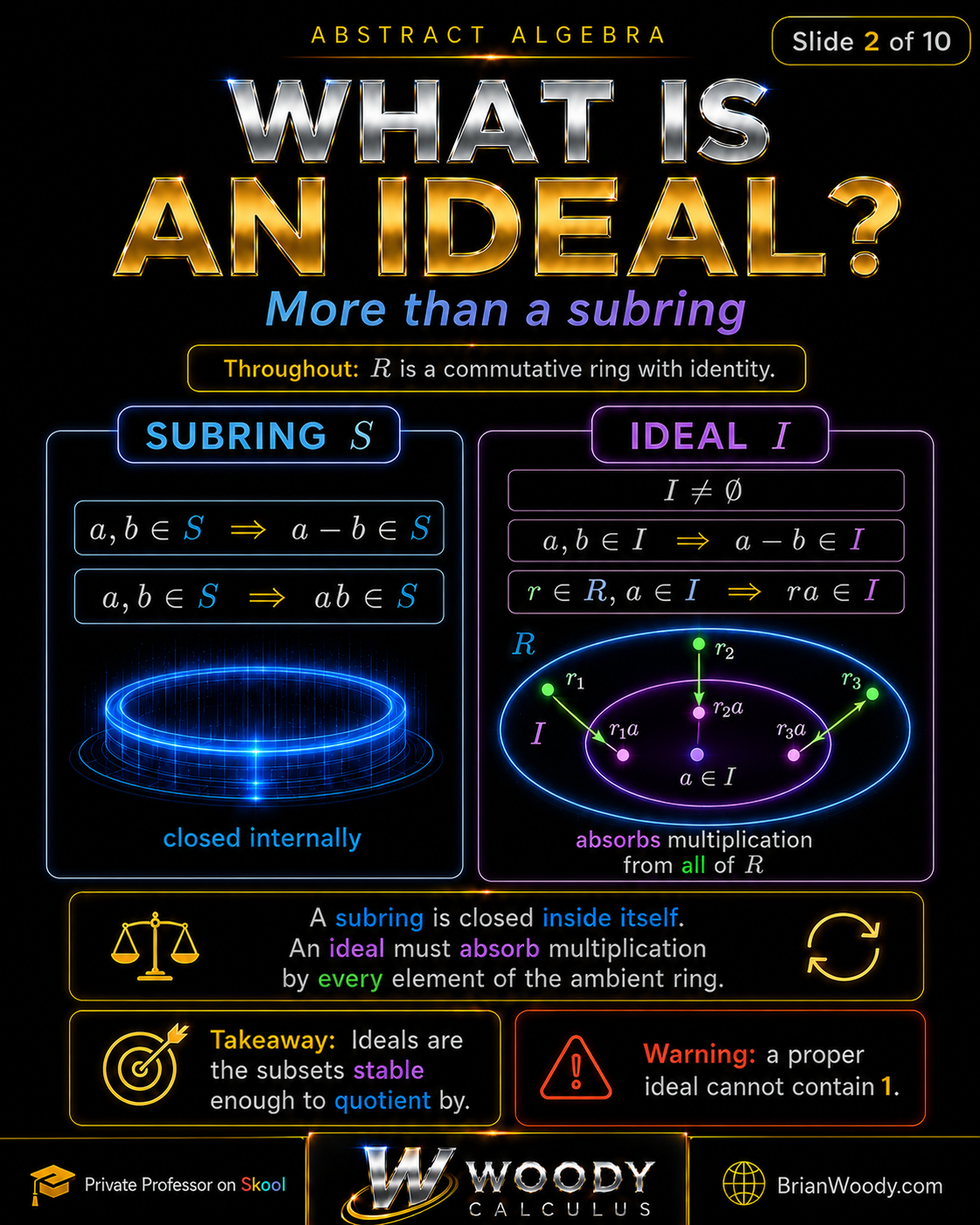
What Is an Ideal?
Ideal test. A subset \(I\subseteq R\) is an ideal if it satisfies the following three conditions.
I\neq\varnothing,\qquad
a,b\in I\Rightarrow a-b\in I,\qquad
r\in R,\ a\in I\Rightarrow ra\in I.
\]
The ideal contains at least one element; the subtraction condition then forces \(0\in I\).
If \(a,b\in I\), then \(a-b\in I\). This makes \(I\) an additive subgroup of \(R\).
If \(a\in I\) and \(r\in R\), then the ambient-ring product \(ra\) stays in \(I\).
A Subring That Is Not an Ideal
The inclusion \(\mathbb Z\subseteq\mathbb Q\) gives a clean counterexample. The integers form a subring of the rationals, but they are not an ideal of \(\mathbb Q\):
1\in\mathbb Z,\qquad \frac12\in\mathbb Q,\qquad \frac12\cdot1=\frac12\notin\mathbb Z.
\]
So the absorption condition fails.
Definition Drill
Write the three ideal conditions from memory three to five times and say each condition aloud as you write it: nonempty, subtraction, absorption. The goal is to make the definition automatic before you start proving things with it.
Principal Ideals: One Generator, All Ring Multiples
If \(a\in R\), the principal ideal generated by \(a\) is
(a)=\{ra:r\in R\}.
\]
Example in the Integers
(6)=\{\ldots,-24,-18,-12,-6,0,6,12,18,24,\ldots\}=6\mathbb Z.
\]
More generally, in \(\mathbb Z\),
\boxed{(n)=n\mathbb Z}.
\]
Therefore the notations \(\mathbb Z/(n)\) and \(\mathbb Z/n\mathbb Z\) describe the same quotient-ring construction.
Example in a Polynomial Ring
(x^2+1)=\{q(x)(x^2+1):q(x)\in F[x]\}.
\]
Examples inside this ideal include \(x^2+1\), \(x(x^2+1)=x^3+x\), and \((x-1)(x^2+1)\).
Why Is \(\mathbb Z[x]\) Not a PID?
The ideal \((2,x)\subseteq\mathbb Z[x]\) is a standard non-principal ideal. It consists of polynomials of the form \(2a(x)+xb(x)\).
Why can’t one polynomial generate \((2,x)\)?
If \((2,x)=(f)\), then \(f\) would divide both \(2\) and \(x\) in \(\mathbb Z[x]\). Since \(f\mid2\), \(f\) must be constant. The only constant divisors that could divide \(x\) are units \(\pm1\), but then \((f)=\mathbb Z[x]\). Yet \((2,x)\) is proper: an equation \(1=2a(x)+xb(x)\) would give \(1=2a(0)\) after setting \(x=0\), impossible in \(\mathbb Z\). Contradiction.
![A principal ideal contains all ring multiples of one generator: (6)=6Z in the integers and (x^2+1) contains every polynomial multiple of x^2+1 in F[x].](https://k3p6r8v3.delivery.rocketcdn.me/wp-content/uploads/2026/08/Ideals-and-Quotient-Rings-Slide-3.png)
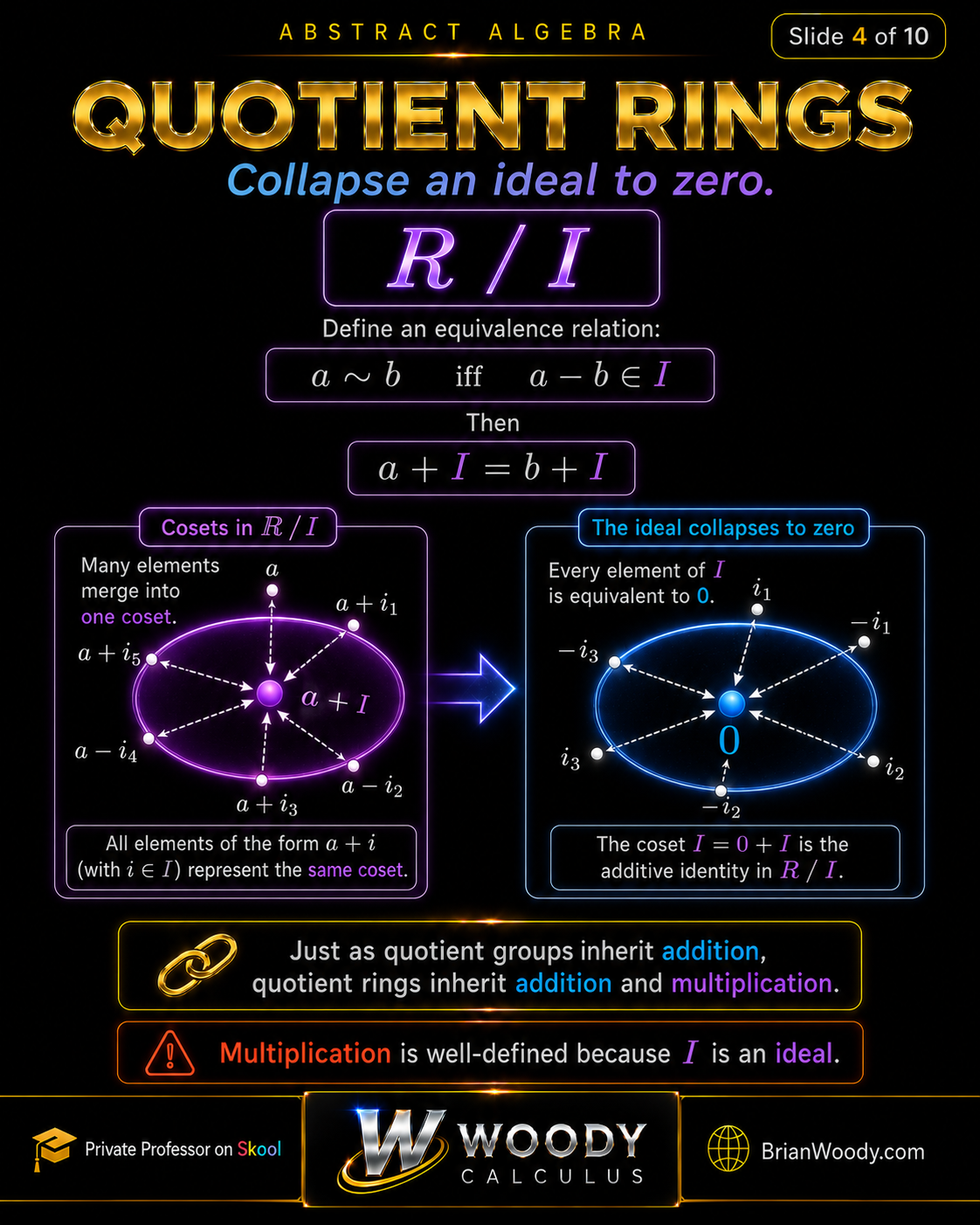
Quotient Rings: Collapse an Ideal to Zero
Let \(I\) be an ideal of \(R\). Define
a\sim b\iff a-b\in I.
\]
The equivalence class of \(a\) is the coset \(a+I\), and the set of all cosets is the quotient ring \(R/I\).
R/I=\{a+I:a\in R\}.
\]
Every element of \(I\) becomes the zero coset because \(i+I=I=0+I\) for every \(i\in I\).
Why Is Multiplication Well-Defined?
This is the mathematical heart of the construction. We want to define
(a+I)(b+I)=ab+I,
\]
but a coset has many representatives. Suppose \(a+I=a^{\prime}+I\) and \(b+I=b^{\prime}+I\). Then \(a-a^{\prime}\in I\) and \(b-b^{\prime}\in I\). We must prove that the products determine the same coset, meaning \(ab-a^{\prime}b^{\prime}\in I\).
Add and subtract the middle term \(ab^{\prime}\):
Swipe formula horizontally if needed →
\begin{aligned}
ab-a^{\prime}b^{\prime}
&=ab-ab^{\prime}+ab^{\prime}-a^{\prime}b^{\prime}\\
&=a(b-b^{\prime})+b^{\prime}(a-a^{\prime}).
\end{aligned}
\]
Because \(b-b^{\prime}\in I\) and \(a-a^{\prime}\in I\), the absorption property gives \(a(b-b^{\prime})\in I\) and \(b^{\prime}(a-a^{\prime})\in I\). Their sum is in \(I\), so \(ab+I=a^{\prime}b^{\prime}+I\).
Ideals Are Kernels: The Ring-Theory Version of Normal Subgroups
If \(\varphi:R\to S\) is a ring homomorphism, then its kernel
\ker\varphi=\{r\in R:\varphi(r)=0\}
\]
is an ideal of \(R\). Conversely, every ideal \(I\) occurs as a kernel: use the natural quotient map
\pi:R\to R/I,\qquad \pi(r)=r+I,
\]
whose kernel is exactly \(I\).
\[
R/I\cong\operatorname{im}\varphi.
\]
This is the ring analogue of the quotient-by-the-kernel theorem from group theory.
See the existing group homomorphisms lesson and quotient groups lesson for the parallel group-theory story.
Is \(\mathbb Z/6\mathbb Z\) a Field?
No. The quickest reason is that \(\mathbb Z/6\mathbb Z\) has nonzero zero divisors.
The quotient has six residue classes:
[0],[1],[2],[3],[4],[5].
\]
But
[2][3]=[6]=[0],
\qquad [2]\neq[0],\ [3]\neq[0].
\]
So the quotient has nonzero zero divisors. Therefore it is not an integral domain and hence not a field.
![Z/6Z is not a field because the nonzero classes [2] and [3] multiply to [0], so the quotient has zero divisors and is not an integral domain.](https://k3p6r8v3.delivery.rocketcdn.me/wp-content/uploads/2026/08/Ideals-and-Quotient-Rings-Slide-5.png)
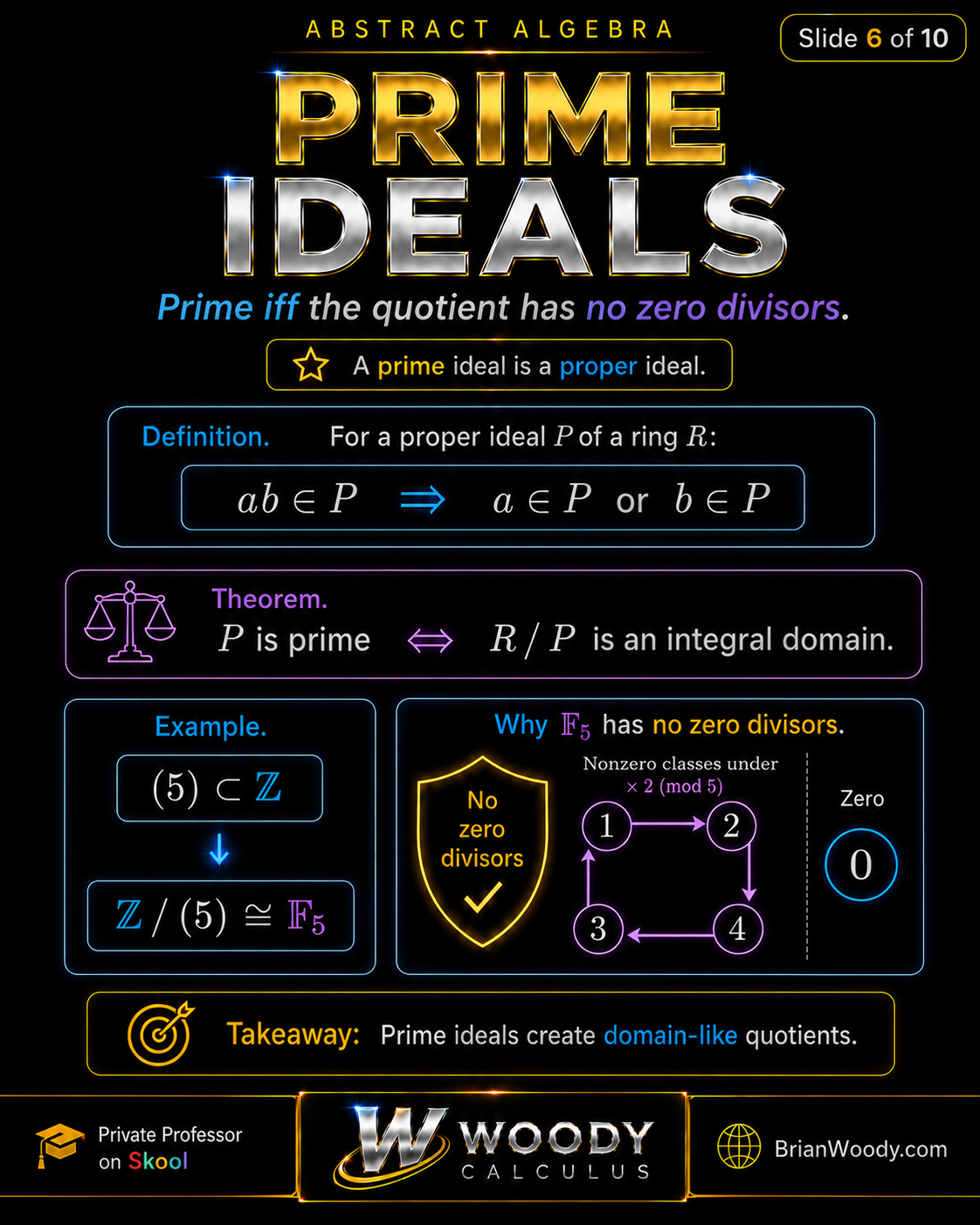
Prime Ideals: Why the Name Comes from Prime Numbers
Prime Ideal Theorem. A proper ideal \(P\subsetneq R\) is prime if and only if \(R/P\) is an integral domain.
P\text{ prime}
\iff
\bigl(ab\in P\Rightarrow a\in P\text{ or }b\in P\bigr)
\iff
R/P\text{ is an integral domain}.
\]
The Prime-Number Connection
Let \(p\) be an ordinary prime number. In \(\mathbb Z\),
ab\in(p)
\iff p\mid ab.
\]
Euclid’s lemma says \(p\mid ab\Rightarrow p\mid a\) or \(p\mid b\), which is exactly the prime-ideal condition for \((p)\).
Example: \((5)\subseteq\mathbb Z\)
\mathbb Z/(5)\cong\mathbb F_5.
\]
Since \(\mathbb F_5\) is a field, it is an integral domain, so \((5)\) is prime.
Maximal Ideals: How Do You Prove an Ideal Is Maximal?
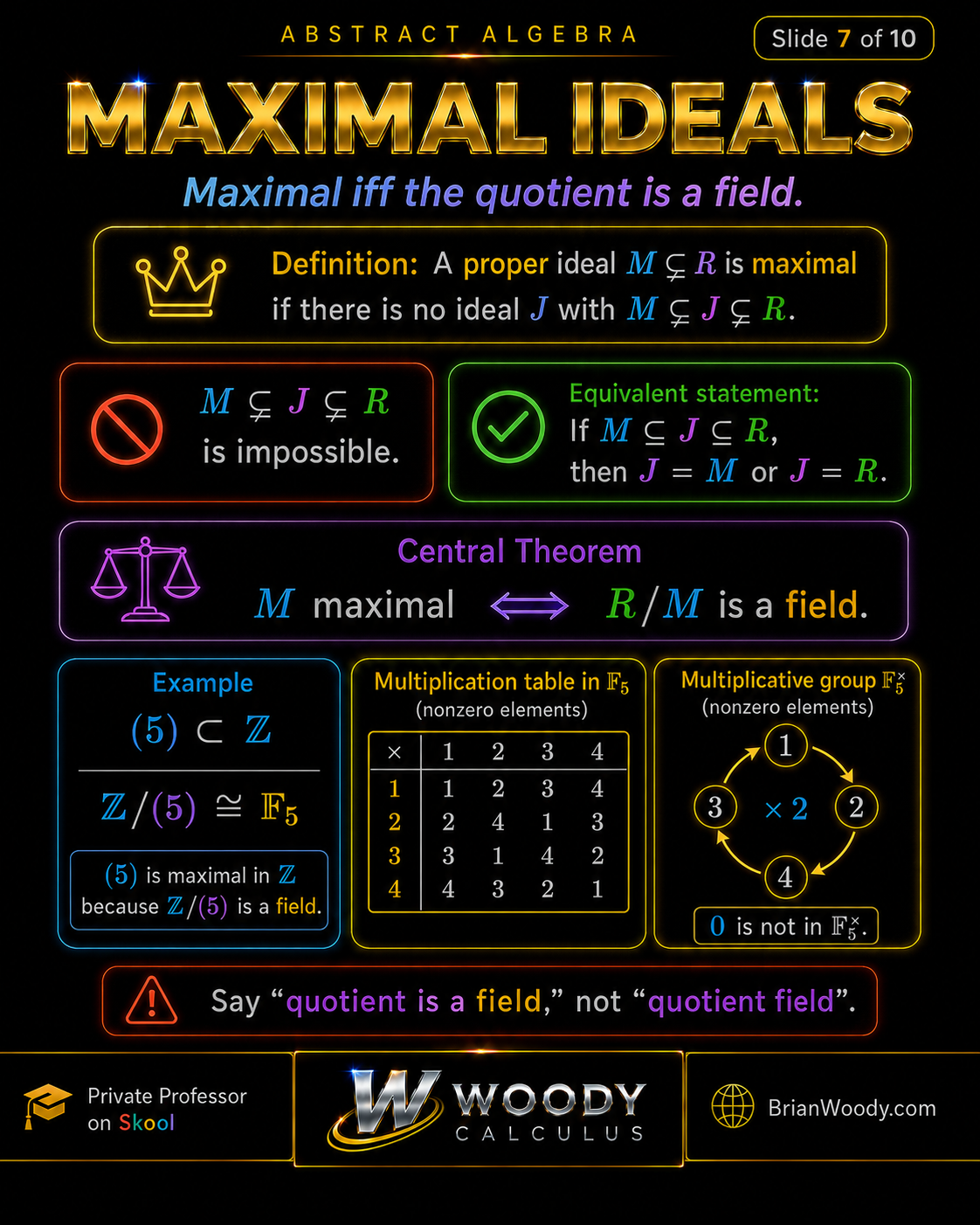
A proper ideal \(M\subsetneq R\) is maximal when no proper ideal lies strictly between \(M\) and \(R\).
M\text{ maximal}
\iff
\text{there is no ideal }J\text{ with }M\subsetneq J\subsetneq R.
\]
The most useful test is usually the quotient theorem:
\boxed{M\text{ maximal}\iff R/M\text{ is a field}.}
\]
Fast Proof Strategy
This is often the shortest route, especially for ideals in \(\mathbb Z\) and \(F[x]\).
Show that every ideal \(J\) with \(M\subseteq J\subseteq R\) must equal \(M\) or \(R\).
Example: \((5)\subseteq\mathbb Z\)
We have \(\mathbb Z/(5)\cong\mathbb F_5\), and \(\mathbb F_5\) is a field. Therefore \((5)\) is maximal in \(\mathbb Z\).
Prime Ideal vs. Maximal Ideal: What’s the Difference?
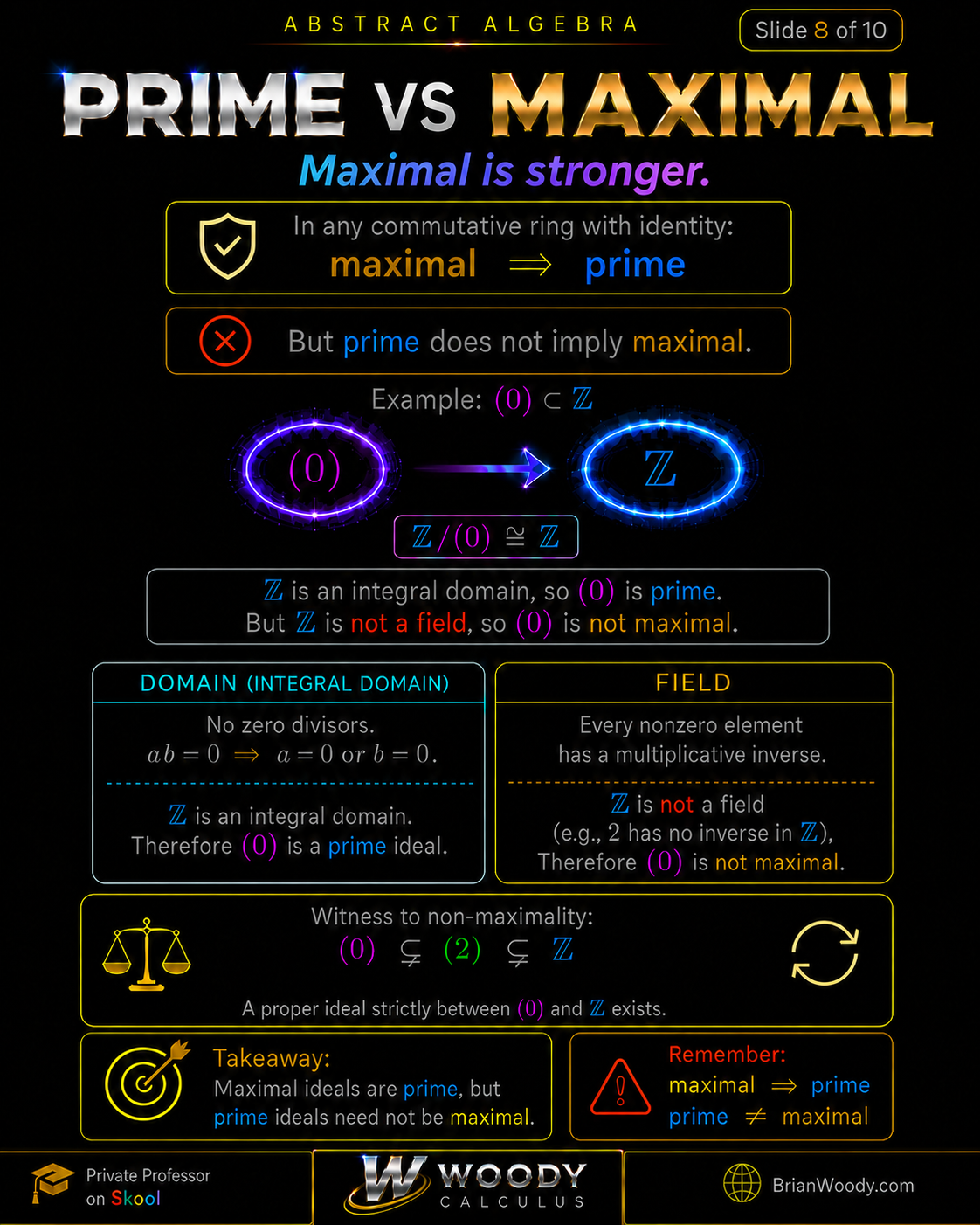
Every maximal ideal is prime, but a prime ideal need not be maximal.
\boxed{\text{maximal}\Longrightarrow\text{prime}},
\qquad
\boxed{\text{prime}\not\Longrightarrow\text{maximal}}.
\]
Why Does Maximal Imply Prime?
If \(M\) is maximal, then \(R/M\) is a field. Every field has no zero divisors: if \(ab=0\) and \(a\neq0\), multiply by \(a^{-1}\) to get \(b=0\). Therefore every field is an integral domain. Hence \(R/M\) is an integral domain, so \(M\) is prime.
Counterexample to the Converse: \((0)\subseteq\mathbb Z\)
\mathbb Z/(0)\cong\mathbb Z.
\]
The integers are an integral domain, so \((0)\) is prime. But \(\mathbb Z\) is not a field, so \((0)\) is not maximal. You can see the failure directly:
(0)\subsetneq(2)\subsetneq\mathbb Z.
\]
| Feature | Prime ideal \(P\) | Maximal ideal \(M\) |
|---|---|---|
| Must be proper? | Yes | Yes |
| Defining multiplication condition | \(ab\in P\Rightarrow a\in P\) or \(b\in P\) | No direct product condition; no proper ideal lies strictly above \(M\) |
| Quotient characterization | \(R/P\) is an integral domain | \(R/M\) is a field |
| Example in \(\mathbb Z\) | \((0)\) and \((p)\) for prime \(p\) | \((p)\) for prime \(p\) |
| Example in \(F[x]\) | \((p(x))\) when \(p(x)\) is irreducible | \((p(x))\) when \(p(x)\) is irreducible |
| Logical relation | Need not be maximal | Always prime |
Why Do Irreducible Polynomials Build Fields?
This is the payoff connecting ideals to the previous Polynomial Rings and Irreducibility lesson.
Polynomial quotient theorem. If \(F\) is a field and \(p(x)\in F[x]\) is nonconstant, then
Swipe formula horizontally if needed →
\boxed{
p(x)\text{ irreducible in }F[x]
\iff
(p(x))\text{ maximal}
\iff
F[x]/(p(x))\text{ is a field}.}
\]
Example: Build \(\mathbb Q(\sqrt2)\)
The polynomial \(x^2-2\) is irreducible over \(\mathbb Q\), so \((x^2-2)\) is maximal in \(\mathbb Q[x]\). Therefore
\mathbb Q[x]/(x^2-2)\cong\mathbb Q(\sqrt2).
\]
If \(\alpha=[x]\), then \(\alpha^2=2\), and every element has the form \(a+b\alpha\) with \(a,b\in\mathbb Q\).
Example: Build \(\mathbb F_4\)
The polynomial \(x^2+x+1\) has no root in \(\mathbb F_2\), so it is irreducible. Hence
\mathbb F_2[x]/(x^2+x+1)\cong\mathbb F_4.
\]
With \(\alpha=[x]\), the relation \(\alpha^2+\alpha+1=0\) reduces every polynomial to a unique expression \(a+b\alpha\) with \(a,b\in\mathbb F_2\).
![An irreducible polynomial p(x) in F[x] generates a maximal ideal, so F[x]/(p(x)) is a field; examples construct Q(sqrt2) and F4.](https://k3p6r8v3.delivery.rocketcdn.me/wp-content/uploads/2026/08/Ideals-and-Quotient-Rings-Slide-9.png)
Professor Woody’s Exam Method
Do not begin by manipulating symbols. First identify what structural question the problem is asking.
Check nonemptiness, subtraction closure, and absorption by arbitrary ring elements.
Identify the cosets and write down what becomes zero.
Search for nonzero zero divisors.
Either use the product definition or prove the quotient is an integral domain.
Usually prove the quotient is a field; alternatively rule out intermediate ideals.
Test whether \(p(x)\) is irreducible over the coefficient field.
State explicitly whether the quotient is a ring, an integral domain, or a field and cite the theorem that justifies it.
| If the problem asks… | Strong first move | Common trap |
|---|---|---|
| Is this subset an ideal? | Apply subtraction + absorption | Checking subring closure is not enough |
| What is \(R/I\)? | Describe cosets and the relation imposed by \(I\) | Forgetting that every element of \(I\) becomes zero |
| Is \(\mathbb Z/n\mathbb Z\) a field? | Look at whether \(n\) is prime or find zero divisors | Assuming every modular ring is a field |
| Is \(P\) prime? | Test whether \(R/P\) is a domain | Forgetting that \(P\) must be proper |
| Is \(M\) maximal? | Test whether \(R/M\) is a field | Reversing prime and maximal |
| Is \(F[x]/(p)\) a field? | Test irreducibility of \(p(x)\) | Forgetting that \(F\) must be a field for this PID argument |
Try It Yourself: Four Structural Decisions
Attempt each problem before opening the solution. The last problem is intentionally field-dependent.
Practice A: Why is \(\mathbb Z/(7)\) a field?
Because \(7\) is prime, \((7)\) is maximal in \(\mathbb Z\). Equivalently, \(\mathbb Z/(7)\cong\mathbb F_7\), and \(\mathbb F_7\) is a field.
Practice B: Show \(\mathbb Z/(8)\) is not an integral domain.
[2][4]=[8]=[0],\qquad [2]\neq[0],\ [4]\neq[0].
\]
So \(\mathbb Z/(8)\) has nonzero zero divisors and is not an integral domain.
Practice C: Show \(\mathbb F_2[x]/(x^2+x+1)\) is a field.
The quadratic has no root in \(\mathbb F_2\): \(f(0)=1\) and \(f(1)=1\). Therefore it is irreducible, so \((x^2+x+1)\) is maximal and the quotient is a field.
Practice D: Is \((x^2+1)\) maximal in \(\mathbb R[x]\)? In \(\mathbb C[x]\)?
Over \(\mathbb R\): yes. The quadratic \(x^2+1\) has no real root, so it is irreducible in \(\mathbb R[x]\). Hence \((x^2+1)\) is maximal.
Over \(\mathbb C\): no. We have \(x^2+1=(x-i)(x+i)\), so the polynomial is reducible in \(\mathbb C[x]\). Therefore \((x^2+1)\) is not maximal.
This is the same field-dependence phenomenon studied in the polynomial irreducibility lesson.
Common Mistakes That Cost Points
A subring is internally closed; an ideal must also absorb multiplication from the entire ambient ring.
Prime and maximal ideals are proper ideals. The whole ring is neither prime nor maximal under the standard convention used here.
Maximal implies prime because field implies domain. Prime need not imply maximal.
\(\mathbb Z/6\mathbb Z\) has zero divisors; quotient rings can have much weaker structure than fields.
In \(R/I\), every element of \(I\) represents the zero coset.
A field of fractions is often called a quotient field, so use the precise phrase “the quotient ring is a field.”
The ideal \((p(x))\) is maximal in \(F[x]\) exactly when \(p(x)\) is irreducible over that particular field \(F\).
How Ideals Connect the Rest of Abstract Algebra
Ideals and quotient rings are not an isolated chapter. They sit at the center of the transition from group theory into ring theory, field theory, finite fields, and Galois Theory.
Normal subgroups make quotient groups possible in exactly the way ideals make quotient rings possible.
Ideals are kernels of ring homomorphisms, leading to the ring version of \(R/\ker\varphi\cong\operatorname{im}\varphi\).
Irreducible polynomials in \(F[x]\) generate maximal ideals and therefore field quotients.
Quotients such as \(\mathbb Q[x]/(x^2-2)\) create concrete field extensions.
Irreducible polynomial quotients construct every finite extension \(\mathbb F_{q^n}\).
For comaximal ideals, CRT decomposes one quotient into a product of simpler quotient rings.
Once finite fields are constructed, Frobenius reveals their automorphisms, conjugates, trace, norm, and cyclic Galois structure.
Ideals, quotient rings, irreducibility, and field extensions become part of the language used to study symmetries of polynomial roots.
![Structure map: an ideal I creates R/I; I is prime exactly when R/I is an integral domain, I is maximal exactly when R/I is a field, and irreducible p(x) creates a maximal ideal in F[x].](https://k3p6r8v3.delivery.rocketcdn.me/wp-content/uploads/2026/08/Ideals-and-Quotient-Rings-Slide-10.png)
University and Reference Resources
A detailed university-level treatment of principal ideals, kernels, quotient rings, and the role of ideals in ring theory.
Includes prime ideals, maximal ideals, quotient rings, and the domain/field quotient characterizations.
University course materials including ideals and quotient rings.
Lecture notes on the ideal test, proper ideals, quotient rings, and examples.
Ideals and Quotient Rings FAQ
What is an ideal in Abstract Algebra?
An ideal \(I\) of a commutative ring \(R\) is a nonempty subset closed under subtraction and satisfying the absorption property: if \(a\in I\) and \(r\in R\), then \(ra\in I\).
What is the difference between a subring and an ideal?
A subring is closed under its own ring operations. An ideal must additionally absorb multiplication by every element of the ambient ring. For example, \(\mathbb Z\) is a subring of \(\mathbb Q\) but not an ideal because \((1/2)\cdot1\notin\mathbb Z\).
Why do ideals matter?
Ideals are exactly the additive subgroups that can be collapsed to zero while keeping quotient-ring multiplication well-defined. They are also exactly the kernels of ring homomorphisms.
What is a principal ideal?
A principal ideal is generated by one element: \((a)=\{ra:r\in R\}\). In \(\mathbb Z\), \((n)=n\mathbb Z\); in \(F[x]\), \((p(x))\) contains every polynomial multiple of \(p(x)\).
Why is \(\mathbb Z[x]\) not a PID?
The ideal \((2,x)\subseteq\mathbb Z[x]\) is not principal, so not every ideal of \(\mathbb Z[x]\) can be generated by one element.
What is a quotient ring?
For an ideal \(I\subseteq R\), the quotient ring \(R/I\) is the set of cosets \(a+I\). Elements whose difference lies in \(I\) become equal in the quotient, and every element of \(I\) becomes zero.
Why is multiplication in a quotient ring well-defined?
If \(a-a^{\prime}\in I\) and \(b-b^{\prime}\in I\), then \(ab-a^{\prime}b^{\prime}=a(b-b^{\prime})+b^{\prime}(a-a^{\prime})\in I\) by the absorption property. Thus \(ab+I=a^{\prime}b^{\prime}+I\), so the product is independent of representatives.
Is \(\mathbb Z/6\mathbb Z\) a field?
No. The nonzero classes \([2]\) and \([3]\) satisfy \([2][3]=[0]\), so the quotient has zero divisors and is not an integral domain or a field.
What is a prime ideal?
A proper ideal \(P\) is prime if \(ab\in P\) implies \(a\in P\) or \(b\in P\). Equivalently, \(R/P\) is an integral domain.
Why are prime ideals called prime?
They generalize prime numbers. If \(p\) is a prime integer, Euclid’s lemma says \(p\mid ab\) implies \(p\mid a\) or \(p\mid b\), which is exactly the statement that \((p)\) is a prime ideal of \(\mathbb Z\).
What is a maximal ideal?
A proper ideal \(M\) is maximal when no proper ideal lies strictly between \(M\) and \(R\). Equivalently, \(R/M\) is a field.
How do you prove an ideal is maximal?
The fastest method is often to show that the quotient \(R/M\) is a field. Alternatively, prove that every ideal containing \(M\) is either \(M\) or the whole ring.
What is the difference between a prime ideal and a maximal ideal?
A prime ideal produces an integral-domain quotient; a maximal ideal produces a field quotient. Every maximal ideal is prime in a commutative ring with identity, but a prime ideal need not be maximal.
Why is \((0)\) prime but not maximal in \(\mathbb Z\)?
Because \(\mathbb Z/(0)\cong\mathbb Z\) is an integral domain, so \((0)\) is prime. But \(\mathbb Z\) is not a field, and \((0)\subsetneq(2)\subsetneq\mathbb Z\), so \((0)\) is not maximal.
When is \(F[x]/(p(x))\) a field?
If \(F\) is a field and \(p(x)\) is nonconstant, then \(F[x]/(p(x))\) is a field exactly when \(p(x)\) is irreducible over \(F\).
What do elements of \(F[x]/(p(x))\) look like?
Every coset has a unique representative of degree less than \(\deg p\). For example, in \(\mathbb Q[x]/(x^2-2)\), every element can be represented as \(a+bx\), which corresponds to \(a+b\sqrt2\).
Turn Definitions Into Proof Structure You Can Use Under Pressure
Ideals, quotient rings, prime ideals, and maximal ideals become much easier when every problem starts with the same question: what structure is the quotient supposed to have?
Inside the Woody Calculus Mastery Lab, students can bring proof attempts and homework problems for professor-guided verification, theorem selection, and complete mathematical communication.