Surface area of revolution measures the curved surface created when a graph rotates around an axis. It is one of the most visual and important applications of integration in Calculus 2 and AP Calculus BC.
Surface-area calculations matter in engineering, manufacturing, architecture, physics, and design because curved objects such as tanks, pipes, domes, nozzles, and machine components must often be measured before they can be built.
The central idea is beautifully simple:
A tiny piece of a curve rotates into a thin circular band.
The area of that band is approximately its circumference times its slant width:
dS=2\pi r\,ds.
\]
Adding all the tiny bands produces the master formula:
\boxed{
S=2\pi\int r\,ds.
}
\]
In plain text: \(S=2\pi\int r\,ds\), where \(r\) is the perpendicular distance from the curve to the axis of rotation and \(ds\) is the arc-length element.
This Woody Calculus lesson derives the formula, explains how the radius changes with the axis of rotation, connects surface area to the complete Woody Calculus guide to arc length, and solves:
y=\sqrt{x},
\qquad
0\le x\le4,
\]
rotated around the \(x\)-axis.
Estimated read time: 16–20 minutes.
Last updated: .
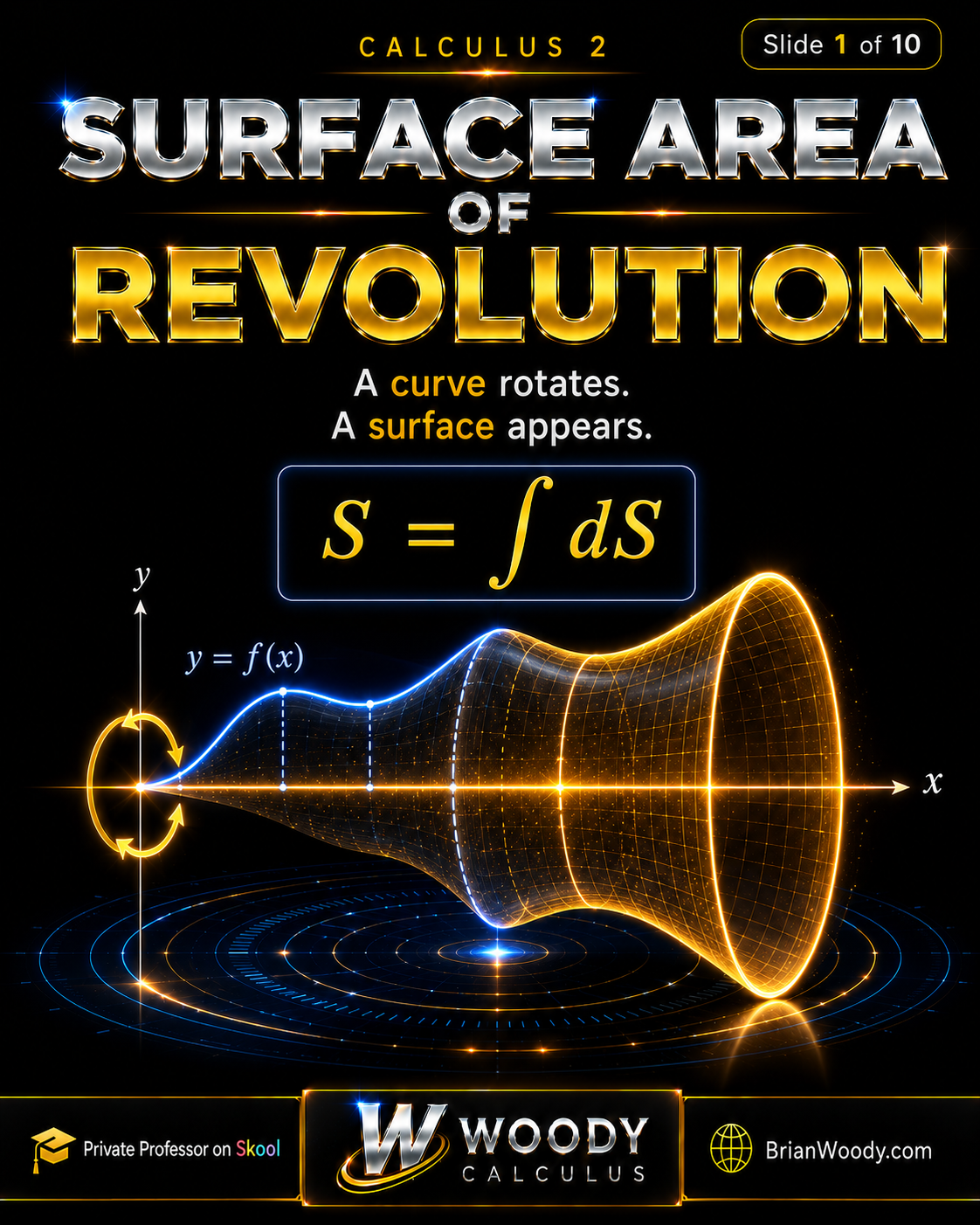
What Is Surface Area of Revolution?
A surface of revolution is created when a curve rotates around a line called the axis of rotation.
For example, rotating a curve \(y=f(x)\) around the \(x\)-axis sweeps out a three-dimensional surface. Each point on the curve travels around a circle whose radius equals the point’s distance from the axis.
Surface area asks:
How much curved material would be needed to cover that generated surface?
The formula measures the curved surface generated by the rotating curve. It does not automatically include flat disks or caps at the endpoints.
How a Tiny Arc Becomes a Thin Band
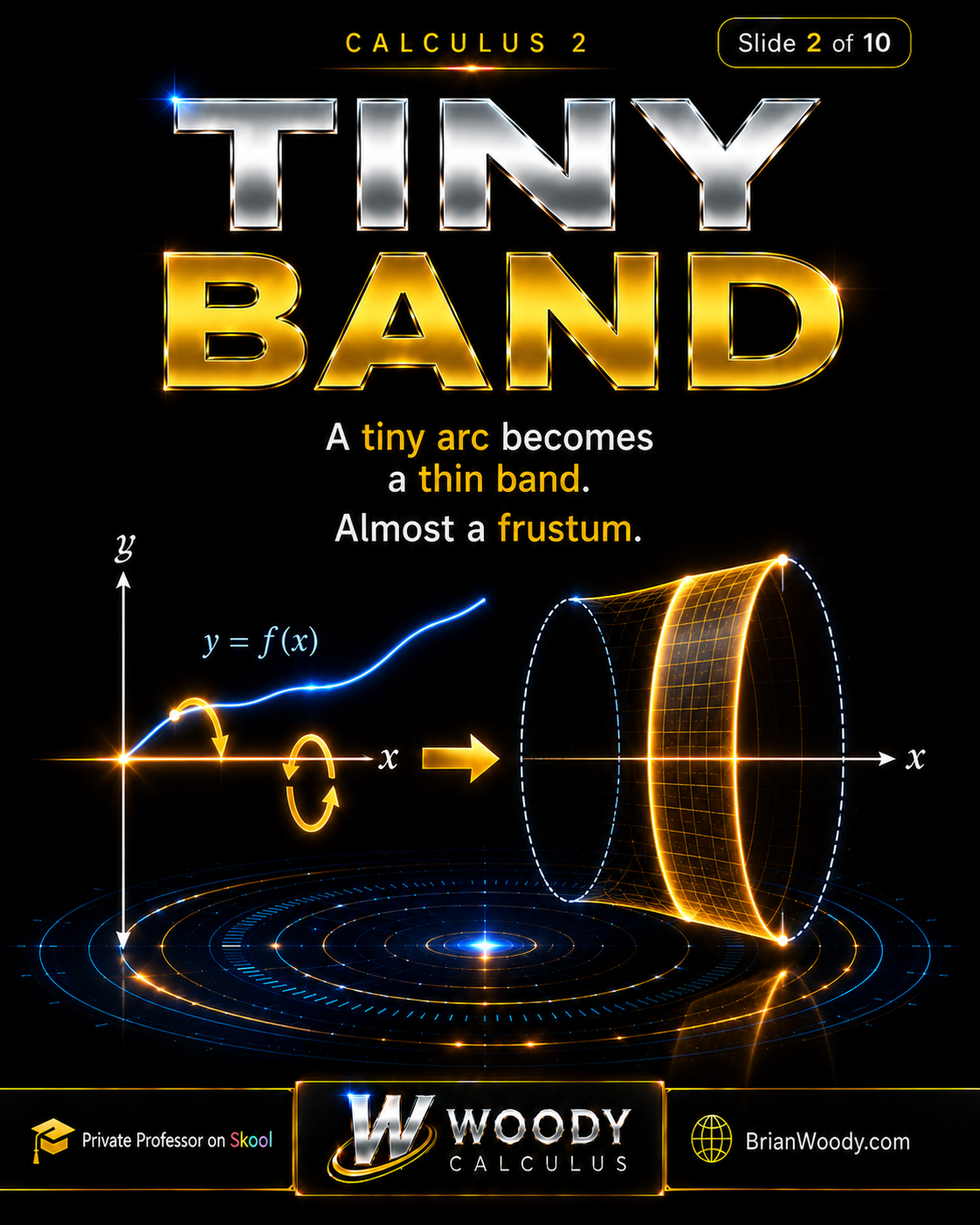
Take a very small piece of the curve. Because the piece is tiny, it behaves almost like a straight segment.
When this tiny arc rotates around an axis, it creates a thin band that is nearly the lateral surface of a frustum.
A frustum is the portion of a cone left after the pointed top is cut off by a plane parallel to the base. A tiny rotated curve segment behaves like an extremely thin frustum.
The band has:
- a circular circumference determined by \(r\), and
- a slant width determined by \(ds\).
Therefore, the band area is approximately:
(\text{circumference})(\text{slant width}).
\]
The Arc-Length Element \(ds\)
Surface area depends on the actual distance along the curve, not merely its horizontal width \(dx\).
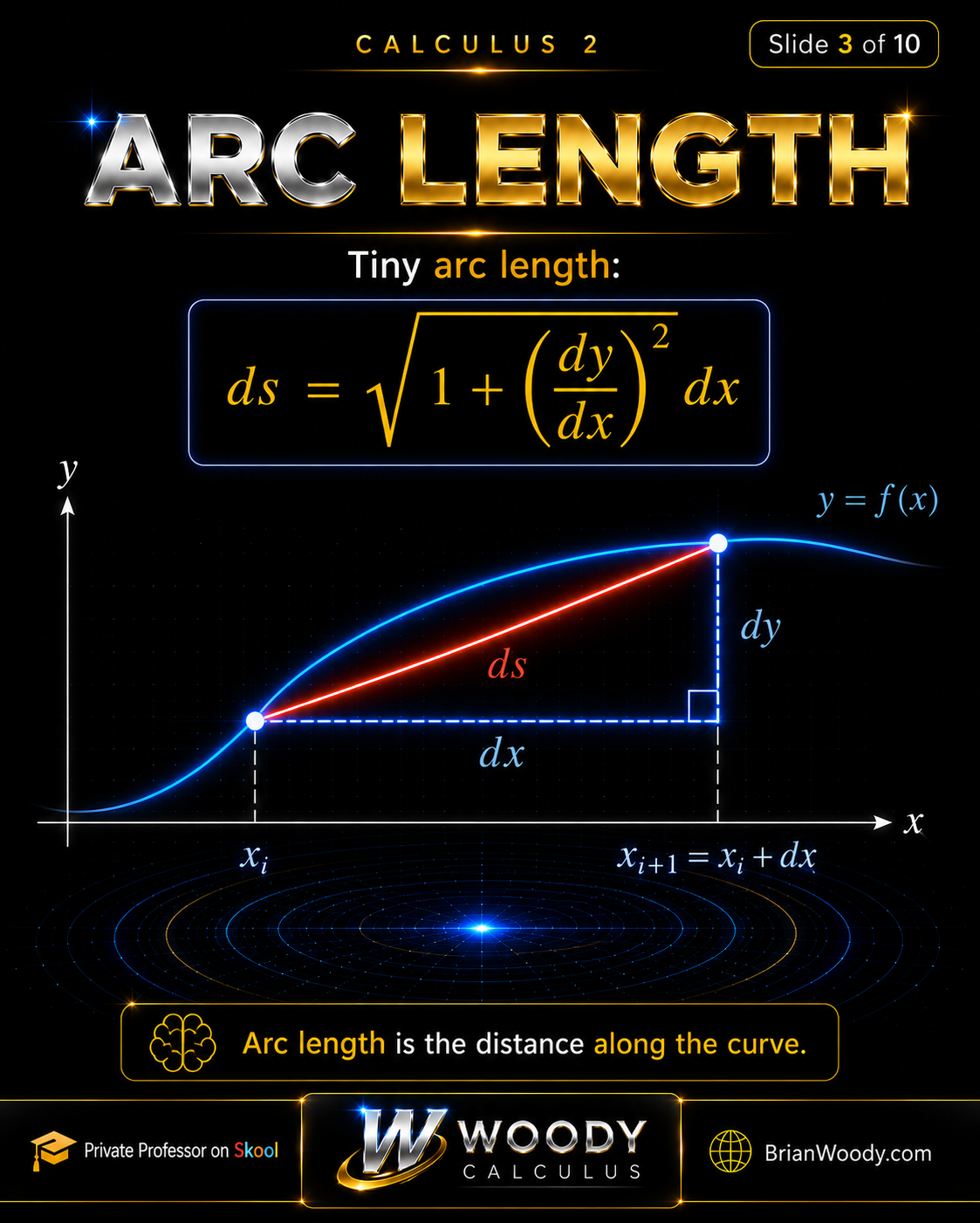
For \(y=f(x)\), a tiny piece of the curve forms a right triangle with horizontal change \(dx\), vertical change \(dy\), and slant distance \(ds\).
(ds)^2=(dx)^2+(dy)^2.
\]
Divide by \((dx)^2\):
\left(\frac{ds}{dx}\right)^2
=
1+\left(\frac{dy}{dx}\right)^2.
\]
Therefore:
\boxed{
ds=\sqrt{1+\left(\frac{dy}{dx}\right)^2}\,dx.
}
\]
This is the same tiny-distance formula developed in the Woody Calculus arc-length lesson.
Why Is \(dS=2\pi r\,ds\)?
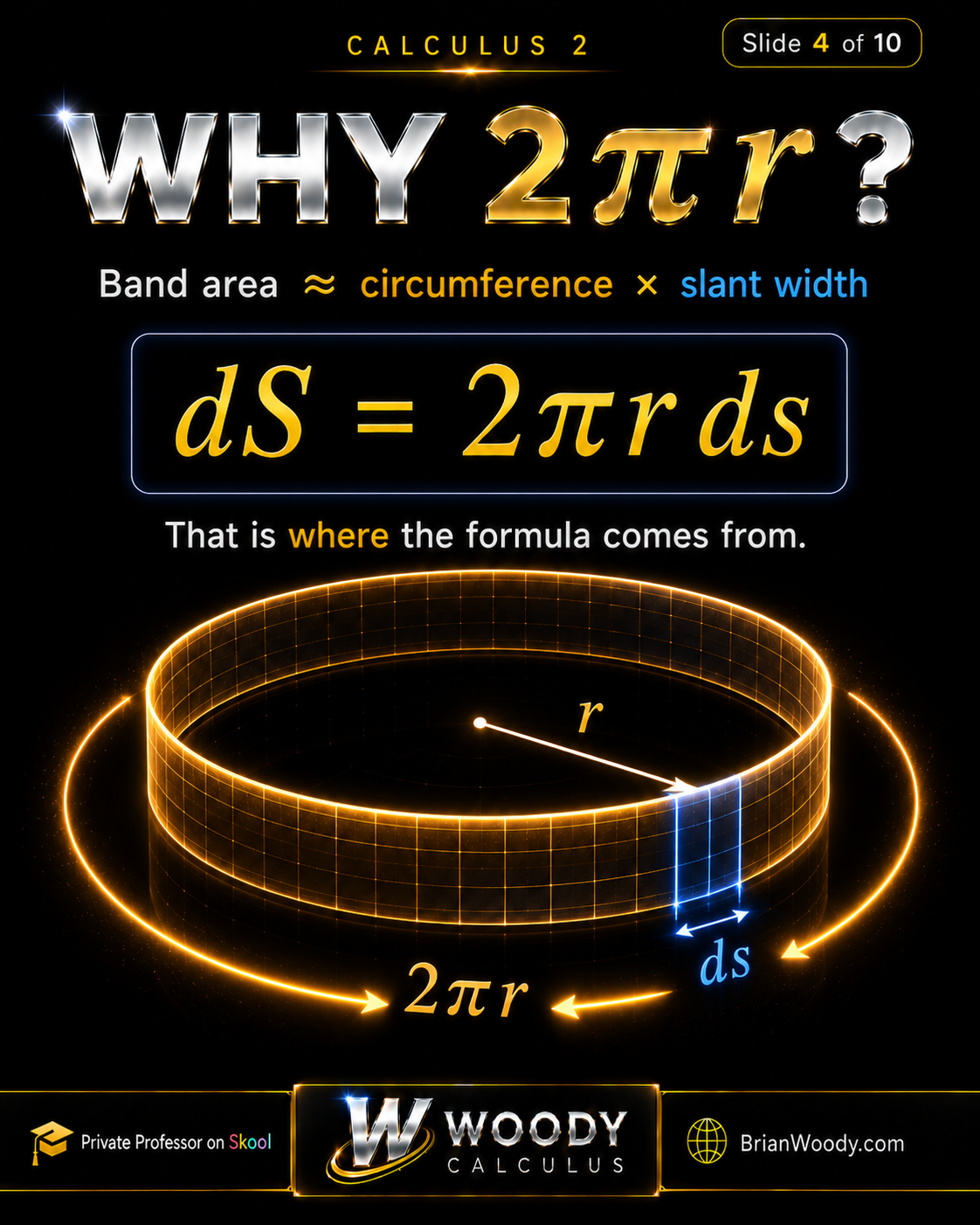
A circle with radius \(r\) has circumference:
2\pi r.
\]
The thin rotating band has approximate area:
(\text{circumference})(\text{slant width}).
\]
Substitute circumference \(2\pi r\) and slant width \(ds\):
\boxed{
dS=2\pi r\,ds.
}
\]
The factor \(2\pi r\) measures how far the tiny arc travels around the axis, while \(ds\) measures the width of the band along the curve.
The Master Surface-Area Formula
Add all the tiny band areas:
S=\int dS.
\]
Since \(dS=2\pi r\,ds\):
\boxed{
S=2\pi\int r\,ds.
}
\]
In plain text: total surface area equals \(2\pi\) times the integral of radius multiplied by arc length.
The formula separates the problem into two geometric pieces:
- \(r\): distance from the curve to the axis of rotation,
- \(ds\): distance along the curve.
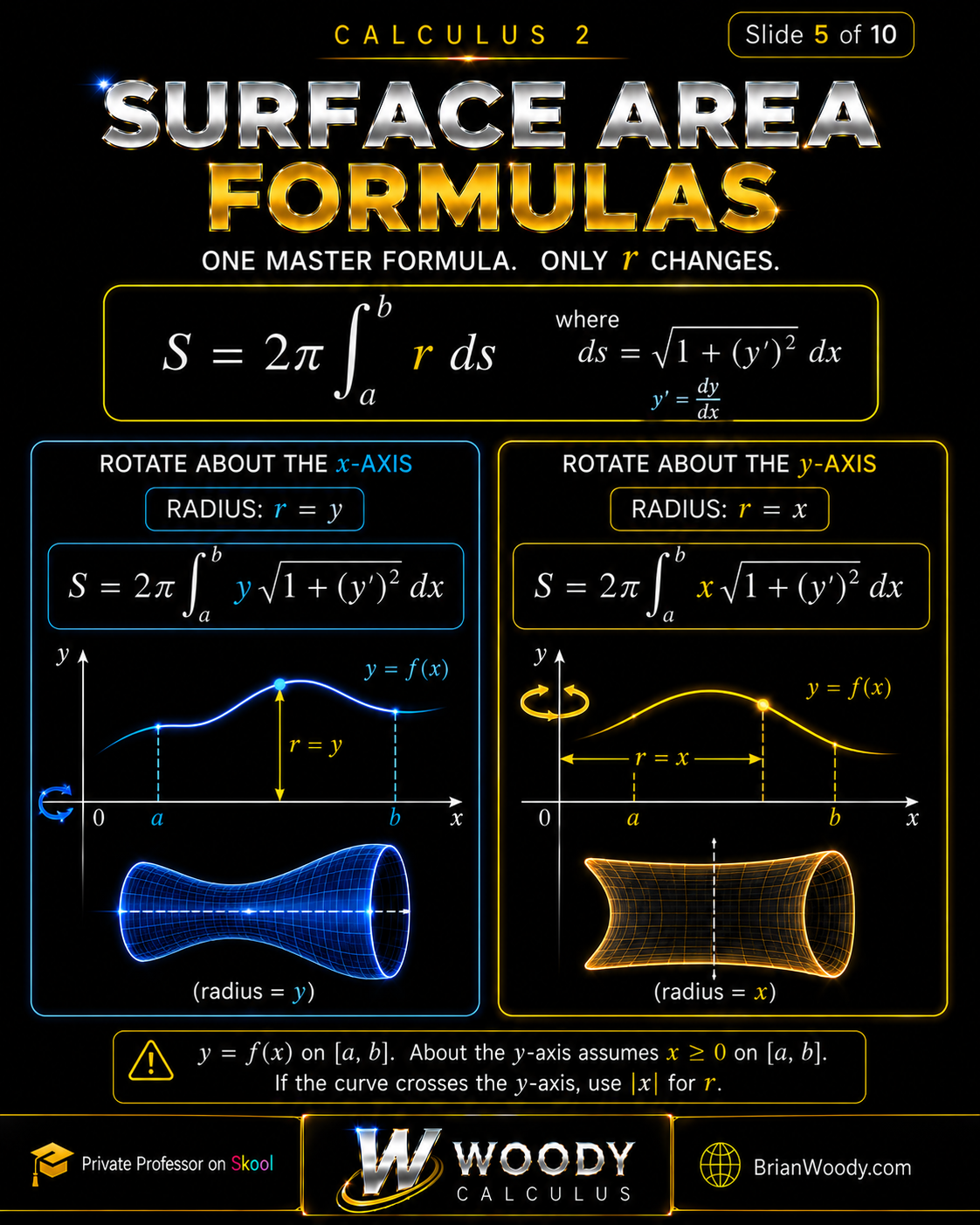
One master formula. Only the radius changes.
Surface Area About the x-Axis and y-Axis
Suppose \(y=f(x)\) on \(a\le x\le b\). Then:
ds=\sqrt{1+\left(f^{\prime}(x)\right)^2}\,dx.
\]
Rotation Around the x-Axis
The radius is the vertical distance to the \(x\)-axis:
r=|f(x)|.
\]
Therefore:
\boxed{
S=2\pi\int_a^b
|f(x)|
\sqrt{1+\left(f^{\prime}(x)\right)^2}\,dx.
}
\]
If \(f(x)\ge0\) on \([a,b]\):
S=2\pi\int_a^b
f(x)
\sqrt{1+\left(f^{\prime}(x)\right)^2}\,dx.
\]
Rotation Around the y-Axis
The radius is the horizontal distance to the \(y\)-axis:
r=|x|.
\]
Therefore:
\boxed{
S=2\pi\int_a^b
|x|
\sqrt{1+\left(f^{\prime}(x)\right)^2}\,dx.
}
\]
If \(x\ge0\) on \([a,b]\):
S=2\pi\int_a^b
x\sqrt{1+\left(f^{\prime}(x)\right)^2}\,dx.
\]
If the curve crosses the axis of rotation, split the interval and examine whether the rotated pieces overlap. The absolute value gives the correct distance, but the geometry determines whether both generated pieces should be counted.
How to Choose the Correct Radius
The radius is not automatically \(x\) or \(y\). It is always:
The perpendicular distance from the curve to the axis of rotation.
| Axis of Rotation | Radius |
|---|---|
| \(x\)-axis | \(r=|y|\) |
| \(y\)-axis | \(r=|x|\) |
| Horizontal line \(y=k\) | \(r=|y-k|\) |
| Vertical line \(x=h\) | \(r=|x-h|\) |
The absolute value matters because a radius is a distance and cannot be negative.
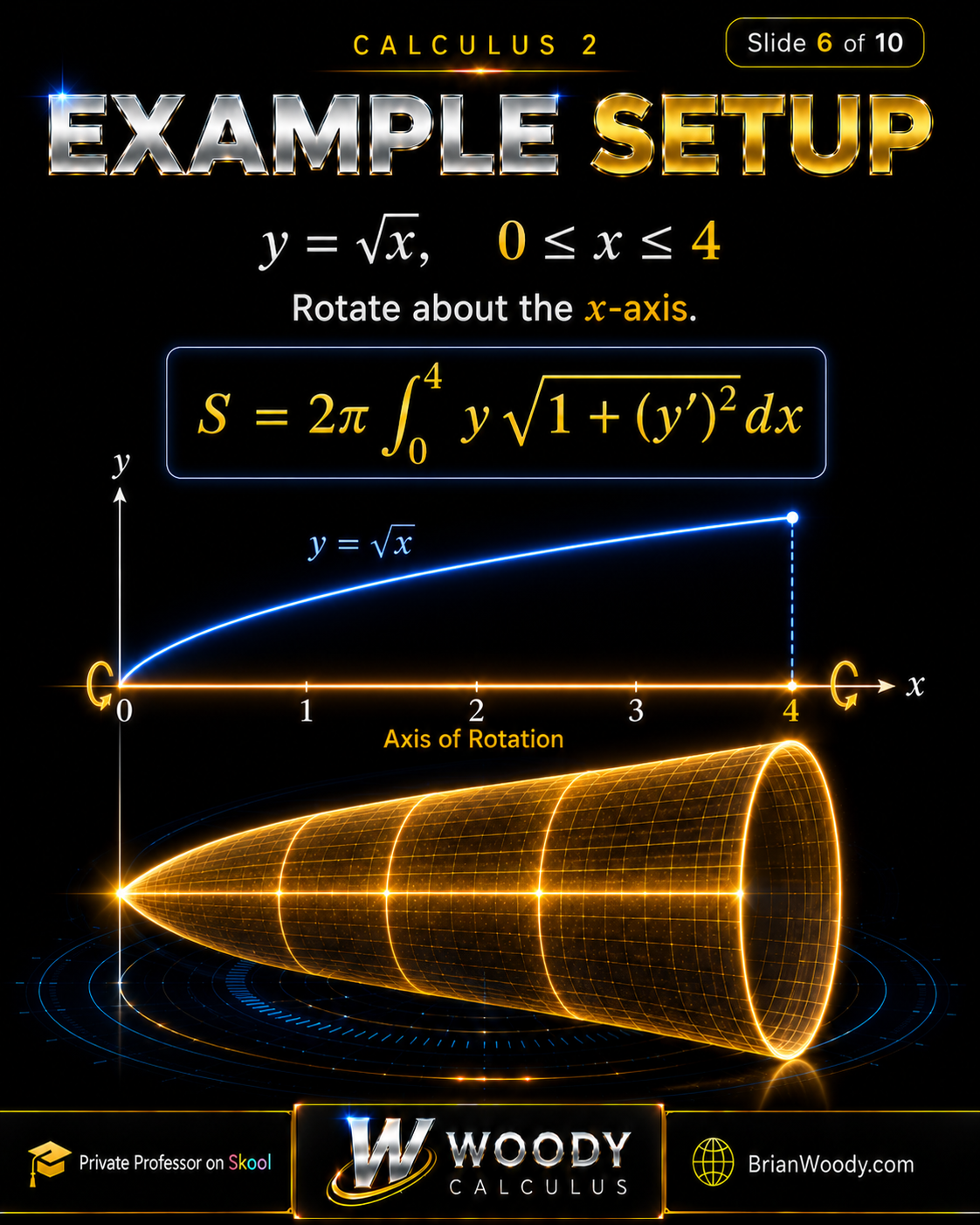
Example: \(y=\sqrt{x}\) Rotated About the x-Axis
Find the surface area generated by rotating:
y=\sqrt{x},
\qquad
0\le x\le4,
\]
around the \(x\)-axis.
Since the curve is above the \(x\)-axis:
r=y=\sqrt{x}.
\]
The surface-area formula is:
S=2\pi\int_0^4
y\sqrt{1+(y^{\prime})^2}\,dx.
\]
Differentiate and Build the Integral
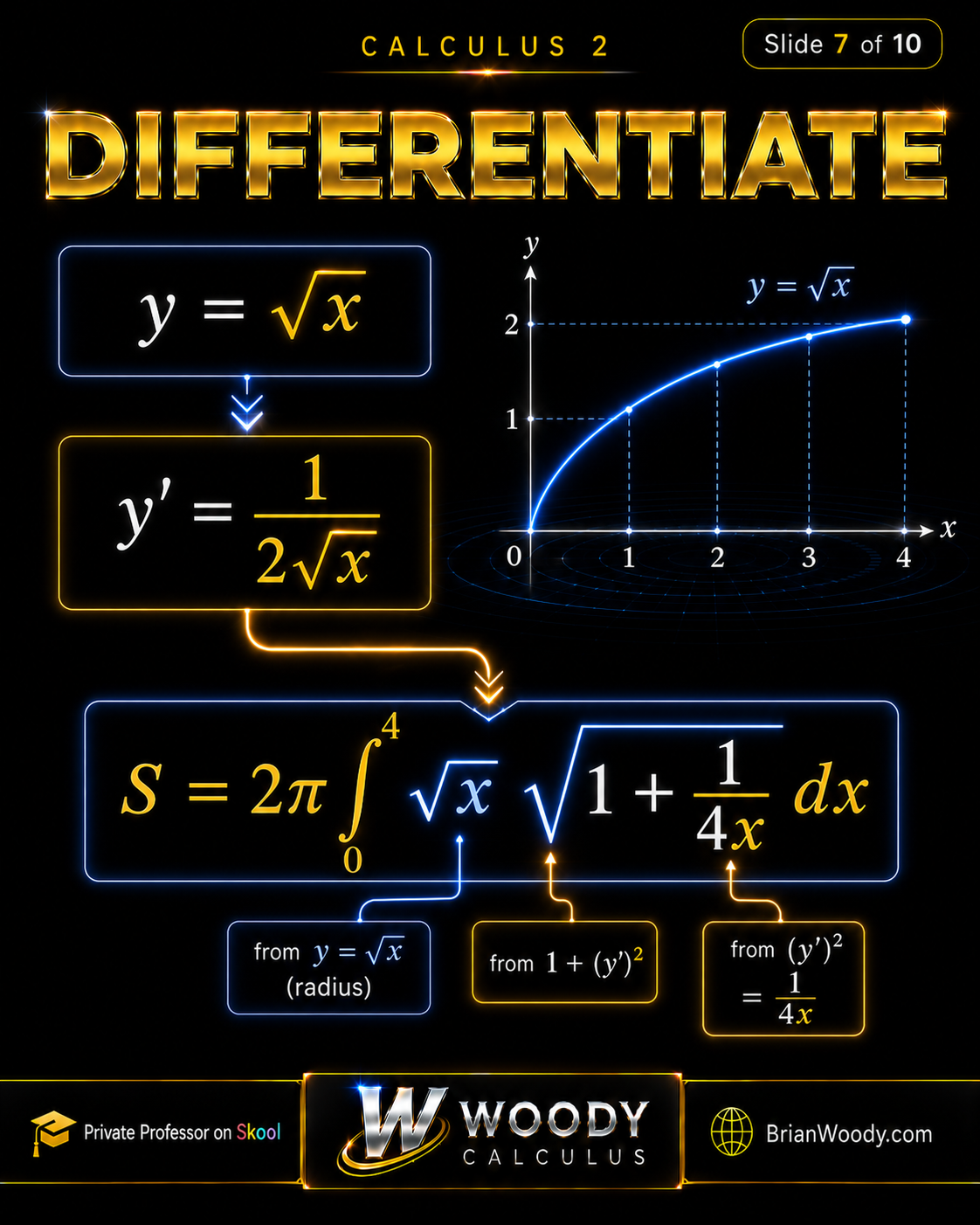
Differentiate:
y=\sqrt{x}=x^{1/2}.
\]
y^{\prime}=\frac{1}{2\sqrt{x}}.
\]
Therefore:
(y^{\prime})^2=\frac{1}{4x}.
\]
Substitute the radius and derivative:
S
=
2\pi\int_0^4
\sqrt{x}
\sqrt{1+\frac{1}{4x}}\,dx.
\]
Simplify the Surface-Area Integrand
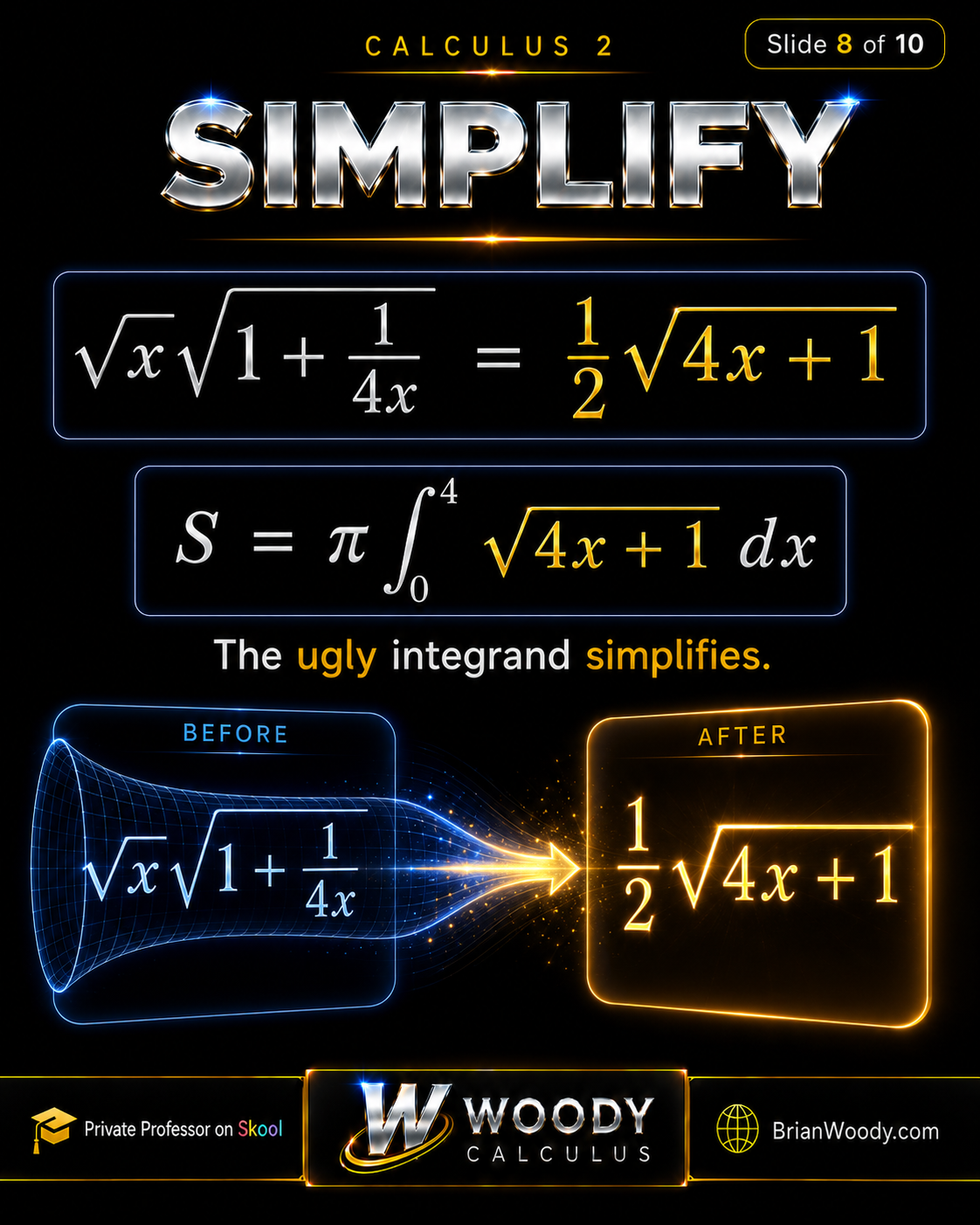
For \(x>0\):
\sqrt{x}
\sqrt{1+\frac{1}{4x}}
=
\sqrt{x}
\sqrt{\frac{4x+1}{4x}}.
\]
\sqrt{\frac{4x+1}{4x}}
=
\frac{\sqrt{4x+1}}{2\sqrt{x}}.
\]
Therefore:
\sqrt{x}
\sqrt{1+\frac{1}{4x}}
=
\frac12\sqrt{4x+1}.
\]
The integral becomes:
S
=
2\pi\int_0^4
\frac12\sqrt{4x+1}\,dx.
\]
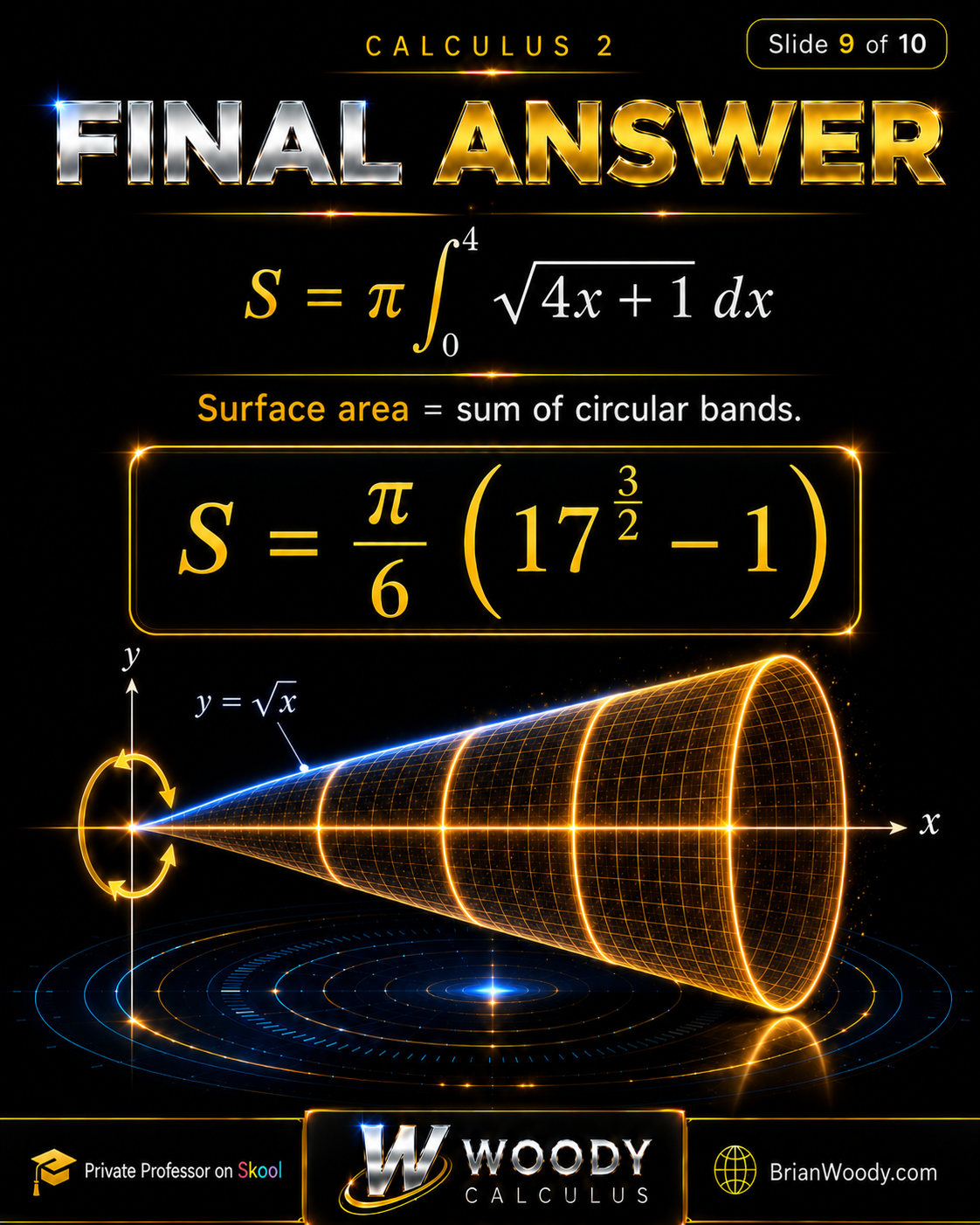
\boxed{
S=\pi\int_0^4\sqrt{4x+1}\,dx.
}
\]
The simplified integrand \(\pi\sqrt{4x+1}\) is continuous at \(x=0\), so it gives the continuous extension of the original improper integrand.
Evaluate the Surface Area
Evaluate:
S=\pi\int_0^4\sqrt{4x+1}\,dx.
\]
Let:
u=4x+1,
\qquad
du=4\,dx,
\qquad
dx=\frac14\,du.
\]
The bounds become:
x=0\Longrightarrow u=1,
\qquad
x=4\Longrightarrow u=17.
\]
S
=
\frac{\pi}{4}
\int_1^{17}u^{1/2}\,du.
\]
S
=
\frac{\pi}{4}
\left[
\frac23u^{3/2}
\right]_1^{17}.
\]
S
=
\frac{\pi}{6}
\left[
u^{3/2}
\right]_1^{17}.
\]
Final answer:
\boxed{
S=
\frac{\pi}{6}
\left(17^{3/2}-1\right).
}
\]
An equivalent exact form is:
\boxed{
S=
\frac{\pi}{6}
\left(17\sqrt{17}-1\right).
}
\]
Numerically:
S\approx36.1769.
\]
Plain-language answer: rotating \(y=\sqrt{x}\) from \(x=0\) to \(x=4\) around the \(x\)-axis creates a curved surface with area \(\frac{\pi}{6}(17^{3/2}-1)\), or approximately \(36.1769\) square units.
Verification by Reparameterization and a Geometric Scale Check
Verification by Reparameterization
Rewrite the curve as:
x=y^2.
\]
Since \(0\le x\le4\):
0\le y\le2.
\]
Differentiate:
\frac{dx}{dy}=2y.
\]
For rotation around the \(x\)-axis, \(r=y\). Therefore:
S
=
2\pi\int_0^2
y
\sqrt{1+\left(\frac{dx}{dy}\right)^2}\,dy.
\]
S
=
2\pi\int_0^2
y\sqrt{1+4y^2}\,dy.
\]
Let \(u=1+4y^2\), so \(du=8y\,dy\):
S
=
\frac{\pi}{4}
\int_1^{17}u^{1/2}\,du
=
\frac{\pi}{6}
\left(17^{3/2}-1\right).
\]
This reparameterization confirms that the \(x\)-based and \(y\)-based surface-area setups agree.
Geometric Scale Check
This is not a separate proof, but it checks whether the numerical answer has a reasonable geometric scale.
The cone joining \((0,0)\) to \((4,2)\) has lateral area:
\pi r\ell
=
\pi(2)\sqrt{4^2+2^2}
=
4\pi\sqrt5
\approx28.10.
\]
A cylinder of radius \(2\) and length \(4\) has lateral area:
2\pi rh
=
2\pi(2)(4)
=
16\pi
\approx50.27.
\]
The calculated value \(36.1769\) lies between these useful comparison scales, so its magnitude is geometrically reasonable.
Surface Area vs Arc Length vs Volume
The fundamental difference is that arc length integrates a one-dimensional line, surface area integrates a two-dimensional band, and volume integrates a three-dimensional slice or shell.
| Quantity | Tiny Piece | Meaning |
|---|---|---|
| Arc Length | \(ds\) | Distance along a curve |
| Surface Area | \(2\pi r\,ds\) | Circumference times slant width |
| Shell Volume | \(2\pi r(\text{height})\,dx\) | Circumference times height times thickness |
| Washer Volume | \(\pi(R^2-r^2)\,dx\) | Cross-sectional area times thickness |
Arc length adds distances. Surface area adds bands. Volume adds slices or shells.
The distinction becomes unforgettable in Gabriel’s Horn, the famous Calculus 2 example in which a solid has finite volume but infinite surface area.
Common Surface-Area Mistakes
Mistake 1: Using \(dx\) Instead of \(ds\)
Surface area follows the slant of the curve. The band width is \(ds\), not merely \(dx\).
Mistake 2: Choosing the Wrong Radius
The radius is the distance from the curve to the axis of rotation. It is not automatically \(x\) or \(y\).
Mistake 3: Forgetting the Absolute Value
Radius is a distance. If a curve crosses an axis, use the appropriate absolute value and inspect the geometry for overlap.
Mistake 4: Confusing Surface Area with Volume
Washer and shell formulas calculate volume. Surface area uses:
S=2\pi\int r\,ds.
\]
Mistake 5: Adding End Caps Automatically
The standard formula calculates the curved surface generated by the rotating curve. Flat endpoint disks are added only when the problem asks for a closed total surface.
Mistake 6: Ignoring an Improper Endpoint
For \(y=\sqrt{x}\), the derivative is undefined at \(x=0\). The integral must be interpreted through a limit, even though the simplified integrand is continuous.
The Woody Calculus Surface-Area Checklist
- Sketch the curve and axis of rotation.
- Identify the radius as a distance to the axis.
- Choose \(x\) or \(y\) as the natural variable.
- Differentiate the curve.
- Build the arc-length element \(ds\).
- Write \(dS=2\pi r\,ds\).
- Substitute the radius and arc-length factor.
- Simplify before integrating.
- Check for improper endpoints, absolute values, and overlap.
- Evaluate and write the exact answer.
- State whether endpoint caps are included.
Formula memorization is non-negotiable, but reading a finished solution is not enough. Rewrite the complete solution while saying each step aloud: axis, radius, derivative, \(ds\), \(dS\), integral, simplification, and final answer.
Surface Area of Revolution FAQ
What is surface area of revolution?
Surface area of revolution is the curved area generated when a plane curve rotates around an axis. It is found by adding thin circular bands along the curve.
What is the master surface-area-of-revolution formula?
The master formula is \(S=2\pi\int r\,ds\), where \(r\) is the distance from the curve to the axis and \(ds\) is a tiny arc-length element.
Why does the formula contain \(2\pi r\)?
The factor \(2\pi r\) is the circumference traveled by a point on the curve. Multiplying that circumference by slant width \(ds\) gives the area of a thin circular band.
What is \(ds\) in the surface-area formula?
For \(y=f(x)\), \(ds=\sqrt{1+\left(f^{\prime}(x)\right)^2}\,dx\). It measures a tiny distance along the curve.
What is the surface-area formula about the x-axis?
For \(y=f(x)\) from \(x=a\) to \(x=b\), the formula is \(S=2\pi\int_a^b |f(x)|\sqrt{1+\left(f^{\prime}(x)\right)^2}\,dx\). If \(f(x)\ge0\), the absolute value may be removed.
What is the surface-area formula about the y-axis?
For \(y=f(x)\) from \(x=a\) to \(x=b\), the formula is \(S=2\pi\int_a^b |x|\sqrt{1+\left(f^{\prime}(x)\right)^2}\,dx\). If \(x\ge0\), the absolute value may be removed.
How do I choose the radius?
The radius is the perpendicular distance from the curve to the axis. About the \(x\)-axis it is \(|y|\), about the \(y\)-axis it is \(|x|\), and for a shifted axis it is the corresponding distance to that line.
Does the formula include end caps?
No. The standard formula calculates the curved generated surface. Flat endpoint caps must be added separately when a problem asks for the total area of a closed surface.
What is the surface area of \(y=\sqrt{x}\) from 0 to 4 about the x-axis?
The surface area is \(S=\frac{\pi}{6}\left(17^{3/2}-1\right)=\frac{\pi}{6}\left(17\sqrt{17}-1\right)\), approximately \(36.1769\) square units.
What happens if the derivative is undefined at an endpoint?
The surface-area integral may need to be interpreted as an improper integral. If the limit converges, the surface area still exists, as it does for \(y=\sqrt{x}\) at \(x=0\).
What should I know before learning surface area of revolution?
Students should know basic differentiation, definite integration, \(u\)-substitution, the Pythagorean theorem, and the arc-length formula.
Master Surface Area with Woody Calculus
Surface area becomes easier when students stop treating the formulas as unrelated expressions.
\text{tiny arc}
\Longrightarrow
\text{thin circular band}
\Longrightarrow
dS=2\pi r\,ds
\Longrightarrow
S=2\pi\int r\,ds.
\]
The formula is not arbitrary. It is circumference times slant width, added over the entire curve.
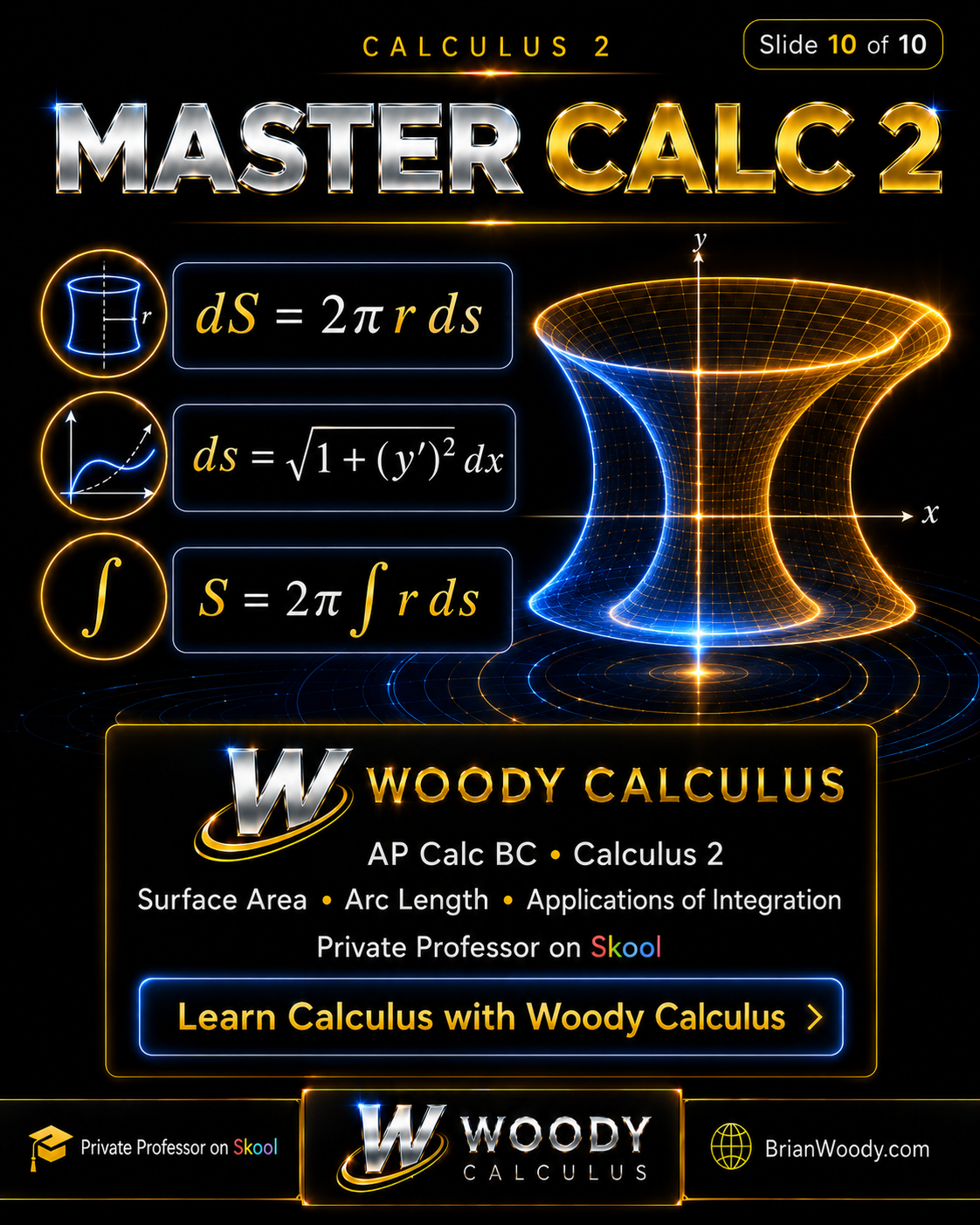
For structured Calculus 2 and AP Calculus BC support, join the Woody Calculus Mastery Lab. Students use the Lab for video lessons, written solutions, exam preparation, homework support, live Q&A, direct chat guidance, and the complete Woody Calculus problem-solving system.
Visit Woody Calculus on Skool to explore the learning community.
Private Instruction
Brian M. Woody works privately with a limited number of serious students who need one-on-one help in AP Calculus BC, Calculus II, Calculus III, Differential Equations, and advanced mathematics.
Private instruction is selective, requires weekly sessions, and requires enrollment in the Woody Calculus Mastery Lab first. Approval is not guaranteed.
Learn more at Private Math Tutor and Advanced Mathematics Instruction.
Selected University Math Help Pages
Visit the University Calculus Tutor Hub for the complete university directory.
Trusted by Students Nationwide
Students use Woody Calculus for structured mathematics support, written solutions, visual lessons, exam-focused training, and guidance in Calculus II, AP Calculus BC, Calculus III, Differential Equations, and advanced mathematics.