The Riemann Hypothesis: The $1,000,000 Pattern Hidden in the Primes
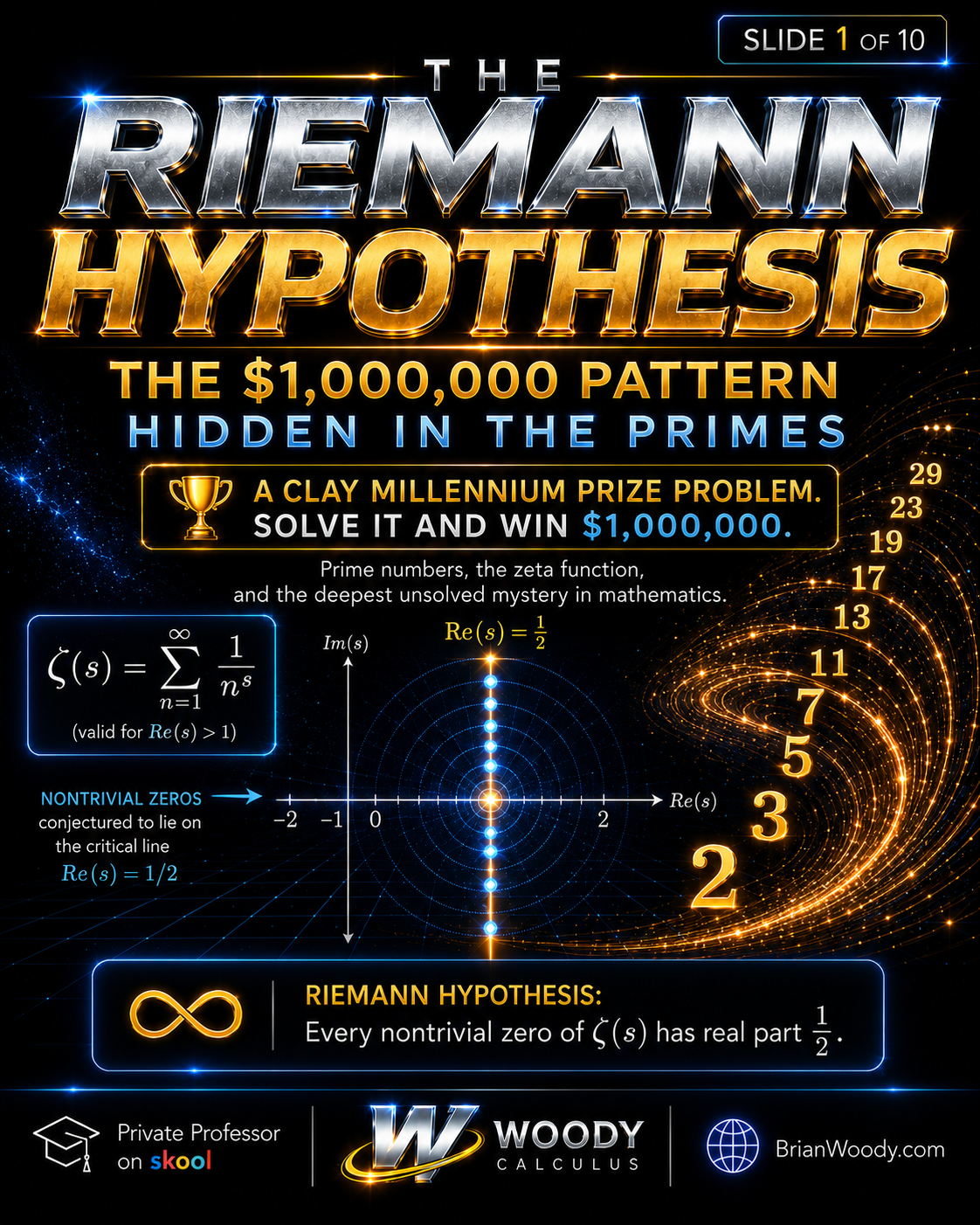
The Riemann Hypothesis is one of the most famous unsolved problems in mathematics. It sits at the intersection of prime numbers, complex analysis, infinite series, number theory, and the deepest question mathematicians can ask:
Is there hidden order inside something that looks random?
Prime numbers appear scattered across the number line with no simple repeating pattern. They do not arrive evenly. They do not follow a simple rhythm. They feel random.
But the Riemann Hypothesis suggests that beneath this apparent randomness, there is a precise structure encoded in a mysterious function called the Riemann zeta function.
This is why the problem is so important. The Riemann Hypothesis is not merely about finding the next prime. It is about understanding the deepest statistical structure behind all prime numbers.
It is also one of the Clay Millennium Prize Problems, with a $1,000,000 prize for a correct proof.
Prime Numbers Feel Random
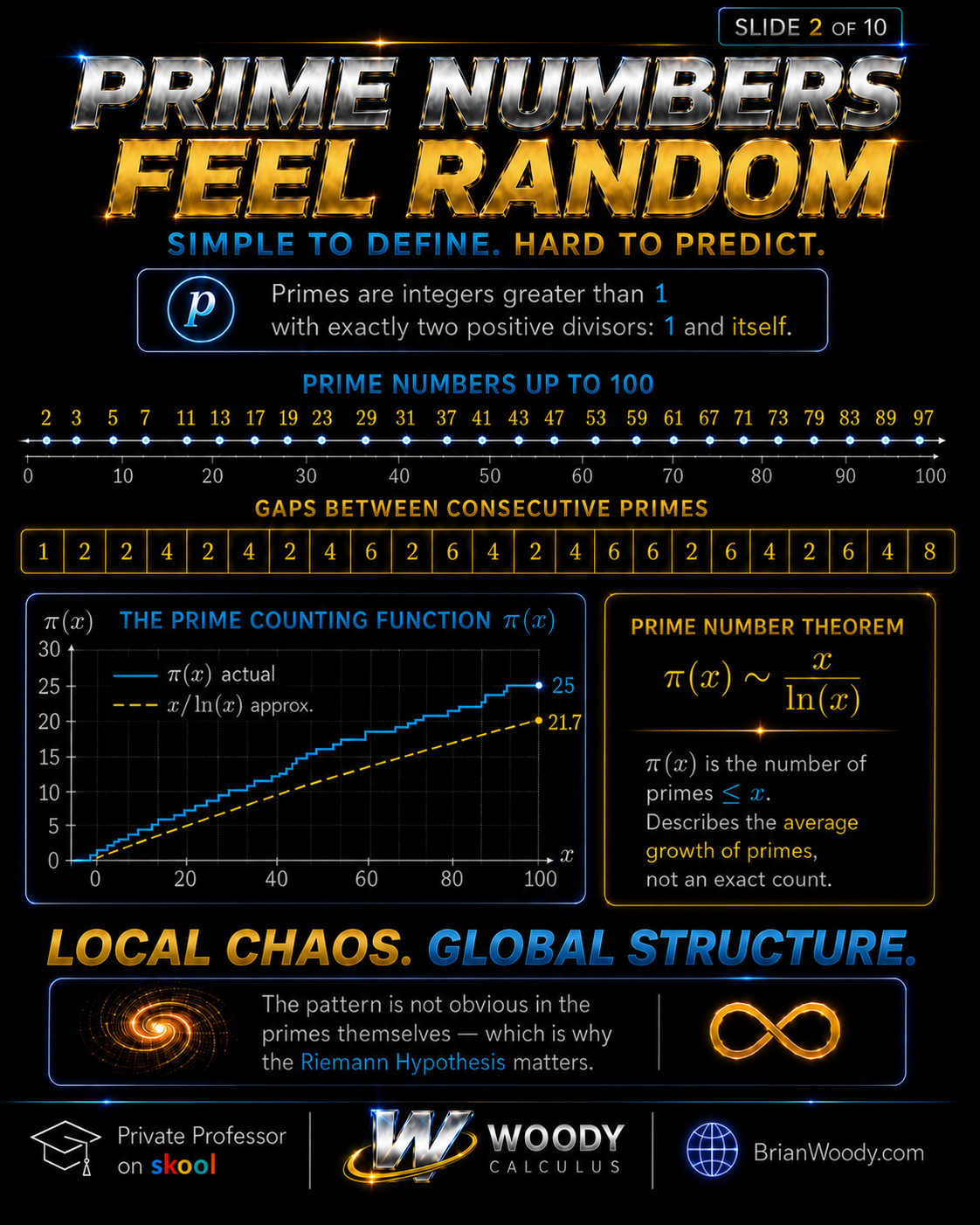
A prime number is an integer greater than 1 with exactly two positive divisors: 1 and itself.
The first few prime numbers are:
\[
2,3,5,7,11,13,17,19,23,29,\dots
\]
This definition is simple. The difficulty is prediction.
The gaps between consecutive primes do not follow an obvious pattern:
\[
1,2,2,4,2,4,2,4,6,2,6,\dots
\]
Sometimes primes appear close together. Sometimes the gaps grow larger. There are patterns, but they are not simple periodic patterns.
One of the first major tools for understanding the distribution of primes is the prime counting function, written as \(\pi(x)\).
The function \(\pi(x)\) counts how many prime numbers are less than or equal to \(x\).
For example, there are 25 primes less than or equal to 100, so:
\[
\pi(100)=25.
\]
The Prime Number Theorem tells us that:
\[
\pi(x)\sim \frac{x}{\ln x}.
\]
This means \(\frac{x}{\ln x}\) approximates the number of primes up to \(x\), with the ratio \(\pi(x)/\left(x/\ln x\right)\) approaching 1 as \(x\) grows.
The key idea is this:
Locally, primes look chaotic. Globally, they follow structure.
Riemann Found a Shadow Pattern
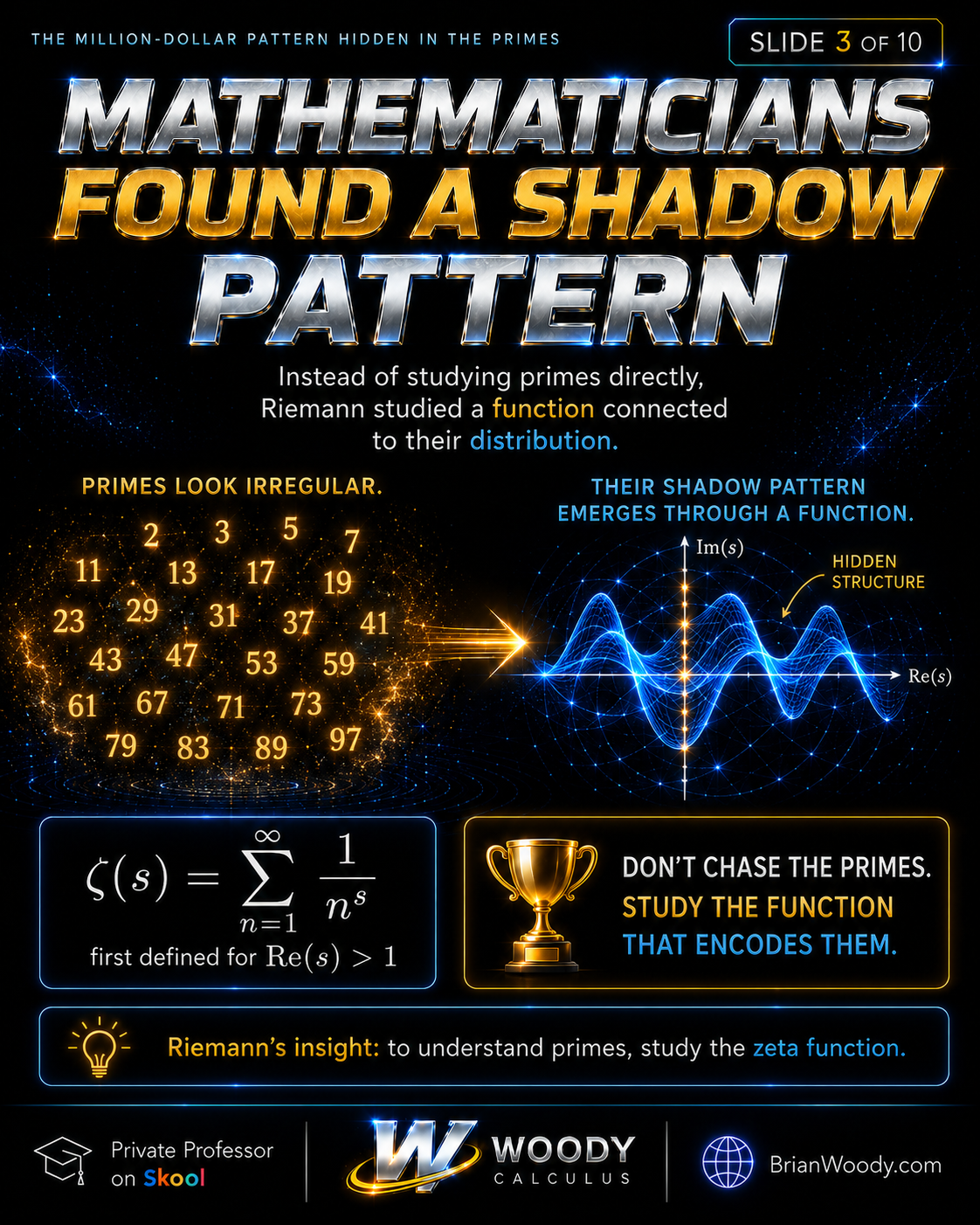
Bernhard Riemann did something brilliant. Instead of studying prime numbers directly, he studied a function connected to their distribution.
That function is the Riemann zeta function.
At first glance, the zeta function begins as a series over all positive integers, not just primes.
That is the surprise.
Somehow, this function carries deep information about prime numbers. Riemann’s insight was that to understand the primes, we should study the zeta function that encodes them.
This is one of the greatest moves in mathematical history: do not chase the primes directly. Study the function that reveals their hidden pattern.
Enter the Riemann Zeta Function
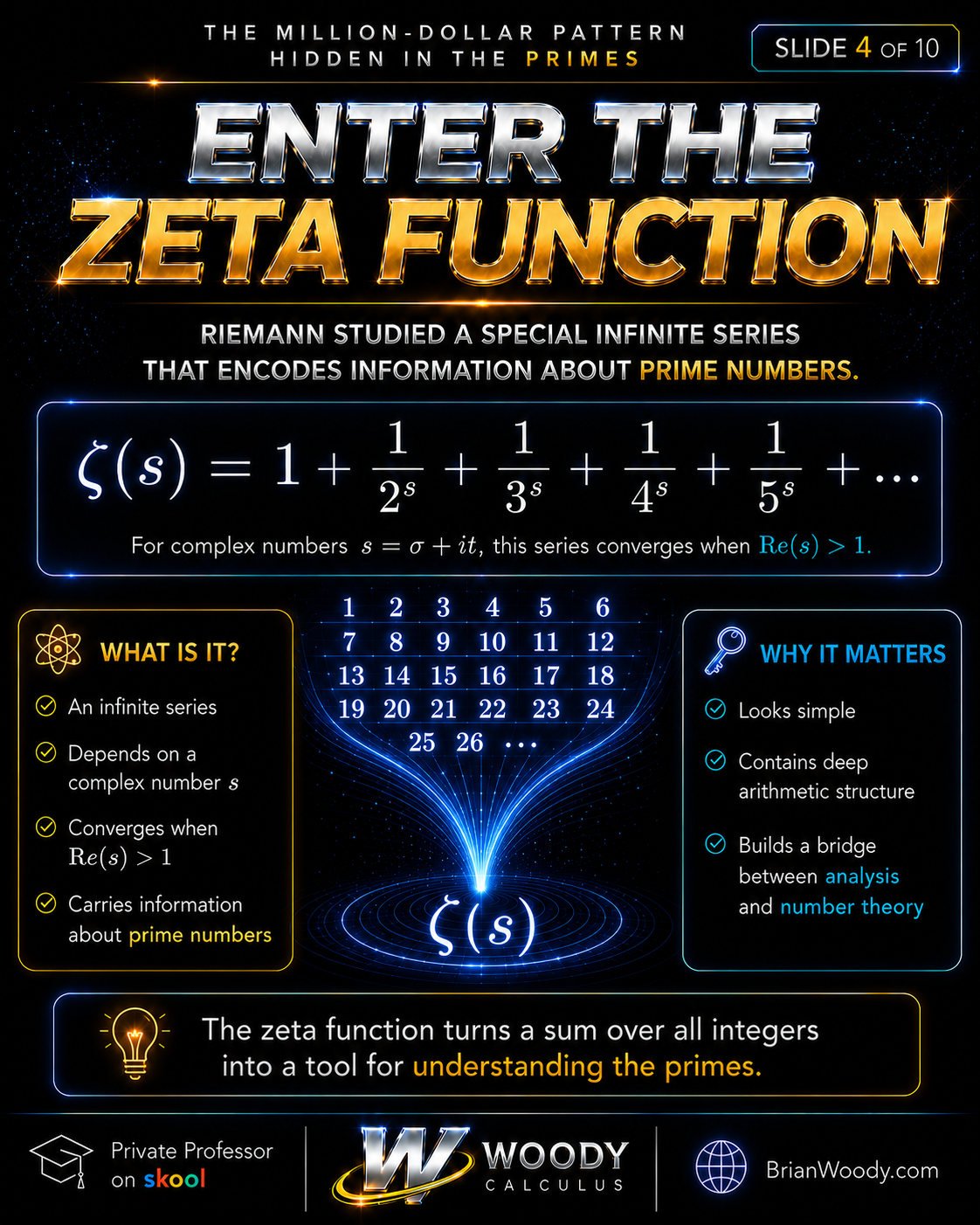
For complex numbers \(s\) with real part greater than 1, the Riemann zeta function is first defined by the infinite series:
\[
\zeta(s)=\sum_{n=1}^{\infty}\frac{1}{n^s}.
\]
Expanded, this becomes:
\[
\zeta(s)=1+\frac{1}{2^s}+\frac{1}{3^s}+\frac{1}{4^s}+\frac{1}{5^s}+\cdots.
\]
Here, \(s\) is usually a complex number:
\[
s=\sigma+it.
\]
The original infinite series converges when:
\[
\operatorname{Re}(s)>1.
\]
That condition matters. The series definition itself does not converge everywhere. To study the deeper structure of \(\zeta(s)\), mathematicians use analytic continuation to extend the zeta function beyond its original region of convergence.
This is where Calculus II ideas like infinite series grow into complex analysis, advanced calculus, and proof-based mathematics.
The zeta function looks simple, but it contains deep arithmetic structure. It creates a bridge between analysis and number theory.
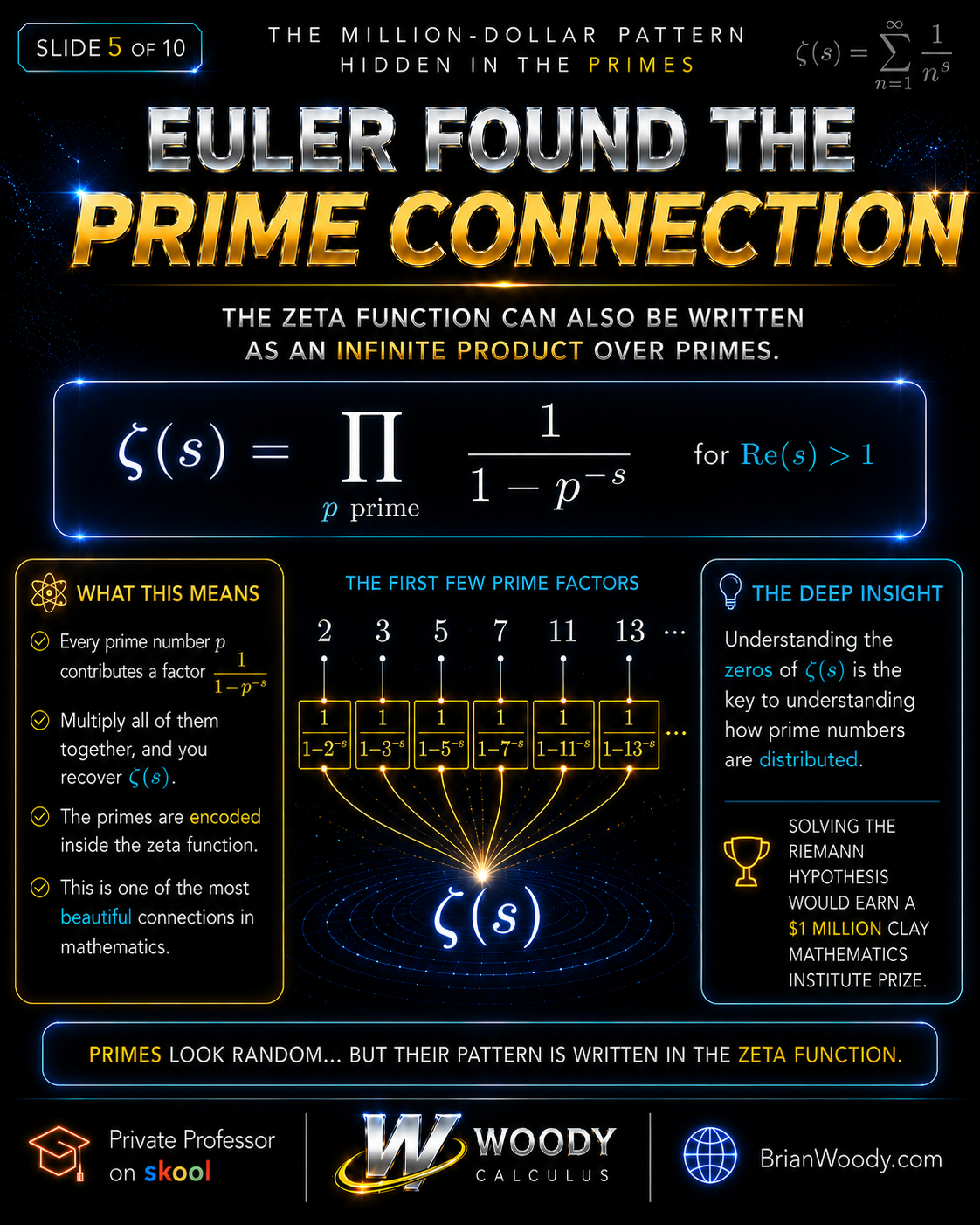
Euler Found the Prime Connection
The reason the zeta function knows about primes comes from one of the most beautiful identities in mathematics: the Euler product formula.
For \(\operatorname{Re}(s)>1\), Euler showed that:
\[
\zeta(s)=\prod_{p\ \text{prime}}\frac{1}{1-p^{-s}}.
\]
This means:
\[
\zeta(s)=
\frac{1}{1-2^{-s}}
\cdot
\frac{1}{1-3^{-s}}
\cdot
\frac{1}{1-5^{-s}}
\cdot
\frac{1}{1-7^{-s}}
\cdots.
\]
This equation is astonishing because it says that a series over all positive integers is equal to a product over the prime numbers.
The reason this works is the Fundamental Theorem of Arithmetic: every positive integer greater than 1 can be written uniquely as a product of primes.
So the primes are not merely related to \(\zeta(s)\). They are encoded inside it.
The sum sees all integers. The product reveals the primes.
That is why understanding the zeros of the zeta function becomes a way of understanding the distribution of prime numbers.
Riemann Went Complex
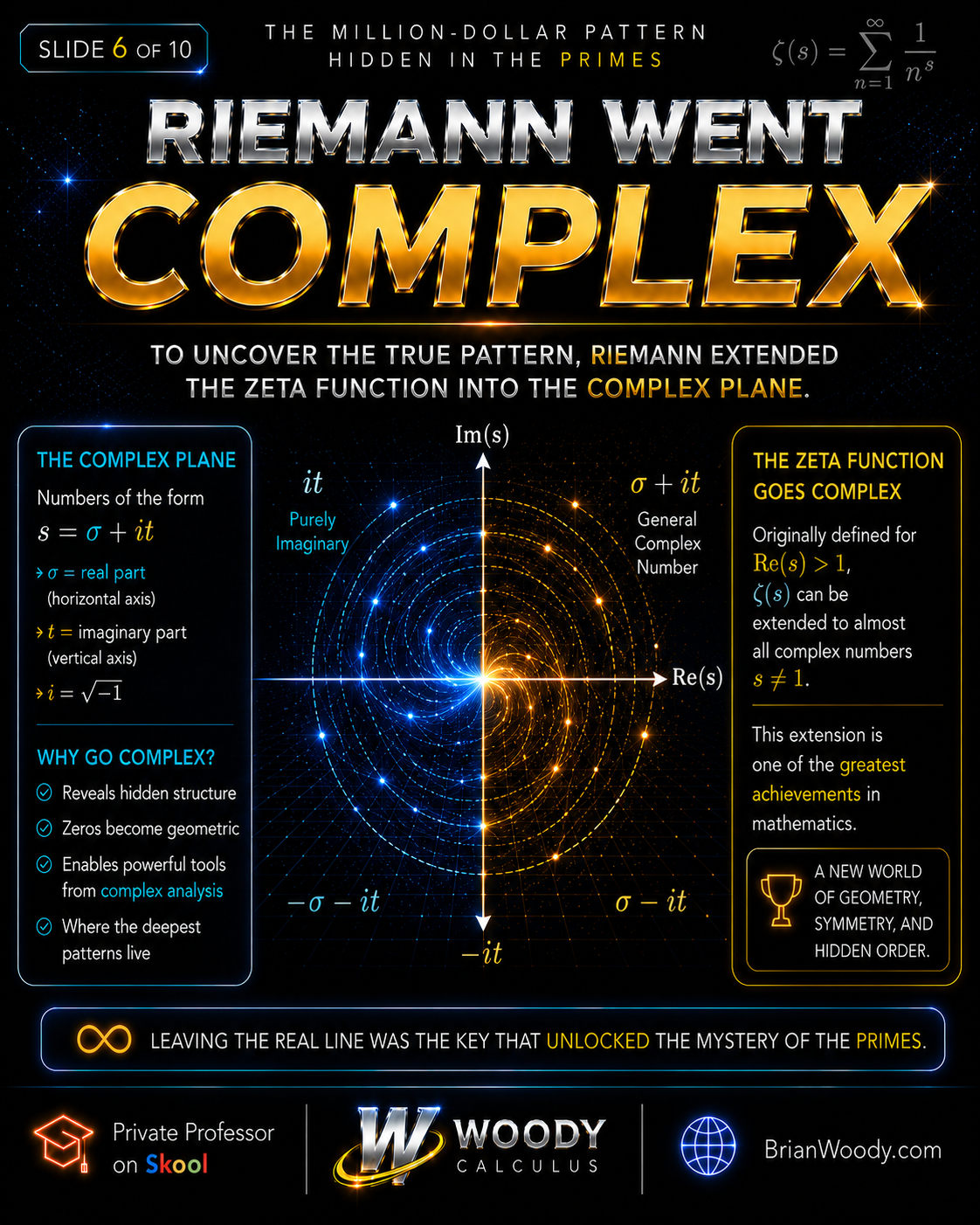
To uncover the deeper pattern, Riemann moved beyond the real number line and studied the zeta function in the complex plane.
A complex number has the form:
\[
s=\sigma+it,
\]
where \(\sigma\) is the real part and \(t\) is the imaginary part.
The complex plane allows us to treat numbers geometrically. The horizontal axis measures the real part, and the vertical axis measures the imaginary part.
This move was revolutionary. When the zeta function is extended into the complex plane, its zeros become geometric objects.
The original series definition works only for \(\operatorname{Re}(s)>1\), but the zeta function can be analytically continued to almost all complex numbers, except for a pole at:
\[
s=1.
\]
This extension opens the door to the critical strip, the critical line, and the precise statement of the Riemann Hypothesis.
Leaving the real line unlocked the mystery of the primes.
The Critical Strip and the Critical Line
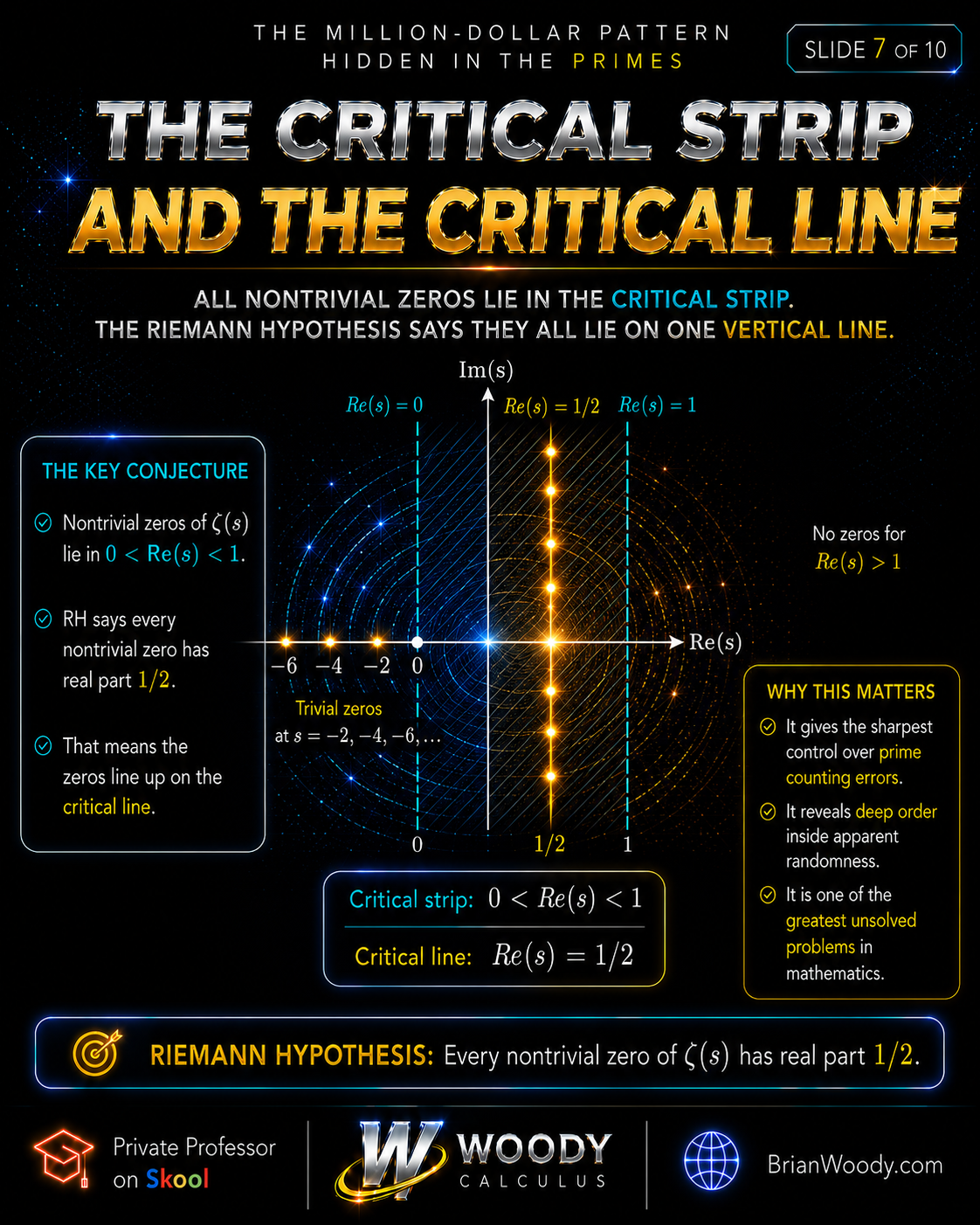
The zeta function has two major types of zeros:
- Trivial zeros, which occur at the negative even integers \(s=-2,-4,-6,\dots\)
- Nontrivial zeros, which lie in the critical strip
The critical strip is the region:
\[
0<\operatorname{Re}(s)<1.
\]
The critical line is the vertical line in the middle of the strip:
\[
\operatorname{Re}(s)=\frac{1}{2}.
\]
The Riemann Hypothesis says:
Every nontrivial zero of \(\zeta(s)\) has real part \(\frac{1}{2}\).
In symbols:
\[
\zeta(s)=0 \text{ and } s \text{ is nontrivial}
\quad \Longrightarrow \quad
\operatorname{Re}(s)=\frac{1}{2}.
\]
This does not say all zeros are the same. Their imaginary parts vary. But the conjecture says that every nontrivial zero lines up on one vertical line.
That line is the critical line.
This is why the Riemann Hypothesis is so visually powerful. A deep statement about prime numbers becomes a geometric statement about zeros in the complex plane.
Why the Riemann Hypothesis Matters
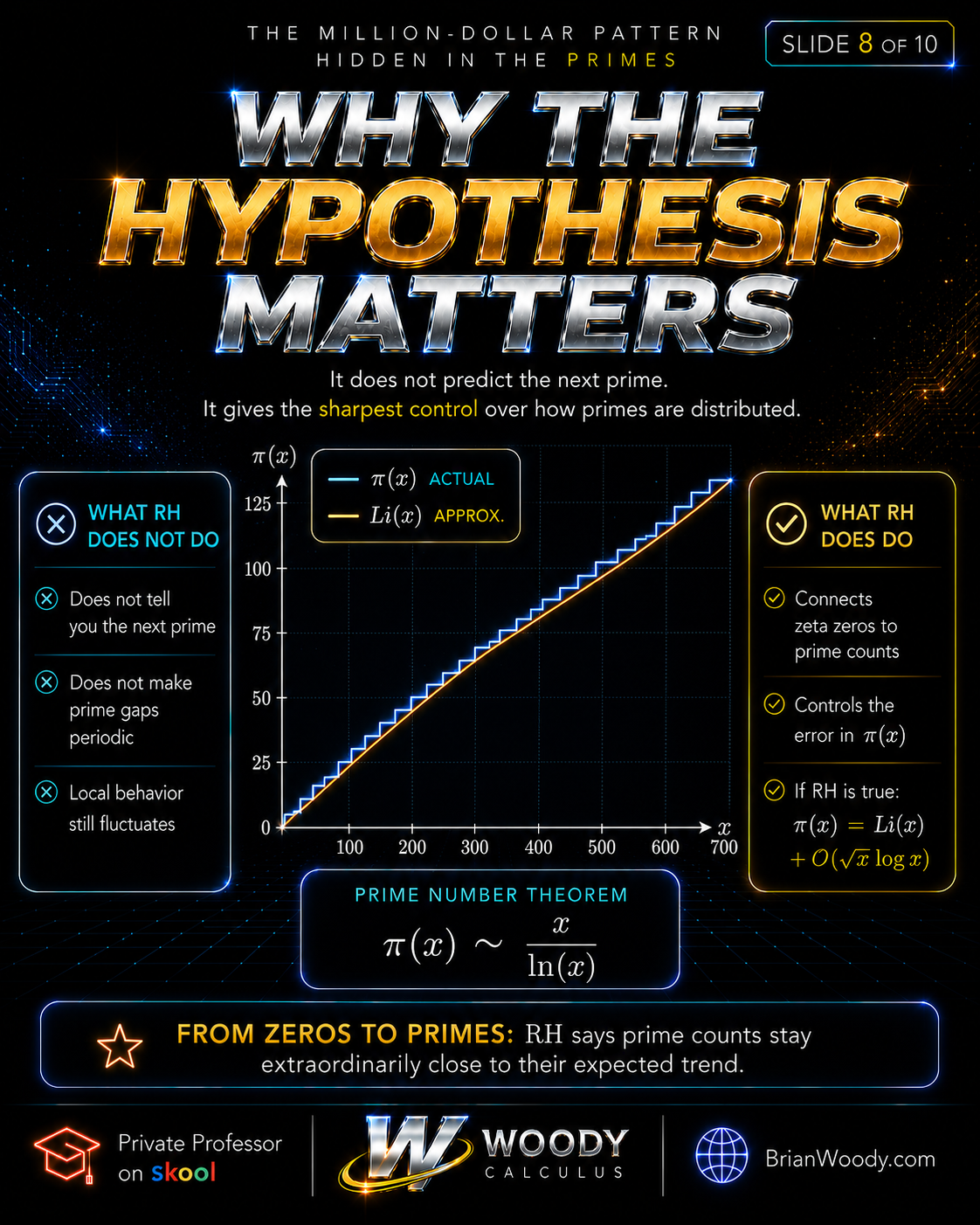
The Riemann Hypothesis does not tell us the next prime number.
It does not make prime gaps periodic.
It does not remove all local fluctuation from prime numbers.
Instead, it gives the sharpest known kind of control over how primes are distributed.
The prime counting function \(\pi(x)\) is irregular because primes do not appear evenly. But there is a smooth expected trend, often modeled more accurately by the logarithmic integral \(\operatorname{Li}(x)\) than by \(\frac{x}{\ln x}\).
If the Riemann Hypothesis is true, then the error between actual prime counts and the expected trend is controlled very tightly.
A common way to express the strength of RH is:
\[
\pi(x)=\operatorname{Li}(x)+O(\sqrt{x}\log x).
\]
This means the Riemann Hypothesis would imply that prime counts stay extraordinarily close to their expected trend, with an error much smaller than what might otherwise be possible.
That is the real power of RH.
It is not a simple prime prediction machine. It is a statement about the deepest possible order inside prime number distribution.
Connections Beyond Prime Numbers
The Riemann Hypothesis is not just about primes in isolation. Its influence reaches across mathematics and beyond.
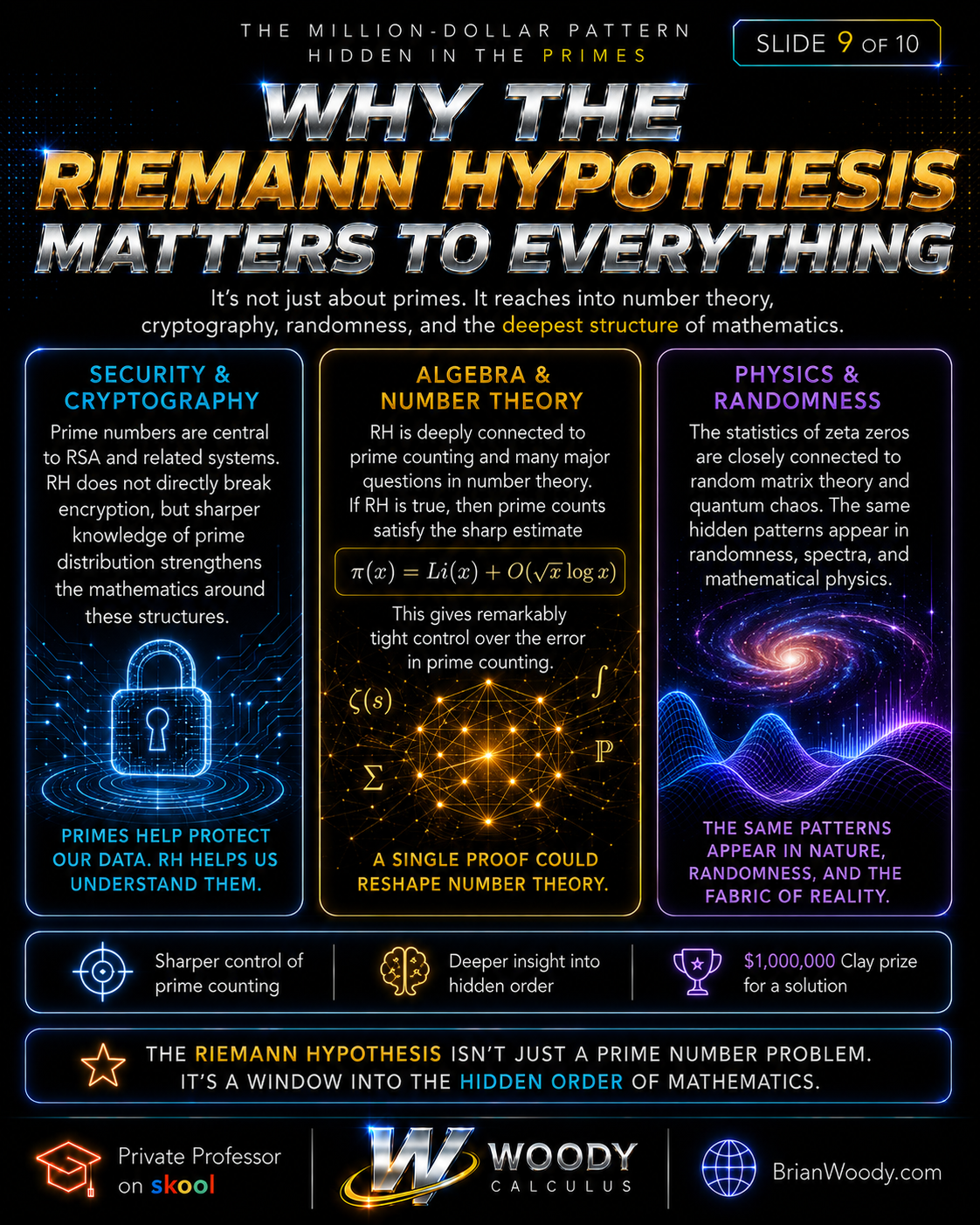
Security and Cryptography
Prime numbers are central to many cryptographic systems, especially RSA and related number-theoretic protocols.
The Riemann Hypothesis does not directly break encryption. That is important. But sharper knowledge about prime numbers strengthens our understanding of the mathematical structures behind cryptography.
Primes help protect data. RH helps us understand primes more deeply.
Algebra and Number Theory
RH is deeply connected to prime counting, arithmetic structure, and many major questions in number theory.
Its proof would reshape the landscape of modern mathematics because many conditional results depend on RH or related generalized hypotheses.
In number theory, RH acts like a central organizing principle. Mathematicians often ask, “What would be true if RH were true?”
Physics, Randomness, and Hidden Order
One of the most surprising aspects of the Riemann Hypothesis is its connection to randomness and mathematical physics.
The statistics of zeta zeros are closely related to patterns studied in random matrix theory and quantum chaos.
This is one of the reasons RH feels so profound. It is not merely a prime number problem. It is a window into hidden order, randomness, spectra, and the deep structure of mathematics itself.
Now Go Deeper with Woody Calculus
The Riemann Hypothesis is far beyond a standard calculus course, but the road toward understanding it begins with the same foundational skills students build in calculus and advanced mathematics:
- Infinite series
- Power series
- Convergence
- Functions of real and complex variables
- Limits and asymptotic behavior
- Proof-based reasoning
- Pattern recognition
This is why topics like Calculus II, Calculus III, Differential Equations, Linear Algebra, Abstract Algebra, and Real Analysis matter so much.
They are not isolated classes. They are pieces of a larger mathematical language.
Inside Woody Calculus Private Professor on Skool, students build that language through rigorous subconscious training. Formula fluency is non-negotiable. Students work from clean expert solutions, rewrite perfect problems, say the steps out loud, and repeat the correct patterns until the mechanics become automatic. That is how real mathematical confidence is built.
The Big Takeaway
The Riemann Hypothesis asks whether every nontrivial zero of the zeta function lies on the critical line:
\[
\operatorname{Re}(s)=\frac{1}{2}.
\]
That one sentence connects:
- Prime numbers
- Infinite series
- The zeta function
- Complex analysis
- The prime number theorem
- Cryptography
- Randomness
- Quantum chaos
- The deepest hidden structure of mathematics
Primes may look random. But the Riemann Hypothesis suggests their deepest pattern may be written in the zeros of the zeta function.
That is why this problem has fascinated mathematicians for over 165 years.
It is not just a million-dollar problem.
It is one of the clearest examples of how mathematics finds order inside chaos.
Learn More with Woody Calculus
If you want to build the foundation for advanced mathematics, start with the courses where the language begins:
- Calculus II Tutor
- Calculus III Tutor
- Differential Equations Help
- Linear Algebra Tutor
- Abstract Algebra Tutor
- Real Analysis Tutor
- AP Calculus BC Tutor
Visit BrianWoody.com or join Woody Calculus Private Professor on Skool for video courses, live help, written solutions, past exams, and serious mathematical training.
Follow @WoodyCalculus on Instagram for more visual mathematical essays, advanced math breakdowns, and Woody Calculus study strategies.
Related Woody Calculus Mathematical Essays
For more visual mathematical essays connecting Calculus II, Calculus III, Differential Equations, Abstract Algebra, Real Analysis, number theory, topology, complex analysis, Taylor series, Fourier series, and proof-based mathematics, explore these Woody Calculus blog posts:
- How to Learn Calculus and Advanced Mathematics
- Taylor Series Explained: Mathematical Time Travel in Calculus 2
- Gabriel’s Horn: Finite Volume and Infinite Surface Area
- Line Integrals and Vector Fields
- Fourier Series
- The Cantor Set
- Galois Theory
- View All Woody Calculus Blog Posts
University-Specific Calculus and Advanced Math Support
Woody Calculus supports students across the country with Calculus II, Calculus III, Differential Equations, Linear Algebra, Abstract Algebra, Real Analysis, and advanced mathematics coursework.
- University Calculus Tutor Hub
- MIT Calculus Tutor
- Purdue Calculus Tutor
- Georgia Tech Calculus Tutor
- UCLA Calculus Tutor
- UCSD Calculus Tutor
- UIUC Calculus Tutor
- University of Michigan Calculus Tutor
- University of Wisconsin Calculus Tutor
- University of Florida Calculus Tutor
- Colorado State University Calculus Help
- UCF Calculus Tutor
- UNR Calculus Tutor
Found a reflection of the primes themselves through the 3, 6 and 9 when looking at the roots of primes when multiplied by a specific number 1st (should be easy to figure out). A reflection of the even/odd imbalance in the relationship between the 3’s and 6’s to the lone 9 found so far, which occupies the second digit of the sequence which probably doesnt repeat because it reflects.
Thanks for sharing your thoughts! Prime numbers certainly have many fascinating patterns, and it’s always interesting to see different ways people explore them.
From your comment, it sounds like you’re describing a numerical pattern involving digital roots (or repeated digit sums) and the numbers 3, 6, and 9 after multiplying primes by a particular constant. I’m not sure I completely follow the construction, though.
Could you clarify:
* What is the specific number you’re multiplying the primes by?
* How exactly are you generating the sequence?
* Is this an observation from a finite set of primes, or have you found a proof that it holds for all primes?
One of the biggest challenges in number theory is distinguishing between intriguing numerical patterns and properties that can be proven mathematically. If your observation is truly universal, I’d be very interested in seeing the details of the argument. Thanks again for contributing to the discussion!