Gabriel’s Horn Explained: Finite Volume, Infinite Surface Area in Calculus 2
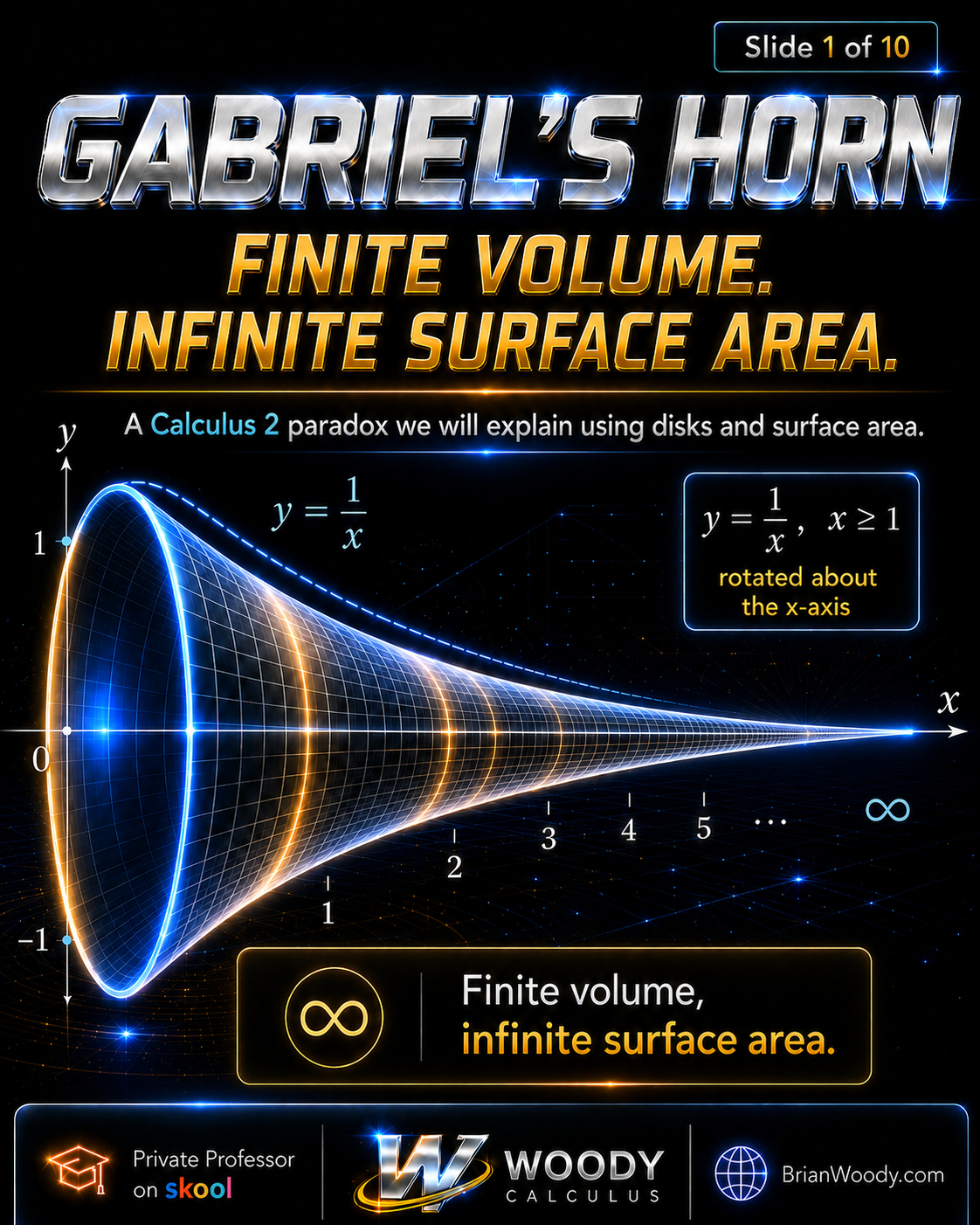
Gabriel’s Horn is one of the most unforgettable paradoxes in Calculus 2.
It starts with a simple curve:
\[
y=\frac{1}{x},\qquad x\geq 1.
\]
Rotate that curve about the \(x\)-axis, and you get a three-dimensional horn stretching forever. Then the paradox appears:
Gabriel’s Horn has finite volume but infinite surface area.
In plain language, the idealized mathematical horn can hold a finite amount of volume, but its outside surface area is infinite. That is why students often hear the famous line:
You can fill Gabriel’s Horn, but you can never paint the whole outside.
More precisely, this is a statement about mathematical surface area. Real paint has thickness, so the physical paint interpretation has limitations. But as a Calculus 2 lesson about improper integrals, volume of revolution, and surface area of revolution, Gabriel’s Horn is one of the cleanest examples ever.
Key Takeaways
- Gabriel’s Horn comes from rotating \(y=\frac{1}{x}\), \(x\geq 1\), about the \(x\)-axis.
- The volume is computed using the disk method.
- The volume integral is improper but converges.
- The volume of Gabriel’s Horn is \(V=\pi\).
- The surface area is computed using the surface area of revolution formula.
- The surface area integral is improper and diverges.
- The paradox exists because volume depends on \(r^2\), while surface area depends roughly on \(r\).
- This is a perfect Calculus 2 lesson in improper integrals, convergence, divergence, and geometric interpretation.
What Is Gabriel’s Horn?
Gabriel’s Horn is the solid formed by rotating the region under
\[
y=\frac{1}{x},\qquad x\geq 1
\]
about the \(x\)-axis.
Because the curve continues forever to the right, the horn also extends forever. The radius gets smaller and smaller, but it never completely reaches zero.
The surprise is that the horn encloses only a finite amount of volume, even though the outside surface area is infinite.
Definition: Gabriel’s Horn
Gabriel’s Horn is the solid of revolution obtained by rotating the region under \(y=\frac{1}{x}\), for \(x\geq 1\), about the \(x\)-axis. It has finite volume and infinite surface area.
Why Gabriel’s Horn Matters in Calculus 2
Gabriel’s Horn is a perfect Calculus 2 problem because it combines several major course topics at once:
- volumes of solids of revolution,
- the disk method,
- surface area of revolution,
- improper integrals,
- convergence and divergence,
- comparison of improper integrals,
- geometric interpretation of integrals.
This is exactly why students should not treat the problem as a trick. Gabriel’s Horn is a training ground. It forces you to know which integral measures volume, which integral measures surface area, and why those two measurements behave differently.
Volume vs. Surface Area: The Paradox at a Glance
| Measurement | Formula Used | Integral | Result |
|---|---|---|---|
| Volume | Disk method | \( \pi\int_1^\infty \frac{1}{x^2}\,dx \) | Converges to \( \pi \) |
| Surface Area | Surface area of revolution | \(2\pi\int_1^\infty \frac{1}{x}\sqrt{1+\frac{1}{x^4}}\,dx\) | Diverges to \( \infty \) |
| Big Idea | Different measurements | Volume uses \(r^2\), surface area uses \(r\) | Same horn, different outcomes |
This table is the entire paradox in one place. Volume shrinks fast enough because the radius is squared. Surface area does not shrink fast enough because the radius appears linearly inside the surface area formula.
Start With a Curve and Rotate It Into a Horn
Start with the curve
\[
y=\frac{1}{x},\qquad x\geq 1.
\]
Now rotate the region under this curve about the \(x\)-axis. Each point on the curve sweeps out a circle, and the entire region becomes a three-dimensional solid of revolution.
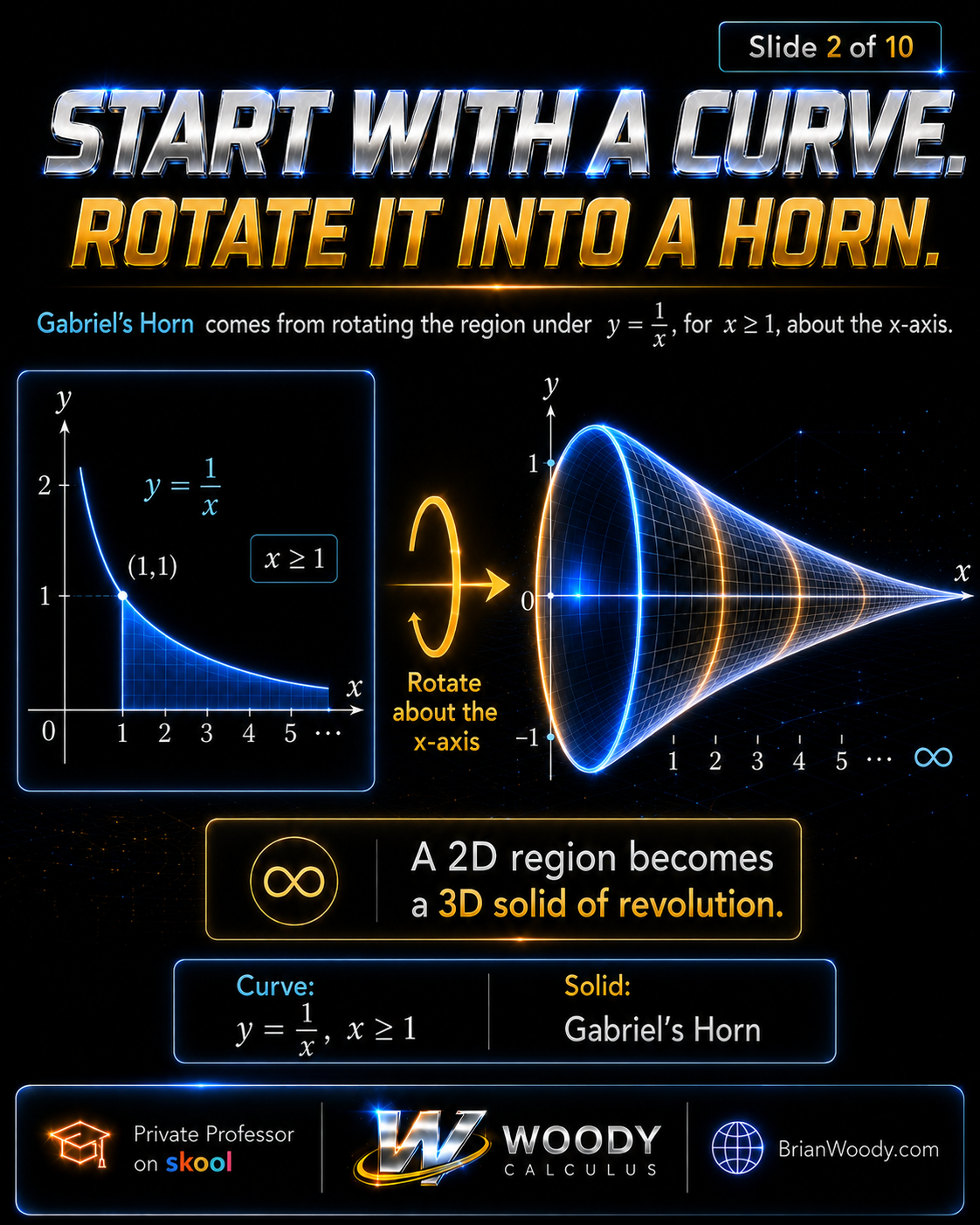
The cross-sections perpendicular to the \(x\)-axis are disks. That is why we use the disk method for volume.
The Disk Method: Add Cross-Sectional Areas
The disk method says that volume comes from adding up thin circular cross-sections.
At a given \(x\)-value, the radius of the disk is the height of the curve:
\[
r(x)=y=\frac{1}{x}.
\]
The area of one disk is
\[
A(x)=\pi[r(x)]^2.
\]
Since \(r(x)=\frac{1}{x}\), we get
\[
A(x)=\pi\left(\frac{1}{x}\right)^2=\frac{\pi}{x^2}.
\]
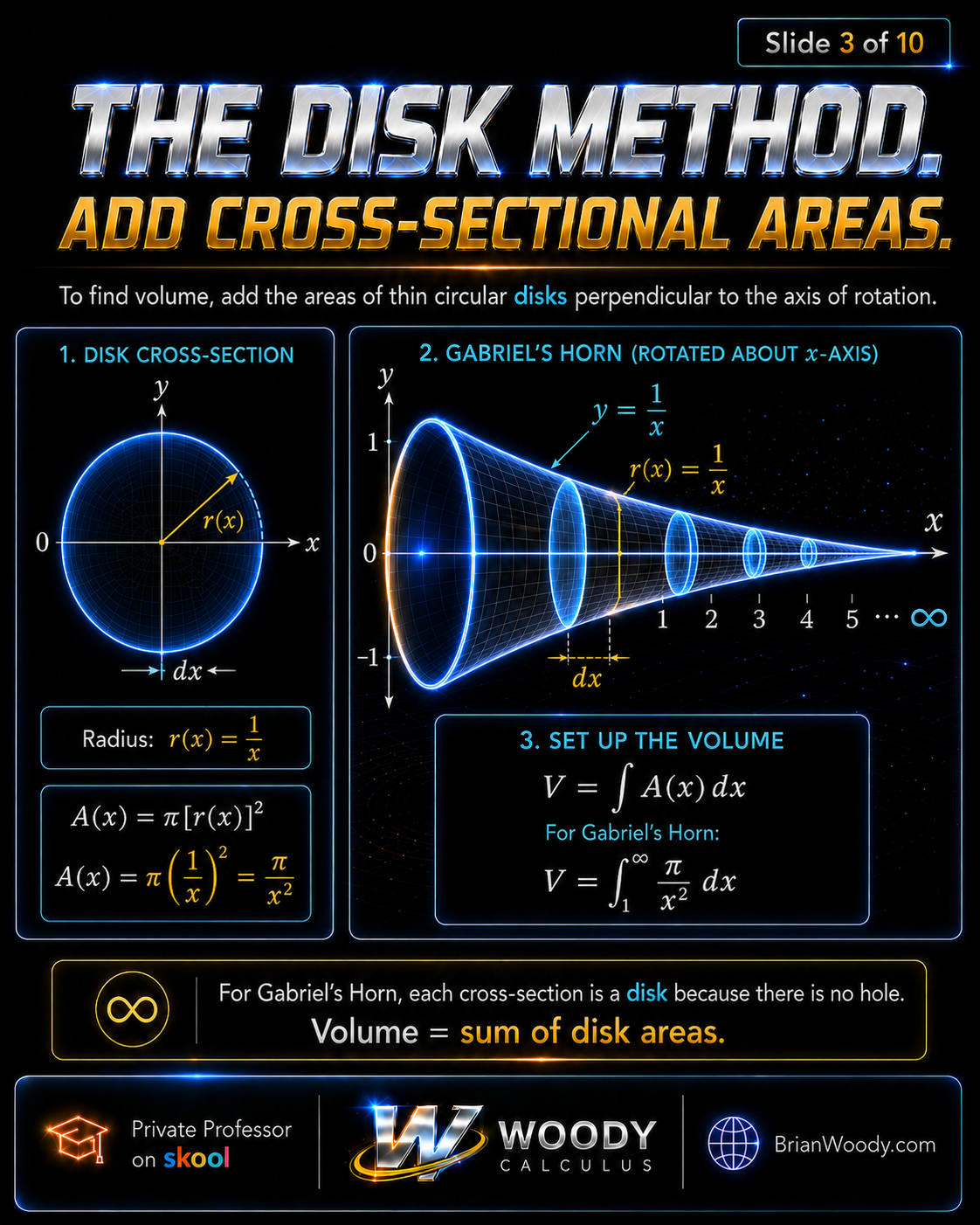
This is the first essential idea:
Volume uses cross-sectional area, and cross-sectional area uses the radius squared.
Set Up the Volume Integral
To find the total volume, integrate the disk areas from \(x=1\) to infinity:
\[
V=\int_1^\infty A(x)\,dx.
\]
Substitute \(A(x)=\frac{\pi}{x^2}\):
\[
V=\int_1^\infty \frac{\pi}{x^2}\,dx.
\]
Equivalently,
\[
V=\pi\int_1^\infty x^{-2}\,dx.
\]
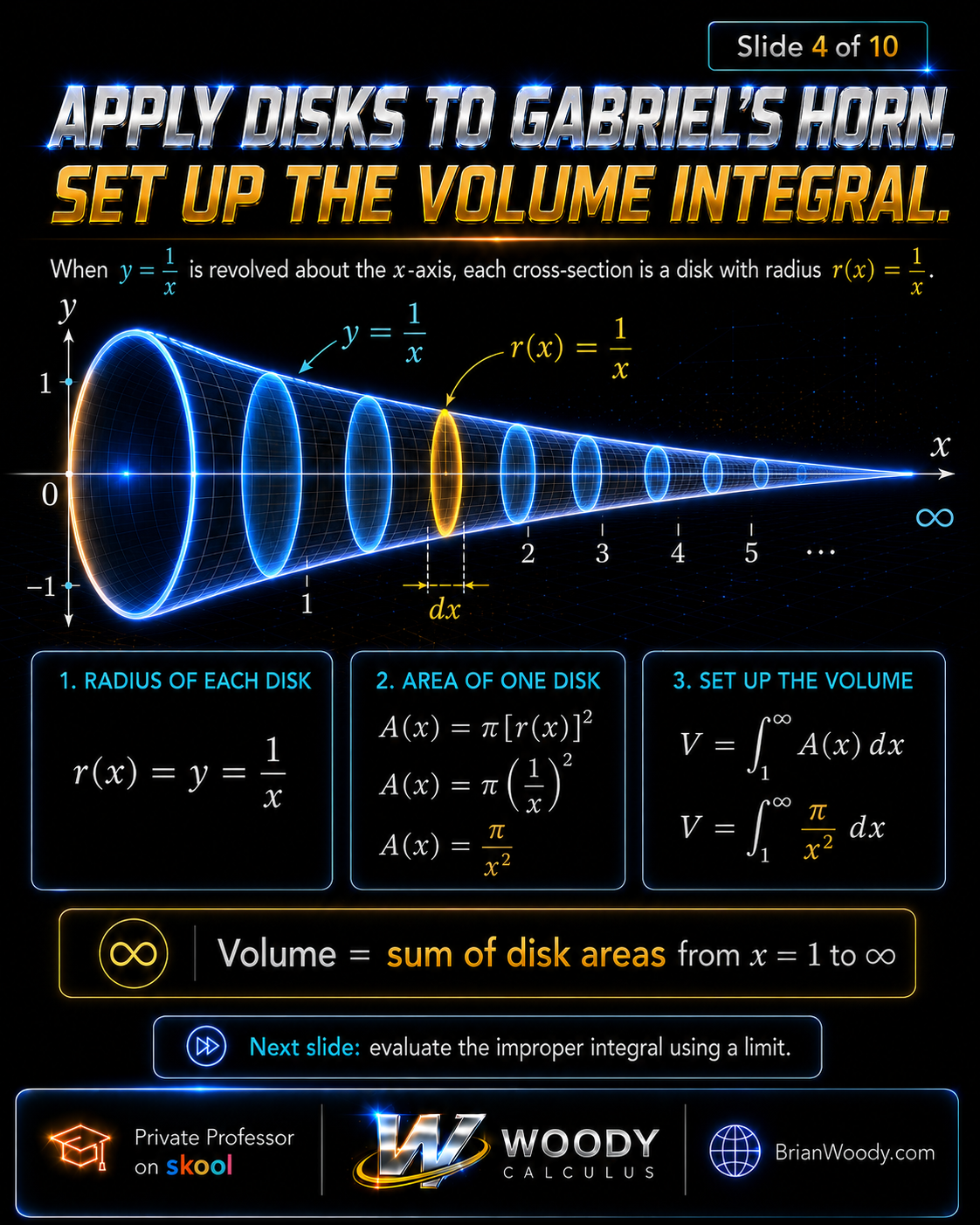
This integral is improper because the upper limit is infinite. In Calculus 2, that means we must evaluate it with a limit.
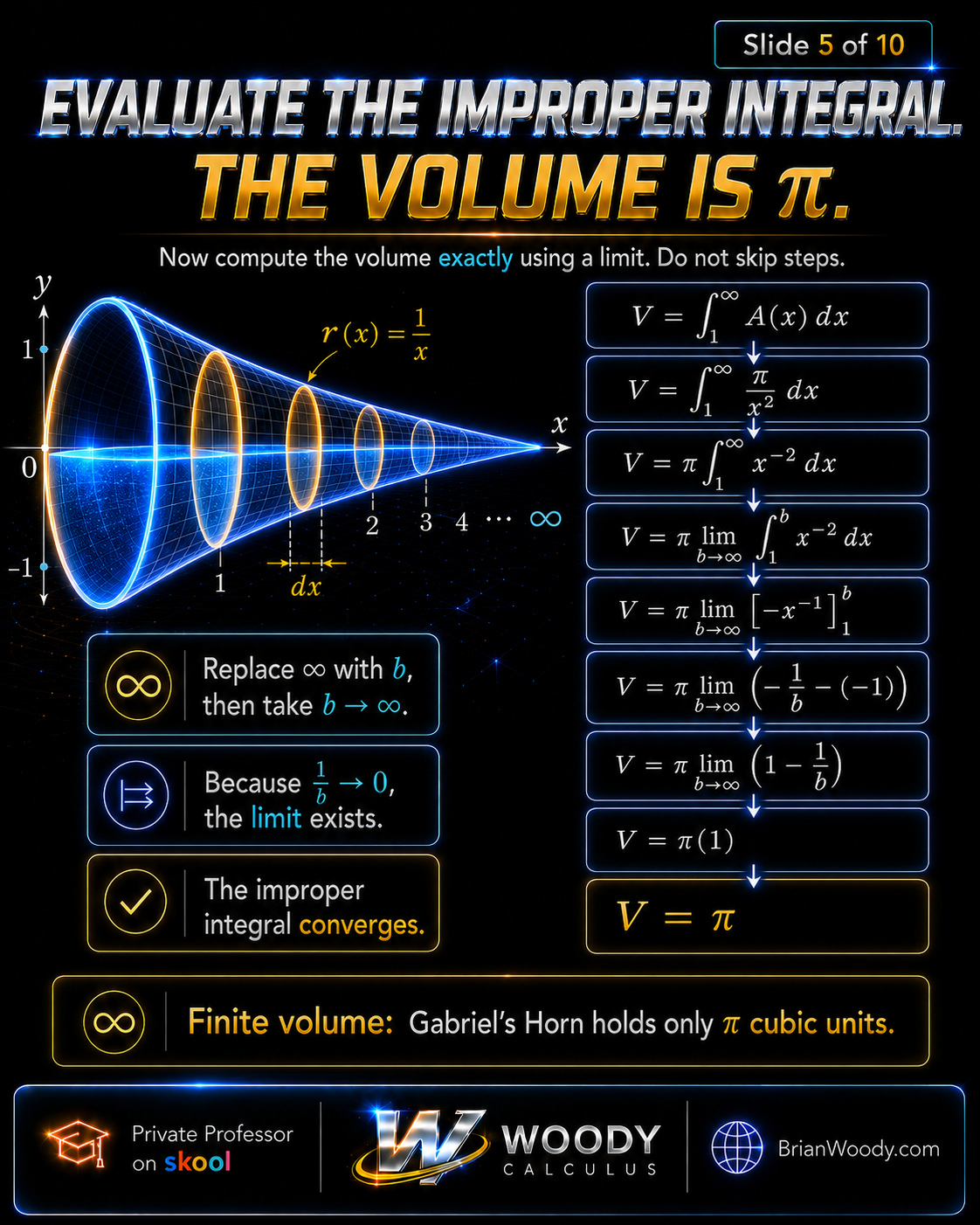
Evaluate the Improper Integral: The Volume Is \( \pi \)
Now compute the volume exactly:
\[
V=\pi\int_1^\infty x^{-2}\,dx.
\]
Replace infinity with \(b\), then take the limit as \(b\to\infty\):
\[
V=\pi\lim_{b\to\infty}\int_1^b x^{-2}\,dx.
\]
Integrate:
\[
\int x^{-2}\,dx=-x^{-1}.
\]
Therefore,
\[
V=\pi\lim_{b\to\infty}\left[-x^{-1}\right]_1^b.
\]
Evaluate the bounds:
\[
V=\pi\lim_{b\to\infty}\left(-\frac{1}{b}-(-1)\right).
\]
Simplify:
\[
V=\pi\lim_{b\to\infty}\left(1-\frac{1}{b}\right).
\]
Since \(\frac{1}{b}\to 0\),
\[
V=\pi(1)=\pi.
\]
Calculus 2 Lesson
The volume is finite because \( \int_1^\infty \frac{1}{x^2}\,dx \) is a convergent improper integral. This is a \(p\)-integral with \(p=2>1\).
Now that we know the volume is finite, the natural question is: what about the outside? This is where Gabriel’s Horn becomes unforgettable. The inside volume converges, but the outside surface area behaves very differently.
Surface Area of Revolution Formula
Now we stop measuring the inside and start measuring the outside.
For a smooth function \(y=f(x)\geq 0\) rotated about the \(x\)-axis, the surface area formula is
\[
S=2\pi\int_a^b y\sqrt{1+(y^{\prime})^2}\,dx.
\]
This formula comes from adding thin surface bands. Each band has approximate area
\[
\text{band area}\approx \text{circumference}\times \text{slant height}.
\]
The circumference is \(2\pi y\), and the slant height element is
\[
ds=\sqrt{1+(y^{\prime})^2}\,dx.
\]
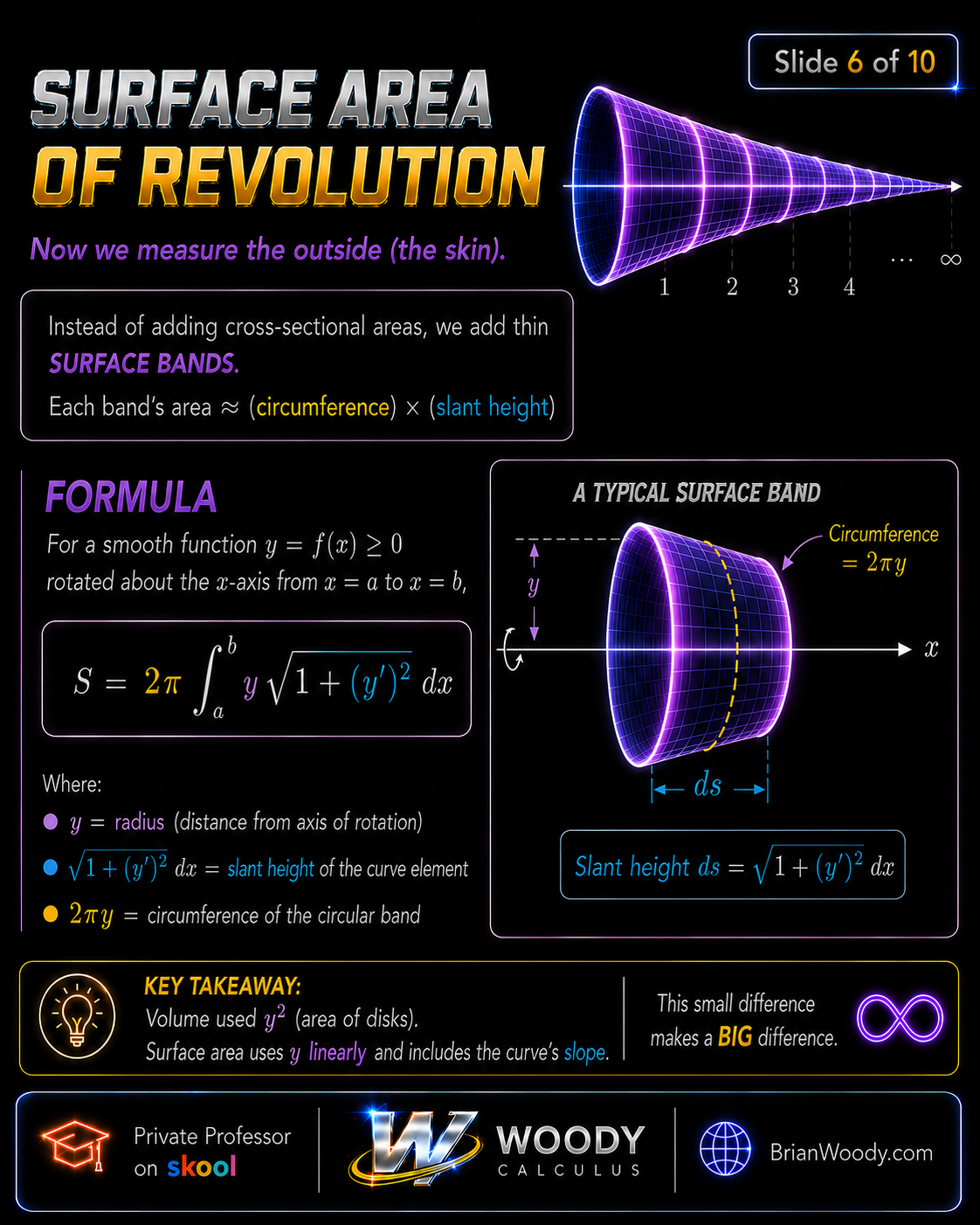
This is where the paradox begins. Volume uses \(y^2\), but surface area uses \(y\) multiplied by a slant-height factor.
Set Up the Surface Area Integral
For Gabriel’s Horn,
\[
y=\frac{1}{x}=x^{-1}.
\]
Differentiate:
\[
y^{\prime}=-x^{-2}=-\frac{1}{x^2}.
\]
So
\[
(y^{\prime})^2=\frac{1}{x^4}.
\]
Substitute into the surface area formula:
\[
S=2\pi\int_1^\infty y\sqrt{1+(y^{\prime})^2}\,dx.
\]
Since \(y=\frac{1}{x}\) and \((y^{\prime})^2=\frac{1}{x^4}\),
\[
S=2\pi\int_1^\infty \frac{1}{x}\sqrt{1+\frac{1}{x^4}}\,dx.
\]
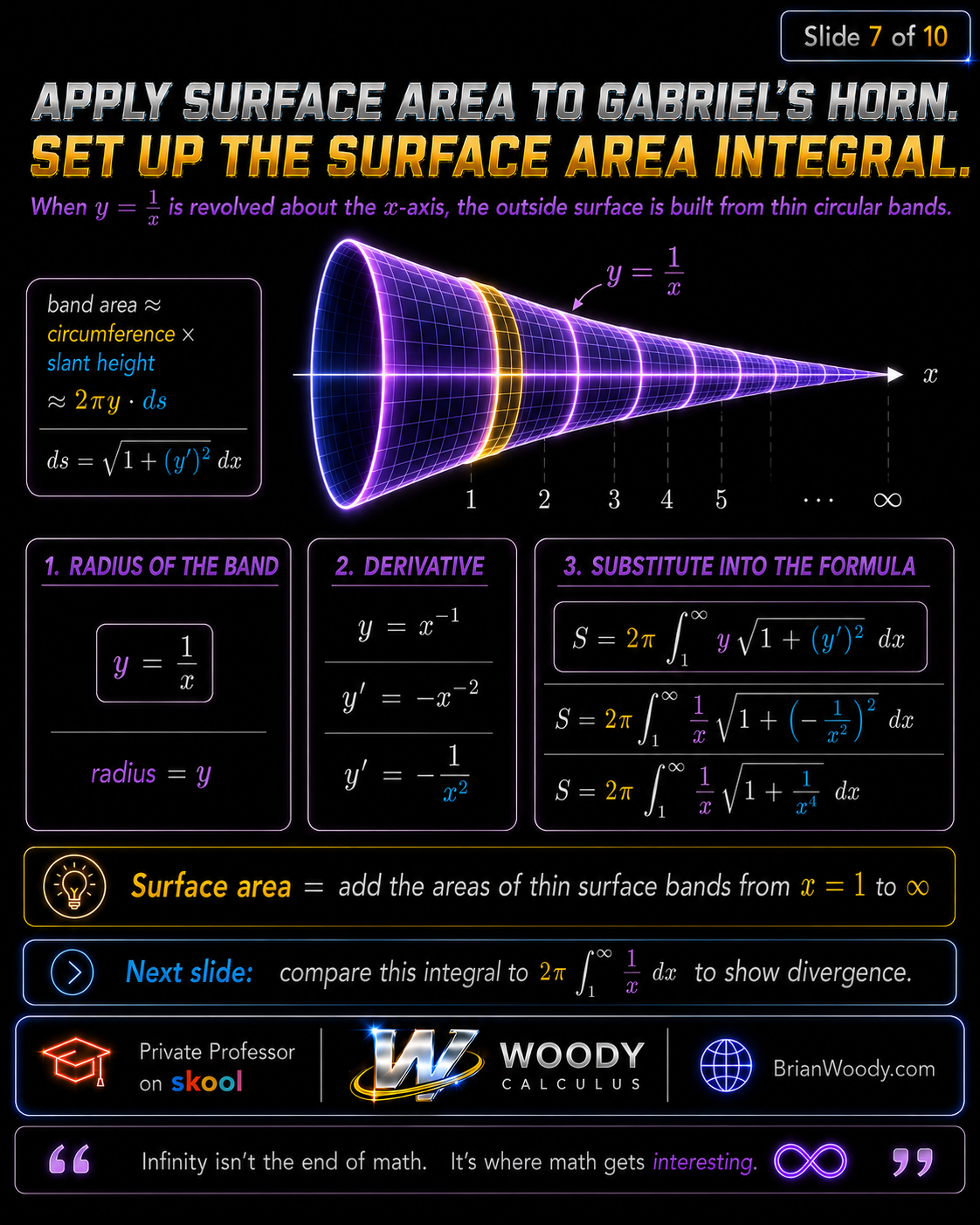
This integral is also improper because the horn extends forever. But unlike the volume integral, this one does not converge.
Show the Surface Area Diverges
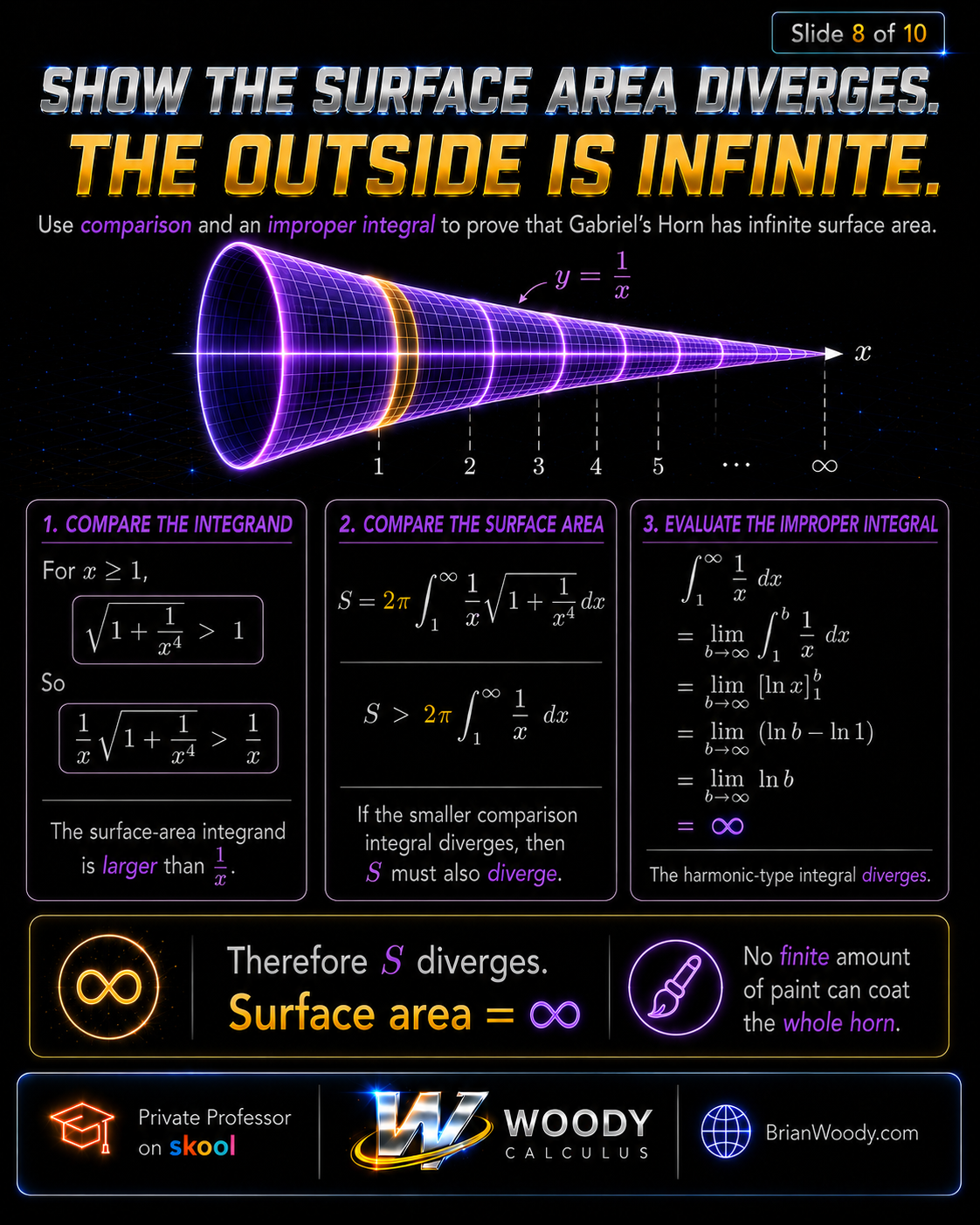
To prove the surface area diverges, use comparison.
For \(x\geq 1\), we know
\[
\sqrt{1+\frac{1}{x^4}}>1.
\]
Therefore,
\[
\frac{1}{x}\sqrt{1+\frac{1}{x^4}}>\frac{1}{x}.
\]
So the surface area satisfies
\[
S=2\pi\int_1^\infty \frac{1}{x}\sqrt{1+\frac{1}{x^4}}\,dx
>
2\pi\int_1^\infty \frac{1}{x}\,dx.
\]
Now evaluate the comparison integral:
\[
\int_1^\infty \frac{1}{x}\,dx
=
\lim_{b\to\infty}\int_1^b \frac{1}{x}\,dx.
\]
Since
\[
\int \frac{1}{x}\,dx=\ln x,
\]
we get
\[
\lim_{b\to\infty}[\ln x]_1^b
=
\lim_{b\to\infty}(\ln b-\ln 1)
=
\infty.
\]
Thus
\[
\int_1^\infty \frac{1}{x}\,dx
\]
diverges. Since the surface area integral is larger than a divergent integral, the surface area also diverges.
Therefore,
\[
S=\infty.
\]
Calculus 2 Lesson
The surface area is infinite because the integrand behaves like \( \frac{1}{x} \) for large \(x\), and \( \int_1^\infty \frac{1}{x}\,dx \) diverges.
Why the Paradox Happens
The paradox happens because volume and surface area measure different things.
For Gabriel’s Horn, the radius is
\[
r(x)=\frac{1}{x}.
\]
Volume uses disk area:
\[
A(x)=\pi[r(x)]^2=\pi\left(\frac{1}{x}\right)^2=\frac{\pi}{x^2}.
\]
Surface area uses surface bands:
\[
2\pi y\sqrt{1+(y^{\prime})^2}.
\]
For large \(x\), the factor \(\sqrt{1+\frac{1}{x^4}}\) is close to \(1\), so the surface-area integrand behaves roughly like
\[
\frac{1}{x}.
\]
That is the key difference:
The Paradox in One Sentence
Volume behaves like \( \int_1^\infty \frac{1}{x^2}\,dx \), which converges, but surface area behaves like \( \int_1^\infty \frac{1}{x}\,dx \), which diverges.
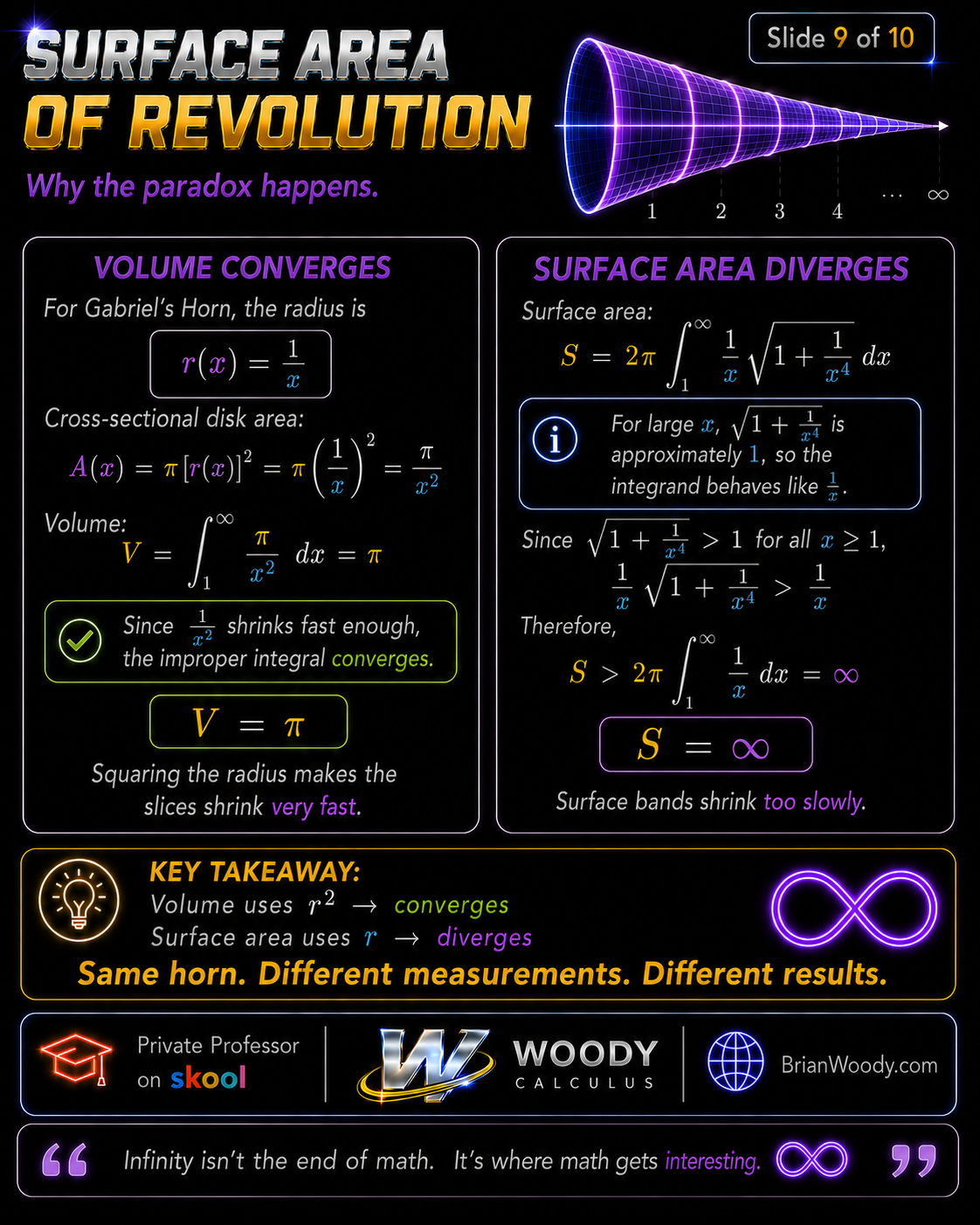
This is why Gabriel’s Horn is so powerful. It shows that infinity is not one-size-fits-all. Some infinite processes converge. Others diverge. Calculus 2 teaches you how to tell the difference.
Can You Really Fill Gabriel’s Horn but Not Paint It?
The classic phrase says:
You can fill Gabriel’s Horn, but you cannot paint the outside.
As a Calculus 2 idea, this is correct in the idealized mathematical sense. The horn has finite volume, so the space inside the horn is finite. But the outside surface area is infinite, so a zero-thickness coating based purely on surface area would require an infinite amount of area coverage.
However, in the physical world, paint has thickness. If paint has positive thickness, the interpretation changes because adding paint is no longer just a surface-area question. So the phrase is best understood as a mathematical paradox about volume and surface area, not a literal engineering instruction.
Important Clarification
Gabriel’s Horn is a mathematical paradox, not a practical paint-bucket problem. The statement “you can fill it but cannot paint it” refers to idealized volume and surface area in calculus.
Common Calculus 2 Mistakes
Students often make the same mistakes when learning Gabriel’s Horn. Here are the big ones to avoid.
Mistake 1: Using washers instead of disks
For Gabriel’s Horn, each cross-section is a disk because there is no hole. The radius is \(r(x)=\frac{1}{x}\).
Mistake 2: Forgetting the improper integral limit
You cannot simply plug in infinity. You must write
\[
\lim_{b\to\infty}.
\]
Mistake 3: Confusing volume with surface area
The volume integral and surface area integral measure different things. Volume uses cross-sectional disk areas. Surface area uses bands around the outside.
Mistake 4: Thinking finite volume should force finite surface area
This is exactly the paradox. Infinite objects can behave differently depending on what you measure.
Mistake 5: Ignoring comparison
The cleanest way to prove the surface area diverges is comparison with \( \int_1^\infty \frac{1}{x}\,dx \).
Complete Worked Solution
Problem
Let the region under \(y=\frac{1}{x}\), \(x\geq 1\), be rotated about the \(x\)-axis. Find the volume and determine whether the surface area is finite or infinite.
Part 1: Volume
The radius of each disk is
\[
r(x)=\frac{1}{x}.
\]
The area of each disk is
\[
A(x)=\pi[r(x)]^2=\pi\left(\frac{1}{x}\right)^2=\frac{\pi}{x^2}.
\]
So the volume is
\[
V=\int_1^\infty \frac{\pi}{x^2}\,dx.
\]
Compute using a limit:
\[
V=\pi\lim_{b\to\infty}\int_1^b x^{-2}\,dx.
\]
\[
V=\pi\lim_{b\to\infty}\left[-x^{-1}\right]_1^b.
\]
\[
V=\pi\lim_{b\to\infty}\left(1-\frac{1}{b}\right).
\]
\[
V=\pi.
\]
Part 2: Surface Area
The surface area formula is
\[
S=2\pi\int_1^\infty y\sqrt{1+(y^{\prime})^2}\,dx.
\]
Since
\[
y=\frac{1}{x},\qquad y^{\prime}=-\frac{1}{x^2},
\]
we get
\[
S=2\pi\int_1^\infty \frac{1}{x}\sqrt{1+\frac{1}{x^4}}\,dx.
\]
For \(x\geq 1\),
\[
\sqrt{1+\frac{1}{x^4}}>1.
\]
So
\[
\frac{1}{x}\sqrt{1+\frac{1}{x^4}}>\frac{1}{x}.
\]
Therefore,
\[
S>2\pi\int_1^\infty \frac{1}{x}\,dx.
\]
But
\[
\int_1^\infty \frac{1}{x}\,dx
=
\lim_{b\to\infty}\ln b
=
\infty.
\]
Thus,
\[
S=\infty.
\]
Final Answer
\[
\boxed{V=\pi}
\]
and
\[
\boxed{S=\infty}.
\]
Gabriel’s Horn has finite volume but infinite surface area.
FAQ: Gabriel’s Horn in Calculus 2
What is Gabriel’s Horn?
Gabriel’s Horn is the solid formed by rotating the region under \(y=\frac{1}{x}\), for \(x\geq 1\), about the \(x\)-axis. It has finite volume but infinite surface area.
Why does Gabriel’s Horn have finite volume?
The volume is finite because the disk method gives \(V=\pi\int_1^\infty \frac{1}{x^2}\,dx\), and this improper integral converges to \(\pi\).
Why does Gabriel’s Horn have infinite surface area?
The surface area is infinite because \(S=2\pi\int_1^\infty \frac{1}{x}\sqrt{1+\frac{1}{x^4}}\,dx\), and this integral is larger than a divergent harmonic-type integral.
What is the volume of Gabriel’s Horn?
The volume of Gabriel’s Horn is \(V=\pi\) cubic units.
What is the surface area of Gabriel’s Horn?
The surface area of Gabriel’s Horn is infinite.
What Calculus 2 topics does Gabriel’s Horn use?
Gabriel’s Horn uses the disk method, surface area of revolution, improper integrals, convergence, divergence, and comparison of improper integrals.
Why is it called a paradox?
It is called a paradox because the horn has finite volume but infinite surface area. That feels contradictory at first, but Calculus 2 explains it through different improper integrals.
Can Gabriel’s Horn really be filled but not painted?
In the idealized mathematical sense, yes: the volume is finite but the surface area is infinite. In the physical world, paint has thickness, so the phrase is best understood as a mathematical metaphor rather than a literal physical instruction.
Why does volume converge but surface area diverge?
Volume uses the square of the radius, producing an integral like \( \int_1^\infty \frac{1}{x^2}\,dx \), which converges. Surface area uses the radius linearly, producing behavior like \( \int_1^\infty \frac{1}{x}\,dx \), which diverges.
Is Gabriel’s Horn an improper integral problem?
Yes. Both the volume and surface area integrals are improper because the horn extends from \(x=1\) to infinity.
Woody Calculus Mastery Task
Train Gabriel’s Horn Until the Pattern Becomes Automatic
Gabriel’s Horn is not just something to admire. It is something to train.
- Write \(y=\frac{1}{x}\), \(x\geq 1\), rotated about the \(x\)-axis.
- Say out loud: “Volume uses disks. Surface area uses bands.”
- Write the volume setup:
\[
V=\pi\int_1^\infty \frac{1}{x^2}\,dx.
\] - Evaluate the volume integral with a limit until \(V=\pi\) is automatic.
- Write the surface area setup:
\[
S=2\pi\int_1^\infty \frac{1}{x}\sqrt{1+\frac{1}{x^4}}\,dx.
\] - Say out loud: “The surface area integrand is larger than \(\frac{1}{x}\), so the surface area diverges.”
- Close the book, then rewrite the full solution perfectly, step by step, without skipping the improper integral limits.
That is the Woody Calculus method: train the setup, rewrite the perfect solution, say the steps out loud, and build automatic mastery for Calculus 2 exams.
Final Thought: Gabriel’s Horn Is Calculus 2 at Its Best
Gabriel’s Horn is unforgettable because it makes infinity feel alive.
The horn stretches forever, but its volume stays finite. The cross-sectional disks shrink fast enough for the volume integral to converge. But the outside surface bands shrink too slowly, so the surface area diverges.
This is exactly why Calculus 2 matters. It gives you the tools to distinguish between infinite processes that converge and infinite processes that diverge.
Same horn. Different measurements. Different results.

Ready to Master Calculus 2?
Woody Calculus Private Professor on Skool is built for serious students who want structure, clarity, and mastery in Calculus 2.
Inside the Woody Calculus Mastery Lab, students train through step-by-step lessons, written solutions, live Q&A, mini courses, exam strategy, pattern recognition, and structured repetition.
Get support in Calculus 2, integration techniques, improper integrals, volumes of revolution, surface area, infinite series, Taylor series, and advanced university mathematics.
This is not casual tutoring. This is structured mathematical training.
2 thoughts on “Gabriel’s Horn Explained: Finite Volume, Infinite Surface Area in Calculus 2”