CALCULUS 3 · VECTOR GEOMETRY · VISUAL LESSON
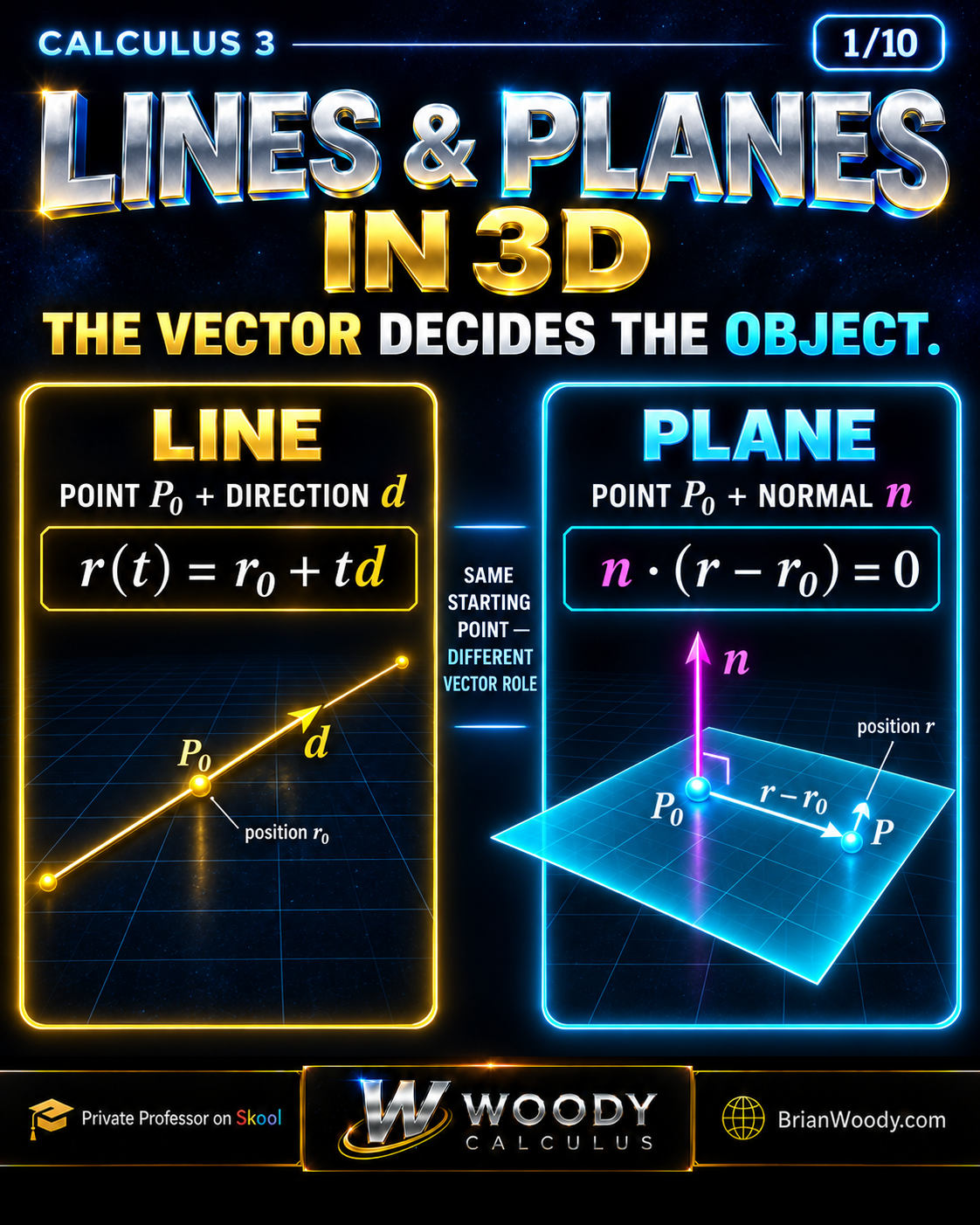
A line in three-dimensional space is determined by a point and a nonzero direction vector. A plane is determined by a point and a nonzero normal vector. A tangent plane uses the same plane equation, with a normal obtained from the surface derivatives.
Point locates. Vector determines orientation.
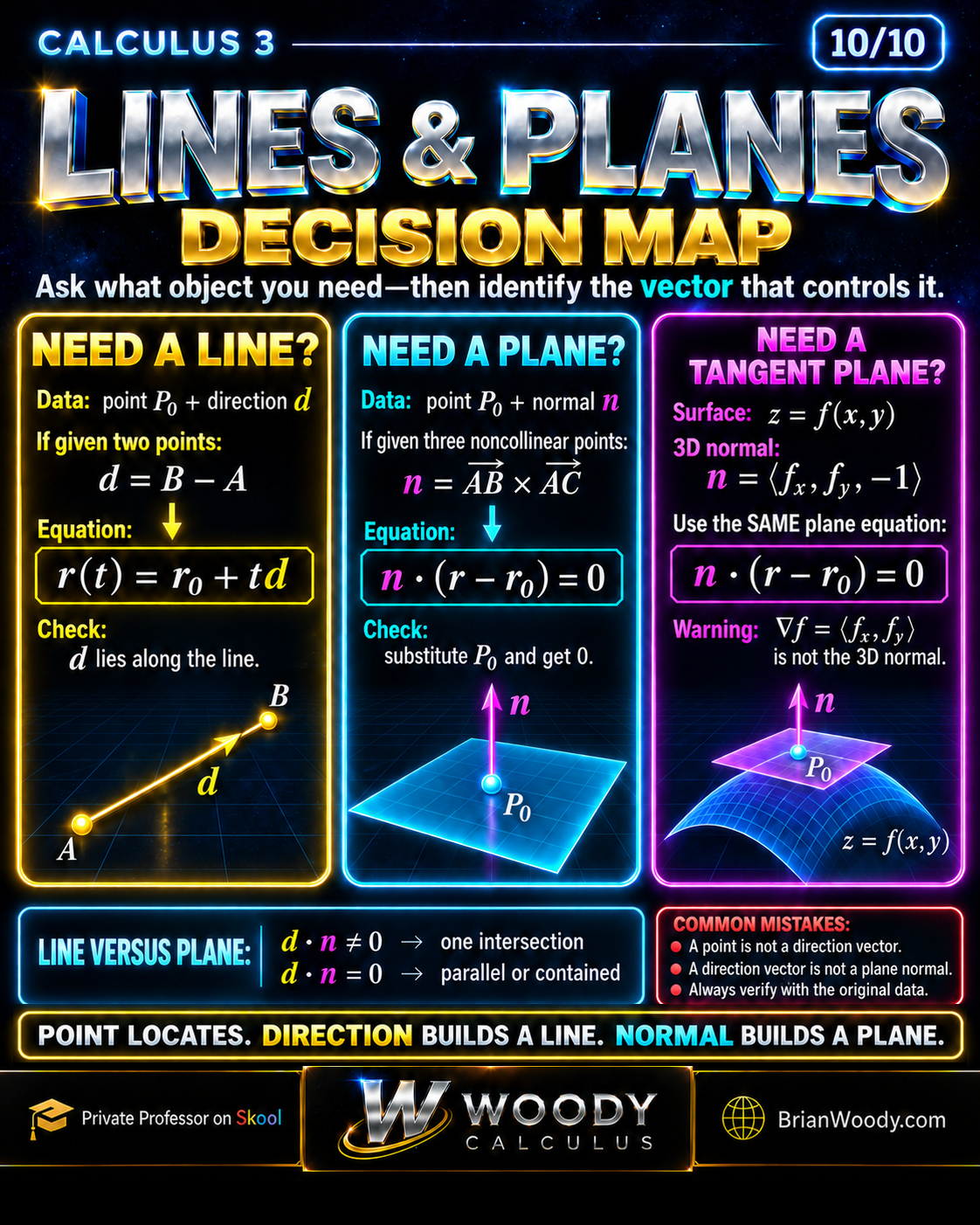
Choose the object first. A direction vector builds a line, a normal vector builds a plane, and substitution checks intersections. Always verify the original point and distinguish the two-dimensional gradient from a three-dimensional graph normal.
By Brian M. Woody (“Woody”), founder of Woody Calculus and a former university mathematics lecturer with more than 25 years of university teaching experience.
Published · Updated
Build a line
One point and a nonzero direction. Convert between vector, parametric, and symmetric equations.
Build a plane
One point and a nonzero normal. Use perpendicularity to write the equation.
Connect to calculus
The same plane equation, with the normal supplied by surface derivatives.
Points, vectors, and position vectors
A point is a location. A vector is a displacement. A position vector connects the origin to a point. These objects can use the same numbers while doing different jobs.
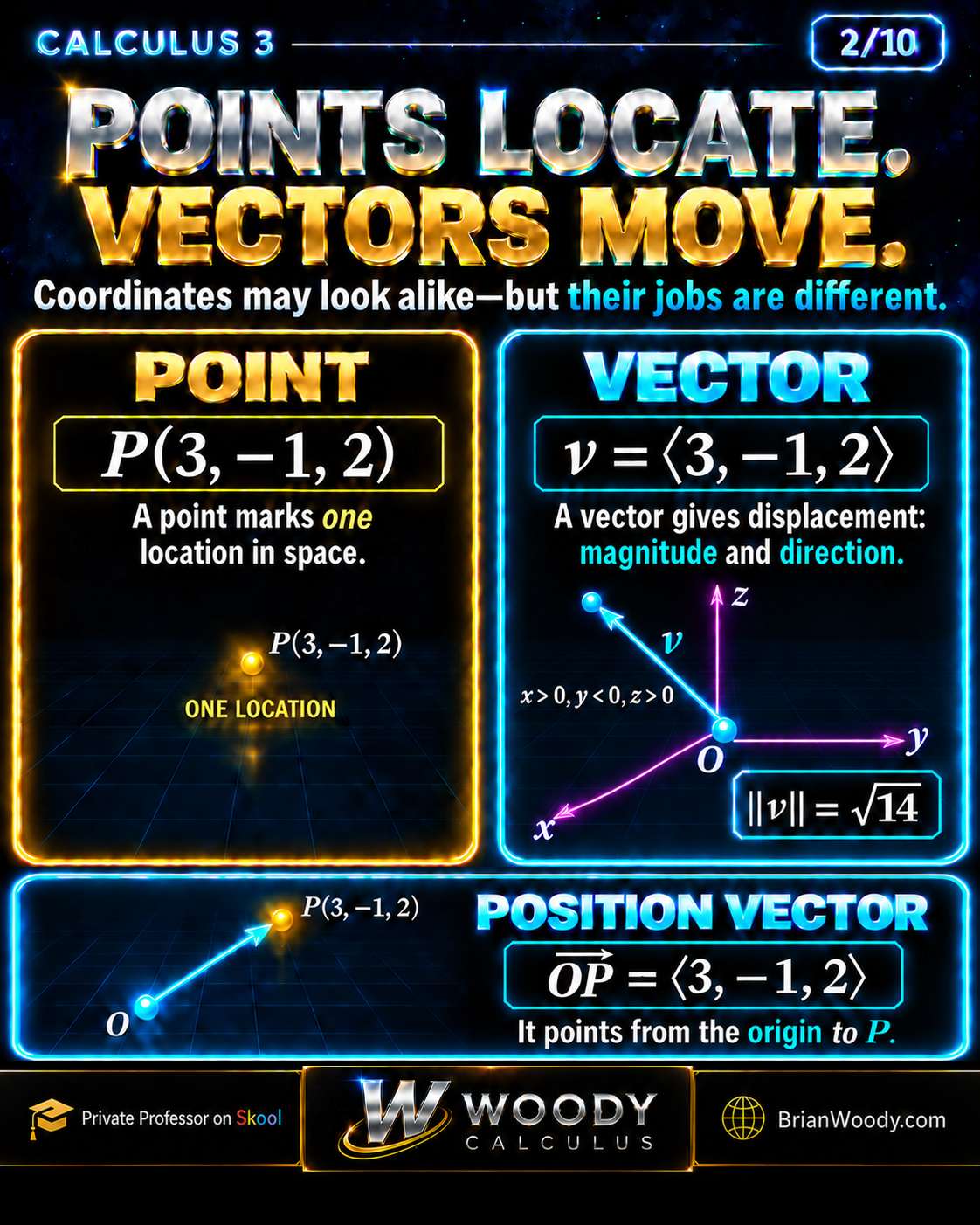
The vector has a positive x-component, a negative y-component, and a positive z-component. Its length is independent of where you draw its tail:
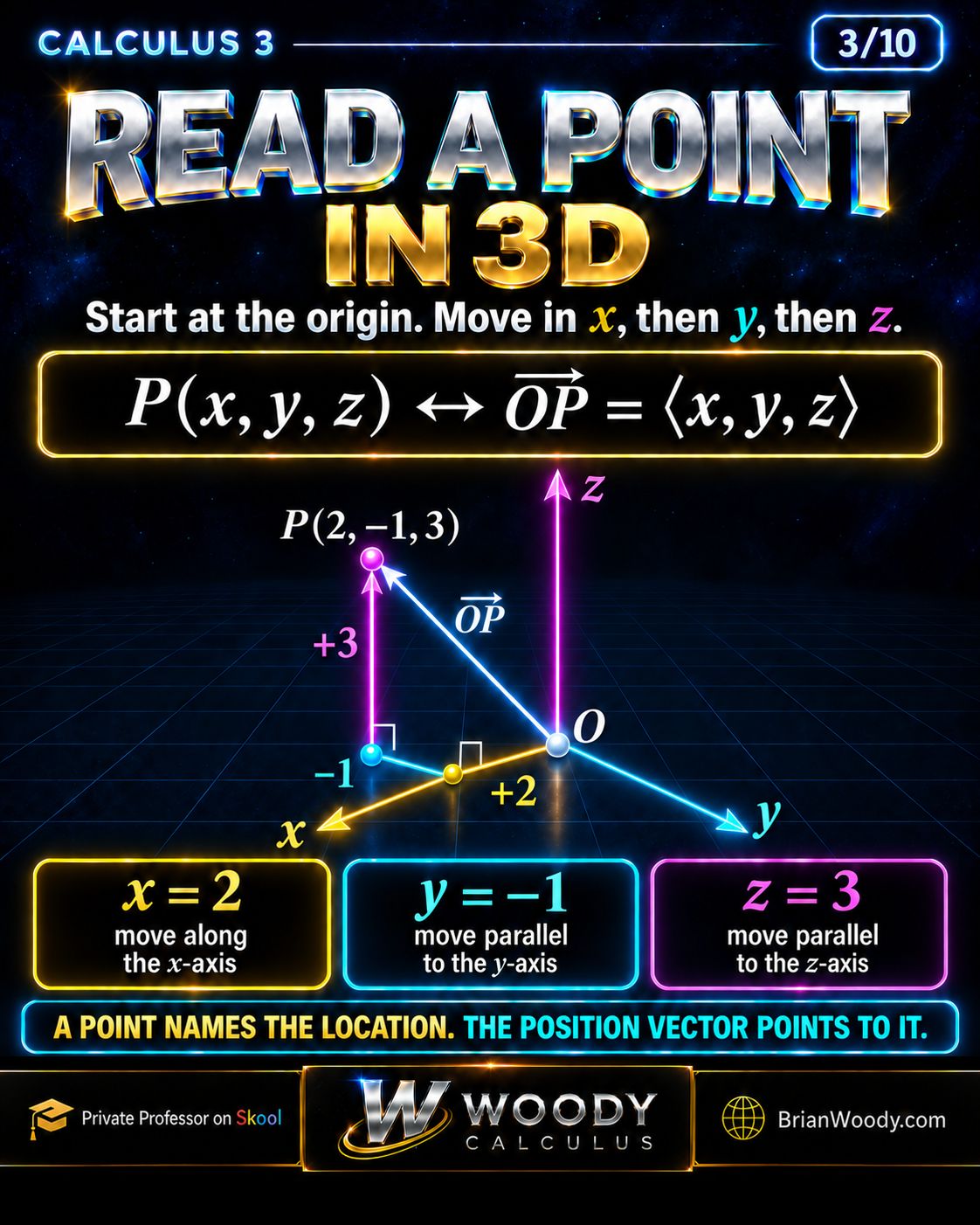
To read P(2, −1, 3), start at the origin, move +2 along x, −1 parallel to y, and +3 parallel to z. The position vector points directly to the endpoint; the coordinate path explains how its components locate that endpoint.
Throughout this lesson, direction vectors and plane normals must be nonzero. A zero direction produces a single point, and a zero normal cannot specify a plane’s orientation.
Vector, parametric, and symmetric equations of a line
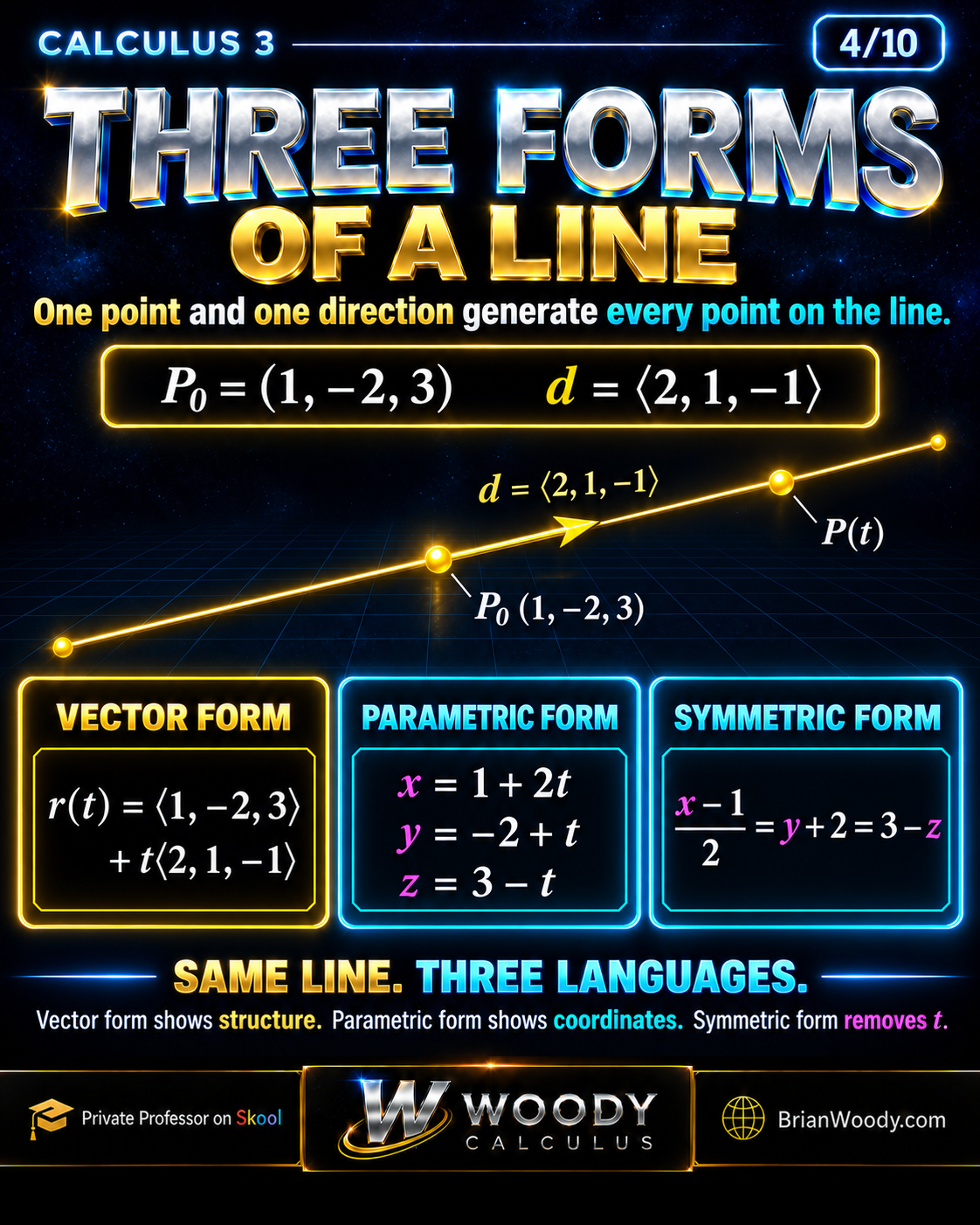
A line through P₀ with nonzero direction d consists of every position obtained by starting at P₀ and moving a real multiple of d. Use different parameter values to travel forward and backward along the line.
For P₀ = (1, −2, 3) and d = ⟨2, 1, −1⟩:
Each coordinate uses the same parameter. Solving all three equations for t gives:
The last two expressions are equal because dividing z − 3 by −1 reverses its sign. At t = 0 you recover the starting point. At t = 1 you reach (3, −1, 2).
What if a direction component is zero?
Keep that coordinate constant. For the line through (1, −2, 3) with d = ⟨0, 2, −1⟩, write:
Never put zero in a symmetric-form denominator. Parametric form handles zero components directly. If two direction components vanish, two coordinates remain fixed.
Worked example: a line through two points
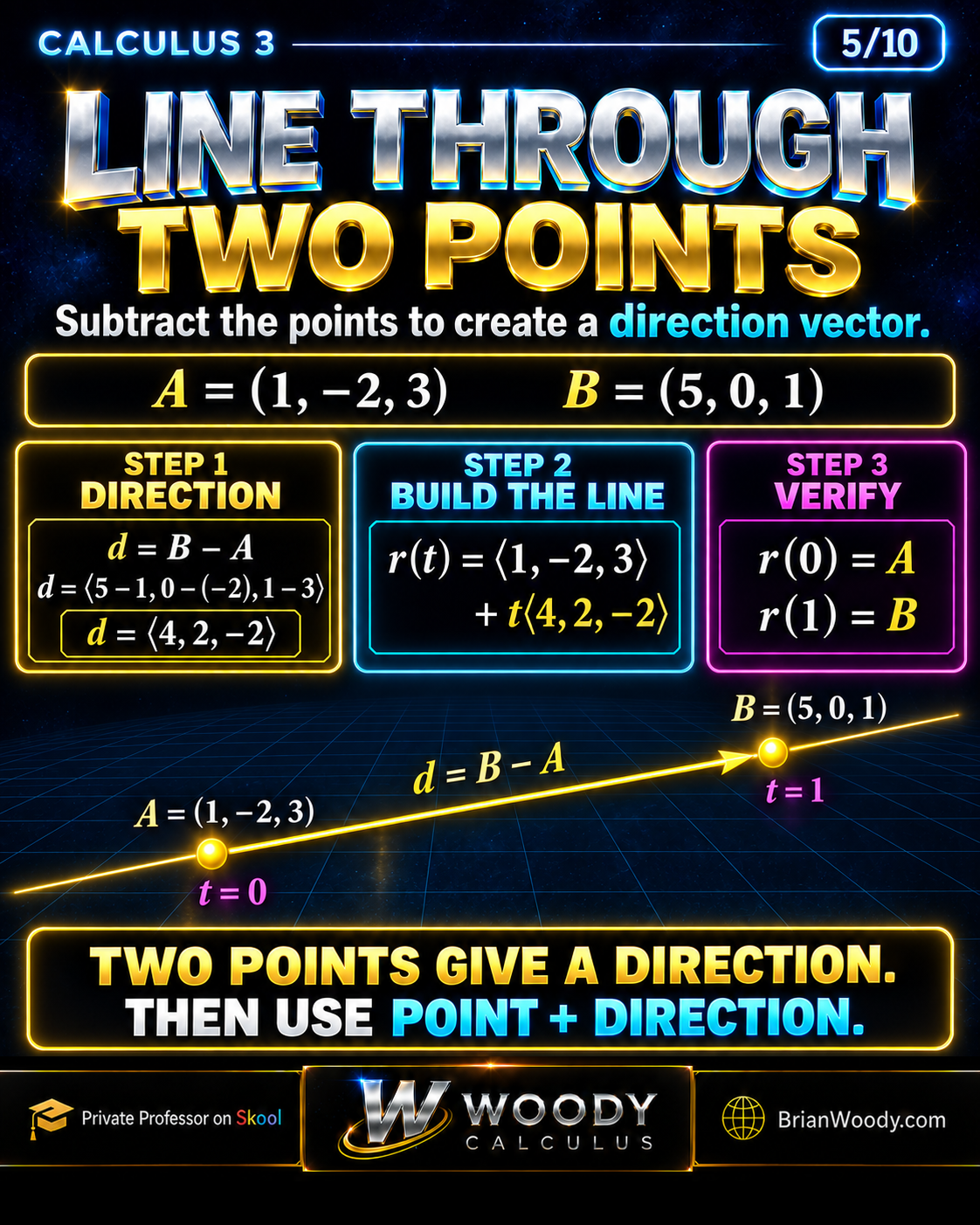
Given A = (1, −2, 3) and B = (5, 0, 1), subtract endpoint minus starting point:
Use A as the starting point:
Verification is built into this parameterization: r(0) = A and r(1) = B. Restricting 0 ≤ t ≤ 1 gives just the segment from A to B; allowing every real t gives the full line.
Different direction vectors can describe the same line
The vector ⟨4, 2, −2⟩ is twice ⟨2, 1, −1⟩. Consequently this example describes the same line as the previous section. The parameter changes its speed along the line, while the set of points stays the same. A nonzero scalar multiple of a direction vector is equally valid.
Why the point-normal equation describes a plane
Let P₀ = (x₀, y₀, z₀) lie in a plane with nonzero normal n = ⟨A, B, C⟩. For any other point P in the plane, the displacement from P₀ to P lies within the plane. Its dot product with n must be zero.
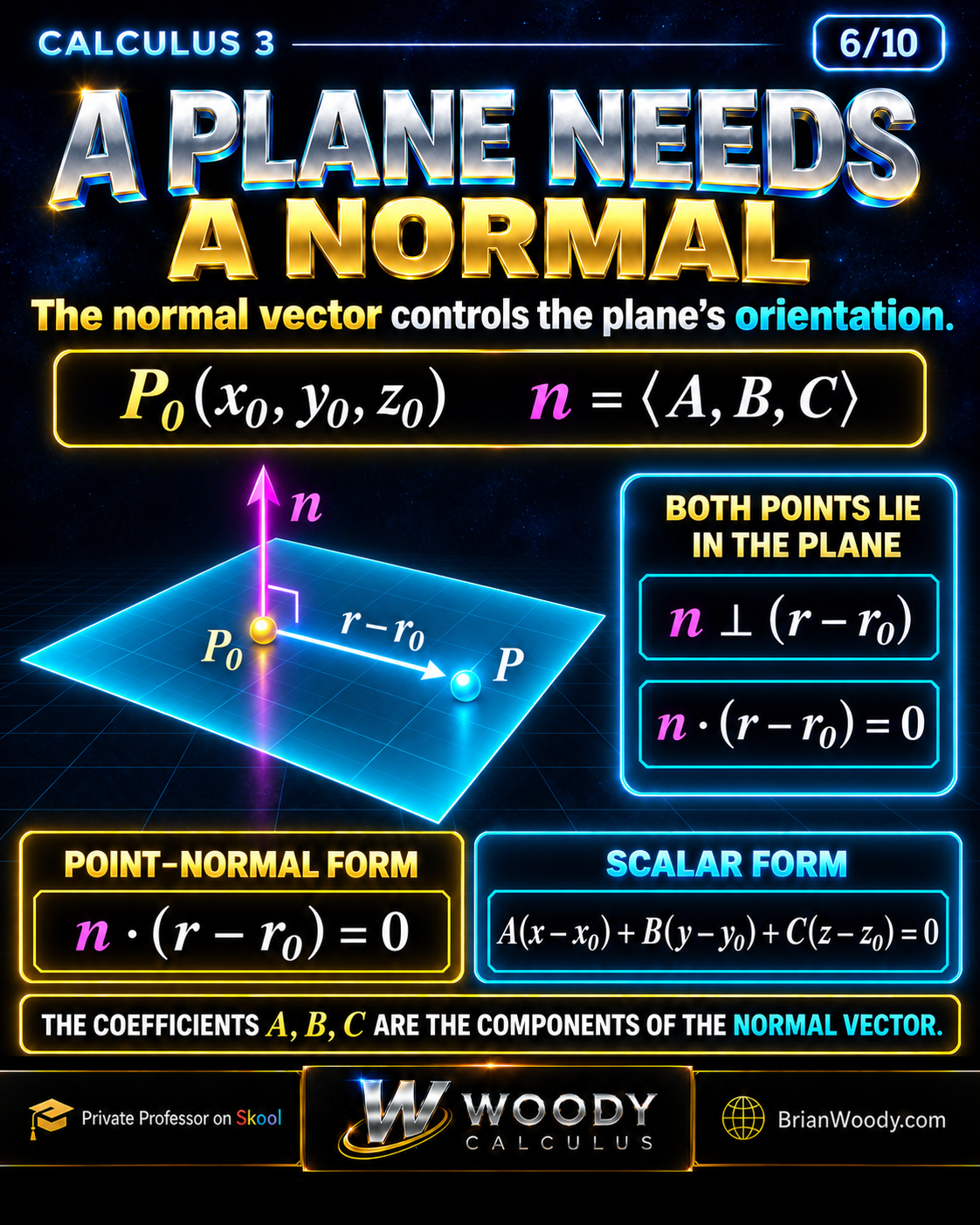
After expansion, the equation has the form Ax + By + Cz + D = 0, where at least one of A, B, C is nonzero. The normal is ⟨A, B, C⟩. The constant D controls the plane’s location relative to the origin.
Multiplying the entire equation by a nonzero constant gives the same plane. In particular, n and −n define the same unoriented plane. Review the dot product and cross product lesson for the underlying perpendicularity test.
Worked example: build and verify a plane
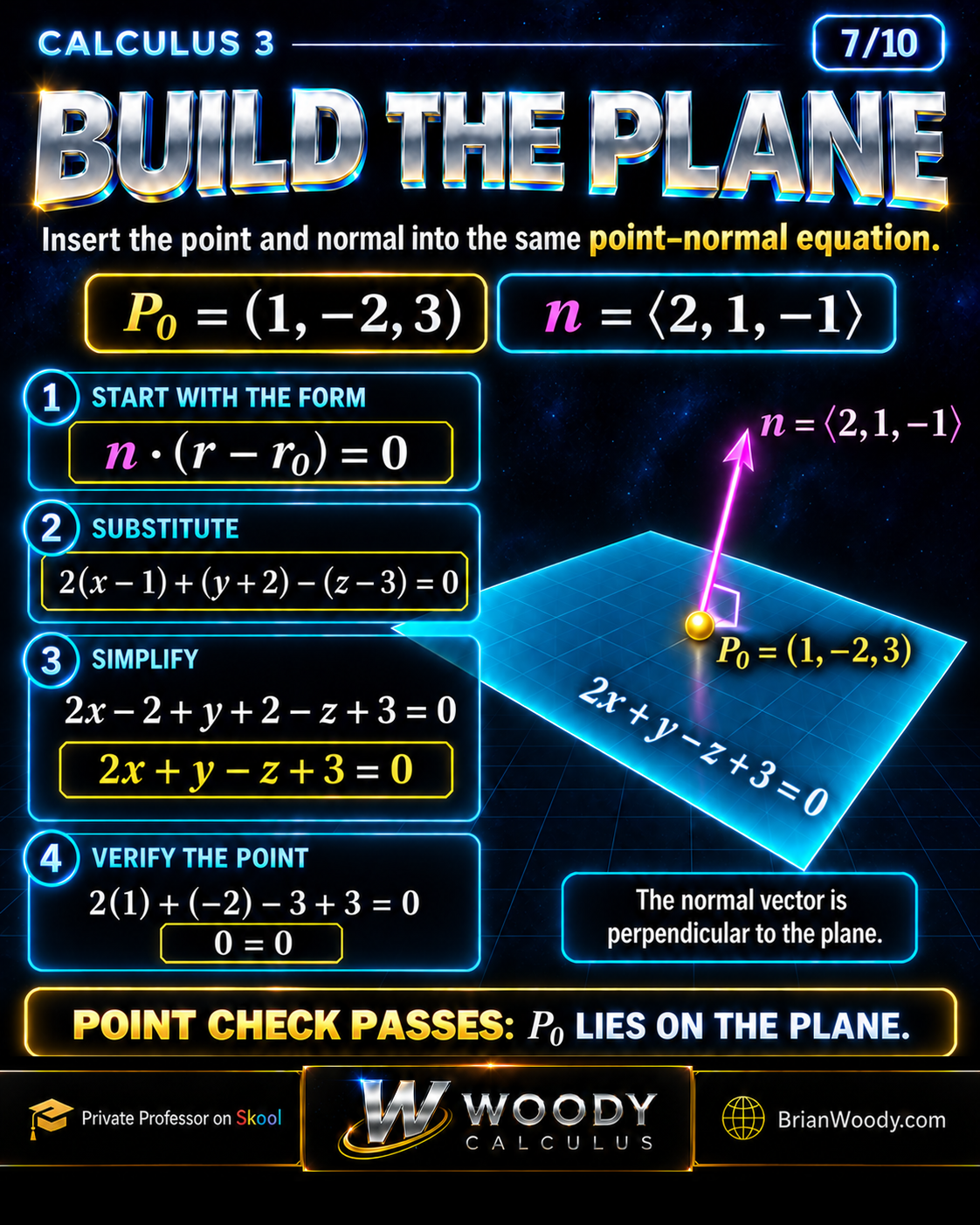
Use P₀ = (1, −2, 3) and n = ⟨2, 1, −1⟩. Substitute before simplifying:
Check the original point: 2(1) + (−2) − 3 + 3 = 0. The coefficients ⟨2, 1, −1⟩ also reproduce the required normal.
How to find a plane through three points
Three noncollinear points determine a unique plane. Subtract one point from the other two to obtain independent in-plane vectors, then take their cross product.
For A = (1, 0, 0), B = (0, 1, 0), and C = (0, 0, 1):
All three original points satisfy the equation. If the cross product is zero, the two displacement vectors are dependent, and the points do not determine a unique plane. For three distinct collinear points, infinitely many planes contain their line.
Line-plane intersection: one point, none, or the whole line
Write the plane as n · r + D = 0 and substitute r = r₀ + td. You obtain one linear equation in t:
Call the first coefficient k and the constant term c. The entire classification comes from kt + c = 0:
| Condition | Result | Reason |
|---|---|---|
| k ≠ 0 | Exactly one point | t = −c/k |
| k = 0, c ≠ 0 | No intersection | A false constant equation |
| k = 0, c = 0 | The entire line lies in the plane | Every t satisfies the equation |
One intersection: the slide example
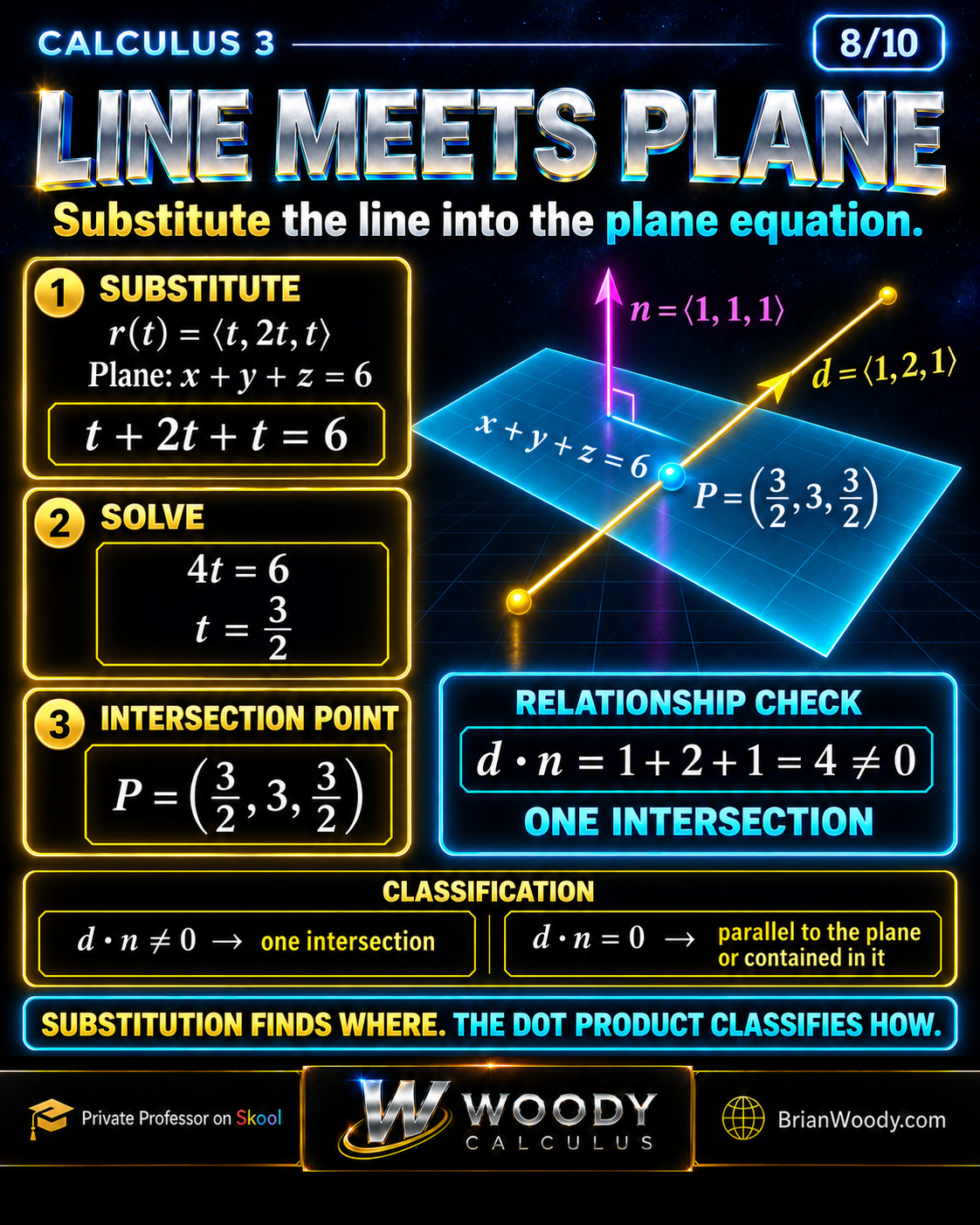
For r(t) = ⟨t, 2t, t⟩ and x + y + z = 6, substitution gives t + 2t + t = 6, hence t = 3/2.
The coordinate sum is 6, and d · n = ⟨1, 2, 1⟩ · ⟨1, 1, 1⟩ = 4 ≠ 0, confirming uniqueness.
Parallel and disjoint
For r(t) = ⟨t, −t, 0⟩, the coordinate sum is always 0, so the line never meets x + y + z = 6.
Contained in the plane
For r(t) = ⟨t, −t, 6⟩, the coordinate sum is always 6, so every point of the line lies in the plane. Both of these directions have zero dot product with ⟨1, 1, 1⟩; the starting point decides which case occurs.
Tangent planes use the same plane equation
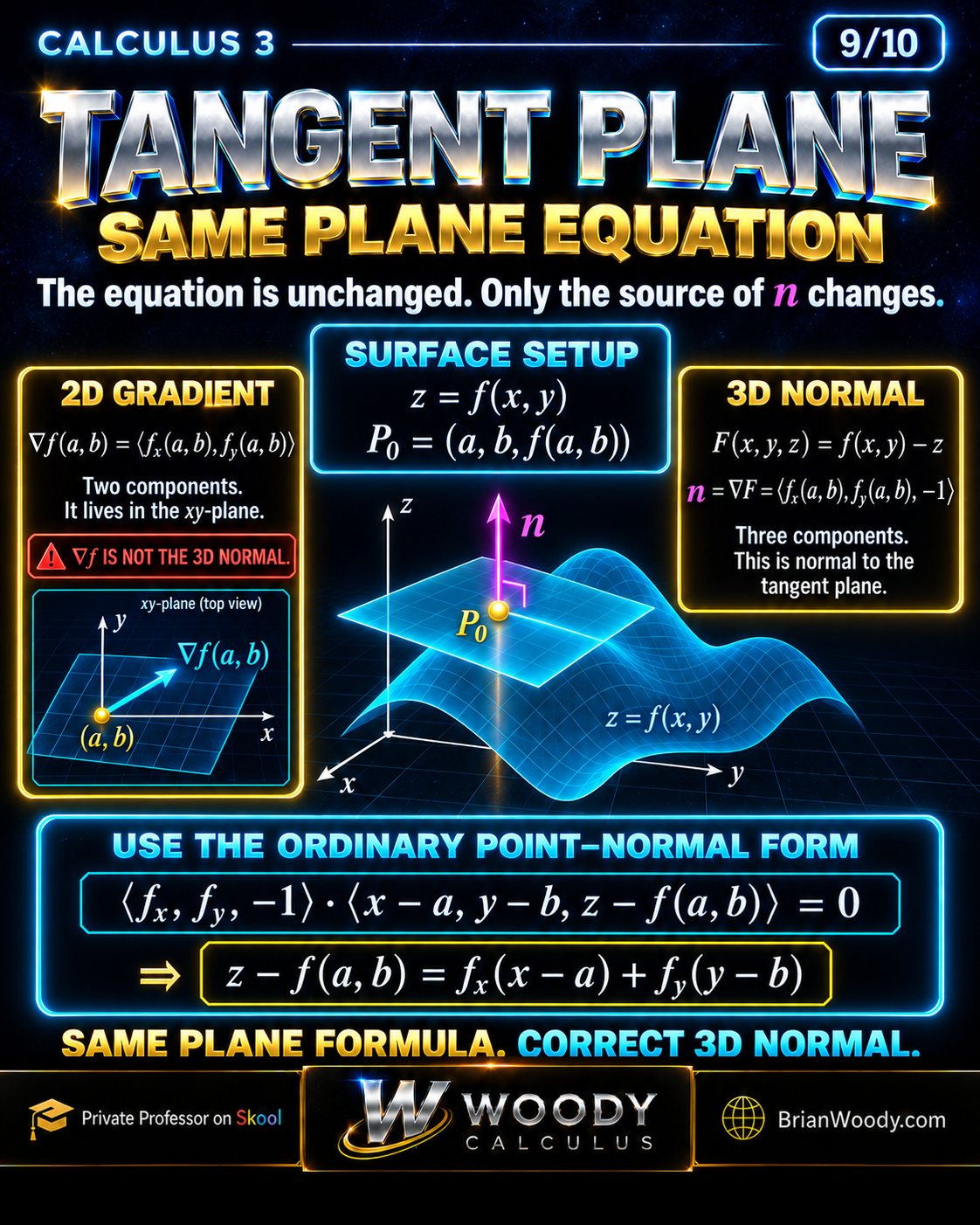
Assume f is differentiable at (a, b). The tangent plane to its graph passes through P₀ = (a, b, f(a, b)). The ordinary point-normal equation still applies. The new task is obtaining the normal from the surface.
The two gradients have different dimensions
This gradient belongs to the two-dimensional input space. It has only two components and is not the three-dimensional normal to the graph. Even padding it with a zero generally fails: it omits the essential vertical component.
Instead, represent the graph as a level surface:
The normal is nonzero because its third component is −1. Substituting it into the ordinary plane equation gives:
Why this vector is perpendicular
The two coordinate tangent vectors to the graph are ⟨1, 0, \(f_x\)⟩ and ⟨0, 1, \(f_y\)⟩. Their dot products with ⟨\(f_x\), \(f_y\), −1⟩ are \(f_x\) − \(f_x\) = 0 and \(f_y\) − \(f_y\) = 0. This verifies the geometry directly.
Worked connection to the partial derivatives lesson
For f(x,y) = x²y + 3xy² − 4y at (1, 2), the surface height is 6 and the first partials are 16 and 9. Thus P₀ = (1, 2, 6) and a normal is ⟨16, 9, −1⟩.
For the differentiation details, continue with partial derivatives, tangent planes, and linear approximation. For a general differentiable level surface F = c, the gradient supplies a normal at a regular point, meaning ∇F is nonzero there. If ∇F vanishes, this method does not determine a normal.
Distances and angles: project onto the normal
A normal does more than build a plane. It identifies the perpendicular direction needed to measure the shortest distance to it.
Distance from a point to a plane
For Q = (x₁, y₁, z₁) and Ax + By + Cz + D = 0:
The numerator measures displacement in the normal direction, and division by the normal’s length removes dependence on how the plane equation was scaled. For the origin and 2x + y − z + 3 = 0:
The closest point on the plane
Move from Q along the normal by the amount needed to satisfy the plane:
For Q = O and n = ⟨2, 1, −1⟩, this gives H = (−1, −1/2, 1/2). Substitution gives −2 − 1/2 − 1/2 + 3 = 0, and ||OH|| = √6/2.
Distance from a point to a line
For a line through P₀ with nonzero direction d, the perpendicular distance from Q is parallelogram area divided by base length:
Angle between a line and a plane
The acute angle α with the plane is complementary to the acute angle with its normal. Consequently:
For the intersection example, sin α = 4/√18, so α ≈ 70.53°. The acute angle with the normal is approximately 19.47°. A perspective sketch does not preserve these apparent angles.
Angle between two planes
Here β is the smaller unoriented angle. Parallel normals mean parallel or coincident planes; checking a point distinguishes those cases.
Two lines and two planes: avoid the 2D trap
Two lines in three-dimensional space can be coincident, parallel and distinct, intersecting, or skew. Skew lines are nonparallel lines that never meet.
For example, r(t) = ⟨t, 0, 0⟩ and s(u) = ⟨0, u, 1⟩ have nonparallel directions. Their z-coordinates are always 0 and 1, so they cannot intersect. They are skew. When solving for an intersection, use separate parameters and verify all three coordinate equations.
Two planes with nonparallel normals intersect in a line whose direction is n₁ × n₂. Find one point satisfying both equations to complete its parameterization.
The normals have cross product ⟨1, 1, −2⟩. The point (0, 0, 1) satisfies both equations, so the intersection line is:
Substituting gives x − y = 0 and x + y + z = 1 for every t.
A six-step method for lines and planes
-
Identify the geometric object
Decide whether you need a line, a plane, a tangent plane, or an intersection.
-
Record the given point or points
Write the coordinates carefully and distinguish points from displacement vectors.
-
Find the controlling vector
Use a nonzero direction for a line and a nonzero normal for a plane. For three noncollinear points, take a cross product.
-
Write the equation before expanding
Use the vector line equation or the point-normal plane equation, then substitute the data.
-
Solve and classify
Convert forms or solve for parameters as needed. For a line and plane, check both the direction-normal dot product and the starting point.
-
Verify the original conditions
Check the original points, the required direction or normal, and every equation used to find an intersection.
Study actively: cover the solution, identify the object aloud, write the correct form, and then reproduce the calculation. Repeat until the choice of vector and equation becomes automatic.
Common mistakes and how to catch them
- Using a point as a direction. Subtract two points when a displacement is needed.
- Using the zero vector. A line needs a nonzero direction; a plane needs a nonzero normal.
- Dropping a negative sign. Write y − (−2) as y + 2 before expanding.
- Dividing by a zero component. Keep the corresponding coordinate constant.
- Calling every zero dot product “no intersection.” A line with direction parallel to a plane can lie entirely in it.
- Using the 2D gradient as a 3D normal. For z = f(x,y), use \(\langle f_x,f_y,-1\rangle\) at the base point.
- Assuming partials alone guarantee a tangent plane. Differentiability is the relevant hypothesis.
- Solving only two coordinates. Verify the third when checking two lines in 3D.
Practice: twelve problems with worked answers
Attempt each problem before opening its answer. Check a proposed equation against the given data, even when the algebra looks familiar.
1. Line from a point and direction
Find vector and parametric equations through (2, 1, −1) with direction ⟨1, −2, 3⟩.
Show solution: Line from a point and direction
Thus x = 2 + t, y = 1 − 2t, and z = −1 + 3t. At t = 0 the original point is recovered.
2. Two points
Find the line through (0, 1, 2) and (2, −1, 3).
Show solution: Two points
Subtract the first point from the second to get ⟨2, −2, 1⟩.
The two given points occur at t = 0 and t = 1.
3. Zero component
Write a symmetric-style description through (3, 0, −2) with direction ⟨0, 1, 4⟩.
Show solution: Zero component
The parametric equations are x = 3, y = t, and z = −2 + 4t. There is no division by zero.
4. Point and normal
Find the plane through (1, 2, −1) with normal ⟨2, −1, 3⟩.
Show solution: Point and normal
The point check gives 2 − 2 − 3 + 3 = 0.
5. Three points
Find the plane through (0, 0, 0), (1, 0, 1), and (0, 1, 1).
Show solution: Three points
The displacement vectors ⟨1, 0, 1⟩ and ⟨0, 1, 1⟩ have cross product ⟨−1, −1, 1⟩.
Each point satisfies the equation, and the cross product is nonzero.
6. Unique intersection
Intersect r(t) = ⟨1 + t, 2 − t, t⟩ with x + y + z = 5.
Show solution: Unique intersection
Substitution gives 3 + t = 5, so t = 2. The intersection is (3, 0, 2), whose coordinate sum is 5.
7. Parallel or contained?
Classify r(t) = ⟨t, −t, 2⟩ relative to x + y + z = 2, then relative to x + y + z = 3.
Show solution: Parallel or contained?
The coordinate sum is always 2. The line is contained in the first plane and parallel to, but disjoint from, the second plane.
8. Tangent plane
Find the tangent plane to z = x² + y² at (1, 2, 5).
Show solution: Tangent plane
The partials at (1, 2) are 2 and 4, so use normal ⟨2, 4, −1⟩.
The point check gives 5 = 2 + 8 − 5.
9. Point-plane distance
Find the distance from the origin to x + 2y + 2z = 9.
Show solution: Point-plane distance
The closest point is (1, 2, 2); it lies on the plane and has distance 3 from the origin.
10. Perpendicular, parallel, or neither?
A line has direction ⟨2, 1, −1⟩. Classify its direction relative to 2x + y − z + 3 = 0.
Show solution: Perpendicular, parallel, or neither?
The direction equals the normal, so the line is perpendicular to the plane. Its direction-normal dot product is 6, so any line with this direction intersects the plane exactly once.
11. Skew lines
Do r(t) = ⟨t, 0, 0⟩ and s(u) = ⟨0, u, 1⟩ intersect?
Show solution: Skew lines
No. Their directions are nonparallel, but their z-coordinates disagree for every parameter choice. They are skew.
12. Plane-plane intersection
Find the intersection of x + y + z = 1 and x − y = 0.
Show solution: Plane-plane intersection
Set x = y = t. Then z = 1 − 2t.
Both plane equations hold for every t.
Lines and planes glossary
- Point
- A location specified by coordinates.
- Position vector
- The vector from the origin to a point.
- Direction vector
- A nonzero vector parallel to a line.
- Normal vector
- A nonzero vector perpendicular to a plane.
- Parameter
- A variable used to describe positions along a line or another geometric object.
- Parametric equations
- Coordinate equations expressed in terms of a shared parameter.
- Symmetric equations
- A line description obtained by equating expressions for its parameter; zero direction components are handled separately.
- Point-normal form
- A plane equation stating that its normal has zero dot product with every displacement from a fixed point to a point in the plane.
- Skew lines
- Nonparallel lines in three-dimensional space that do not intersect.
- Tangent plane
- The plane giving the first-order linear approximation to a differentiable surface at a point.
- Gradient
- The vector of first partial derivatives of a scalar-valued function.
- Level surface
- A set in three-dimensional space on which a scalar-valued function has a fixed value.
Frequently asked questions
What is the difference between a direction vector and a normal vector?
A direction vector runs along a line. A normal vector is perpendicular to a plane. Both must be nonzero when used to specify these objects.
How do you find a line through two points?
Subtract one point from the other to obtain a direction vector, then add a real multiple of that vector to either starting position. The two points must be distinct.
Can different equations describe the same line?
Yes. Changing the starting point to another point on the line or scaling the direction by a nonzero number can change the parameterization without changing the line.
What happens when a direction component is zero?
The corresponding coordinate stays constant. Keep that equation separately instead of dividing by zero in symmetric form.
How do you find a plane through three points?
Form two displacement vectors from one of the points and take their cross product as a normal. The three points must be noncollinear to determine a unique plane.
How can you tell whether a line intersects a plane?
Substitute the line into the plane. A nonzero direction-normal dot product gives one intersection; a zero dot product gives either no intersection or a contained line, depending on the starting point.
Is the gradient of f the normal to z = f(x,y)?
The two-component gradient of f is not the three-dimensional graph normal. Use the gradient of F(x,y,z) = f(x,y) − z, which has components f sub x, f sub y, and −1 at the point.
Does a tangent plane use a different plane equation?
No. It uses the ordinary point-normal equation. Differentiability supplies the tangent plane, and the surface derivatives supply its normal.
Can two nonparallel lines in 3D fail to intersect?
Yes. Such lines are called skew lines. Solve all three coordinate equations with separate parameters to test for an intersection.
Do you need a unit normal to write a plane equation?
No. Any nonzero normal works. Normalize when you need a unit direction, such as for an oriented distance or a projection formula using a unit normal.
References and further reading
For a textbook treatment, see Gilbert Strang and Edwin “Jed” Herman, Calculus Volume 3, OpenStax (2016), Section 2.5: Equations of Lines and Planes in Space. The worked examples and teaching sequence on this page follow the Woody Calculus visual lesson.