Galois Theory Explained: Hidden Symmetry, Polynomial Equations, and Why the Quintic Has No General Formula
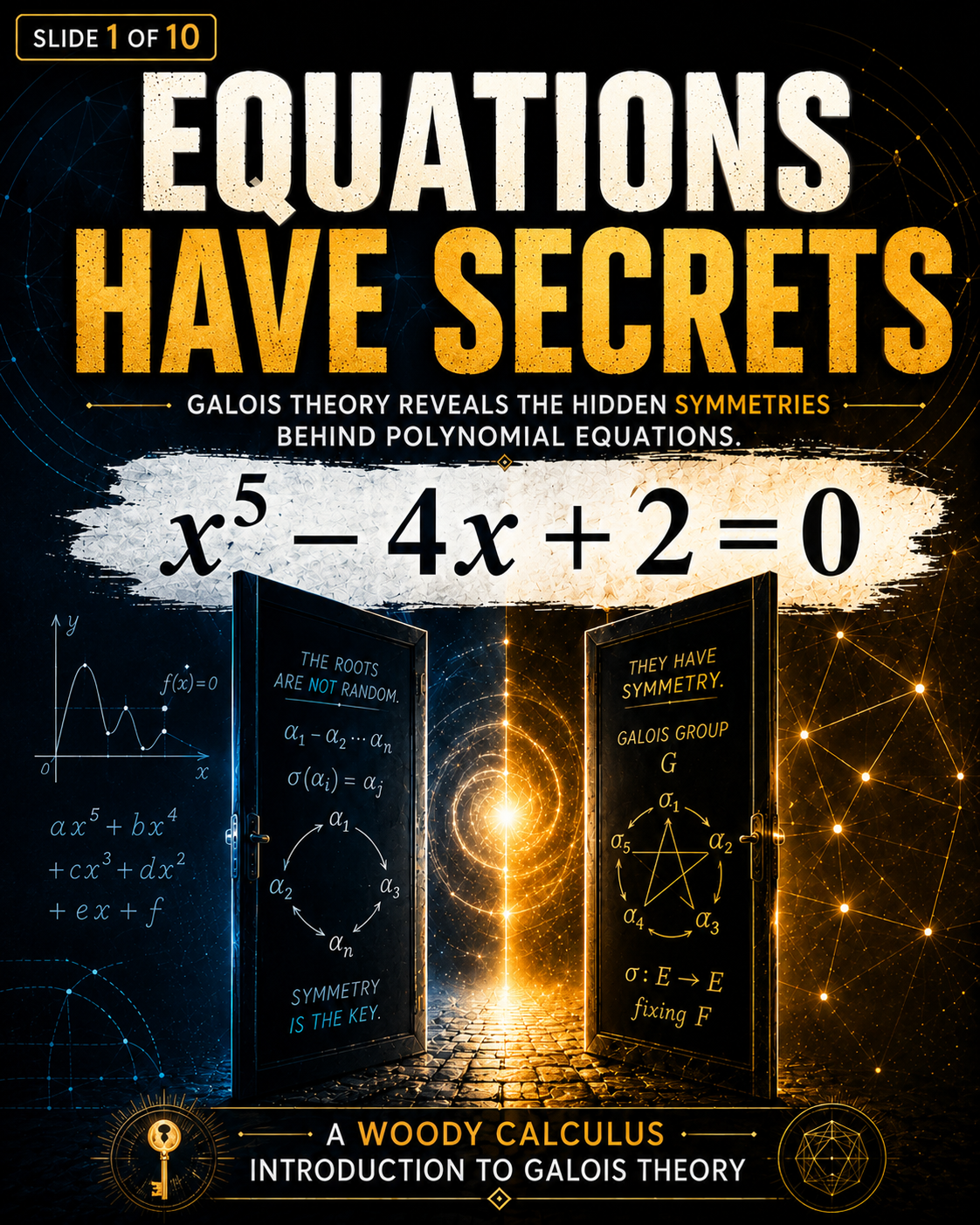
Galois Theory explained simply begins with one shocking idea: equations have hidden symmetries.
This updated Woody Calculus lesson is designed for Abstract Algebra students who want to connect polynomial roots, field extensions, quotient groups, finite fields, and modern research-level algebra. For the focused cubic example, read Why Does \(x^3-2\) Create \(S_3\)? Galois Theory Explained.
At first, algebra looks like the art of solving equations. We learn to solve linear equations. Then quadratic equations. Eventually, we discover the quadratic formula:
\[
x=\frac{-b\pm \sqrt{b^2-4ac}}{2a}.
\]
This formula feels like a victory. No matter what quadratic equation appears, as long as
\[
ax^2+bx+c=0,
\]
we have a universal procedure.
For a long time, mathematicians searched for similar formulas for higher-degree equations. Cubic equations have formulas. Quartic equations have formulas. These formulas are much more complicated than the quadratic formula, but they exist.
So the natural question became:
\[
\text{Is there a formula for the general quintic equation?}
\]
That is, can every equation of the form
\[
ax^5+bx^4+cx^3+dx^2+ex+f=0
\]
be solved using addition, subtraction, multiplication, division, and radicals?
The answer is no.
But the deeper question is not merely that the answer is no. The deeper question is:
\[
\textit{Why is the answer no?}
\]
Galois theory answers this question.
Galois theory says that every polynomial has a hidden structure. The roots may look like numbers, but beneath them lies a system of symmetries. These symmetries form a group. That group tells us what kind of equation we are really dealing with.
In other words, Galois theory does not simply ask:
\[
\text{What are the roots?}
\]
It asks:
\[
\text{What are the symmetries among the roots?}
\]
That shift changed algebra forever.

Galois Theory Explained: Key Takeaways
- Galois theory studies the hidden symmetries of polynomial roots.
- A Galois group is a group of field automorphisms that permute roots while preserving algebraic relationships.
- A splitting field is the smallest field containing all roots of a polynomial.
- The Fundamental Theorem of Galois Theory connects intermediate fields with subgroups of the Galois group.
- The correspondence reverses inclusion: bigger fields correspond to smaller groups.
- Solvability by radicals is controlled by whether the Galois group is solvable.
- The general quintic has no radical formula because its generic Galois group is \(S_5\), which is not solvable.
- The cubic \(x^3-2\) gives a concrete \(S_3\) example through roots of unity and a six-element symmetry group.
- Modern finite-field research uses the same language of roots, fields, automorphisms, and algebraic structure.
What Is Galois Theory?
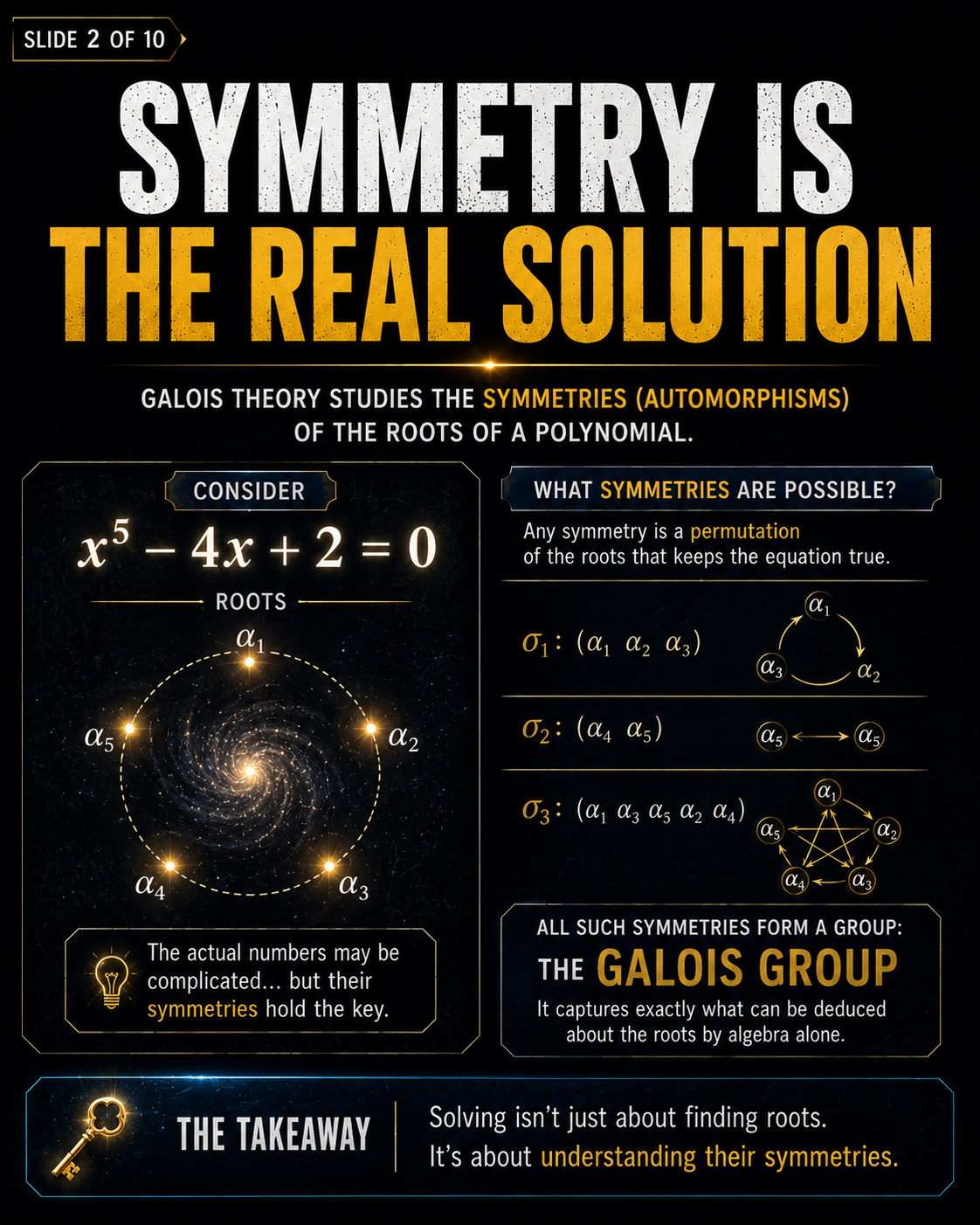
Galois theory is the study of the symmetries of polynomial equations.
More precisely, Galois theory studies how the roots of a polynomial can be permuted while preserving all algebraic relationships visible from the base field.
If the base field is \(\mathbb{Q}\), then rational numbers must remain fixed. The roots may move, but rational algebraic truths cannot move.
Definition: Galois Group
A Galois group is a group of field automorphisms of a splitting field that fix the base field. These automorphisms permute the roots of a polynomial while preserving the algebraic structure of the field.
This article is written for undergraduate students studying Abstract Algebra, especially students beginning to connect groups, fields, polynomial roots, splitting fields, automorphisms, and solvability by radicals.
This is one of the places where Abstract Algebra becomes breathtaking.
The Basic Idea: Roots Have Symmetry
Consider the polynomial
\[
f(x)=x^2-2.
\]
Its roots are
\[
\sqrt{2}
\quad \text{and} \quad
-\sqrt{2}.
\]
At first, these seem like two separate numbers. But from the point of view of rational numbers, they are almost indistinguishable.
Why?
Because both roots satisfy the same equation:
\[
x^2-2=0.
\]
If all we are allowed to use are rational numbers, there is no rational reason to prefer \(\sqrt{2}\) over \(-\sqrt{2}\). The two roots are algebraic twins.
There is a symmetry:
\[
\sqrt{2}\longmapsto -\sqrt{2},
\]
and this symmetry preserves every rational algebraic relationship.
This is the beginning of Galois theory.
The First Big Idea
A Galois group is a group of symmetries of the roots of a polynomial. The roots may move, but the algebraic relationships over the base field must remain unchanged.
Fields: The Natural Home of Algebra
A field is a set in which we can add, subtract, multiply, and divide by nonzero elements.
The most familiar examples are
\[
\mathbb{Q}, \quad \mathbb{R}, \quad \mathbb{C}.
\]
The rational numbers \(\mathbb{Q}\) form a field because we can add, subtract, multiply, and divide rational numbers without leaving \(\mathbb{Q}\), as long as we do not divide by zero.
In Galois theory, we usually begin with a base field such as \(\mathbb{Q}\). Then we enlarge it by adding roots of polynomials.
For example, \(\sqrt{2}\notin \mathbb{Q}\), so if we want a field containing both rational numbers and \(\sqrt{2}\), we write
\[
\mathbb{Q}(\sqrt{2}).
\]
This field contains all numbers of the form
\[
a+b\sqrt{2},
\]
where \(a,b\in \mathbb{Q}\).
So
\[
\mathbb{Q}(\sqrt{2})
=
\{a+b\sqrt{2}:a,b\in \mathbb{Q}\}.
\]
This is called a field extension.
If \(F\) is a field and \(E\) is a larger field containing \(F\), then \(E/F\) is called a field extension. For a full student-friendly explanation, read Field Extensions Explained: When Numbers Need a Bigger Universe.
Automorphisms: Symmetries of Fields
An automorphism of a field \(E\) is a bijective function
\[
\sigma:E\to E
\]
such that for all \(a,b\in E\),
\[
\sigma(a+b)=\sigma(a)+\sigma(b),
\]
and
\[
\sigma(ab)=\sigma(a)\sigma(b).
\]
In other words, an automorphism is a way of rearranging the elements of a field while preserving addition and multiplication.
In Galois theory, we usually care about automorphisms that fix the base field.
Let \(E/F\) be a field extension. An automorphism
\[
\sigma:E\to E
\]
is said to fix \(F\) if
\[
\sigma(a)=a
\]
for every \(a\in F\).
So if we are working over \(\mathbb{Q}\), then our automorphisms must leave every rational number unchanged.
The First Example: \(x^2-2\)
Let
\[
f(x)=x^2-2.
\]
The roots are
\[
\sqrt{2},\quad -\sqrt{2}.
\]
The splitting field of \(f(x)\) over \(\mathbb{Q}\) is
\[
\mathbb{Q}(\sqrt{2}).
\]
Every element of this field has the form
\[
a+b\sqrt{2},
\]
where \(a,b\in\mathbb{Q}\).
Now suppose
\[
\sigma:\mathbb{Q}(\sqrt{2})\to \mathbb{Q}(\sqrt{2})
\]
is an automorphism fixing \(\mathbb{Q}\).
Since \(\sigma\) fixes rational numbers,
\[
\sigma(2)=2.
\]
Also,
\[
(\sqrt{2})^2=2.
\]
Applying \(\sigma\) gives
\[
\sigma\left((\sqrt{2})^2\right)=\sigma(2).
\]
Since \(\sigma\) preserves multiplication,
\[
\sigma(\sqrt{2})^2=2.
\]
Therefore,
\[
\sigma(\sqrt{2})=\sqrt{2}
\quad \text{or} \quad
\sigma(\sqrt{2})=-\sqrt{2}.
\]
So there are two possible automorphisms:
\[
\sigma_1(\sqrt{2})=\sqrt{2},
\]
and
\[
\sigma_2(\sqrt{2})=-\sqrt{2}.
\]
The first is the identity automorphism. The second sends
\[
a+b\sqrt{2}
\longmapsto
a-b\sqrt{2}.
\]
Thus
\[
\operatorname{Gal}(\mathbb{Q}(\sqrt{2})/\mathbb{Q})
=
\{\sigma_1,\sigma_2\}.
\]
This group has two elements, so it is isomorphic to \(C_2\), the cyclic group of order \(2\).
\[
\boxed{
\operatorname{Gal}(\mathbb{Q}(\sqrt{2})/\mathbb{Q})\cong C_2.
}
\]
This is the simplest example of a Galois group.
What This Example Teaches
The Galois group does not merely list the roots. It records the allowed algebraic symmetries of the roots over the base field.
For \(x^2-2\), the two roots can be swapped while rational numbers stay fixed. That swap is the entire nontrivial symmetry.
Splitting Fields
To understand the Galois group of a polynomial, we need the field where the polynomial fully factors.
Let \(F\) be a field, and let
\[
f(x)\in F[x].
\]
A splitting field of \(f(x)\) over \(F\) is the smallest field extension \(E/F\) such that \(f(x)\) factors completely into linear factors over \(E\).
For example,
\[
x^2-2
\]
does not split over \(\mathbb{Q}\), because
\[
\sqrt{2}\notin \mathbb{Q}.
\]
But it does split over \(\mathbb{Q}(\sqrt{2})\):
\[
x^2-2=(x-\sqrt{2})(x+\sqrt{2}).
\]
So the splitting field is
\[
\mathbb{Q}(\sqrt{2}).
\]
The Galois Group of a Polynomial
Let \(f(x)\in F[x]\), and let \(E\) be the splitting field of \(f(x)\) over \(F\). The Galois group of \(f(x)\) over \(F\) is
\[
\operatorname{Gal}(E/F),
\]
the group of field automorphisms of \(E\) that fix every element of \(F\).
Every automorphism in the Galois group must send roots to roots.
Why?
Suppose
\[
f(x)\in F[x],
\]
and \(\alpha\) is a root of \(f(x)\). Then
\[
f(\alpha)=0.
\]
If \(\sigma\) fixes \(F\), then it fixes the coefficients of \(f(x)\). Applying \(\sigma\) gives
\[
\sigma(f(\alpha))=\sigma(0)=0.
\]
Since \(\sigma\) fixes the coefficients,
\[
f(\sigma(\alpha))=0.
\]
Therefore, \(\sigma(\alpha)\) is also a root of \(f(x)\).
Key Fact
Elements of the Galois group permute the roots of the polynomial. But not every permutation is allowed. Only the permutations that preserve all algebraic relationships among the roots are allowed.
If \(f(x)\) has roots
\[
\alpha_1,\alpha_2,\ldots,\alpha_n,
\]
then each automorphism permutes these roots. So the Galois group embeds into
\[
S_n,
\]
the symmetric group on \(n\) objects.
\[
\operatorname{Gal}(f)\leq S_n.
\]
Why the Quintic Changes Everything
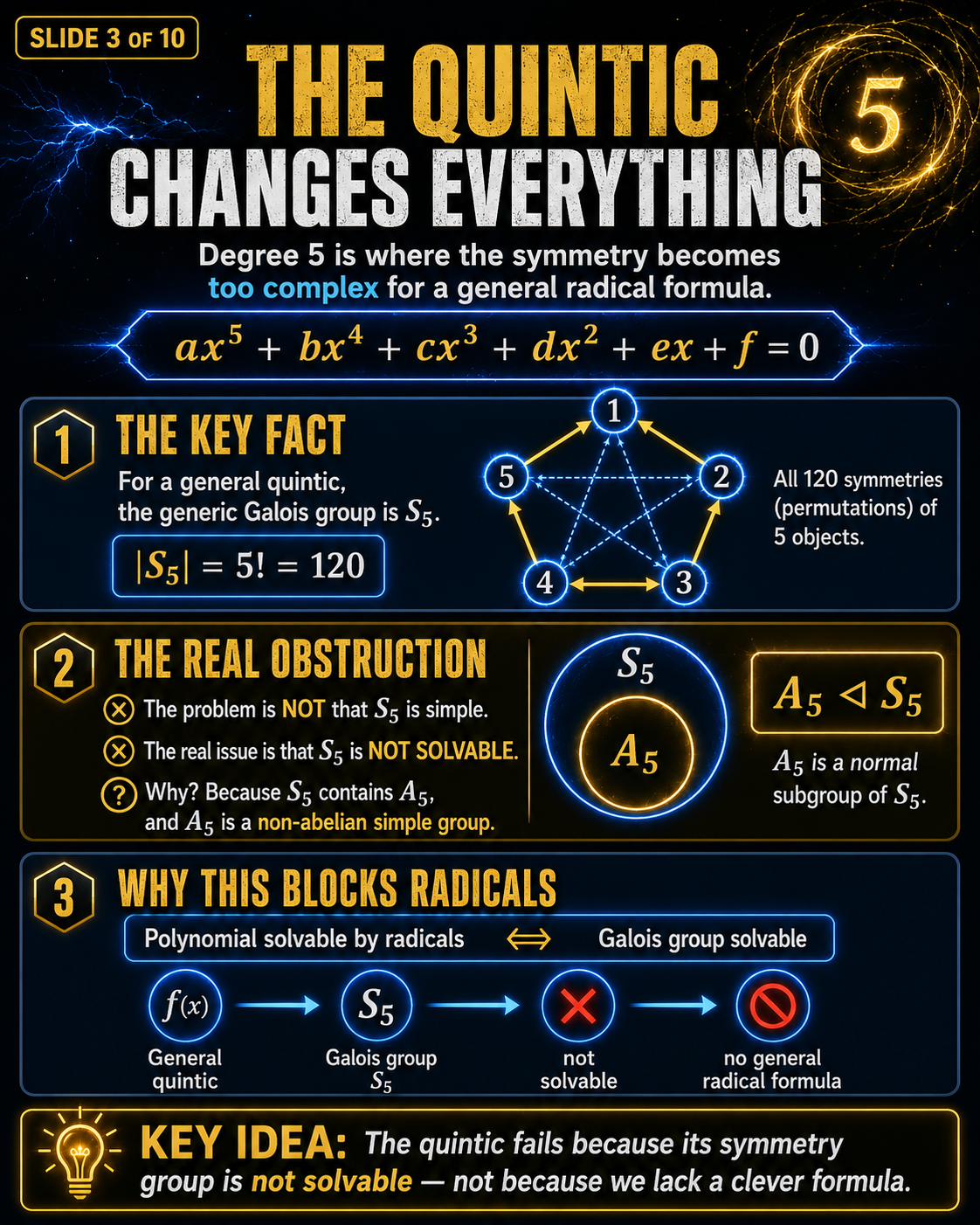
The general quintic equation has the form
\[
ax^5+bx^4+cx^3+dx^2+ex+f=0.
\]
Degree \(5\) is where the symmetry becomes too complex for a general radical formula.
For a generic quintic, the Galois group is
\[
S_5.
\]
The symmetric group \(S_5\) has
\[
|S_5|=5!=120
\]
symmetries. The issue is not that \(S_5\) is simple. It is not. The issue is that \(S_5\) is not solvable.
The reason is that \(S_5\) contains \(A_5\), and \(A_5\) is a nonabelian simple group. That nonabelian simple subgroup blocks the normal subgroup chain required for solvability.
Therefore, the generic quintic cannot be solved by radicals.
The Fundamental Theorem of Galois Theory
This is the heart of the subject.
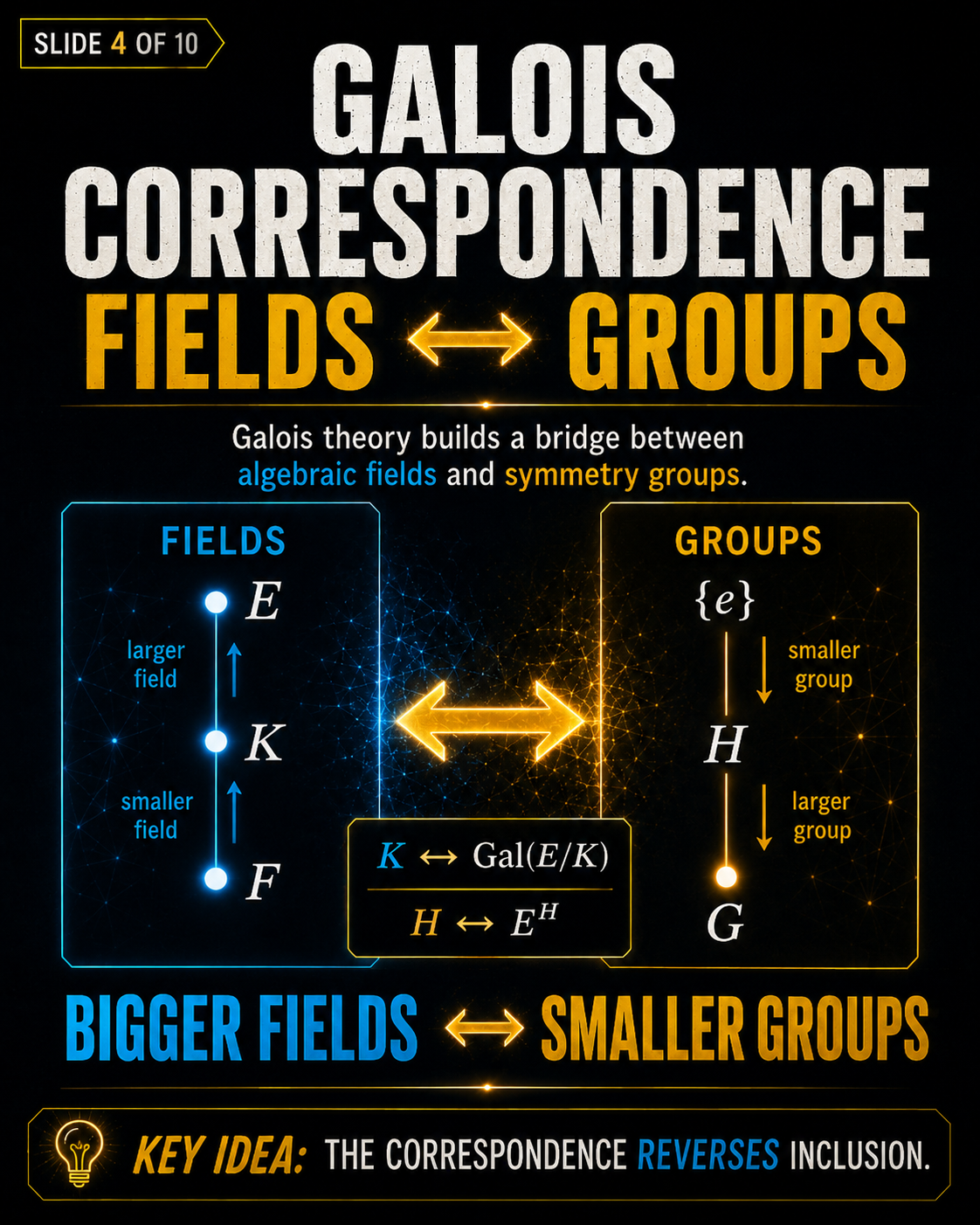
Galois theory builds a bridge between fields and groups.
On one side, we have intermediate fields:
\[
F\subseteq K\subseteq E.
\]
On the other side, we have subgroups of the Galois group:
\[
H\leq \operatorname{Gal}(E/F).
\]
Fundamental Theorem of Galois Theory
Let \(E/F\) be a finite Galois extension, and let \(G=\operatorname{Gal}(E/F)\). There is an inclusion-reversing correspondence between intermediate fields \(F\subseteq K\subseteq E\) and subgroups \(H\leq G\).
\[
K \longmapsto \operatorname{Gal}(E/K),
\qquad
H \longmapsto E^H.
\]
The field \(E^H\) is called the fixed field of \(H\):
\[
E^H=\{x\in E:\sigma(x)=x\text{ for every }\sigma\in H\}.
\]
The correspondence is inclusion-reversing because larger fields correspond to smaller groups.
If
\[
F\subseteq K_1\subseteq K_2\subseteq E,
\]
then
\[
\operatorname{Gal}(E/K_2)\leq \operatorname{Gal}(E/K_1).
\]
Why?
Because fixing more elements gives an automorphism less freedom.
A bigger field means more elements must stay fixed. More restrictions mean fewer automorphisms.
\[
\boxed{
\text{Bigger fields correspond to smaller groups.}
}
\]
Normal Subgroups and Galois Subextensions
There is one more important part of the Fundamental Theorem of Galois Theory.
Let \(E/F\) be a finite Galois extension, and let
\[
G=\operatorname{Gal}(E/F).
\]
If \(K\) is an intermediate field,
\[
F\subseteq K\subseteq E,
\]
then \(K/F\) is Galois if and only if
\[
\operatorname{Gal}(E/K)
\]
is a normal subgroup of \(G\).
In that case,
\[
\operatorname{Gal}(K/F)\cong G/\operatorname{Gal}(E/K).
\]
So normal subgroups correspond to Galois intermediate extensions:
\[
\boxed{
K/F \text{ is Galois}
\quad \Longleftrightarrow \quad
\operatorname{Gal}(E/K)\triangleleft \operatorname{Gal}(E/F).
}
\]
This is where Galois Theory naturally meets quotient groups, cosets, and normal subgroups. Normal subgroups are not just a group theory detail — they decide when quotient Galois groups describe intermediate field extensions.
Cubic Example: \(x^3-2\)
Now consider
\[
f(x)=x^3-2.
\]
Let
\[
\alpha=\sqrt[3]{2}.
\]
One root is \(\alpha\). But over the complex numbers, there are three roots:
\[
\alpha,\quad \omega\alpha,\quad \omega^2\alpha,
\]
where
\[
\omega=e^{2\pi i/3}
=
-\frac12+\frac{\sqrt{3}}{2}i.
\]
The number \(\omega\) is a primitive cube root of unity, so
\[
\omega^3=1,
\qquad
\omega\neq 1,
\qquad
1+\omega+\omega^2=0.
\]
The splitting field of \(x^3-2\) over \(\mathbb{Q}\) is
\[
E=\mathbb{Q}(\alpha,\omega).
\]
This field contains all three roots:
\[
\alpha,\quad \omega\alpha,\quad \omega^2\alpha.
\]
An automorphism
\[
\sigma\in \operatorname{Gal}(E/\mathbb{Q})
\]
must send roots of \(x^3-2\) to roots of \(x^3-2\). Therefore,
\[
\sigma(\alpha)\in \{\alpha,\omega\alpha,\omega^2\alpha\}.
\]
Also, \(\omega\) satisfies
\[
\omega^2+\omega+1=0.
\]
So \(\sigma(\omega)\) must be another root of
\[
x^2+x+1.
\]
Therefore,
\[
\sigma(\omega)\in\{\omega,\omega^2\}.
\]
There are three choices for \(\sigma(\alpha)\) and two choices for \(\sigma(\omega)\), producing six automorphisms.
Thus
\[
|\operatorname{Gal}(E/\mathbb{Q})|=6.
\]
Since the Galois group permutes the three roots, it is a subgroup of \(S_3\). Since it has six elements,
\[
\operatorname{Gal}(E/\mathbb{Q})\cong S_3.
\]
So
\[
\boxed{
\operatorname{Gal}(x^3-2\text{ over }\mathbb{Q})\cong S_3.
}
\]
For a dedicated visual lesson on this example — including the root triangle, the splitting field \(\mathbb{Q}(\sqrt[3]{2},\omega)\), the six automorphisms, and the quotient \(S_3/A_3\cong C_2\) — read Why Does \(x^3-2\) Create \(S_3\)? Galois Theory Explained.
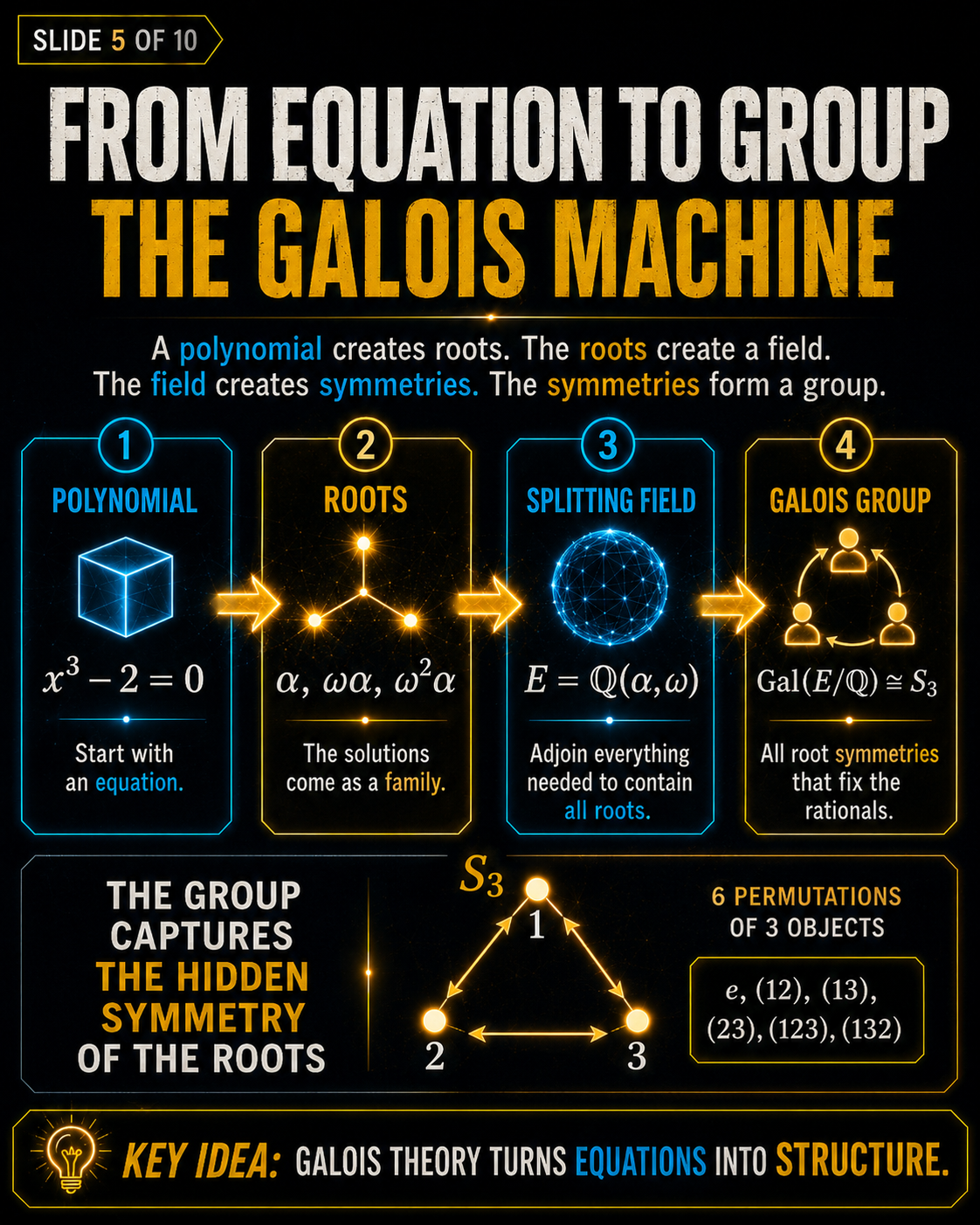
The Galois Machine: From Equation to Group
Galois theory follows a powerful sequence:
\[
\text{Polynomial}
\longrightarrow
\text{Roots}
\longrightarrow
\text{Splitting Field}
\longrightarrow
\text{Automorphisms}
\longrightarrow
\text{Galois Group}.
\]
The polynomial creates the roots. The roots create a field. The field creates symmetries. The symmetries form a group.
For \(x^3-2\), this process gives
\[
E=\mathbb{Q}(\alpha,\omega),
\qquad
\operatorname{Gal}(E/\mathbb{Q})\cong S_3.
\]
Permutations in Action: How Symmetries Compose
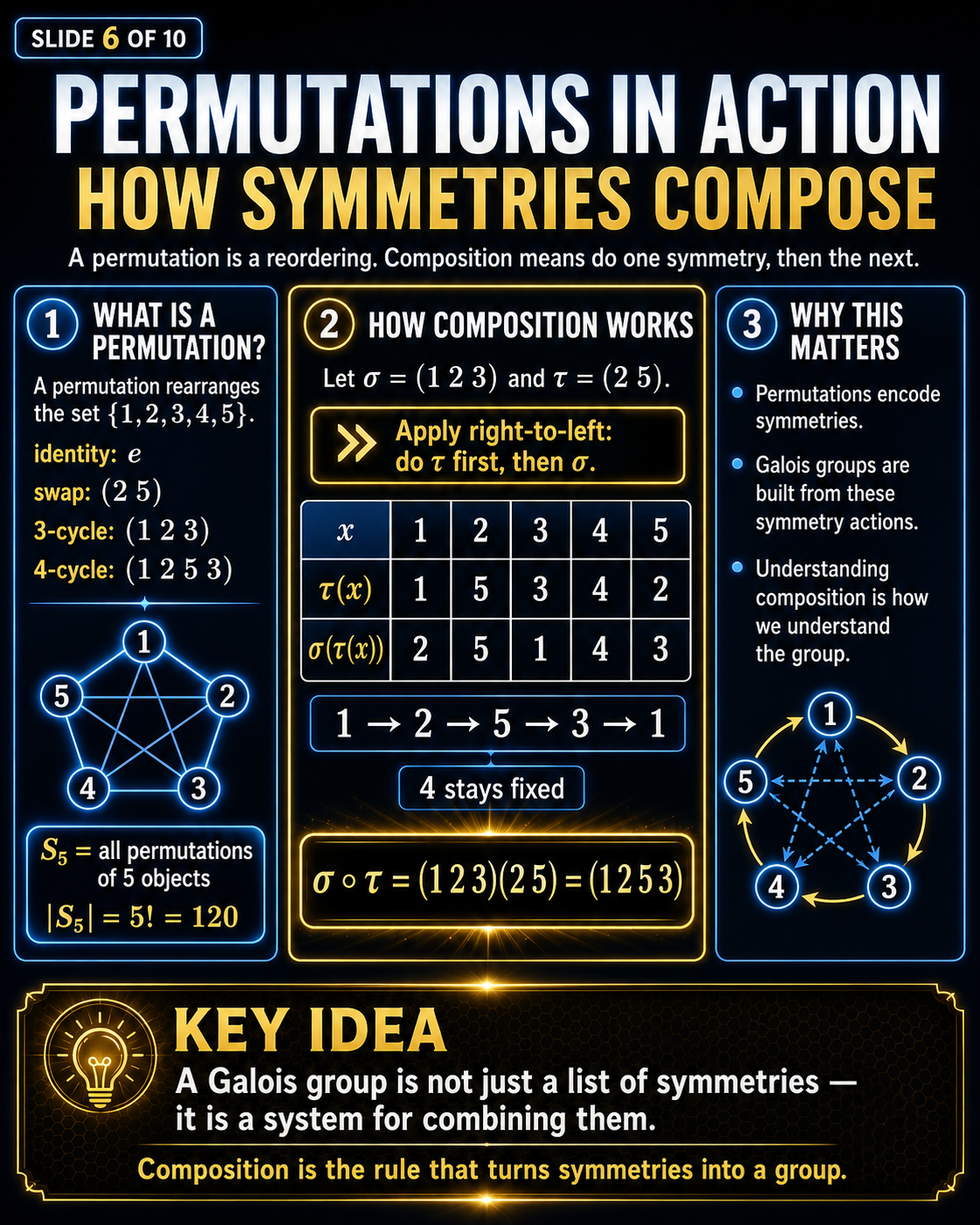
A permutation is a reordering of a set. In Galois theory, permutations encode the possible symmetries of roots.
If a polynomial has five roots, then the largest possible permutation group acting on those roots is
\[
S_5.
\]
This group has
\[
|S_5|=5!=120
\]
elements.
A Galois group is not merely a list of root symmetries. It is a system for combining them.
If
\[
\sigma=(123)
\quad \text{and} \quad
\tau=(25),
\]
then the composition \(\sigma\circ\tau\) means apply \(\tau\) first, then \(\sigma\).
Composition is the rule that turns symmetries into a group.
Fixed Fields and Subfields: What Does a Subgroup See?
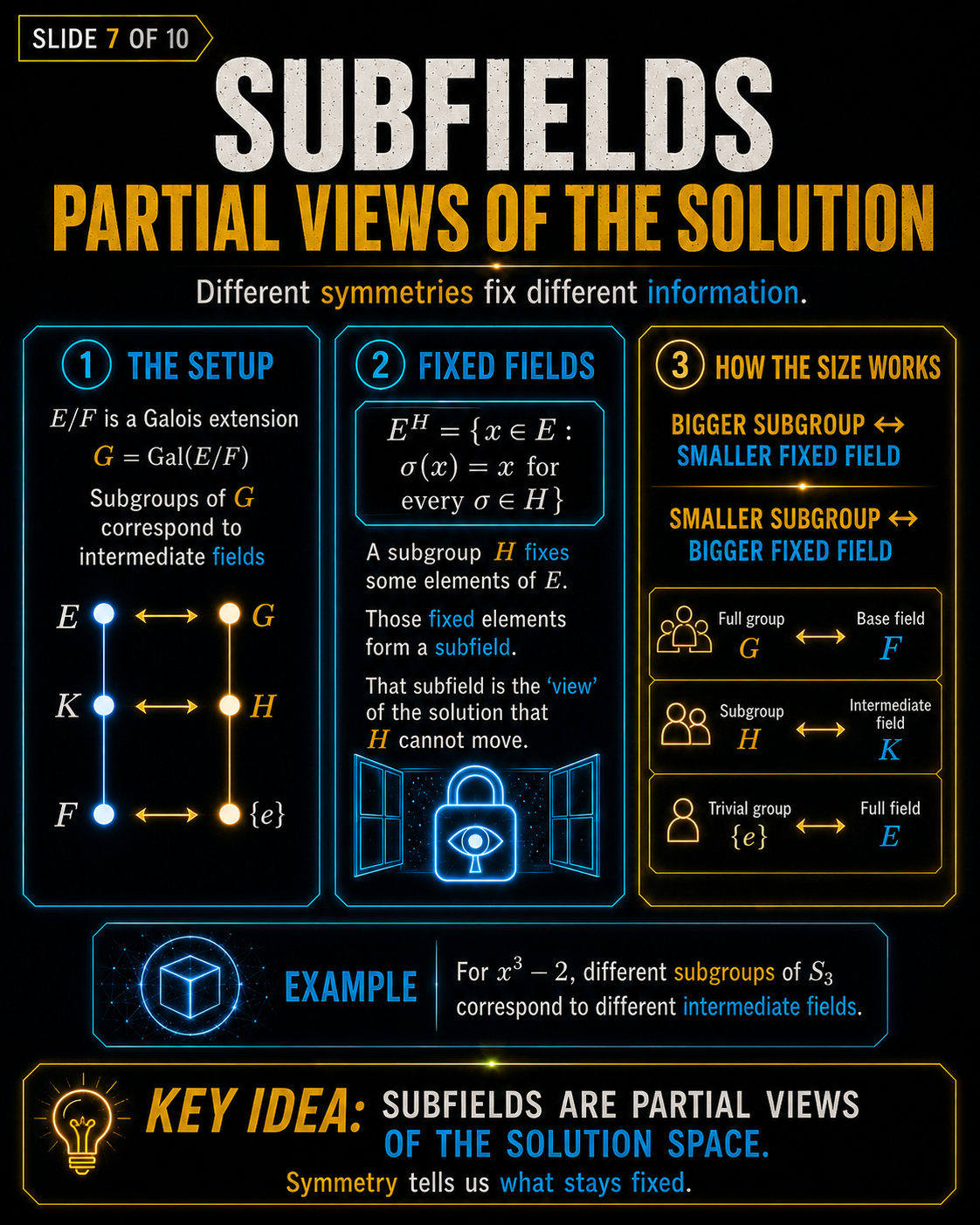
Let \(E/F\) be a Galois extension with Galois group \(G\).
If \(H\) is a subgroup of \(G\), then
\[
E^H
\]
is the set of elements that \(H\) cannot move.
This is a powerful idea.
A subgroup represents a limited set of symmetries. The fixed field represents the quantities that remain unchanged under those symmetries.
\[
\boxed{
\text{Groups describe motion. Fixed fields describe invariance.}
}
\]
Example: Fixed Fields of \(\mathbb{Q}(\sqrt{2})\)
Let
\[
E=\mathbb{Q}(\sqrt{2}),
\qquad
F=\mathbb{Q}.
\]
We found
\[
G=\operatorname{Gal}(E/F)\cong C_2.
\]
So
\[
G=\{1,\sigma\},
\]
where
\[
\sigma(\sqrt{2})=-\sqrt{2}.
\]
The subgroups of \(G\) are:
\[
\{1\}
\quad \text{and} \quad
G.
\]
The fixed field of \(\{1\}\) is all of \(E\):
\[
E^{\{1\}}=E=\mathbb{Q}(\sqrt{2}).
\]
The fixed field of \(G\) is:
\[
E^G=\mathbb{Q}.
\]
Indeed, if \(a+b\sqrt{2}\) is fixed by \(\sigma\), then
\[
a+b\sqrt{2}=a-b\sqrt{2}.
\]
Thus
\[
2b\sqrt{2}=0,
\]
so \(b=0\). Therefore, the fixed elements are exactly the rational numbers.
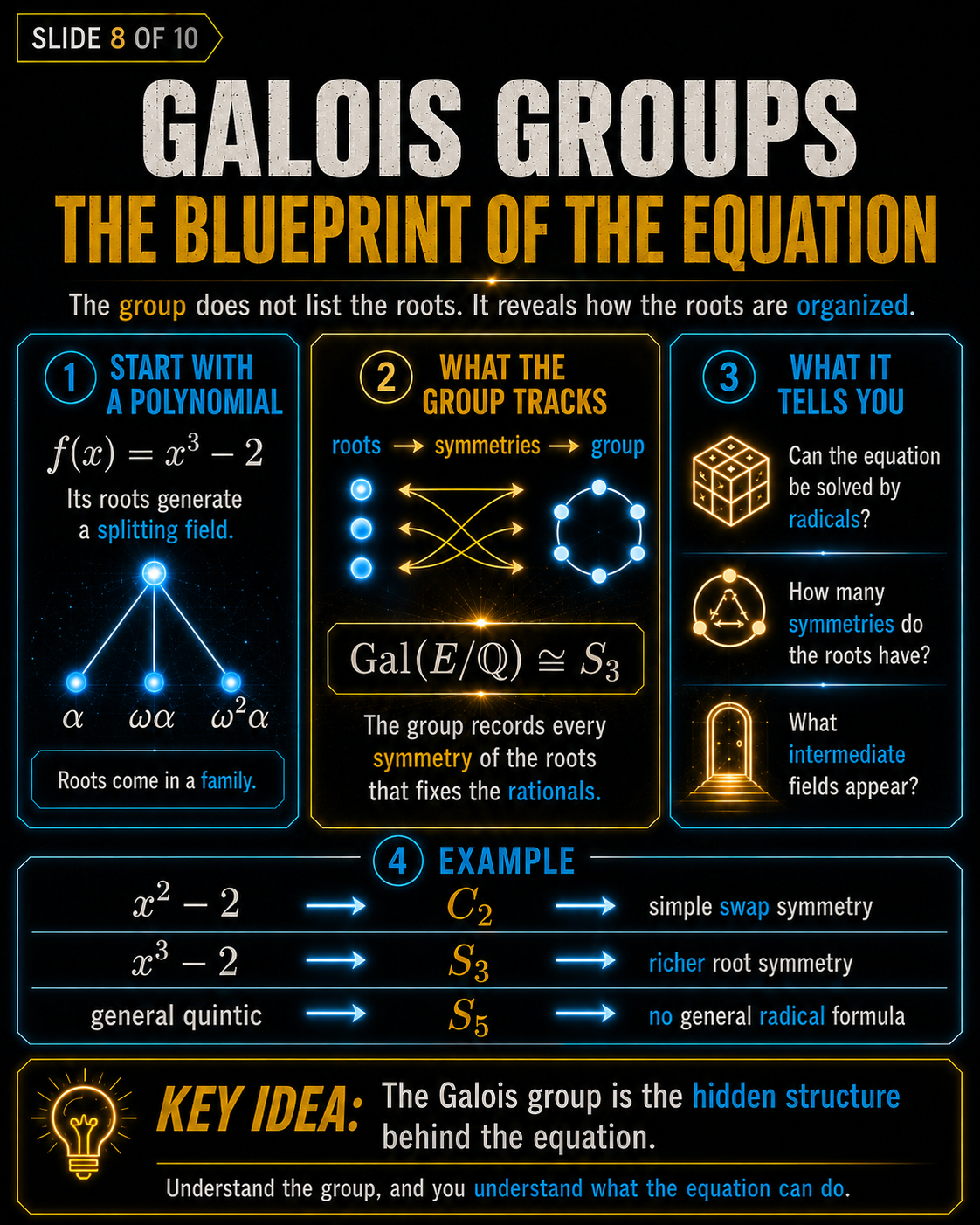
Galois Groups as the Blueprint of the Equation
The Galois group does not simply list the roots.
It reveals how the roots are organized.
It tells us what symmetries are possible, what algebraic relationships must be preserved, what intermediate fields appear, and whether radicals are enough to solve the equation.
This is why Galois theory feels so different from ordinary algebra. The equation itself is only the beginning. The group is the hidden structure behind the equation.
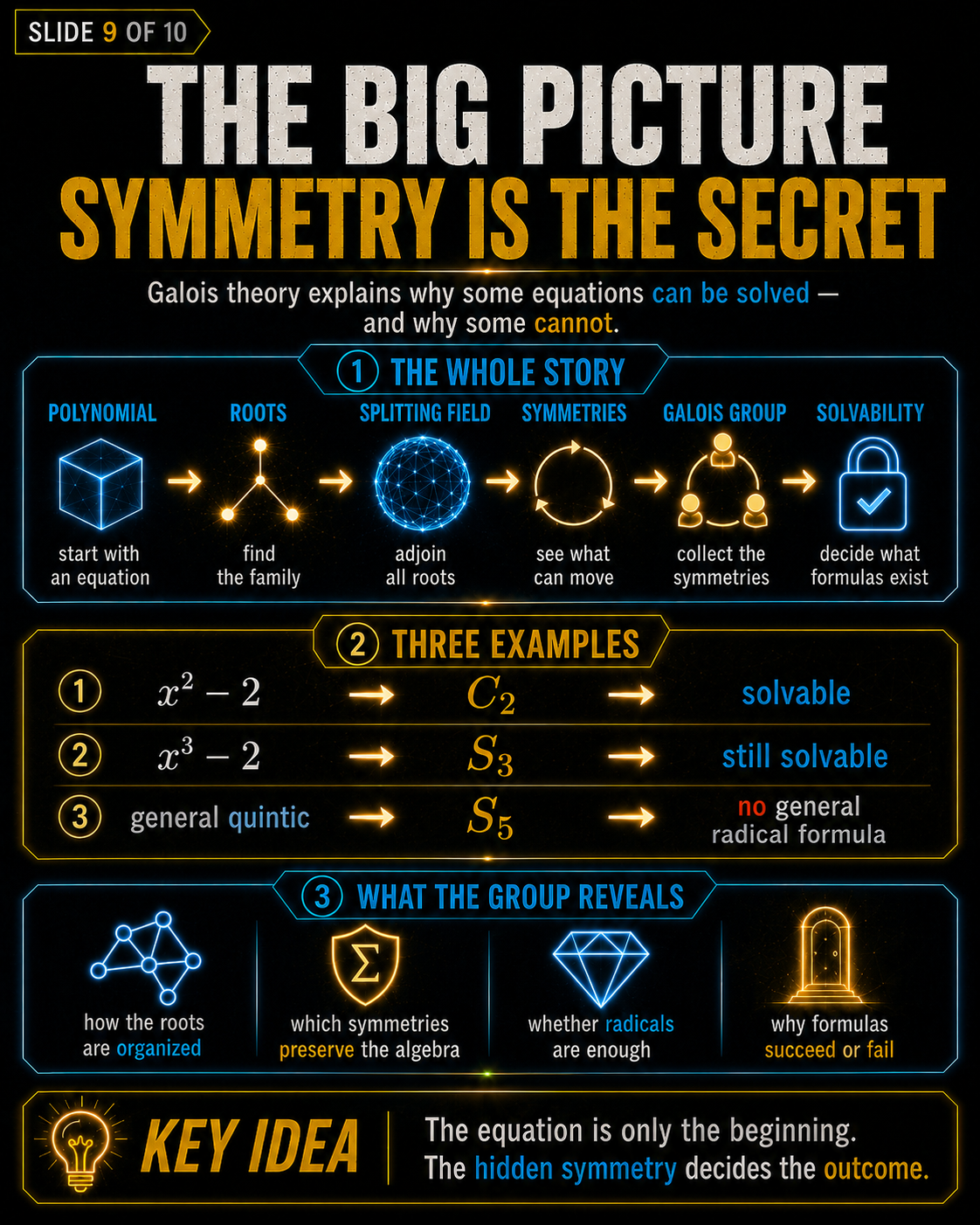
The Big Picture of Galois Theory
The entire story can be summarized in one chain:
\[
\text{Polynomial}
\longrightarrow
\text{Roots}
\longrightarrow
\text{Splitting Field}
\longrightarrow
\text{Symmetries}
\longrightarrow
\text{Galois Group}
\longrightarrow
\text{Solvability}.
\]
For quadratics, the group is small enough to allow radical formulas.
For many cubics and quartics, the group is still solvable.
For the general quintic, the group is generically \(S_5\), and \(S_5\) is not solvable.
That is why the general quintic has no radical formula.
The hidden symmetry decides the outcome.
The Discriminant Connection
For a cubic polynomial, the discriminant gives a quick way to distinguish between \(A_3\) and \(S_3\) in many cases.
Suppose
\[
f(x)\in \mathbb{Q}[x]
\]
is an irreducible cubic.
Then the Galois group of \(f(x)\) over \(\mathbb{Q}\) is a transitive subgroup of \(S_3\).
The transitive subgroups of \(S_3\) are:
\[
A_3
\quad \text{and} \quad
S_3.
\]
The discriminant tells us which one occurs.
Irreducible Cubic Shortcut
- If the discriminant is a square in \(\mathbb{Q}\), then the Galois group is \(A_3\cong C_3\).
- If the discriminant is not a square in \(\mathbb{Q}\), then the Galois group is \(S_3\).
For
\[
f(x)=x^3-2,
\]
the discriminant is
\[
\Delta=-108.
\]
Since \(-108\) is not a square in \(\mathbb{Q}\), we get
\[
\operatorname{Gal}(x^3-2)\cong S_3.
\]
This shows something important:
\[
\boxed{
\text{The Galois group is not guessed from the degree alone.}
}
\]
It depends on the hidden algebraic relationships among the roots.
Normal and Separable Extensions
The cleanest version of Galois theory works for extensions that are both normal and separable.
Since most undergraduate introductions focus on fields of characteristic zero, especially \(\mathbb{Q}\), separability is usually automatic.
A field extension \(E/F\) is separable if every element of \(E\) is the root of a separable polynomial over \(F\).
A polynomial is separable if it has no repeated roots in its splitting field.
Over fields of characteristic zero, such as
\[
\mathbb{Q},\quad \mathbb{R},\quad \mathbb{C},
\]
every irreducible polynomial is separable.
So over \(\mathbb{Q}\), separability is usually not the dangerous part. Normality is the more visible condition.
A field extension \(E/F\) is normal if every irreducible polynomial in \(F[x]\) that has one root in \(E\) splits completely over \(E\).
A splitting field is the standard example of a normal extension.
A finite field extension \(E/F\) is called a Galois extension if it is normal and separable.
For finite Galois extensions, the size of the Galois group matches the degree of the field extension:
\[
\boxed{
|\operatorname{Gal}(E/F)|=[E:F].
}
\]
Example: The Galois Group of \(x^4-2\)
Now consider
\[
f(x)=x^4-2.
\]
Let
\[
\alpha=\sqrt[4]{2}.
\]
The roots are
\[
\alpha,\quad -\alpha,\quad i\alpha,\quad -i\alpha.
\]
The splitting field is
\[
E=\mathbb{Q}(\alpha,i).
\]
An automorphism fixing \(\mathbb{Q}\) must send \(\alpha\) to another root of \(x^4-2\), so
\[
\alpha\mapsto \alpha,\,-\alpha,\,i\alpha,\,-i\alpha.
\]
It must also send \(i\) to a root of
\[
x^2+1.
\]
So
\[
i\mapsto i
\quad \text{or} \quad
i\mapsto -i.
\]
The Galois group has order \(8\) and is isomorphic to the dihedral group of order \(8\):
\[
\operatorname{Gal}(x^4-2\text{ over }\mathbb{Q})\cong D_4.
\]
This is the symmetry group of a square.
That is not an accident.
The roots
\[
\alpha,\quad i\alpha,\quad -\alpha,\quad -i\alpha
\]
sit like the vertices of a square in the complex plane.
The Galois group acts by algebraic symmetries of this square.
\[
\boxed{
\text{Algebraic roots secretly organize themselves geometrically.}
}
\]
A More Detailed Lattice Example: \(x^3-2\)
Now return to
\[
f(x)=x^3-2.
\]
Let
\[
\alpha=\sqrt[3]{2},
\qquad
\omega=e^{2\pi i/3}.
\]
The splitting field is
\[
E=\mathbb{Q}(\alpha,\omega).
\]
We showed that
\[
\operatorname{Gal}(E/\mathbb{Q})\cong S_3.
\]
The group \(S_3\) has six elements. Its subgroup structure is simple but rich enough to show the real power of Galois theory.
Since \(E/\mathbb{Q}\) is a finite Galois extension,
\[
[E:\mathbb{Q}]=|\operatorname{Gal}(E/\mathbb{Q})|=6.
\]
The subgroups of \(S_3\) are:
\[
\{e\},
\]
three subgroups of order \(2\),
\[
\langle (12)\rangle,\quad \langle (13)\rangle,\quad \langle (23)\rangle,
\]
one subgroup of order \(3\),
\[
A_3=\langle (123)\rangle,
\]
and the full group
\[
S_3.
\]
By the Fundamental Theorem of Galois Theory, these correspond to intermediate fields between \(\mathbb{Q}\) and \(E\).
Subgroups of order \(2\) correspond to intermediate fields of degree
\[
\frac{|S_3|}{2}=3.
\]
Subgroups of order \(3\) correspond to intermediate fields of degree
\[
\frac{|S_3|}{3}=2.
\]
Thus the three order-\(2\) subgroups correspond to the three cubic fields:
\[
\mathbb{Q}(\alpha),
\quad
\mathbb{Q}(\omega\alpha),
\quad
\mathbb{Q}(\omega^2\alpha).
\]
The order-\(3\) subgroup \(A_3\) corresponds to the quadratic field:
\[
\mathbb{Q}(\omega).
\]
All four intermediate fields are incomparable. None contains another. They all sit strictly between \(\mathbb{Q}\) and \(E\).
Normality in the \(x^3-2\) Example
The subgroup
\[
A_3\triangleleft S_3
\]
is normal. It corresponds to the intermediate field
\[
\mathbb{Q}(\omega).
\]
Therefore,
\[
\mathbb{Q}(\omega)/\mathbb{Q}
\]
is a Galois extension.
In fact,
\[
\operatorname{Gal}(\mathbb{Q}(\omega)/\mathbb{Q})
\cong
S_3/A_3
\cong C_2.
\]
This quotient group connection is explained in more detail in Quotient Groups Explained: Cosets, Normal Subgroups, and the First Isomorphism Theorem.
On the other hand, the subgroups of order \(2\) are not normal in \(S_3\). These correspond to the cubic fields
\[
\mathbb{Q}(\alpha),
\quad
\mathbb{Q}(\omega\alpha),
\quad
\mathbb{Q}(\omega^2\alpha).
\]
Therefore, these cubic extensions are not Galois over \(\mathbb{Q}\).
For example, \(\mathbb{Q}(\alpha)/\mathbb{Q}\) is not Galois because it contains one root of \(x^3-2\), but not all three roots.
Normality Detects Completeness
A field may contain one root of a polynomial without containing all of them. Normality detects whether the algebraic world is complete enough to contain every conjugate root.
Solvability by Radicals
Now we return to the original question.
What does it mean to solve an equation by radicals?
Roughly, it means that the roots can be expressed using:
\[
+,\quad -,\quad \times,\quad \div,\quad \sqrt{\phantom{x}},\quad \sqrt[3]{\phantom{x}},\quad \sqrt[4]{\phantom{x}},\quad \ldots
\]
For example, the quadratic formula solves every quadratic equation by radicals:
\[
x=\frac{-b\pm \sqrt{b^2-4ac}}{2a}.
\]
The cubic formula solves every cubic equation by radicals.
The quartic formula solves every quartic equation by radicals.
But there is no general radical formula for degree \(5\) polynomials.
This result is known as the Abel–Ruffini theorem.
Galois theory explains why.
The reason is group-theoretic.
A group \(G\) is called solvable if there exists a chain of subgroups
\[
\{e\}=G_0\triangleleft G_1\triangleleft \cdots \triangleleft G_n=G
\]
such that each quotient
\[
G_{k+1}/G_k
\]
is abelian.
The word “solvable” is not a coincidence. It is directly connected to solving equations.
Solvability by Radicals
Over a field of characteristic zero, a polynomial is solvable by radicals if and only if its Galois group is a solvable group.
\[
\boxed{
\text{Polynomial solvable by radicals}
\quad \Longleftrightarrow \quad
\text{Galois group solvable}.
}
\]
This is stunning.
A question about formulas becomes a question about groups.
Concrete Galois Group Computations
Galois theory can feel abstract until you compute specific examples. Here are three important examples for undergraduate Abstract Algebra students.
Example 1: \(x^2-5\)
Let
\[
f(x)=x^2-5.
\]
The roots are
\[
\sqrt{5}
\quad \text{and} \quad
-\sqrt{5}.
\]
The splitting field is
\[
E=\mathbb{Q}(\sqrt{5}).
\]
The Galois group has two automorphisms:
\[
\sigma_1(\sqrt{5})=\sqrt{5},
\qquad
\sigma_2(\sqrt{5})=-\sqrt{5}.
\]
Thus
\[
\operatorname{Gal}(E/\mathbb{Q})\cong C_2.
\]
Example 2: \(x^2+1\)
Let
\[
f(x)=x^2+1.
\]
The roots are
\[
i
\quad \text{and} \quad
-i.
\]
The splitting field over \(\mathbb{Q}\) is
\[
\mathbb{Q}(i).
\]
The nontrivial automorphism is complex conjugation:
\[
i\mapsto -i.
\]
So
\[
\operatorname{Gal}(\mathbb{Q}(i)/\mathbb{Q})\cong C_2.
\]
This example reveals something important: Galois automorphisms generalize complex conjugation.
Example 3: \(x^3-3x+1\)
Consider
\[
f(x)=x^3-3x+1.
\]
This polynomial is irreducible over \(\mathbb{Q}\) by the rational root test. The only possible rational roots are \(\pm 1\), and neither works.
For a cubic polynomial
\[
ax^3+bx^2+cx+d,
\]
the discriminant is
\[
\Delta=b^2c^2-4ac^3-4b^3d-27a^2d^2+18abcd.
\]
For \(f(x)=x^3-3x+1\), we have
\[
a=1,\quad b=0,\quad c=-3,\quad d=1.
\]
Thus
\[
\Delta=81=9^2.
\]
Since the discriminant is a square in \(\mathbb{Q}\), and the polynomial is irreducible cubic, its Galois group is
\[
A_3\cong C_3.
\]
Therefore,
\[
\boxed{
\operatorname{Gal}(x^3-3x+1\text{ over }\mathbb{Q})\cong C_3.
}
\]
This example contrasts beautifully with \(x^3-2\), whose Galois group is \(S_3\).
The degree is the same. The hidden symmetry is different.
Why This Matters for Abstract Algebra Students
Galois theory brings together many ideas that may seem separate at first:
- fields
- field extensions
- roots of polynomials
- irreducibility
- automorphisms
- groups
- subgroups
- normal subgroups
- quotient groups
- solvable groups
- symmetric groups
- alternating groups
At first, these topics may feel disconnected.
Galois theory reveals that they are part of one story.
A polynomial is not merely an expression. It is a doorway into a field. That field has symmetries. Those symmetries form a group. The structure of that group tells us what the polynomial can and cannot do.
This is why Galois theory is one of the crowning achievements of Abstract Algebra.
Connection to Brian Woody’s Finite Field Research
Galois Theory is not only a historical explanation of why the general quintic has no radical formula. It is also part of the language behind modern finite-field research. Roots of unity, field extensions, automorphisms, quotient structures, and polynomial maps all appear in Brian M. Woody’s current research on reciprocal quadrinomials and permutation polynomials over \(\mathbb{F}_{q^2}\).
Students who want to see how undergraduate Abstract Algebra leads into research can explore the Brian M. Woody Research Hub, the degree-five finite field classification paper guide, and the companion manuscript guide on Dickson Trace Curves and Reciprocal Quadrinomials over Finite Fields.
- Brian M. Woody Research Hub
- Finite Field Theory Explained: Galois Fields, Cryptography, and Abstract Algebra
- Finite Field Permutation Polynomial Research
- Dickson Trace Curves and Reciprocal Quadrinomials over Finite Fields
Woody Calculus Mastery Task
Do not just read this article. Train it.
- Write the flow:
\[
\text{Polynomial}\to\text{Roots}\to\text{Splitting Field}\to\text{Automorphisms}\to\text{Galois Group}\to\text{Solvability}.
\] - Say out loud: “Automorphisms fix the base field and permute the roots.”
- Rewrite the \(x^2-2\) example until you can explain why the Galois group is \(C_2\).
- Rewrite the \(x^3-2\) example until you can explain why the Galois group is \(S_3\).
- Explain why bigger fields correspond to smaller groups.
- Explain why solvability by radicals becomes a question about solvable groups.
- Say out loud: “The general quintic fails because \(S_5\) is not solvable.”
This is the Woody Calculus approach: train the structure, rewrite the logic, say the mathematics out loud, and build automatic fluency.
The Woody Calculus Perspective: Structure Before Computation
In most math classes, students are trained to compute.
Compute the derivative. Compute the integral. Compute the determinant. Compute the eigenvalues. Compute the roots.
But advanced mathematics requires a deeper skill:
\[
\boxed{
\text{See the structure before you compute.}
}
\]
Galois theory is one of the greatest examples of this principle.
Instead of forcing a formula onto every polynomial, Galois theory asks:
\[
\text{What structure controls this equation?}
\]
Instead of blindly solving, it studies the symmetries. Instead of focusing only on the roots, it studies the relationships among the roots.
This is the same transition students must make in Abstract Algebra.
Early math often asks:
\[
\text{Can you get the answer?}
\]
Abstract Algebra asks:
\[
\text{What structure makes the answer possible?}
\]
That is a higher level of thinking.
A Summary of the Main Ideas
- A field is a number system where addition, subtraction, multiplication, and division work.
- A field extension adds new algebraic elements to a base field.
- The splitting field of a polynomial is the smallest field containing all of its roots.
- A field automorphism is a symmetry preserving addition and multiplication.
- A Galois group is the group of automorphisms of the splitting field that fix the base field.
- Elements of the Galois group permute the roots of the polynomial.
- Not every permutation is allowed. Only permutations preserving algebraic relationships are allowed.
- For finite Galois extensions, the size of the Galois group equals the degree of the extension.
- The Fundamental Theorem of Galois Theory connects intermediate fields with subgroups of the Galois group.
- The correspondence between fields and subgroups is inclusion-reversing.
- Normal subgroups correspond to intermediate fields that are Galois over the base field.
- A polynomial is solvable by radicals precisely when its Galois group is solvable.
- The Abel–Ruffini theorem says there is no general radical formula for the quintic.
- The general quintic has Galois group \(S_5\), which is not solvable.
- Therefore, there is no general radical formula for all quintic equations.
Final Reflection: Equations Have Secrets
A polynomial may look simple:
\[
x^5-4x+2.
\]
But hidden inside that expression is a universe of structure.
There are roots. There are fields. There are automorphisms. There are groups. There are subgroups. There are fixed fields. There are symmetries that reveal what can be solved and what cannot.
This is the beauty of Galois theory.
It shows us that equations have secrets.
Some equations open easily. Some equations resist. Some equations cannot be solved by the methods we hoped would always work.
But even that resistance is not chaos.
It has structure.
It has symmetry.
It has a reason.
Mathematics is not only about finding answers. It is about discovering why certain answers are possible in the first place.
\[
\boxed{
\text{Galois theory is the study of the hidden symmetries that decide the fate of equations.}
}
\]
FAQ: Galois Theory, Polynomial Equations, and Solvability
What is Galois theory?
Galois theory is the study of the symmetries of polynomial roots. It connects field extensions, automorphisms, groups, and solvability by radicals.
What is a Galois group?
A Galois group is the group of field automorphisms of a splitting field that fix the base field. These automorphisms permute the roots while preserving algebraic relationships.
What is a splitting field?
A splitting field is the smallest field extension over which a polynomial factors completely into linear factors. It is the field containing all roots of the polynomial.
Why do Galois groups permute roots?
If an automorphism fixes the coefficients of a polynomial, then it sends roots to roots. Therefore, automorphisms of the splitting field act as permutations of the roots.
What is the Fundamental Theorem of Galois Theory?
The Fundamental Theorem of Galois Theory gives an inclusion-reversing correspondence between intermediate fields of a finite Galois extension and subgroups of its Galois group.
What does solvable by radicals mean?
A polynomial is solvable by radicals if its roots can be expressed using arithmetic operations and radicals. Galois theory shows this happens exactly when the Galois group is solvable.
Why is there no general quintic formula?
There is no general radical formula for the quintic because the generic quintic has Galois group \(S_5\), and \(S_5\) is not solvable.
Does this mean no quintic equation can be solved?
No. Some quintic equations can be solved by radicals. The Abel–Ruffini theorem says there is no single radical formula that solves every quintic equation.
How is Galois theory connected to Abstract Algebra?
Galois theory brings together fields, groups, automorphisms, subgroups, normality, quotient groups, symmetric groups, alternating groups, and solvability. It is one of the central achievements of Abstract Algebra.
Why does \(x^3-2\) create \(S_3\)?
The splitting field of \(x^3-2\) is \(\mathbb{Q}(\sqrt[3]{2},\omega)\). Its three roots form a triangle, and the six automorphisms of the splitting field act like the six symmetries of that triangle, so the Galois group is \(S_3\).
How does Galois theory connect to finite fields?
Finite fields are also called Galois fields. The same ideas of fields, extensions, roots of unity, automorphisms, and polynomial structure appear in finite field theory, cryptography, coding theory, and research on permutation polynomials.
Ready to Master Abstract Algebra and Advanced Mathematics?
Woody Calculus Mastery Lab is built for serious students who want structure, clarity, repetition, and mastery in advanced mathematics.
Inside Woody Calculus, students get support in:
- Calculus 1
- Calculus 2
- Calculus 3
- Differential Equations
- Linear Algebra
- Abstract Algebra
- Real Analysis
- Galois Theory
- Field Theory and finite fields
- Advanced proof-based mathematics
- Exam preparation and homework support
This is not casual tutoring. This is structured mathematical training for serious students.
Explore the Woody Calculus Mastery Lab
Skool: Visit Woody Calculus on Skool
Private instruction: Apply for Private Math Tutor and Advanced Mathematics Instruction
Universities supported: See universities supported by Woody Calculus
Reviews: Read Woody Calculus Google Reviews
Instagram: Follow @WoodyCalculus for more advanced mathematics visualizations
1 thought on “Galois Theory Explained: Hidden Symmetry and the Quintic”